Modeling Collaborative Referring for Situated Referential Grounding
Changsong Liu, Rui Fang, Lanbo She, Joyce Y. Chai Department of Computer Science and Engineering
Michigan State University East Lansing, MI 48824
{cliu, fangrui, shelanbo, jchai}@cse.msu.edu
Abstract
In situated dialogue, because humans and agents have mismatched capabilities of perceiving the shared physical world, ref-erential grounding becomes difficult. Hu-mans and agents will need to make ex-tra efforts by collaborating with each other to mediate a shared perceptual basis and to come to a mutual understanding of in-tended referents in the environment. In this paper, we have extended our previous graph-matching based approach to explic-itly incorporate collaborative referring be-haviors into the referential grounding al-gorithm. In addition, hypergraph-based representations have been used to account for group descriptions that are likely to oc-cur in spatial communications. Our empir-ical results have shown that incorporating the most prevalent pattern of collaboration with our hypergraph-based approach sig-nificantly improves reference resolution in situated dialogue by an absolute gain of over 18%.
1 Introduction
As more and more applications require humans to interact with robots, techniques to support sit-uated dialogue have become increasingly impor-tant. In situated dialogue, humans and artificial agents (e.g., robots) are co-present in a shared environment to achieve joint tasks. Their dia-logues often involve making references to the en-vironment. To ensure the conversation proceeds smoothly, it is important to establish a mutual un-derstanding of these references, a process called
referential grounding(Clark and Brennan, 1991): the agent needs to identify what the human refers to in the environment and the human needs to know whether the agent’s understanding is correct; and vice versa.
Although reference resolution (Heeman and Hirst, 1995; Gorniak and Roy, 2004; Siebert and Schlangen, 2008) and referential ground-ing (Traum, 1994; DeVault et al., 2005) have been studied in previous work, the unique characteris-tics of situated dialogue post bigger challenges to this problem. In situated dialogue, although hu-mans and agents are co-present in a shared world, they have different capabilities in perceiving the environment (a human can perceive and reason about the environment much better than an agent). The shared perceptual basis, which plays an im-portant role in facilitating referential grounding between the human and the agent, thus is miss-ing. Communication between the human and the agent then becomes difficult, and they will need to make extra efforts to jointly mediate a shared basis and reach a mutual understanding (Clark, 1996). The goal of this paper is to investigate what kinds of collaborative efforts may happen under mismatched perceptual capabilities and how such collaborations can be incorporated into our refer-ential grounding algorithm.
Previous psycholinguistic studies have indi-cated that grounding references is a collaborative process (i.e., collaborative referring) (Clark and Wilkes-Gibbs, 1986; Clark and Brennan, 1991): The process begins with one participant present-ing an initial referrpresent-ing expression. The other par-ticipant would then either accept it, reject it, or postpone the decision. If a presentation is not accepted, then either one participant or the other needs to refashion it. This new presentation (i.e., the refashioned expression) is then judged again, and the process continues until the current pre-sentation is accepted. To understand the implica-tion of collaborative referring under the situaimplica-tion of mismatched perceptual capabilities, we have conducted experiments on human-human conver-sation using a novel experimental setup. Our col-lected data demonstrate an overwhelming use of
collaborative referring to mediate a shared percep-tual basis.
Motivated by these observations, we have de-veloped an approach that explicitly incorporates collaborative referring into a graph-matching al-gorithm for referential grounding. As the conver-sation unfolds, our approach incrementally builds a dialogue graph by keeping track of the contri-butions (i.e., presentation and acceptance) from both the human and the robot. This dialogue graph is then matched against the perceived en-vironment (i.e., a vision graph representing what are perceived by the robot from the environment) in order to resolve referring expressions from the human. In addition, in contrast to our previous graph-based approach (Liu et al., 2012), the new approach applies hypergraphs: a more general and flexible representation that can capture group-based (n-ary) relations (whereas a regular graph can only model binary relations between two enti-ties). Our empirical results have shown that, incor-porating the most prevalent pattern of collabora-tion (i.e., agent-present-human-accept, discussed later) with the hypergraph-based approach signif-icantly improves reference resolution in situated dialogue by an absolute gain of over 18%.
In the following sections, we first give a brief discussion about the related work. We then de-scribe our experiment setting and the patterns of collaboration observed in the collected data. We then illustrate how to build a dialogue graph as the conversation unfolds, followed by the formal definition of the hypergraph representation and the referential grounding procedure. Finally we demonstrate the advantage of using hypergraphs and incorporating a prevalent collaborative behav-ior into the graph-matching approach for reference resolution.
2 Related Work
In an early work, Mellish (Mellish, 1985) used a constraint satisfaction approach to identify refer-ents that could be only partially specified. This work illustrated the theoretical idea of how to re-solve referring expressions based on an internal model of a world. Heeman and Hirst (Heeman and Hirst, 1995) presented a planning-based ap-proach to cast Clark’s collaborative referring idea into a computational model. They used plan con-struction and plan inference to capture the pro-cesses of building referring expressions and
identi-fying their referents. Previous work in situated set-tings (Dhande, 2003; Gorniak and Roy, 2004; Fu-nakoshi et al., 2005; Siebert and Schlangen, 2008) mainly focused on developing/learning computa-tional models that map words to visual features of objects in the environment. These “visual tics” of words were then integrated into seman-tic composition procedures to resolve referring ex-pressions.
These previous work has provided valuable in-sights in computational approaches for reference resolution. However, they mostly dealt with a sin-gle expression or a sinsin-gle referent. In this pa-per, our goal is to resolve complex referring di-alogues that involve multiple objects in a shared environment. In our previous work (Liu et al., 2012), we developed a graph-matching based ap-proach to address this problem. However, the pre-vious approach can not handle group-based rela-tions among multiple objects. Furthermore, it did not look into incorporating collaborative behav-iors, which is a particularly important characteris-tic in situated dialogue. This paper aims to address these limitations.
3 Experiments and Observations
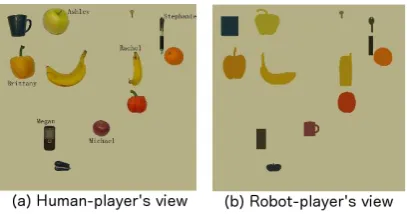
To investigate collaborative referring under mis-matched perceptual capabilities, we conducted ex-periments on human-human interaction (details of the experimental setup can be found in (Liu et al., 2012)). In these experiments, we have two human subjects play a set of naming games. One sub-ject (referred to as thehuman-player) is provided with an original image containing over ten objects (Figure 1(a)). Several of these objects have se-cret names. The other subject (referred to as the
robot-player) only has access to an impoverished image of the same scene (Figure 1(b)) to mimic the lower perceptual capability of a robot. The human-player’s goal is to communicate the names of target objects to the robot-player so that the robot-player knows which object in his view has what name. The impoverished image was auto-matically created by applying standard computer vision algorithms and thus may contain different types of processing errors (e.g., mis-segmentation and/or mis-recognition).
Figure 1: An example of different images used in our experiments.
H1: there is basically a cluster of four objects in the upper left, do you see that
R2: yes
H: ok, so the one in the corner is a blue cup
R: I see there is a square, but fine, it is blue
H: alright, I will just go with that, so and then right under that is a yellow pepper
R: ok, I see apple but orangish yellow
H: ok, so that yellow pepper is named Brittany
R: uh, the bottom left of those four? Because I do see a yellow pepper in the upper right
H: the upper right of the four of them?
R: yes
H: ok, so that is basically the one to the right of the blue cup
R: yeah
H: that is actually an apple, it is green, I guess it has some amount of yellow on it, but that is a green apple and it is named Ashley
. . . .
This example demonstrates two important char-acteristics regarding referential communication under mismatched perceptual capabilities. First, conversation partners rely on both object-specific properties (e.g., object class, color) and spatial relations to describe objects in the environment. Spatial expressions include not only the binary re-lations (e.g., “the one to the left of the blue cup”), but also thegroup-basedreferences (Tenbrink and Moratz, 2003; Funakoshi et al., 2005) (e.g., “the upper right of the four of them”).
Second, because the shared perceptual basis is missing here, the partners make extra efforts to refer and ground references. For example, the human-player go through step-by-step install-ments (Clark and Wilkes-Gibbs, 1986) to come to the targeted object. The robot-player often proactively provides what he perceives from the environment. The human-player and the robot-player collaborate with each other through itera-tive presentation-acceptance phases as described in theContribution Modelproposed in (Clark and Schaefer, 1989; Clark and Brennan, 1991).
1Hstands for the human-player. 2Rstands for the robot-player.
These observations indicate that, the approach to referential grounding in situated dialogue should capture not only binary relations but also group-based relations. Furthermore, it should go beyond traditional approaches that purely rely on semantic constraints from single utterances. It should incorporate the step-by-step collaborative dynamics from the discourse as the conversation proceeds.
4 Modeling Collaboration
In this section, we first give a brief description of collaboration patterns observed in our data, and then discuss one prevalent pattern and illustrate how it may be taken into consideration by our computational approach for referential grounding.
4.1 Patterns of Collaboration
Consistent with Clark’s Contribution Model, the interactions between the human-player and the robot-player in general fall into two phases: a pre-sentationphase and an acceptancephase. In our data, a presentation phase mainly consists of the following three forms:
• A complete description: the speaker issues a complete description in a single turn. For ex-ample, “there is a red apple on the top right”. • An installment: a description is divided into several parts/installments, each of which needs to be confirmed before continuing to the rest. For example,
A: under the big green cup we just talked about, B: yes
A: there are two apples, B: OK
A: one is red and one is yellow.
• A trial: a description (either completed or in-complete) with a try marker. For example, “Is there a red apple on the top right?”
In an acceptance phase, the addressee can either accept or reject the current presentation. Two ma-jor forms of accepting a presentation are observed in our data:
• Acknowledgement: the addressee explicitly shows his/her understanding, using assertions (e.g., “Yes”,“Right”, “I see”) or continuers (e.g., “uh huh”, “ok”).
In addition, there are also two forms of rejecting a presentation:
• Rejection: the addressee explicitly rejects the current presentation, for example, “I don’t see any apple”.
• Alternative description: the addressee presents an alternative description. For example, A says “there is a red apple on the top left,” and immediately following that B says “I only see a red apple on the right”. In general, referential grounding dialogues in our data emerge as hierarchical structures of re-cursive presentation-acceptance phases. The ac-ceptance to a previous presentation often repre-sents a new presentation itself, which triggers fur-ther acceptance. In particular, our data shows that when mediating their shared perceptual ba-sis, the human-player often takes into considera-tion what the robot-player sees and uses that to gradually lead to his intended referents. This is demonstrated in the following example3, where
the human-player accepts (Turn 3) the robot-player’s presentation (Turn 2) through a relevant next turn.
(Turn 1)H: There is a kiwi fruit.
(Turn 2)R: I don’t see any kiwi fruit. I see an apple. (Turn 3)H: Do you see a mug to the right of that apple? (Turn 4)R: Yes.
(Turn 5)H: OK, then the kiwi fruit is to the left of that apple.
As shown later in Section 5, this is one promi-nent collaborative strategy observed in our data. We give this pattern a special name: agent-present-human-accept collaboration. Next we continue to use this example to show how the agent-present-human-accept pattern can be incor-porated to potentially improve reference resolu-tion.
4.2 An Illustrating Example
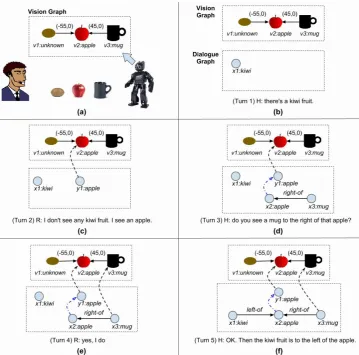
In this example, the human and the robot face a shared physical environment. The robot per-ceives the environment through computer vision (CV) algorithms and generates a graph represen-tation (i.e., a vision graph), which captures the perceived objects and their spatial relations4. As
shown in Figure 2(a), the kiwi is represented as an unknown object in the vision graph due to in-sufficient object recognition. Besides the vision
3This is a clean-up version of the original example to demonstrate the key ideas.
4The spatial relations between objects are represented as their relative coordinates in the vision graph.
graph, the robot also maintains adialogue graph
that captures the linguistic discourse between the human and the robot.
At Turn 1 in Figure 2(b), the human says “there is a kiwi fruit”. Upon receiving this utterance, through semantic processing, a node representing “a kiwi” is generated (i.e.,x1). The dialogue graph at this point only contains this single node. Iden-tifying the referent of the expression “a kiwi fruit” is essentially a process that matches the dialogue graph to the vision graph. Because the vision graph does not have a node representing a kiwi ob-ject, no high confidence match is returned at this point. Therefore, the robot responds with a rejec-tion as in Turn 2 (Figure 2(c)) “I don’t see any kiwi fruit”5. In addition, the robot takes an extra
effort to proactively describe what is being con-fidently perceived (i.e., “I see an apple”). Now an additional node y1 is added to the dialogue graph to represent the term “an apple”6. Note that
when the robot generates the term “an apple”, it knows precisely which object in the vision graph this term refers to. Therefore, as shown in Fig-ure 2(c),y1 is mapped tov2in the vision graph.
In Turn 3 (Figure 2(d)), through semantic pro-cessing on the human’s utterance “a mug to the right of that apple”, two new nodes (x2 andx3) and their relation (RightOf) are added to the di-alogue graph. In addition, since “that apple”(i.e., x2) corefers with “an apple” (i.e.,y1) presented by the robot in the previous turn, a coreference link is created fromx2 toy1. Importantly, in this turn human displays his acceptance of the robot’s pre-vious presentation (“an apple”) by coreferring to it and building further reference based on it. This is exactly the agent-present-human-accept strategy described earlier. Sincey1 maps to objectv2 and x2 now links toy1, it becomes equivalent to con-siderx2 also maps to v2. We name a node such as x2 a grounded node, since from the robot’s point of view this node has been “grounded” to a perceived object (i.e., a vision graph node) via the agent-present-human-accept pattern.
At this point, the robot matches the updated di-alogue graph with the vision graph again and can
5Note that, since in this paper we are working with a dataset of human-human (i.e., the human-player and the robot-player) dialogues, decisions from the robot-player are assumed known. We leave robot’s decision making (i.e., re-sponse generation) into our future work.
6We use x
Figure 2:An example of incorporating collaborative efforts in an unfolding dialogue into graph representations.
successfully matchx3 tov3. Note that, the match-ing occurs here is considered constrained graph-matchingin the sense that some nodes in the dia-logue graph (i.e., x2) are already grounded, and the only node needs to be matched against the vision graph is x3. Different from previous ap-proaches that do not take dialogue dynamics into consideration, the constrained matching utilizes additional constraints from the collaboration pat-terns in a dialogue and thus can improve both the efficiency and accuracy of the matching algorithm. This is one innovation of our approach here.
Based on such matching result, the robot re-sponds with a confirmation as in Turn 4 Fig-ure 2(e)). The human further elaborates in Turn 5 “the kiwi is to the left of the apple”. Again se-mantic processing and linguistic coreference reso-lution will allow the robot to update the dialogue graph as shown in Figure 2(f). Given this dialogue graph, based on the context of the larger dialogue graph and through constrained matching, it will
be possible to matchx1 tov1 although the object class ofv1 is unknown.
This example demonstrates how the dialogue graph can be created to incorporate the collabo-rative referring behaviors as the conversation un-folds and how such accumulated dialogue graph can help referential resolution through constrained matching. Next, we give a detailed account on how to create a dialogue graph and briefly discuss graph-matching for reference resolution.
4.3 Dialogue Graph
To account for different types of referring expres-sions (i.e., object-properties, binary relations and group-based relations), we use hypergraphs to rep-resent dialogue graphs.
4.3.1 Hypergraph Representation
A directed hypergraph (Gallo et al., 1993) is a 2-tuple in the form ofG= (X, A), in which
X={xm}
(a) Dialogue Graph (b) Vision Graph
Figure 3: Example hypergraph representations
Xis a set of nodes, andAis a set of “hyperarcs”. Similar to an arc in a regular directed graph, each hyperarcai in a hypergraph also has two “ends”,
i.e., a tail (ti) and a head (hi). The tail and head
of a hyperarc are both subsets ofX, thus they can contain any number of nodes inX. Hypergraph is a more general representation than regular graph. It can represent not only binary relations between two nodes, but also group-based relations among multiple nodes.
For example, suppose the language input issued by the human includes the following utterances:
1. There is a cluster of four objects in the upper left. 2. The one in the corner is a blue cup.
3. Under the blue cup is a yellow pepper.
4. To the right of the blue cup, which is also in the upper right of the four objects, is a green apple.
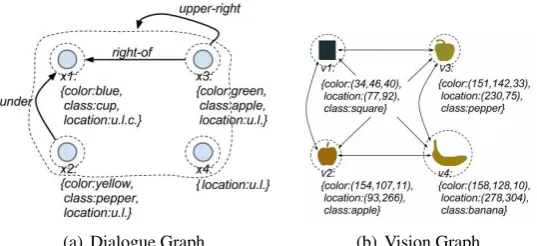
The corresponding dialogue graph Gd =
(Xd, Ad) is shown in Figure 3(a), where Xd =
{x1, x2, x3, x4} and Ad = {a1, a2, a3}. In Ad,
for example, a1 = ({x1},{x3}) represents the relation “right of” between the tail {x3} and the head{x1}, anda3= ({x3},{x1, x2, x3, x4})
rep-resents the group-based relation “upper right” be-tween one node and a group of nodes.
As also illustrated in Figure 3(a), we can at-tach a set of labels (or attributes) {attrk} to a
node/hyperarc, and use them to store specific in-formation about this node/hyperarc. The per-ceived visual world can be represented by a hypergraph in a similar way (i.e., a vision graph), as shown in Figure 3(b)7.
4.3.2 Building Dialogue Graphs
Given the hypergraph representation, a set of op-erations can be applied to build a dialogue graph as the conversation unfolds. It mainly consists of three components:
7Hyperarcs of the vision graph are not shown in the figure. A hyperarc may exist between any two subsets of objects.
Semantic Constraints. Apply a semantic parser to extract information from human utterances. For example, the utterance “The kiwi is to the left of the apple” can be parsed into a formal meaning representation as
[x1, x2],[Kiwi(x1), Apple(x2), Lef tOf(x1, x2)]
This representation contains a list of discourse entities introduced by the utterance, and a list of FOL predicates specifying the properties and rela-tions of these entities. For each discourse entity, a node is added to the graph. Unary predicates be-come the labels for nodes, and binary predicates become arcs in the graph. Group-based relations are incorporated into the graphs as hyperarcs. Discourse Coreference. For each discourse entity in a referring expression, identify whether it is a new discourse entity or it corefers to a discourse entity mentioned earlier. In our previous example in Figure 2(d),x2 corefers with y1, thus a coref-erence link is added to link the coreferring nodes. Coreferring nodes are merged before matching. Dialogue Dynamics. Different types of dialogue dynamics can be modeled. In this paper, we only focus on a particularly prevalent type of dynamics as observed from our data, i.e. the agent-present-human-accept pattern as we described in Section 4.1. When such a pattern is identified, the associ-ated nodes (e.g.,x2 in the previous example) will be marked as grounded nodes and the mappings to their grounded visual entities (i.e., vision graph nodes) will be added into the dialogue graph.
Based on the above three types of operations, the dialogue graph is updated at each turn of the conversation.
4.3.3 Constrained Matching
Given a dialogue graph G = (X, A) and a
vi-sion graph G0 = (X0, A0), reference resolution
find a one-to-one mapping between the nodes in X and in X0. Due to the insufficiencies of the NLP and the CV components, both the dialogue graph and the vision graph are likely to contain er-rors. Therefore, we do not require every node in the dialog graph to be mapped to a node in the vi-sion graph, but follow the inexact graph matching criterion (Conte et al., 2004) to find the best match even if they are only partial.
The matching algorithm is similar to the one used in our previous work for regular graphs (Liu et al., 2012), which uses a state-space search ap-proach (Zhang, 1999). The key difference here is to incorporate the agent-present-human-accept collaboration pattern. The search procedure can now start from the state that already represents the known matching of grounded nodes (as il-lustrated in Section 4.2), instead of starting from the root. Thus it is constrained in a smaller and more promising subspace to improve both effi-ciency and accuracy.
5 Evaluation
A total of 32 dialogues collected from our ex-periments (as described in Section 3) are used in the evaluation. For each of these dialogues, we have manually annotated (turn-by-turn) the formal semantics, discourse coreferences and grounded nodes as described in Section 4.3.2. Since the fo-cus of this paper is on incorporating collaboration into graph matching for referential grounding, we use these annotations to build the dialogue graphs in our evaluation. Vision graphs are automatically generated by CV algorithms from the original im-ages used in the experiments. The CV algorithms’ object recognition performance is rather low: only 5% of the objects in those images are correctly rec-ognized. Thus reference resolution will need to rely on relations and collaborative strategies.
The 32 dialogue graphs have a total of 384 nodes8that are generated from human-players’
ut-terances (12 per dialogue on average), and a to-tal of 307 nodes generated from robot-players’ ut-terances (10 per dialogue on average). Among the 307 robot-player generated nodes, 187 (61%) are initially presented by the robot-player and then coreferred by human-players’ following ut-terances (i.e., relevant next turns). This indicates
8As mentioned in Section 4.3.2, multiple expressions that are coreferential with each other and describing the same en-tity are merged into a single node.
that the agent-present-human-accept strategy is a prevalent way to collaborate in our experiment. As mentioned earlier, those human-player generated nodes which corefer to nodes initiated by robot-players are marked as grounded nodes. In total, 187 out of the 384 human-player generated nodes are in fact grounded nodes.
To evaluate our approach, we apply the graph-matching algorithm on each pair of dialogue graph and vision graph. The matching results are com-pared with the annotated ground-truth to calcu-late the accuracy of our approach in ground-ing human-players’ referrground-ing descriptions to vi-sual objects. For each dialogue, we have pro-duced matching results under four different set-tings: with/without modeling collaborative re-ferring (i.e., the agent-present-human-accept col-laboration) and with/without using hypergraphs. When collaborative referring is modeled, the graph-matching algorithm uses the grounded nodes to constrain its search space to match the remaining ungrounded nodes. When collabora-tive referring is not modeled, all the human-player generated nodes need to be matched.
The results of four different settings (averaged accuracies on the 32 dialogues) are shown in Ta-ble 1. Modeling collaborative referring improves the matching accuracies for both regular graphs and hypergraphs. When regular graphs are used, it improves overall matching accuracy by 11.6% (p = 0.05, paired Wilcoxon T-test). The improve-ment is even higher as 18.3% when hypergraphs are used (p = 0.012, paired Wilcoxon T-test). The results indicate that proactively describing what the robot sees to the human to facilitate com-munication is an important collaborative strategy in referential grounding dialogues. Humans can often ground the robot presented object via the agent-present-human-accept strategy and use the grounded object as a reference point to further describe other intended object(s), and our graph-matching approach is able to capture and utilize such collaboration pattern to improve the referen-tial grounding accuracy.
Regular graph Hypergraph
Not modeling 44.1% 47.9%
collaborative referring
Modeling 55.7% 66.2%
collaborative referring
[image:8.595.77.287.61.129.2]Improvement 11.6% 18.3%
Table 1: Averaged matching accuracies under four different settings.
Group 1 Group 2 Group 3
Number of dialogues 9 11 12
% of grounded nodes <30% 30%˜60% >60%
Average number of 20 21 12
object propertiesa
Average number of 11 13 8
relationsb
Not modeling 49.7% 49.4% 45.3%
collaborative referring
Modeling 57.0% 76.6% 63.6%
collaborative referring
Improvement 7.3% 27.2% 18.3%
aSpecified by human-players.
bSpecified by human-players. The number includes both
binary and group-based relations.
Table 2: Matching accuracies of three groups of dialogues (all the matching results here are pro-duced using hypergraphs).
Whereas in regular graphs one grounded node can only improve the chance of one other node, since only one-to-one (binary) relations are captured by regular graphs.
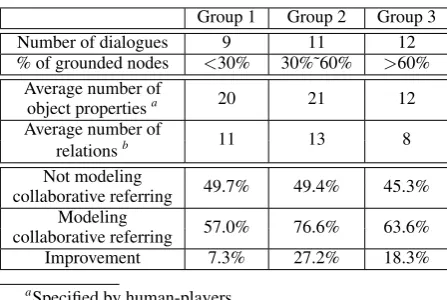
To further investigate the effect of modeling collaborative referring, we divide the 32 dia-logues into three groups according to how often the agent-present-human-accept collaboration pat-tern happens (measured by the percentage of the grounded nodes among all the human-player gen-erated nodes in a dialogue). As shown at the top part of Table 2, the agent-present-human-accept pattern happened less often in the dialogues in group 1 (i.e., less than 30% of human-player gen-erated nodes are grounded nodes). In the dia-logues in group 2, robot-players more frequently provided proactive descriptions which led to more grounded nodes. Robot-players were the most proactive in the dialogues in group 3, thus this group contains the highest percentage of grounded nodes. Note that, although the dialogues in group 3 contain more proactive contributions from robot-players, human-players tend to specify less num-ber of properties and relations describing intended objects (as shown in the middle part of Table 2).
The matching accuracies for each of the three groups are shown at the bottom part of Table 2.
Since the agent-present-human-accept pattern ap-pears less often in group 1, modeling collabora-tive referring only improves matching accuracy by 7.3%. The improvements for group 2 and group 3 are more significant compared to group 1. However, group 3’s improvement is less than group 2, although the dialogues in group 3 contain more proactive contributions from robot-players. This indicates that in some cases even with mod-eling collaborative referring, underspecified in-formation from human speakers (human-players in our case) may still be insufficient to identify the intended referents. Therefore, incorporating a broader range of dialogue strategies to elicit ade-quate information from humans is also important for successful human-robot communication. 6 Conclusion
In situated dialogue, conversation partners make extra collaborative efforts to mediate a shared per-ceptual basis for referential grounding. It is impor-tant to model such collaborations in order to build situated conversational agents. As a first step, we developed an approach for referential grounding that takes a particular type of collaborative refer-ring behavior, i.e. agent-present-human-accept, into account. By incorporating this pattern into the graph-matching process, our approach has shown an absolute gain of over 18% in subsequent refer-ence resolution. Extending the results in this pa-per, our future work will address explicitly model-ing the collaborative dynamics with a richer repre-sentation. The dialogue graph presented in this pa-per represents all the mentioned entities and their relations that are currently available at any given dialogue status. But we have not modeled the col-laborative dynamics at the illocutionary level. Our next step is to explicitly represent those dynam-ics, not only for grounding human references to the physical world, but also generating the collab-orative behaviors for the agent.
Acknowledgments
This work was supported by N00014-11-1-0410 from the Office of Naval Research and IIS-1208390 from the National Science Foundation.
References
Herbert H Clark and Susan E Brennan. 1991.
Ground-ing in communication. Perspectives on socially
[image:8.595.72.296.165.315.2]Herbert H Clark and Edward F Schaefer. 1989.
Contributing to discourse. Cognitive science,
13(2):259–294.
Herbert H Clark and Deanna Wilkes-Gibbs. 1986.
Referring as a collaborative process. Cognition,
22(1):1–39.
Herbert H Clark. 1996. Using language, volume 4.
Cambridge University Press Cambridge.
Donatello Conte, Pasquale Foggia, Carlo Sansone, and Mario Vento. 2004. Thirty years of graph
match-ing in pattern recognition. International journal
of pattern recognition and artificial intelligence, 18(03):265–298.
David DeVault, Natalia Kariaeva, Anubha Kothari, Iris Oved, and Matthew Stone. 2005. An
information-state approach to collaborative reference. In
Pro-ceedings of the ACL 2005 on Interactive poster and demonstration sessions, pages 1–4. Association for Computational Linguistics.
Sheel Sanjay Dhande. 2003. A computational model to connect gestalt perception and natural language. Master’s thesis, Massachusetts Institute of Technol-ogy.
Kotaro Funakoshi, Satoru Watanabe, Takenobu Toku-naga, and Naoko Kuriyama. 2005. Understanding referring expressions involving perceptual grouping. In 4th International Conference on Cyberworlds, pages 413–420.
Giorgio Gallo, Giustino Longo, Stefano Pallottino, and Sang Nguyen. 1993. Directed hypergraphs
and applications. Discrete applied mathematics,
42(2):177–201.
Peter Gorniak and Deb Roy. 2004. Grounded seman-tic composition for visual scenes. J. Artif. Intell. Res.(JAIR), 21:429–470.
Peter A Heeman and Graeme Hirst. 1995. Collabo-rating on referring expressions. Computational Lin-guistics, 21(3):351–382.
Changsong Liu, Rui Fang, and Joyce Y Chai. 2012. Towards mediating shared perceptual basis in
situ-ated dialogue. In Proceedings of the 13th Annual
Meeting of the Special Interest Group on Discourse and Dialogue, pages 140–149. Association for Com-putational Linguistics.
Christopher S Mellish. 1985. Computer interpretation
of natural language descriptions. John Wiley and Sons, New York, NY.
Alexander Siebert and David Schlangen. 2008. A simple method for resolution of definite reference
in a shared visual context. In Proceedings of the
9th SIGdial Workshop on Discourse and Dialogue, pages 84–87. Association for Computational Lin-guistics.
Thora Tenbrink and Reinhard Moratz. 2003. Group-based spatial reference in linguistic human-robot in-teraction. InProceedings of EuroCogSci, volume 3, pages 325–330.
David R Traum. 1994. A Computational Theory
of Grounding in Natural Language Conversation. Ph.D. thesis, University of Rochester.
Weixiong Zhang. 1999. State Space Search: