BioNLP Shared Task 2013 – An overview of the Genic Regulation
Network Task
Robert Bossy, Philippe Bessières, Claire Nédellec
Unité Mathématique, Informatique et Génome
Institut National de la Recherche Agronomique
UR1077, F78352 Jouy-en-Josas, France
[email protected]
Abstract
The goal of the Genic Regulation Network task (GRN) is to extract a regulation network that links and integrates a variety of molecular interactions between genes and proteins of the well-studied model bacterium Bacillus subtilis. It is an extension of the BI task of BioNLP-ST’11. The corpus is composed of sentences selected from publicly available PubMed scientific abstracts. The paper details the corpus specifications, the evaluation metrics, and it summarizes and discusses the participant results.
1
Introduction
The Genic Regulation Network (GRN) task consists of (1) extracting information on molecular interactions between genes and proteins that are described in scientific literature, and (2) using this information to reconstruct a
regulation network between molecular partners in a formal way. Several other types of biological networks can be defined at the molecular level, such as metabolisms, gene expressions, protein-protein interactions or signaling pathways. All these networks are closely interconnected. For example, a gene codes for a protein that catalyzes the transformation of small molecules (metabolites), while the expression of the gene and its related regulation is controlled by other proteins.
The concept of biological networks is not new. However, the development of new methods in molecular biology in the past twenty years has made them accessible at the level of an organism as a whole. These new methods allow for the design of large-scale experimental approaches with high throughput rates of data. They are then used to build static and dynamic models that represent the behavior of a cell in the field of Systems Biology (Kitano, 2002; de Jong, 2002). In this context, there has recently been a
considerable focus on “biological network inference”, that is to say the process of making inferences and predictions about these networks (D'haeseleer, et al., 2000). Therefore, it is expected that Information Extraction (IE) from scientific literature may play an important role in the domain, contributing to the construction of networks (Blaschke et al., 1999). IE also plays a role in the design and the validation of large-scale experiments, on the basis of detailed knowledge that has already been published.
2
Context
Extracting molecular interactions from scientific literature is one of the most popular tasks in IE challenges applied to biology. The GRN task adds a supplementary level that is closer to the biological needs: the participant systems have to extract a regulation network from the text that links and integrates basic molecular interactions. The GRN task is based on a series of previous challenges in IE that started with the LLL challenge in 2005 (Nédellec, 2005). The LLL corpus is a set of sentences of PubMed abstracts about molecular interactions of the model bacterium Bacillus subtilis. Originally, the LLL task defined a unique binary genic interaction relation between proteins and genes. Since then, it has evolved to include the description of interaction events in a fine-grained representation that includes the distinction between transcription, different types of regulations and binding events, as proposed by (Manine et al., 2009). This new schema better captures the complexity of regulations at the molecular level. Entities other than genes and proteins were introduced, such as DNA sites (e.g. transcription promoter sites, transcriptional regulator binding sites). We proposed the Genic Interaction task (Bossy et al., 2012) in the BioNLP’11 Shared Task with a full re-annotation of the LLL corpus that follows this schema. The GRN task in
BioNLP-ST’13 builds on this corpus and includes annotation improvements and extensions that are detailed below.
3
Task description
The BioNLP-ST 2013 GRN task consists of the automatic construction of the regulation network that can be derived from a set of sentences. As usual in relation extraction tasks, the GRN corpus includes text-bound annotations. However the extraction target is the network, which is a structure with a higher level of abstraction. GRN thus also provides an explicit procedure to derive a network from a set of text-bound annotations.
The GRN annotation is stacked in four successive levels of annotation:
1. Text-bound entities represent genes, proteins and aggregates (families, complexes). Some entities directly relate to a gene and are given a unique gene identifier corresponding to a node of the network. These entities are hereby called genic named entities.
2. Biochemical events and relations are molecular-level events (e.g. transcription, binding) and detailed knowledge on relationships between entities (e.g. promoter of gene, regulon membership).
3. Interactions denote relations between entities and events and relations. Interactions are the first abstract annotations; they are the key to the construction of the network arcs. 4. Finally, the Genic Regulation Network is
derived from the Interactions and from the identifiers of the named genic entities.
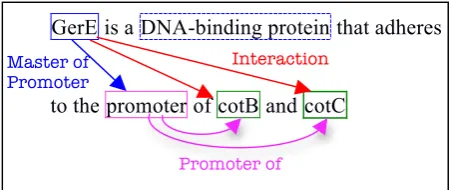
GerE is a DNA-binding protein that adheres
[image:2.595.67.293.569.664.2]to the promoter of cotB and cotC
Figure 1. Example of annotated sentence. Levels 1, 2 and 3 were obtained by a manual annotation of the GRN corpus sentences by a domain expert. Level 4 was automatically computed from the lower level annotations. The training corpus was provided to the participants with level 1, 2 and 3 annotations. The algorithm
to compute the next level was described and implemented as a script and made available to the participants during the training stage of the challenge.
The test corpus was provided with only level 1 annotations (entities). The participants submitted their prediction either as a set of Interactions (level 3) or directly as a network (level 4). This setting allows the participants to train systems that work at different levels of abstraction. Submissions in the form of Interactions are translated into a Genic Regulation Network using the algorithm provided during the training stage. The evaluation of each submission is carried out by comparing the predicted network with the reference network. The reference network is itself computed from the gold level 1, 2 and 3 annotations of the test sentences.
The following subsections describe the four annotation levels. The full annotation schema that specifies the constraints on event and relation arguments can be found on the task web page1.
3.1 Text-bound entity types
Text-bound entities come in three kinds: event trigger words, genic entities and entity aggregates. Trigger words are of type Action, they serve as anchors for events.
Genic entities represent mentions of biochemical objects of the bacteria cell. Genic entity types include Gene, mRNA, Promoter, Protein and Site. Finally aggregates denote composite objects of the bacteria cell. Aggregate types are:
- GeneFamily: homologous gene families. - Operon: operons sensu prokaryotes.
- PolymeraseComplex: RNA polymerase complexes, either the core complex alone, or bound to a sigma factor.
- ProteinComplex: protein complexes formed by several proteins that bind together.
- ProteinFamily: homologous protein families. - Regulon: regulons, sensu prokaryotes.
3.2 Biochemical events and relation types
Biochemical events and relations represent the knowledge of cellular mechanisms at the molecular level. There are three types of events:
- Transcription_by represents the
transcription event by a specific RNA
1 https://sites.google.com/site/bionlpst2013/tasks/gene -regulation-network
Master of Promoter
Interaction
polymerase. Its agent is usually a
PolymeraseComplex.
- Transcription_from represents the
transcription from a specific site or promoter.
- Action_Target is a generic bio-molecular event.
The relation types represent three major genetic regulation patterns in bacteria: promoter activation, regulons and binding to specific DNA sites. Two types of relations specifically denote mechanisms that involve promoters:
- Promoter_of is a relation between a gene (or operon) and its promoter.
- Master_of_Promoter relation represents the control of the transcription from a specific promoter by a proteic entity (Protein,
ProteinComplex or ProteinFamily).
Two other relation types represent the function of regulons:
- Member_of_Regulon relation denotes the membership of a genic entity to a regulon. - Master_of_Regulon relation represents the
control of the activity of an entire regulon by a protein.
Finally two types are used to represent relations that are common to different regulation mechanisms:
- Bind_to relation represents the binding of a proteic entity to a site on the chromosome. - Site_of relation denotes the belonging of a
chromosomal site to a genic entity such as a gene or a promoter.
3.3 Interaction types
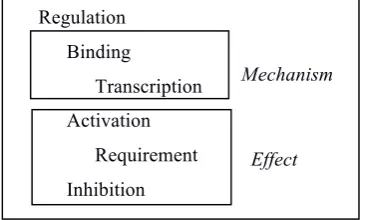
Interaction relations are labeled with one of six types grouped into a small hierarchy following two axes: mechanism and effect. The hierarchical levels are figured here by the text indentations.
Regulation Binding
Transcription Activation
[image:3.595.73.256.637.747.2]Requirement Inhibition
Figure 2. Types of Interaction relations
The Binding and Transcription types specify the mechanism through which the agent regulates the target. In a Binding Interaction, the agent binds to the target; this includes Protein-DNA binding and excludes Protein-Protein binding mechanisms. In a Transcription Interaction, the agent affects the transcription of the target. The Activation, Requirement and Inhibition types specify the effect of the agent on the target. In an
Activation Interaction, the agent increases the expression of the target. In a Requirement Interaction, the agent is necessary for the expression of the target. In an Inhibition Interaction, the agent reduces the expression of the target.
The Regulation type is the default type: in such interactions, neither the mechanism nor the effect is specified.
3.4 Genic Regulation Network inference algorithm
The genic regulation network corresponding to a corpus is inferred from the set of Interaction
relations. The network presents itself as a directed labeled graph where nodes represent gene identifiers and edges represent gene interactions. The inference is done in two steps: the resolution of Interaction relations and the removal of redundant arcs.
Step 1: Resolution of Interaction relations
The agent and the target of an Interaction
relation are not necessarily genic named entities. They can be secondary events or relations, another Interaction, or auxiliary entities (e.g.
Promoter). The resolution of an Interaction aims to look for the genic named entity in order to infer the node concerned by the network edge. The resolution of Interaction arguments is performed using the rules specified below. These rules express well-known molecular mechanisms in a logical manner:
1. If the agent (or target) is a genic named entity, then the agent (or target) node is the gene identifier of the entity. If the entity does not have a gene identifier, then it is not a genic named entity and there is no node (and thus no edge).
2. If the agent (or target) is an event, then the agent (or target) node is the entity referenced by the event.
3. If the agent (or target) is a relation, then the agent (or target) of both arguments of the relation are nodes.
Mechanism
4. If the target is a Promoter and this promoter is the argument of a Promoter_of relation, then the target node is the other argument of the Promoter_of relation. i.e. if A interacts with P, and P is a promoter of B, then A interacts with B.
5. If the agent is a Promoter and this promoter is the argument of a Master_of_Promoter
relation, the agent is the other argument of the
Master_of_Promoter relation. i.e. if A is the master of promoter P, and P interacts with B, then A interacts with B.
The resolution of Interaction arguments consists of a traversal of the graph of annotations where these rules are applied iteratively. Event and relation arguments are walked through. Promoter
entities are handled according to rules 4 and 5. If the resolution of the agent or the target yields more than one node, then the Interaction resolves to as many edges as the Cartesian product of the resolved nodes. For instance, if both the agent and the target resolve to two nodes, the
Interaction relation resolves into four edges. Edges are labeled with the same set of types as the Interactions. Each edge inherits the type of the Interaction relation from which it has been inferred.
Step 2: Removal of redundant arcs
In this step, edges with the same agent, target and type are simplified into a single edge. This means that if the same Interaction is annotated several times in the corpus, then it will resolve into a single edge. This means that the prediction of only one of the interactions in the corpus is enough to reconstruct the edge.
Moreover, Interaction types are ordered according to the hierarchy defined in the preceding section. Since the sentences are extracted from PubMed abstracts published during different periods, they may mention the same Interaction with different levels of detail, depending on the current state of knowledge. For a given edge, if there is another edge for the same node pair with a more specialized type, then it is removed. For instance, the edges (A, Regulation, B) and (A, Transcription, B) are simplified into (A, Transcription, B). Indeed the former edge conveys no additional information in comparison with the latter.
4
Corpus description
The GRN corpus is a set of 201 sentences selected from PubMed abstracts, which are
mainly about the sporulation phenomenon in
Bacillus subtilis. This corpus is an extended version of the LLL and BI (BioNLP-ST’11) corpora. The additional sentences ensure a better coverage of the description of the sporulation. An expert of this phenomenon examined the regulation network derived from the annotation of the original sentences, and then manually listed the important interactions that were missing. We selected sentences from PubMed abstracts that contain occurrences of the missing pairs of genes. In this way, the genic interaction network is more complete with respect to the sporulation. Moreover, the publications from which the sentences are extracted cover a wider period, from 1996 to 2012. They represent a diverse range of writing styles and experimental methods. 42 sentences have been added, but 4 sentences were removed from the BI sentences because they described genic interactions in bacteria other than Bacillus subtilis. The distribution of the sentences among the training, development and test sets has been done in the following way:
- Legacy sentences belong to the same set as in previous evaluation campaigns (LLL and BI).
- Additional sentences have been randomly distributed to training, development and test sets. The random sampling has been constrained so that the proportion of different types of interactions is as much as possible the same as in the three sets. The GRN task does not include the automatic selection by the participant methods of the relevant sentences, which are provided. With regards to a real-world application, this selection step can be achieved with good performance by sentence filtering, as demonstrated by Nédellec
et al. (2001), by using a Naive Bayesian classifier. Moreover, the corpus contains sentences with no interaction.
where the biological mechanisms are detailed at a molecular level.
Entity # Train+Dev Test
Gene 199 70% 30%
GeneFamily 2 50% 50%
mRNA 1 100% 0%
Operon 33 67% 33%
PolymeraseComplex 62 71% 29%
Promoter 63 73% 27%
Protein 486 65% 35%
ProteinComplex 7 100% 0%
ProteinFamily 18 78% 22%
Regulon 14 79% 21%
Site 32 78% 22%
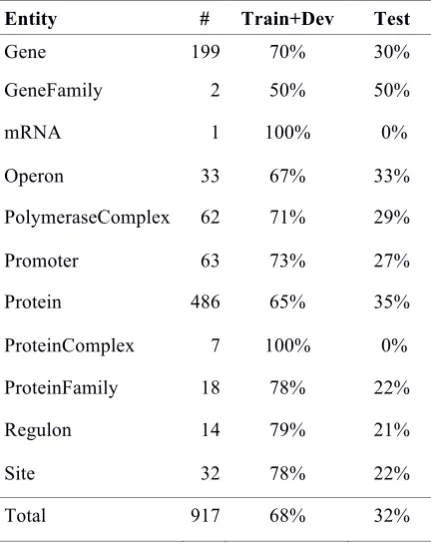
[image:5.595.71.287.103.377.2]Total 917 68% 32%
Table 1. Entity distribution in the GRN corpus. Table 2 details the distribution of the biochemical events and relations (level 2). The most frequent event is Action Target. Action Target links, for instance, Transcription by and
Transcription from events to the target gene.
Event/Relation # Train+dev Test
Action target 226 68% 32%
Bind to 9 78% 22%
Master of Promoter 60 80% 20%
Master of Regulon 13 85% 15%
Member of Regulon 12 92% 8%
Promoter of 47 72% 28%
Site of 24 75% 25%
Transcription by 86 71% 29%
Transcription from 18 78% 22%
Total 495 72% 28%
Table 2. Distribution of the biochemical events and relations in the GRN corpus.
Finally, Table 3 details the distribution of the
Interaction relations (level 3). The distribution
among Interaction relations is more uniform than among entities and molecular events. The frequency of the Transcription relation is much higher than Binding, which is not surprising since transcription is the major mechanism of regulation in bacteria, while binding is rare. Conversely, the relative frequency of relations among Effect types of relations is balanced.
Interaction # Train+dev Test
Regulation 80 65% 35%
Inhibition 50 66% 34%
Activation 49 67% 33%
Requirement 35 66% 34%
Binding 12 75% 25%
Transcription 108 74% 26%
Total 334 69% 31%
Table 3. Distribution of the Interaction relations in the GRN corpus.
5
Annotation methodology
A senior biologist, who is a specialist of Bacillus subtilis and a bioinformatician, a specialist of semantic annotation, defined the annotation schema. The biologist annotated the whole corpus, using the BI annotations as a starting point. The bioinformatician carefully checked each annotation. They both used the AlvisAE Annotation Editor (Papazian et al., 2012) that supported their productivity due to its intuitive visualization of dense semantic annotations.
Subtiwiki provided the identifiers of genes and proteins (Flórez et al., 2009). Subtiwiki is a community effort that has become the reference resource for the gene nomenclature normalization of Bacillus subtilis. Other genic named entities, like operons, families or protein complexes, were given an identifier similar to their surface form. Several annotation iterations and regular cross-validations allowed the annotators to refine and normalize these identifiers.
[image:5.595.307.524.184.341.2] [image:5.595.69.289.471.710.2]6
Evaluation procedure
6.1 Campaign organization
The same rules and schedule were applied to GRN as the other BioNLP-ST tasks. The training and development data were provided eleven weeks before the test set. The submissions were gathered through an on-line service, which was active for ten days. We took into account the final run of each participant to compute the official scores. They were published on the BioNLP-ST web site together with the detailed scores.
6.2 Evaluation metrics
The predictions of the participating teams were evaluated by comparing the reference network to the predicted network that was either submitted directly, or derived from the predicted
Interactions. Since the genic named entity annotations are provided with their identifier, the network nodes are fixed. Therefore, the evaluation consists of comparing the edges of the two networks. Their discrepancy is measured using the Slot Error Rate (SER) defined by (Makhoul et al., 1999) as:
SER = (S + D + I) / N
where:
- S is the number of substitutions (i.e. edges predicted with the wrong type)
- D is the number of deletions (false negatives)
- I is the number of insertions (false positives)
- N is the number of arcs in the reference network.
The SER has the advantage over F1, namely it uses an explicit characterization of the substitutions. (Makhoul et al., 1999) demonstrates that the implicit comprehension of substitutions in both recall and precision scores leads to the underestimation of deletions and insertions in the F score. However, we compute the Recall, Precision and F1 in order to make the interpretation of results easier:
Recall = M / N Precision = M / P
where:
- M is the number of matches (true positives). - P is the number of edges in the predicted
network.
Matches, substitutions, deletions and insertions are counted for each pair of nodes. The genic regulation network is an oriented graph, thus the
node pairs (A,B) and (B,A) are handled independently. For a given node pair (A,B), the number of exact matches (M) is the number of edges with the same type in the prediction as in the reference. The number of substitutions, deletions and insertions depends on the number of remaining edges. We name q and r, the number of remaining edges between two nodes A
and B in the prediction and the reference respectively:
- S = min(q, r)
- if q > r, then I = q – r, D = 0
- if q < r, then I = 0, D = r – q
In other words, edges from the prediction and the reference are paired, first by counting matches, then by maximizing substitutions. The remaining edges are counted either as insertions or deletions depending if the extra edges are in the prediction or reference, respectively.
The values of S, D, I and M for the whole network are the sum of S, D, I and M on all the node pairs.
7
Results
7.1 Participating systems
Five systems participated in GRN:
- University of Ljubljana (Slovenia) (Žitnik et al., 2013),
- K.U.Leuven (Belgium) (Provoost and Moens, 2013),
- IRISA-TexMex (INRIA, France) (Claveau, 2013),
- EVEX (U. of Turku / TUCS, Finland and VIB / U. of Ghent, Belgium) (Hakala et al., 2013),
- TEES-2.1 (TUCS, Finland) (Björne and Salakoski, 2013).
Participant SER Recall Precision
U. of Ljubljana 0.73 34% 68%
K.U.Leuven 0.83 23% 50%
TEES-2.1 0.86 23% 54%
IRISA-TexMex 0.91 41% 40%
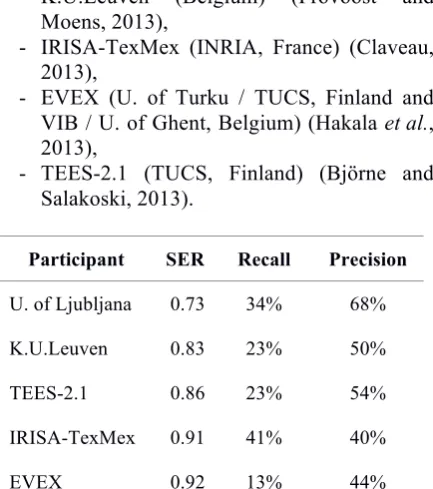
[image:6.595.307.524.459.704.2]EVEX 0.92 13% 44%
Table 4. Final evaluation of the GRN task. Teams are ranked by SER. S: Substitutions, D:
Table 4 summarizes the scores by decreasing order. The scores are distributed between the best SER, 0.73 achieved by the University of Ljubljana, 20 points more than the lowest at 0.92. For all systems, the number of insertions is much lower than the number of deletions, except for IRISA-TexMex.
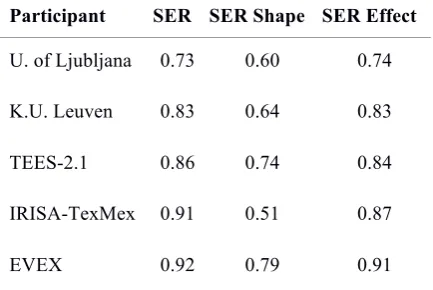
The substitutions correspond to the edges that were predicted with the wrong type. In order to reveal the quality of the predictions with regards to the edge types, we calculated two alternate SERs. The results are displayed in Table 5.The
SER Network Shape is obtained by erasing the type of all of the edges in the reference and predicted networks, as if all edges were of the
Regulation type. The SER Network Shape
measures the capacity of the systems to reconstruct the unlabeled shape of the regulation network. The SER Effect is obtained by erasing the mechanism types of all edges only, as if
Binding and Transcription edges were of type
Regulation. The Effect edges are kept unchanged. The SER Effect measures the quality of the predictions for valued networks that only contain
Effect edges.
Participant SER SER Shape SER Effect
U. of Ljubljana 0.73 0.60 0.74
K.U. Leuven 0.83 0.64 0.83
TEES-2.1 0.86 0.74 0.84
IRISA-TexMex 0.91 0.51 0.87
EVEX 0.92 0.79 0.91
Table 5. Scores obtained by erasing edge types (Network Shape) or mechanism types (Effect). The SER Network Shape is significantly better for all systems, but the impact is dramatic for IRISA-TexMex and K.U. Leuven, showing that the typing of relations may be the major source of error. The SER Effect does not differ significantly from the original score. We deduce from the comparison of the three scores that the types that are the hardest to discriminate are effect types. This result is interesting because
Effect labels are in fact the most valuable for systems biology and network inference studies. U. of Ljubljana and TEES-2.1 submissions contained level 2 and 3 predictions (interactions and biochemical events). IRISA provided only
predictions at level 3 (interactions only). K.U. Leuven and EVEX directly submitted a network. The performance of the systems that use annotations of level 2 confirms our hypothesis that a significant part of the interactions can be deduced from low-level events.
7.2 Systems description and result analysis
All systems applied machine-learning algorithms with linguistic features that were stems or lemmas, POS-tags and parses, most of them being provided by the BioNLP supporting resources. With the exception of K.U. Leuven, all systems used dependency paths between candidate arguments. However different ML algorithms were used, as shown in Table 6.
Participant ML algorithm
U. Ljubljana Linear-chain CRF
K.U.Leuven SVM (Gaussian RBF)
TEES-2.1 SVMmulticlass (linear)
IRISA-TexMex kNN (language model)
[image:7.595.67.284.398.543.2]EVEX SVM (TEES-2.1)
Table 6. ML algorithms used by the participants. Beyond syntactic parses and ML algorithms, the participant systems combined many different sources of information and processing, so that no definitive conclusion on the respective potential of the methods can be drawn here.
8
Conclusion
The GRN task has a strong legacy since the corpus is derived from LLL. Moreover, the GRN task has advanced a novel IE setting. We proposed to extract a formal data structure from successive abstract layers. Five different teams participated in the task with distinct strategies. In particular, we received submissions that work on all proposed abstraction levels.
This shows that Information Extraction implementations have reached a state of maturity, which allow for new problems to be addressed quickly. The performances are promising, yet some specific problems have to be addressed, like the labeling of edges.
Acknowledgments
References
Jari Björne, Tapio Salakoski. 2013. TEES 2.1: Automated Annotation Scheme Learning in the BioNLP 2013 Shared Task. In Proceedings of the BioNLP 2013 Workshop, Association for Computational Linguistics.
Christian Blaschke, Miguel A. Andrade, Christos Ouzounis, Alfonso Valencia. 1999. Automatic Extraction of Biological Information From Scientific Text: Protein-Protein Interactions.
Proceedings of the International Conference on Intelligent Systems for Molecular Biology (ISMB 1999), 60-67.
Robert Bossy, Julien Jourde, Alain-Pierre Manine, Philippe Veber, Erick Alphonse, Marteen van de Guchte, Philippe Bessières, Claire Nédellec. 2012. BioNLP Shared Task - The Bacteria Track. BMC Bioinformatics. 13(Suppl 11):S3.
Vincent Claveau. 2013. IRISA participation to BioNLP-ST 2013: lazy-learning and information retrieval for information extraction tasks. In
Proceedings of the BioNLP 2013 Workshop, Association for Computational Linguistics.
Patrik D'haeseleer, Shoudan Liang, Roland Somogyi. 2000. Genetic network inference: from co-expression clustering to reverse engineering.
Bioinformatics. 16(8):707-726.
Lope A. Flórez, Sebastian F Roppel, Arne G Schmeisky, Christoph R Lammers, Jörg Stülke. 2009. A community-curated consensual annotation that is continuously updated: the Bacillus subtilis
centred wiki SubtiWiki. Database (Oxford), 2009:bap012.
Kai Hakala, Sofie Van Landeghem, Tapio Salakoski, Yves Van de Peer and Filip Ginter. 2013. EVEX in ST’13: Application of a large-scale text mining resource to event extraction and network construction. In Proceedings of the BioNLP 2013 Workshop, Association for Computational Linguistics.
GenBank. http://www.ncbi.nlm.nih.gov/
Hidde de Jong. 2002. Modeling and simulation of genetic regulatory systems: a literature review. J. Computational Biology, 9(1):67-103.
Hiroaki Kitano. 2002. Computational systems biology.
Nature, 420(6912):206-210.
John Makhoul, Francis Kubala, Richard Schwartz and Ralph Weischedel. 1999. Performance measures for information extraction. In Proceedings of DARPA Broadcast News Workshop, Herndon, VA, February.
Alain-Pierre Manine, Erick Alphonse, Philippe Bessières. 2009. Learning ontological rules to extract multiple relations of genic interactions from text. Int. J. Medical Informatics, 78(12):31–38.
Claire Nédellec, Mohamed Ould Abdel Vetah, Philippe Bessières. 2001. Sentence filtering for information extraction in genomics, a classification problem. Practice of Knowledge Discovery in Databases (PKDD 2001), 326-337.
Claire Nédellec. 2005. Learning Language in Logic - Genic Interaction Extraction Challenge" in
Proceedings of the Learning Language in Logic (LLL05) workshop joint to ICML'05. Cussens J. and Nédellec C. (eds). Bonn.
Frédéric Papazian, Robert Bossy and Claire Nédellec. 2012. AlvisAE: a collaborative Web text annotation editor for knowledge acquisition. The 6th Linguistic Annotation Workshop (The LAW VI), Jeju, Korea.
Thomas Provoost, Marie-Francine Moens. 2013. Detecting Relations in the Gene Regulation Network. In Proceedings of the BioNLP 2013 Workshop, Association for Computational Linguistics.