AMMONIUM ENOLATES IN ASYMMETRIC SYNTHESIS
Siobhan Rose Smith
A Thesis Submitted for the Degree of PhD at the
University of St Andrews
2014
Full metadata for this item is available in St Andrews Research Repository
at:
http://research-repository.st-andrews.ac.uk/
Please use this identifier to cite or link to this item: http://hdl.handle.net/10023/11532
Applications of Isothiourea Generated
Ammonium Enolates in Asymmetric
Synthesis
Siobhan Rose Smith
2014
This thesis is submitted in partial fulfillment for the
1. Candidate’s declarations:
I, Siobhan Rose Smith hereby certify that this thesis, which is approximately 50000 words in length, has
been written by me, that it is the record of work carried out by me and that it has not been submitted in any
previous application for a higher degree.
I was admitted as a research student in September 2010 and as a candidate for the degree of Doctor in July
2011; the higher study for which this is a record was carried out in the University of St Andrews between
2010 and 2014.
Date ……….. Signature of candidate ………..
2. Supervisor’s declaration:
I hereby certify that the candidate has fulfilled the conditions of the Resolution and Regulations
appropriate for the degree of Doctor of Philosophy in the University of St Andrews and that the candidate
is qualified to submit this thesis in application for that degree.
Date ……….. Signature of supervisor ………..
3. Permission for electronic publication:
In submitting this thesis to the University of St Andrews I understand that I am giving permission for it to
be made available for use in accordance with the regulations of the University Library for the time being
in force, subject to any copyright vested in the work not being affected thereby. I also understand that the
title and the abstract will be published, and that a copy of the work may be made and supplied to any bona
fide library or research worker, that my thesis will be electronically accessible for personal or research use
unless exempt by award of an embargo as requested below, and that the library has the right to migrate my
thesis into new electronic forms as required to ensure continued access to the thesis. I have obtained any
third-party copyright permissions that may be required in order to allow such access and migration, or
have requested the appropriate embargo below.
The following is an agreed request by candidate and supervisor regarding the electronic publication of this
thesis:
(iii) Embargo on both all of printed copy and electronic copy for the same fixed period of 2 years on the
following grounds:
Acknowledgements
Firstly I must thank Andy for welcoming me into his group and all his support throughout my undergraduate and postgraduate – without his encouragement I wouldn’t be where I am today! I’ve thoroughly enjoyed being part of his research team! Also thanks to my industrial supervisor Pete for welcoming me to GSK Stevenage and for many cheering emails – and of course GSK and the EPSRC for funding.
Secondly, thank you to the Postdocs for all their hard work and help especially over the last few months – thank you Dave for looking through even the roughest drafts of this thesis, and JT and Charlene for having the beadiest eyes and always being there to help. I definitely couldn’t have done this without all of you!
Thank you to Melanja and Tomas for running a great NMR service and their assistance over the years, Prof. Alex Slawin for her work on X-ray crystal analysis throughout the work on these projects, and the EPSRC mass spec team in Swansea along with our in house mass spec service.
To all of the ADS group past and present – thank you for making the lab and office an amazing place to work. Special thanks to Craig and Eoin for teaching me the basics, Pei-Pei and Louie for being with me throughout it all, Dan and Emily for being excellent fume hood buddies in the last stressful year, Nassilia and Tom for being entertaining in the office, and Jim and Hugues, my project students, for all their hard work!
Abstract
This thesis describes expansion of the ability of isothioureas to act as organocatalysts in formal [2+2]-, [3+2]- and [4+2]-cycloadditions between carboxylic acids and various acceptors via Type I ammonium enolate intermediates.
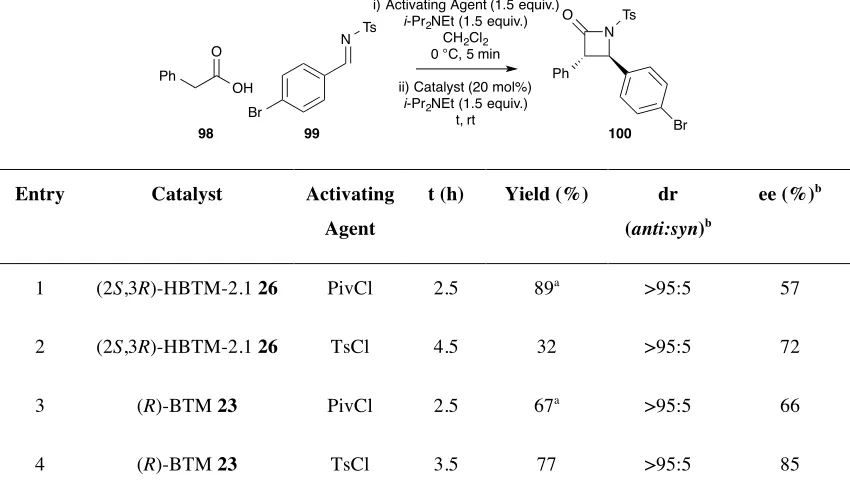
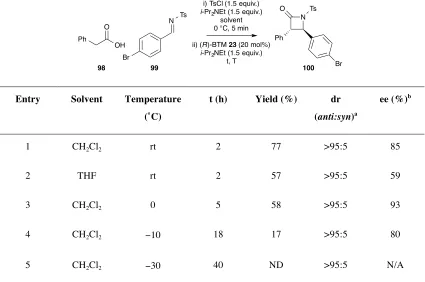
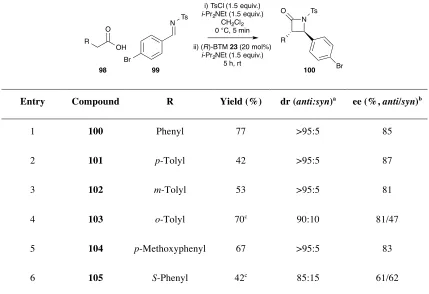
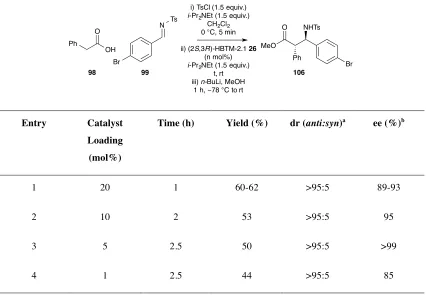
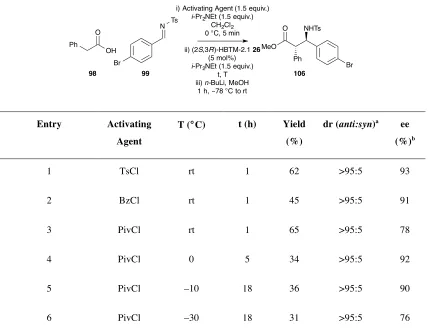
Chapter 2 describes the optimisation and investigation of [2+2]-cycloadditions from ammonium enolates and N-sulfonylimines as the two components. The development of this methodology allows successful access to highly stereodefined β-lactams and, following in situ ring-opening, β-aminoesters. The products are obtained from either preformed homoanhydrides or directly from carboxylic acids, using open flask conditions, from simple, bench-stable starting materials and is scalable. A variety of
anti-β-lactams (21 examples, 46-68% yield, up to >95:5 dr, 21->99% ee) and β -aminoesters (9 examples, 44-74% yield, up to >95:5 dr, 68-92% ee) were accessed in moderate yield, excellent diastereo- and good enantioselectivity. This represents an improved route to anti-β-lactams over previously described ketene and N-triflyl imine based methods.
Chapter 3 subsequently describes studies focussed on the use of ester surrogates in the formal [4+2]-cycloaddition reactions of isothiourea generated Type I ammonium enolates. Iso-propylphosphonate 163 proved highly effective as the four-component in this process, which following the in situ ring-opening of the initial dihydropyranone product allowed isolation of a range of novel diester products which were previously unobtainable using this methodology. The products were accessed in moderate to excellent yields, excellent diastereo- and enantiocontrol (9 examples, 12-63% yield, up to >95:5 dr, 67-99% ee) with this process also amenable to a large scale. Furthermore, selective reduction and acid-catalysed cyclisation allowed access to δ -lactone products in good yield with retention of stereocontrol.
Publications
The work described in this thesis has formed the basis of the following peer reviewed publications to date:
1. “Isothiourea-catalyzed asymmetric synthesis of β-lactams and β-amino esters from arylacetic acid derivatives and N-sulfonyl aldimines” S. R. Smith, J. Douglas, H. Prevet, P. Shapland, A. M. Z. Slawin and A. D. Smith J. Org. Chem.2014, 79, 1626-1639.
2. “α-Ketophosphonates as Ester Surrogates: Isothiourea-Catalyzed Asymmetric Diester and Lactone Synthesis” S. R. Smith, S. M. Leckie, R. Holmes, J. Douglas, C. Fallan, P. Shapland, D. Pryde, A. M. Z. Slawin and A. D. Smith
Org. Lett.2014, 16, 2506-2509.
3. “Organocatalytic Michael Addition-Lactonisation of Carboxylic Acids using
α,β-Unsaturated Trichloromethyl Ketones as α,β-Unsaturated Ester Equivalents” L. C. Morrill, D. G. Stark, J. E. Taylor, S. R. Smith, J. A. Squires, A. D’Hollander, C. Simal, P. Shapland, T. J. C. O’Riordan and A. D. Smith
Abbreviations
Ac Acetyl
app. Apparent
ASAP Atmospheric solids analysis probe
aq Aqueous
Ar Aromatic
atm Atmosphere
BEMP 2-tert-Butylimino-2-diethylamino-1,3-dimethylperhydro-1,3,2- diazaphosphorine
BINAP 2,2'-Bis(diphenylphosphino)-1,1'-binaphthyl
Bn Benzyl
Boc N-tert-Butoxycarbonyl
br Broad
BTM Benzotetramisole
Bu Butyl
BQ Benzoylquinine
BQd Benzoylquinidine
Bs Bosyl
Bz Benzoyl
c Concentration
C Celsius
cat. Catalyst
Cy Cyclohexyl
cm Centimeter
d Doublet
DCC Dicyclohexylcarbodiimide
DHPB 3,4-Dihydro-2H-pyrimido[2,1-b]benzothiazole DIBAL-H Di-iso-butylaluminium hydride
DMAP 4-Dimethylaminopyridine
DMF Dimethylformamide
DMSO Dimethyl sulfoxide dr Diasteroisomeric ratio
ee Enantiomeric excess
EI Electron impact
Equiv. Equivalent molar quantity ESI Electrospray ionisation
Et Ethyl
g Gram(s)
GC Gas chromatography
h Hour(s)
HOMO Highest occupied molecular orbital
HBTM Homobenzotetramisole
HPLC High performance liquid chromatography HRMS High resolution mass spectrometry
Hz Hertz
KHMDS Potassium hexamethyldisilazide LDA Lithium di-iso-propylamide LRMS Low resolution mass spectrometry LUMO Lowest occupied molecular orbital
M Molar (i.e. mol dm-3
)
m Multiplet
m Meta
Me Methyl
MHz Megahertz
mg Milligram(s)
mL Millilitre(s)
mol Mole(s)
mp Melting point
MS Mass spectrometry
M. S. Molecular sieves
NBS N-Bromosuccinimide
NCAL Nucleophile-catalysed Aldol-lactonisation NHC N-heterocyclic carbene
NMR Nuclear magnetic resonance
nOe Nuclear Overhauser effect spectroscopy
Ns Nosyl
NSI Nanospray ionisation
o Ortho
p Para
Ph Phenyl
Piv Pivaloyl
PMP p-Methoxyphenyl
ppm Parts per million PPY 4-Pyrrolidinopyridine
Pr Propyl
PS Polymer supported
q Quartet
R Alkyl
rt Ambient (room) temperature
s Singlet
sat. Saturated
t Triplet/time
t Tert
T Temperature
TBS tert-Butyldimethylsilyl
Tf Triflyl
TFA Trifluoroacetic acid TFAA Trifluoroacetic anhydride
THF Tetrahydrofuran
tlc Thin layer chromatography
TM Tetramisole
TMS Trimethylsilyl
Contents
Chapter 1: Introduction ... 1
1.1 Asymmetric Synthesis ... 1
1.2 Organocatalysis ... 1
1.2.1 Brønsted Acid Organocatalysis ... 3
1.2.2 Brønsted Base Organocatalysis ... 6
1.2.3 Lewis Acid Organocatalysis ... 7
1.2.4 Lewis Base Organocatalysis ... 8
1.3 Type I Ammonium Enolates: Generation From Carboxylic Acids ... 15
1.4 Aims and Objectives ... 17
1.5 References for Chapter 1 ... 18
Chapter 2: Asymmetric Synthesis of β-Lactams and β-Aminoesters using Isothiourea Organocatalysts ... 21
2.1 Introduction ... 21
2.1.1 β-Lactams ... 21
2.1.2 Preparation of β-Lactams ... 22
2.2 Results and Discussion ... 34
2.2.1 Initial Optimisation of Reaction to β-Lactams ... 34
2.2.2 Variation of Acid ... 40
2.2.3 Derivatisations ... 41
2.2.4 Optimisation of Reaction to β-Aminoesters ... 42
2.2.5 Variation of the Carboxylic Acid Component ... 47
2.2.6 Variation of the Imine ... 49
2.2.7 Recrystallisation of β-Amino Ester Products ... 51
2.2.8 Proposed Pre-Transition State Assemblies ... 53
2.3 Reaction from the Preformed Homoanhydride ... 55
2.3.1 Optimisation of Reaction from Preformed Anhydride ... 55
2.3.2 Variation of the Imine ... 56
2.3.3 Variation of the Anhydride ... 58
2.3.4 Control Studies ... 59
2.4 Conclusions ... 60
2.5 References for Chapter 2 ... 61
3.1 Introduction ... 65
3.1.1 Esters Surrogates as Michael Acceptors ... 65
3.2 Aims and Objectives ... 68
3.3 Results and Discussion ... 69
3.3.1 Previous Work on [4+2]-cycloadditions of α-Ketophosphonates Within the Smith Group ... 69
3.3.2 Further Optimisation ... 70
3.3.3 Iso-Propylphosphonate ... 72
3.3.4 Previous Work on [4+2]-cycloadditions of Trichloromethylketones Within the Smith Group ... 77
3.3.5 Expansion of This Work to Alkenyl Acids ... 78
3.4 Conclusions ... 78
3.5 References For Chapter 3 ... 80
Chapter 4: An Isothiourea Catalysed Formal [3+2]-Cycloaddition Towards Oxazolidin-4-ones ... 82
4.1 Introduction ... 82
4.1.1 Expansion of Isothiourea Ammonium Enolate Chemistry to Formal [3+2]-Cycloadditions ... 82
4.1.2 Oxaziridines ... 82
4.1.3 Oxaziridines in Asymmetric Synthesis ... 84
4.1.4 Oxaziridines in Asymmetric Catalysis ... 86
4.2 Aim ... 90
4.3 Results and Discussion ... 91
4.3.1 Previous Work on [3+2]-Cycloadditions Within the Smith Group ... 91
4.3.2 Reaction Optimisation ... 91
4.3.3 Investigation into the Scope of the Reaction ... 98
4.3.4 Scale Up ... 100
4.3.5 Derivatisation of Products ... 101
4.3.6 Stereoselectivity Investigations ... 103
4.3.7 Proposed Reaction Mechanism and Stereochemical Rationale ... 107
4.3.8 Conclusions ... 108
4.4 References for Chapter 4 ... 109
Chapter 5: Conclusions ... 112
Chapter 6: Experimental ... 115
6.2 Experimental for Chapter 2 ... 117
6.2.1 Isothiourea Catalysts ... 117
6.2.2 General Experimental Procedures ... 122
6.2.3 Starting Materials Synthesis ... 124
6.2.4 Optimisation Studies on 100 ... 127
6.2.5 Optimisation Studies on 106 ... 129
6.2.6 Experimental Procedures ... 132
6.2.7 Detosylation reaction ... 160
6.2.8 Control Experiments ... 160
6.3 Experimental for Chapter 3 ... 162
6.3.1 General Experimental Procedures ... 162
6.3.2 Starting Material Synthesis ... 163
6.3.3 Optimisation Studies on 162 ... 165
6.3.4 Experimental Procedures ... 166
6.4 Experimental for Chapter 4 ... 177
6.4.1 General Experimental Procedures ... 177
6.4.2 Starting Materials ... 177
6.4.3 Optimisation Studies on 216 ... 182
6.4.4 Experimental Procedures ... 182
6.4.5 Stereoselectivity Experiments ... 200
Chapter 1:
Introduction
1.1 Asymmetric Synthesis
The chiral recognition of biological systems has led to the increased significance of asymmetric synthesis. As two enantiomers of a chiral compound are often recognised as different substances in vivo, they can often produce entirely different biological responses. In the best case the undesired enantiomer will be ineffective but it could have negative side effects or even exhibit toxicity. A well documented example of this is the case of thalidomide, which was prescribed as the racemate for severe morning sickness in the 1950’s. In 1961 it was removed from the market following the discovery that it was a severe teratogen causing birth defects in thousands of children.1
In this case, one of the enantiomers was found to be responsible for this detrimental effect and, as the enantiomers interconvert in vivo selling an enantiomerically pure drug would be unproductive.2
However, in many other cases, the synthesis and administration of only the desired enantiomer of a drug would not only potentially reduce costs and increase atom efficiency but also lead to fewer side effects and possibly lower required doses. Indeed, the U.S. Food and Drug Administration agency treat the presence of an undesired enantiomer as an impurity and withhold drug approval unless exclusively one enantiomer is present. Chemical and enzymatic resolution alongside the use of chiral auxiliaries are traditional routes for the synthesis of enantiomerically pure chiral compounds. However, more recently the field of asymmetric catalysis has come to the fore utilising chiral catalysts in sub-stoichiometric quantities to create enantiomerically pure products. The potential economic advantages of this approach has led to the development of this field of synthesis and along with metal and biocatalysis, it has been established that small organic molecules can be highly selective and efficient catalysts.3
Now considered the “third pillar” of asymmetric catalysis,4
organocatalysis is the focus of this thesis.
1.2 Organocatalysis
In recent years, the ability of small organic molecules to promote synthetic transformations has been investigated extensively. First termed “organocatalysis” by MacMillan in 2000,5
weight organic molecules as catalysts.6,7
The use of small organic molecules as enantioselective catalysts has many advantages over alternative synthetic strategies including ease of availability and mild, simple reaction conditions.4 In comparison
with metal catalysts, which have been invaluable throughout the history of synthetic chemistry, they often can enable the development of new chemistry. Also, in some cases the development of organocatalytic alternatives to metal-based processes can be highly attractive.6
Early work in this area, prior to the acceptance of organocatalytic methods as useful tools in synthetic organic chemistry, began to emerge in the 1960s. Pracejus described the first example of a chiral organic molecule catalysing an organic process when o -acetylquinine 1 (1 mol%) was shown to catalyse the addition of methanol to a ketene at low temperature (Scheme 1.1).8
The enantioenriched ester 2 was isolated in 93% yield and 74% ee.
Scheme 1.1: Addition of Methanol to a Prochiral Ketene Catalysed by o-Acetylquinine 1
Following this pioneering study, in 1971 the Hajos-Parrish-Eder-Sauer-Wiechert reaction was reported.9
This process employed the naturally occurring amino acid L
-proline 3 to catalyse the intramolecular asymmetric aldol reaction of a triketone (Scheme 1.2). In the reaction mechanism, L-proline 3 reacts the starting ketone 4 to
form enamine 5 as the active species. Proton transfer between the carboxylic acid of the enamine nucleophile and the carbonyl electrophile in the proposed intermediate 5
gives the product precursor 6. Subsequent hydrolysis to release L-proline gives the bicyclic diketone product 7 in high yield and with 95% ee at low catalyst loading (3 mol%).
O
Ph Me
Ph OMe
O Me
2 93% Yield
74% ee 1 (1 mol%)
MeOH (1.1 equiv.) Toluene !111 °C
N
N
OC(O)Me OMe
Scheme 1.2: The Hajos-Parrish-Eder-Sauer-Wiechert Reaction
Since these early examples of chiral induction, organocatalysis has become increasingly important in asymmetric synthesis due to the possibility of forming multiple new bonds and stereocentres in a one-pot synthesis with a wide variety of activation modes. In 2005, List defined four broad classes of organocatalysis based on the character of the substrate-catalyst interaction:3
Brønsted acid, Brønsted base, Lewis acid, and Lewis base. These classes will be discussed further in the following sections.
1.2.1 Brønsted Acid Organocatalysis
Brønsted acid organocatalysis is defined as a process initiated by protonation or partial protonation to activate an electrophilic substrate - usually a carbonyl or imine3
- generating a catalyst/substrate complex and allowing reaction to proceed to generate the product (Scheme 1.3). This activation is similar to enzymatic activation where hydrogen-bonding to an enzyme’s active site occurs and for this reason, Brønsted acid organocatalysis is also known as hydrogen-bonding catalysis.
Me O
MeO
O
Me N
MeO
O CO2H
O N
O O
H
Me O OH
N O O
Me O O
O
Me
OH 3
L-Proline N H
CO2H
4
5 6
Scheme 1.3: General Catalytic Cycle for Brønsted Acid Organocatalysis
This type of organocatalysis was pioneered by Jacøbsen who reported an enantioselective Strecker reaction in 1998 as the first example of Brønsted acid catalysis. The unanticipated discovery that Schiff bases, originally designed for use as ligands in metal catalysed processes, could independently catalyse the asymmetric hydrocyanation reaction of a wide variety of imine substrates initiated this work (Scheme 1.4).10
Mechanistic investigations showed it was consistent with a double hydrogen-bond activation of the imine by the acidic NH protons of thiourea 8 leading to a lowering in the energy of its LUMO and enhancing its electrophilic nature. Since this work, chiral alcohols such as BINOL11
and TADDOL12
derivatives have also been used as catalysts for similar processes.
Scheme 1.4: Jacøbsen’s Brønsted Acid Catalysed Asymmetric Strecker Reaction
Subsequent studies from the same group expanded this concept to include the Mannich reaction between N-Boc imine 9 and ketene acetal 10 (Scheme 1.5).13
Access to the β-amino ester was achieved in excellent yield and ee and again it is presumed that a double hydrogen-bonding activation allows high reactivity and
A-H A SH P S Acid-Substrate Ion Pair Subsequent Reaction Proton Transfer Release of Product A PH
A-H = Brønsted Acid Catalyst S = Substrate
P = Product
N R
i) HCN (2 equiv.) MeOH
8 (2 mol%) Toluene, !78 °C
ii) TFAA N R CN N N H N H S H N O t-Bu 8 O F3C
Up to 92% Yield Up to 91% ee
Ph
HO
t-Bu OMe
Scheme 1.5: Asymmetric Thiourea Catalysed Mannich-Reaction
Hydrogen-bonding catalysis has been successfully applied to the synthesis of many natural products including that of (–)-epibatidine 11 by Takemoto and co-workers in 2004 (Scheme 1.6).14
The key step required activation of nitrostyrene 12 for an initial asymmetric intermolecular Michael addition catalysed by their thiourea catalyst 13, followed by an intramolecular Michael addition which gave the ketoester product 14
in 75% ee.
Scheme 1.6: Hydrogen-bonding Catalysis in the Synthesis of (–)-Epibatidine 11
In this case, thiourea 13 acts as as a bifunctional catalyst with Takemoto proposing that the thiourea activates the nitro-olefin through a double hydrogen-bonding interaction whilst the neighbouring tertiary amine forms a hydrogen-bond to the incoming enol, enhancing its nucleophilicity. In this mechanism, the approach of the
N
Ph
Boc OTBS
Oi-Pr
i) 8 (5 mol%) Toluene !40 °C, 48 h
ii) TFA, 2 min Oi-Pr
O Ph NH Boc 95% Yield 97% ee N N H N H X N O Bn Me t-Bu HO t-Bu OMe
X = O, S
9 10
NO2
N
Cl MeO O
O
O 13 MeO O
O O N O OH N Cl O O N O O N Cl MeO OH 11 (!)-Epibatidine S N H N H CF3
F3C
nucleophile is also fixed by the chiral catalyst, which accounts for the high levels of enantioselectivity observed (Figure 1.1). Other advances in this area have involved the use of chiral stronger acids such as BINOL derived phosphoric acids.6
[image:24.595.133.463.410.554.2]
Figure 1.1: Bifunctionality of Takemoto’s Thiourea Catalyst 13
1.2.2 Brønsted Base Organocatalysis
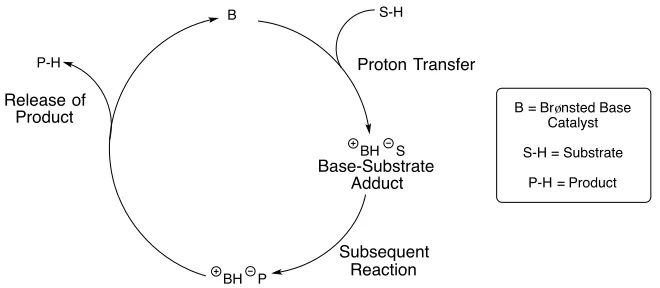
A Brønsted base is defined as being as a molecule capable of accepting a proton from an acid and therefore in contrast to Brønsted acid catalysis, the Brønsted base catalytic cycle is initiated by complete or partial deprotonation of a substrate (Scheme 1.7). Typical examples of organic Brønsted base catalysis in asymmetric synthesis are hydrocyanation reactions and Michael additions.3
Scheme 1.7: General Brønsted Base Catalytic Cycle
Onoue et al. described an example of Brønsted base catalysis with use of cyclopeptide
15 as a catalyst in the addition of hydrogen cyanide to various aldehydes (Scheme 1.8).15
This process produced cyanohydrins in excellent yield and ee, which could be further elaborated to α-hydroxy carboxylic acids, α-hydroxy esters, and β-amino alcohols.
S N N CF3
F3C
NMe2
H H
O O
N
R
H
O O
EtO OEt
B
P-H
S-H
Base-Substrate Adduct
Subsequent Reaction
Proton Transfer Release of
Product
S BH
P BH
B = Brønsted Base Catalyst S-H = Substrate
Scheme 1.8: Brønsted Base Catalysed Addition of Hydrogen Cyanide
Another example of Brønsted base catalysis was reported by Isobe and co-workers describing the Michael reaction of a prochiral glycine derivative t-butyl diphenyliminoacetate 16 with acrylates in the presence of a modified guanidine catalyst 17 under solvent free conditions (Scheme 1.9).16
Functionalised stereodefined amino esters 18 were isolated in high yield with enhanced enantioselectivity for a range of substrates.
Scheme 1.9: Isobe’s Brønsted Base Catalysed Michael Reaction
1.2.3 Lewis Acid Organocatalysis
Lewis acid catalysts are defined as having a vacant orbital and activate nucleophilic substrates through accepting a lone pair of electrons (Scheme 1.10). Many examples fall into the class of phase-transfer catalysts in which the reaction of the catalyst and substrate facilitates migration from one phase (usually organic) to another (usually aqueous) where the reaction occurs.
Scheme 1.10: Lewis Acid Catalysis General Cycle
The epoxidation of olefins using chiral dioxiranes generated in situ is an important example of Lewis Acid organocatalysis. Shi’s example utilises D-fructose derived
Ph O H HCN 2 equiv. Ph OH CN 97% Yield 95% ee 15 (2 mol%)
Toluene
!20 °C HN
NH Ph O O N HN 15 N H N O O H Ph H H NH HN O Ph H CN via t-BuO O N Ph Ph
CO2Me t-BuO
O
N Ph
Ph MeO2C
17 (20 mol%) rt 3 days 18 98% Yield 93% ee NMe N Me N OH Ph Ph Ph 17 16 A A S P S Acid-Substrate Species Subsequent Reaction Nucleophilic Addition Release of Product A P
A = Lewis Acid Catalyst S = Substrate
ketone catalyst 19 with Oxone® as a stoichiometric oxidant to generate the epoxide products in excellent ee (Scheme 1.11).17
Scheme 1.11: Lewis Acid Catalysed Epoxidation Reaction
1.2.4 Lewis Base Organocatalysis
In 1923, Gilbert N. Lewis proposed the definition of a Lewis base18
as a molecule with a lone pair of electrons in its HOMO that can fill the valence shell of a Lewis acid (an electron deficient molecule). Lewis base-mediated catalysis represents the largest area of organocatalysis (Scheme 1.12). In this mode of catalysis, the Lewis base forms an adduct with a Lewis acid substrate via nucleophilic addition. This addition changes the reactivity of the substrate, converting it to either an activated nucleophile or electrophile3
and therefore increases the rate of reaction with another reagent and product formation. The Lewis base is regenerated during this process resulting by definition in a catalytic process.19
Scheme 1.12: Lewis Base Organocatalysis
The Hajos-Parrish-Eder-Sauer-Wichert reaction is an early example of Lewis base catalysis (previously discussed in Scheme 1.2) and more specifically, enamine catalysis. Lewis base catalysis can be subdivided based upon activation mode into enamine, iminium, NHC catalysis and ammonium enolate catalysis amongst others (Figure 1.2) and representative examples of these selected reaction modes are described in the remainder of this chapter. Asymmetric Lewis base organocatalysis is
R CO2Et R
CO2Et
O
19 (30 mol%) Oxone® (1.38 equiv.)
K2CO3 (5.8 equiv.)
MeCN-DMM-0.05 M
aq. Buffer (1:2:2) Up to 96% Yield Up to 98% ee
O O
O
OAc
AcO O
O O
O
OAc AcO
O O
19
via
B
B S P
S
Lewis-Base-Substrate Adduct
Subsequent Reaction
Nucleophilic Addition Release of
Product
B P
B = Lewis Base Catalyst S = Substrate
the main focus of research within the Smith group and therefore of this thesis, especially utilising isothiourea catalysts to form ammonium enolate intermediates.
Figure 1.2: Modes of Lewis Base Activation
1.2.4.1 Iminium Catalysis
In iminium catalysis, reversible reaction of the Lewis basic amine catalyst with a carbonyl substrate forms an activated iminium ion lowering the LUMO. MacMillan’s enantioselective Diels-Alder reaction of α,β-unsaturated aldehydes and ketones, with dienes using a chiral imidazolidinone catalyst 27 was the pioneering example of this principle in modern organocatalysis (Scheme 1.13).20
Although the diastereoselectivity of this reaction was low, the enantioselectivity was excellent, giving functionalised cyclohexanes in high yields.
Scheme 1.13: MacMillan’s Enantioselective Diels-Alder Reaction
This active species has been used to facilitate many asymmetric reactions including Knoevenagel condensations,21
Diels-Alder reactions,5
and 1,3-dipolar cycloadditions.22
1.2.4.2 Enamine Catalysis
Formation of a catalytically generated iminium ion from a nucleophilic amine catalyst and a carbonyl compound, followed by deprotonation to form a nucleophilic enamine intermediate is the basis of enamine catalysis. This intermediate can then go on to react with various electrophiles or alternatively undergo a pericyclic reaction. List and co-workers developed enamine catalysis, expanding on the previously described Hajos-Parrish reaction, by reporting an intermolecular aldol reaction (Scheme 1.14).23
They utilised ketone 28 and aldehyde 29 in a L-Proline 3 catalysed process and gave
access to the crossed aldol product 30 in excellent enantioselectivity.
R2 NR2 R1
R1 R2
NR2 N
N N R1
NR3 O R
Enamine Iminium NHC Ammonium Enolate
Ph O
CHO Ph 27 (3 mol%)
MeOH.H2O rt
99% Yield 1:1.3 dr 93% ee
N H2
NMe O
Ph
Me Me Cl
27
N NMe O
Ph
Me Me Cl
Scheme 1.14: Asymmetric Intermolecular Aldol Reaction
1.2.4.3 Carbene Catalysis
Carbene catalysis, particularly N-heterocyclic carbene (NHC) catalysed activation of a substrate can occur in a wide variety of reaction manifolds.24
The use of NHCs to catalyse the benzoin reaction is well established with Enders and co-workers illustrating the use of a t-leucine-derived triazolium NHC 31 to catalyse an asymmetric benzoin reaction in 2002 (Scheme 1.15).25
In this reaction, salt 31 is deprotonated in situ to reveal the carbene. The reaction then proceeds with the carbene adding into an aromatic aldehyde to form the Breslow intermediate 32via an NHC/aldehyde tetrahedral adduct. The Breslow intermediate is nucleophilic and can add to a second molecule of aldehyde. Finally, extrusion of the NHC catalyst affords the benzoin product 33 in excellent yield and ee. The related carbene catalysed Stetter reaction also takes advantage of the reactivity of the Breslow intermediate.26
Scheme 1.15: NHC-Catalysed Asymmetric Benzoin Reaction
Chiral azolium enolates can be accessed by the reaction of NHCs with ketenes or via
redox processes with α-functionalised aldehydes or enals.27
Ye and co-workers showed in 2008 that NHCs could catalyse the formal [4+2]-cycloaddition of disubstituted ketenes and enones via azolium enolate 34 forming the anti -dihydropyranone product 35 in excellent yield, dr and ee (Scheme 1.16).28
Scheme 1.16: NHC-Catalysed Formal [4+2]-Cycloaddtion via Azolium Enolate 34 O
H
O 3 (20 mol%) DMSO rt O OH 31 97% Yield 96% ee N H CO2H 3 28 Excess N CO2H via 29 Ph H O Ph O Ph OH 33 83% Yield 90% ee
31 (10 mol%) KOt-Bu (10 mol%)
THF rt, 16 h
N N N O
t-Bu Ph
BF4
31
N N N O
t-Bu Ph
Ph OH 32 via Ph O 35 79% Yield >20:1 dr 91% ee
36 (10 mol%) Cs2CO3 (20 mol%)
THF 0 °C to rt, 24 h
N N N Ph
BF4
36
via EtO2C
O C Et Ph 1.5 equiv. O O Ph EtO2C
Et Ph
Ph OTBS Ph
The number of NHC-mediated reactions has vastly increased in recent years and now include reactions such as transesterification, activation of esters and conjugate additions amongst many others.29
1.2.4.4 Amidines and Isothioureas as Lewis Base Organocatalysts
In the last decade, Birman and co-workers have developed a range of catalysts based on amidine and isothiourea core structures.30
These catalysts are highly successful in a range of processes such as the use of amidine 20 in the kinetic resolution of secondary alcohols (Scheme 1.17).31
Scheme 1.17: Birman’s Kinetic Resolution of Secondary Alcohols
Following the success of amidine 20 in the resolution of secondary alcohols, the Birman group undertook investigations to optimise the structure of these catalysts (Figure 1.3).32
The addition of a second aromatic ring led to the development of amidine 21.33
This was designed to have greater π-stacking with the aromatic alcohol substrates. It was found that both the reaction rate and selectivity were improved when compared with 20. Birman and co-workers made a further improvement by changing to an isothiourea core. It was shown the commercially available isothiourea (–)-tetramisole.HCl 22 and its derivative (R)-benzotetramisole 23 were superior in the kinetic resolution.34
The use of homobenzotetramisole (HBTM, 24) led to increased levels of enantioselectivity35
and then simultaneously but independently, Birman36
and Smith37
found that an alkyl substituent at the C(3) position of HBTM (25and26) gave an increase in catalytic activity when used in two different systems – the kinetic resolution of secondary alcohols, and O- to C-carboxyl group transfer of oxazolyl carbonates respectively.
Ar OH
R
20 (2 mol%) (EtCO)2O (0.75 equiv.)
i-Pr2NEt (0.75 equiv.) CHCl3, 0 °C
Ar OH
R Ar
O
R OEt O
39% Yield S = 36
N
N Ph
CF3
Figure 1.3: Evolution of Amidine and Isothiourea Catalysts
1.2.4.5 Ammonium Enolate Catalysis
Lewis base catalysis has recently been extended to include ammonium enolates as intermediates in asymmetric organocatalysis. This important and widespread strategy,38
often explored utilising chiral tertiary amine catalysts, provides a chiral environment for enolate reactions allowing control of enantioselectivity and often result in enhanced reactivity.39
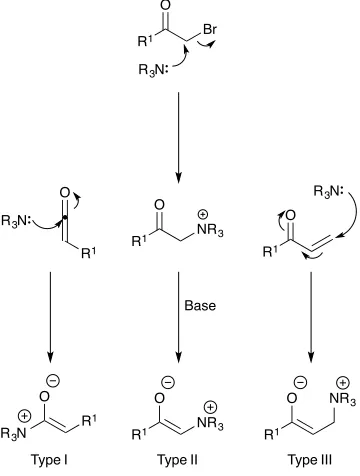
Ammonium enolates can be subdivided and are classed as Type I, II or III with the number referring to the number of atoms from the enolate oxygen to the ammonium nitrogen (Figure 1.4). Type I enolates are formed directly from the reaction of a nucleophilic amine catalyst with a ketene or alternatively, by the acylation of a tertiary amine followed by deprotonation by a base. Type II ammonium enolates are formed by the SN2 displacement of an α leaving group by an
amine and Type III are generated by Michael addition of an amine to an acrylate or vinyl ketone. The ammonium enolate intermediate can then go on to react with a range of electrophiles and their use has been exploited in many areas of organocatalysis including β-lactone synthesis, α-halogenation reactions and [4+2]-cycloaddition type reactions among others.39
N N Ph
CF3
20
N N Ph
21
Cl
N N Ph
22
S
N N Ph
23
S
N
24
S N Ph
N S N Ph Alkyl
•HCl
25 Alkyl = Me29
Figure 1.4: Classes of Ammonium Enolate
In the synthesis of β-lactones, Type I ammonium enolates are utilised to promote the asymmetric dimerization of ketenes. Early work by Pracejus and Sauer40
was expanded by Calter into a method for asymmetric dimerisation of methylketene 37
giving the β-lactone product 38 in high ee (Scheme 1.18).41
Subsequent lithium aluminium hydride mediated ring-opening gives access to highly versatile polyketide building blocks with preservation of stereochemistry.
Scheme 1.18: The Use of Type I Ammonium Enolates in β-Lactone Synthesis
Gaunt et al. have shown Type II ammonium enolates can react in an intermolecular fashion with electron-deficient olefins to give cyclopropanes in excellent yields and ees (Scheme 1.19).42
Initial nucleophilic attack of amine catalyst 40 on the alkyl halide 41 at the α-position, followed by deprotonation forms ammonium enolate 42
(Type II). This activates the substrate which can then undergo Michael addition onto the vinyl ketone 43, forming a Type III ammonium enolate species 44. Nucleophilic attack of the enolate to release the catalyst forms cyclopropane product 45.
R3N R
1 O
R1 NR3 O
R1
O NR3
Type I Type II Type III O
R1 R3N
R1 O
Br
R3N
R1 NR3 O
R1 O
R3N
Base
C O
O
O O OH
39 (1 mol%) THF
!78 °C
LiAlH4 THF
!78 °C
N N
OMe
OH H
37 38
39
Scheme 1.19: Gaunt’s Cyclopropane Formation and Mechanism
The use of Type III ammonium enolates can be exemplified by the use of tertiary amine catalyst 46 in the Morita-Baylis-Hillman reaction (Scheme 1.20).43
It is proposed that in this case the catalyst is “bifunctional” with the hydroxyl group being important in the observed selectivity, forming a hydrogen bond to the aldehyde carbonyl in the proposed transition state 47, orientating it for attack by the ammonium enolate.
Scheme 1.20: Type III Ammonium Enolates in a Catalytic Morita-Baylis-Hillman Reaction
R1 Br
O
R2 O
N OMe 40 (10-20 mol%)
Cs2CO3 MeCN 80 °C, 24 h
R2 O R1 O 45 63-96% yield 80-97% ee H N OMe 40 NR3 R1 O Br R1 O
R3N
Cs2CO3
CsBr + CsHCO3 R1
O
R3N R2
O R1 O
R3N
O R2 R2 O R1 O Br 45 44 43 42 41 41 43 N O Et N OH O
O CF3
CF3 O
R R OH O O CF3 CF3 46 (10 mol%)
DMF, 55 °C
31-58% yield 91-99% ee 46 N O Et N O O
O CF3
CF3
H
O R
1.3 Type I Ammonium Enolates: Generation From Carboxylic Acids
Recent work within the Smith group has focussed on investigating alternatives to the use of ketenes in the generation of Type I ammonium enolates. Ketenes can be difficult substrates to handle due to their high levels of reactivity, which in turn leads to poor long-term stability and often reduced isolated yields. There are also limitations in substrate diversity when using ketenes as starting materials with disubstituted ketenes being the most common. 44
Activated carboxylic acids have been shown to be an excellent alternative to ketenes in the generation of Type I ammonium enolates. For example, Romo and co-workers reported their nucleophile-catalysed aldol lactonisation (NCAL) reaction in which carboxylic acid 48 undergoes activation by pyridinium salt 49 and in the presence of base and cinchona alkaloid 40 forms Type I ammonium enolate 50. Intramolecular aldol reaction and lactonisation then occurs to give lactone 51 with excellent levels of stereocontrol (Scheme 1.21).45
Scheme 1.21: Organocatalytic β-Lactone Formation from Aldehyde-Acids.
In 2010, the Smith group expanded the utility of this form of activation in asymmetric inter- and intra-molecular Michael-addition/lactonisation reactions (Scheme 1.22).38
Using isothiourea catalyst 26 or 22, the formal [4+2]-cycloaddition products can be accessed in high yield and enantioselectivities.
HO2C
O
H N Cl
Me I 49 (3 equiv.)
40 (10 mol%)
i-Pr2NEt (4 equiv.) CH3CN rt, 108 h
O O
51 54% Yield
>19:1 dr 92% ee
N OMe
N OMe
40
N OMe
N OMe
O O via
Scheme 1.22: Isothiourea-Catalysed Asymmetric Inter- and Intramolecular Michael-Addition/Lactonisations
In the proposed reaction mechanism for these reactions, activation of carboxylic acid
53 using pivaloyl chloride forms mixed anhydride 54 (Scheme 1.23). Nucleophilic addition of the isothiourea catalyst 26 and subsequent deprotonation gives access to the chiral Type I ammonium enolate 55. The ammonium enolate then undergoes Michael addition to the double bond of the α,β-unsaturated ketoester 56 to form zwitterionic intermediate 57, which can then cyclise with release of the catalyst to give lactone product 58. Following the publication of this work, the scope has been further expanded to further Michael acceptors including N-tosyl-α,β-unsaturated ketimines,46
N-aryl-N-aroyldiazenes47
and trifluoromethylenones.48 OH
O
Ar
26 (10 mol%) (CH3)3CCOCl (1.5 equiv.)
i-Pr2NEt (4.0 equiv.) CH2Cl2 !30 °C, 16 h
O O
CO2Me Ph
Ar
62 - 81% Yield >95:5 dr 86-99% ee
CO2H R2 O
R1 O
R2 O H
H
22 (20 mol%) (CH3)3CCOCl (1.2 equiv.)
i-Pr2NEt (3.6 equiv.) CH2Cl2, rt, 1 h
N
S N Ph
•HCl
74-99% Yield >95:5 dr 90 - 99% ee
Ph CO2Me
O
N
26
S N Ph i-Pr
a)
b)
R1
Scheme 1.23: Proposed Mechanism for the Isothiourea-Catalysed Intermolecular Michael-Addition/Lactonisation
Subsequently, Romo has also extended his protocol towards highly enantioselective intramolecular desymmetrising aldol-lactonisation reactions, initially using isothiourea catalyst HBTM 24 (Scheme 1.24).49
Similarly, this process is initiated by activation of keto-acid 59 with tosyl chloride and in the presence of base and the isothiourea, forms a Type I ammonium enolate that goes on to form tricyclic β -lactone 60 in excellent yield and ee.
Scheme 1.24: Romo’s Desymmetrising Aldol/Lactonisation Reaction
1.4 Aims and Objectives
This thesis aims to investigate novel applications for Type I ammonium enolates generated from isothioureas and carboxylic acids in intermolecular cycloaddition reactions. In addition to expansion of their use in formal [4+2]-cycloaddition
N N S Ph Ar O O O t-Bu N N S Ph O Ar N N S Ph O Ar Ph O CO2Me N N S Ph O O
CO2Me Ar
Ph
i-Pr2NEt
i-Pr2NH+Et O Ar Ph O CO2Me O t-Bu O 26 54 55 56 57 58 Ar OH O 53
(CH3)3CCOCl3 i-Pr2NEt
O
O
CO2H
Me 24 (20 mol%)
TsCl (1.25 equiv.)
i-Pr2NEt (4 equiv.)
LiCl (1 equiv.) CH2Cl2
rt, 24 h
reactions, their use in formal [2+2]- and [3+2] reactions will be discussed. The ultimate aim is to create efficient, straight-forward routes to highly stereodefined heterocyclic products and their derivatives using bench stable reagents and in open-flask conditions.
1.5 References for Chapter 1
1 Ojima, I. Catalytic Asymmetric Synthesis, 2nd. ed.; Wiley-VCH: USA, 2000, 6-7
2 Teo, S. K.; Colburn, W. A.; Tracewell, W. G.; Kook, K. A.; Stirling, D. I.; Jaworsky, M. S.; Scheffler,
M. A.; Thomas, S. D.; Laskin, O. Clin. Pharmacokinet. 2004, 43, 311-327.
3 Seayan, S.; List, B. Org. Biomol. Chem.2005, 3, 719-724.
4 Moyano, A.; Rios, R. Chem. Rev. 2011, 111, 4703-4832.
5 Ahrendt, K. A.; Borths, C. J.; MacMillan, D. W. C. J. Am. Chem Soc., 2000, 122, 4243-4244.
6 Dondoni, A.; Massi, A. Angew. Chem., Int. Ed.2008, 47, 4638-4660.
7 Dalko, P. I. Moisan, L. Angew. Chem., Int. Ed. 2004, 43, 5138-5175.
8 Pracejus, H. Justus Liebigs Ann. Chem.1960, 634, 9-22.
9 (a) Eder, V.; Sauer, G.; Wiechert, R. Angew. Chem., Int. Ed. 1971, 10, 496-497. (b) Hajos, Z. G.; Parrish, D. R. J. Org. Chem. 1974, 39, 1615-1621.
10 Sigman, M. S.; Jacøbsen, E. N. J. Am. Chem. Soc.1998, 120, 4901-4902.
11 McDougal, N. T.; Schaus, S. E. J. Am. Chem. Soc. 2003, 125, 12094-12095.
12 Huang, Y.; Unni, A. K.; Thadani, A. N.; Rawal, V. H. Nature 2003, 424, 146.
13 Wenzel, A. G.; Jacøbsen, E. N. J. Am. Chem. Soc.2002, 124, 12964-12965.
14 Hoashi, Y.; Yabuta, T.; Takemoto, Y. Tetrahedron Lett. 2004, 45, 9185-9188.
15 Tanaka, K.; Mori, A.; Inoue, S. J. Org. Chem. 1990, 55, 181-185.
16 Ishikawa, T.; Araki, Y.; Kumamoto, T.; Seki, H.; Fukuda K.; Isobe, T. Chem. Commun.2001, 245– 246.
17 Wu, X-Y.; She, X.; Shi, Y. J. Am. Chem. Soc. 2002, 124, 8792-8793.
18 Lewis, G. N. Valence and The Structure of Atoms and Molecules, Chemical catalog, New York,
1923
19 Denmark S. E.; Beutner, G. L. Angew. Chem., Int. Ed.2008, 47, 1560-1638.
21 Knoevenagel reaction review: Tietze, L. F.; Comprehensive Organic Synthesis ed. Trost, B. M. Pergamon Press, New York, 1991, vo. 2 pp. 341-494.
22 Jen, W. S.; Wiener, J. J. M.; MacMillan, D. W. C. J. Am. Chem. Soc. 2000, 122, 9874-9875.
23 (a) List, B.; Lerner, R. A.; Barbas, C. F. J. Am. Chem. Soc. 2000, 122, 2395-2396. (b) Notz, W.; List, B. J. Am. Chem. Soc. 2000, 122, 7386-7387. (c) List, B.; Pojarliev, P.; Castello, C. Org. Lett. 2001, 3, 573-575. (d) Bahmanyar, S.; Houk, K. N.; Martin, H. J.; List, B. J. Am. Chem. Soc. 2003, 122, 2475-2479. (e) Pidathala, C.; Hoang, L.; Vignola, N.; List, B. Angew. Chem., Int. Ed. 2003, 42, 2785-2788.
24 For a review on N-heterocyclic carbene catalysis see: Enders, D.; Niemeier, O.; Henseler, A. Chem.
Rev.2007, 107, 5606-5655.
25 Enders D.; Kallfass, U. Angew. Chem., Int. Ed.2002, 41, 1743-1745.
26 Okino, T.; Hoashi, Y.; Takemoto, Y. J. Am. Chem. Soc.2003, 125,12672-12673.
27 For a review on C1-azolium enolate generation and reactivity see: Douglas, J.; Churchill, G.; Smith,
A. D. Synthesis2012, 2295-2309.
28 Zhang, Y-R.; Lv, H.; Zhou, D.; Ye, S. Chem. Eur. J.2008, 14, 8473-8476.
29 Naumann, S.; Buchmeiser, M. R. Catal. Sci. Technol. 2014, 4, 2466-2479.
30 For a review see: Taylor, J. E.; Bull, S. D.; Williams, J. M. J. Chem. Soc. Rev. 2012, 41, 2109-2121. 31 Birman, V. B.; Uffman, E. W.; Jiang, H.; Li, X.; Kibane C. J. J. Am. Chem. Soc.2004, 126, 12226-12227.
32 Li, X.; Jiang, H.; Uffman, E. W.; Guo, L.; Zhang, Y.; Yang, X.; Birman, V. B. J. Org.Chem.2012,
77, 1722-1737.
33 Birman, V. B.; Jiang, H. Org. Lett.2005, 7, 3445-3447.
34 Birman, V. B.; Li, X. Org. Lett.2006, 8, 1351-1354.
35 Birman, V. B.; Li, X. Org. Lett. 2008, 10, 1115-1118.
36 Zhang, Y.; Birman, V. B. Adv. Synth. Catal.2009, 351, 2525-2529.
37 Joannesse, C.; Johnston, C. P.; Concellón, C.; Simal, C.; Philp, D.; Smith, A. D. Angew.Chem., Int.
Ed. 2009, 48, 8914-8918.
38 Belmessieri, D.; Morrill, L. C.; Simal, C.; Slawin, A. M. Z.; Smith, A. D. J. Am. Chem. Soc. 2011, 133, 2714–2720.
39 Gaunt, M. J.; Johansson, C. C. C. Chem. Rev. 2007, 107, 5596-5605.
40 (a) Samtleben, R.; Pracejus, H. J. Prakt. Chem.1972, 517; (b) Sauer, J. C. J. Am. Chem. Soc.1947,
69, 2444-2448.
42 Papageorgiou, D.; Ley, S. V.; Gaunt, M. J. Angew. Chem., Int. Ed.2003, 42, 828-831.
43 Iwabuchi, Y. Y.; Nakatani, M.; Yokoyama, N.; Hatakeyama, S. J. Am. Chem. Soc. 1999, 121, 10219-10220.
44 Taggi, A. E.; Hafez, A. M.; Wack, H.; Young, B.; Ferraris, D.; Lectka, T. J. Am. Chem. Soc. 2002,
124, 6626-6635.
45 Cortez, G. S.; Tennyson, R. L.; Romo, D. J. Am. Chem. Soc.2001, 123, 7945-7946.
46 Simal, C.; Lebl, T.; Slawin, A. M. Z.; Smith, A. D. Angew. Chem., Int. Ed.2012, 51, 3653-3657.
47 Morrill, L. C.; Lebl, T.; Slawin, A. M. Z.; Smith, A. D. Chem. Sci.2012, 3, 2088-2093.
48 Morrill, L. C.; Douglas, J.; Lebl, T.; Slawin, A. M. Z.; Fox, D. J.; Smith, A. D. Chem. Sci. 2013, 4, 4146-4155.
Chapter 2:
Asymmetric Synthesis of
β
-Lactams and
β
-Aminoesters using Isothiourea Organocatalysts
2.1 Introduction
To expand the scope of previous work within the group, this chapter develops an intermolecular formal [2+2]-cycloaddition based on the [4+2]-intermolecular Michael addition/lactonisation previously discussed. In looking for suitable partners for the [2+2]-cycloaddition, imines were attractive substrates as their use would lead to the formation of β-lactams, a widely recognised pharmacophore in both chemistry and biology, and therefore of great synthetic interest (Scheme 2.1).1
Scheme 2.1: Proposed Route to β-Lactams via Isothiourea Generated Ammonium Enolates
2.1.1 β-Lactams
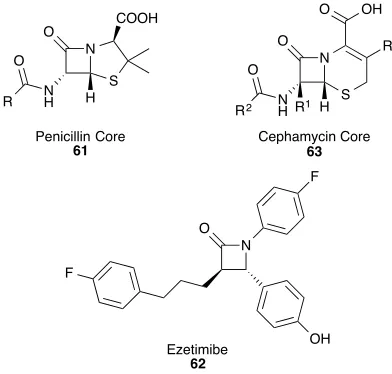
Consisting of a 4-membered cyclic amide with up to two stereocentres in the lactam core, β-lactams are most famously the key structural component in many antibiotics, including the penicillins 61 (Figure 2.1). Since Sir Alexander Fleming, Scottish scientist and Nobel laureate, discovered the antibiotic behaviour of penicillin in 19282
and Dorothy Crowfoot-Hodgkin subsequently assigned its structure by X-ray crystallography in 1945,3
the β-lactam ring has received extensive biological and synthetic investigations.1
They are also key in a wide variety of other drugs for example Ezetimibe 62, which is used for the inhibition of cholesterol absorption.4
This central motif is also prevalent in natural products such as the cephamycins 63, another family of antibiotic compounds. A large number of methodologies for the synthesis of β-lactams have been developed5
and their use as synthons for the synthesis of a wide variety of targets has also been extensively studied.6
Functionalisation of lactams allows access to heterocycles of various sizes, amino(hydroxyl) acid derivatives, β-amino ketones, γ-amino alcohols, and other compounds.6,7
N Ph
Ts
i) (CH3)3CCOCl i-Pr2NEt
CH2Cl2 rt, 5 mins ii) (2S,3R)-HBTM-2.1 26
i-Pr2NEt Ar
OH O
Ar
NR3 O
N Ph
Ts
N
O Ts
Figure 2.1: A Range of Molecules Containing the β-Lactam Motif
The β-lactam ring sets itself apart from other cyclic and acyclic amides with differences in their reactivity owing to changes in the rotational barrier of the carbonyl C-N bond. In an acyclic amide, this barrier is approximately 16-22 kcal mol-1
as a consequence of the strong resonance between the nitrogen atom lone pair and the carbonyl π-system.8 In the case of
β-lactams, the strain of the four-membered ring disrupts this resonance making the carbonyl much more electrophilic. In extreme cases the β-lactam can be as reactive as acid chlorides, although in most cases β -lactams can still be isolated.9
This also alters the IR stretch of the amide carbonyl – whereas acyclic amide carbonyls are typically ca. 1660 cm-1
, β-lactams show a stretch between 1720 and 1815 cm-1
.10
2.1.2 Preparation of β-Lactams
There are many routes for the construction of β-lactams including cyclisation reactions, cycloaddition reactions, organometallic-mediated reactions, and other miscellaneous approaches such as ring contraction and radical processes.5
The first reported synthesis of a β-lactam through a formal [2+2]-cycloaddition of imines to ketenes was reported in 1907 by Staudinger (Scheme 2.2).11
In this reaction, imine 64
acts as the nucleophile, adding to diphenylketene 65 forming zwitterionic intermediate 66 that undergoes ring-closure to give β-lactam product 67.12
N
S O
N H
COOH
H R
O N
S
O OH
R O
N HR1 H R2
O
N O
F
OH F Penicillin Core
61 Cephamycin Core63
Scheme 2.2: The Staudinger Reaction
This synthesis did not receive much attention until the 1940’s, but with the elucidation of the structure of the antibiotic penicillin G it has been extensively investigated as the basis of many modern routes into β-lactams. Recently these have focussed on the development of asymmetric and specifically catalytic methods.
2.1.2.1 Current Methods for β-Lactam Synthesis
The Staudinger reaction marked the beginning of synthetic chemistry towards β -lactams and although many modern methods are based on this approach, there are a number of other existing methodologies for β-lactam synthesis. For example, Gilman and Speeter first reported the formation of β-lactams via condensation of ethyl α -bromoacetate 68 and N-phenyl benzaldimine 64 in 1943 as a modification of the Reformatsky reaction (Scheme 2.3). 13
Scheme 2.3: The Gilman-Speeter Reaction
Although this process works reasonably well and is tolerant of a wide range of functional groups, including a range of aryl and alkyl substituents on the nitrogen atom, the yields are often reduced by competitive protonation of intermediate 69. Grignard addition to the resulting side-product can convert it into the β-lactam via
deprotonation and cyclisation, but this adds additional steps to the synthesis, decreasing the efficiency of this reaction.14
Alternatively, Ohno et al.15
used triphenylphosphine and Mukaiyama’s 2,2’-dipyridyldisulfide 70 to convert β-amino acids into β-lactams (Scheme 2.4). This is generally applicable to a wide range of β-amino acids with a range of functional groups but with varying yields.
O C
Ph Ph
N Ph
Ph
N O Ph
Ph Ph
Ph
N
O Ph
Ph Ph
Ph CH2Cl2
0 °C
65 64 66 67
Br
OEt O
O
EtO Zn
Br
N Ph
Ph
O
EtO Ph
N
Zn R
Br
N O
Ph R Zn
56-80% Yield
69
Scheme 2.4: β-Lactam Formation Using Mukaiyama’s Reagent 70
Other methods towards β-lactams include photo-induced rearrangements16
and radical cyclisations.17
However, owing to the need for the effective synthesis of enantioenriched compounds, especially for medicinal chemistry, recent advancements have focussed on the development of stereoselective variants of these established synthetic methods.10
2.1.2.2 Methods for Asymmetric β-Lactam Synthesis
There are two possible stereocentres in the β-lactam core and therefore the possibility of up to four stereoisomers. Consequently, controlling the relative and absolute configuration during synthesis of these products is important in the context of using them as potential pharmaceuticals. In drug molecules different stereoisomers can have differing binding to their biological targets and therefore could possibly have entirely different pharmacological effects.18
This was the case for Penicillin V, whose unnatural enantiomer has less than 1% of the efficacy of the natural enantiomer.19
For these reasons, the development of asymmetric routes to enantiopure β-lactams are of great importance.
Much work has been carried out on introducing and controlling stereochemistry through adaption of the Staudinger reaction in which stereoinduction through either of the two components of the reaction is possible. Inducing asymmetry through the imine component can be achieved by utilizing an imine derived from either an enantiomerically enriched aldehyde20
or the amine.21
For example, Gunda used an enantioenriched N-protecting group on the imine to give the syn-β-lactam product in high diastereoselectivity but in only modest yield (Scheme 2.5). In addition, this method required two steps to synthesise the enantiopure imine and a further two steps to remove the N-protecting group if required.
HOOC NH2 O NH
N
H S
Ph3PO
84% Yield [!]D +65 (c 1.11, CHCl3) 70
Ph3P
CH3CN 60 °C, 12 h
N S 2
Scheme 2.5: Gunda’s Chiral Auxiliary Approach to β-Lactam Synthesis
Alternatively, Evans et al.demonstrated that the use of a stereodirecting group on the ketene could also be effective (Scheme 2.6).22
Homochiral (4S )-phenyloxazolidylacetyl chloride 71 was used as a ketene precursor, with base being used to generate the ketene in situ. Following reaction with imine 72 and cleavage of both the chiral oxazolidinone and N-protecting groups in one step, β-lactam 73 was isolated in excellent yield and diastereoselectivity. The requisite oxazolidinone could be accessed in two steps from the commercially available amino acid (S )-phenylglycine in good overall yield (62%) and the facile, one-step removal is a benefit of this chemistry.
Scheme 2.6: Evans’s Chiral Auxiliary Approach to β-Lactam Synthesis
However, both of these examples rely on chiral auxiliaries that whilst effective, are required in stoichiometric quantities with added costs and require extra steps for their introduction and removal.10
It is for this reason that catalytic, asymmetric syntheses of the β-lactam ring have been of increasing interest in recent years.
2.1.2.3 Catalytic Asymmetric Synthesis of β-Lactams
One of the first asymmetric synthesis of β-lactams in conjunction with catalysis was a metal-catalysed carbonylation reaction that produces β-lactam rings by the insertion of carbon monoxide into C-N bonds. Expanding on their 1981 work on the carbonylation of azirines,23
Alper et al. reported the metal-catalysed carbonylation of aziridines to yield β-lactams (Scheme 2.7).24
Using an enantiopure aziridine starting material, 5 mol% of a rhodium (I) catalyst under 20 atm CO pressure at 90 ˚C yielded
N Ph OTBS Ph OTBS N O
R2N
OTBS Ph OTBS Ph N O
R2N
OTBS Ph
OTBS
Ph R2N
Cl O NEt3 dr 8:1 52% Yield Li/NH3 73 Up to 90% Yield
Up to 92:8 dr ee 92-97%
NH O
H2N R
exclusive insertion of the carbon monoxide into the aryl-substituted C-N bond with complete retention of configuration and quantitative yields.
Scheme 2.7: Rhodium Catalysed Carbonylation to β-Lactams
This was later expanded to an asymmetric variant using racemic aziridines in a kinetic resolution (Scheme 2.8).24b Excess chiral additive
L-menthol 74 was employed with a
chloro(1,5-cycloctadiene)rhodium(I) dimer 75 as the catalyst to give the (S)-β-lactam in excellent optical yield. This gave access to optically enriched β-lactams using an inexpensive, commercially available chiral additive, although owing to the use of excess equivalents this could be seen as less efficient than later methods.
Scheme 2.8: Kinetic Resolution of Aziridine to give β-Lactams in High Optical Purity
An alternative approach to β-lactam asymmetric synthesis is the intramolecular C-H insertion reaction. This process was first reported by Corey and Felix in 196525
and later developed into an asymmetric process by Doyle and co-workers (Scheme 2.9).26
Using conformationally constrained diazoacetylazacycloalkanes to allow competitive formation of β-lactams over γ-lactams, chiral dirhodium(II) carboxamate catalyst 76
gave the desired β-lactam products in good yields and excellent enantioselectivity whilst using low catalyst loadings (2 mol%).
Scheme 2.9: Rhodium Catalysed Asymmetric C-H Insertion Reaction
In 1972, Kinugasa and Hashimoto reported the synthesis of syn-β-lactams in the reaction between a copper(I) acetylide and a nitrone.27
This original Kinugasa reaction
N N
R R O
Ar Ar
cat. [Rh(CO)2Cl]2 CO, 20 atm
90 °C
Benzene Up to >99% Yield
N N
R R O
Ph Ph
75 (20 mol%) L-Menthol 74 (3 equiv.)
CO (20 atm) 90 °C
>99% Optical Yield
Me OH
Me Me L-Menthol 74 75
Rh Cl ClRh
H
N2
N O
(CH2)n
N (CH2)n
O
(CH2)n
N O
!-Lactam "-Lactam
!:">99:1 ee 97% Rh2(5S-MEPY)476
(2 mol%)
CH2Cl2
Rh2(5S-MEPY)4
76
N CO2Me
O
Rh2
by Ding and Irwin in 1976 (Scheme 2.10).28
It is postulated that [3+2]-cycloaddition of the nitrone and copper acetylide initiates the reaction and following formation of ketene and cyclisation, the β-lactam product is formed. Ding had evidence to support this mechanism including experiments varying the groups on both the nitrone and acetylide, which led to products with the predicted substitution patterns, whilst reaction in the presence of 18
O labelled water produced no 18
O-labelled products. This indicated that the oxygen in the product was derived from the nitrone.
Scheme 2.10: Kinugasa Reaction
The Kinugasa reaction is amenable to catalysis with the first catalytic modification described by Miura in 1993 and later extended to incorporate chiral ligands.29
However, this reaction is highly sensitive to both the ligand used and the substitution on the nitrone, with the product distribution between β-lactams, azaenynes, imines and carboxylic acids varying and the methodology generally suffers from low enantioselectivities.51a
In 2002, Fu and co-workers developed the first successful diastereo- and enatioselective catalytic variant in which a variety of nitrones and terminal alkynes were coupled to make syn-β-lactams using 1-2.4 mol% of CuCl and a C2-symmetric planar-chiral bis(azaferrocene) ligand 77 (Scheme 2.11).30
This successful method incorporated a wide scope of nitrones and alkynes with good isolated yields and high ees and drs.
1 equiv. 1 equiv.
i) Pyridine, 1 h, rt ii) H+/H 2O
Cu
Ph
N H Ph O
Ph
N
O Ph
Ph Ph
55% Yield
Cu
Ph
N H Ph O
Ph
N O
Ph Cu
Ph
Ph Ph Ph
N
O Ph
Ph Ph
C O
N Ph