Cochrane
Database of Systematic Reviews
Professional, structural and organisational interventions in
primary care for reducing medication errors (Review)
Khalil H, Bell B, Chambers H, Sheikh A, Avery AJ
Khalil H, Bell B, Chambers H, Sheikh A, Avery AJ.
Professional, structural and organisational interventions in primary care for reducing medication errors.
Cochrane Database of Systematic Reviews2017, Issue 10. Art. No.: CD003942. DOI: 10.1002/14651858.CD003942.pub3.
T A B L E O F C O N T E N T S
1 HEADER . . . .
1 ABSTRACT . . . .
2
PLAIN LANGUAGE SUMMARY . . . .
4
SUMMARY OF FINDINGS FOR THE MAIN COMPARISON . . . .
6
BACKGROUND . . . .
7 OBJECTIVES . . . .
7 METHODS . . . .
10 RESULTS . . . .
Figure 1. . . 11
Figure 2. . . 14
Figure 3. . . 16
Figure 4. . . 17
Figure 5. . . 18
Figure 6. . . 19
21 ADDITIONAL SUMMARY OF FINDINGS . . . . 24 DISCUSSION . . . . 25 AUTHORS’ CONCLUSIONS . . . . 25 ACKNOWLEDGEMENTS . . . . 26 REFERENCES . . . . 32 CHARACTERISTICS OF STUDIES . . . . 83 DATA AND ANALYSES . . . . Analysis 1.1. Comparison 1 Professional interventions versus standard care, Outcome 1 Number of hospital admissions. 84 Analysis 1.2. Comparison 1 Professional interventions versus standard care, Outcome 2 Number of people admitted to hospital. . . 84
Analysis 1.3. Comparison 1 Professional interventions versus standard care, Outcome 3 Number of emergency department visits. . . 85
Analysis 1.4. Comparison 1 Professional interventions versus standard care, Outcome 4 Mortality. . . 85
Analysis 2.1. Comparison 2 Organisational interventions versus standard care, Outcome 1 Number of hospital admissions. . . 86
Analysis 2.2. Comparison 2 Organisational interventions versus standard care, Outcome 2 Number of people admitted to hospital. . . 87
Analysis 2.3. Comparison 2 Organisational interventions versus standard care, Outcome 3 Number of emergency department visits. . . 88
Analysis 2.4. Comparison 2 Organisational interventions versus standard care, Outcome 4 Mortality. . . 89 89 ADDITIONAL TABLES . . . .
117 APPENDICES . . . .
144 HISTORY . . . .
144
CONTRIBUTIONS OF AUTHORS . . . .
144 DECLARATIONS OF INTEREST . . . .
144 SOURCES OF SUPPORT . . . .
145
[Intervention Review]
Professional, structural and organisational interventions in
primary care for reducing medication errors
Hanan Khalil1, Brian Bell2, Helen Chambers1, Aziz Sheikh3, Anthony J Avery2
1Faculty of Medicine, Nursing and Health Sciences, School of Rural Health, Moe, Australia.2Division of Primary Care, University
of Nottingham, Nottingham, UK.3Allergy & Respiratory Research Group and Asthma UK Centre for Applied Research, Centre for Medical Informatics, Usher Institute of Population Health Sciences and Informatics, The University of Edinburgh, Edinburgh, UK
Contact address: Hanan Khalil, Faculty of Medicine, Nursing and Health Sciences, School of Rural Health, PO Box 973, Moe, Victoria, 3825, [email protected].
Editorial group:Cochrane Effective Practice and Organisation of Care Group. Publication status and date:New, published in Issue 10, 2017.
Citation: Khalil H, Bell B, Chambers H, Sheikh A, Avery AJ. Professional, structural and organisational interventions in pri-mary care for reducing medication errors. Cochrane Database of Systematic Reviews2017, Issue 10. Art. No.: CD003942. DOI: 10.1002/14651858.CD003942.pub3.
Copyright © 2017 The Cochrane Collaboration. Published by John Wiley & Sons, Ltd.
A B S T R A C T
Background
Medication-related adverse events in primary care represent an important cause of hospital admissions and mortality. Adverse events could result from people experiencing adverse drug reactions (not usually preventable) or could be due to medication errors (usually preventable).
Objectives
To determine the effectiveness of professional, organisational and structural interventions compared to standard care to reduce pre-ventable medication errors by primary healthcare professionals that lead to hospital admissions, emergency department visits, and mortality in adults.
Search methods
We searched CENTRAL, MEDLINE, Embase, three other databases, and two trial registries on 4 October 2016, together with reference checking, citation searching and contact with study authors to identify additional studies. We also searched several sources of grey literature.
Selection criteria
We included randomised trials in which healthcare professionals provided community-based medical services. We also included inter-ventions in outpatient clinics attached to a hospital where people are seen by healthcare professionals but are not admitted to hospital. We only included interventions that aimed to reduce medication errors leading to hospital admissions, emergency department visits, or mortality. We included all participants, irrespective of age, who were prescribed medication by a primary healthcare professional.
Data collection and analysis
Main results
We included 30 studies (169,969 participants) in the review addressing various interventions to prevent medication errors; four studies addressed professional interventions (8266 participants) and 26 studies described organisational interventions (161,703 participants). We did not find any studies addressing structural interventions. Professional interventions included the use of health information technology to identify people at risk of medication problems, computer-generated care suggested and actioned by a physician, electronic notification systems about dose changes, drug interventions and follow-up, and educational interventions on drug use aimed at physicians to improve drug prescriptions. Organisational interventions included medication reviews by pharmacists, nurses or physicians, clinician-led clinics, and home visits by clinicians.
There is a great deal of diversity in types of professionals involved and where the studies occurred. However, most (61%) of the interventions were conducted by pharmacists or a combination of pharmacists and medical doctors. The studies took place in many different countries; 65% took place in either the USA or the UK. They all ranged from three months to 4.7 years of follow-up, they all took place in primary care settings such as general practice, outpatients’ clinics, patients’ homes and aged-care facilities. The participants in the studies were adults taking medications and the interventions were undertaken by healthcare professionals including pharmacists, nurses or physicians. There was also evidence of potential bias in some studies, with only 18 studies reporting adequate concealment of allocation and only 12 studies reporting appropriate protection from contamination, both of which may have influenced the overall effect estimate and the overall pooled estimate.
Professional interventions
Professional interventions probably make little or no difference to the number of hospital admissions (risk ratio (RR) 1.24, 95% confidence interval (CI) 0.79 to 1.96; 2 studies, 3889 participants; moderate-certainty evidence). Professional interventions make little or no difference to the number of participants admitted to hospital (adjusted RR 0.99, 95% CI 0.92 to 1.06; 1 study, 3661 participants; high-certainty evidence). Professional interventions may make little or no difference to the number of emergency department visits (adjusted RR 0.71, 95% CI 0.50 to 1.02; 2 studies, 1067 participants; low-certainty evidence). Professional interventions probably make little or no difference to mortality in the study population (adjusted RR 0.98, 95% CI 0.82 to 1.17; 1 study, 3538 participants; moderate-certainty evidence).
Organisational interventions
Overall, it is uncertain whether organisational interventions reduce the number of hospital admissions (adjusted RR 0.85, 95% CI 0.71 to 1.03; 11 studies, 6203 participants; very low-certainty evidence). Overall, organisational interventions may make little difference to the total number of people admitted to hospital in favour of the intervention group compared with the control group (adjusted RR 0.92, 95% CI 0.86 to 0.99; 13 studies, 152,237 participants; low-certainty evidence. Overall, it is uncertain whether organisational interventions reduce the number of emergency department visits in favour of the intervention group compared with the control group (adjusted RR 0.75, 95% CI 0.49 to 1.15; 5 studies, 1819 participants; very low-certainty evidence. Overall, it is uncertain whether organisational interventions reduce mortality in favour of the intervention group (adjusted RR 0.94, 95% CI 0.85 to 1.03; 12 studies, 154,962 participants; very low-certainty evidence.
Authors’ conclusions
Based on moderate- and low-certainty evidence, interventions in primary care for reducing preventable medication errors probably make little or no difference to the number of people admitted to hospital or the number of hospitalisations, emergency department visits, or mortality. The variation in heterogeneity in the pooled estimates means that our results should be treated cautiously as the interventions may not have worked consistently across all studies due to differences in how the interventions were provided, background practice, and culture or delivery of the interventions. Larger studies addressing both professional and organisational interventions are needed before evidence-based recommendations can be made. We did not identify any structural interventions and only four studies used professional interventions, and so more work needs to be done with these types of interventions. There is a need for high-quality studies describing the interventions in more detail and testing patient-related outcomes.
P L A I N L A N G U A G E S U M M A R Y
Actions to reduce medication errors in adults in primary care
The aim of this Cochrane Review was to find out the best way to reduce medication errors by primary healthcare professionals in adult patients that lead to hospital admissions, emergency department visits, and death. We wanted to know whether targeting individual health professionals (e.g. with educational materials and reminders about drug dosage etc.), changing the organisation of primary care (e.g. revising professional roles, such as nurse- or pharmacist-led prescribing etc.), or structural actions, such as organising quality monitoring services can reduce medication errors by primary healthcare professionals. We collected and analysed relevant studies to answer this question and found 30 studies.
Key messages
The 30 studies (169,969 participants) in this Cochrane Review showed that actions aimed at reducing medication errors, such as medication reviews by pharmacists or physicians probably make little or no difference to the number of people admitted to hospital, number of hospital admissions, number of emergency department visits, or death. In general, all the actions described in the review were found to have unclear benefits. We did not find any studies that fitted the criteria of structural actions. The main limitation of this review is the small number of studies addressing each method and the low-certainty of the evidence.
What was studied in the review?
Prescribing medications is one of the most powerful tools available to general practitioners (GPs) in the prevention and treatment of disease. Medication-related adverse events could be the result of people either experiencing adverse drug reactions (not usually preventable) or as a result of medication errors (usually preventable). We studied the effectiveness of professional and organisational methods compared to standard care in primary care settings (examples of primary care settings include general practices, community pharmacies, patient homes, community settings, outpatient clinics, and aged-care facilities) to reduce preventable medication errors that lead to hospital admissions, emergency department visits, and death in adults who are prescribed medication in primary care.
What are the main results of the review?
We included 30 studies in our analysis. We classified 26 studies as organisational and the remaining four as professional actions. We found no structural actions in our search. The studies included in this Cochrane Review showed that based on moderate- and low-certainty evidence, actions in primary care for reducing preventable medication errors probably make little or no difference to the number of people admitted to hospital or the number of hospitalisations, emergency department visits, or death. Most of the studies took place in the UK and the USA; studies undertaken in high-income countries with disadvantaged populations, and in low- and middle-income countries, were underrepresented. This might affect the generalisation of the results.
Certainty of the evidence
We found the overall certainty of evidence for the professional actions to vary considerably across the reported outcomes: moderate-certainty for number of hospital admissions, high-moderate-certainty for number of people admitted to hospital, low-moderate-certainty for number of emergency department visits, and moderate-certainty for deaths. The certainty of evidence for organisational actions was less varied: very low-certainty for number of hospital admissions, low-certainty for number of people admitted to hospital, and very low-certainty for number of emergency department visits and deaths.
More work needs to be done in improving the quality of the studies regarding selection of participants and adequate blinding of participants and study assessors. Participants dropping out of the studies was another concern in the certainty of evidence. Funding of the included studies came from various sources and it is difficult to decide whether the funding affected the results of the studies.
How up-to-date is this review?
S U M M A R Y O F F I N D I N G S F O R T H E M A I N C O M P A R I S O N [Explanation]
Professional interventions compared to standard/ usual care for prevention of medication errors
Patient or population:adults receiving m edication in prim ary care Setting:prim ary and com m unity care
Intervention:prof essional interventions (using health inf orm ation technology to identif y people at risk or using it to generate a patient care plan) Comparison:standard/ usual care
Outcomes Anticipated absolute effects∗(95% CI) Relative effect (95% CI)
of participants (studies)
Certainty of the evi-dence
(GRADE)
Comments
Risk with standard/ usual care
Risk with professional interventions
Num ber of hospital ad-m issions
Study population RR 1.24
(0.79 to 1.96)
3889 (2 RTs)
⊕⊕⊕
M oderate1
The two studies had wide conf idence inter-vals.
17 per 1000 21 per 1000 (13 to 33)
Num ber of people ad-m itted to hospital
Study population RR 0.99
(0.92 to 1.06)
3661 (1 RT)
⊕⊕⊕⊕
High2
448 per 1000 443 per 1000 (412 to 475)
Num ber of em ergency departm ent visits
Study population RR 0.71
(0.50 to 1.02)
1067 (2 RTs)
⊕⊕
Low1,3
The two studies had wide conf idence inter-vals and selection bias 118 per 1000 85 per 1000
(59 to 121)
M ortality Study population RR 0.98
(0.82 to 1.17)
3538 (1 RT)
⊕⊕⊕
M oderate3
122 per 1000 119 per 1000 (100 to 142)
GRADE Working Group grades of evidence
High- certainty:we are very conf ident that the true ef f ect lies close to that of the estim ate of the ef f ect.
M oderate- certainty:we are m oderately conf ident in the ef f ect estim ate: the true ef f ect is likely to be close to the estim ate of the ef f ect, but there is a possibility that it is substantially dif f erent.
Low- certainty:our conf idence in the ef f ect estim ate is lim ited: the true ef f ect m ay be substantially dif f erent f rom the estim ate of the ef f ect.
Very low- certainty:we have very little conf idence in the ef f ect estim ate: the true ef f ect is likely to be substantially dif f erent f rom the estim ate of ef f ect
1We downgraded one level due to im precision.
2We did not downgrade the outcom es because all included studies had low risk of bias and narrow conf idence intervals. 3We downgraded one level due to risk of bias (selection bias).
B A C K G R O U N D
Description of the condition
Medication-related (drug-related) adverse events in primary care represent an important cause of hospital admissions and mortality (Howard 2003). Medication-related adverse events could be the result of people either experiencing adverse drug reactions (not usually preventable) or as a result of medication errors (usually preventable) (Bates 1995;Ioannidis 2001).
According toEdwards 2000, adverse drug reactions can be defined as “an appreciably harmful or unpleasant reaction resulting from an intervention related to the use of a medicinal product.” Medi-cation errors on the other hand, are mostly preventable. A medica-tion error is defined byFerner 2006as “a failure in the treatment process that leads to, or has the potential to lead to, harm to the patient.” They are mainly due to prescribing or medication man-agement errors. A reduction of these types of prescribing/medi-cation errors has been a high priority for healthcare policy in or-der to improve the safety profile of the healthcare delivery system (Howard 2003;Soe 2013).
A prospective cohort study has shown that within four weeks of receiving a primary care prescription, 25% of participants expe-rienced an adverse drug event, 11% of which were judged pre-ventable (Gandhi 2003). A systematic review and meta-analysis byWinterstein 2002reported that a median 7.1% (inter-quartile range 5.7% to 16.2%) of hospital admissions resulted from drug-related problems, of which 59% were considered preventable (i.e. attributable to error), whileHoward 2007reported that a median of 3.7% of hospital admissions were preventable and drug-related. Improving patient safety is, as a consequence, now a government priority in many high-income and middle- and low-income coun-tries, including the UK, USA and five African countries; Egypt, South Africa, Morocco, Tanzania and Zimbabwe (Brown 2008;
WHO 2004).
Description of the intervention
In this review we examined interventions in primary care to re-duce preventable medication errors that resulted in hospital ad-missions, emergency department visits, and mortality. The three main types of interventions that we examined included profes-sional, organisational, and structural interventions as described by Cochrane Effective Practice and Organisation of Care (EPOC) (Appendix 1). Professional interventions included quality assur-ance tools that provided educational interventions for practition-ers or participants, such as teaching the use of structured assess-ments with general practitioners (GPs). Organisational interven-tions included revision of professional roles (e.g. nurse- or phar-macist-led chronic disease clinics and nurse prescribing) and revi-sion of clinical multidisciplinary teams (e.g. pharmacist-managed
medication reviews). Structural interventions included the organ-isation of quality monitoring services. We used these interventions for any type of primary care-based population, irrespective of their characteristics. The comparator was no intervention or standard or usual care. The selected outcomes included in the review were the number of hospital admissions, emergency department visits, and mortality. These outcomes were selected as they are tangible and mostly reported in primary studies. We did not consider patient-oriented or patient-mediated outcomes in this review due to the complexity of the included interventions. We will consider these outcomes in the updated review.
How the intervention might work
The three main interventions, mentioned above, used different approaches to achieve a reduction in medication errors that led to hospital admissions, emergency department visits, and mortality. Professional interventions included continuing education and quality assurance that provided educational interventions for prac-titioners or participants, such as teaching the use of structured as-sessments with GPs. Other examples of professional interventions included drug education programmes for physicians that were run by physicians, electronic health record systems that provided in-formation about drugs and gave recommendations about chang-ing doses, health technology that identified care home residents at risk of falls, and computer-based drug-ordering systems that gave suggestions to physicians and pharmacists.
Organisational interventions included revision of professional roles (e.g. nurse- or pharmacist-led chronic disease clinics and nurse prescribing) and revision of clinical multidisciplinary teams (e.g. pharmacist-managed medication reviews). Organisational in-terventions may have included telephone consultations along with home-based medication reviews by pharmacists or nurses. Such interventions aimed at engaging workers in the management of risk to increase patient safety.
Structural interventions included the organisation of quality mon-itoring services. Examples of these interventions included struc-tural approaches such as social, economic, and political interven-tions that could improve public health outcomes by increasing the willingness and ability of individuals to practice prevention. An example of the latter would be the introduction of financial incentives to healthcare workers to reduce medication errors. By looking at all of these interventions in the current review, we can begin to address the multiple perspectives of various stakeholders who provide health care to individuals in primary care (Benning 2011).
Why it is important to do this review
allevia-tion of symptoms (Spencer 2014). However, medication-related adverse events arising as a result of primary care prescribing are an important source of participant morbidity, much of which could be prevented by higher-quality prescribing and medicines man-agement (Howard 2007). To date, there is little information on the interventions mentioned above, aimed at reducing preventable medication-related adverse events in primary care due to errors. A review undertaken byIoannidis 2001, addressed interventions of all types of medical errors in both primary and secondary care. It highlighted the complexity in studying those types of interventions aimed at minimising errors in healthcare delivery. Other reviews byDurieux 2012andO’Brien 2008focused on interventions to improve professional practice and healthcare outcomes, including prescribing. A review byRoyal 2006found that there was weak evidence to support pharmacist-led medication interventions be-ing effective in reducbe-ing hospital admissions. However, none of these reviews have focused on other types of interventions at the professional, organisational or structural level that could possibly reduce medication errors in the primary care setting.
Given that preventable medication errors in primary care are asso-ciated with hospital admissions, emergency department visits, and mortality, it is important to know whether there are any interven-tions that have been found to be effective in reducing the occur-rence of these outcomes. While members of our team published a related systematic review on this topic (Royal 2006), there has been no Cochrane Review of interventions aimed at reducing the incidence of preventable medication errors that lead to hospital admissions, emergency department visits, and mortality.
O B J E C T I V E S
To determine the effectiveness of professional, organisational and structural interventions compared to standard care to reduce pre-ventable medication errors by primary healthcare professionals that lead to hospital admissions, emergency department visits, and mortality in adults.
M E T H O D S
Criteria for considering studies for this review
Types of studies
We included randomised trials in this review. We excluded con-trolled before-after studies and other non-randomised designs as they provided much weaker evidence due to the non-randomisa-tion of participants to experimental and control groups. We did
not impose any restriction on the language or country in which studies were carried out.
Types of participants
We included studies directed at healthcare professionals and or-ganisations involved in the provision of primary care in the com-munity setting who were authorised to prescribe, sell or adminis-ter medications, including primary care physicians (general prac-titioners (GPs), family doctors, family physicians, family practi-tioners), dental practitioners, community nurses, nurse practition-ers, community pharmacists, dispensers in community pharmacies and any other relevant healthcare providers. We included all adult participants who were receiving a medication through the inter-vention of the aforementioned primary healthcare professionals. Examples of community settings included general practice, com-munity pharmacies, and nursing and residential homes. We ex-cluded studies of interventions for outpatients in a clinic attached to a hospital or a day hospital unless these were specifically de-scribed as primary care clinics.
Types of interventions
Using the taxonomy of interventions developed by EPOC, we categorised interventions that improved patient safety by reducing hospital admissions, emergency department visits, and mortality (
Appendix 1). We compared the interventions with inactive control interventions such as no treatment, or standard or conventional care. We divided interventions into the following categories.
Professional interventions
Professional interventions included the use of health information technology to identify people at risk of medication problems, com-puter-generated care suggested and actioned by a physician, elec-tronic notification systems about dose changes, drug interventions and follow-up, and educational interventions on drug use aimed at physicians to improve drug prescriptions.
Organisational interventions
Examples of organisational interventions included medication re-views by pharmacists, nurses or physicians, clinician-led clinics, and home visits by clinicians.
Structural interventions
Types of outcome measures
We included studies that addressed preventable medication errors with the following outcomes. All the outcomes below are included
inSummary of findings for the main comparisonandSummary
of findings 2.
Primary outcomes
• Number of hospital admissions (this outcome takes into account that one patient can have multiple admissions)
• Number of people admitted to hospital (this outcome reports on the number of people admitted to hospital irrespective of the number of times they were admitted during the study period)
Secondary outcomes
• Number of emergency department visits • Mortality
Search methods for identification of studies
EPOC’s Information Specialist, Paul Miller, developed the search strategies in consultation with the review authors. The Informa-tion Specialist searched the Cochrane Database of Systematic Re-views and the Database of Abstracts of ReRe-views of Effects (DARE) for related systematic reviews, and the databases listed below for primary studies.
Electronic searches
We searched the following databases on 4 October 2016. • Cochrane Central Register of Controlled Trials (CENTRAL; 2016, Issue 9), in the Cochrane Library.
• MEDLINE Ovid (including epub ahead of print, in-process and other non-indexed citations) (1946 to 4 October 2016).
• Embase, Ovid (1974 to 3 October 2016).
• Health Technology Assessment Database (NHSEED; 2015, Issue 2), in the Cochrane Library.
• NHS Economic Evaluation Database (NHSEED; 2015, Issue 2), in the Cochrane Library.
• CINAHL EBSCO (Cumulative Index to Nursing and Allied Health Literature; 1981 to 4 October 2016).
Search strategies are comprised of keywords and controlled vocab-ulary terms. We applied no language or time limits. We searched all databases from database start date to date of search. All search strategies used are provided inAppendix 2.
Searching other resources
Grey literature
On 4 October 2016 we conducted a grey literature search to iden-tify studies not indexed in the databases listed above. Sources in-cluded the sites listed below. We documented additional sources, if any, in the review.
• Open Grey (opengrey.eu).
• Grey Literature Report (New York Academy of Medicine) (
greylit.org).
• Agency for Healthcare Research and Quality (AHRQ) (
ahrq.gov).
• Joanna Briggs Institute (joannabriggs.edu.au).
• National Institute for Health and Care Excellence (NICE) (
nice.org.uk).
Trial registries
We searched the following trial registries on 4 October 2016. • International Clinical Trials Registry Platform (ICTRP), Word Health Organization (WHO) (who.int/ictrp).
• ClinicalTrials.gov, US National Institutes of Health (NIH) (clinicaltrials.gov).
We undertook the following.
• Screened individual journals and conference proceedings (e.g. handsearch).
• Reviewed reference lists of all included studies, relevant systematic reviews/primary studies/other publications.
• Contacted authors of relevant studies or reviews to clarify reported published information/seek unpublished results/data. • Contacted researchers with expertise relevant to the review topic/EPOC interventions.
• Conducted cited reference searches for all included studies in citations indexes.
Data collection and analysis
Selection of studies
Data extraction and management
Three review authors (HK, HC and BB) independently completed data extraction using a customised version of the EPOC data col-lection checklist (EPOC 2017a). All three review authors met fre-quently to discuss progress, with discrepancies resolved by dis-cussion between the review authors. We grouped studies together on the basis of similar interventions and common outcomes and used Review Manager 5 software to manage and pool data (Review Manager 2014), as mentioned in chapter 7 of theCochr ane Hand-book for Systematic Reviews of Interventions(Higgins 2011a). We documented the selection process in sufficient detail to complete a PRISMA flow chart (Liberati 2009), and aCharacteristics of excluded studiestable.
Assessment of risk of bias in included studies
Three review authors (HK, HC and BB) independently assessed the risk of bias of all included studies using the criteria described in the Cochrane Handbook for Systematic Reviews of Interventions (Higgins 2011b). We resolved differences through discussion. We assessed seven parameters including random sequence gener-ation, allocation concealment, blinding of participants and out-come assessors, incomplete outout-come data, selective reporting, and other bias including protection against contamination and publi-cation bias. We discussed the inclusion of the selected studies in the meta-analysis based on their risk of bias. We assessed studies on the basis of having low, unclear or high risk of bias. We included all trials in the final meta-analysis.
Measures of treatment effect
For each of the primary outcomes listed above, we reported out-comes for each study in natural units (i.e. number of participants with an event per total number of participants at follow-up). We examined funnel plots for evidence of publication bias and anal-ysed data using Review Manager 5 (Review Manager 2014). We presented results with 95% confidence intervals (CIs) and esti-mates for dichotomous data (number of people admitted to hos-pital) as risk ratios (RRs).
Unit of analysis issues
We examined the methods of analysis of all study types critically. All randomised trials were appropriately analysed. We analysed cluster-randomised trials at the same level as the allocation, thereby avoiding unit-of-analyses errors (Alvarez 2001;Coleman 1999;
Gernant 2016;Kaczorowski 2011;Lapane 2011;Lowrie 2012;
Malet-Larrea 2016;Roberts 2001). Therefore, we did not need to reanalyse the results and it was appropriate to combine them with other randomised trials.
Dealing with missing data
We did not exclude any studies from the meta-analysis due to a differential loss to follow-up or missing data. Most studies had adequate reporting of the participants in their samples. We were able to extract all the data needed for analysis from the included studies. We did not need to contact any study authors for more information.
Assessment of heterogeneity
Because trials may not have been carried out according to a com-mon protocol, there were usually variations in participant groups, clinical settings, concomitant care, etc. Therefore, we assessed erogeneity between trial results. We considered trial data to be het-erogeneous where the I2statistic was greater than 40% (Higgins
2003). For analyses, we used the random-effects method. We at-tempted to explain the differences between studies on the basis of the characteristics of interventions in the included studies.
Assessment of reporting biases
We carefully assessed all studies for reporting bias. Reporting bias was especially likely with outcomes that used participant self-re-ports or self-administered surveys.
Data synthesis
We carried out statistical analysis using Review Manager 5 soft-ware (Review Manager 2014). We used a random-effects meta-analysis for combining data due to the clinical and methodolog-ical heterogeneity between studies. We grouped studies based on the two main interventions (i.e. professional and organisational). Where appropriate, we carried out meta-analyses to establish the effects of interventions on medication-related hospital admissions, emergency department visits, and mortality. We found no studies addressing structural interventions and hence no analysis was un-dertaken.
’Summary of findings table’ and GRADE
We included two ’Summary of findings’ tables for the main in-tervention comparisons: ’professional inin-terventions compared to usual care’ (Summary of findings for the main comparison); and ’organisational interventions compared to usual care’ (Summary of findings 2). The ’Summary of findings’ tables include the justifi-cation for our decisions to downgrade or upgrade the evidence for an outcome, along with comments to help the reader understand the process. We included the following outcomes in the ’Sum-mary of findings’ tables: number of hospital admissions, number of people admitted to hospital, number of emergency department visits, and mortality.
moder-ate, low, and very low) with respect to five criteria (risk of bias, in-consistency, indirectness, imprecision, and publication bias), with disagreements resolved through discussion (Guyatt 2008). We used methods and recommendations described in Section 8.5 and Chapter 11 of theCochrane Handbook for Systematic Reviews of interventionsand GRADEpro GDT software (GRADE pro GDT 2015;Higgins 2011b;Schünemann 2011). In addition, we used the EPOC worksheets to write plain language statements to report these findings in the review (EPOC 2017b).
Subgroup analysis and investigation of heterogeneity
We conducted the analyses based on the types of interventions (professional, organisational, structural) as described byDeeks 2011. We undertook analyses for the following interventions.
1. Professional interventions, such as provision of educational interventions for practitioners or participants.
2. Organisational interventions, including revision of professional roles (e.g. nurse- or pharmacist-led chronic disease clinics, nurse prescribing) and clinical multidisciplinary teams (e.g. pharmacist-managed medication reviews).
We found no studies addressing structural interventions and there-fore, we did not include this type of intervention in our review. There was no other subgroup analysis undertaken in the review.
Sensitivity analysis
We used a sensitivity analysis to explore the influence of the fol-lowing on effect size: repeating the analysis; and excluding any high risk of bias studies to see how they influenced the results.
We did this in order to help understand whether the results of the review are robust.
R E S U L T S
Description of studies
Results of the search
Searches of the main electronic databases led to identification of 14,604 titles. A search of the grey literature and of trial registries yielded a total of five articles that did not make it in the final included studies. Handsearching of the references listed did not yield new studies.
Included studies
Method (design)
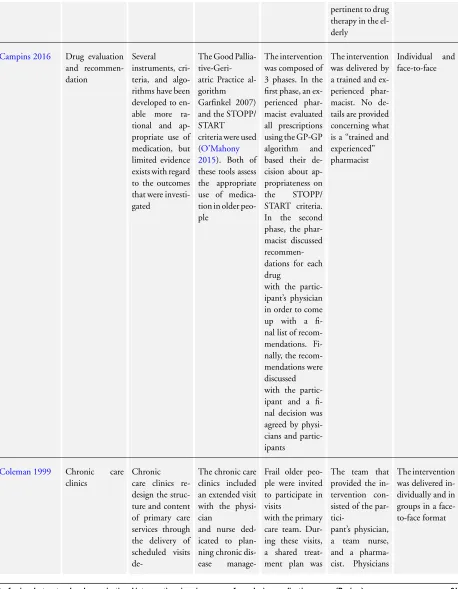
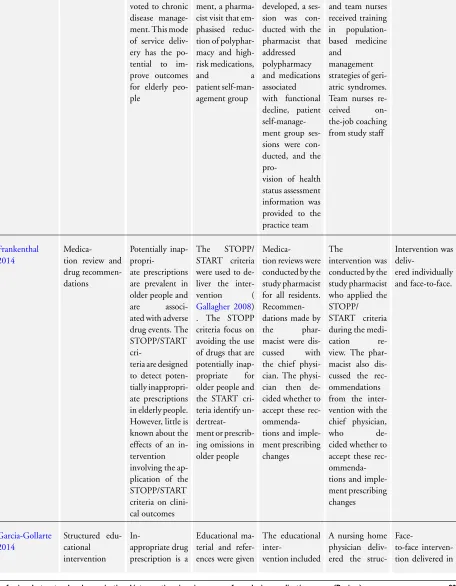
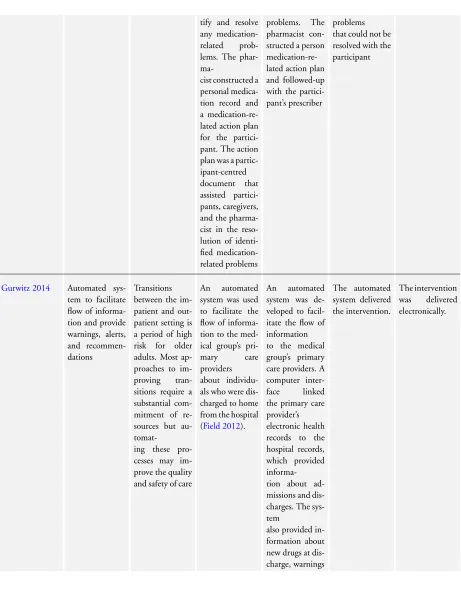
We included a total of 30 studies (169,969 participants) in this review. Four studies addressed professional interventions (8266 participants) and 26 studies described organisational interven-tions (161,703 participants). Overall, there were eight cluster-randomised trials (Alvarez 2001;Coleman 1999;Gernant 2016;
Kaczorowski 2011; Lapane 2011; Lowrie 2012; Malet-Larrea
2016;Roberts 2001), and 22 randomised trials (Bernsten 2001;
Campins 2016;Frankenthal 2014;Garcia-Gollarte 2014;Gurwitz 2014;Hawes 2014;Holland 2005;Ibrahim 2013;Korajkic 2011;
Krska 2001;Lenaghan 2007;Malone 2000;Moertl 2009;Murray 2004;Nabagiez 2013;Okamoto 2001;Olesen 2014;Pai 2009;
Rytter 2010;Triller 2007;Zermansky 2001;Zermansky 2006. They all ranged from three months to 4.7 years of follow-up. A full description of the interventions of each study is included in the ’Characteristics of included studies’,Table 1andTable 2. All cluster-randomised trials were appropriately analysed.Alvarez 2001reported randomisation at the pharmacy level. They used adjusted Pearson’s Chi2to compare means.Coleman 1999used statistical techniques that accounted for potential within-practice correlation that results from randomisation of practices. For con-tinuous variables, they used a mixed model analysis of covariance and regression analysis and for binary values, they used generalised estimating equations. They derived P values from a t-distribution rather than a normal distribution.Gernant 2016used a multivari-able logistic regression model using generalised estimating equa-tions to examine the effect of the intervention on the probability of 60-day all-cause emergency department utilisation. The anal-ysis was approved by the Purdue University Institutional Review Board.Kaczorowski 2011fitted linear regression models by using the Poisson distribution.Lapane 2011analysed their results using a Poisson regression model and accounted for the cluster trial de-sign to provide estimates adjusted for potential confounders. In contrast,Lowrie 2012compared the main outcomes between the intervention and control groups using a Cox proportional hazards frailty model, which accounted for the cluster-randomisation de-sign.Malet-Larrea 2016included a random intercept for pharma-cies nested within a group, to account for clustering of participants within pharmacies, and was adjusted by covariate that could affect hospital admissions (age, gender and number of health problems). Differences between groups in hospital costs were analysed by hos-pital admission and by participant, and the latter ones adjusted by analysis of covariance (ANCOVA) for the number of health prob-lems.Roberts 2001used robust variance estimation techniques (SUDAAN 2012), in which the effect of clustering within nursing
homes on the variance was accounted for.
Participants and study setting
There is a great deal of diversity in types of professionals in-volved and where the studies occurred. However, most (61%) of the interventions were conducted by pharmacists or a com-bination of pharmacists and medical doctors. The studies took place in many different countries; 65% took place in either the USA or the UK. The study settings included general prac-tices (Coleman 1999;Gurwitz 2014;Krska 2001;Lowrie 2012;
Murray 2004; Zermansky 2001), community pharmacies (Alvarez 2001;Bernsten 2001;Malet-Larrea 2016), patient homes or com-munity settings (Campins 2016; Gernant 2016; Kaczorowski
2011; Holland 2005; Ibrahim 2013; Lenaghan 2007; Olesen
2014;Rytter 2010;Triller 2007), outpatient clinics (Hawes 2014;
Korajkic 2011;Malone 2000;Moertl 2009;Okamoto 2001; Pai 2009), and aged care facilities (Frankenthal 2014;Garcia-Gollarte
2014; Lapane 2011; Roberts 2001; Triller 2007; Zermansky
2006).
Interventions
We included a total of 30 studies (169,969 participants) in this review.
Four studies (8266 participants) reported on professional interven-tions (Garcia-Gollarte 2014;Gurwitz 2014;Lapane 2011;Murray 2004). Two of these studies (3889 participants) reported on the number of hospital admissions (Lapane 2011;Murray 2004), one study (3661 participants) reported on the number of people ad-mitted to hospital (Gurwitz 2014), one study (3538 participants) reported on mortality (Lapane 2011), and two studies (1067 par-ticipants) reported on the number of emergency department visits (Garcia-Gollarte 2014;Murray 2004).
A total of 26 studies (161,703 participants) reported on organ-isational interventions (Alvarez 2001;Bernsten 2001;Campins 2016;Coleman 1999;Frankenthal 2014;Gernant 2016;Hawes 2014;Holland 2005;Ibrahim 2013;Kaczorowski 2011;Korajkic 2011;Krska 2001;Lenaghan 2007;Lowrie 2012;Malet-Larrea
2016; Malone 2000; Moertl 2009; Nabagiez 2013; Okamoto
2001; Olesen 2014; Pai 2009; Roberts 2001; Rytter 2010;
Triller 2007; Zermansky 2001; Zermansky 2006). Eleven tri-als (6203 participants) reported on number of hospital ad-missions (Coleman 1999;Holland 2005;Ibrahim 2013;Krska 2001;Lenaghan 2007;Lowrie 2012;Malone 2000;Moertl 2009;
Nabagiez 2013;Okamoto 2001; Rytter 2010). A total of 13 stud-ies (152,237 participants) reported on the number of people ad-mitted to hospital (Alvarez 2001;Bernsten 2001;Campins 2016;
2011;Malet-Larrea 2016; Nabagiez 2013;Olesen 2014;Triller 2007;Zermansky 2001;Zermansky 2006). Five studies (1819 par-ticipants) reported on emergency department visits (Alvarez 2001;
Coleman 1999;Gernant 2016;Hawes 2014;Ibrahim 2013), and 12 studies (154,962 participants) reported on mortality (Campins 2016;Holland 2005;Kaczorowski 2011;Lenaghan 2007;Lowrie 2012;Moertl 2009;Olesen 2014;Pai 2009;Roberts 2001;Triller 2007;Zermansky 2001;Zermansky 2006).
We did not find any studies that fitted the criteria of structural interventions. This was in concordance with the EPOC taxonomy of interventions (Appendix 1).
The ’Characteristics of included studies’ tables provide a summary of the interventions and comparisons. The interventions varied. Professional interventions included the use of health information technology to identify people at risk of medication problems: com-puter-generated care suggested and actioned by physicians; elec-tronic notification system about dose changes, drug interventions and follow-up; and educational interventions on drug use aimed at physicians to improve drug prescriptions. Organisational inter-ventions included medication reviews by pharmacists, nurses or physicians, clinician-led clinics and home visits by clinicians.
Outcomes
The primary outcomes were number of hospital admissions and number of people admitted to hospital. A total of 13 studies (10,092 participants) reported on number of hospital admis-sions (Coleman 1999;Holland 2005;Ibrahim 2013;Krska 2001;
Lapane 2011;Lenaghan 2007;Lowrie 2012;Malone 2000;Moertl
2009; Murray 2004; Nabagiez 2013; Okamoto 2001; Rytter
2010); and 14 studies (155,898 participants) reported on num-ber of people admitted to hospital (Alvarez 2001;Bernsten 2001;
Campins 2016;Frankenthal 2014;Kaczorowski 2011;Gurwitz 2014;Hawes 2014;Korajkic 2011;Malet-Larrea 2016;Nabagiez 2013;Olesen 2014;Triller 2007;Zermansky 2001; Zermansky 2006).
The secondary outcomes were the number of emergency depart-ment visits and mortality. Seven studies (2886 participants) re-ported on the number of emergency department visits (Alvarez
2001; Coleman 1999; Garcia-Gollarte 2014; Gernant 2016;
Hawes 2014; Ibrahim 2013; Murray 2004); and 13 studies
(158,500 participants) reported on mortality (Campins 2016;
Holland 2005;Kaczorowski 2011;Lenaghan 2007;Lapane 2011;
Lowrie 2012;Moertl 2009;Olesen 2014;Pai 2009;Roberts 2001;
Triller 2007;Zermansky 2001;Zermansky 2006).
Excluded studies
We have summarised the 59 excluded studies, with the reasons for their exclusion in the ’Characteristics of excluded studies’ ta-ble. We excluded studies with an unsuitable design (Furniss 2000;
Graffen 2004; Hugtenburg 2009; Lee 1996; Leendertse 2011;
Leendertse 2013; Mills 2001; Montero-Balosa 2016; Moreno
2016;Ni 2016;Safran 1993;Saltzberg 2011). Other reasons for exclusion were studies that did not occur in a primary care setting (Alassaad 2014;Barker 2012;Bell 2016;Bonnet-Zamponi 2013;
Briggs 2015;Gorgas 2012;Hanlon 1996;Keane 2014;Naunton 2003;Neven 2016;Xin 2014); results reported elsewhere (Sturgess 2003); data for outcomes not available (Cowper 1998;Knowlton 1994;Liu 2010;Yuan 2003); interventions not relevant to the review (Al-Arifi 2014;Benard-Laribiere 2015;Carrington 2013;
Fredericks 2013;Pinnock 2013); outcomes not relevant to the re-view (Barker 2016;Barnes 2014;Basheti 2016;Billington 2015;
Clyne 2015; Clyne 2016; Dhalla 2014; Geurts 2016; Guthrie 2016;Hallsworth 2016;Huiskes 2014;Malin 2016;Perula 2014;
Setter 2009;Sinnott 2015;Wolf 2015); and 10 studies were pub-lished protocols (Alicic 2016;Bhatt 2014;Clyne 2013;Desveaux 2016;Elliott 2014;Forster 2015; Phung 2013; Przytula 2015;
Stingl 2016;Wooster 2016), as described in the PRISMA diagram (seeFigure 1).
Risk of bias in included studies
Allocation
A total of 21 studies reported adequate sequence generation
(Bernsten 2001; Campins 2016; Frankenthal 2014;
Garcia-Gollarte 2014; Gernant 2016; Gurwitz 2014; Hawes 2014;
Holland 2005; Kaczorowski 2011; Krska 2001; Lowrie 2012;
Malet-Larrea 2016;Malone 2000;Okamoto 2001;Olesen 2014;
Pai 2009;Roberts 2001;Rytter 2010;Triller 2007;Zermansky
2001; Zermansky 2006); and 18 reported adequate
conceal-ment of allocation (Bernsten 2001;Campins 2016;Frankenthal 2014;Gernant 2016;Gurwitz 2014;Hawes 2014;Holland 2005;
Kaczorowski 2011;Lenaghan 2007;Lowrie 2012;Malone 2000;
Malet-Larrea 2016;Murray 2004;Pai 2009;Roberts 2001;Rytter 2010;Triller 2007; Zermansky 2001).
Blinding
Thirteen studies adequately blinded measurements of partici-pants and personnel delivering the intervention (Bernsten 2001;
Campins 2016;Coleman 1999;Garcia-Gollarte 2014;Gernant 2016; Gurwitz 2014; Kaczorowski 2011; Krska 2001; Lapane 2011;Lowrie 2012;Murray 2004;Pai 2009;Triller 2007), whereas adequate blinding of outcome assessment was undertaken in 19 studies (Bernsten 2001;Campins 2016; Frankenthal 2014;
Garcia-Gollarte 2014;Gurwitz 2014;Hawes 2014;Holland 2005;
Kaczorowski 2011; Korajkic 2011; Krska 2001; Malet-Larrea 2016; Murray 2004; Nabagiez 2013; Olesen 2014; Pai 2009;
Roberts 2001; Rytter 2010; Triller 2007; Zermansky 2006). Eleven studies reported an unclear risk of detection bias (Alvarez
2001; Coleman 1999; Gernant 2016; Ibrahim 2013; Lapane
2011;Lenaghan 2007;Lowrie 2012;Malone 2000;Moertl 2009;
Okamoto 2001; Zermansky 2001).
Incomplete outcome data
A total of five studies had high risk of attrition bias (Alvarez 2001;Bernsten 2001;Hawes 2014;Nabagiez 2013;Pai 2009). Twenty-two studies adequately addressed problems with incom-plete outcomes (Campins 2016;Frankenthal 2014;Gernant 2016;
Gurwitz 2014;Holland 2005;Ibrahim 2013;Kaczorowski 2011;
Korajkic 2011;Krska 2001;Lapane 2011;Lenaghan 2007;Lowrie 2012;Malet-Larrea 2016;Malone 2000;Moertl 2009;Okamoto 2001; Olesen 2014; Roberts 2001; Rytter 2010; Triller 2007;
Zermansky 2001;Zermansky 2006), that is, these studies reported complete outcome data or they replaced any missing outcome data using a recognised statistical method, such as last observation car-ried forward with participants remaining in the group to which they had been allocated.
Selective reporting
There was no selective reporting in the included studies. All studies assessed their predefined primary and secondary outcomes.
Other potential sources of bias
Other potential sources of bias included protection against con-tamination, publication bias and other bias.
Protection against contamination bias
A total of 12 studies adequately protected against contamination bias (Bernsten 2001;Coleman 1999;Gernant 2016;Lapane 2011;
Lowrie 2012;Murray 2004;Nabagiez 2013; Olesen 2014;Pai 2009;Roberts 2001;Rytter 2010;Triller 2007); whereas 16 stud-ies, had unclear risk of protection against contamination (Alvarez 2001;Campins 2016;Frankenthal 2014;Gurwitz 2014;Hawes 2014;Holland 2005;Ibrahim 2013;Kaczorowski 2011;Korajkic 2011;Lenaghan 2007;Malet-Larrea 2016;Malone 2000;Moertl 2009;Okamoto 2001;Zermansky 2001;Zermansky 2006), and two studies clearly did not adequately protect against contami-nation bias (Garcia-Gollarte 2014;Krska 2001). Contamination bias occurs when members of the control group are inadvertently exposed to the intervention, thus potentially minimising the dif-ference in outcomes between the two groups (Higgins 2011b).
Publication bias
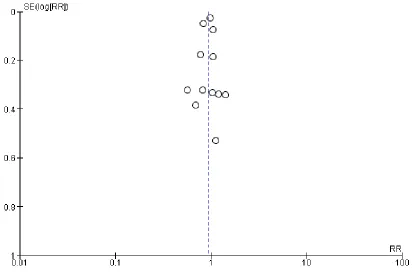
Figure 6. Funnel plot of comparison: 2 Organisational interventions, outcome: 2.4 Mortality
Other bias
A total of 22 studies had an unclear risk of ’other bias’ (Bernsten
2001; Campins 2016;Coleman 1999;Gernant 2016; Gurwitz
2014;Hawes 2014;Ibrahim 2013;Korajkic 2011;Krska 2001;
Lapane 2011;Lowrie 2012; Malet-Larrea 2016; Malone 2000;
Murray 2004;Nabagiez 2013;Okamoto 2001;Olesen 2014;Pai 2009;Roberts 2001;Rytter 2010;Zermansky 2001; Zermansky 2006). Seven studies had a high risk of ’other bias’ (Alvarez 2001;
Frankenthal 2014; Garcia-Gollarte 2014; Kaczorowski 2011;
Lenaghan 2007;Moertl 2009; Triller 2007), while only one study had a low risk of ’other bias’ (Holland 2005). Other biases in-cluded inappropriate administration of the intervention, such as the method of training used to deliver the intervention or level of knowledge of the health professional delivering the interven-tion. Short length of the intervention was a bias in some studies (Kaczorowski 2011; Triller 2007), with the level of knowledge of the pharmacist or health professional delivering the intervention a bias in other studies. For example, in the study byLenaghan 2007, research was carried out in one rural general practice with a single experienced review pharmacist, which may have had a bearing on the generalisability of the results.
InBernsten 2001, one aspect of the study that was not rigorously
controlled was the training of participating pharmacists. A study manual was provided to each participating pharmacist, followed by a one-day training session. Further training was provided in individual countries; however, the extent of this was driven by available resources. Other biases include small sample sizes in the intervention arms; with 48 participants inMoertl 2009and 77 participants inTriller 2007, and poor pharmacist-prescriber com-munication, which may have reduced the efficacy of the interven-tion (Triller 2007).Alvarez 2001did not report on any pre-inter-vention data for most of the outcome measures.Garcia-Gollarte 2014had a short intervention of a six-month period and a short follow-up of three months.Frankenthal 2014conducted the study in only one geriatric centre.
There was a total of eight cluster-randomised studies included in the review (Alvarez 2001; Coleman 1999; Gernant 2016;
Kaczorowski 2011; Lapane 2011; Lowrie 2012; Malet-Larrea
2016;Roberts 2001). Cluster-randomised studies include other potential biases such as recruitment bias and complete loss of a cluster in a trial. The extent of this type of bias was not fully re-ported and therefore we considered it under this section.
[image:21.595.102.514.103.376.2]See:Summary of findings for the main comparisonProfessional interventions compared to standard/usual care for prevention
of medication errors; Summary of findings 2 Organisational
interventions compared to standard/usual care for prevention of medication errors
Professional interventions
We performed a meta-analysis on the number of hospital admis-sions and the number of emergency department visits, as they were the only outcomes reported by more than one study. We have pre-sented effect estimates and certainty of evidence for each outcome inSummary of findings for the main comparison(seeAppendix 3for the full GRADE evidence profile). We obtained all reported data from the published papers.
Primary outcomes
We measured hospital admissions as either the number of hospital admissions or the number of people admitted to hospitals.
1. Number of hospital admissions
Two studies (3889 participants) reported on the number of hospi-tal admissions (Lapane 2011;Murray 2004). Overall, professional interventions in health information technology to identify people at risk of medication problems in the case ofLapane 2011, or the computer-generated care suggested and actioned by the physician described byMurray 2004, reported an increase in the number of hospital admissions, but the 95% confidence interval (CI) indi-cates that it probably makes little or no difference (risk ratio (RR) 1.24, 95% CI 0.79 to 1.96; moderate-certainty evidence). There was no significant heterogeneity (I2= 0%, P = 0.44) across the studies, as shown inSummary of findings for the main comparison.
2. Number of people admitted to hospital
One study (3661 participants) reported on number of people ad-mitted to hospital (Gurwitz 2014). The study authors found that the intervention, which included an electronic notification system about dose changes, drug interactions, and follow-up, made little or no difference to the number of people admitted to hospital (ad-justed RR 0.99, 95% CI 0.92 to 1.06; high-certainty evidence).
Secondary outcomes
1. Number of emergency department visits
Two studies (1067 participants) reported on this outcome ( Garcia-Gollarte 2014;Murray 2004).Garcia-Gollarte 2014described an educational intervention on drug use aimed at physicians to im-prove drug prescriptions.Murray 2004described an intervention
including computer-generated care suggested and actioned by the physician. Both professional interventions described by the study authors may make little or no difference to the number of emer-gency department visits (adjusted RR 0.71, 95% CI 0.50 to 1.02; low-certainty evidence). There was no significant heterogeneity among the two studies (I2= 0%, P = 0.64).
2. Mortality
One study (3538 participants) reported on the number of deaths (Lapane 2011). The health information technology to identify people at risk of medication problems probably makes little or no difference to the number of deaths in the study population (adjusted RR 0.98, 95% CI 0.82 to 1.17; moderate-certainty ev-idence).
Organisational interventions
We performed a meta-analysis on the number of hospital admis-sions, number of people admitted to hospital, the number of emer-gency department visits, and mortality. We have presented effect estimates and certainty of evidence for each outcome inSummary of findings 2(seeAppendix 4for the full GRADE evidence pro-file). We obtained all reported data from the published papers.
Primary outcome
1. Number of hospital admissions
Eleven trials (6203 participants) reported on the number of hos-pital admissions (Coleman 1999;Holland 2005;Ibrahim 2013;
participants by concluding that the participants were better in-formed about adverse events through the pharmacist intervention, and this promoted help-seeking behaviour, which resulted in an admission.
We undertook a sensitivity analysis by removing studies at high risk of bias (Holland 2005;Krska 2001;Moertl 2009;Nabagiez 2013), and again it is uncertain whether organisational interven-tions (which included pharmacist home visits, pharmaceutical care plan, home-based nurse care and home visits by physician assis-tants) reduce the number of hospital admissions (adjusted RR 0.86, 95% CI 0.72 to 1.03).Ibrahim 2013,Moertl 2009and
Rytter 2010showed a reduction in hospital admissions with a rela-tively narrow confidence interval: adjusted RR 0.40, 95% CI 0.22 to 0.74 (Ibrahim 2013); RR 0.38, 95% CI 0.19 to 0.72 (Moertl 2009); and RR 0.76, 95% CI 0.61 to 0.95 (Rytter 2010), in favour of the interventions. These three studies were characterised by fre-quent follow-up by the clinical pharmacists. In the case ofIbrahim 2013, there was a three-month follow-up and a once-a-week tele-phone conversation;Moertl 2009had frequent follow-up by the clinical pharmacists at three, six, nine, and 12 months; andRytter 2010also had three follow-up contacts by GPs and district nurses.
2. Number of people admitted to hospital
A total of 13 studies (152,237 participants) reported on the num-ber of people admitted to hospital (Alvarez 2001;Bernsten 2001;
Campins 2016; Frankenthal 2014; Hawes 2014; Kaczorowski
2011;Korajkic 2011;Malet-Larrea 2016;Nabagiez 2013;Olesen 2014; Triller 2007;Zermansky 2001;Zermansky 2006). Most of the organisational interventions described included medication reviews by pharmacists, nurses or physicians, clinician-led clinics, and home visits by clinicians. Overall, organisational interventions may make little or no difference to the total number of people admitted to hospital in favour of the intervention group compared with the control group (adjusted RR 0.92, 95% CI 0.86 to 0.99; low-certainty evidence) with significant heterogeneity (I2= 47%, P = 0.03). Three studies showed that the organisational interven-tions reduced the total number of people admitted to hospital, as the RR was less than 1 (Bernsten 2001;Hawes 2014;Malet-Larrea 2016).
We undertook a sensitivity analysis by removing studies at high risk of bias (Alvarez 2001; Bernsten 2001; Frankenthal 2014;
Hawes 2014; Kaczorowski 2011; Malet-Larrea 2016; Nabagiez 2013;Triller 2007), and again, the intervention made little or no difference to the number of people admitted to hospital (adjusted RR 0.98, 95% CI 0.85 to 1.13) with low, non-significant hetero-geneity between studies (I2= 28%, P = 0.23).
Secondary outcomes
1. Number of emergency department visits
Five studies (1819 participants) reported on emergency depart-ment visits (Alvarez 2001;Coleman 1999;Gernant 2016;Hawes 2014;Ibrahim 2013). Overall, it is uncertain whether organisa-tional interventions including medication reviews by pharmacists, nurses or physicians, clinician-led clinics, and home visits by clicians reduce emergency department visits in favour of the in-tervention group compared with the control group (adjusted RR 0.75, 95% CI 0.49 to 1.15; very low-certainty evidence). Please refer toSummary of findings 2.
There was also significant heterogeneity between the studies (I2= 73%, P = 0.005). We undertook a sensitivity analysis by removing studies at high risk of bias (Alvarez 2001;Hawes 2014). Phar-maceutical care and care transition clinic interventions may make little or no difference in emergency department visits (adjusted RR 0.68, 95% CI 0.37 to 1.27) with significant heterogeneity between studies (I2= 79%, P = 0.009).
All studies showed wide confidence intervals, and althoughAlvarez 2001showed an increase in the number of emergency department visits in favour of the intervention, this study had high risk of bias as there was a high proportion of incomplete data in the outcomes measured.
2. Mortality
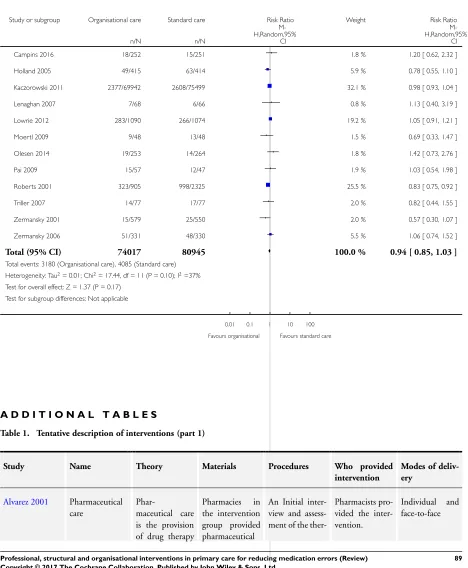
A total of 12 studies (154,962 participants) reported on mortal-ity (Campins 2016;Holland 2005;Kaczorowski 2011;Lenaghan 2007;Lowrie 2012;Moertl 2009;Olesen 2014;Pai 2009;Roberts 2001;Triller 2007;Zermansky 2001;Zermansky 2006). Over-all, it is uncertain whether organisational interventions, which in-cluded medication reviews by pharmacists, nurses or physicians, clinician-led clinics, and home visits by clinicians reduce mortal-ity in favour of the intervention group (adjusted RR 0.94, 95% CI 0.85 to 1.03; very low-certainty evidence) with non-significant heterogeneity (I2= 37%, P = 0.10). Please refer toSummary of
findings 2.
We undertook sensitivity analysis by removing studies at high risk of bias (Holland 2005;Kaczorowski 2011;Lenaghan 2007;
Moertl 2009;Olesen 2014;Roberts 2001), and we found that interventions addressing home visits by pharmacists, educational sessions to assess cardiovascular risk, medication reviews, home-based nurse care, and nurse education probably made little or no difference to mortality (adjusted RR 1.02, 95% CI 90 to 1.17). There was no significant heterogeneity between studies after the removal of the six studies (I2= 0%, P = 0.45).
Structural interventions
A D D I T I O N A L S U M M A R Y O F F I N D I N G S [Explanation]
Organisational interventions compared to standard/ usual care for prevention of medication errors
Patient or population:adults receiving m edication in prim ary care Setting:prim ary care
Intervention:organisational interventions (provision of pharm aceutical care, m edication reviews, f ollow-up visits by a healthcare prof essional including a pharm acist, nurse or physician)
Comparison:standard/ usual care
Outcomes Anticipated absolute effects∗(95% CI) Relative effect (95% CI)
of participants (studies)
Certainty of the evi-dence
(GRADE)
Comments
Risk with standard/ usual care
Risk with organisa-tional interventions
Num ber of hospital ad-m issions
Study population RR 0.85
(0.71 to 1.03)
6203 (11 RTs)
⊕
Very low1,2,3
Som e studies had un-clear risk of bias (selec-tion and attri(selec-tion), high heterogeneity and wide conf idence intervals 274 per 1000 233 per 1000
(194 to 282)
Num ber of people ad-m itted to hospital
Study population RR 0.92
(0.86 to 0.99)
152,237 (13 RTs)
⊕⊕
Low1,3
Som e studies had un-clear risk of bias (se-lection, attrition and perf orm ance bias) and wide conf idence inter-vals
13 per 1000 13 per 1000 (11 to 14)
Num ber of em ergency departm ent visits
Study population RR 0.75
(0.49 to 1.15)
1819 (5 RTs)
⊕
Very low1,2,3
Studies had unclear risk of bias (selection, per-f orm ance and attrition bias), high heterogene-ity and wide conf idence intervals
234 per 1000 176 per 1000 (115 to 269)
M ortality Study population RR 0.94 (0.85 to 1.03)
154,962 (12 RTs)
⊕
Very low3,4
Studies had high risk of selection, attrition and perf orm ance bias and wide conf idence inter-vals
50 per 1000 47 per 1000 (43 to 52)
*The risk in the intervention group(and its 95% conf idence interval) is based on the assum ed risk in the com parison group and therelative effectof the intervention (and its 95% CI).
CI:conf idence interval;RR:risk ratio;RT: random ised trial.
GRADE Working Group grades of evidence
High- certainty:we are very conf ident that the true ef f ect lies close to that of the estim ate of the ef f ect.
M oderate- certainty:we are m oderately conf ident in the ef f ect estim ate: the true ef f ect is likely to be close to the estim ate of the ef f ect, but there is a possibility that it is substantially dif f erent.
Low- certainty:our conf idence in the ef f ect estim ate is lim ited: the true ef f ect m ay be substantially dif f erent f rom the estim ate of the ef f ect.
Very low- certainty:we have very little conf idence in the ef f ect estim ate: the true ef f ect is likely to be substantially dif f erent f rom the estim ate of ef f ect
1We downgraded one level f or unclear risk of bias (selection and attrition bias). 2We downgraded one level f or inconsistency (high heterogeneity across studies). 3We downgraded one level f or im precision.
4We downgraded two levels f or high risk of bias (selection, perf orm ance and attrition bias).
D I S C U S S I O N
Summary of main results
The studies included in this Cochrane Review showed that, based on moderate- and low-certainty evidence, interventions in primary care for reducing preventable medication errors probably make lit-tle or no difference to the number of people admitted to hospital or the number of hospitalisations, emergency department visits, or mortality. Most of the interventions took place in the UK and the USA; studies undertaken in high-income countries with disad-vantaged populations, and in low- and middle-income countries, were underrepresented. This might affect the generalisability of the results. We undertook sensitivity analysis by removing studies at high risk of bias and detecting whether there was any difference on the overall effect size. Overall, there is no evidence of an effect in any of the outcomes.
Overall completeness and applicability of evidence
The types of interventions included in this review were based on the taxonomy of interventions developed by Cochrane EPOC (Appendix 1); four studies used professional interventions and 26 studies used organisational interventions. The professional inter-ventions included the use of health information technology to identify people at risk of medication problems: computer-gener-ated care suggested and actioned by a physician; electronic notifi-cation systems about dose changes, drug interventions and follow-up; and educational interventions on drug use aimed at physicians to improve drug prescriptions. Organisational interventions con-sisted of medication reviews by pharmacists, nurses or physicians, clinician-led clinics and home visits by clinicians.
The interventions described in the review were complex and gener-ally multifaceted, which resulted in significant heterogeneity. The variation in heterogeneity in the pooled estimates means that our results should be treated cautiously as the interventions may not have worked consistently across all studies due to differences in how the interventions were provided, background practice, set-ting, healthcare system, or delivery of the interventions. Another potential limitation is the quality of the studies. The methods sections of the studies provided varying levels of detail on how complex interventions were developed, the design of the trials or how staff were trained to deliver the interventions. There was also evidence of potential bias in some studies, with only 18 studies reporting adequate concealment of allocation and only 12 stud-ies reporting appropriate protection from contamination, both of which may have influenced the overall effect estimate and the over-all pooled estimate.
Certainty of the evidence
The certainty of the evidence obtained from the ’Summary of find-ings’ tables using the GRADE system highlights the very low to high certainty of the evidence reported by the studies. The primary outcomes of number of hospital admissions and number of people admitted to hospital were reported to have very low- to high-cer-tainty evidence, respectively. Mortality was reported in 13 studies (1 study involving professional interventions, moderate-certainty evidence; and 12 studies involving organisational interventions, very low-certainty evidence), with the main type of biases being detection and performance bias. We considered studies reporting on emergency department visits to have low-certainty evidence for professional interventions and very low-certainty evidence for or-ganisational interventions using the GRADE system, due to study design and heterogeneity. Further research and better study de-signs are likely to change the overall estimate reported using these outcomes.
The Methods sections provided few details about study method-ology and how complex interventions were delivered. The overall quality of the evidence presented in this review is either at high risk or unclear risk of bias. The main limitations were the het-erogeneity between studies, the imprecision in results due to the wide confidence intervals amongst studies, unclear selection bias, performance and detection bias, and attrition bias.
Potential biases in the review process