Coordination polymer chains built
from Cu
IIand adipate ions linked by
hydrogen bonds to form a
three-dimensional framework structure
Zouaoui Setifi,a,bMehdi Boutebdja,bFatima Setifi,c* Hocine Merazigband Christopher Glidewelld*
aDe´partement de Technologie, Faculte´ de Technologie, Universite´ 20 Aouˆt 1955-Skikda, BP 26, Route d’El-Hadaiek, Skikda 21000, Algeria,bUnite´ de Recherche de Chimie de l’Environnement et Mole´culaire Structurale (CHEMS), Universite´ Constantine 1, Constantine 25000, Algeria,cLaboratoire de Chimie, Inge´nierie Mole´culaire et Nanostructures (LCIMN), Universite´ Ferhat Abbas Se´tif 1, Se´tif 19000, Algeria, anddSchool of Chemistry, University of St Andrews, Fife KY16 9ST, Scotland Correspondence e-mail: [email protected], [email protected]
Received 22 May 2014 Accepted 11 June 2014
In the title compound, catena-poly[bis[(2,20-bipyridine-2
N,N0
)-(1,1,3,3-tetracyano-2-ethoxypropenido-N)copper(II)]-4
-hex-anedioato-6
O1,O10:O1:O6,O60:O6], [Cu2(C9H5N4O)2(C6H8O4
)-(C10H8N2)2]n, the adipate (hexanedioate) dianion lies across a centre of inversion in the space groupP1. The CuIIcentre adopts a distorted form of axially elongated (4+2) coordina-tion, and the CuII and adipate components form a one-dimensional coordination polymer from which the 2,20
-bipyridine and 1,1,3,3-tetracyano-2-ethoxypropenide compo-nents are pendent, and where each adipate dianion is bonded to four different CuII centres. The coordination polymer chains are linked into a three-dimensional framework
structure by a combination of C—H N and C—H O
hydrogen bonds, augmented by a–stacking interaction.
Keywords: crystal structure; one-dimensional coordination polymer; copper(II) complex; adipate;p–pstacking interactions; 2,2000-bipyridine; polynitrile anions; 1,1,3,3-tetracyano-2-ethoxypropenide.
1. Introduction
The design and synthesis of metal coordination compounds containing carboxylate ligands is currently an active area of research due to their potential applications in the fields of molecular magnetism (Setifi et al., 2006, 2007; Setifi, Setifi, Ghazzali et al., 2014), catalysis (Ma et al., 2009), nonlinear optics (Zanget al., 2006) and luminescence (Taoet al., 2000). A number of new coordination polymers containing not only carboxylate ligands but also chelating diamines as co-ligands have been reported recently (Mukherjeeet al., 2003; Zhenget al., 2002, 2004; Zheng & Lin, 2003; Ghosh et al., 2007;
Kathalikkattilet al., 2010; Setifi, Setifi, Ghazzaliet al., 2014). In addition to a variety of coordination polymer types, finite complexes have also been observed, ranging from dinuclear (Setifi, Setifi, Ghazzaliet al., 2014) to octanuclear (Ghoshet al., 2007). In this context, the aim of some of our recent work has been to extend the potential versatility of such complexes to include four-component systems which also incorporate polynitrile anions as ligands and/or counter-ions, as such anions are of interest in exhibiting both a high degree of electronic delocalization and a variety of coordination modes (Atmani et al., 2008; Setifi, Domasevitch et al., 2013; Setifi, Setifi et al., 2013; Setifi, Setifi, El Ammari et al., 2014). Accordingly, we report here the synthesis, molecular structure and supramolecular assembly of the title compound, [Cu2
(tc-noet)2(adipate)(bipy)2]n, (I), where adipate represents hex-ane-1,6-dionate, bipy represents 2,20-bipyridine and tcnoet
represents 1,1,3,3-tetracyano-2-ethoxypropenide.
2. Experimental
2.1. Synthesis and crystallization
The salt K(tcnoet) was prepared following the published method of Middletonet al.(1958). Under aerobic conditions, an ethanolic solution (5 ml) of 2,20-bipyridine (50.0 mg,
0.32 mmol) was added, with stirring at ambient temperature, to an ethanol solution (5 ml) of copper(II) chloride dihydrate (54.5 mg, 0.32 mmol). A pale-green precipitate appeared quickly in the green solution. An aqueous solution of di-sodium adipate (2M) was then added slowly with stirring until complete dissolution of the precipitate had occurred (ca 15 ml). To the resulting blue solution was added an aqueous solution (10 ml) of K(tcnoet) (144 mg, 0.64 mmol). Slow
research papers
Acta Cryst.(2014). C70 doi:10.1107/S205322961401359X #2014 International Union of Crystallography
1 of 5
Acta Crystallographica Section C
Structural Chemistry
evaporation of this final solution, at ambient temperature and in air, gave blue crystals of (I) suitable for single-crystal X-ray diffraction (yield 37%).
2.2. Refinement
Crystal data, data collection and structure refinement details are summarized in Table 1. All H atoms were located in difference maps and then treated as riding atoms in geome-trically idealized positions, with C—H = 0.95 (aromatic), 0.98 (CH3) or 0.99 A˚ (CH2), and withUiso(H) =kUeq(C), wherek=
1.5 for the methyl group, which was permitted to rotate but not to tilt, and 1.2 for all other H atoms. Reflection 110, which had been attenuated by the beam stop, was omitted from the refinements.
3. Comment
The title compound, (I) (Fig. 1), is closely related to [Cu4(adipate)3(bipy)4](tcnoet)2, (II) (Setifi et al., 2006). The
composition of these two compounds differs only in the molecular ratio of the adipate and tcnoet anionic components. Both compounds were prepared from reaction mixtures containing CuII, bipy and tcnoet in a molar ratio of 2:2:1, together with an excess of sodium adipate, but (I) was formed in an aqueous ethanol solution, whereas (II) was formed in aqueous methanol. As discussed below, the structures of (I) and (II) are markedly different, suggesting that a rich variety of structural topologies is potentially accessible with only
minor variations in the reaction conditions used for their synthesis. Compound (I) contains [Cu(tcnoet)(bipy)] units lying in general positions and adipate units lying across centres of inversion; the reference adipate unit was selected as that lying across (1
2, 1 2, 1
2) (Fig. 1).
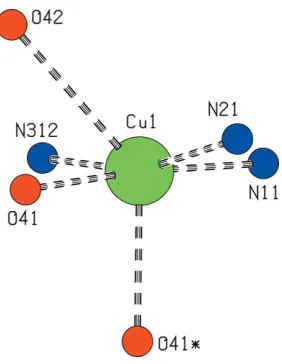
The coordination polyhedron around the CuIIcentre in (I) can be regarded as having square-pyramidal geometry, where there are three independent ligating N atoms and two symmetry-related atoms of type O41, augmented by a rather long contact to atom O42, so forming a distorted form of the normal axially elongated (4+2) coordination geometry,
research papers
2 of 5
Setifiet al. [Cu [image:2.610.310.562.70.307.2]2(C9H5N4O)2(C6H8O4)(C10H8N2)2] Acta Cryst.(2014). C70
Table 1
Experimental details.
Crystal data
Chemical formula [Cu2(C9H5N4O)2(C6H8O4 )-(C10H8N2)2]
Mr 476.97
Crystal system, space group Triclinic,P1
Temperature (K) 150
a,b,c(A˚ ) 8.8825 (3), 10.5610 (4), 12.2541 (5)
,,() 71.724 (3), 80.582 (4), 84.974 (3)
V(A˚3
) 1076.03 (7)
Z 2
Radiation type MoK
(mm1
) 1.05
Crystal size (mm) 0.200.150.10
Data collection
Diffractometer Agilent Xcalibur Sapphire2
diffrac-tometer
Absorption correction Multi-scan (SADABS; Sheldrick, 2003)
Tmin,Tmax 0.771, 0.929
No. of measured, independent and observed [I> 2(I)] reflections
10761, 6143, 4850
Rint 0.021
(sin /)max(A˚ 1
) 0.703
Refinement
R[F2> 2(F2)],wR(F2),S 0.032, 0.078, 0.96
No. of reflections 6143
No. of parameters 290
H-atom treatment H-atom parameters constrained
max,min(e A˚ 3
) 0.46,0.24
[image:2.610.46.292.93.360.2]Computer programs: CrysAlis PRO(Agilent, 2013), SHELXS97 (Sheldrick, 2008), SHELXL2014(Sheldrick, 2014) andPLATON(Spek, 2009).
Figure 2
Part of the crystal structure of (I), showing the coordination around the CuIIcentre, where a square-pyramidal geometry is augmented by a long
contact to atom O42. The atom marked with an asterisk (*) is at the symmetry position (x+ 1,y,z+ 1).
Figure 1
The molecular structure of (I), showing the atom-labelling scheme. Displacement ellipsoids are drawn at the 30% probability level. Atoms labelled with the suffix ‘b’ are at the symmetry position (x+ 1,y+ 1,
[image:2.610.371.512.520.702.2]possibly better described for (I) as (4+1+1) (Fig. 2). The bipy ligand occupies a mutuallycispair of equatorial sites, the other two of which are occupied by one of the N atoms of the tcnoet ligand, bonded in aNmode (Batten & Murray, 2003), and by one of the carboxylate atoms, O41, of the adipate dianion. Two other sites are occupied by O atoms, viz. atom O42 of the reference adipate dianion centred across (12,
1 2,
1
2) and atom O41
at (x+ 1,y,z+ 1), which is part of the adipate dianion centred across (1
2, 1 2,
1
2). While the four equatorial bonds to
CuII are fairly similar in length (Table 2), the two ‘axial’ Cu—O distances are significantly different. Except for the very small angle subtended at the CuIIcentre by the chelating adipate dianion, the bond angles between mutuallycispairs of ligating sites range from 78.46 (4) to 99.15 (5), while the
corresponding angles between mutuallytranspairs of sites are 162.55 (6) and 173.79 (5)for the equatorial ligands, but only
130.61 (4) for the two axial ligands (cf. Fig. 2).
In the tcnoet unit of (I), the two independent –C(CN)2units
are twisted, in conrotatory fashion, out of the plane of the central propenide unit. The dihedral angles between the central C3 fragment and the two –C(CN)2 units containing
atoms C31 and C33 are 23.0 (2) and 23.8 (2), entirely typical of the behaviour of this anion and its simple analogues (Setifi et al., 2010; Setifi, Domasevitchet al., 2013; Setifi, Setifiet al.,
2013; Setifi, Setifi, El Ammariet al., 2014; Setifi, Lehchiliet al., 2014). On the other hand, the bond distances (Table 2) provide evidence for some localization of the negative charge, in contrast with the strong delocalization often observed for this anion and its analogues. Thus, the backbone C32—C33 distance is shorter than C31—C32, while the C31—C312 distance is shorter than the other C—CN distances, which are all very similar. These observations suggest significant locali-zation of the negative charge on atom N312, which is the only N atom of this unit bonded to CuII, as in form (A) (see Scheme).
Within the carboxylate group of the adipate dianion of (I), the two C—O distances are significantly different. Indeed, the C41—O41 and C41—O42 distances are rather similar to the distances for single and double C—O bonds, respectively, in carboxylic acid esters, where single C—O bonds have a mean value of 1.336 A˚ with a lower quartile value of 1.328 A˚, and double bonds have a mean value of 1.196 A˚ with an upper quartile value of 1.202 A˚ (Allenet al., 1987). This difference in (I) is thus indicative of strong localization of the negative charge on atom O41. In fact, this atom acts as a bridging atom between the two CuII centres at (x, y, z) and (x + 1,y,
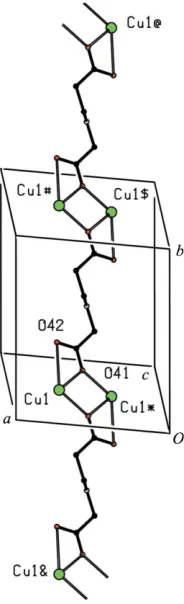
z + 1), so forming a centrosymmetric motif in the form of three edge-fused four-membered rings, consisting of a central Cu2O2 ring flanked by two inversion-related CO2Cu rings
(Fig. 3 and Scheme). Propagation of this fused-ring motif by inversion generates a coordination polymer chain built only from the CuII centres and the adipate dianions, running parallel to the [010] direction (Fig. 3), and along which Cu2O2
rings centred at (1 2,n,
1
2) alternate with adipate dianions centred
at (12,n+ 1 2,
1
2), wherenrepresents an integer in each case.
These coordination polymer chains running parallel to [010] are linked into a three-dimensional framework structure by a
combination of C—H N and C—H O hydrogen bonds
(Table 3), and it is convenient to consider the framework formation in terms of simpler substructures (Fergusonet al., 1998a,b; Gregson et al., 2000). In the simplest of these
research papers
Acta Cryst.(2014). C70 Setifiet al. [Cu
[image:3.610.313.566.82.276.2]2(C9H5N4O)2(C6H8O4)(C10H8N2)2]
3 of 5
Table 2
Selected geometric parameters (A˚ ,).
Cu1—N11 1.9835 (13) C31—C312 1.406 (2)
Cu1—N21 1.9914 (13) O41—C41 1.3029 (18)
Cu1—N312 1.9943 (14) C311—N311 1.151 (2)
Cu1—O41 1.9466 (11) C312—N312 1.146 (2)
Cu1—O42 2.7741 (14) C33—C331 1.425 (2)
Cu1—O41i
2.2737 (11) C33—C332 1.423 (3)
C31—C32 1.418 (2) C331—N331 1.146 (2)
C32—C33 1.391 (2) C332—N332 1.149 (2)
C31—C311 1.422 (2) O42—C41 1.2250 (19)
N11—Cu1—N21 81.40 (5) O42—Cu1—N21 89.09 (5)
N11—Cu1—O41 173.79 (5) O42—Cu1—N312 79.72 (5)
N21—Cu1—O41 95.13 (5) O41—Cu1—O41i
78.46 (4)
N11—Cu1—N312 96.26 (6) O42—Cu1—O41i 130.61 (4)
N21—Cu1—N312 162.55 (6) N11—Cu1—O41i
96.88 (5)
O41—Cu1—N312 88.58 (5) N21—Cu1—O41i
98.30 (5)
O41—Cu1—O42 52.20 (4) N312—Cu1—O41i
99.15 (5)
O42—Cu1—N11 132.48 (5)
C31—C32—C33—C331 154.77 (18) C33—C32—C31—C311 165.66 (17) C31—C32—C33—C332 20.6 (3) C41—C42—C43—C43ii
70.2 (2)
Symmetry codes: (i)xþ1;y;zþ1; (ii)xþ1;yþ1;zþ1.
Figure 3
[image:3.610.125.217.374.676.2]hydrogen-bonded substructures, polymer chains related by translation along [001] are linked by the C—H N hydrogen bond having atom N331 as the acceptor, forming a chain of edge-fused R2
2(40) (Bernstein et al., 1995) rings running
parallel to the [001] direction (Fig. 4).
A more complex substructure is generated by the combi-nation of the two C—H O hydrogen bonds, where atoms C13 and C23 of the bipyridine unit at (x, y, z), which itself forms part of the coordination polymer chain along (1
2, y, 1 2),
both act as hydrogen-bond donors to atom O42 at (x+ 2,y,
z+ 1), which lies in the coordination polymer chain along (3
2, y, 1
2). These linkages are augmented by a – stacking
interaction. The planes of the pyridine rings containing atoms N11 and N21 at (x,y,z) and (x+ 2,y,z+ 1), respectively, make a dihedral angle of 4.83 (8). The ring-centroid
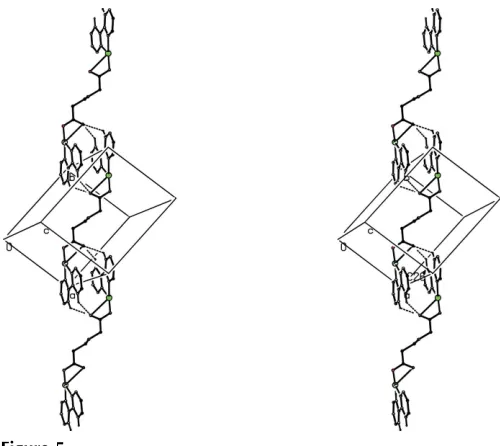
separa-tion is 3.7389 (10) A˚ and the shortest perpendicular distance from the centroid of one ring to the plane of the other is 3.409 A˚ , corresponding to a ring-centroid offset ofca1.54 A˚ . Thus, while the C—H O angles in the hydrogen bonds here are not large (cf.Woodet al., 2009), the combined action of the two generates a chain running parallel to the [110] direction, in which cage-like structures containR1
2(7) andR 2
2(12) rings and
where the hydrogen bonding is augmented by the –
stacking interaction (Fig. 5). The combination of chains along
the [010], [001] and [110] directions suffices to generate a single three-dimensional framework, which is modestly re-inforced by the second, longer, C—H N hydrogen bond.
It is of interest briefly to compare the one-dimensional coordination polymer based upon six-coordinate CuIIfound in (I) with the structures of some closely related CuIIcomplexes containing both adipate and 2,20-bipyridine ligands. In
[Cu4(adipate)3(bipy)4](tcnoet)2, (II), mentioned above (Setifi
et al., 2006), pairs of five-coordinate CuIIcentres separated by 3.154 (1) A˚ and having trigonal–bipyramidal geometry are triply bridged; two of the bridges are O atoms from two different adipate units, while the third bridge is a bidentate carboxylate unit. There are two independent adipate units in the structure, one bonded to three different CuIIcentres in a
3-mode (Batten & Murray, 2003), forming a centrosymmetric
[Cu4(adipate)2(bipy)4] unit, while the other lies across a centre
of inversion and binds in a2-mode, so linking the tetrameric
units into a rather complex one-dimensional coordination polymer. Similar pairs of triply bridged CuIIcentres are found in [{CuCl(OH)(bipy)}2(adipate)](tcnoet)22H2O, (III) (Setifi,
Setifi & Glidewell, 2014), where the shortest Cu Cu distance is 2.9806 (6) A˚ , but no polymer is formed in this case. By contrast, a very simple one-dimensional coordination polymer containing square-pyramidal CuIIis present in [Cu(adipate)-(bipy)(H2O)]n, (IV) (Ghoshet al., 2007; Kathalikkattilet al., 2010). The rich variety of topologies in these systems is emphasized by the contrast between the linear coordination polymer found in (IV) and the finite centrosymmetric dimer present in its pentane-1,5-dionate analogue (Ghosh et al., 2007). Finally, in the 2,20-dipyrrilamine (dpa) complex
[Cu(adipate)(dpa)]22H2O, (V), the adipate unit bonds in a 2-mode to two six-coordinate Cu
II
centres, forming a finite
research papers
4 of 5
Setifiet al. [Cu [image:4.610.314.564.68.291.2] [image:4.610.48.296.88.149.2]2(C9H5N4O)2(C6H8O4)(C10H8N2)2] Acta Cryst.(2014). C70
Table 3
Hydrogen-bond geometry (A˚ ,).
D—H A D—H H A D A D—H A
C13—H13 O42iii
0.95 2.42 3.118 (2) 130
C15—H15 N332iv
0.95 2.55 3.322 (3) 138
C23—H23 O42iii
0.95 2.39 3.155 (2) 138
C26—H26 N331v
0.95 2.50 3.316 (3) 144
[image:4.610.46.297.479.706.2]Symmetry codes: (iii)xþ2;y;zþ1; (iv)xþ2;y;z; (v)x;y;zþ1.
Figure 4
A stereoview of part of the crystal structure of (I), showing the formation of a chain of hydrogen-bonded edge-fusedR2
2(40) rings running parallel
to the [001] direction. Dashed lines indicate hydrogen bonds. For the sake of clarity, H atoms not involved in the motif shown have been omitted.
Figure 5
A stereoview of part of the crystal structure of (I), showing the formation of a hydrogen-bonded chain running parallel to the [110] direction, comprising cage-like aggregates containing R1
2(7) and R 2
2(12) rings
centrosymmetric dimer (Setifi, Setifi, Ghazzali et al., 2014). Hence, it appears that, in systems of this type, small changes in the nature and ratio of the anionic co-ligands can affect both the coordination number and coordination geometry at CuII, as well as the overall supramolecular assembly. However, structural generalizations of predictive value are, as yet, elusive.
The authors acknowledge the Algerian Ministry of Higher Education and Scientific Research, the Algerian Directorate-General for Scientific Research and Technological Develop-ment and Ferhat Abbas Se´tif 1 University for financial support.
Supporting information for this paper is available from the IUCr electronic archives (Reference: YF3065).
References
Agilent (2013).CrysAlis PRO. Agilent Technologies Ltd, Yarnton, Oxford-shire, England.
Allen, F. H., Kennard, O., Watson, D. G., Brammer, L., Orpen, A. G. & Taylor, R. (1987).J. Chem. Soc. Perkin Trans. 2, pp. S1–S19.
Atmani, C., Setifi, F., Benmansour, S., Triki, S., Marchivie, M., Salau¨n, J.-Y. & Go´mez-Garcı´a, C. J. (2008).Inorg. Chem. Commun.11, 921–924. Batten, S. R. & Murray, K. S. (2003).Coord. Chem. Rev.246, 103–130. Bernstein, J., Davis, R. E., Shimoni, L. & Chang, N.-L. (1995).Angew. Chem.
Int. Ed. Engl.34, 1555–1573.
Ferguson, G., Glidewell, C., Gregson, R. M. & Meehan, P. R. (1998a).Acta Cryst.B54, 129–138.
Ferguson, G., Glidewell, C., Gregson, R. M. & Meehan, P. R. (1998b).Acta Cryst.B54, 139–150.
Ghosh, A. K., Ghoshal, D., Zangrando, E., Ribas, J. & Ray Chaudhuri, N. (2007).Inorg. Chem.46, 3057–3071.
Gregson, R. M., Glidewell, C., Ferguson, G. & Lough, A. J. (2000).Acta Cryst. B56, 39–57.
Kathalikkattil, A. C., Subramanian, P. S. & Eringathodi, S. (2010).J. Chem. Crystallogr.40, 1087–1093.
Ma, L., Abney, C. & Lin, W. (2009).Chem. Soc. Rev.38, 1248–1256. Middleton, W. J., Little, E. L., Coffman, D. D. & Engelhardt, V. A. (1958).
J. Am. Chem. Soc.80, 2795–2806.
Mukherjee, P. S., Konar, S., Zangrando, E., Mallah, T., Ribas, J. & Chaudhuri, N. R. (2003).Inorg. Chem.42, 2695–2703.
Setifi, F., Benmansour, S., Triki, S., Go´mez-Garcı´a, C. J., Marchivie, M., Salau¨n, J.-Y. & Maamache, M. (2007).Inorg. Chim. Acta,360, 3879–3886. Setifi, F., Bouchama, A., Sala-Pala, J., Salau¨n, J.-Y. & Triki, S. (2006).Inorg.
Chim. Acta,359, 3269–3274.
Setifi, Z., Domasevitch, K. V., Setifi, F., Mach, P., Ng, S. W., Petrˇı´cˇek, V. & Dusˇek, M. (2013).Acta Cryst.C69, 1351–1356.
Setifi, Z., Gaamoune, B., Stoeckli-Evans, H., Rouag, D.-A. & Setifi, F. (2010). Acta Cryst.C66, m286–m289.
Setifi, Z., Lehchili, F., Setifi, F., Beghidja, A., Ng, S. W. & Glidewell, C. (2014). Acta Cryst.C70, 338–341.
Setifi, Z., Setifi, F., El Ammari, L., El-Ghozzi, M., Sopkova´-de Oliveira Santos, J., Merazig, H. & Glidewell, C. (2014).Acta Cryst.C70, 19–22.
Setifi, Z., Setifi, F., Ghazzali, M., El-Ghozzi, M., Avignant, D., Pe´rez, O. & Reedijk, J. (2014).Polyhedron,75, 68–72.
Setifi, Z., Setifi, F. & Glidewell, C. (2014). Private communication (accession number CCDC1001384). CCDC, Union Road, Cambridge, England. Setifi, Z., Setifi, F., Ng, S. W., Oudahmane, A., El-Ghozzi, M. & Avignant, D.
(2013).Acta Cryst.E69, m12–m13.
Sheldrick, G. M. (2003).SADABS. University of Go¨ttingen, Germany. Sheldrick, G. M. (2008).Acta Cryst.A64, 112–122.
Sheldrick, G. M. (2014).SHELXL2014. University of Go¨ttingen, Germany. Spek, A. L. (2009).Acta Cryst.D65, 148–155.
Tao, J., Tong, M. L., Shi, J. X., Chen, X. M. & Ng, S. W. (2000).Chem. Commun. pp. 2043–2044.
Wood, P. A., Allen, F. H. & Pidcock, E. (2009).CrystEngComm,11, 1563– 1571.
Zang, S. Q., Su, Y., Li, Y. Z., Ni, Z. P. & Meng, Q. J. (2006).Inorg. Chem.45, 174–180.
Zheng, Y.-Q., Kong, Z.-P. & Lin, J.-L. (2002).J. Coord. Chem.55, 1249–1257. Zheng, Y.-Q. & Lin, J.-L. (2003).Z. Anorg. Allg. Chem.629, 578–580. Zheng, Y.-Q., Lin, J.-L. & Kong, Z.-P. (2004).Inorg. Chem.43, 2590–2596.
research papers
Acta Cryst.(2014). C70 Setifiet al. [Cu
supporting information
sup-1
Acta Cryst. (2014). C70supporting information
Acta Cryst. (2014). C70 [doi:10.1107/S205322961401359X]
Coordination polymer chains built from Cu
IIand adipate ions linked by
hydrogen bonds to form a three-dimensional framework structure
Zouaoui Setifi, Mehdi Boutebdja, Fatima Setifi, Hocine Merazig and Christopher Glidewell
Computing details
Data collection: CrysAlis PRO (Agilent, 2013); cell refinement: CrysAlis PRO (Agilent, 2013); data reduction: CrysAlis
PRO (Agilent, 2013); program(s) used to solve structure: SHELXS97 (Sheldrick, 2008); program(s) used to refine
structure: SHELXL2014 (Sheldrick, 2014); molecular graphics: PLATON (Spek, 2009); software used to prepare material
for publication: SHELXL2014 (Sheldrick, 2014) and PLATON (Spek, 2009).
catena-poly[bis[(2,2′-bipyridine-κ2N,N′)(1,1,3,3-tetracyano-2-ethoxypropenido-κN)copper(II)]-µ4
-hexane-1,6-dioato-κ6O1,O1′:O1:O6,O6′:O6]
Crystal data
[Cu2(C9H5N4O)2(C6H8O4)(C10H8N2)2]
Mr = 476.97
Triclinic, P1
a = 8.8825 (3) Å
b = 10.5610 (4) Å
c = 12.2541 (5) Å
α = 71.724 (3)°
β = 80.582 (4)°
γ = 84.974 (3)°
V = 1076.03 (7) Å3
Z = 2
F(000) = 488
Dx = 1.472 Mg m−3
Mo Kα radiation, λ = 0.71073 Å Cell parameters from 26499 reflections
θ = 3.0–31.7°
µ = 1.05 mm−1
T = 150 K Plate, blue
0.20 × 0.15 × 0.10 mm
Data collection
Agilent Xcalibur Sapphire2 diffractometer
Radiation source: Enhance (Mo) X-ray Source Graphite monochromator
Detector resolution: 9.091 pixels mm-1
ω scans
Absorption correction: multi-scan (SADABS; Sheldrick, 2003)
Tmin = 0.771, Tmax = 0.929
10761 measured reflections 6143 independent reflections 4850 reflections with I > 2σ(I)
Rint = 0.021
θmax = 30.0°, θmin = 3.0°
h = −12→12
k = −14→14
l = −17→13
Refinement
Refinement on F2
Least-squares matrix: full
R[F2 > 2σ(F2)] = 0.032
wR(F2) = 0.078
S = 0.96 6143 reflections 290 parameters
0 restraints
Primary atom site location: structure-invariant direct methods
Secondary atom site location: difference Fourier map
supporting information
sup-2
Acta Cryst. (2014). C70H-atom parameters constrained
w = 1/[σ2(F
o2) + (0.0442P)2]
where P = (Fo2 + 2Fc2)/3
(Δ/σ)max = 0.001
Δρmax = 0.46 e Å−3
Δρmin = −0.24 e Å−3
Special details
Geometry. All e.s.d.'s (except the e.s.d. in the dihedral angle between two l.s. planes) are estimated using the full covariance matrix. The cell e.s.d.'s are taken into account individually in the estimation of e.s.d.'s in distances, angles and torsion angles; correlations between e.s.d.'s in cell parameters are only used when they are defined by crystal symmetry. An approximate (isotropic) treatment of cell e.s.d.'s is used for estimating e.s.d.'s involving l.s. planes.
Fractional atomic coordinates and isotropic or equivalent isotropic displacement parameters (Å2)
x y z Uiso*/Ueq
Cu1 0.67620 (2) 0.02804 (2) 0.43636 (2) 0.01549 (6)
N11 0.83199 (14) −0.07966 (13) 0.36463 (11) 0.0171 (3) C12 0.92158 (17) −0.16286 (16) 0.43799 (15) 0.0183 (3) C13 1.02475 (19) −0.25364 (18) 0.40281 (17) 0.0271 (4)
H13 1.0856 −0.3127 0.4556 0.033*
C14 1.0379 (2) −0.2570 (2) 0.28951 (18) 0.0314 (4)
H14 1.1082 −0.3183 0.2637 0.038*
C15 0.9480 (2) −0.17036 (19) 0.21448 (17) 0.0284 (4)
H15 0.9563 −0.1704 0.1362 0.034*
C16 0.84563 (19) −0.08370 (17) 0.25537 (15) 0.0223 (3)
H16 0.7827 −0.0249 0.2041 0.027*
N21 0.78358 (15) −0.05943 (13) 0.57302 (11) 0.0168 (3) C22 0.89765 (17) −0.14788 (15) 0.55611 (14) 0.0176 (3) C23 0.98343 (19) −0.21505 (18) 0.64309 (16) 0.0254 (4)
H23 1.0631 −0.2770 0.6300 0.030*
C24 0.9517 (2) −0.19086 (19) 0.74950 (16) 0.0275 (4)
H24 1.0092 −0.2361 0.8102 0.033*
C25 0.83545 (19) −0.10028 (17) 0.76607 (15) 0.0238 (4)
H25 0.8122 −0.0822 0.8383 0.029*
C26 0.75326 (19) −0.03618 (16) 0.67625 (14) 0.0205 (3)
H26 0.6731 0.0261 0.6879 0.025*
C31 0.45825 (19) 0.31347 (16) 0.14602 (14) 0.0196 (3)
C32 0.44649 (18) 0.29425 (16) 0.03834 (14) 0.0200 (3)
C33 0.5597 (2) 0.22925 (18) −0.01953 (14) 0.0239 (4)
C311 0.3582 (2) 0.40499 (17) 0.18925 (15) 0.0235 (3)
N311 0.2789 (2) 0.47836 (18) 0.22640 (16) 0.0390 (4)
C312 0.54965 (18) 0.22554 (16) 0.22276 (14) 0.0196 (3) N312 0.62068 (17) 0.15319 (14) 0.28773 (12) 0.0232 (3) O321 0.31363 (13) 0.34181 (12) 0.00000 (10) 0.0251 (3)
C321 0.3025 (2) 0.38306 (19) −0.12369 (15) 0.0292 (4)
H32A 0.2851 0.3052 −0.1481 0.035*
H32B 0.3977 0.4247 −0.1697 0.035*
C322 0.1697 (3) 0.4819 (2) −0.14135 (19) 0.0453 (6)
H32C 0.1895 0.5591 −0.1184 0.068*
H32D 0.0769 0.4399 −0.0938 0.068*
supporting information
sup-3
Acta Cryst. (2014). C70C331 0.5301 (2) 0.1641 (2) −0.09915 (16) 0.0318 (4)
N331 0.5069 (2) 0.1076 (2) −0.16029 (17) 0.0473 (5)
C332 0.7124 (2) 0.2165 (2) 0.00508 (15) 0.0290 (4)
N332 0.83659 (19) 0.2075 (2) 0.02288 (14) 0.0397 (4)
O41 0.51673 (12) 0.11565 (10) 0.51947 (9) 0.0163 (2)
O42 0.68662 (13) 0.27034 (12) 0.47807 (12) 0.0268 (3)
C41 0.55653 (18) 0.23265 (15) 0.51653 (13) 0.0166 (3)
C42 0.43386 (19) 0.31663 (16) 0.56424 (15) 0.0221 (3)
H42A 0.3959 0.2665 0.6457 0.027*
H42B 0.3474 0.3312 0.5193 0.027*
C43 0.4852 (2) 0.45202 (15) 0.56094 (14) 0.0222 (3)
H43A 0.4056 0.4922 0.6080 0.027*
H43B 0.5798 0.4387 0.5968 0.027*
Atomic displacement parameters (Å2)
U11 U22 U33 U12 U13 U23
supporting information
sup-4
Acta Cryst. (2014). C70C43 0.0339 (9) 0.0132 (7) 0.0207 (8) −0.0003 (7) −0.0006 (7) −0.0086 (6)
Geometric parameters (Å, º)
Cu1—N11 1.9835 (13) C32—C33 1.391 (2)
Cu1—N21 1.9914 (13) C31—C311 1.422 (2)
Cu1—N312 1.9943 (14) C31—C312 1.406 (2)
Cu1—O41 1.9466 (11) O41—C41 1.3029 (18)
Cu1—O42 2.7741 (14) C311—N311 1.151 (2)
Cu1—O41i 2.2737 (11) C312—N312 1.146 (2)
N11—C16 1.338 (2) C32—O321 1.3400 (19)
N11—C12 1.353 (2) C33—C331 1.425 (2)
C12—C13 1.386 (2) C33—C332 1.423 (3)
C12—C22 1.484 (2) O321—C321 1.458 (2)
C13—C14 1.386 (3) C321—C322 1.501 (3)
C13—H13 0.9500 C321—H32A 0.9900
C14—C15 1.381 (3) C321—H32B 0.9900
C14—H14 0.9500 C322—H32C 0.9800
C15—C16 1.381 (2) C322—H32D 0.9800
C15—H15 0.9500 C322—H32E 0.9800
C16—H16 0.9500 C331—N331 1.146 (2)
N21—C26 1.343 (2) C332—N332 1.149 (2)
N21—C22 1.3524 (19) O41—Cu1i 2.2737 (11)
C22—C23 1.384 (2) O42—C41 1.2250 (19)
C23—C24 1.386 (3) C41—C42 1.504 (2)
C23—H23 0.9500 C42—C43 1.525 (2)
C24—C25 1.379 (2) C42—H42A 0.9900
C24—H24 0.9500 C42—H42B 0.9900
C25—C26 1.383 (2) C43—C43ii 1.515 (3)
C25—H25 0.9500 C43—H43A 0.9900
C26—H26 0.9500 C43—H43B 0.9900
C31—C32 1.418 (2)
N11—Cu1—N21 81.40 (5) N21—C26—C25 121.84 (15)
N11—Cu1—O41 173.79 (5) N21—C26—H26 119.1
N21—Cu1—O41 95.13 (5) C25—C26—H26 119.1
N11—Cu1—N312 96.26 (6) C312—C31—C32 120.45 (15)
N21—Cu1—N312 162.55 (6) C312—C31—C311 117.27 (14)
O41—Cu1—N312 88.58 (5) C32—C31—C311 121.27 (14)
O41—Cu1—O42 52.20 (4) O321—C32—C33 123.67 (15)
O42—Cu1—N11 132.48 (5) O321—C32—C31 113.01 (14)
O42—Cu1—N21 89.09 (5) C33—C32—C31 123.30 (15)
O42—Cu1—N312 79.72 (5) C32—C33—C332 120.54 (15)
O41—Cu1—O41i 78.46 (4) C32—C33—C331 123.30 (16)
O42—Cu1—O41i 130.61 (4) C332—C33—C331 116.01 (16)
N11—Cu1—O41i 96.88 (5) N311—C311—C31 178.43 (19)
N21—Cu1—O41i 98.30 (5) N312—C312—C31 178.08 (18)
supporting information
sup-5
Acta Cryst. (2014). C70C16—N11—C12 119.14 (14) C32—O321—C321 120.66 (13)
C16—N11—Cu1 125.59 (11) O321—C321—C322 106.34 (16)
C12—N11—Cu1 115.03 (11) O321—C321—H32A 110.5
N11—C12—C13 121.30 (16) C322—C321—H32A 110.5
N11—C12—C22 114.21 (13) O321—C321—H32B 110.5
C13—C12—C22 124.48 (15) C322—C321—H32B 110.5
C14—C13—C12 119.07 (17) H32A—C321—H32B 108.7
C14—C13—H13 120.5 C321—C322—H32C 109.5
C12—C13—H13 120.5 C321—C322—H32D 109.5
C15—C14—C13 119.37 (16) H32C—C322—H32D 109.5
C15—C14—H14 120.3 C321—C322—H32E 109.5
C13—C14—H14 120.3 H32C—C322—H32E 109.5
C14—C15—C16 118.76 (17) H32D—C322—H32E 109.5
C14—C15—H15 120.6 N331—C331—C33 177.6 (2)
C16—C15—H15 120.6 N332—C332—C33 178.7 (2)
N11—C16—C15 122.34 (16) C41—O41—Cu1 111.58 (10)
N11—C16—H16 118.8 C41—O41—Cu1i 146.30 (10)
C15—C16—H16 118.8 Cu1—O41—Cu1i 101.54 (4)
C26—N21—C22 119.27 (14) O42—C41—O41 121.48 (15)
C26—N21—Cu1 125.75 (11) O42—C41—C42 122.62 (14)
C22—N21—Cu1 114.97 (11) O41—C41—C42 115.90 (13)
N21—C22—C23 121.33 (15) C41—C42—C43 114.41 (14)
N21—C22—C12 114.08 (14) C41—C42—H42A 108.7
C23—C22—C12 124.59 (14) C43—C42—H42A 108.7
C22—C23—C24 119.22 (16) C41—C42—H42B 108.7
C22—C23—H23 120.4 C43—C42—H42B 108.7
C24—C23—H23 120.4 H42A—C42—H42B 107.6
C25—C24—C23 119.17 (16) C43ii—C43—C42 113.11 (17)
C25—C24—H24 120.4 C43ii—C43—H43A 109.0
C23—C24—H24 120.4 C42—C43—H43A 109.0
C24—C25—C26 119.18 (16) C43ii—C43—H43B 109.0
C24—C25—H25 120.4 C42—C43—H43B 109.0
C26—C25—H25 120.4 H43A—C43—H43B 107.8
C16—N11—C12—C13 −1.3 (2) C23—C24—C25—C26 0.2 (3)
Cu1—N11—C12—C13 173.42 (13) C22—N21—C26—C25 0.0 (2)
C16—N11—C12—C22 179.19 (14) Cu1—N21—C26—C25 −179.01 (12)
Cu1—N11—C12—C22 −6.14 (17) C24—C25—C26—N21 −0.1 (3)
N11—C12—C13—C14 1.3 (3) C312—C31—C32—O321 152.09 (15)
C22—C12—C13—C14 −179.24 (16) C311—C31—C32—O321 −16.1 (2)
C12—C13—C14—C15 −0.2 (3) C312—C31—C32—C33 −26.2 (3)
C13—C14—C15—C16 −0.8 (3) O321—C32—C33—C332 161.28 (16)
C12—N11—C16—C15 0.2 (2) O321—C32—C33—C331 −23.3 (3)
Cu1—N11—C16—C15 −173.86 (13) C31—C32—C33—C331 154.77 (18)
C14—C15—C16—N11 0.8 (3) C31—C32—C33—C332 −20.6 (3)
C26—N21—C22—C23 0.1 (2) C33—C32—C31—C311 165.66 (17)
Cu1—N21—C22—C23 179.22 (12) C33—C32—O321—C321 −27.7 (2)
supporting information
sup-6
Acta Cryst. (2014). C70Cu1—N21—C22—C12 0.14 (17) C32—O321—C321—C322 −155.75 (16)
N11—C12—C22—N21 3.9 (2) Cu1—O41—C41—O42 −8.53 (19)
C13—C12—C22—N21 −175.61 (15) Cu1i—O41—C41—O42 −177.28 (12)
N11—C12—C22—C23 −175.12 (15) Cu1—O41—C41—C42 172.13 (11)
C13—C12—C22—C23 5.3 (3) Cu1i—O41—C41—C42 3.4 (3)
N21—C22—C23—C24 −0.1 (3) O42—C41—C42—C43 −0.2 (2)
C12—C22—C23—C24 178.90 (16) O41—C41—C42—C43 179.18 (14)
C22—C23—C24—C25 −0.1 (3) C41—C42—C43—C43ii 70.2 (2)
Symmetry codes: (i) −x+1, −y, −z+1; (ii) −x+1, −y+1, −z+1.
Hydrogen-bond geometry (Å, º)
D—H···A D—H H···A D···A D—H···A
C13—H13···O42iii 0.95 2.42 3.118 (2) 130
C15—H15···N332iv 0.95 2.55 3.322 (3) 138
C23—H23···O42iii 0.95 2.39 3.155 (2) 138
C26—H26···N331v 0.95 2.50 3.316 (3) 144
supporting information
sup-1
Acta Cryst. (2014). C70, 702-706supporting information
Acta Cryst. (2014). C70, 702-706 [doi:10.1107/S205322961401359X]
Coordination polymer chains built from Cu
IIand adipate ions linked by
hydrogen bonds to form a three-dimensional framework structure
Zouaoui Setifi, Mehdi Boutebdja, Fatima Setifi, Hocine Merazig and Christopher Glidewell
Computing details
Data collection: CrysAlis PRO (Agilent, 2013); cell refinement: CrysAlis PRO (Agilent, 2013); data reduction: CrysAlis
PRO (Agilent, 2013); program(s) used to solve structure: SHELXS97 (Sheldrick, 2008); program(s) used to refine
structure: SHELXL2014 (Sheldrick, 2014); molecular graphics: PLATON (Spek, 2009); software used to prepare material
for publication: SHELXL2014 (Sheldrick, 2014) and PLATON (Spek, 2009).
catena-poly[bis[(2,2′-bipyridine-κ2N,N′)(1,1,3,3-tetracyano-2-ethoxypropenido-κN)copper(II)]-µ4
-hexane-1,6-dioato-κ6O1,O1′:O1:O6,O6′:O6]
Crystal data
[Cu2(C9H5N4O)2(C6H8O4)(C10H8N2)2]
Mr = 476.97 Triclinic, P1
a = 8.8825 (3) Å
b = 10.5610 (4) Å
c = 12.2541 (5) Å
α = 71.724 (3)°
β = 80.582 (4)°
γ = 84.974 (3)°
V = 1076.03 (7) Å3
Z = 2
F(000) = 488
Dx = 1.472 Mg m−3
Mo Kα radiation, λ = 0.71073 Å Cell parameters from 26499 reflections
θ = 3.0–31.7°
µ = 1.05 mm−1
T = 150 K Plate, blue
0.20 × 0.15 × 0.10 mm
Data collection
Agilent Xcalibur Sapphire2 diffractometer
Radiation source: Enhance (Mo) X-ray Source Graphite monochromator
Detector resolution: 9.091 pixels mm-1
ω scans
Absorption correction: multi-scan
(SADABS; Sheldrick, 2003)
Tmin = 0.771, Tmax = 0.929
10761 measured reflections 6143 independent reflections 4850 reflections with I > 2σ(I)
Rint = 0.021
θmax = 30.0°, θmin = 3.0°
h = −12→12
k = −14→14
l = −17→13
Refinement
Refinement on F2 Least-squares matrix: full
R[F2 > 2σ(F2)] = 0.032
wR(F2) = 0.078
S = 0.96 6143 reflections 290 parameters
0 restraints
Primary atom site location: structure-invariant direct methods
Secondary atom site location: difference Fourier map
supporting information
sup-2
Acta Cryst. (2014). C70, 702-706H-atom parameters constrained
w = 1/[σ2(F
o2) + (0.0442P)2] where P = (Fo2 + 2Fc2)/3
(Δ/σ)max = 0.001 Δρmax = 0.46 e Å−3 Δρmin = −0.24 e Å−3
Special details
Geometry. All e.s.d.'s (except the e.s.d. in the dihedral angle between two l.s. planes) are estimated using the full covariance matrix. The cell e.s.d.'s are taken into account individually in the estimation of e.s.d.'s in distances, angles and torsion angles; correlations between e.s.d.'s in cell parameters are only used when they are defined by crystal symmetry. An approximate (isotropic) treatment of cell e.s.d.'s is used for estimating e.s.d.'s involving l.s. planes.
Fractional atomic coordinates and isotropic or equivalent isotropic displacement parameters (Å2)
x y z Uiso*/Ueq
Cu1 0.67620 (2) 0.02804 (2) 0.43636 (2) 0.01549 (6)
N11 0.83199 (14) −0.07966 (13) 0.36463 (11) 0.0171 (3)
C12 0.92158 (17) −0.16286 (16) 0.43799 (15) 0.0183 (3)
C13 1.02475 (19) −0.25364 (18) 0.40281 (17) 0.0271 (4)
H13 1.0856 −0.3127 0.4556 0.033*
C14 1.0379 (2) −0.2570 (2) 0.28951 (18) 0.0314 (4)
H14 1.1082 −0.3183 0.2637 0.038*
C15 0.9480 (2) −0.17036 (19) 0.21448 (17) 0.0284 (4)
H15 0.9563 −0.1704 0.1362 0.034*
C16 0.84563 (19) −0.08370 (17) 0.25537 (15) 0.0223 (3)
H16 0.7827 −0.0249 0.2041 0.027*
N21 0.78358 (15) −0.05943 (13) 0.57302 (11) 0.0168 (3)
C22 0.89765 (17) −0.14788 (15) 0.55611 (14) 0.0176 (3)
C23 0.98343 (19) −0.21505 (18) 0.64309 (16) 0.0254 (4)
H23 1.0631 −0.2770 0.6300 0.030*
C24 0.9517 (2) −0.19086 (19) 0.74950 (16) 0.0275 (4)
H24 1.0092 −0.2361 0.8102 0.033*
C25 0.83545 (19) −0.10028 (17) 0.76607 (15) 0.0238 (4)
H25 0.8122 −0.0822 0.8383 0.029*
C26 0.75326 (19) −0.03618 (16) 0.67625 (14) 0.0205 (3)
H26 0.6731 0.0261 0.6879 0.025*
C31 0.45825 (19) 0.31347 (16) 0.14602 (14) 0.0196 (3)
C32 0.44649 (18) 0.29425 (16) 0.03834 (14) 0.0200 (3)
C33 0.5597 (2) 0.22925 (18) −0.01953 (14) 0.0239 (4)
C311 0.3582 (2) 0.40499 (17) 0.18925 (15) 0.0235 (3)
N311 0.2789 (2) 0.47836 (18) 0.22640 (16) 0.0390 (4)
C312 0.54965 (18) 0.22554 (16) 0.22276 (14) 0.0196 (3)
N312 0.62068 (17) 0.15319 (14) 0.28773 (12) 0.0232 (3)
O321 0.31363 (13) 0.34181 (12) 0.00000 (10) 0.0251 (3)
C321 0.3025 (2) 0.38306 (19) −0.12369 (15) 0.0292 (4)
H32A 0.2851 0.3052 −0.1481 0.035*
H32B 0.3977 0.4247 −0.1697 0.035*
C322 0.1697 (3) 0.4819 (2) −0.14135 (19) 0.0453 (6)
H32C 0.1895 0.5591 −0.1184 0.068*
H32D 0.0769 0.4399 −0.0938 0.068*
supporting information
sup-3
Acta Cryst. (2014). C70, 702-706C331 0.5301 (2) 0.1641 (2) −0.09915 (16) 0.0318 (4)
N331 0.5069 (2) 0.1076 (2) −0.16029 (17) 0.0473 (5)
C332 0.7124 (2) 0.2165 (2) 0.00508 (15) 0.0290 (4)
N332 0.83659 (19) 0.2075 (2) 0.02288 (14) 0.0397 (4)
O41 0.51673 (12) 0.11565 (10) 0.51947 (9) 0.0163 (2)
O42 0.68662 (13) 0.27034 (12) 0.47807 (12) 0.0268 (3)
C41 0.55653 (18) 0.23265 (15) 0.51653 (13) 0.0166 (3)
C42 0.43386 (19) 0.31663 (16) 0.56424 (15) 0.0221 (3)
H42A 0.3959 0.2665 0.6457 0.027*
H42B 0.3474 0.3312 0.5193 0.027*
C43 0.4852 (2) 0.45202 (15) 0.56094 (14) 0.0222 (3)
H43A 0.4056 0.4922 0.6080 0.027*
H43B 0.5798 0.4387 0.5968 0.027*
Atomic displacement parameters (Å2)
U11 U22 U33 U12 U13 U23
supporting information
sup-4
Acta Cryst. (2014). C70, 702-706C43 0.0339 (9) 0.0132 (7) 0.0207 (8) −0.0003 (7) −0.0006 (7) −0.0086 (6)
Geometric parameters (Å, º)
Cu1—N11 1.9835 (13) C32—C33 1.391 (2)
Cu1—N21 1.9914 (13) C31—C311 1.422 (2)
Cu1—N312 1.9943 (14) C31—C312 1.406 (2)
Cu1—O41 1.9466 (11) O41—C41 1.3029 (18)
Cu1—O42 2.7741 (14) C311—N311 1.151 (2)
Cu1—O41i 2.2737 (11) C312—N312 1.146 (2)
N11—C16 1.338 (2) C32—O321 1.3400 (19)
N11—C12 1.353 (2) C33—C331 1.425 (2)
C12—C13 1.386 (2) C33—C332 1.423 (3)
C12—C22 1.484 (2) O321—C321 1.458 (2)
C13—C14 1.386 (3) C321—C322 1.501 (3)
C13—H13 0.9500 C321—H32A 0.9900
C14—C15 1.381 (3) C321—H32B 0.9900
C14—H14 0.9500 C322—H32C 0.9800
C15—C16 1.381 (2) C322—H32D 0.9800
C15—H15 0.9500 C322—H32E 0.9800
C16—H16 0.9500 C331—N331 1.146 (2)
N21—C26 1.343 (2) C332—N332 1.149 (2)
N21—C22 1.3524 (19) O41—Cu1i 2.2737 (11)
C22—C23 1.384 (2) O42—C41 1.2250 (19)
C23—C24 1.386 (3) C41—C42 1.504 (2)
C23—H23 0.9500 C42—C43 1.525 (2)
C24—C25 1.379 (2) C42—H42A 0.9900
C24—H24 0.9500 C42—H42B 0.9900
C25—C26 1.383 (2) C43—C43ii 1.515 (3)
C25—H25 0.9500 C43—H43A 0.9900
C26—H26 0.9500 C43—H43B 0.9900
C31—C32 1.418 (2)
N11—Cu1—N21 81.40 (5) N21—C26—C25 121.84 (15)
N11—Cu1—O41 173.79 (5) N21—C26—H26 119.1
N21—Cu1—O41 95.13 (5) C25—C26—H26 119.1
N11—Cu1—N312 96.26 (6) C312—C31—C32 120.45 (15)
N21—Cu1—N312 162.55 (6) C312—C31—C311 117.27 (14)
O41—Cu1—N312 88.58 (5) C32—C31—C311 121.27 (14)
O41—Cu1—O42 52.20 (4) O321—C32—C33 123.67 (15)
O42—Cu1—N11 132.48 (5) O321—C32—C31 113.01 (14)
O42—Cu1—N21 89.09 (5) C33—C32—C31 123.30 (15)
O42—Cu1—N312 79.72 (5) C32—C33—C332 120.54 (15)
O41—Cu1—O41i 78.46 (4) C32—C33—C331 123.30 (16)
O42—Cu1—O41i 130.61 (4) C332—C33—C331 116.01 (16)
N11—Cu1—O41i 96.88 (5) N311—C311—C31 178.43 (19)
N21—Cu1—O41i 98.30 (5) N312—C312—C31 178.08 (18)
supporting information
sup-5
Acta Cryst. (2014). C70, 702-706C16—N11—C12 119.14 (14) C32—O321—C321 120.66 (13)
C16—N11—Cu1 125.59 (11) O321—C321—C322 106.34 (16)
C12—N11—Cu1 115.03 (11) O321—C321—H32A 110.5
N11—C12—C13 121.30 (16) C322—C321—H32A 110.5
N11—C12—C22 114.21 (13) O321—C321—H32B 110.5
C13—C12—C22 124.48 (15) C322—C321—H32B 110.5
C14—C13—C12 119.07 (17) H32A—C321—H32B 108.7
C14—C13—H13 120.5 C321—C322—H32C 109.5
C12—C13—H13 120.5 C321—C322—H32D 109.5
C15—C14—C13 119.37 (16) H32C—C322—H32D 109.5
C15—C14—H14 120.3 C321—C322—H32E 109.5
C13—C14—H14 120.3 H32C—C322—H32E 109.5
C14—C15—C16 118.76 (17) H32D—C322—H32E 109.5
C14—C15—H15 120.6 N331—C331—C33 177.6 (2)
C16—C15—H15 120.6 N332—C332—C33 178.7 (2)
N11—C16—C15 122.34 (16) C41—O41—Cu1 111.58 (10)
N11—C16—H16 118.8 C41—O41—Cu1i 146.30 (10)
C15—C16—H16 118.8 Cu1—O41—Cu1i 101.54 (4)
C26—N21—C22 119.27 (14) O42—C41—O41 121.48 (15)
C26—N21—Cu1 125.75 (11) O42—C41—C42 122.62 (14)
C22—N21—Cu1 114.97 (11) O41—C41—C42 115.90 (13)
N21—C22—C23 121.33 (15) C41—C42—C43 114.41 (14)
N21—C22—C12 114.08 (14) C41—C42—H42A 108.7
C23—C22—C12 124.59 (14) C43—C42—H42A 108.7
C22—C23—C24 119.22 (16) C41—C42—H42B 108.7
C22—C23—H23 120.4 C43—C42—H42B 108.7
C24—C23—H23 120.4 H42A—C42—H42B 107.6
C25—C24—C23 119.17 (16) C43ii—C43—C42 113.11 (17)
C25—C24—H24 120.4 C43ii—C43—H43A 109.0
C23—C24—H24 120.4 C42—C43—H43A 109.0
C24—C25—C26 119.18 (16) C43ii—C43—H43B 109.0
C24—C25—H25 120.4 C42—C43—H43B 109.0
C26—C25—H25 120.4 H43A—C43—H43B 107.8
C16—N11—C12—C13 −1.3 (2) C23—C24—C25—C26 0.2 (3)
Cu1—N11—C12—C13 173.42 (13) C22—N21—C26—C25 0.0 (2)
C16—N11—C12—C22 179.19 (14) Cu1—N21—C26—C25 −179.01 (12)
Cu1—N11—C12—C22 −6.14 (17) C24—C25—C26—N21 −0.1 (3)
N11—C12—C13—C14 1.3 (3) C312—C31—C32—O321 152.09 (15)
C22—C12—C13—C14 −179.24 (16) C311—C31—C32—O321 −16.1 (2)
C12—C13—C14—C15 −0.2 (3) C312—C31—C32—C33 −26.2 (3)
C13—C14—C15—C16 −0.8 (3) O321—C32—C33—C332 161.28 (16)
C12—N11—C16—C15 0.2 (2) O321—C32—C33—C331 −23.3 (3)
Cu1—N11—C16—C15 −173.86 (13) C31—C32—C33—C331 154.77 (18)
C14—C15—C16—N11 0.8 (3) C31—C32—C33—C332 −20.6 (3)
C26—N21—C22—C23 0.1 (2) C33—C32—C31—C311 165.66 (17)
Cu1—N21—C22—C23 179.22 (12) C33—C32—O321—C321 −27.7 (2)
supporting information
sup-6
Acta Cryst. (2014). C70, 702-706Cu1—N21—C22—C12 0.14 (17) C32—O321—C321—C322 −155.75 (16)
N11—C12—C22—N21 3.9 (2) Cu1—O41—C41—O42 −8.53 (19)
C13—C12—C22—N21 −175.61 (15) Cu1i—O41—C41—O42 −177.28 (12)
N11—C12—C22—C23 −175.12 (15) Cu1—O41—C41—C42 172.13 (11)
C13—C12—C22—C23 5.3 (3) Cu1i—O41—C41—C42 3.4 (3)
N21—C22—C23—C24 −0.1 (3) O42—C41—C42—C43 −0.2 (2)
C12—C22—C23—C24 178.90 (16) O41—C41—C42—C43 179.18 (14)
C22—C23—C24—C25 −0.1 (3) C41—C42—C43—C43ii 70.2 (2)
Symmetry codes: (i) −x+1, −y, −z+1; (ii) −x+1, −y+1, −z+1.
Hydrogen-bond geometry (Å, º)
D—H···A D—H H···A D···A D—H···A
C13—H13···O42iii 0.95 2.42 3.118 (2) 130
C15—H15···N332iv 0.95 2.55 3.322 (3) 138
C23—H23···O42iii 0.95 2.39 3.155 (2) 138
C26—H26···N331v 0.95 2.50 3.316 (3) 144