Synthesis and X-ray Structures of New Phosphorus-Selenium Heterocycles
with an E-P(Se)-E’ (E, E’ = N, S, Se) Linkage
Guoxiong Hua, Amy L. Fuller, Yang Li, Alexandra M. Z. Slawinand J. Derek Woollins*
School of Chemistry, University of St Andrews, Fife, KY16 9ST, UK
*
Corresponding author. Tel.: (+44)-1334-463384; email: [email protected]
Refluxing a toluene solution of Woollins’ reagent, WR, with difunctional aromatic substrates (aryldiamines and aryldithiols) leads to a series of novel five- to seven-membered heterocycles 2a-e, 4a, 4b and 6a-c with an E-P(Se)-E’ (E, E’ = N, S, Se) linkage in 7-98%isolated yields. This method offers a new approach to the library of
phosphorus-selenium heterocyclic compounds. All new compounds have been characterized by IR, 1H, 13C, 31P, 77Se NMR, mass
spectrometry and elemental analysis or accurate mass measurement. Four representative X-ray structures are reported.
Key words: Woollins’ reagent; Aryldiamine; Aryldithiole; Phosphorus-selenium heterocycle; X-ray structure.
Introduction
Following the discovery of seleno-enzymes, selenium-containing compounds have been studied extensively because of their interesting reactivity profile1 and potential pharmaceutical significance.2 For example, there has been considerable interest in organoselenium compounds as reagents or intermediates in synthetic chemistry,3 as heavy atom versions of oligonucleotides and proteins for crystallographic studies,4-6 as human metabolites,7 as cancer-preventative agents6,7 and as substrates for biomimetic studies.10-12 Typical selenium reagents used for the preparation of organoselenium systems include SeO2, PhSeO2H, PhSeCl, PhSe-,1b,13,14
selenoethers and phosphine selenides.15 However, the synthesis of selenium-containing organic heterocycles can be problematic due to the use of these toxic selenium reagents which are often difficult to handle. In recent years, 2,4-bis(phenyl)-1,3-diselenadiphosphetane-2,4-diselenide [PhP(Se)(µ-Se)]2, which has been
known as Woollins’ reagent, WR, has received increasing attention due to its less unpleasant chemical properties and relatively easy preparation, as well as ease of handling.16 Now it is becoming a very useful selenium source in synthetic chemistry.17
heterocycles via the selenation of a variety of difunctional nucleophilic substrates (aryldiamines, aryldithiol, aminoarylthiol) and their derivates by WR. Fourrepresentative X-ray crystal structures are reported.
Results and Discussion
Synthesis of monophosphorus-selenium heterocycles of 2a-e, 4a, 4b and 6a-c
The reaction between WR and two molar equivalents of 1a or 1b proceeded with the rupture of the P2(µ-Se)2
ring to give the five-membered monophosphorus species C6H5P(Se)(NR1C6H4NR2-1,2) 2a (R1 = C6H5; R2 = H)
and 2b (R1 = R2 = C6H5CH2) in 51% and 65% yield, respectively (Scheme 1). The difference in yields of
diazaphosphepines suggests that the more substituted the amine, the easier for the completion of its cyclization with WR. This can not be simply explained by the nucleophilic property of the nitrogen, as the C6H5CH2
group makes the nitrogen atom of the amine more nucleophilic, but, the C6H5 group has the opposite effect.
Refluxing a toluene solution of WR with two molar equivalents of 1,8-diaminonaphthalene (1c), 1-(2-aminophenyl)naphthalene-2-amine (1d), or 1,1’-binaphthyl-2,2’-diamine (1e) led to the corresponding six-/seven-membered monophosphorus species 2c, 2d and 2e in good yields (68% for 2c, 96% for 2d, and 98% for 2e) (Scheme 1). In addition to the increasing hyperconjugation effect of the aromatic rings, the reduced strain in the six- or seven-membered ring may contribute to the stability and therefore the yield of the product.
P Se N N R1 R2
2a = Phenyl-1,2-diyl, R1= C
6H5, R2= H, 51% 2b = Phenyl-1,2-diyl, R1= R2= C
6H5CH2, 65% 2c = Naphthalene-1,8-diyl, R1= R2= H, 68%
2d = 1-Phenyl-1'-naphthyl-2,2'-diyl, R1= R2= H, 96% 2e = 1,1'-Dinaphthyl-2,2'-diyl, R1= R2= H, 98%
NHR2 NHR1 P P Se Se Se Ph Ph
Se Toluene, ref lux, 7 h +
WR
1a = Phenyl-1,2-diyl, R1= C
6H5, R2= H 1b = Phenyl-1,2-diyl, R1= R2= C
6H5CH2 1c = Naphthalene-1,8-diyl, R1= R2= H
1d = 1-Phenyl-1'-naphthyl-2,2'-diyl, R1= R2= H 1e = 1,1'-Dinaphthyl-2,2'-diyl, R1= R2= H
Scheme 1. Synthesis of five to seven-membered N-P(Se)-N heterocycles 2a-e
spectra of 2a-c and 2e, the coupling constants are in the region of 810 - 842 Hz (J(P,Seexo), which are
considerably lower than those in the non-substituted PhP(Se)(NHC6H4NH-1,2) (J(P,Seexo) = 895 Hz).19 There
is a progressive shift to low frequency in δP in the range of 84.7 - 40.5 ppm. The lowest case is 2c due to the
six-membered ring present. The 77Se NMR spectra of2a-c, 2e consist of a set of doublet (δSe = -115.7 ppm
(J(P,Seexo) = 842 Hz) for 2a, -188.7 ppm (J(P,Seexo) = 842 Hz) for 2b, -182.1 ppm (J(P,Seexo) = 820 Hz) for
2c and –193.5 ppm (J(P,Seexo) = 810 Hz) for 2e. The NMR spectra of 2d reveal a mixture of two
diasteroisomers with similar 31P and 77Se NMR spectra patterns. In the IR spectra of 2 the ν(P=Se) vibration was observed in the region 607 - 562 cm-1.
The two five-membered P-Se heterocyclic compounds 4a and 4b were prepared by the reaction of WR with one molar quantity of 4-methylbenzene-1,2-dithiol (3a) or 2-aminobenzenethiol (3b) in refluxing toluene (Scheme 2). 4a was obtained as a white solid, while 4b, a greenish paste. Both are air stable and soluble in dichloromethane and chloroform. The 31P NMR spectra contain sharp singlets at δ = 74.4 and 71.3 ppm, with coupling constants J(P,Se) = 840 and 836 Hz, respectively. The 1H and 13C NMR spectra confirm the presence of the aromatic substituents on the phosphorus centre, the benzyl groups being readily observed in the 1H and
13
C NMR spectra. The IR spectra of 4a and 4b showed similar patterns except for the presence of the CH3
absorption peak in 4b. In all cases the expected M+ ions are found in their mass spectra.
Scheme 2. Synthesis of five-membered S/NH-P(Se)-S heterocycles 4a and 4b
Reacting WR with two molar equivalents of c,d][1,2]dithiole (5a), naphtho[1,8-cd][1,2]thioselenole 5b or naphtho[1,8-cd][1,2]selenole (5c) in refluxing toluene (Scheme 3) leads to the formation of 6a-c. The isolated yields range from 7% for 6c to 92% for 6a, indicating that the reactive order with WR is cd][1,2]dithiole (5a) › cd][1,2]selenole (5c) » naphtho[1,8-cd][1,2]thioselenole (5b). 6a-cwere obtained as white or yellow or brown solids which turned pink in air over several months due to slow decomposition in aerobic conditions. All compounds showed the anticipated [M]+ or [M+H]+ peak in their EI or CI mass spectra. The elemental microanalyses or accurate mass measurements for all compounds were satisfactory. The 31P NMR spectrum of 6a comprises a singlet at 21.7 ppm, flanked by selenium satellite J(P, Seexo) = 810 Hz, these values are similar to those in 2a-e. However, the 31P NMR
selenium satellites (798 and 390 Hz for 6b, and 819 and 439 Hz for 6c), indicating that there is a P-Se single bond and a P=Se double bond present in these two compounds.This is further substantiated by the 77Se NMR spectrum, which shows two doublets at 502.6 and -50.9 ppm for 6b, and 386.9 and -26.0 ppm for 6c with coupling constants of J(P,Se) 799 and 390 Hz for 6b, and 820 and 441 Hz for 6c..
Scheme 3. Synthesis of six-membered E-P(Se)-E (E, E’ = S, Se) heterocycles 6a-c
It is known that the S-S and S-Se bonds are fairly weak. It is not surprising that WR reacts with 5a-c to give the E-P(Se)-E heterocycles 6a-c. However, splitting the guanidine group, especially a cyclic guanidine, derived from diamine and cyanogen bromide in dry methanol in the presence of anhydrous sodium acetate, is rather difficult. We found that WR broke the ring of the cyclic guanidine 3H-dinaphtho[2,1-d:1’,2’-f][1,3]diazepin-4-amine (7), and gave 2e in excellent yield (90%) (Scheme 4). The result suggests that WR is a powerful phosphorus-selenation reagent.
Scheme 4. Synthesis of 2e via the reaction of 3H-dinaphtho[2,1-d:1’2’-f][1,3]diazepin-4-amine (7) with WR
X-ray crystal structures of 2a, 2b, 4b and 6a
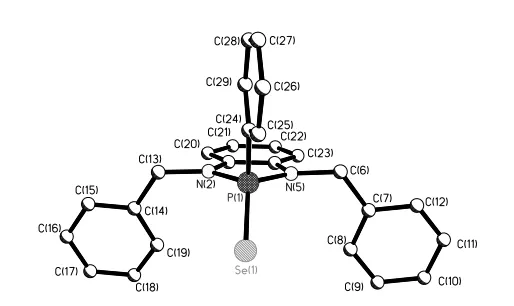
NH(Ph2PSe)2.20 For compound 2b, it can be seen from Figure 2 that the molecule has approximate
[image:5.612.201.402.164.290.2] [image:5.612.177.434.422.575.2]non-crystallographic mirror symmetry. For the structures of 2a and 2b, the five-membered rings (P-N-C-C-N) are essentially planar. The P=Se distances, 2.0927(10) Å for 2c, 2.0804(16) Å for 2b are normal,21-24 while the shortness of the P-N bond lengths (1.662(3), 1.690(3) Å for 2a, 1.684(4), 1.678(5) Å for 2b suggests some multiple bond character. The X-ray structures of 2c and 2e whilst allowing confirmation of connectivity could not be refined well because of disorder issues and will not be discussed in detail.
Figure 1. The X-ray structure of 2a illustrating the dimer pair H bonding. The additional "a" letter in the Se1a label indicates that this atom is at (1-x,1-y,2-z). Selected bond lengths (Å) and angles (˚) (esds in parentheses): Se(1)-P(1) 2.0927(10), P(1)-N(5) 1.662(3), P(1)-N(2) 1.690(3), P(1)-C(16) 1.801(4), N(2)-C(3) 1.400(4), N(5)-P(1)-N(2) 92.31(15), N(5)-P(1)-C(16) 107.79(16), N(2)-P(1)-C(16) 105.72(15), N(5)-P(1)-Se(1) 118.57(11), N(2)-P(1)-Se(1) 117.44(10), C(16)-P(1)-Se(1) 112.70(12), C(3)-N(2)-P(1) 112.2(2), C(4)-N(5)-P(1) 113.1(2).
Figure 2. The X-ray structure of 2b (Hydrogen atoms omitted for clarity). Selected bond lengths (Å) and angles (˚) (esds in parentheses): Se(1)-P(1) 2.0804(16), P(1)-N(5) 1.684(4), P(1)-N(2) 1.678(5), P(1)-C(24) 1.806(6), N(2)-C(3) 1.416(6), N(2)-P(1)-N(5) 91.2(2), N(2)-P(1)-C(24) 107.2(2), N(5)-P(1)-C(24) 106.2(2), N(2)-P(1)-Se(1) 118.20(16), N(5)-P(1)-Se(1) 117.75(16), C(24)-P(1)-Se(1) 113.65(18), C(3)-N(2)-P(1) 113.5(3), C(13)-N(2)-P(1) 123.1(3).
The molecular structures of 4b and 6a (Figures 3 and 4, Table 1) reveal a somewhat different structural motif. 4b has a similar conformation to 2a for the P(Se)SNC2 heterocycle. The six membered P(Se)S2C3 ring in 6a
respectively] are in good agreement with each other and are consistent with the related selenides containing PV=Se bonds [2.08-2.12 Å].19,21-24 The internal angle of S(1)-P(1)-S(2) being 102.28(5)° in 6a shows significant distortion from ideal tetrahedral. We note that the internal angle of N(1)-P(1)-S(1) [94.23(7)°] in 4b is slightly bigger that the value in the similar structure of 2a [N(1)-P(1)-N(2) 92.31(15)°]. In 4b adjacent molecules are linked by N-H…Se Hydrogen bonds (NH(2)...Se(1)* 2.654(18), N...Se* 3.5368(19) Å N-H.. .Se* 163(2) o), where the * indicates that the Se atom is at 1+x, y, z to form chain-like packing extending in the a-direction.
Figure 3. The X-ray structure of 4b (Hydrogen atoms on phenyl rings omitted for clarity). Selected bond lengths (Å) and angles (˚) (esds in parentheses): Se(1)-P(1) 2.1021(6), S(1)-C(1) 1.772(2), S(1)-P(1) 2.1110(8), P(1)-N(2) 1.6671(19), P(1)-C(7) 1.803(2); C(1)-S(1)-P(1) 92.49(7), N(2)-P(1)-C(7) 105.77(10), N(2)-P(1)-Se(1) 117.15(7), C(7)-P(1)-Se(1) 113.71(7), N(2)-P(1)-S(1) 94.23(7), C(7)-P(1)-S(1) 107.81(7), Se(1)-P(1)-S(1) 116.09(3).
In conclusion, we have successfully applied Woollins’ reagent, WR, to the synthesis of a series of novel five- to seven-membered heterocycles with an E-P(Se)-E’ (E, E’ = N, S, Se) linkage from the selenation of difunctional aromatic substrates. Using 1H, 31P{1H}, 77Se{1H} NMR spectroscopy and microanalysis or accurate mass measurements in conjunction with single-crystal X-ray crystallography, the structures of the novel heterocycles have been elucidated.
Experimental Section
Unless otherwise stated, all reactions were carried out under an oxygen free, nitrogen atmosphere using pre-dried solvents and standard Schlenk techniques. Subsequent chromatographic and work up procedures were performed in air. 1H (270 MHz), 13C (67.9 MHz), 31P-{1H} (109 MHz) and 77Se-{1H} (51.4 MHz referenced to external Me2Se) NMR spectra were recorded in CDCl3 at 25 ºC (unless stated otherwise) on a JEOL GSX
270. IR spectra were recorded as KBr pellets in the range of 4000-250 cm-1 on a Perkin-Elmer 2000 FTIR/Raman spectrometer. Microanalysis was performed by the University of St Andrews microanalysis service. Mass spectrometry was performed by the EPSRC National Mass Spectrometry Service Centre, Swansea and the University of St Andrews Mass Spectrometry Service.
Syntheses
General procedure for the synthesis of 2a-e: A mixture of diamine (2.0 mmol) and WR (0.54g, 1.0 mmol) in 20 cm-3 of dry toluene was refluxed for 7 h. The red suspension disappeared and a grey solution formed along with a small amount of black elemental selenium. Upon cooling to room temperature and removing the solvent the residue was purified by column chromatography (silica gel, toluene as eluent) to give monophosphorus products 2a-e.
2a. 190 mg as pale white solid in 51% yield. M.p. 188-190 ºC. Selected IR (KBr, cm-1): 3259(m, NH), 1590(m), 1485(vs), 1377(m), 1297(m), 1249(s), 1183(m), 1100(s), 1024(m), 970(m), 897(m), 878(m), 738(s), 690(s), 568(s, P=Se). 1H NMR (CDCl3, δ), 7.99-7.90 (m, 2H, ArH), 7.45-7.32 (m, 3H, ArH), 7.30-7.22 (m,
2H, ArH), 7.22-7.18 (m, 2H, ArH), 6.85-6.77 (m, 4H, ArH), 6.50 (d, J(P,H) = 7 Hz, 2H, ArH), 5.29 (d, J(P,H) = 18 Hz, 1H, NH) ppm. 13C NMR (CDCl3, δ), 133.2, 132.7, 132.0 (d, 3J(P,C) = 14 Hz), 129.7, 128.7, 128.3 (d,
31
P NMR (CDCl3, δ), 75.5 (s, J(P,Seexo) = 842 Hz) ppm. 77Se NMR (CDCl3,δ), -115.7 (d, J(P,Seexo) = 842 Hz)
ppm. MS (CI+, m/z): 371 [M+H]+. Accurate mass measurement (EIMS): 370.0133, calculated mass for C18H15N2PSe: 370.0133.
2b. 306 mg as white solid in 65% yield. M.p. 211-212 ºC. Selected IR (KBr, cm-1): 3056(w), 3017(w), 2892(w), 2843(w), 1595(m), 1492(vs), 1435(m), 1383(m), 1283(s), 1134(s), 1098(m), 1044(m), 911(m), 864(m), 735(s), 718(m), 688(m), 562(s, P=Se). 1H NMR (CDCl3, δ), 7.83 (dd, J(H,H) = 7.2 Hz, 3J(P,H) =
15.3 Hz, 2H, ArH), 7.46 (m, J(H,H) = 7.2 Hz, 3H, ArH), 7.39-7.7.15 (m, 10H, ArH), 6.69 (dd, J(H,H) = 7.2 Hz, 2H, ArH), 6.54 (d, J(H,H) = 7.2 Hz, 2H, ArH), 4.68 (d, 3J(P,H) = 15.8 Hz, 4H, NCH2) ppm. 13C NMR
(CDCl3, δ), 136.4 (J(P,C) = 3.1 Hz), 136.3 (d, J(P,C) = 106 Hz), 135.9, 135.7, 132.7, 132.0 (d, 3J(P,C) = 14.5
Hz), 128.5, 128.4, 128.2, 127.4, 127.4, 120.1, 109.4 (d, J(P,C) = 6.2 Hz), 46.4 (d, 3J(P,C) = 7.3 Hz) ppm. 31P NMR (CDCl3, δ), 84.7 (s, J(P,Seexo) = 842 Hz) ppm. 77Se NMR (CDCl3, δ), -188.7 (d, J(P,Seexo) = 842 Hz)
ppm. MS (ES+, m/z): 497 [M+Na]+. Accurate mass measurement (EIMS): 470.0785, calculated mass for C26H23N2P76Se: 470.0786.
2c. 250 mg as milky white solid in 67% yield. M.p. 195-197 ºC. Selected IR (KBr, cm-1): 3248(vs, NH), 1589(vs), 1359(s), 1107(m), 1057(s), 908(s), 809(s), 748(s), 683(s), 607(m, P=Se). 1H NMR (CDCl3, δ), 8.12
(m, J(H,H) = 7 Hz, 2H, ArH), 7.65-7.53 (m, 11H, ArH), 7.01 (d, J(H,H) = 7 Hz, 2H, ArH), 6.28 (d, J(P,H) = 13 Hz, 2H, NH) ppm. 13C NMR (CDCl3, δ), 139.1 (d, 1J(P,C) = 107 Hz), 136.2, 135.9 (d, 2J(P,C) = 52 Hz),
132.1, 130.6 (d, 3J(P,C) = 13 Hz), 128.8 (d, 3J(P,C) = 15 Hz), 127.4, 121.5, 111.9 (d, 4J(P,C) = 7 Hz) ppm, 31P NMR (CDCl3, δ), 40.5 (s, J(P,Seexo) = 817 Hz) ppm. 77Se NMR (CDCl3, δ), -182.1 (d, J(P,Seexo) = 820 Hz)
ppm. MS (CI+, m/z): 373 [M+H]+. Anal. calcd. for C18H17N2PSe (372.03): C, 58.1; H, 4.6; N, 7.5. Found: C,
58.4; H, 4.7; N, 7.3.
2d. 402 mg as white solid in 96% yield. M.p. 201-203 ºC. The NMR spectra of 31P and 77Se showed that the product is a mixture of two diasteroisomers. Selected IR (KBr, cm-1): 3168(s, NH), 1493(m, 1434(s), 1365(s), 1285(m), 1229(m), 1102(s), 753(s), 690(m), 584(m, P=Se). 1H NMR (CD2Cl2, ), 8.00-7.73 (2xm, 10H, ArH),
7.56-7.17 (2xm, 20H, ArH), 6.89 (2xd, J(P,H) = 8.6 Hz, 4H, NH) ppm. 13C NMR (CD2Cl2, 25ºC, ), 136.2,
133.0, 132.5, 132.1, 131.9, 131.7, 129.5, 129.3, 129.0, 128.7, 128.3, 128.1, 127.9, 127.0, 126.7, 126.5, 126.1, 125.8, 125.5, 125.2, 124.9, 124.5, 124.4 ppm.31P NMR (CD2Cl2, ), 83.5 (s, J(P,Se) = 805 Hz) ppm; 84.5 (s,
J(P,Se) = 805 Hz) ppm.77Se NMR (CD2Cl2, ), -207.0 (d, J(P,Seexo) = 805 Hz) ppm; -209.8 (d, J(P,Seexo) =
805 Hz) ppm. Mass spectrum (EI+): m/z 420 [M+H]+, 217 [M-C6H6NPSe]+. Anal. Calcd. for C22H17N2PSe: C,
2e. 460 mg as slightly pink white solid in 98% yield. M.p. 198-199 ºC. Selected IR (KBr, cm-1): 3168 (vs, NH), 1617(m), 1599(m), 1505(s), 1433(s), 1362(s), 1220(m), 1102(m), 956(m), 815(s), 748(vs), 694(m), 574(m, P=Se). 1H NMR (Acetone-d6, δ), 8.09 - 690 (m, 12H, ArH), 2.05 (s, 2H, NH) ppm. 13C NMR
(Acetone-d6, δ), 144.1, 134.2, 136.1, 129.1, 128.4, 127.8, 127.6, 127.2, 126.6, 126.2, 125.3, 124.7, 123.7,
118.5 ppm. 31P NMR (Acetone-d6, δ), 82.5 (s, J(P,Seexo) = 810 Hz) ppm. 77Se NMR (Acetone-d6, δ), -193.5
(d, J(P,Seexo) = 810 Hz). MS (CI+, m/z): 470 [M+H]+.Anal. Calcd. for C26H19N2PSe (469.38): C, 66.5; H, 4.1;
N, 6.0. Found:C, 66.1; H, 4.4; N, 6.3.
4a. A toluene (10 cm-3) refluxing mixture of 2-aminobenzenethiol (0.12g, 1.0 mmol) and WR (0.54g, 1.0 mmol) was carried out for 7 h. The red suspension disappeared and a black red suspension was formed. The mixture was dried in vacuo to remove toluene and the residue was dissolved in dichloromethane. The unique compound 7a (160 mg, white solid) was obtained after fresh chromatographic purification (silica gel, dichloromethane as eluent) and crystallisation from dichloromethane/hexane in 52% yield. M.p: 160-162 ˚C. Selected IR (KBr, cm-1): 3211(s), 1579(m), 1470(s), 1454(m), 1438(m), 1368(s), 1293(m), 1260(m), 1096(s), 892(s), 743(vs), 687(m), 555(s), 489(m). 1H NMR (CD2Cl2, ), 8.08-7.98 (m, 2H, ArH), 7.57-7.43 (m, 3H,
ArH), 7.23-7.20 (m, J(H,H) = 8.2 Hz, 1H, ArH), 7.13-7.06 (m, J(H,H) = 8.2 Hz, 1H, ArH), 6.93-6.87 (m, J(H,H) = 8.2 Hz, 2H, ArH), 5.68 (d, 2J(P,H) = 13.5 Hz, 1H, NH) ppm. 13C NMR (CD2Cl2, ), 138.7 (d, 1
J(P,C) = 93.4 Hz), 132.7 (d, 4J(P,C) = 3.1 Hz), 131.2 (d, 2J(P,C) = 14.5 Hz), 128.4 (d, 2J(P,C) = 15.6 Hz),
126.7, 124.2 (d, 3J(P,C) = 6.2 Hz), 121.8, 113.0, 112.9 ppm. 31P NMR (CD2Cl2, ), 74.4 (s, J(P,Seexo) = 840
Hz) ppm. 77Se NMR (CD2Cl2, ), -32.5 (d, J(P,Seexo) = 842 Hz) ppm. Mass spectrum (EI+): m/z 311 [M]+, 231
[M-Se]+, 154 [M-C6H5Se]+. Anal. Calcd. for C12H10NPSSe: C, 46.5; H, 3.3; N, 4.5. Found: C, 46.7; H, 3.1; N,
4.7.
4b. A mixture of 4-methyl-1,2-benzenedithiol (66.0 mg, 0.5 mmol) and WR (270 mg, 0.5 mmol) in toluene (20 cm-3) was refluxed for 7 h. The red suspension disappeared and a reddish yellow solution was formed. Upon cooling to RT, the mixture was dried in vacuo. The residue was dissolved in dichloromethane and was purified by column chromatography (silica gel, dichloromethane as eluent) to afford compound 7b (100 mg) as greenish yellow paste in 59% yield. M.p: 150-151 ˚C. Selected IR (KBr, cm-1): 3215(m), 2935(m), 1576(m), 1472(s), 1439(m), 1366(s), 1294(m), 1096(s), 895(s), 742(vs), 685(m), 554(s), 490(m). 1H NMR (CD2Cl2, ), 8.20-8.10 (m, 2H, ArH), 7.54-7.43 (m, 3H, ArH), 7.27-7.20 (m, 2H, AeH), 7.02-6.99 (m, 1H,
ArH), 2.29 (s, 3H, CH3). 13C NMR (CD2Cl2, ), 138.2, 136.7, 135.8, 135.6, 133.0, 132.9, 131.0 (d, 2J(P,C) =
Mass spectrum (EI+): m/z 342 [M]+, 294 [M-Se]+. Anal. Calcd. for C13H11PS2Se: C, 45.8; H, 3.3. Found: C,
46.0; H, 3.5.
General procedure for the synthesis of 6a-c: A mixture of cd][1,2]dithiole, naphtho[1,8-cd][1,2]selenole, or naphtho[1,8-cd][1,2]thioselenole (2.0 mmol) and WR (0.54 g, 1.0 mmol) in 20 cm-3 of dry toluene was stirred at room temperature for 7 h, the red suspension stayed unchanged. Then the mixture was refluxed for 7 h. The red suspension disappeared and a solution with some black selenium precipitate formed. Upon cooling to room temperature and removing the solvent, the residue was purified by column chromatography (silica gel, toluene as eluent) to give compounds 6a-c.
6a. 348 mg as white solid in 92% yield. M.p: 154-155 ˚C. Selected IR (KBr, cm-1): 1545(m), 1477(w), 1432(m), 1330(w), 1198(w), 1154(w), 1093(s), 813(s), 749(s), 576(s), 566(s, P=Se).1H NMR (CD2Cl2, ),
7.88 (dd, J(P,H) = 16.5 Hz, J(H,H) = 7.4 Hz, 2H, ArH), 7.70 (d, J(H,H) = 7.4 Hz, 1H, ArH), 7.60(dd, J(H,H) = 7.4 Hz, 2H, ArH), 7.43 (d, J(H,H) = 8.0 Hz, 2H, ArH), 7.32(m, 2H, ArH) ppm. 13C NMR (CD2Cl2, ),
135.9, 134.9(d, J(P,C) = 73 Hz), 132.5 (d, J(P,C) = 3.1 Hz), 131.0 (d, J(P,C) = 7.3 Hz), 130.6, 130.5, 13.4, 128.9 (d, J(P,C) = 14.5 Hz), 126.3 ppm. 31P NMR (CD2Cl2, ), 21.7 (s, J(P,Seexo) = 810 Hz) ppm. 77Se NMR
(CD2Cl2, ), -81.2 (d, J(P,Seexo) = 810 Hz) ppm. Mass spectrum (EI+): m/z 378 [M]+, 298 [M-Se]+, 190
[M-C6H5PSe]+. Mass spectrum (CI+): 379 [M+H]+. Anal. Calcd. for C16H11PS2Se: C, 50.9; H, 2.9. Found: C, 50.4;
H, 2.8.
6b. 335 mg as pale brown solid in 79% yield. M.p: 130-131 ˚C. Selected IR (KBr, cm-1): 1543(w), 1431(w), 1151(w), 1090(m), 811(m), 748(s), 686(m), 568(vs, P=Se), 548(P-Se). 1H NMR (CD2Cl2, ), 7.94-7.7.60 (m,
6H, ArH), 7.41-7.33 (m, 5H, ArH) ppm. 13C NMR (CD2Cl2, ), 136.1 (d, J(P,C) = 63.4 Hz), 132.5, 132.4,
132.3, 131.9 (d, J(P,C) = 7.3 Hz), 131.4, 130.8, 130.7, 130.5128.8 (d, J(P,C) = 14.5 Hz), 126.4, 126.1 ppm.
31
P NMR (CD2Cl2, ), 3.7 (s, J(P,Seexo) = 798 Hz, J(P,Seendo) = 390 Hz) ppm. 77Se NMR (CD2Cl2, ), 502.6
(d, J(P,Seendo) = 390 Hz), -50.9 (d, J(P,Seexo) = 799 Hz) ppm. Mass spectrum (EI+): m/z 424 [M]+, 237
[M-C6H5PSe]+. Anal. Calcd. for C16H11PSSe2: C, 45.3; H, 2.6. Found: C, 45.4; H, 2.9.
6c. 33 mg as yellow solid in 7% yield. M.p: 90-91 ˚C. 1H NMR (CD2Cl2, ), 8.01-7.92 (m, 5H, ArH),
7.51-7.47 (m. 4H, ArH), 7.25-7.10 (m, 2H, ArH) ppm. 13C NMR (CD2Cl2, ), 138.0, 132.2, 131.3, 130.3, 130.1,
129.9, 128.6, 128.4 ppm. 31P NMR (CD2Cl2, ), 76.6 (s, J(P,Seexo) = 819 Hz, J(P,Seendo) = 439 Hz ppm. 77Se
NMR (CD2Cl2, ), 386.9 (d, J(P,Seexdo) = 441 Hz), -26.0 (d, J(P,Seexo) = 820 Hz) ppm. Mass spectrum (EI+):
Preparation of 3H-dinaphtho[2,1-d:1’,2’-f][1,3]diazepin-4-amine (7): To a solution of 1,1’-binaphthyl-2,2’-diamine 1e (1.00 g, 3.5 mmol) and 2.40 g of NaOAc in 50 cm-3 of dry methanol and 20 cm-3 of Et3N was
added 3.4 cm-3 of BrCN (3M in dichloromethane, 10 mmol). The reaction mixture was stirred for 2 h at 0ºC, and then at room temperature for 70 h to give a white suspension. The solvent was removed under vacuum, and the residue was extracted by dichloromethane/H2O (300 cm-3, 1:1 ratio) to give two layers of liquid, an
organic layer and an aqueous solution. The organic layer was dried over MgSO4, filtered and rotary
evaporated to give crude product (a white solid). The crude product was purified on silica gel (1:9 = ethyl acetate/dichloromethane as eluent) to afford 1.06 g as a grey green solid. Re-crystallization from dichloromethane/hexane gave 7 as grey green needles. Yield: 98%. Selected IR (KBr, cm-1): 3048(w), 1619(vs, C=N), 1508(m), 1430(m), 1380(m), 1348(m), 1280(m), 1210(m), 1145(m), 1092(m), 1022(m), 922(w), 816(s), 748(s). 1H NMR (CDCl3, δ), 7.82-7.78 (m, 2H, ArH), 7.22-7.02 (m, 11H, ArH), 5.28(s, 1H, NH), 3.67
(bs, 1H, NH) ppm. 13C NMR (CDCl3, δ), 142.8, 133.8, 129.6, 128.6, 128.3, 126.9, 124.1, 122.5, 118.4, 112.7,
45.9 ppm. MS (CI+, m/z): 310 [M+H]+. Anal. Calcd. for C21H15N3 (309.36): C, 81.53; H, 4.89; N, 13.58.
Found: C, 81.45; H, 4.92; N, 13.67.
Reaction of compound 7 with WR: A mixture of 3H-dinaphtho[2,1-d:1’,2’-f][1,3]diazepin-4-amine 7 (0.31 g, 1.0 mmol) and WR (0.27 g, 0.5 mmol) in 20 cm-3 of dry toluene was heated to reflux for 30 min. The red suspension turned orange. Upon cooling to room temperature and removal of the solvent, the residue was extracted by ethyl acetate and purified by silica gel (1:1 ethyl acetate/dichloromethane as eluent) to give 2e as a pinkish white solid (190 mg) in 81% yield based on WR.
X-Ray Structure Determinations
X-ray crystal data for compounds 2a, 2b and 4b were collected at 93 K using a Rigaku MM007 High brilliance RA generator/confocal optics and Mercury CCD system. Data for 6a were collected using the St Andrews Robotic diffractometer (Saturn724 CCD) at 125 K with graphite monochromated Mo-Kα radiation (λ = 0.71073 Å).25,26 Intensity data were collected using ω steps accumulating area detector images spanning at
Crystallographic Data centre, 12 Union Road, Cambridge CB2 1EZ, UK; fax (+44) 1223-336-033; e-mail: [email protected].
Acknowledgement
The authors are grateful to the University of St Andrews and the Engineering and Physical Science Research Council (EPSRC, U.K.) for financial support.
References and Notes
1. a) Topics in Current Chemistry: Organoselenium Chemistry, Modern Developments in Organic Synthesis;
T. Wirth, Ed.; Springer: Berlin, Germany, 2000; b) T. Wirth, Angew. Chem., Int. Ed. 2000, 39, 3740-3749.
2. a) Organic Selenium Compounds: Their Chemistry and Biology; D. L. Klayman, W. H. H. Gunther, Eds.;
Wiley: New York, 1973; b) K. C. Nicolaou, N. A. Petasis, Selenium in Natural Products Synthesis; CIS:
Philadelphia, 1984; c) G. Mugesh, W. W. Du Mont, H. Sies, Chem. Rev. 2001, 101, 2125-2179.
3. T. G. Back, Organoselenium Chemistry-A Practical Approach, Oxford Press: New York, 2000. 4. C. Hobartner, and R. Micura, J. Am. Chem. Soc. 2004, 126, 1141-1149.
5. Y. Buzin, N. Carrasco, and Z. Huang, Org. Lett. 2004, 6, 1099-1102.
6. D. M. Hatch, J. O. Boles, Z. Z. Li, and L. A. Silks, Curr. Org. Chem. 2004, 8, 47-64.
7. Y. Kobayashi, Y. Ogra, K. Ishiwata, H. Takayama, N. Aimi, and K. T. Suzuki, Proc. Natl. Acad. Sci. U.S.A. 2002, 99, 15932-15936.
8. K. EI-Bayoumy, and R. Sinha, Mutat. Res. 2004, 551, 181-197. 9. P. D. Whanger, Brit. J. Nutr. 2004, 91, 11-28.
10.G. Roy, M. Nethaji, and G. Mugesh, J. Am. Chem. Soc. 2004, 126, 2712-2713.
11.Y. T. Zhu, M. D. Gieselman, H. Zhou, O. Averin, and W. A. van der Donk, Org. Biomol, Chem. 2003, 1, 3304-3315.
12.G. Mugesh, and W. W. du Mont, Chem. Eur. J. 2001, 7, 1365-1370.
13.A. Krief in “Comprehensive Organometallic Chemistry”, Eds E. W. Abel, F. G. A. Stone, G. Wilkinson, Pergamon Press, 1995, Volume 11, p.515.
14.T. G. Back in “Encyclopaedia of Inorganic Chemistry”, Ed. R. B. King, 1994, volume 7, p. 3690. 15.E. G. Hope and W. Levason, Coord. Chem. Rev. 1993, 122, 109.
18.G. Hua, Y. Li, A. M. Z. Slawin and J. D. Woollins. Angew. Chem., Int. Ed. 2008, 47, 2857-2859. 19.P. Bhattacharyya, A. M. Z. Slawin and J. D. Woollins, J. Organomet. Chem. 2001, 623, 116-119.
20.P. Bhattacharyya, J. Novosad, A. M. Z. Slawin, D. J. William and J. D. Woollins, J. Chem. Soc. Dalton Trans. 1995, 1607.
21.M. J. Pilkington, A. M. Z. Slawin, D. J. Williams, P. T. Wood and J. D. Woollins, Heteroatom Chem. 1990, 1, 351-355.
22.P. Bhattacharyya, A. M. Z. Slawin, D. J. Williams and J. D. Woollins, Chem. Eur. J. 2002, 8, 2705-2711. 23.P. Bhattacharyya, A. M. Z. Slawin, D. J. Williams and J. D. Woollins, Angew. Chem. Int. Ed. 2000, 39,
1973-1975.
24.P. Bhattacharyya, A. M. Z. Slawin, D. J. Williams and J. D. Woollins, Dalton Trans. 2001, 300-303. 25.Rigaku (2006). Crystal Structure, Version 3.8. Single Crystal Structure Analysis Software. Rigaku/MSC,
9009 TX, USA 77381-5209. Rigaku, Tokyo 196-8666, Japan.
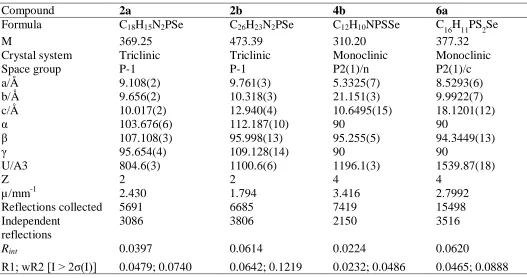
Table 1. Details of the X-ray data collections and refinements for compounds 2a, 2b, 4b, 6a.
Compound 2a 2b 4b 6a
Formula C18H15N2PSe C26H23N2PSe C12H10NPSSe C16H11PS2Se
M 369.25 473.39 310.20 377.32
Crystal system Triclinic Triclinic Monoclinic Monoclinic
Space group P-1 P-1 P2(1)/n P2(1)/c
a/Å 9.108(2) 9.761(3) 5.3325(7) 8.5293(6)
b/Å 9.656(2) 10.318(3) 21.151(3) 9.9922(7)
c/Å 10.017(2) 12.940(4) 10.6495(15) 18.1201(12)
α 103.676(6) 112.187(10) 90 90
β 107.108(3) 95.998(13) 95.255(5) 94.3449(13)
γ 95.654(4) 109.128(14) 90 90
U/A3 804.6(3) 1100.6(6) 1196.1(3) 1539.87(18)
Z 2 2 4 4
µ/mm-1 2.430 1.794 3.416 2.7992
Reflections collected 5691 6685 7419 15498
Independent reflections
3086 3806 2150 3516
Rint 0.0397 0.0614 0.0224 0.0620