Running Head: QUESTION FORMAT SHIFTS BIAS 1
Question format shifts bias away from the emphasised response in tests of recognition memory
Ravi D. Mill and Akira R. O‟Connor
School of Psychology and Neuroscience, University of St Andrews
Ravi D. Mill, School of Psychology and Neuroscience, University of St Andrews; Akira R. O‟Connor, School of Psychology and Neuroscience, University of St
Andrews.
Ravi Mill is supported by a PhD studentship from the Scottish Imaging Network: A
Platform for Scientific Excellence (SINAPSE).
Correspondence concerning this article should be addressed to Akira O‟Connor,
School of Psychology, University of St Andrews, St Mary's College, South Street, St
Abstract
The question asked to interrogate memory has potential to influence response bias at retrieval, yet has not been systematically investigated. According to framing effects in the field of eyewitness testimony, retrieval cueing effects in cognitive psychology and the acquiescence bias in questionnaire responding, the question should establish a confirmatory bias. Conversely, according to findings from the rewarded decision-making literature involving mixed incentives, the question should establish a disconfirmatory bias. Across three experiments (ns = 90 [online], 29 [laboratory] and 29 [laboratory]) we demonstrate a disconfirmatory bias - "old?" decreased old responding. This bias is underpinned by a goal-driven mechanism wherein participants seek to maximise emphasised response accuracy at the
expense of frequency. Moreover, we demonstrate that disconfirmatory biases can be generated without explicit reference to the goal state. We conclude that subtle
aspects of the test environment influence retrieval to a greater extent than has been previously considered.
Keywords: episodic memory; recognition; decision-making; evaluation; response
1. Introduction
Each time we decide whether or not we recognise something in our environment, the
environment itself informs both why we are attempting to tell old from new, and the
consequences of making such a decision. When making memory decisions in the
real world, it is therefore sensible to consider all aspects of our memory decisions,
from cause to consequence, so as to set appropriate goals that enable more
strategic use of the available memory evidence. To illustrate this, consider a memory
user faced with two tasks: the first being to identify a criminal from a suspect line-up;
the second being to decide whether or not to greet a potential acquaintance at the
supermarket. If both the suspect and the potential acquaintance evoke equal
memory evidence in their respective scenarios, it is conceivable that the markedly different consequences of incorrect “old”decisions in each situation will lead to
different memory outcomes. In the line-up the available memory evidence may be
deemed insufficient to inform the police that the criminal is present, whereas in the
supermarket, the same level of evidence may be more than enough to greet the
potential acquaintance. In this way, even subtle manipulations of standard
recognition testing environments may influence memory evaluations.
How the testing environment biases memory has been the subject of extensive
laboratory investigation, which has fuelled the formalisation of the source monitoring framework – the collection of monitoring/control processes that underpin the
evaluation of retrieved memory content (Jacoby, Kelly & McEllrey, 1999; Johnson,
Hashtroudi & Lindsay, 1993). For instance, numerous studies have demonstrated
influences of the testing environment on the likelihood of endorsing false memories,
as manipulated both in the Deese-Roediger-McDermott paradigm (DRM; Deese,
McDermott, 1995) and in laboratory analogues of eyewitness testimony (Lindsay &
Johnson, 1989; Loftus, Donders, Hoffman & Schooler, 1989; Loftus, 1996). Testing
bias effects in the standard single item recognition paradigm have also been
observed, albeit with a predominant focus on one particular manipulation – cueing.
Cueing participants that a word presented at test is likely to be old or new has been
shown to bias decision-making in a confirmatorydirection e.g. a “likely old” cue increases the likelihood of “old”responding. This effect is consistent across many
methods of cue delivery, ranging from informing participants of the relative proportion
of old and new items at test (Ratcliff, Sheu, & Gronlund, 1992; Van Zandt, 2000),
providing valid and invalid performance feedback (Estes & Maddox, 1995; Han &
Dobbins, 2009; Rhodes & Jacoby, 2007), and trial-by-trial cueing by text,
presentation location and colour (Aminoff et al., 2012; Jaeger, Cox, & Dobbins, 2012;
O'Connor, Han, & Dobbins, 2010; Rhodes & Jacoby, 2007). As long as cues can be
easily assimilated into the memory decision-making process, they lead to a
confirmatory bias that increases endorsements of the cued decision (albeit often to a
lesser degree than would be optimal according to the cue; Cox & Dobbins, 2011;
Healy & Kubovy, 1978; Wallace, 1980).
Despite the large volume of research on how explicit cues bias memory, whether
implicit cues embedded within traditional laboratory-based recognition experiments
also introduce bias has remained largely overlooked. This is surprising given the
extensive research in analogous applied domains such as questionnaire design (e.g.
response acquiescence; Podsakoff, MacKenzie, Lee, & Podsakoff, 2003) and
eyewitness testimony (e.g. leading questions; Loftus, 1996) in which strong
influences of question format on decision-making have been observed. These effects
employs the single item recognition paradigm (often termed yes/norecognition) in which the question “old?” is presented with a to-be-judged item and is responded to
with either “yes” or “no” keypresses (e.g. Donaldson, 1996). If this format implicitly
emphasises the importance of making an “old” decision, and this implicit emphasis
biases memory performance, then this bias is likely presenting itself in most
laboratory-based memory research where this canonical “old?”-cued recognition test
is employed.
The direction of any bias observed in recognition memory research would provide
insight into memory decision-making processes that ultimately determine
responding. Two competing predictions of bias direction are apparent, one derived
from the laboratory-based memory cueing and applied framing literatures
summarised above, and an alternative derived from research into rewarded decision-making. Findings from the cueing/framing literatures suggest that the question “old?”
sets up an expectation of encountering an old item, thereby leading to a bias towards
making the emphasised memory decision. A bias in the opposite direction would be
anticipated from findings in the rewarded decision-making literature. In mixed
incentive research, increasing both the monetary payoff for a correct response and
the monetary punishment for an incorrect response, for one of two available
response options, motivates a bias against making that monetized response (e.g.
Newman, Widom & Nathan, 1985). To clarify, if the aim was to instantiate similar
incentives for a single item recognition task, this might involve offering a £1 reward for each correct “old” decision, as well as a £1 punishment for each incorrect “old”
decision, whilst not providing any incentives for correct or incorrect “new” decisions.
Dobbins 2010). This reluctance is putatively goal-driven, as participants seek to
maximise the accuracy of endorsing the decision that is monetarily emphasised as a
higher-order goal, even if this entails making it less often (e.g. preferring 10
responses with 90% accuracy to 20 responses with 65% accuracy). If the format of
the test question serves to impart similar albeit more implicit emphasis to particular
memory decisions, we would hence expect a different bias direction to the cueing hypothesis outlined above: the question “old?” should reduce the likelihood of
responding “old”, thereby leading to a bias against making the emphasised memory
decision.
Below we report three recognition experiments which assess whether the format of
the test question biases recognition memory responding, and in what direction. We
used both an established measure (signal detection estimates of response criterion,
which bin responses by new or old item status) and a somewhat unorthodox measure („decision accuracy‟, which bins responses by decision status; Duncan,
Sadanand & Davachi, 2012) of recognition performance.Across these experiments,
we replicated a novel form of memory bias sensitive to the decision goals implicitly
emphasised by the test environment.
2. Experiment 1
We first used an online experiment to explore whether bias in yes/no recognition
memory is influenced by the question presented alongside to-be-judged words at
test. Following an incidental encoding procedure, the test question was varied on an item-by-item basis, between “old?” (old question emphasis condition) and “new?”
(new question emphasis condition), to which participants could respond “yes” or “no”.
2.1.1. Participants. Participants were 90 self-reported native English speakers who
reached the minimum performance threshold of d' > 0.1 in each within-subjects
experimental condition1 (58 female; mean age = 34.7; age range = 20 to 66), from a
full sample of 120 completing the online experiment (25 were excluded on the basis
of being self-reported non-native English speakers2, 5 for poor performance).
Participants were recruited via links to the experiment posted on the laboratory
website and social networking sites (i.e. Facebook and Twitter), and were told that
they would get feedback on their memory performance (i.e. d' and c values) as a
participation incentive. Informed consent was obtained in accordance with the
University Teaching and Research Ethics Committee at the University of St
Andrews.
2.1.2. Stimuli. For each participant, a different set of words was randomly sampled
from a pool of 2199 singular, common nouns from the English Lexicon Project
(Balota et al., 2007), after the removal of low frequency words (Hyperspace
Analogue to Language HAL frequency high-pass cut-off: 7.70). This served to
exclude highly distinctive items, which could lead to extreme variations in memory
strength and consequently reduce the bias effects of primary interest (final word list
characteristics: mean HAL frequency = 8.98, mean word length = 7.24, mean
number of syllables = 2.43). One hundred and twenty words were used in the single
study-test block administered to participants, with 60 words presented at both study
and test (old words) and 60 words presented only at test (new words). The
1
This performance threshold was maintained across all three experiments.
2
experiment was programmed using JavaScript and presented to participants via their
internet browsers.
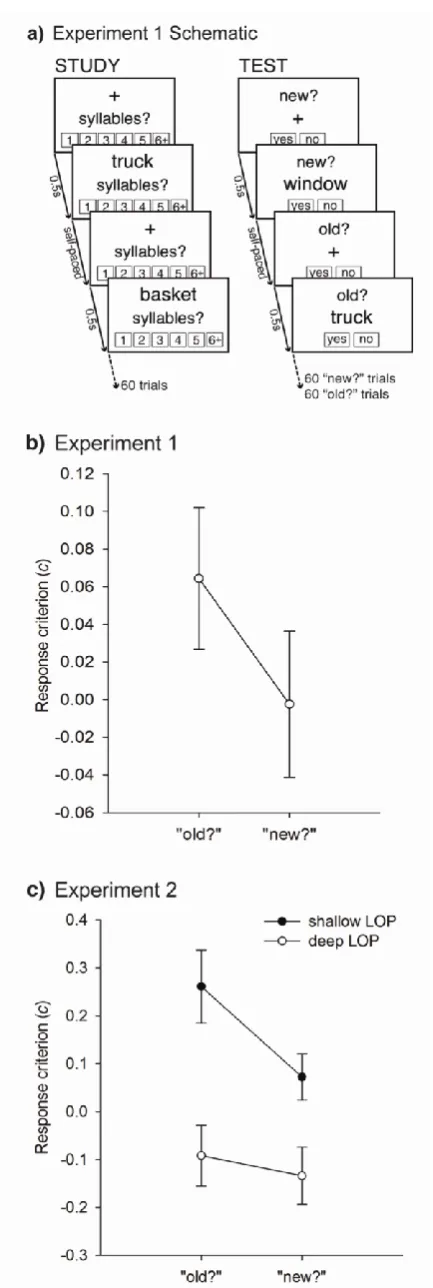
2.1.3. Procedure. Onscreen instructions were followed by a single study-test block.
During the study phase, participants counted the syllables in each of 60 serially
presented words. For each self-paced study trial, single words were presented above the cue “syllables?” and participants used their mouse to indicate a response
by pressing a button corresponding to “1” through “6+” (study phase RT M = 2.25s,
SD = 1.02). A 0.5 s fixation cross preceded each study trial. The test phase
immediately followed the study phase. A 0.5 s fixation cross preceded each
self-paced test trial (test phase RT M = 2.62s, SD = 0.75), during which the question for the upcoming trial was presented: either “old?” or “new?”. The fixation was replaced
by the to-be-judged word and participants used their mouse to indicate a response by pressing one of two onscreen buttons corresponding to “yes” or “no”. Thirty old
words and 30 new words were presented in each question emphasis condition and
stimuli were randomly intermixed throughout the test phase (see Fig. 1a).
2.1.4. Calculation
Our analyses for all reported experiments were conducted on sensitivity (d′) and
response bias (c) parameters, derived from assumptions of the equal variance signal
detection model (Green & Swets, 1966; Macmillan & Creelman, 2005). As in
Snodgrass and Corwin (1988), a correction for errorless responding was made by
taking the numbers of hits (Hn; the number of old items correctly judged “old”),
misses (Mn; the number of old items incorrectly judged “new”), correct rejections
number of new items incorrectly judged “old”), and calculating adjusted hit (H') and
false alarm rates (FA') as follows:
H' = (Hn + 0.5) / (Hn + Mn + 1) (1)
FA' = (FAn + 0.5) / (FAn + CRn + 1) (2)
These adjusted measures were then used to compute d′ and c:
d′ = z(H′) – z(FA′), (3)
c = -0.5 × [z(H′) + z(FA′)] (4)
The signal detection model assumes a continuous normal distribution of memory
strength and hence the sensitivity and bias parameters could theoretically span an
infinite range of values. However, in practice d' typically ranges from 0 to 3 (for
above chance performance) and c ranges from -1 to 1 (with a value of 0 reflecting
unbiased performance). As highlighted in the introduction, the absolute value of
criterion on the memory strength continuum in any given recognition test reflects the
influence of multiple sources of recognition bias. Hence, bias effects specifically
attributable to the present manipulation of question format were inferred via scrutiny
of the relative criterion shifts between question conditions in positive or negative
directions (rather than via interpretation of the absolute criterion values relative to 0
in each isolated condition). To summarise, larger d' parameters indicate increased
sensitivity (better discrimination of old from new) and increasingly positive c
We also conducted more unorthodox analyses of the accuracy of “old” and “new”
decisions (oldcorr and newcorr respectively). These decision accuracy measures
represent the proportion correct out of all “old” or “new” decisions made by each
subject, with responses binned according to “subjective” decision status i.e. the total
number of “old” or “new” decisions made (which varied across subjects). This is not
to be confused with the standard Hit and Correct Rejection rates which bin
responses according to objective “item status” categories i.e. the proportion correct
out of all old or new items presented in the test list (which remained fixed across
subjects). As examples of these decision accuracy measures, consider a recognition
test phase that presents 30 old and 30 new items. If Participant A makes a total of 20 “old” decisions during their experimental run, with 15 of these decisions being correct
in identifying old items, this would lead to an oldcorr value of .75 (i.e. 15 correct out of
a total of 20 “old” decisions). Similarly, if the same participant makes a total of 10
“new” decisions and 9 of these decisions are correct in identifying new items, this
would lead to a newcorr value of .90 (i.e. 9 correct out of a total of 10 “new”
decisions). If Participant B also makes 9 correct “new” decisions but attempts a
greater overall number of 20 “new” decisions, this would lead to a lower newcorr value
of .45 (9 correct out of 20 made) – a performance difference with Participant A that
would be obscured by comparison of Correct Rejection rates alone (which would be
9 correctly identified new items out of a possible 30 for both participants i.e. .30). The decision accuracy measures therefore provide further insight into participants‟
subjective experience in making memory decisions under varying question emphasis
conditions.
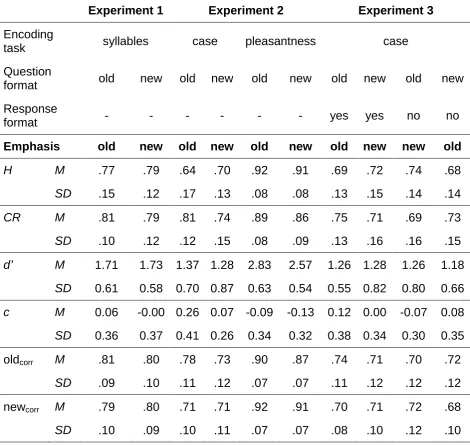
2.2.1. Sensitivity and bias. For all experiments, means and standard deviations are
presented in Table 1. We first established that d' did not differ across question
emphasis conditions, t(89) = 0.29, p = .771, d = 0.03. Participants‟ sensitivity in
discriminating old from new words was not influenced by the test question.
Bias introduced by question emphasis was then assessed by comparing criterion
placement across the two emphasis conditions, each comprising a test wordlist with
an equal proportion of old and new items (see Fig. 1b). Estimates of c were
significantly higher in the old emphasis than the new emphasis condition, t(89) =
2.141, p = .035, d = 0.23. Participants were biased against endorsing the decision emphasised by the question i.e. the question “old?” reduced the likelihood of
responding “old” relative to the question “new?” Notably the counter-emphasis
direction of this bias contrasts that observed following cueing manipulations, which
act to increase endorsement of the cued decision (e.g. O'Connor et al., 2010).
Rather these findings favour a goal-driven interpretation, wherein the test question
serves to emphasise one memory decision as a goal and participants are
consequently more cautious in how they make that emphasised decision.
2.2.2. Decision accuracy analyses. To further elucidate the mechanisms
underlying the observed question bias, we also analysed how the accuracy of “old”
and “new” decisions varied across emphasis conditions (oldcorr and newcorr
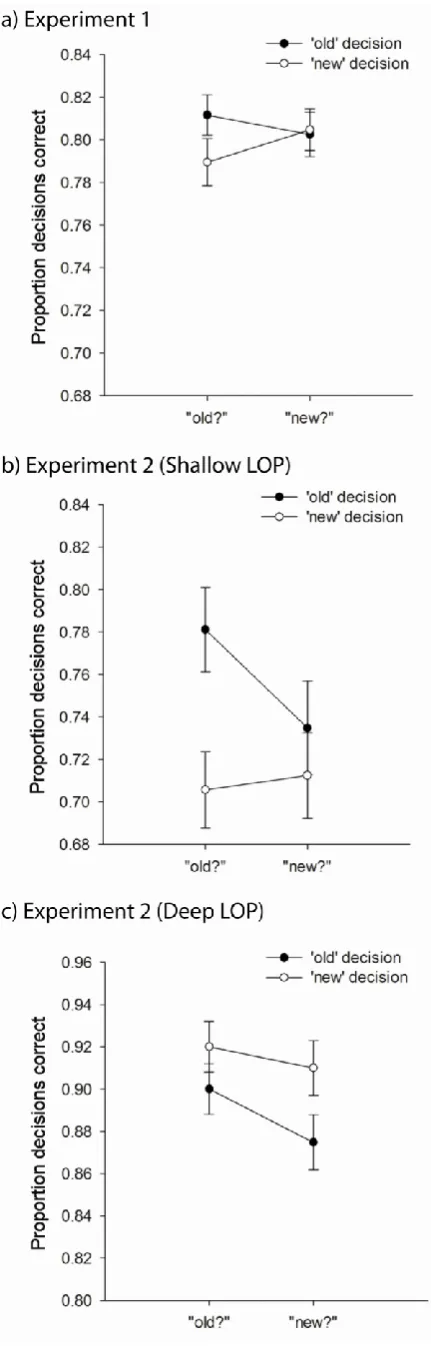
respectively; see Fig. 2a). A 2 (decision type: old or new) x 2 (question emphasis: “old?” or “new?”) repeated measures ANOVA was conducted on decision accuracy,
revealing no significant main effects of decision type and question emphasis, both Fs
F(1,89) = 6.07, p = .016, ηp2 = .064.3 Question emphasis improved the accuracy of endorsements of the emphasised decision i.e. “old?” improved the accuracy of “old”
decisions and “new?” improved the accuracy of “new” decisions (see Table 1 for
decision accuracy means). Post-hoc comparisons revealed nonsignificant accuracy effects in counter-emphasis directions for both “new” and “old” decisions, t(89) =
1.63, p = .106, d = 0.16 and t(89) = 0.94, p = .348, d = 0.10 respectively (see Fig.
2a). These findings support the goal-driven interpretation of the observed bias,
suggesting that the reduction in endorsements of the decision emphasised by the
question may in fact reflect the instilling of a more stringent monitoring strategy that
serves to improve the accuracy in making that decision.
___________________
TABLE 1 ABOUT HERE
___________________
____________________
FIGURE 1 ABOUT HERE
____________________
____________________
FIGURE 2 ABOUT HERE
3
____________________
3. Experiment 2
Given the numerically small effects observed in Experiment 1, we first sought to
replicate these exploratory findings in Experiment 2. We also aimed to follow-up
observation of the question bias with targeted attempts at clarifying its underlying
mechanism. We hence repeated the question emphasis manipulation from Experiment 1 in a more controlled laboratory setting, albeit with the “old?” and
“new?” questions varied in block-wise fashion rather than the previously instantiated
intermixed approach (to ease participants‟ cognitive load during the longer laboratory
run time). A levels-of-processing (LOP; Craik & Lockhart, 1972) manipulation was
also incorporated to assess whether the question bias is attenuated under conditions
of high overall memory strength. Two incidental encoding procedures were
employed in separate blocks: a deep LOP pleasantness judgement task; and a
shallow LOP letter case judgement task. To clarify, the case judgement task was
expected to instil an even lower level of overall memory strength than the
syllable-counting task in Experiment 1 (i.e. expected LOP pleasantness > LOP syllable
counting > LOP case judgement), and therefore enhance the observed bias.
Evidence of bias in shallow but not deep LOP conditions would further indicate that
the effect is caused by higher order decision strategies whose influence is greater in
situations of low overall memory strength and associated subjective uncertainty
(Hirshman, 1995; Kahneman, Slovic & Tversky, 1982).
3.1. Method
3.1.1. Participants. Participants were 29 native English speakers who reached the
from a full sample of 31 completing the experiment (2 were excluded for poor
performance). Informed consent was obtained in accordance with the University
Teaching and Research Ethics Committee at the University of St Andrews and all
participants were compensated for their time at the rate of £5/hr.
3.1.2. Stimuli. The pool of stimuli from which words were drawn was identical to that
used in Experiment 1. Each of four study-test blocks utilised 120 words (60 old and
60 new at each test phase) such that participants were presented with 480 words
over the course of the experiment. The experiment was presented and responses
recorded using PCs running MATLAB (The MathWorks Inc., Natick, MA, 2000) and
Psychophysics Toolbox (Brainard, 1997).
3.1.3. Procedure. After the presentation of on-screen instructions and a practice
phase, participants completed four self-paced study-test blocks comprising blocked combinations of study LOP (shallow, deep) and test question emphasis (“old?”,
“new?”). In the two shallow LOP study phases, 60 serially presented words were
shown in either uppercase or lowercase (50% uppercase) below the prompt “uppercase?” and participants used the keyboard to indicate a “yes” or a “no”
response (shallow LOP RT M = 1.31s, SD = 0.62). In the two deep LOP study
phases, all words were shown in lowercase and the response prompt was
“pleasant?” with “yes” and “no” response options (deep LOP RT M = 1.87s, SD =
0.84). Each test phase, comprising 60 old and 60 new words, immediately followed
the preceding study phase. In the two old emphasis condition test phases, single words were presented below the question “old?”, which was onscreen throughout the
test block, and participants used the keyboard to give a “yes” or a “no” response (test
decision, they received the prompt “confidence?” and provided a “low”, “medium” or
“high” confidence rating using the keyboard. The only difference in the new
emphasis condition was that the question “new?” was onscreen throughout the test
block. A 0.5 s fixation cross preceded each trial across all study and test blocks. The
confidence assessment for each test trial was preceded by a 0.25 s fixation cross.
Across participants, the study-test block order was pseudo-randomised such that
only one level of a factor would change in any block transition. Thus, while it was possible for a participant to experience a shallow-“old?” to shallow-“new?” block
transition, it was not possible for a participant to experience a shallow-“old” to
deep-“new” block transition. Following completion of all four study-test blocks, a short
battery of standardized cognitive measures was administered - results from the
battery are not presented here.
3.2. Results and Discussion
3.2.1. Sensitivity and bias. To confirm that the LOP manipulation affected memory
performance as anticipated, a 2 (LOP: shallow or deep) x 2 (question emphasis: “old?” or “new?”) repeated measures ANOVA was conducted on estimates of d′ (see
Table 1 for condition means). The ANOVA revealed a main effect of LOP, F(1,28) = 109.14, p = .001, ηp2 = .796. As expected, sensitivity was lower in the shallow LOP
(M = 1.33, SD = 0.73) than the deep LOP condition (M= 2.70, SD = 0.52). There was
also an unexpected main effect of question emphasis, F(1,28) = 5.84, p = .022, ηp2 =
.173, such that d' was higher in the old (M= 2.10, SD = 0.55) than the newemphasis
condition (M = 1.92, SD = 0.57). There was no significant LOP x emphasis
The primary analysis on c was carried out using a 2 (LOP) x 2 (question emphasis)
repeated measures ANOVA. We found a main effect of question emphasis on c, with
significantly higher c estimates observed in the old (M = 0.09, SD = 0.24) than the
new (M = -0.03, SD = 0.32) emphasis condition, F(1,28) = 6.65, p = .015, ηp2 = .192.
Although there was no significant interaction effect, F(1,28) = 3.13, p = .088, ηp2 =
.101, a numerical trend towards an interaction was observed, and planned pairwise
comparisons revealed that the question bias achieved statistical significance only in
the shallow LOP condition, t(28) = 3.05, p = .005, d = 0.62, but not in the deep LOP
condition, t(28) = .70, p = .487, d = 0.13 (see Figure 1c). These findings replicate the
bias observed in Experiment 1, and support our prediction of an attenuated bias
under conditions of high overall memory strength.
From the same ANOVA on c, we found a main effect of LOP on criterion placement,
such that c estimates were significantly lower in the deep (M = -0.11, SD = 0.29)
than the shallow LOP conditions (M = 0.17, SD = 0.30), F(1,28) = 23.66, p = .001,
ηp2 = .458. Considered with the prior unexpected effects of emphasis on d′, this
suggests a complex relationship between higher-order and memory-specific processes in the deep LOP condition which may warrant clarification in future research4.
3.2.3. Decision accuracy analyses. As before, we also analysed how the accuracy of “old” and “new” decisions was influenced by question emphasis, separately for
shallow and deep LOP conditions. A 2 (decision type) x 2 (question emphasis)
repeated measures ANOVA for the shallow LOP conditions revealed a significant
main effect of decision type, F(1,28) = 9.77, p = .004, ηp2 = .259 (see Fig, 2b).
4
Participants‟ “old” decisions were characterised by greater overall accuracy (M = .76,
SD = .10) than their “new” decisions (M = .71, SD = .09). Though not of primary
relevance to our question bias effects, similar disparities in the response profiles of “old” and “new” decisions have been reported previously (e.g. Jaeger, Cox &
Dobbins, 2012). No main effect of question emphasis was observed, F(1,28) = 1.46,
p = .237, ηp2 = .050. Crucially however, the decision type x question emphasis
interaction was significant, F(1,28) = 9.04, p = .006, ηp2 = .244. This replicated the
decision accuracy finding from Experiment 1 - question emphasis improved accuracy in endorsing the emphasised decision i.e. “old?” improved the accuracy of “old”
decisions and “new?” improved the accuracy of “new” decisions (see Table 1 for
decision accuracy means). Post-hoc comparisons revealed a significant difference in “old” decision accuracy across question conditions, t(28) = 2.23, p = .034, d = 0.41,
with a nonsignificant difference obtained for “new” decision accuracy, t(28) = 0.42, p
= .679, d = 0.07.
A 2 x 2 ANOVA was also conducted for decision accuracy in the deep LOP
condition, yielding a nonsignificant main effect of decision type, F(1,28) = 3.80, p =
.061, ηp2 = .119, and a significant main effect of question emphasis, F(1,28) = 5.65, p
= .025, ηp2 = .168 (see Fig, 2c). Further, the interaction effect was nonsignificant,
F(1,28) = 1.00, p = .326, ηp2 = .034. The question “old?” (M = .91, SD = .05) hence led to greater decision accuracy than the question “new?” (M = .89, SD = .05), a
finding supported by the previously presented effect of old emphasis in improving d′
in the same deep LOP condition. Collectively, these findings raise the possibility that the question “old?” instilled a more rigorous source monitoring strategy that
improved performance, given the higher proportion of recollected old items likely to be encountered at test. This contrasts the lack of a main effect of emphasis on
decision accuracy or d′ in the shallow LOP condition, where old items were less likely
to be associated with recollected content and hence the adoption of a monitoring
strategy that exclusively prioritised recollection exerted a less beneficial influence on
performance.
To summarise, the observed effects of the test question manipulation support the
instilment of a goal-driven bias which is particularly prominent under conditions of
low memory strength. This reflects the heightened influence of an underlying
strategic process that sets a higher threshold when evaluating diagnostic evidence in
favour of the decision option emphasised as goal salient. When memory evidence is
weakly diagnostic overall, this leads to fewer instances of this heightened emphasis
threshold being surpassed and this served to enhance the counter-emphasis
behavioural tendency, as indexed by effects on bias and decision accuracy. There
also appear to be test question-driven effects on memory sensitivity, raising the
potential for question format to impact directly on the assessment of memory
evidence. Although not the primary emphasis of this set of experiments, it may be a
finding which warrants separate investigation.
4. Experiment 3
The effects of test question on recognition performance in Experiments 1 and 2 have
thus far been suggestive of a counter-emphasis bias, wherein one dimension of the
test environment, the question, implicitly emphasises a particular memory decision
as a salient goal and leads to reduced endorsement of that decision. However, in
respond “no”, irrespective of the presented question and the implicitly emphasised
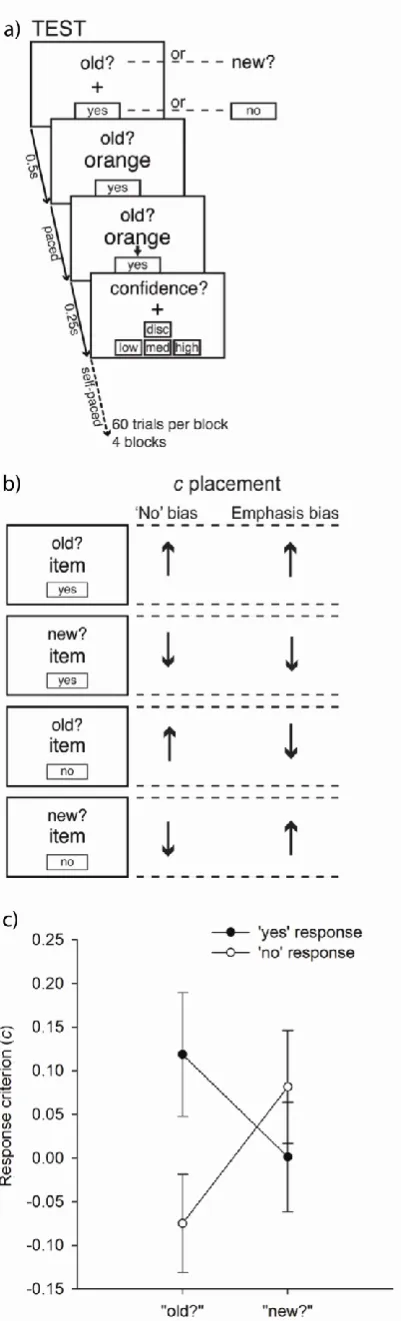
decision goals (see Fig. 3b).
To adjudicate between these interpretations, we independently manipulated question
format (similar to emphasis in Experiments 1 and 2) and response format. The
response format manipulation was effectuated by providing only one response option
at test, with the alternative response indicated by withholding from using that
response option. This is similar to laboratory-based go/no go procedures (e.g. Bruin
& Wijers, 2002) and applied eye-witness identification procedures where participants
are given the option of not-responding in perpetrator-free line-ups (e.g. Weber &
Perfect, 2012) Across study-test blocks, this single response option denoted either a
"yes" or a "no" response, and was varied independently of question format. This
allowed us to test whether bias shifts according to the decision emphasised as a
goal by the combination of the question and response formats, or whether it followed
the decision which maps onto a "no" response irrespective of emphasis (see Fig.
3b).
____________________
FIGURE 3 ABOUT HERE
____________________
____________________
FIGURE 4 ABOUT HERE
____________________
4.1.1. Participants. Participants were 29 native English speakers who reached the
minimum performance threshold (21 female; mean age = 20.6; age range = 18 to 25)
from a full sample of 35 completing the experiment (4 were excluded for failing to
understand task instructions, 2 for poor task performance). Informed consent and
compensation procedures were identical to those in Experiment 2.
4.1.2. Stimuli. The pool of stimuli from which words were drawn was identical to that
used in Experiments 1 and 2. Each of five study-test blocks utilised 120 words (60
old and 60 new at each test phase) such that participants were presented with 600
words over the course of the study. The experiment was presented and responses
recorded using PCs running MATLAB and Psychophysics Toolbox.
4.1.3. Procedure. After the presentation of on-screen instructions and a practice
phase, participants completed five study-test blocks. All study phases employed a
self-paced case judgement task presented and responded to in a manner identical to
that described for Experiment 2 (study phase RT M = 1.09s, SD = 0.58), and were
immediately followed by test phases comprising 60 old words and 60 new words.
The first test phase comprised a recognition test with neutral emphasis (no single
decision was emphasised by the question or response format) and was used to
calibrate the response window in which recognition decisions could be made in
subsequent test phases. In this calibration test phase, to-be-judged words were presented below the question “old/new?”, and participants used the keyboard to give
an “old” or a “new” response. Following each recognition decision, participants
received the prompt “confidence?” and provided a confidence rating of “low”,
“medium” or “high”. Both responses were self-paced. The response window for
participant-by-participant basis, as the 80th percentile of the slowest category of recognition decisions broken down by confidence (typically “low” confidence decisions). This
response window ensured that participants had sufficient time to make paced
recognition decisions in subsequent test phases (M = 3.84 s, SD = 1.69).
The next four test phases comprised blocked combinations of question format (“old?”
or “new?”) and response format (“yes” keypress or “no” keypress; see Fig. 3a).
Question format was manipulated across blocks as described for Experiment 2. Response format was manipulated across blocks by allocating either “yes” or “no” to
a single keyboard response. Participants submitted the allocated response with a
keypress or endorsed the opposing response by withholding the keypress for the
duration of the paced trial. To prevent preferential keypress responding to hasten
completion of the task, the second stage of responding was initiated after the full
response window had elapsed, irrespective of whether a keypress was made or withheld. Subsequently, participants received the prompt “confidence?” and provided
a self-paced confidence rating of “low”, “medium” or “high”. Participants could
alternatively make a “discard” response if they wanted their previous recognition
decision to be ignored. This option was intended for when participants had failed to
render a response due to an attentional lapse and prevented such trials from being
coded as deliberately withheld responses. A 0.5 s fixation cross preceded each
recognition assessment and a 0.25 s fixation cross preceded each confidence
assessment.
Across the four study-test blocks, participants completed two test phases with an old
decision emphasis (“old?”-“yes” and “new?”-“no”), and two test phases with a new
pseudorandomised order that minimised the combined switching of question and
response formats across study-test blocks.
4.2. Results and Discussion
4.2.1. Sensitivity and bias. A 2 (response format: “yes” keypress or “no” keypress) x 2 (question format: “old?” or “new?”) repeated measures ANOVA on estimates of d′
revealed no significant main or interaction effects, all Fs < 1. As expected, sensitivity
was unaffected by the test format manipulations.
For the main analysis, a 2 (response format) x 2 (question format) repeated
measures ANOVA on response criterion c found no main effects of response or
question format, F(1,28) = 3.73, p = .064, ηp2 = .117 and F < 1 respectively.
Crucially, the interaction of response format and question format was significant,
F(1,28) = 8.50, p = .007, ηp2 = .233 (see Table 1 for means). Planned pairwise
comparisons revealed significant increases in c (i.e. a shift towards conservative “old” responding) when old was emphasised by the combination of response and
question formats (see Fig. 3c). For the “yes” response format, c was placed higher
for “old?” than “new?” questions, t(28) = 2.41, p = .023, d = 0.45. For the “no”
response format, c was lower for “old?” than “new?” questions, t(28) = 2.77, p = .010,
d = 0.52.Note that in the “no” response format condition, old emphasis is imparted by a “new?” question and new emphasis is imparted by an “old?” question (see Fig.
3a for further details).These findings replicate the biases observed in Experiments 1
and 2, and suggest that the effect is indeed driven by which decision is emphasised as a goal, and not by a general tendency to respond “no”.
separately for each response format condition. A 2 (decision type) x 2 (question format) repeated measures ANOVA for the “yes” response condition yielded no
significant effects of decision type, F(1,28) = 1.98, p = .171, ηp2 = .066, and question
format, F < 1. Importantly, the decision type x question format interaction was
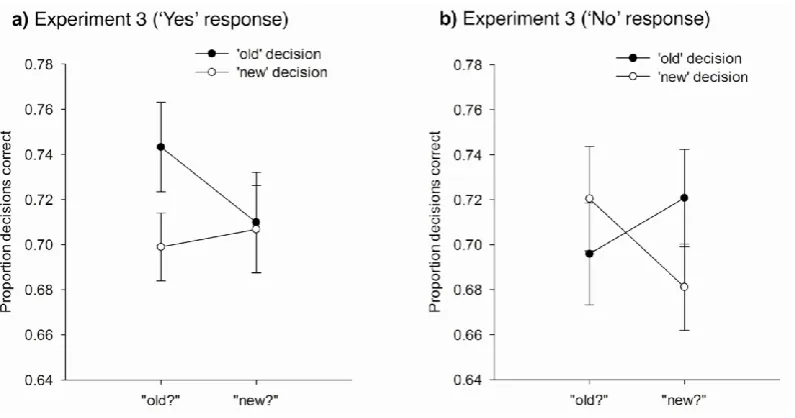
significant, F(1,28) = 14.19, p = .001, ηp2 = .336, with “old?” improving the accuracy of “old” decisions and “new?” improving the accuracy of “new” decisions (see Fig. 4a;
see Table 1 for means). Post-hoc comparisons revealed a numerical difference approaching significance in “old” decision accuracy across question conditions, t(28)
= 2.01, p = .054, d = 0.37, with a nonsignificant difference in the same emphasis-consistent direction obtained for “new” decision accuracy, t(28) = 0.48, p = .637, d =
0.09.
A 2 (decision type) x 2 (question format) repeated measures ANOVA for the “no”
response condition yielded no significant main effects of decision type and question
format, both Fs < 1. Crucially, the decision type x question format interaction was
significant, F(1,28) = 14.19, p = .001, ηp2 = .336, with “new?” improving the accuracy of “old” decisions and “old?” improving the accuracy of “new” decisions (as
mentioned before, this bias is in a goal-driven direction, given the inverse emphasis imparted by the question in the “no” response condition; see Fig. 4b). Post-hoc
comparisons revealed an emphasis-consistent trend approaching significance for
new decision accuracy across question conditions, t(28) = 2.04, p = .051, d = 0.39,
with a nonsignificant effect in the same emphasis-driven direction obtained for old
decision accuracy, t(28) = 1.12, p = .271, d = 0.21. The decision accuracy findings
from Experiments 1 and 2 were hence replicated in both response format conditions
5. General Discussion
Across three recognition experiments, the format of the test question acted as a
consistent source of bias in memory decision-making. Experiment 1 recruited a large
online sample and provided some preliminary evidence of bias effects introduced by
the test question typically presented in recognition research. Experiment 2
effectuated a more targeted laboratory follow-up to these exploratory findings, by
demonstrating that the question bias is most prominent under conditions of low
memory strength. Experiment 3 tested two competing explanations for the bias,
finding evidence that it was driven by a goal-driven mechanism rather than a preference for “no” responses. In all three experiments, we replicated the novel
finding of a counter-emphasis bias – a decrease in endorsement of the memory
decision emphasised by the memory test itself. Our analyses involving the more
unorthodox decision accuracy measures also recovered a consistent effect of
question emphasis improving the accuracy of endorsements of the emphasised
decision. Considered with the response bias effects, the pattern of results suggests
that the counter-emphasis serves to improve the accuracy of making emphasised
responses, at the expense of their frequency. We now discuss these results in light
of previous findings in the fields of memory and decision-making.
Prior studies observing effects of test format on memory performance have often
employed recognition paradigms primarily tailored for the study of false memories,
such as the Deese-Roediger-McDermott paradigm (DRM; Deese, 1959; Johnson et
al., 1997; Mather, Henkel & Johnson, 1997; Roediger & McDermott, 1995). Further,
those studies that have investigated effects of test format in the standard single item
subjective experiences of memory (Bastin & Van der Linden, 2003; Dodson &
Johnson, 1993; Hicks & Marsh, 1999; Khoe, Kroll, Yonelinas, Dobbins, & Knight,
2000; Marsh & Hicks, 1998). For example, Hicks and Marsh (1999) reported an increase in “old” responding in a recognition test phase comprising three response
options with two “old” subcategories (“remember old”/“know old”/“new”) compared to
a test phase with two equally weighted response options (“old”/“new”, followed by
“remember”/“know”; though cf. Bruno & Rutherford, 2010). Here we present
evidence of a test format bias in the primary measure of recognition performance,
which manifests in the absence of unequally weighted response options.
Nevertheless, our findings coalesce with previously reported test format biases in
false memory and source memory paradigms, in highlighting the salient influence of
monitoring and control processes in constraining the outcomes of memory
evaluations (Johnson et al., 1993; Jacoby et al., 1999).
Further, the observed bias was in the opposite direction to previously reported test
format biases, such as the acquiescence bias in questionnaire responding
(Podsakoff, et al., 2003), the Loftus framing effect (Loftus, 1996) and decision cueing
in recognition research (e.g. Egan, 1958; O'Connor, et al., 2010; Ratcliff, et al., 1992;
Rhodes & Jacoby, 2007). We suggest that our counter-emphasis bias differs from
cue-driven biases in that it establishes a decision goal against which retrieved
memory evidence is evaluated, rather than contributing to the evidence itself. This
aspect also differentiates the present question effects from the classic Loftus framing
effect, in which questions that framed details of potentially encoded contexts (“leading questions”) led to a confirmatory response tendency that enhanced
fallacious endorsement of contexts as having been previously experienced (Loftus,
would putatively impact upon memory decision-making by directly interfering with the
assessment of memory evidence. Rather, our question manipulations impacted via a
more meta-memorial pathway, by implicitly emphasising a particular memory
decision as a higher order goal, the endorsement of which demanded a higher level
of memory evidence relative to the non-emphasised decision. Our findings therefore
inform a tentative distinction between three major strategic biases wrought by
different aspects of the retrieval environment on memory decision-making: decision
cueing (confirmatory), evidence framing (confirmatory) and goal emphasis
(disconfirmatory). Future research will be needed to corroborate this distinction.
The present effects hence reveal a strategic influence on conscious memory use
consistent with findings in the rewarded decision-making literature, particularly mixed
incentive research. In mixed incentive research, monetising one of two available
response options leads to a reluctance to endorse the monetised decision (Newman
et al., 1985). A similar disconfirmatory bias was reported in a prior recognition experiment that differentially provided mixed incentives for “old” or “new”decisions
(Han et al., 2010). The present findings are notable for inducing comparable caution
without the provision of incentives, and demonstrate that even in the absence of any
explicit mention of reward, participants display a goal-directed bias that is driven by
implicit information gleaned from the testing environment. Future research is
necessary to test the correspondence of the present question emphasis effects with
more explicit emphasis mechanisms involving incentives.
We also found evidence that the counter-emphasis bias, whilst decreasing the
frequency of the emphasised decision, improved the accuracy of these decisions
no impact on old/new discrimination sensitivity, which is largely determined by
encoding processes (Craik & Lockhart, 1972; Stretch & Wixted, 1998; albeit with
some exceptions; Dobbins & McCarthy, 2008; Marsh & Hicks, 1998). Indeed, across
all three experiments our retrieval manipulations had little effect on measures of d′ sensitivity that binned responses by „objective‟ item categories and collapsed across
old and new decisions. However, the reported effects on decision accuracy (oldcorr
and newcorr; measures that binned responses by „subjective‟ decision categories)
highlight the efficacy of these more unorthodox analyses in elucidating a strategic
effect which would otherwise be obscured by standard d' sensitivity analysis.
Analogous influences of the test environment on the strategies adopted in monitoring
retrieved memory evidence have been highlighted previously in the study of source
monitoring and false memories (Johnson et al., 1997; Lindsay & Johnson, 1989;
Mather et al., 1997). In the present context, it furthers our suggestion of a
goal-directed mechanism underlying the counter-emphasis bias, in that participants were
seemingly prompted by the question to adjust their response criterion towards a
more rigorous evaluation of the retrieved memory evidence supporting the
emphasised decision. The question therefore served to instil the goal of getting a
greater proportion of the emphasised decisions correct, even if that entailed making
fewer endorsements of that decision.
Whilst the counter-emphasis bias was reliably elicited across three experiments,
further research is undoubtedly necessary to corroborate our interpretations of its
underlying mechanism. Beyond the highlighted need to test both the proposed
differentiation of retrieval format biases and the correspondence between implicit
and explicit forms of goal emphasis, future research might also seek to clarify
(as has been recently suggested e.g. Kafkas & Montaldi, 2014), as well as the
potential mediating role of individual differences in bias tendency (Aminoff et al.,
2012; Kantner & Lindsay, 2012). Another intriguing avenue for future research could examine participants‟ awareness of the variations in question emphasis, and how
manipulating this awareness (e.g. by dividing attention at test) impacts on the
evoked bias. Nonetheless, the reliable effect of question format on recognition bias
presented here reflects the role that subtle aspects of the test environment can have
on the precise quantification of established memory measures. Importantly for
laboratory-based memory research, we show that the canonical yes-no memory
experiment itself provides a source of bias which has hitherto received scant
systematic investigation.
As with many psychological phenomena, it is useful to think of the findings reported
here as functional or adaptive when placed in the context of the real world in which
we make almost all of our memory decisions. An eyewitness confronted with a line-up of potential suspects is cautious of making an “old” decision as this initiates an
action sequence that might end with the prosecution of the identified individual; the alternate “new” decision is comparatively less consequential, as no conclusive step
is taken to end the ongoing suspect search. Alternatively, a guard tasked with
ensuring security at restricted event may be cautious about making a “new”decision,
as this initiates apprehension of the identified individual, whereas rendering the alternate “old” decision maintains the status quo. In sum, the present findings add to
emerging research highlighting the close coupling of memory and environmental
factors which may be the reason the evaluation is being made in the first place.
Above all, it is necessary to remember that memory function, like any cognitive
great difficulty. Even when we believe we have this isolation, the inferences our
participants make which carry over from their adaptive use in hundreds of
day-to-decisions, may have pervasive and unexpected influences which it is important to
References
Aminoff, E. M., Clewett, D., Freeman, S., Frithsen, A., Tipper, C., Johnson, A., . . .
Miller, M. B. (2012). Individual differences in shifting decision criterion: a
recognition memory study. Memory and Cognition, 40(7), 1016-1030. doi:
10.3758/s13421-012-0204-6
Balota, D. A., Yap, M. J., Cortese, M. J., Hutchison, K. A., Kessler, B., Loftis, B., . . .
Treiman, R. (2007). The English Lexicon Project. Behavior Research
Methods, 39, 445-459. doi: 10.3758/BF03193014
Bastin, C., & Van der Linden, M. (2003). The contribution of recollection and
familiarity to recognition memory: a study of the effects of test format and
aging. Neuropsychology, 17(1), 14-24. doi: 10.1037//0894-4105.17.1.14
Brainard, D. H. (1997). The Psychophysics Toolbox. Spatial Vision 10, 433-436. doi:
10.1163/156856897X00357
Bruin, K. J., & Wijers, A. A. (2002). Inhibition, response mode, and stimulus
probability: A comparative event-related potential study. Clinical
Neurophysiology, 113, 1172-1182.
Bruno, D., & Rutherford, A. (2010). How many response options? A study of
remember-know testing procedures. Acta Psychologica, 134(2), 125-129.
Cox, J. C., & Dobbins, I. G. (2011). The striking similarities between standard,
distractor-free, and target-free recognition. Memory and Cognition, 39(6),
925-940. doi: 10.3758/s13421-011-0090-3
Craik, F. I. M., & Lockhart, R. S. (1972). Levels of processing: A framework for
memory research. Journal of Verbal Learning and Verbal Behavior, 11,
Deese, J. (1959). On the prediction of occurrence of particular verbal intrusions in
immediate recall. Journal of Experimental Psychology, 58(1), 17-22.
Dobbins, I. G., & McCarthy, D. (2008). Cue-framing effects in source remembering:
A memory misattribution model. Memory & Cognition, 36(1), 104-118. doi:
10.3758/MC.36.1.104
Dodson, C. S., & Johnson, M. K. (1993). Rate of false source attributions depends
on how questions are asked. The American journal of psychology, 541-557.
Donaldson, W. (1996). The role of decision processes in remembering and knowing.
Memory & Cognition, 24(4), 523-533. doi: 10.3758/BF03200940
Duncan, K., Sadanand, A., & Davachi, L. (2012). Memory's penumbra: episodic
memory decisions induce lingering mnemonic biases. Science, 337(6093),
485-487. doi: 10.1126/science.1221936
Egan, J. P. (1958). Recognition memory and the operating characteristic. USAF
Operational Applications Laboratory Technical Note, 58-51, ii, 32.
Egan, J. (1975). Signal detection theory and ROC analysis. New York: Academic
press.
Estes, W. K., & Maddox, W. T. (1995). Interactions of stimulus attributes, base rates,
and feedback in recognition. Journal of Experimental Psychology: Learning,
Memory, and Cognition, 21(5), 1075-1095. doi: 10.1037/0278-7393.21.5.1075
Green, D. M., & Swets, J. A. (1966). Signal detection theory and psychophysics.
New York: Wiley.
Han, S., & Dobbins, I. G. (2009). Regulating recognition decisions through
incremental reinforcement learning. Psychonomic Bulletin & Review, 16(3),
Han, S., Huettel, S. A., Raposo, A., Adcock, R. A., & Dobbins, I. G. (2010).
Functional significance of striatal responses during episodic decisions:
recovery or goal attainment? Journal of Neuroscience, 30(13), 4767-4775.
doi: 10.1523/jneurosci.3077-09.2010
Healy, A. F., & Kubovy, M. (1978). The effects of payoffs and prior probabilities on
indices of performance and cutoff location in recognition memory. Memory
and Cognition, 6(5), 544-553. doi: 10.3758/BF03198243
Hicks, J. L., & Marsh, R. L. (1999). Remember-know judgments can depend on how
memory is tested. Psychonomic Bulletin & Review, 6(1), 117-122. doi:
10.3758/BF03210818
Hirshman, E. (1995). Decision processes in recognition memory: criterion shifts and
the list strength paradigm. Journal of Experimental Psychology: Learning,
Memory, and Cognition, 21(2), 302-313. doi: 10.1037//0278-7393.21.2.302
Jacoby, L. L., Kelley, C. M., & McElree, B. D. (1999). The role of cognitive control:
Early selection versus late correction. In S. Chaiken & Y. Trope (Eds.),
Dual-process theories in social psychology (Vol. xii, pp. 383-400). New York, NY,
US: Guilford Press.
Jaeger, A., Cox, J. C., & Dobbins, I. G. (2012). Recognition confidence under
violated and confirmed memory expectations. Journal of Experimental
Psychology General, 141(2), 282-301. doi: 10.1037/a0025687
Johnson, M. K., Hashtroudi, S., & Lindsay, D. S. (1993). Source monitoring.
Psychological Bulletin, 114(1), 3-28.
Johnson, M. K., Nolde, S. F., Mather, M., Kounios, J., Schacter, D. L., & Curran, T.
recognition memory depends on test format. Psychological Science, 8(3),
250-257. doi: 10.1111/j.1467-9280.1997.tb00421.x
Kafkas, A., & Montaldi, D. (2014). Two separate, but interacting, neural systems for
familiarity and novelty detection: A dual-route mechanism. Hippocampus. doi:
10.1002/hipo.22241
Kahneman, D., Slovic, P., & Tversky, A. (1982). Judgement under uncertainty:
Heuristics and biases. New York, NY: Cambridge University Press.
Kantner, J., & Lindsay, D. S. (2012). Response bias in recognition memory as a
cognitive trait. Memory & Cognition, 40(8), 1163-1177. doi:
10.3758/s13421-012-0226-0
Khoe, W., Kroll, N. E. A., Yonelinas, A. P., Dobbins, I. G., & Knight, R. T. (2000). The
contribution of recollection and familiarity to yes-no and forced-choice
recognition tests in healthy subjects and amnesics. Neuropsychologia, 38(10),
1333-1341. doi: 10.1016/s0028-3932(00)00055-5
Lindsay, D. S., & Johnson, M. K. (1989). The eyewitness suggestibility effect and
memory for source. Memory & Cognition, 17(3), 349-358.
Loftus, E. F., Donders, K., Hoffman, H. G., & Schooler, J. W. (1989). Creating New
Memories That Are Quickly Accessed and Confidently Held. Memory &
Cognition, 17(5), 607-616. doi: 10.3758/Bf03197083
Loftus, E. F. (1996). Eyewitness testimony: Harvard University Press.
Macmillan, N. A., & Creelman, C. D. (2005). Detection theory: A user's guide
(Second ed.). New York: Lawrence Erlbaum.
Marsh, R. L., & Hicks, J. L. (1998). Test formats change source-monitoring decision
processes. Journal of Experimental Psychology: Learning, Memory, and
Mather, M., Henkel, L. A., & Johnson, M. K. (1997). Evaluating characteristics of
false memories: Remember/know judgments and memory characteristics
questionnaire compared. Memory & Cognition, 25(6), 826-837. doi:
10.3758/Bf03211327
Newman, J. P., Widom, C. S., & Nathan, S. (1985). Passive avoidance in syndromes
of disinhibition: psychopathy and extraversion. Journal of Personality and
Social Psychology, 48(5), 1316-1327. doi: 10.1037//0022-3514.48.5.1316
O'Connor, A. R., Han, S., & Dobbins, I. G. (2010). The inferior parietal lobule and
recognition memory: Expectancy violation or successful retrieval? . Journal of
Neuroscience, 30(8), 2924-2934. doi: 10.1523/JNEUROSCI.4225-09.2010
Podsakoff, P. M., MacKenzie, S. B., Lee, J. Y., & Podsakoff, N. P. (2003). Common
method biases in behavioral research: a critical review of the literature and
recommended remedies. Journal of Applied Psychology, 88(5), 879. doi:
10.1037/0021-9010.88.5.879
Ratcliff, R., Sheu, C.-F., & Gronlund, S. D. (1992). Testing Global Memory Models
Using ROC Curves. Psychological Review, 99(3), 518-535. doi:
10.1037/0033-295X.99.3.518
Rhodes, M. G., & Jacoby, L. L. (2007). On the dynamic nature of response criterion
in recognition memory: effects of base rate, awareness, and feedback.
Journal of Experimental Psychology Learning Memory and Cognition, 33(2),
305-320. doi: 10.1037/0278-7393.33.2.305
Roediger, H. L., III, & McDermott, K. B. (1995). Creating false memories:
Remembering words not presented in lists. Journal of Experimental
Snodgrass, J. G., & Corwin, J. (1988). Pragmatics of Measuring Recognition
Memory: Applications to Dementia and Amnesia. Journal of Experimental
Psychology: General, 117(1), 34-50. doi: 10.1037/0096-3445.117.1.34
Stretch, V., & Wixted, J. T. (1998). Decision rules for recognition memory confidence
judgements. Journal of Experimental Psychology: Learning, Memory, and
Cognition, 24(6), 1397-1410. doi: 10.1037/0278-7393.24.6.1397
Van Zandt, T. (2000). ROC curves and confidence judgments in recognition memory.
Journal of Experimental Psychology: Learning, Memory, and Cognition, 26(3),
582-600. doi: 10.1037/0278-7393.26.3.582
Wallace, W. P. (1980). On the use of distractors for testing recognition memory.
Psychological Bulletin, 88(3), 696-704. doi: 10.1037//0033-2909.88.3.696
Weber, N. & Perfect, T. (2012).Improving eyewitness identification accuracy by
screening out those who say they don't know. Law and Human Behavior,
Tables
Table 1.
Note: M, mean; SD, standard deviation.
Experiment 1 Experiment 2 Experiment 3
Encoding
task syllables case pleasantness case
Question
format old new old new old new old new old new Response
format - - - yes yes no no
Emphasis old new old new old new old new new old
H M .77 .79 .64 .70 .92 .91 .69 .72 .74 .68
SD .15 .12 .17 .13 .08 .08 .13 .15 .14 .14
CR M .81 .79 .81 .74 .89 .86 .75 .71 .69 .73
SD .10 .12 .12 .15 .08 .09 .13 .16 .16 .15
d′ M 1.71 1.73 1.37 1.28 2.83 2.57 1.26 1.28 1.26 1.18
SD 0.61 0.58 0.70 0.87 0.63 0.54 0.55 0.82 0.80 0.66
c M 0.06 -0.00 0.26 0.07 -0.09 -0.13 0.12 0.00 -0.07 0.08
SD 0.36 0.37 0.41 0.26 0.34 0.32 0.38 0.34 0.30 0.35 oldcorr M .81 .80 .78 .73 .90 .87 .74 .71 .70 .72
SD .09 .10 .11 .12 .07 .07 .11 .12 .12 .12
newcorr M .79 .80 .71 .71 .92 .91 .70 .71 .72 .68
Figures
Captions
Table 1. Design key and descriptive statistics for unadjusted hit rate (H), unadjusted
correct rejection rate (CR), sensitivity (d′), response bias (c), “old” decision accuracy
(oldcorr) and “new” decision accuracy (newcorr), as observed across all experiments.
Figure 1. a) Design schematic for Experiment 1 showing study and test phases. b)
Experiment 1 results for response criterion (c) across question emphasis conditions.
c) Experiment 2 results for c across question emphasis conditions, with separate
lines denoting LOP condition. Error bars represent standard error of the mean.
Figure 2. Results of the accuracy by decision type analyses for: a) Experiment 1, b)
the Experiment 2 shallow LOP condition and c) the Experiment 2 deep LOP
condition. Separate lines denote decision type (“old” or “new”; responses binned by
decision status) and error bars represent standard error of the mean.
Figure 3. a) Design schematic for Experiment 3 test phase. Within each 120-trial test block, participants responded to words presented alongside a question (either “old?”
or “new?”; varied blockwise) by endorsing or withholding a single response (either
“yes” or “no”; varied blockwise). The response window for endorsing or withholding
recognition responses was equated, and calibrated on a participant-by-participant
basis. After each recognition response, confidence was assessed on a three-point scale, with an additional “discard” option allowing participants to discard missed
competing bias predictions for Experiment 3. Arrows denote deviations from optimal
criterion placement at 0, with increasing c associated with decreased “old”
responding („conservative‟ “old” responding) and decreasing c associated with
increased “old” responding („liberal‟ “old” responding). According to the “no”
attraction prediction, participants consistently prefer responding “no”, and hence c
should decrease when an “old”decision maps to the “no” response option
(“new?”-“yes” and “new?”-“no” test blocks), and increase when it maps to the „yes‟ response
option (“old?”-“yes” and “old?”-“no” test blocks). According to the counter-emphasis
prediction, the combination of the question and response formats serves to
emphasise one class of decision, and participants decrease endorsement of that
decision. Hence, c should increase when “old” decisions are emphasised
(“old?”-“yes” and “new?”-“no” test blocks) and decrease when “new”decisions are
emphasised (“new?”-“yes” and “old?”-“no” test blocks). c) Experiment 3 results for c
across question format conditions, grouped by response format conditions. Error
bars represent standard error of the mean.
Figure 4. Results of the accuracy by decision type analyses for the two response format conditions in Experiment 3: a) “Yes” response condition and b) “No” response
condition. Note that in the „no‟ response condition, emphasis is reversed i.e.
“old?”-“no” emphasises “new” decisions and “new?”-“old?”-“no” emphasises “old” decisions.
Separate lines denote decision type (old” or “new”; responses binned by decision