Exceptions and their Correlations: A Methodology
for Research in Grammar
Christopher Beedham
Dept. of German, School of Modern Languages, University of St
Andrews
Abstract
A method of empirical research is described in which unexplained exceptions to a rule and their correlations are used in a systematic way to lead the researcher to a revised version of the rule which explains and removes the rule’s anomalies, especially the exceptions which one started out with. Two rules and their exceptions in English, German, and Russian are presented as case studies in the method: the passive and non-passivizable transitive verbs; tense formation and irregular verbs. It is hoped that other linguists will try out the method on their own chosen constructions in their own languages.
1. Introduction
In this paper we will look at how unexplained exceptions to a rule and their correlations can be used in a systematic way to lead the researcher to a revised version of the rule which explains and removes the rule’s anomalies, especially the exceptions which one started out with.1 We will examine two constructions and their exceptions as case studies in the method – the rule of passive, and non-passivizable transitive verbs; tense formation, and irregular verbs – in English, German, and Russian. The examination of these two areas will be brief, because the paper is about method, not about the passive or irregular verbs, but references will be given to enable the reader to follow up the analyses presented. Because the reason for writing the paper is to encourage other linguists to try out the method on their own chosen constructions in their own languages some detail of the history of the method, how it
developed over time, how long it took to carry out the data collection, is included in order to give the reader an idea of the time-scale involved if he or she decides to try it out. For the same reason some further practical details about using reference works, native speaker
informants, and research assistants are also included. For further details on all these matters -the method, -the passive, and irregular verbs - see Beedham (2005b), Danks (this volume); on exceptions in general see Simon and Wiese (eds.) (2011), Corbin and Dessaux-Berthonneau (1985).2
2. Theoretical background
1This paper is an updated version of the Summer School part of the Summer School and Conference on the Method of Lexical Exceptions held at the University of St Andrews, Scotland, from 2 – 8 September 2007. Hitherto I have referred to the method as ‘the method of lexical exceptions’. I now i.e. from this volume -refer to it as the method of exceptions and their correlations. It is the same method, but called by a name which goes more to the heart of how the method works.
The approach taken by the method of exceptions and their correlations is descriptive (as opposed to generative) and based on Saussurean structuralism (Saussure, 1983). The term ‘descriptive’ is used here despite the fact that it is misleading in that some linguists claim that descriptive linguistics merely describes, without explaining. However, in our view
‘descriptive’ linguistics is indeed analytical – it produces analyses - and explanatory, i.e. theoretical (in the pre-Chomskyan sense of ‘theoretical’): the explanation is in the
description. There is a link with pedagogical grammars and language teaching: the areas of grammar and lexis which descriptive grammarians choose to examine are usually the ones which foreign learners of a language find difficult. And for descriptivists the ultimate test of a new theoretical analysis is whether it is taken up in pedagogical grammars.
It is useful though not essential when using the method of exceptions and their correlations to investigate the same formal construction in two or more languages, because it gives you two or more different angles on the same construction. It is also helpful if one of your languages is a foreign language, i.e. not your native language, because you then automatically have the psychic distance necessary to carry out an objective, scientific analysis. It is all too easy when analysing one’s native language to fall into the trap of thinking that the categories and rules one sees there are natural and logical and based on the way the world is, rather than the language-specific, idiosyncratic and arbitrary (in the Saussurean sense) categories and rules which they, in fact, are. You should be an advanced learner of the foreign language in question and hence speak it reasonably fluently: this is necessary to enable you to adjudicate the grammaticality judgements of your native-speaker informants. On the other hand, if one of your languages is your native language that is also handy because of the greater intuitive insights you have for that language. For both foreign language and native language the researcher is actually trying to bring out his or her native speaker(-like) intuitions into an explicit, scientific analysis. Having said it is best to investigate your chosen construction in two or more languages, of course the arguments in support of an analysis in a given language have to come from the structure of that language, one cannot argue across languages and say, for example, because the situation in Russian is this I want to analyse a construction of English like this. The arguments for English have to come from the structure of English.
3. The passive and non-passivizable transitive verbs
One of the problems we face in theoretical linguistics is how to make the discipline empirical. Some would say it does not need to be empirical, it just is a theoretical discipline, but every theory needs a practice, theory and practice go together. Others would say that linguistics is already empirical, e.g. through the use of computer corpora, and that is true, but there is another,langue-oriented and grammar-based way in which we can make it empirical, and that is through the use of unexplained exceptions to grammatical rules. Let us take
non-passivizable transitive verbs as an example. The traditional and still wide-spread rule of passive says that every transitive verb can form a passive, but it is well-known that there are a small number of transitive verbs in English, German and Russian which do not form a
passive, despite being transitive, e.g. 1 in English, 2 in German and 3 in Russian below (on the passive in English see Quirk et al., 1985, pp. 159-171; in German see Durrell, 2002, pp. 307-322, and Helbig and Buscha, 1989, pp. 161-188; in Russian see Borras and Christian
1971, pp. 165-173, and Грамматика русского языка, 1960, pp. 504-515):
(1) a. James knows Fiona.
b. ?Fiona is known by James. (2) a. Er mag Käse.
b. ?Käse wird von ihm gemocht cheese is by him liked ‘cheese is liked by him’
(3) a. Predsedatel’ poblagodaril Ivana the-chairman thanked Ivan ‘the chairman thanked Ivan’
b. *Ivan byl poblagodaren predsedatelem Ivan was thanked by-the-chairman ‘Ivan was thanked by the chairman’
3.1. Identifying the exceptions
A common approach in descriptive grammars and theoretical-descriptive accounts is to view these unexplained exceptions, the non-passivizable transitive verbs, as part of the sometimes wilful nature of language and simply to list them, without even attempting an explanation; or else to give a separate semantic reason almost for each sentence, e.g. the agent is not
sufficiently agentive, the patient is not sufficiently patient-like, the verb is stative, relational, psychological, etc., such that so many different reasons are given, and all of them semantic, that one realises that no genuine explanation in terms of a significant generalization is being given at all. But firstly, there must surely be some reason for the aberrant behaviour of the exceptions – we just have to look for it and find it. Secondly, surely the first question we need to ask is exactly how many verbs like that – not able to form a passive, despite being transitive – are there in a given language, and which verbs are they? Instead of theorising in a vacuum one needs to carry out some empirical work, some work with dictionaries and native speaker informants. That is what the author did for his PhD in the period 1976-1979 (published as Beedham, 1982), he trawled through dictionaries of English, German, and Russian and got sentences tested for their grammaticality by native speakers, and in the space of about 6 months3an exhaustive and finite list of every non-passivizable transitive verb in English, German, and Russian was produced. The dictionaries used were for English the Oxford advanced learner’s dictionary of current English(1974); for German Mater (1971),
and Klappenbach and Steinitz (1977); for Russian the 17 vol. Словарь cовременного русского языка (1951-1965). The most useful dictionaries were those which give plenty of
example sentences showing how a word is used. Of course, there are always grey areas, in this case to do with what exactly is a transitive verb, what do you do with verbs which passivize in one meaning but not another, some verbs form a passive in one sentence but not another, etc. etc. But in essence it was possible to extract an exhaustive and finite list of more or less non-passivizable transitive verbs in the three languages within a reasonable space of time, some examples of which are given in (4) for English and (5) for German below:
(4) some English non-passivizable transitive verbs:4 become boast contain cost cross dread dream exceed get have involve know lack live love marry near need possess regret remind resemble stall walk want (5) some German non-passivizable transitive verbs:
anheimeln ‘make feel at home’ anwidern ‘nauseate’ bekommen ‘receive’ besitzen ‘possess’ enthalten ‘contain’ erforden ‘require’ ergötzen ‘enthrall’ freuen ‘please’ haben ‘have’ kennen ‘know’ kosten ‘cost’ kriegen ‘get’ mögen ‘like’ schmerzen ‘hurt’ spüren ‘feel, sense’ tragen ‘bear (fruit)’ träumen ‘dream’ treffen ‘meet’ überkommen ‘overcome’ übersteigen ‘exceed’ verdienen ‘deserve’ verdrieen ‘annoy’ wiegen ‘weigh’ wissen ‘know’ wundern ‘surprise’
That in itself, acquiring the complete set – or at least a tentatively complete set, given the caveats expressed above and in fn. 4 - of the verbs which present the problem is worth more than endless theorising about two or three well-worn examples. It is pointless to
postulate and hypothesize endlessly on the basis of a tiny number of examples, when you can produce in a relatively short space of time a substantial amount of data, hard facts, which can serve as a sound basis for analysis. Of course, you still need to carry out a theoretical
analysis, we are not collecting data instead of doing analysis, but now one has an empirical basis on which to do it. It took 6 months to produce the data but it was 6 months well spent, since it was the new data which led to the new analysis which will be presented below. 3.2. Conducting “experiments”
We have the data, i.e. the finite and exhaustive list of non-passivizable transitive verbs, but what do you do with them? Our working hypothesis is that the exceptions are not really there in the actual structure of language, standing completely outside the system, but are there by dint of an incorrect analysis, they are an artefact of a mistake by the grammarians. The grammarians must have come up with an incorrect rule to have produced so many unexplained exceptions. The exceptions must fit into the system somewhere, because a language is a system whose elements are determined by their place in the system (Saussure, 1983) – all of whose elements, not just some of them. So what you do is you examine the exceptions in minute detail, bringing out their properties – syntactic, morphological,
semantic, everything you can think of – to try to see what it is that is special about them, what is it about them that makes them resist a construction which by rights they ought to undergo, what is it that makes them non-passivizable. In 1976-1979 the author had no idea where to
look or where to start, so he cast around fairly randomly and blindly, testing the verbs and sentences he had for the effects of questions, negation, the absence of a passiveby-phrase, the presence of an adverb, etc. etc. on their passivizability. This part of the exercise took about a year, and all the afore-mentioned avenues of research drew a blank. Then, completely out of the blue, on a hunch, he tested them for their ability to form a resultative perfect.5 A
resultative perfect is a sentence in the perfect which expresses an action and the result which ensues from that action, as in (6) below (Leech, 1971):
(6) She has broken the doll.
In (6) the subject carried out an action in the past, breaking a doll, which led to a result, the result being that the doll is now (at the moment of speech) broken. The result meaning is not just implied or pragmatically deducible, it is formally realized in the perfect. To the author’s surprise two-thirds of the non-passivizable transitive verbs were unable to express a
resultative perfect, as illustrated by (7) for English and (8) for German: (7) James has known Fiona. (Cf. 1)
(8) *Jetzt hat er Käse gemocht. (Cf. 2) now has he cheese liked
‘now he has liked cheese’
In (7) the sentence could only be understood as an experiential perfect – in which James has experienced knowing Fiona at some point in the past – but never as a resultative perfect. In (8), in which a resultative interpretation is forced by starting the sentence withjetzt‘now’ (see Gelhaus and Latzel, 1974, pp. 228-229), the sentence is ungrammatical.
This crucial methodological point, of exploring different avenues which may or may not lead somewhere, does not come across in Waltisberg’s 2012 otherwise excellent review of Danks 2011. Waltisberg (2012:634) writes:
Already in this chapter, D makes extensive use of the chi-square test, a statistical hypothesis test … . Although this methodology yields interesting results, its complexity may not be readily comprehensible to many readers unfamiliar with mathematical statistics. Considering the complexity of this methodology, D’s statistical results seem overall a bit meagre (… for example, ‘one-quarter of pattern III and one-third of pattern VI verbs do not conform to these dominant meanings’ … ).
I am not sure here to what extent Waltisberg is referring to the use of the chi-square test and to what extent the method of exceptions and their correlations.6 As regards the latter, it is important to realise that, with reference to Waltisberg’s statement that ‘D’s statistical results seem overall a bit meagre’, the method works by trying out different avenues which
inevitably initially do not lead anywhere but then eventually, hopefully, the researcher does hit on an avenue which leads to a significant correlation, as happened to Danks. And Waltisberg does indeed speak elsewhere in the review of Danks ‘presenting valuable statistical data’. The point is that without going through the counts which do not end up producing valuable data you wouldn’t do the counts which (unexpectedly) do lead to valuable data and correlations (see also Danks, this volume, footnotes 5 and 10). The ‘unexpectedly’ here is crucial. What you expect is based on your current knowledge. But scientific research
5The resultative perfect test was applied only to the English and German data, it cannot be applied to Russian, because Russian does not have a formally realized perfect, i.e. a construction structurally equivalent tohave+ 2ndparticiple. In fact, it turned out that the Russian participial passive displays an even more interesting correlation than the passive-perfect correlation of English and German – see below, section 3.4.
is about expanding our knowledge. If you restrict yourself to what current knowledge leads you to expect you will be trapped within the confines of that knowledge, you will never discover anything new empirically and thus will never come up with any new ideas. The only route to new knowledge is through empirical exploration, data collection and
experiments. People associate experiments with physics and chemistry, not with grammar, but the method of exceptions and their correlations allows you to do just that, to carry out experiments in grammar which lead empirically to new insights and knowledge.
3.3. Interpreting the data
Returning to the perfect-passive correlation, the question then was, why? Why was it that such an unexpectedly large proportion7of non-passivizable transitive verbs did not form a resultative perfect? When the test or “experiment” was carried out there was no reason, given our state of knowledge then, to expect that that would be the case. There was no reason to expect that the passive had anything to do with the resultative perfect. What had been discovered – note ‘discovered’, not assumed or hypothesised – was a syntactic correlation between the passive and the perfect (syntax in the sense of combinatorial possibilities (not word order)). The passive and the perfect are exhibiting the same behaviour vis-à-vis the same set of verbs, viz. they will allow them to form neither a passive nor a resultative perfect. In other words, the passive is behaving like the perfect. The inference which was drawn from this correlation – taken together with numerous other arguments, e.g. the formal differences between active and passive when they are supposed to be (cognitively) synonymous, the fact that four-fifths of passives occurring in texts are without a realized agentiveby-phrase, etc. (see Beedham, 2005b, pp. 33-60 for details) – was that the passive is the same construction as the perfect, viz. an aspect of the type Auxiliary + Participle, with its own meaning, ‘action + state’, i.e. a new state is expressed (on the subject) as the result of a preceding action (hence the subject is patient), which is similar to the perfect meaning ‘action + result’. To form a passive – and a resultative perfect – a verb or a sentence has to be telic, i.e. it has to have a built-in potential end-point in its semantics, an end-point which becomes the end-state of the meaning ‘action + state’ (on telicity see Comrie, 1976, pp. 44-48). The non-passivizable transitive verbs do not have a built-in end-point, they are atelic. That is why they do not form a passive (for further details see for English Beedham, 1987a, Tobin, 1993, pp. 280-313; for
German Beedham, 1987b, Abraham, 2000; for Russian Бидэм, 1988, Schoorlemmer, 1995,
Beedham, 1998, Poupynin, 1999). The formal evidence for the idea that non-passivizable transitive verbs are atelic is the fact that they do not form a resultative perfect.
This last point is the nub of the method of exceptions and their correlations. The data which take you to a particular analysis also serve as the syntactic evidence for that analysis. This feature of the method arises from the Saussurean point mentioned above that a language is a structure or system whose elements are determined by their place in the system. Also crucial is the fact that the experiment is repeatable, i.e. it is open to anyone to test
non-passivizable transitive verbs – in English, German, or any language which has a
(formally realized) resultative perfect, the modern language or a historically earlier stage of a language – for their ability to form a resultative perfect. Such a repeated experiment would confirm or refute the analysis given here.
Within the methodology described here it is important to note that a new rule for the passive and a new meaning for the passive were found at the same time. This fact ties in with the indivisibility of the linguistic sign, i.e.signifiant(form) andsignifié(meaning) are
inextricably linked (Saussure, 1983, Tobin, 1990, Zubin and Köpcke, 1984, Köpcke, 1982, Beedham, 2008). It is also significant that it was a syntactic correlation – the passive-perfect correlation – which led us to both the new rule and the new meaning: it is an example of form determining meaning.
3.4. The Russian passive
The analysis of the passive as an aspect works particularly well in Russian. Russian has two passive constructions, one formed withbyt’‘to be’ + passive participle, the other formed with the reflexive clitic –sja‘self’, as shown in (9) and (10) below:
(9) Most byl postroen izvestnym inženerom. bridge was built by-famous engineer ‘the bridge was built by a famous engineer’ (10) Most stroilsja izvestnym inženerom.
bridge built-itself by-famous engineer ‘the bridge was built by a famous engineer’
The two Russian passives display a well-known aspectual restriction: usually only perfective verbs form a participial passive, whilst only imperfective verbs form the reflexive passive. The question is, why? Under the voice analysis one has no idea, so much so that the question is never asked. But under the aspect analysis the answer is clear. The two Russian passives are two very different animals. The participial passive is an aspect of the type Auxiliary + Participle, with the meaning ‘action + state’. One sees immediately from the meaning why the participial passive is confined to the perfective verb only. The perfective verb views an action from the outside, having an overview from the beginning to the end of the action. The imperfective verb, in contrast, views an action from within, from inside. Thus only the perfective verb has sight of the end of an action, thus only the perfective verb can form a construction involving the end-state of an action, i.e. the participial passive. The
imperfective verb cannot form it, because it cannot see the end of an action, it is firmly ensconced in the middle of the action. The reflexive passive, on the other hand, is not an aspect of the type Auxiliary + Participle – it has a quite different form, based on the reflexive clitic –sja‘self’ – and it does not mean ‘action + state’. Hence the imperfective verb can form the reflexive passive, despite the fact that it cannot form the participial passive.
The advantage of working on the same formal construction in more than one language can be seen here. With hindsight it was probably the aspectual restriction on the passive in Russian which subconsciously led the author to the passive-perfect correlation in English and German; even though it was not until he discovered the passive-perfect correlation and realised that the passive is an aspect in English and German that he realised that the
participial passive in Russian is an aspect. (For an aspectual analysis of the passive in Arabic see Danks 2011, in Spanish see Gregory 2006, and Daniel Honert, Non-Passivizable
Transitive Verbs in Spanish, paper given at the Romance Linguistics Seminar, Cambridge, 5-6 January 2012).
3.5. Recognising errors and correcting them
step forward and made the new insight that the passive is an aspect of the type Auxiliary + Participle, which like all Auxiliary + Participle aspects is sensitive to the lexical aspect of the verb with which it combines and to the compositional aspect of the sentence in which it appears. Compositional aspect is the overall aspect of a sentence, as determined not just by the verb but by the subject, object and adverbials as well (Verkuyl, 1972, 1993). This
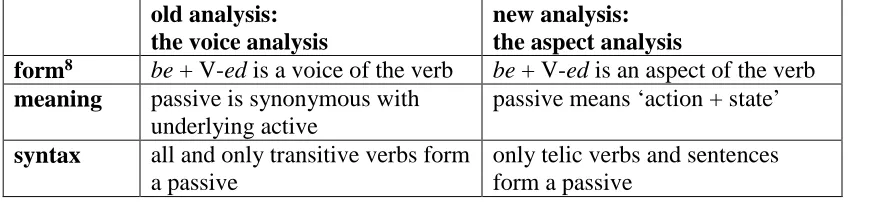
analysis replaces the old voice analysis, under which passives are derived from an underlying active, actives and passives are ‘cognitively synonymous’, and all and only transitive verbs form a passive. We can see now that the voice analysis was wrong. Actives and passives are not synonymous, passivizability is not determined by transitivity, and the passive is not a ‘voice’ of the verb. The passive is an aspect of the verb, it has its own meaning, ‘action + state’, and its syntax is determined by lexical and compositional aspect. Moreover, we have explained the exceptions of the voice rule that we started out with, and rendered them no longer exceptions. We are back again with the nub of the method - the empirical data that you start out with take you to the theoretical analysis which you end up with. If your rule is ‘transitive verbs form a passive’ you have exceptions, but if your rule is ‘to form a passive a verb has to be telic’ you do not. This situation is summed up in Table 1 (for details see Beedham, 2005b, pp. 33-60).
old analysis: the voice analysis
new analysis: the aspect analysis
form8 be+ V-edis a voice of the verb be+ V-edis an aspect of the verb
meaning passive is synonymous with underlying active
passive means ‘action + state’ syntax all and only transitive verbs form
a passive
[image:8.595.65.505.321.422.2]only telic verbs and sentences form a passive
Table 1. The voice analysis versus the aspect analysis of the passive (in Englishbe+ V-ed) The structuralist tenet that a language is a system whose elements are determined by their place in the system, the idea of syntax as combinatorial possibilities, and the notion of compositional aspect are three different ways of saying what is basically the same thing. They all have their embodiment in the sentence.
3.6. The measurement of pro and contra examples
It was said in section 3.2 above that in the experiment conducted two-thirds of
non-passivizable transitive verbs did not form a resultative perfect. So what about the one-third counter-examples, for example many atelic verbs can form a passive, e.g.to like? Firstly, the kind of passive sentences which spring to mind with atelic verbs are those with a special compositional aspect, e.g.John is liked by everyone(in contrastJohn is liked by Maryis odd). The fact that compositional aspect affects passivizability is entirely to be expected if the passive is an aspect of the type Auxiliary + Participle (but is not to be expected if the passive is a voice of the verb). Secondly, to say that some or many atelic verbs form a passive is an impressionistic and vague statement, whilst the method of exceptions and their correlations allows or forces you to list the atelic verbs, using a formal test – we have used the resultative perfect – and then to list the subset of them which form a passive. This was done in Beedham (1982, pp. 102-106), where under the heading ‘Inconsistencies’ 27
sentences of English and 11 sentences of German are given which are atelic – they do not form a resultative perfect – but which nevertheless form a passive. There then follows a section headed ‘Tentative explanation of inconsistencies’ (p.107). Out of the 219 transitive sentences of English and German, each one containing a different transitive verb (see fn. 4), given in Beedham (1982, pp. 59-81, 92-107) two-thirds of them support the aspect analysis because they form neither a passive nor a resultative perfect, and one-third are
counterexamples because they form one but not the other (either a passive but not a resultative perfect, or a resultative perfect but not a passive). The question arises, do the one-third counterexamples refute the aspect analysis of the passive? Indeed, if you think of just one counterexample does it refute the aspect analysis and show that it is wrong? The answer is no. In grammar you will never get 100% support from the data for any analysis, because any scientific analysis is only ever an approximation to the truth, it is never the whole and absolute truth; because language is a complex system of sub-systems, and some of the smaller sub-systems are bound to bump up against the bigger sub-system that you are explaining; and because the number of sentences in a language is infinite, you can never list them all, not the ones in support of your analysis and not the ones which contradict your analysis. If we reject the aspect analysis because of the one-third counterexamples we would have to return to the voice analysis. And the voice analysis cannot explain the two-thirds of examples which are explained by the aspect analysis (ignoring for the moment the numerous other anomalies of the voice analysis which are explained by the aspect analysis). Moreover, for each counterexample there are special circumstances which plausibly explain their
counterexample status, which are discussed in the above-mentioned section ‘Tentative explanation of inconsistencies’, e.g. the 2ndparticiple ofto marryis also an adjective, married, indicating that the verb has a special lexical aspect which allows it to form a
resultative perfect –John has married Mary– but not a passive - *Mary was married by John (assuming John is not the church minister who performed the ceremony). There will always be counterexamples, but the method of exceptions and their correlations allows you to see the proportion of pro examples to contra examples, in order to put the contra examples in
perspective. By squaring up to the existence of exceptions and the complex interaction of the sub-systems of a language the method of exceptions and their correlations brings precision, explicitness, exhaustiveness, repeatability and a systematic approach to linguistics, in place of vague impressions. The one-third counter-examples in the passive-perfect correlation point the way towards where more work needs to be done but they do not refute the aspect analysis of the passive.
3.7. Time-scale
In terms of the debate between rationalism and empiricism, we have come to a rationalist conclusion – a new analysis – on the basis of empirical groundwork. We have combined theory and practice. We have engaged in data collection, but it is smart data collection. After spending about 6 months isolating the problem, i.e. identifying all the non-passivizable transitive verbs, and a further year testing those verbs for their compatibility with a wide range of different constructions, it took another 6 months thinking through theoretically the implications of the data, to arrive at the insight that the passive is an aspect, and that the voice analysis – the tradition of deriving passives from an underlying active – was wrong. It then took another year, i.e. a third year,9writing up the results of the previous two years’ work, in a PhD thesis which was published as Beedham (1982). The 18 months spent collecting and analysing data was a hard slog, and it was risky, because it was entirely possible that the
series of experiments carried out would all be negative, entirely possible that a pattern would never emerge. But it was worth it in the end, since it was primarily the empirical correlation discovered – the passive-perfect correlation – which led to the realisation that the passive is an aspect.
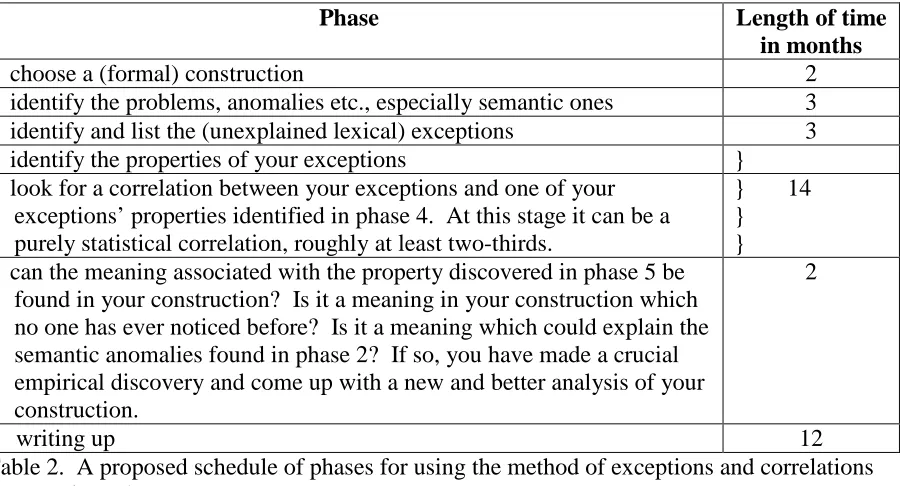
In Beedham (2005b:163-164) I summarised the work of the method in six phases. I would like now to put a time-scale on those six phases, assuming a full-time British PhD of three years – see Table 2 below.10 Obviously, the period allocated here to each phase is approximate, it will vary from project to project.
Phase Length of time
in months
1 choose a (formal) construction 2
2 identify the problems, anomalies etc., especially semantic ones 3 3 identify and list the (unexplained lexical) exceptions 3
4 identify the properties of your exceptions }
5 look for a correlation between your exceptions and one of your exceptions’ properties identified in phase 4. At this stage it can be a purely statistical correlation, roughly at least two-thirds.
} 14
} } 6 can the meaning associated with the property discovered in phase 5 be
found in your construction? Is it a meaning in your construction which no one has ever noticed before? Is it a meaning which could explain the semantic anomalies found in phase 2? If so, you have made a crucial empirical discovery and come up with a new and better analysis of your construction.
2
[image:10.595.79.529.195.438.2]writing up 12
Table 2. A proposed schedule of phases for using the method of exceptions and correlations in a PhD
3.8 The link with language teaching
The methodology described here is a mixture of theory and practice and is closely associated with language teaching. According to this approach the ultimate test of a new grammatical analysis is for it to be accepted into pedagogical grammars, as mentioned above. Despite the fact that the aspect analysis of the passive was first published in 1981 and 1982 it still
remains true today that no language course-book or pedagogical grammar, of English,
German, or Russian, has been published which incorporates it. Why? The aspect analysis of the passive seems to me to be eminently applicable in language teaching, and this view was reinforced recently, in 2011, when a 2ndyr. student of German at my University, Ashley Husband Powton, having read Beedham 2005b, was rather miffed to find that the passive in her German language classes was taught as a voice of the verb (related to an underlying active), and she asked her tutor to teach it as an aspect. She then went further, and sent an e-mail, signed by all nine members of the German Society (student) Committee, to the Head of the German Department, again asking that the German passive be taught in language classes as an aspect, in all its relations to and affinity with the German perfect, not as a voice of the verb. This episode raises the question, if a 2ndyr. modern languages student, albeit a particularly talented one, is able to understand the aspect analysis of the passive and see immediately that it is begging to be applied in the language teaching classroom, why have professional applied linguists not incorporated the aspect analysis of the passive into their course-books and grammars for language students? In my view it is because the link between
theoretical and applied linguistics has been broken by the dominance in theoretical linguistics of the formalistic model-building approach known as generative grammar (see Chapter 4 of Beedham 2005b, and Beedham 2002b). I hope that language teachers will eventually take on board the aspect analysis of the passive, and if and when they do I hope they reflect on why it took so long.
4. Tense formation and irregular verbs
After completion of the passive research the next set of exceptions chosen to work on was irregular verbs, again in English, German, and Russian. The term ‘irregular’ verb is used here to mean all those verbs whose conjugation in the modern language differs from the regular (in English and German ‘weak’, in Russian ‘productive’) verbs, so in English and German modal and mixed verbs are included and in Russian the fact that one can identify sub-regularities amongst the non-productive verbs does not make them any the less irregular in comparison to the regular/productive verbs. For this project it was not necessary to spend time identifying the exceptions, as had had to be done for the passive, since every grammar book and dictionary of English and German lists the irregular verbs (known as ‘strong’ verbs), and the irregular verbs of Russian (known as ‘non-productive’ verbs) are quite well picked out and described in some grammars of Russian. The reason for the difference is that for the passive the exceptions were syntactic exceptions - i.e. is this verb transitive, and if so, does it form a passive? – and as such they were quite difficult to identify, whereas the
irregular verbs are a morphological question, much easier to identify and isolate. 4.1. Working with informants
When working with native speaker informants the difference between syntax and
morphology takes on a new significance in a highly inflecting language like Russian. With syntax one is more likely to present a sentence to a native speaker and ask is it correct. With Russian, because it is so highly inflecting – e.g. most verbs have about 45 different possible forms – it makes more sense to present a single verb form, not in a sentence, completely devoid of any context whatsoever, to informants and ask is it correct. Of course, one does not take the response entirely at face value, the responses of informants have to be viewed
critically and evaluated, not least because informants often disagree; this applies both to judgements of sentences and of isolated morphological forms.
The way a researcher handles informants differs from language to language, depending on the structure and sociolinguistic variety of the language concerned, and from culture to culture, depending on the education system and the attitude to language in that culture. Danks (2011, this volume) had to cope with the fact that the language he was investigating, Modern Standard Arabic, is the high form in a diglossic relationship with a range of national and local Arabic dialects. Thus, while Arabs may be native speakers of Egyptian Arabic, Moroccan Arabic, etc., Modern Standard Arabic is used primarily as a written language and spoken only in formal and pan-Arab contexts. Moreover, the structure of Arabic vocabulary – most often three root consonants fitted into a finite number of patterns to derive different words – is such that it is difficult to draw a line between words or forms which actually exist and those which are theoretically possible but are not attested. Both these factors made Danks’ task of identifying unexplained exceptions and getting words and sentences evaluated by native speaker informants extremely difficult.
perceive and talk about its constituent morphemes.11 This would make a study of Mohawk grammar using the method of exceptions and their correlations extremely difficult indeed.
The situation is also intriguing when one considers that the method of exceptions and their correlations should certainly be usable on an earlier synchronic stage of a language, e.g. Old English, Middle High German, whereby there are no longer any native speaker informants alive to obtain grammaticality judgements from. Again, anyone attempting to carry out such research would be faced with a challenging new set of circumstances within which to work. On using informants to obtain grammaticality judgements see Schütze (1996), Kepser and Reis (eds.) (2005), Cornips and Poletto (2005), Sorace and Keller (2005), Cowart (1997), Quirk and Svartvik (1966).
4.2. Identifying the exceptions
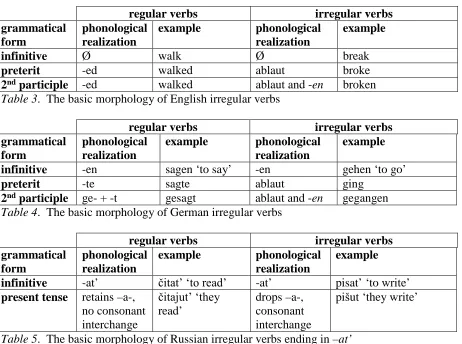
Returning to the irregular verbs, the English and German irregular verbs are irregular in terms of preterit tense and participle formation, whilst the Russian irregular verbs are irregular in respect of the present tense paradigm. The overwhelming majority of English verbs form their preterit and 2ndparticiple with –ed, e.g.walk walked walked– these are the regular verbs. But a substantial minority of verbs form their preterit and 2ndparticiple with ablaut and the ending –eninstead, e.g.break broke broken(Quirk et al., 1985, pp. 96-120) – these are the irregular verbs, of which there are 126 in our data. Turning to German, most German verbs form their preterit with –teand their 2ndparticiple withge- + -t, e.g.sagen sagte gesagt ‘to say’. A substantial minority of verbs, however, form their preterit and 2ndparticiple with ablaut and the ending –en, e.g.gehen ging gegangen‘to go’ (Durrell, 2002, pp. 231-260; Helbig and Buscha, 1989, pp. 34-49) – these are the irregular verbs, of which there are 169 in our data. Moving to Russian, most verbs ending in –at’form their present tense by retaining the –a- in the stem and by not undergoing consonant interchange, e.g.čitat’‘to read’čitajut ‘they read’ – these are the regular or ‘productive’, as they are usually called, verbs. But again a substantial minority of Russian verbs ending in –at’form their present tense differently, they form it by dropping the –a- in the stem and by undergoing consonant interchange in all persons, e.g.pisat’‘to write’pišut‘they write’ (Pulkina and Zakhava-Nekrasova, 1960, pp.
226-244; Грамматика русского языка, 1960, pp. 531-576)12– these are the non-productive verbs in –at’, of which there are 132 simplex such verbs in our data.13 This situation is summarised in Tables 3, 4 and 5 below. Having explained the exceptions to the passive rule, viz. some transitive verbs do not form a passive because they are atelic, the hope now is to explain the exceptions to the rule of tense formation, i.e. to explain (synchronically, structurally) why it is that some verbs for example in English form their preterit and 2nd participle with ablaut instead of with –ed.
11Mithun, M., 2006, Rhetorical Prosody and Polysynthesis, paper given at the 39thAnnual Meeting of the Societas Linguistica Europaea (SLE), Bremen, Germany.
12All productive verbs in –it’undergo consonant interchange, but only in the 1stpers. sing.. Another contrast of non-productive verbs in -at’with the productive verbs in –at’concerns the distinction between 1stconjugation and 2ndconjugation. Most non-productive verbs in -at’are 1stconjugation (like the productive verbs in -at’; productive verbs in -it’are 2ndconjugation), but a small number of non-productive verbs in -at’(about 17%) are 2ndconjugation, like verbs in -it’.
13Russian verbs in –et’were also included in the research project adumbrated below, but will not be mentioned here for reasons of space. Our research was confined initially to verbs in –at’and –et’only, because their
irregular verbs are easiest to identify (Бидэм, 2004). Verbs ending in –it’and verbs with a miscellaneous
regular verbs irregular verbs grammatical
form
phonological realization
example phonological
realization
example
infinitive Ø walk Ø break
preterit -ed walked ablaut broke
[image:13.595.71.533.66.410.2]2ndparticiple -ed walked ablaut and -en broken
Table 3. The basic morphology of English irregular verbs
regular verbs irregular verbs
grammatical form
phonological realization
example phonological realization
example
infinitive -en sagen ‘to say’ -en gehen ‘to go’
preterit -te sagte ablaut ging
2ndparticiple ge- + -t gesagt ablaut and -en gegangen
Table 4. The basic morphology of German irregular verbs
regular verbs irregular verbs
grammatical form
phonological realization
example phonological
realization
example
infinitive -at’ čitat’ ‘to read’ -at’ pisat’ ‘to write’ present tense retains –a-,
no consonant interchange
čitajut’ ‘they
read’
drops –a-, consonant interchange
[image:13.595.66.530.73.159.2]pišut ‘they write’
Table 5. The basic morphology of Russian irregular verbs ending in –at’
Once again, the standard approach in grammars of English, German and Russian is not to attempt to explain the existence of these irregular exceptions, but rather to view them as synchronically inexplicable irregularities. Historical explanations are given – the irregular verbs are a historical vestige – or psycholinguistic explanations are given – the irregular verbs are easy to remember because they are very common – but no synchronic, purely
grammatical or structural explanation is ever attempted. But again, that approach is
misguided in our view. If a language is a Saussurean system such fairly substantial numbers of verbs, even if they are in the minority, cannot stand outside the system, isolated, in a vacuum, not part of the system. They must fit in somehow. Moreover, forms do not exist synchronically in a language for no reason, they are there for a reason, basically to carry meanings. It follows that the irregular verbs, with their own special and indeed very striking forms, must have a meaning of their own which those forms carry. The fact that we cannot say now what that meaning is speaks of our ignorance and the research still to be done but it does not follow that the forms do not have a meaning. Remember, under the voice analysis of the passivebe+ V-eddid not have a meaning, but thanks to the aspect analysis we now know that it does have a meaning, viz. ‘action + state’. Tobin (1993) suggested that the irregular verbs of English, Hebrew, and the Romance languages have a resultative meaning, in contrast to the regular verbs, which are process-oriented.14 And Quirk (1970) suggested that a subset at least of the English irregular verbs are perfective, viz. the irregularburnt, dreamt, etc. in contrast to the regularburned,dreamedetc.. Whilst they do not give structural, grammatical evidence for their semantic impressions, I believe that the meaning Tobin and Quirk suggest will turn out to be correct. But we must have synchronic, structural, lexico-grammatical evidence for it.
It is that structural evidence which we are looking for. The aim is to find a rule or rules by which one can derive the formsdrank,hit,left, etc., i.e. the forms which at the moment are irregular. As happened with our research on the passive we expect to find a new rule and a new meaning at the same time. For this project, the irregular verbs, we seem to have an indication of the meaning – resultative – before we have found the rule, which is the other way round to what happened with the passive, where we found first the rule – the passive is an aspect – and then the meaning – the passive (in Englishbe+ V-ed) means ‘action + state’. But in both cases the indivisibility of the sign still holds, and our assumption is that we won’t really know what the irregular verb forms mean until we know the rule(s) by which they are derived.
4.3. Conducting experiments
4.3.1. VCs of irregular and regular verbs
So again, the question arises, what do we do with the irregular verbs, these lexical
exceptions? The answer is the same as before, for the non-passivizable transitive verbs. We examine them in great detail, to try to find out what is special about them, what is it about them that makes them behave differently in terms of their tense formation. We look at their morphological, syntactic, semantic, etc. properties, to see if we find anything odd, i.e. odd in terms of our current state of knowledge. We look for a formal correlation between the irregular verbs and something else in the lexico-grammar of the languages concerned, some still to be identified thing. The author has been working on the irregular verbs since about 1981 – in contrast to the passive project described above, for part of the time only, not full-time - and tested them, using native speaker informants, for their ability to form an imperative, an actional passive, a statal passive, an attributive 2ndparticiple, an expanded attributive 2ndparticiple, and for many other properties. Again, as happened at first with the passive, all of these avenues of research drew a blank. It was then decided to change tack and in 1992 the phonotactic properties of the irregular verbs were examined, and here at last something came to light.15 Again, it is a question of finding something which marks out the irregular verbs as different, i.e. different from the regular verbs. In order to make it easier to spot the difference an exhaustive list of all the regular verbs in the relevant languages was compiled. As with the passive it is important that the list be exhaustive. That was not as difficult as it might sound, because you only need to compare those regular verbs which are structurally comparable with the irregular verbs, since obviously one wants to compare like with like. Since nearly all the (stems of the) irregular verbs are monosyllabic, the first restriction is that you only need to look at regular verbs which are monosyllabic or which have a monosyllabic stem. Again, standard dictionaries and other reference works were used to facilitate the task: for English theOxford advanced learner’s dictionary of current
English, 1989, for German Mater, 1967a, for Russian Daum and Schenk, 1971, and the
Обратный словарь русского языка. Together with the effects of other restrictions arising from structural comparability – see Beedham (2005b, pp. 107-133) for details – the final numbers in our data were 1,768 English regular verbs, 1,467 German regular verbs, and 891 Russian regular verbs in –at’. Thus the relative proportions are that one had 14 times as many English regular verbs as irregular verbs, 9 times as many German regular verbs as irregular verbs, and 7 times as many Russian productive verbs in –at’as non-productive verbs in –at’. This situation is summarised in Table 6 below.
irregular verbs structurally comparable regular
verbs
proportion of regular to irregular verb
English 126 1,768 14:1
German 169 1,467 9:1
Russian 132 891 7:1
Table 6. Numbers of irregular verbs and structurally comparable regular verbs in English, German, and Russian
It was now a question of laying out the two lists for each language side by side, and trying to spot the difference. What was the difference between the verbs in the irregular list and the verbs in the regular list? On the face of it there was no difference, at first glance there appeared to be no significant difference between the infinitives of the irregular verbs and those of the regular verbs. Might the irregular verbs contain more high front vowels? No, an examination of the lists soon showed that this was not the case. Might the irregular verbs contain more voiced consonants? Again no, they did not. Then, with the help of a research assistant, Uwe Junghanns, bearing in mind that the overwhelming majority of the (stems of the simplex) irregular verbs are monosyllabic, the vowel + consonant sequences (VCs, in which C stands for consonant or consonant cluster) were examined and here a difference became apparent. We noticed that the list of irregular verbs contained a large number of certain VCs, VCs which occurred in only small numbers in the regular verb list.16 At this point the irregular verb forms themselves were added to the infinitive forms, e.g. not just (to)drinkbut alsodrankanddrunk. To give an example from English, there were 11 irregular verbs with [ɪ] (e.g.bring,cling) but only 4 regular verbs with [ɪ] (e.g.to wing). Given that the regular verb list was 14 times longer than the irregular verb list this was surprising. To give an example from German, there were 11 irregular verbs with [i:s] (e.g. flieen‘to flow’) but only 1 regular verb with [i:s] (viz.spieen‘to skewer’). Again, given that the German regular verb list was 9 times longer than the irregular verb list this was surprising. To give an example from Russian, -otappeared in 13 non-productive verbs (e.g. bormotat’‘to mutter’) but in only 4 productive verbs (e.g.rabotat’‘to work’). Once again, given that the Russian regular verb list was 7 times longer than the irregular verb list this was surprising.
Moreover, many of the regular verbs containing an irregular verb VC had special reasons for doing so. The overwhelming majority of irregular verbs are base verbs, i.e. not derived (synchronically). But many of the regular verbs containing an irregular verb VC were derived verbs. Either they were derived from a noun, and had to conjugate regularly so as to retain the VC of the noun from which they derive in order to maintain that derivational link, e.g. going back to verbs in English with [ɪ]to wing, from the nounwing(in other words, if it wentwing wang wungthe derivation ofwangfrom the nounwingwould no longer be discernible). Or else they were phonaesthetic verbs designating a sound, i.e. the pronunciation of the verb imitates the sound it designates, which again have to conjugate regularly in order to maintain their phonaesthetic effect, e.g. returning again to verbs with [ɪ] the verbsto ping,to ting(on phonaesthemes see Hinton et al. (eds.), 1994; Gamkrelidze, 2006). Thus we see that were it not for the special circumstances of derived verbs and
phonaesthetic verbs there would be no (monosyllabic) regular verbs whatsoever with [ɪ], and we would be looking at a statistical difference of 11:0, not 11:4.
So the initial answer to the question, how do irregular verbs differ from regular verbs, is that they differ in terms of their VCs: the irregular verbs contain VCs which tend not to occur on the regular verbs. Thus the VCs serve as phonotactic markers of strong conjugation in English and German and non-productive conjugation in Russian. Although this is not so much an analysis as an initial observation it is worth pointing out that once again, using the method advocated here, it is not a hypothesis or assumption but a discovery. Once again the data have taken us to an analysis, or here rather an initial observation on the way hopefully to a full analysis. Once again, as with the passive, the experiment is repeatable, i.e. other linguists can explicate and compare the VCs of the irregular verbs and regular verbs of English, German, Russian, and any language which has irregular verbs, either the modern language or a historically earlier stage of a language, to confirm or refute the findings described here.
The findings described here are similar to those given in Pinker (1999) (see also Pinker 1994, pp. 138-145; see Beedham, 2002a; see also Bybee and Slobin, 1982). Firstly, Pinker notes the role of the consonant or consonant cluster following or preceding the vowel of the irregular verb in the structural sustainability of irregular conjugation:
The verbs undergoing a given irregular change are far more similar than they have to be. If you are a verb and want to undergo thei-a-upattern, all you really need is ani. But the verbs that do follow the pattern (drink,spring,shrink, and so on) have much more in common; most begin with a consonant cluster like st-, str-,dr-, sl-, orcl-, and most end in -ngor -nk. … Imagine a rule that said, ‘If a verb has the sound consonant-consonant -i-ng, change i to u’. (Pinker, 1999, p. 91)
Secondly, he notes that verbs which one would expect to be strong because of the vowels and consonants in them are prevented from undergoing strong conjugation because they are derived from a noun or adjective: “Verbs that are recognized as thinly disguised nouns or adjectives don’t accept irregular forms, even when they sound like an irregular verb”, e.g. the verbto ringas inPowell ringed the city with artillery(Pinker, 1999, p. 158). Thirdly, he notes the way in which phonaesthetic or onomatopoeic verbs are prevented from being strong by their onomatopoeia:
Onomatopoeic verbs … need past tense … forms, but because they are not canonical roots, they cannot tap into the lexicon of roots and linked irregular forms that encourage irregular analogies. Onomatopoeic forms therefore are regular, even when their sound would otherwise tempt people to borrow an irregular pattern:
The enginepinged[notpangorpung]. (Pinker, 1999, p. 155)
4.3.2. Irregular verb VCs and function words
The next obvious question to ask was, do the VCs of the irregular verbs, now shown to be characteristic of the irregular verbs, crop up elsewhere in the grammar or vocabulary of the languages concerned? To find out the answer to this question, in 1999 with the help of research assistant Wendy Anderson and in 2002 with the help of research assistant Albina Ozieva17another experiment was conducted in which all the monosyllabic18function words
(pronouns, conjunctions, etc.) were extracted from dictionaries of English, German, and Russian, and their VCs examined. The dictionaries used were for English theOxford advanced learner’s dictionary of current English, 1989, for German theDuden Bedeutungswörterbuch, for Russian theСловарь структурных слов русского языка
(Морковкин, 1997). It was found that for all three languages the VCs of the irregular verbs
had a surprisingly high rate of occurrence there: 72% of English monosyllabic function words contained a strong verb VC, 64% of German monosyllabic function words contained a strong verb VC, and 79% of Russian monosyllabic function words with a VC contained a non-productive verb VC.19 Once again, these experiments are repeatable, i.e. other linguists can identify the VCs of irregular verbs and look for them in monosyllabic function words, either in English, German and Russian or in any other language which has irregular verbs, the modern language or a historically earlier stage of a language, to come up with their own results which will either confirm or contradict the findings given here.
4.3.3. Working with research assistants
As has been noted, research assistants play an important role in the data collection which is the day to day work of any project involving the method of exceptions and their correlations. Having the services of a research assistant at your disposal is useful because the work with dictionaries and native speaker informants is time-consuming and the tasks involved are often rather mechanical (though never entirely mechanical, they all require a great deal of
knowledge, sensitivity and skill). If you are working by yourself you start down various avenues and there is simply not the time to pursue them all fully, so by having research assistants you get more done. However, a word of caution here. You do still have to work closely with your research assistant, you cannot give him or her some tasks to do and let them get on with it for several months. You have to consult with them regularly, several times a week for hours at a time, to learn from them what they have discovered and where they should go next in the light of their discoveries. Moreover, you yourself still have to do some of the legwork, because it is precisely during explorations of the data that you yourself both acquire conscious new knowledge of what is going on and an intuitive, subconscious awareness of what is going on which will surface in time one way or another into conscious knowledge. For that reason having a full-time research assistant will only work if you yourself have either a full-time research post or temporary research leave and can devote all your time to the project in hand. If you are carrying out the research alongside teaching and administrative duties it is better to have a part-time research assistant.
4.3.4. Irregular verb VCs and prefixes in German
How does one interpret this latest discovery, that the irregular verb VCs have an unusually high rate of occurrence in function words? That is difficult to say at the moment, but there is one area where an explanation does readily suggest itself for German. A study was
conducted in which the 7,290 separable verbs listed in Mater (1970) were examined for the
speaker of Russian – and a Germanist, Anglicist and lexicographer - and who used her native speaker knowledge of Russian to great effect on the project.
18The investigation was restricted to monosyllabic function words only because, as mentioned in 4.3.1, the overwhelming majority of irregular verb stems are monosyllabic.
VCs in their prefixes. It was found that 74% of the separable prefixes20listed contained a strong verb VC, and 79% of the verbs listed had a prefix with a strong verb VC.21 Prefixes in German have a perfectivising function,22many of them add an element of result to a verb, which matches Tobin’s resultative meaning for the English irregular verbs, and indeed Quirk called a subset of the English irregular verbs perfective, as was pointed out earlier. In other words, in German, verbal prefixes tend to be resultative, the strong verbs have probably a resultative meaning, and they share the same VCs.23 So if this correlation is to be believed, we have formal confirmation of the idea that the German strong verbs have their own
meaning, different to that of the weak verbs, and that meaning is resultative, in contrast to the process meaning of the weak verbs, as predicted by Tobin and Quirk. Strong verbs and separable prefixes in German tend to contain the same VCs because they both mean
resultative/perfective.24 The meaning proposed here illustrates a link between form (ablaut and –en, and VC) and meaning (resultative), it illustrates the indivisibility of the linguistic sign, it corroborates the view being advocated here that the apparently bizarre and senseless forms of the irregular verbs are the grammarian’s mistake, that those forms must fit in
somewhere in the verbal system of English, German, and Russian, and that they must convey meanings, in the usual way in language. If it does turn out that the VCs of the strong verbs are meaningful in the manner indicated above we will have to recognise a new level of language, between morphology and phonology, a variant of phonaesthemes which are more clearly meaningful than the familiar phonaesthemes. However, there is no point in tackling that question until we have greater clarity on whether the strong verb VCs are indeed meaningful in the manner indicated above. That clarity will only emerge from further empirical research, from more experiments (for further details on the phonotactics of irregular verbs see for English Beedham, 1994, forthcoming, Tobin, 1993, pp. 315-354; for German Beedham, 1994, 2005;25 for Russian Бидэм, 2004, Forthcoming).
20In contrast to the function words, where only monosyllabic function words were taken, this time both monosyllabic and polysyllabic prefixes were examined, whereby the stressed syllable of polysyllabic prefixes was taken as the source of the VC. The motivation for this change of tack was simply to see what would happen. Fortunately, it was a move which turned out to be fruitful.
21See Beedham 2012; Eine phonotaktische Korrelation und semantische Verbindung zwischen starken Verben und trennbaren Präfixen der deutschen Gegenwartssprache [A phonotactic correlation and semantic link between strong verbs and separable prefixes in modern German], paper given at the University of Bonn and the University of Münster, June 2010.
22Helbig and Buscha, 1989, p. 73;Duden-Grammatik, 2006, p. 415; Flämig, 1965, p. 8; Fleischer, 1976, pp. 326-328. Helbig and Buscha defineperfektivfor German as follows: ‘Perfektive Verbengrenzen den Verlauf des Geschehens zeitlich ein oder drücken den Übergang von einem Geschehen zu einem anderen Geschehen aus’ (Perfective verbsplace a temporal limit on the course of an event or express the transition from one event to another event) (Helbig and Buscha, 1989, p. 72). Like Russian there is a link in German between perfective verbs and resultative meaning, expressed in the fact that in German only perfective transformative verbs form a statal passive (whereby the statal passive, which in German has its own auxiliarysein‘to be’ in contrast to the auxiliarywerden‘to become’ of the actional passive, expresses the result of a process): ‘Das Zustandspassiv kann … nur gebildet werden von solchen transitiven Verben, die perfektiv und transformativ sind, die einen solchen starken Grad der Affizierung des Akkusativobjekts ausdrücken, daß ein zeitweilig bleibendes Resultat … überhaupt ermöglicht wird’ (The statal passive can only be formed from those transitive verbs which are perfective and transformative, which express such a strong degree of affectedness of the accusative object that a temporarily lasting result is made at all possible) (Helbig and Buscha, 1989, pp. 181-182).
23Interestingly, Wegener (2007) says that the irregular verbs are more prone to take a prefix than the regular verbs.
24The parallel place to look in English is the particles and prepositions of phrasal verbs. I have not checked them out yet, but certainly Bolinger (1971:96-110) discusses the perfective characteristics of phrasal verbs in English.
Be that as it may, the point is – granted the ongoing nature of the work on irregular verbs presented above – once again we have used unexplained lexical exceptions to a grammatical rule to empirically investigate that rule and to come up with pointers to a new explanation of how it works.26
Turning briefly again to typology, in exemplifying the method of exceptions and their correlations two examples have been used which show that apparently diverse languages and language families are more similar in their structure than is usually thought. Taking two Germanic languages, viz. English and German, and a Slav language, viz. Russian, we have seen that in all three languages, in both language families, Germanic and Slav, the passive is the same construction, viz. an aspect of the type Auxiliary + Participle, subject to the same aspectual constraints, viz. lexical and compositional aspect – to form a passive a verb must be telic;27 and the irregular verbs again in all three languages, in both language families,
Germanic and Slav, display similar phonotactic patterns concerning their vowel + consonant sequences. Beneath apparent linguistic diversity lies uniformity, if we dig deep enough. 5. Conclusion
In the course of the last 35 years the author has used the method of exceptions and their correlations twice, on the passive in English, German and Russian to produce a complete new analysis, the aspect analysis, and on the irregular verbs of English, German and Russian in on-going research which has so far unearthed some hitherto unnoticed phonotactic patterns which it is hoped will lead eventually to a new account of the tense systems of those
languages, rendering the irregular verbs regular. David Crystal has described the method as being like detective work,28and the comparison is entirely apt. The method is empirical, and allows the researcher to sift through large amounts of data in a systematic and reasoned way, using research assistants where appropriate. It encourages the grammarian to work
systematically through dictionaries, thus uniting grammar and the lexicon, grammarians and lexicographers. Yet this highly empirical method sits squarely in the middle of a
langue-oriented, theoretical linguistics in which one produces new analyses of grammatical phenomena. The method is practical, in that the new analyses produced, if they are correct and therefore persuasive, will be taken up by language teachers in their pedagogical
grammars. By the same token the analyses are easily understood, and can be summarised in a sentence and explained fairly successfully to the non-specialist. It is an interesting and
exciting method to use, partly because one works a lot with native speaker informants, and partly because one goes down various avenues of research, looking and probing, any one of which could produce a discovery leading to a new analysis. The method allows you to follow up your hunches, and to discover something by accident. It is hoped that other linguists will try out the method to see if they can use it on their own chosen area of grammar in their own language or languages.29
between strong verbs and separable prefixes in modern German], paper given at the University of Bonn and the University of Münster, June 2010.
26To give an idea of the time-scale involved, the author has probably spent part-time over the last 30 years slightly longer than he spent on the passive full-time, viz. the equivalent of roughly 4 years full-time.
27Furthermore, as mentioned above, Danks (2011) shows that the passive in Arabic is an aspect, governed by telicity, and Gregory (2006) shows that the passive in Spanish is an aspect, thus adding Semitic and Romance languages to the list of different language families with an aspectual passive.
28On the website of Beedham 2005b: http://www.benjamins.com/#catalog/books/sfsl.55/main, accessed 18 September 2013.
References
Abraham, Werner. 2000. Das Perfektpartizip: seine angebliche Passivbedeutung im Deutschen. Zeitschrift für germanistische Linguistik 28 (2), 141-166.
Beedham, Christopher. 1981. The passive in English, German and Russian. Journal of Linguistics17:319-327.
Beedham, Christopher. 1982. The passive aspect in English, German and Russian. Salford University PhD thesis, 1979. Narr, Tübingen.
Beedham, C., 1987a. The English passive as an aspect. Word 38, 1-12.
Beedham, C., 1987b. Das deutsche Passiv: Aspekt, nicht Genus verbi [The German passive: aspect, not voice]. Deutsch als Fremdsprache 24, 160-165.
Beedham, C., 1994. The role of consonants in marking strong verb conjugation in German and English.Folia LinguisticaXXVIII, 279-296.
Beedham, C., 1998. The perfect passive participle in Russian. Review of Schoorlemmer, M. (1995): Participial passive and aspect in Russian, Utrecht: OTS. Lingua 105, 79-94. Beedham, C., 2002a. Irregularity in language: Saussure versus Chomsky versus Pinker.
Review of Pinker, S. (1999): Words and rules, London: Weidenfeld & Nicolson. Word 53, 341-367.
——. 2002b. Über die Anwendbarkeit der theoretischen Grammatik in pädagogischen Grammatiken: Saussure, das Passiv und starke Verben. InAkten des X.
Internationalen Germanistenkongresses Wien 2000: “Zeitenwende - Die Germanistik auf dem Weg vom 20. ins 21. Jahrhundert”, P. Wiesinger (ed.), Band 4, 37-42. Bern: Peter Lang.
Beedham, C., 2005a. Eine phonotaktische Verbindung zwischen starken Verben und grammatischen Wörtern der deutschen Gegenwartssprache [A phonotactic link between strong verbs and function words in modern German].Deutsch als Fremdsprache42, 167-172.
Beedham, C., 2005b.Language and meaning: The structural creation of reality. Benjamins, Amsterdam.
Beedham, C., 2008. La méthode des exceptions lexicales et la relation entre la langue et la réalité [The method of lexical exceptions and the relationship between language and reality]. In: Frath, P., Gledhill, C., Pauchard, J. (eds.), Res per nomen. Editions et Presses universitaires de Reims, Reims, pp. 215-229.
Beedham, C. 2012. Starke Verben: Deutsche Morphologie in Harmonie mit Englisch und Russisch [Strong verbs: German morphology in harmony with English and Russian], in F. Grucza (ed.), Akten des XII. Internationalen Germanistenkongresses Warschau 2010, Band 15,Vielheit und Einheit der Germanistik weltweit, Frankfurt am Main: Peter Lang, pp. 27-31.
Beedham, C., forthcoming. A phonotactic link between strong verbs and function words in English. Word.
Bolinger, Dwight. 1971. The Phrasal Verb in English. Cambridge, Mass.: Harvard University Press.
Borras, F.M., Christian, R.F., 1971. Russian syntax: Aspects of modern Russian syntax and vocabulary. Oxford University Press, London.
Bybee, Joan L., Slobin, Dan I., 1982. Rules and schemas in the development and use of the English past tense. Language 58, 265-289.
Comrie, Bernard. 1976. Aspect: an introduction to the study of verbal aspect and related problems. Cambridge University Press, Cambridge.
Corbin, D., Dessaux-Berthonneau, A.-M., 1985. L’exception. Langue Française 66.
Cornips, Leonie, Poletto, C., 2005. On standardising syntactic elicitation techniques (part 1). Lingua 115, 939-957.
Cowart, Wayne. 1997. Experimental syntax: applying objective methods to sentence judgments. Sage, Thousand Oaks, California.
Danks, Warwick. 2011. The Arabic verb: form and meaning in the vowel-lengthening patterns. St Andrews University PhD thesis, 2009. Benjamins, Amsterdam. Danks, W., this volume. Evaluation and adaptation: applying the method of lexical
exceptions to Modern Standard Arabic.
Daum, E., Schenk, W., 1971. Die russischen Verben. Mit einem Aufsatz zur Syntax und
Semantik der Verben des modernen Russisch von Prof. Dr. R. Růžička. Enzyklopädie,
Leipzig.
Duden 10: Das Bedeutungswörterbuch, 1985. 2. Auflage. Dudenverlag, Mannheim. Duden 4: Grammatik der deutschen Gegenwartssprache, 2006. 7. Auflage. Dudenverlag,
Mannheim.
Durrell, Martin. 2002. Hammer’s German grammar and usage. Fourth Edition. Arnold, London.
Even-Simkin, Elena & Yishai Tobin. 2013. The Regularity of the ‘Irregular’ Verbs and Nouns in English. Amsterdam: Benjamins.
Flämig, Walter. 1965. Zur Funktion des Verbs. III. Aktionsart und Aktionalität. Deutsch als Fremdsprache 2, 4-12.
Fleischer, Wolfgang. 1976. Wortbildung der deutschen Gegenwartssprache. 4. Aufl. Bibliographisches Institut, Leipzig.
Gamkrelidze, Thomas V. 2006. The problem of ‘L’arbitraire du signe’. In: Hajnal, I (ed.), Gamkrelidze, Th.V., Selected writings: linguistic sign, typology and language reconstruction. Institut für Sprachen und Literaturen der Universität Innsbruck, Innsbruck, 56-64.
Gelhaus, Hermann. Latzel, Sigbert. 1974. Studien zum Tempusgebrauch im Deutschen. Narr, Tübingen.
Gregory, Amy E., 2006. Review of Beedham, C., 2005, Language and meaning: The structural creation of reality, Benjamins, Amsterdam.LINGUIST List17, 3168. Helbig, Gerhard. 1973. Geschichte der neueren Sprachwissenschaft. Unter dem besonderen
Aspekt der Grammatik-Theorie. Leizpig: Bibliographisches Institut.
Helbig, Gerhard, Buscha, Joachim. 1989. Deutsche Grammatik: Ein Handbuch für den Ausländerunterricht. Langenscheidt/Enzyklopädie, Berlin.
Hinton, Leanne. Nichols Johanna. Ohala, John J. (eds.), 1994. Sound symbolism. Cambridge University Press, Cambridge.
Joseph, John E. 2012. Saussure. Oxford: Oxford University Press.