0883±9514/00 $12.001 .00
u
AUTONOMOUS AGENTS FOR
BUSINESS PROCESS
MANAGEMENT
N. R. JENNINGS, T. J. NORMAN, P. FARATIN
Dept. Electronic Engineering, Queen Mary & Westfield College, University of London, London, UK
P. O’BRIEN and B. ODGERS
BT Research Labs, Ipswich, Suffolk, UK
T raditional approaches to managing business processes are often inadequate for large±scale,
organisation±wide,dynamic settings.However,since Internet and Intranet technologies
have become widespread,an increasing number of business processes exhibit these
properties.T herefore,a new approach is needed.T o this end,we describe the motivation,
conceptualization,design,and implementation of a novel agent±based business process
management system.T he key advance of our system is that responsibility for enacting
various components of the business process is delegated to a number of autonomous
problem± solving agents.T o enact their role,these agents typically interact and negotiate
with other agents in order to coordinate their actions and to buy in the services they
require.This approach leads to a system that is signicantly more agile and robust than its
traditional counterparts.T o help demonstrate these benets,a companion paper describes
the application of our system to a real±world problem faced by British T elecom.
Successful companies organize and run their business activities in an efficient manner. Core activities are completed on time and within the specied resource constraints. However, to stay competitive in today’s markets, com± panies need to continually improve their efficiency± business activities need to be completed more quickly, to a higher quality and at a lower cost. To this end, there is an increasing awareness of the benets and potential com± petitive advantage that well± designed business process management systems can provide. Such systems can substantially improve efficiency by ensuring that business activities are better scheduled, executed, monitored, and coor± dinated.
ADEPT was a collaborative project under the DTI/EPSRC Intelligent Systems Integration Pro±
gramme (ISIP). The project partners were BT Laboratories, ICI Engineering, Loughborough University, and Queen Mary and Westeld College.
Address correspondence to Professor Nick Jennings, Dept. of Electronics and Computer Science, University of Southampton, Southampton SO17 1BJ. E±mail: [email protected]
146 N.R.Jennings et al.
The design and implementation of corporate± wide business management systems is a complex activity. The software has to support the distributed design and operation of many concurrent activities that are highly interde± pendent. Moreover, many of the activities have a real± time component, require the ability to access legacy software, and need context± dependent execution (i.e., their operation depends on the state of previous activities and the environment± they are reactive systems (Pnueli, 1986)). In short, business management is a demanding domain that requires state± of± the± art software solutions. In this work, it was decided to conceptualize, design, and imple± ment the business process management system using an agent± based approach. Thus, in project ADEPT (Advanced Decision Environment for Process Tasks) the business process is viewed as a collection of autonomous problem± solving entities that negotiate with one another and come to mutually acceptable agreements that coordinate their interdependent sub± activities. The main advantages of this approach over more traditional counterparts such as management information systems, work± ow manage± ment, and enterprise integration are that it oŒers greater exibility, agility,
and adaptability.
The contribution of this work is in two main areas± business process management systems and agent± based systems. In the former case, this work represents a novel means of conceptualizing and implementing software solutions. The insights gained in this work will assist designers of business process management systems in evaluating the appropriateness and benets of the agent paradigm, in identifying the potential pitfalls, and in oŒering
guidance on how to structure their applications. In the latter case, the work represents one of the few applications of multiagent techniques to real± world problems (this has been identied as a major shortcoming of the discipline to date (Jennings, 1994)). This work also makes contributions to the eld of automated negotiation ; previous work either made assumptions that are unrealistic for practical implementations or failed to adequately capture the richness of negotiation required in practical applications.
process for providing a quote for installing a network at a customer’s prem± ises.
AGENT-BASED BUSINESS PROCESS MANAGEMENT
This section introduces the domain of business process management, presents the case for an agent± based solution, identies and justies ADEPT’s key conceptual components, and indicates how these components are used to build agent± based solutions.
The Basics of Business Process Management
Medina± Mora et al. (1993) categorize processes in an organization into material processes (the assembly of physical components or the delivery of physical products), information processes (related to the automated and par± tially automated tasks that create, process, manage, and provide information), and business processes (market± centered descriptions of an organization’s activities, implemented as information processes and/or material processes). In more detail, a business process can be split into a number of constituent components (Figure 1).
First, there needs to be a denition of the business process (left branch of Figure 1). It describes, in some specication language, the activities that need to be performed, the participants who could or should perform them, and
[image:3.419.40.378.353.578.2]148 N.R.Jennings et al.
the interdependencies that exist between them.1 Specication languages vary
greatly in their details, but at a conceptual level they are broadly similar± they must provide a set of concepts useful for describing processes, their tasks, the dependencies between the tasks, and the required roles that can perform the specied tasks (Georgakopoulos et al., 1995). The activities in the process description may be automated or involve humans interacting with computers.
Second, the business process needs to be executed and managed (right branch of Figure 1). A software system needs to be devised that is capable of ensuring that the process description is realized in practice. This system must allow the human and the manual activities to be assigned appropri± ately ; provide access to the software tools (e.g., databases, spreadsheets, design software, etc.) required to complete the tasks ; and ensure that the dependencies between the tasks are satised. Moreover, the software should transparently support multiple invocations (instances) of a given process and a given task.
The types of business process for which management systems have been devised vary enormously± from ad hoc interactions with few set paths and few set patterns of interactions, to repetitive, predictable processes with simple hard± wired coordination rules ; from dealing predominantly with human± oriented activities (i.e., groupware applications) to entirely automa± ted activities. See Georgakopoulos et al. (1995) for a detailed survey and classication. Here, we are interested in large± scale (hundreds of activities), organization± wide business processes. Our analysis identied the following key characteristics of this class of application (Jennings et al., 1996):
processes are dynamic and unpredictable. It is impossible to give a d The
complete a priori specication of all the activities that need to be per± formed and how they should be ordered. Any detailed time plans that are produced are often disrupted by unavoidable delays or unanticipated events (e.g., people are ill or tasks take longer than expected). Coordi± nation between the tasks also needs to be handled in a similarly exible manner.
processes involve a mixture of human activities and automated tasks. d The
The exact ratio varies between applications. Issues relating to the roles and interactions of humans in our system are dealt with in the companion paper.
organizations may be involved in the process. Each organization d Multiple
attempts to maximize its own prot within the overall activity.
are physically distributed; this distribution may be across one d Processes
site, across a country, or even across continents.
organizations, there is a decentralized ownership of the tasks, d Within
groups within organizations are relatively autonomous± they d DiŒerent
control how their resources are consumed, by whom, at what cost, and in what time frame. They also have their own information systems, with their own idiosyncratic representations, for managing their resources.
is a high degree of natural concurrency± many interrelated tasks d There
are running at any given point of the business process.
is a requirement to monitor and manage the overall business d There
process. Although the control and resources of the constituent subparts are decentralized, there is a need to place constraints on the entire process (e.g., total time, total budget, etc.).
The Case for an Agent-Based Solution
The traditional (workow) approach to business process management involves describing the entire process from a centralized perspective. That is, a complete list of all the activities and paths are provided, the criteria for following a particular path are specied, and the ordering constraints on the actions are given. Given this complete specication, the business process management system has the comparatively straightforward task of executing it. This approach works well for simple business processes. It has led to a range of commercial products (such as In± Concert (McCarthy & Sarin, 1993), StaŒware (http://www.staŒware.com/), and Action Workow
(Medina± Mora, 1992)) and has an estimated market size of $2.5 billion (McCreed, 1992). However, for the class of business processes we considered, the following inherent shortcomings mean a traditional approach is unsuitable± it lacks (Trammel, 1996):
i. reactivity± workow management systems require an a priori represen± tation of the business process and all potential deviations from that process ;
ii. semantics± many workow management systems lack an appreciation of the content of a business process and do not make decisions based on the nature of the information that is generated ;
iii. extensibility± many systems are not extensible on line;
iv. resource management± workow management systems do not control the resourcing of a business process and so they rely on the process being fully dimensioned beforehand ;
v. heterogeneity± workow management systems tend to take a centralized view with a single management engine that does not operate across multiple± server platforms or multiple± client operating systems.
150 N.R.Jennings et al.
process activities to the constituent components, rather than maintain it cen± trally, and to make these components more active. Thus, each of the business processes’ main activities are assigned to a particular problem± solving entity, and that entity is responsible for ensuring the activity is ful± lled within the specied constraints. The means by which the activities are performed are left to the responsible entity to determine. In many cases, a responsible entity needs the services of others to achieve specic subactivities and these interactions may again involve devolving responsibility. Thus, delegation can continue through many levels of nesting.
Devolved responsibility means that the business process management system needs to be considerably more sophisticated than its traditional counterpart. Many decisions that are traditionally made in the process description at design time are now moved to the execution system and deter± mined at run time. Thus, instead of executing a fully dened process descrip± tion, the execution system has to determine which activities should be performed, how much resource each activity can consume, who should perform them, when they should be performed, and how any interdepen± dencies should be resolved.
Given this conceptualization, a natural way to design and implement the business process management system is to make each responsible entity an autonomous agent. Such agents have specic goals to achieve and interact with one another to manage their interdependencies. In this context, an agent can be viewed as an encapsulated problem solving entity that exhibits the following properties (Wooldridge & Jennings, 1995):
agents perform the majority of their problem± solving tasks d Autonomy:
without the direct intervention of humans or other agents, and they have control over their own actions and internal state.
ability : agents interact, when they deem appropriate, with other d Social
agents in order to complete their problem± solving and to help others with their activities.
agents take the initiative and exploit unexpected d Proactiveness:
opportunities where appropriate.
agents perceive their environment and respond in a d Responsiveness :
timely fashion to changes in it.
Secondary factors that point towards agents as a suitable solution tech± nology include:
ii. the integrity of the existing organizational structure and the autonomy of its subparts needs to be maintained (appeals to the autonomous nature of the agents);
iii. interactions are fairly sophisticated, including negotiation, information sharing, and coordination (requires the complex social skills of agents); iv. the problem solution cannot be prescribed entirely from start to nish
(the problem solvers need to be responsive to changes in the environ± ment and to unpredictability in the process and proactively take opportunities when they arise);
v. the domain includes a number of legacy systems, especially databases, that need to be incorporated into the business process (wrap up the existing code as an autonomous agent so that it can interact exibly, through the agent’s social abilities, with a range of new applications (Geneserech & Ketchpel, 1994 ; Jennings et al., 1993).
The main benets of an agent± based approach over the traditional work± ow view are as follows:
i. it oŒers greater exibility since actions can be based upon the agent’s
current situation, rather than being prescribed in advance;
ii. it oŒers greater agility since new services can be added and congured
with minimal eŒect on other agents ;
iii. it oŒers greater adaptability since an agent’s choices can be guided by
feedback received from previous invocations of particular paths through the business process.
The relative drawbacks of an agent± based approach are that it oŒers a
more fragmented view of the process and it is more difficult to ensure that process± wide constraints are satised. However, on balance, it is felt that the benets outweigh the drawbacks.
The Conceptual Framework
152 N.R.Jennings et al.
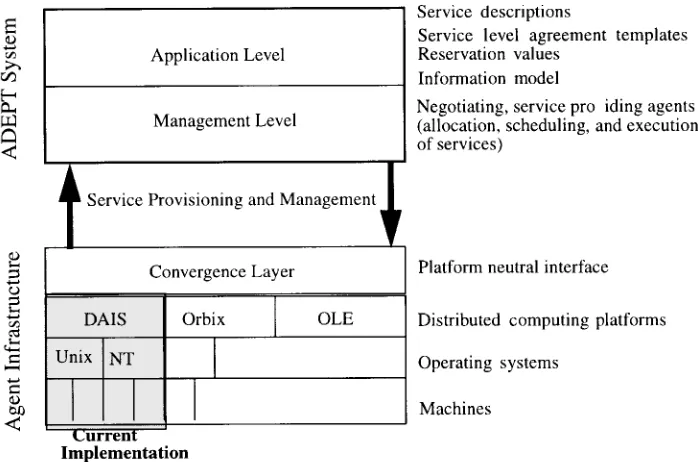
FIGURE 2.The conceptual architecture of an ADEPT system.
a chemical factory), and produce some (possibly no) outputs. Services go through three phases :
i. specication± detail what needs to be done;
ii. provisioning± determine which agent is responsible for executing the service and under what terms and conditions ;
iii. management± execute the service in line with the agreed terms and con± ditions.
services by adding ordering constraints and conditional control. A service description language (SDL) has been developed to specify services and this language corresponds to ADEPTs process denition language.
As the agents are autonomous, there are no control dependencies between them. Therefore, if an agent requires a service that is managed by another agent it cannot simply instruct it to start the service.2 Rather,
service provisioning requires the agents to come to a mutually acceptable agreement about the terms and conditions under which the desired service will be performed (here such contracts are called service level agreements (SLAs)). The mechanism for making SLAs interagent negotiation± a process in which parties verbalize contradictory demands and then move towards agreement by concession± making or searching for new alternatives (MuÈ ller, 1996). The basic context and form of all ADEPTs negotiations is identical. It involves connecting an agent that requires a service (the client) with one that is willing to provide it (the server). We term such negotiation service± oriented (Sierra et al., 1997). To perform such negotiations, agents need a protocol that species the role of the current message interchange± e.g., whether the agent is making a proposal or responding with a counter± proposal, or whether it is accepting or rejecting a proposal. Additionally, agents need a means of describing and referring to the domain terms involved in the negotiation± for example, both agents need to be sure they are describing the same service even though they may both have a diŒerent
(local) name for it and represent it in a diŒerent manner. This heterogeneity
is inherent in most organizations, because each department typically models its own information and resources in its own way. Thus, when agents inter± act, a number of semantic mappings and transformations may need to be performed to create a mutually comprehensible information sharing lan± guage.
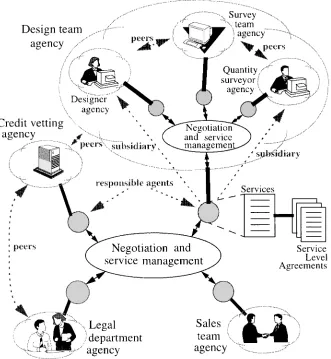
In many business process applications there is a need to reect the company’s organizational structure when modelling the process and describ± ing the behavior of the problem± solving components. Within the range of applications we considered, two types of relationships were observed: peer± to± peer and organizational hierarchies. To reect these relationship types, ADEPT uses the notion of agency (Norman et al. 1997). An agency is recur± sively dened : consisting of a single responsible agent, a possibly empty set of tasks that the responsible agent can execute, and a possibly empty set of subagencies (Figure 3).3 For example, agency D has a single responsible
agent that has two distinct tasks (TD1 and TD2) and three subagencies (E, F, and G). The responsible agent represents the interests of the agency to its peers.4Any communication with an agency must go through the responsible
154 N.R.Jennings et al.
relationship between subagency and responsible agent can be viewed as a type of social commitment (Norman & Jennings, 1997). This means when a responsible agent requests a service from one of its subagencies, the request is not refused without good reason. However, a subagency is not a sub± routine. It retains a degree of local autonomy. For example, the manager of a design department may request a design engineer to work on a particular project. If the engineer can perform the task, the request will be accepted, but the conditions under which the request will be met are open to negotia± tion. In contrast, the relationship between peer agents is more open: an agent is not obliged to accept a request from a peer. An agent will come to an agreement with a peer agent if it is in its best interests to do so.
[image:10.419.35.386.404.575.2]The agency structure also provides a mechanism for the encapsulation and abstraction of services. As an example, consider the agency illustrated in Figure 3. Suppose that this diagram represents the structure of an organiz± ation in which the design department is agency D. In this case, the responsible agent represents the department manager (i.e., the agent through which other departments (agencies A, B, and C) may contact the design department), subagency E represents a single design engineer that is capable of performing two distinct tasks (or atomic services), and one of the other agencies (say F) represents a team of surveyors. Furthermore, suppose that the department manager has registered a ‘‘cost and design network’’ service that can be provided by the design department to other agencies in the organization. Before the department manager is able to register this service, it must know that it is able to provide that service to other agents in the community under certain conditions. Suppose that for the manager to be able to provide the ‘‘cost and design network’’ service, the design engineer must be able to provide a ‘‘design network’’ service. Also, the engineer must
collaborate with a surveyor to ensure that the design that is proposed is consistent with the geographical requirements of the proposed network site. Therefore, for the manager to register the ‘‘cost and design network’’ service, at least one design engineer must register with its peers and responsible agent the service ‘‘design network,’’ and the agent representing the team of surveyors must register a ‘‘survey site’’ service. Then, subject to a negotiated contract, the department manager may agree to cost and design a proposed network installation with certain characteristics at a particular location for another agent.5 Note that it is neither necessary for the agent requiring the
‘‘cost and design network’’ service to know how this is achieved, nor is it necessary for the department manager to know how to design a network or survey the geographical requirements of a particular site. This provides a mechanism for agents to represent and reason about services at an appropri± ate level of abstraction.
In general, the services that an agent registers in the community are the tasks that it is able to perform plus services constructed through the com± bination of its tasks and services available from its subagencies. (Although, in unusual circumstances an agent can use services provided by its peers in combination with other services to construct a new service.) However, during its lifetime an agent may register new services as they become avail± able, or withdraw services if necessary (e.g., due to other agents or tasks becoming unavailable).
Building Business Process Applications using ADEPT
The ADEPT system relieves some of the engineering burden of building business process applications by automating the allocation, scheduling, and execution decisions (the management level of Figure 4) that are specied at design time in traditional systems. (Refer to the next section for details of how these activities are realized.) This in± built functionality enables the design engineer to concentrate on the specication of the application layer (Figure 4) of an ADEPT implementation.6 This process involves a number
of constituent activities. First, specifying services using ADEPTs SDL and determining their distribution between the system’s agents and agencies. Second, dening the SLA template that represents, on a per service basis, the issues that need to be settled during a particular service± oriented negotia± tion. Thus, for example, the SLA template for service S1 may specify that the names of the client and server, the name of the service, the price of the service, and the time at which the service is to be provided are required as slots in S1s SLA. Whereas for a diŒerent service, S2, the SLA template may
156 N.R.Jennings et al.
FIGURE 4.The ADEPT implementation system.
minimum price that can be paid for a particular service, the shortest time in which a service can be completed, and the maximum number of concurrent invocations of a given service. These reservation values represent the agent’s domain knowledge of a service, and they are used to constrain the process of service provisioning. Finally, specifying the information models that agents use during information sharing so they are able to interoperate, despite the heterogeneity that is present in their local representations.
Dening the SLA template and providing the reservation values for each of the services are fairly simple knowledge acquisition tasks in most cases (see the companion paper for more details). However, using the SDL to specify how services are realized and how diŒerent information models are
related are considerably more complex and time± consuming activities. The latter issue is dealt with at length in the next section and the former is discussed in the remainder of this section.
servicePrepare–Table(Figure 5), four mandatory (man) inputs (one to be provided by the client (cli), one provided by the server (ser), and two that
can be provided by either (any)), and one optional (opt) input that can be provided by either the client or the server. There are no such distinctions for the outputs of a service they are all assigned a value by the server; e.g., the output information object Home–Seat–Allocation. The inputs and outputs are dened in terms of the information model of the agent that is responsible for the service. By convention, the name of an information object is prepended by the name of the information model in which it is dened. For instance, the inputs and outputs to the Prepare–Table service are
information objects dened within the server’sHomeinformation model. A guard is a boolean condition relating to the state of the world in which the service can be executed. It is evaluated when the service is invoked. If it evaluates to false, the service fails without the body of the service being processed. For example, the servicePrepare–Tablerequires
that the number of guests is less than or equal to the number of people that can be accommodated. If the guard evaluates to true, the agent starts exe± cuting the service’s body.
The body of a service description species how the service is to be exe± cuted, and consists of the restrictions on the order of its component services (tasks being atomic services), the conditions under which the service will be deemed successful, and how information ows between those component services. The body is composed of a single block that may be composed of further nested subblocks. Each block has the following syntax :7
k block±typel ` :Â k block±identifierl `:Â k execution±listl `}® Â k completion±expressionl
The k block±typel is one of block± type font (sequence of services), can±para (services can be performed in parallel), must±para (services
must be performed in parallel), and loop (service iterates until some condi± tion holds). Figure 6 consists of a sequence block, and can±para and
158 N.R.Jennings et al.
FIGURE 6.Exemplar service description:Meal.
must±para subblocks. The k block±identifierl can be used outside the block to refer to the completion state of that block. For example, the block identierprepareidenties a can±parasubblock. This block iden± tier is used in the completion condition of themeal block, and will have
the value true if the block to which it refers has been successfully com± pleted, false if it has failed, and unknown if it has not yet been com± menced or is in the process of being executed.
Thek execution±listl is a comma separated list of services, condi± tionals, and blocks. In this example, the execution list of the blockmeal is a sequence of a must±para sub± block organize, a can± para subblock prepare, a single service Eat–Meal, and another can±para subblock
clean–up. The execution list may also include conditional statements.
These statements can be used to test a piece of information. For example, the subblock organise tests whether there are any friends to ask for a
meal. If the set of friends is nonempty, the identierhave–friendsevalu± ates totrue, otherwise it evaluates tofalse.
Every block, service, and conditional has a completion state that can evaluate to one ofsuccess, fail, or unknown. The completion state expresses whether the block, service, or conditional completed successfully or not. If a block has not yet been executed, or if it is still being executed, its completion state is unknown. A loop block type may also returnunknown
when it has nished executing ; ifunknownis returned, the block is executed again. A conditional may return unknown if it relies on some information
block meal states that the block is successfully completed if the meal is organized, prepared, eaten, and cleaned up. If one of these components fails, then the whole block fails.
Services are called by referring to them by name and providing sufficient parameters for them to be executed. For example, the service
Prepare–Table is called with a single parameter. The parameter is the
choice output from the Plan–GuestList service, specied using the
syntax Plan–GuestList : :choice. (Note that the keyword service
refers to the service in which this block is situated, and hence the informa± tionservice : :friendsis the friends input to this service.)
Once the application layer has been instantiated, the business process is dened and can now be executed and managed through the functions of the ADEPT agents (which are described in the following section).
REALIZING THE AGENT FUNCTIONALITY
This section describes how ADEPTs conceptual framework is realized. The next section describes the functional architecture of an ADEPT agent and the section following deals with interagent communication issues. A description of how the architecture and the communication infrastructure support the agent’s key activities of service provisioning and service manage± ment is then undertaken.
The Functional Architecture
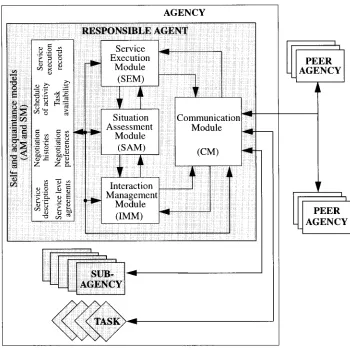
ADEPT agents consist of a number of distinct functional modules8
(Figure 7) that are responsible for handling interagent negotiation (the inter± action management module or IMM), for assessing the agent’s current problem± solving situation (the situation assessment module or SAM), and for executing services (the service execution module or SEM). These modules utilize persistent information about other agents in the environment that is stored in the acquaintance models (AMs) and information about themselves which is stored in the self model (SM). An agent sends and receives commu± nications through its communication module or CM.
The Self and Acquaintance Models
160 N.R.Jennings et al.
FIGURE 7.Functional architecture of an ADEPT agent.
current schedule of activity. In its acquaintance models, it stores information about the existence and known capabilities of other agents, histories of past encounters with them, and knowledge of how they model information.
The Interaction Management Module
The IMM is responsible for provisioning services through negotiation. Thus it both tries to procure the services the agent requires from its acquaintances, and decides which services the agent will provide to others and under what terms and conditions. In either case, services can be provi± sioned in two diŒerent modes depending on the client agent’s intended
pattern of usage and the server agent’s scheduling capabilities : (i) one± oŒ:
by the client on an as± needed basis within a given time frame (subject to some maximum volume measurement).
The process of obtaining a service from another agent is initiated by the SAM. The SAM also indicates the desired mode of provision. The IMM is then responsible for determining which agent or agents to approach, which negotiation strategies to employ, etc. The IMMs decision± making is sup± ported by four types of information : scheduling constraints emanating from the SAM ; knowledge an agent has about its preferences for particular agents, service prices, etc. (represented in its SM); the reservation values for each issue under negotiation (represented in its SM); and its knowledge of the capabilities of other agents (represented in its AM). With this knowledge and the agent’s negotiation model, the IMM generates initial proposals, evaluates incoming counter± proposals, and produces counter± proposals of its own, all with the intention of reaching a mutually acceptable agreement for the provision of the required service.
The process of deciding which services to supply to others is initiated by the receipt of a proposal from another agent. This proposal is evaluated, in terms of whether it is feasible (dened by the SAM) and benecial, and a decision is made as to whether it should be accepted, rejected, or modied. Again, this process is expanded upon in the section on Service Provisioning.
The Situation Assessment Module
The SAM is responsible for assessing and monitoring the agent’s ability to meet the SLAs it has already agreed upon and for assessing the agent’s ability to meet any SLAs that are currently under negotiation. This involves two main activities: (i) the scheduling of services and tasks and (ii) the hand± ling of high± level exceptions that occur when services and tasks are executed.
162 N.R.Jennings et al.
follow from the agent’s ongoing negotiations to generate one of the follow± ing responses : accept± it is likely that the proposed schedule will be satis± able: reject± the agent cannot satisfy the proposed schedule; or revise± it is unlikely that the proposed schedule will be satisable, but the service is pre± dicted to be satisable at the specied alternative. Fine grain scheduling is used when an agreed SLA is in place. It relates to the xing of a particular time at which the service should be executed and a specic set of the agent’s resources that will be deployed in this execution. Resources are therefore reserved before an agreed SLA is executed by the client. Furthermore, if the service is provisioned in an on± demand manner, the SAM uses the agreed volume of invocations to predict the future demand for its resources under that agreement.
The high± level exception handler analyses service execution exceptions as they occur (or even before in certain circumstances) and tries to formulate a set of recovery actions that will prevent the service from failing. For example, during the execution of a particular service, the SEM may realize that it requires a subsidiary service for which no SLA has yet been agreed (perhaps because this subsidiary service is on a little used path through the business process). The SAM then requests the IMM to arrange for this service to be made available if it is not already doing so. As a second example, if a service is delayed, then the SAM may decide to locally res± chedule it (if this can be achieved without violating the existing SLA), to request that the IMM renegotiate the SLA (i.e., attempt to agree to a new schedule with the service’s consumer if the existing SLA cannot be met), or to terminate it altogether and pay any penalties specied in the SLA (if renegotiation fails).
The Service Execution Module
The SEM is responsible for managing services throughout their execu± tion. This involves three main activities. First, service execution management that involves parsing the service’s SDL and ring oŒits constituent subparts
this cannot be achieved, it will refer the problem up to the SAM for reprovi± sioning or renegotiation.
The Communication Module
The CM is responsible for packaging messages destined for other agents in the shared communication language and information model, and the receipt and interpretation of messages from other agents and its tasks (see the next section). During task management (e.g., the activation, suspension, or resumption of a task), messages are routed between the SEM and the tasks managed by that agent. During service execution management (e.g., the initiation or termination of a service being provided by another agent under an existing SLA), messages are routed between the agent’s SEM and the service provider/consumer agent. During negotiation, messages are routed between the agent’s IMM and the agent being negotiated with. In addition to this, the CM checks the validity of incoming messages to ensure they are correct in the present context (e.g., if the agent receives a counter± proposal from an agent it is not negotiating with, an appropriate error message is generated), and translates the content of the message between the shared information model and the agent’s local information model.
InterAgent Communication
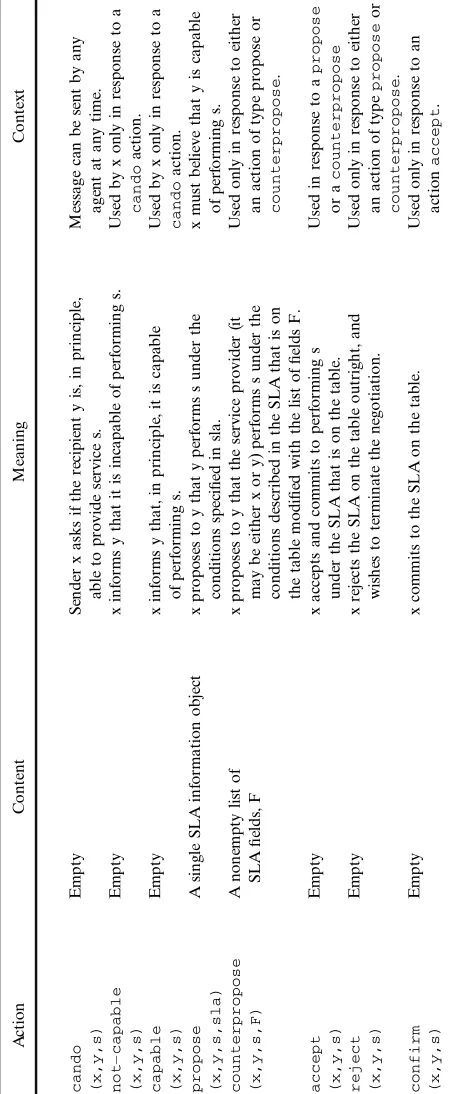
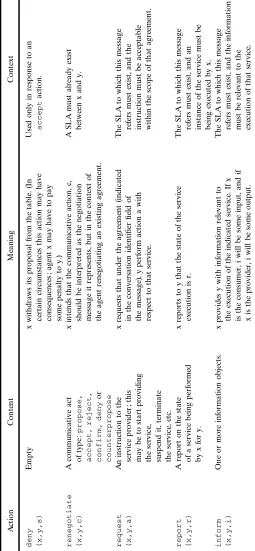
Agents communicate via an agent communication language (ACL). ADEPT’s ACL consists of messages containing : one of a limited number of primitive message types, the identity of the sender, recipient (both agent identiers) and thread of communication, the service concerned, and the information model with reference to which the contents of the message should be understood. Altogether there are 13 message types (Table 1): 10 of which are used during negotiation (i.e., used by the IMM), and 3 are used during service execution (i.e., used by the SEM).
In addition to the requirements that agents must share a common message syntax and interpret diŒerent message types in a uniform manner,
information that is shared by two or more agents must have a common semantic interpretation. This is a signicant problem when interacting agents do not necessarily model information in a consistent way.9 Suppose,
for example, that a network design department agent within a telecommuni± cations company interprets the location of a customer’s site to mean its postal address. However, a team of surveyors may understand the symbol ‘‘location’’ to refer to the site’s grid reference on a standard ordinance survey map. If the design department requires a survey of a customer’s site, how are these agents with their diŒerent models of information to understand one
166 N.R.Jennings et al.
Our approach is to use a common information model, through which agents may share information. This information model is built on a number of basic information object classes (e.g.,Adept–Boolean, Adept–Float, Adept–Integerand Adept–Char), where each class is prepended by the name of the information model, in this case``Adept.  Each class within
the ADEPT information model contains a number of named slots contain± ing further ADEPT information objects. For example, an object of type
Adept–Timemay be specied as follows :
(class Adept–Time
(Adept–Integer year) (Adept–String month) (Adept–Integer day) (Adept–Integer hour) (Adept–Integer minute) (Adept–Integer second))
The information model specication is then parsed to create a represen± tation of that model in the native language of the agent (e.g., C, CLIPS, Prolog, etc.). Using the ADEPT model, an application± specic common information model is built that may, for example, specify information object classes for a customer’s details, which may include their name, address, contact number, etc. A concrete example of such information objects for the BT application is given in the companion paper. In the unlikely event that the business process management system is being developed from scratch, the agent designer could choose to use this model within its domain tasks. However, in many cases business process tasks involve legacy software (e.g., a database of old customer records), which were built using a diŒerent model
of information. Furthermore, if agents representing the interests of diŒerent
companies are to interact, a common information model must reect the information sharing needs between these organizations since it is extremely unlikely that they will use identical models internally. For these reasons, agents must have the ability to manage heterogeneous information models, and transform information that is expressed in task± specic or organization± specic models to and from a common information model.
In transforming information between an internal and common model, simple schema translations that specify the mapping between objects in each model may be used (Jennings et al., 1996). For example, the agent may be provided with a function that transforms its internal representation of a time point into an information object of the classAdept–Time illustrated above.
representations of the internal and common information models (sometimes referred to as ontologies [Gruber, 1994 ; Takeda et al., 1995]) to search for a transformation of an information object from one model to another. The initial production of ontology solutions is as costly as schema translation, but they have the advantage of potentially being reused. However, reasoning with ontologies is computationally expensive.
Given these design trade± oŒs, a hybrid approach that provides both the
speed of the schema translation approach and the exibility of the ontology based approach (Figure 6) was adopted. Here the agent maintains a set of model mapping descriptions that declare the procedure required to trans± form a specic information object from one model to another. If such a mapping exists, the agent uses it to transform the information object as required (solid lines in Figure 6). If no such mapping can be found, the agent searches for a mapping using its ontology descriptions. This mapping may then be stored for later use (dashed lines in Figure 6). Typically an agent is provided with an initial set of schema translations, but it has the exibility to update this set when appropriate mappings cannot be found.
Service Provisioning
The performance of the overall ADEPT system and the various stake± holders that oŒer and consume services is intimately related to the efficiency
of the interagent negotiation process. To prosper, agents need to be able to make benecial agreements in a reasonable time frame, without using exces± sive resources (either communication± related or computational). Moreover, this negotiation must be enacted in a decentralized fashion (i.e., without arbitration or third± party intervention (Pruit, 1981 ; RaiŒa, 1982)), since cen± tralization of processes creates bottlenecks and is susceptible to failure. Con± sequently, each agent has a negotiation capability± the agent’s IMM.
To cope with the variety of negotiation situations in which an agent may nd itself, the IMM needs a number of diŒerent negotiation strategies and
tactics. These vary the agent’s behavior from competitive, through accom± modative, to conciliatory (Pruit, 1981). Such a range of behavior is necessary because negotiating with a peer diŒers from negotiating with a subsidiary
agent, negotiating with an agent from an external organization diŒers from
negotiation with an agent from the same organization, negotiation that requires a rapid agreement diŒers from negotiation in which time is plentiful,
and so on. In more detail, a number of requirements for service± oriented negotiation emerged from the business process applications studied in ADEPT (Sierra et al., 1997):
given service can be provided by more than one agent. The available
d A
168 N.R.Jennings et al.
agents can be both clients and servers for diŒerent services in
d Individual
diŒerent negotiation contexts.
can range over a number of quantitative (e.g., price, dura± d Negotiations
tion, and cost) and qualitative (e.g., type of reporting policy and nature of the contract) issues. Each successful negotiation requires a range of such issues to be resolved to the satisfaction of both parties. Agents may be required to make trade± oŒs between issues (e.g., faster completion time for
lower quality) in order to come to an agreement.
social context and interrelationships of the participants inuences the d The
way agents negotiate. Some negotiations involve entities within the same organization or within the same department and are generally cooperative in nature. Other negotiations are interorganizational, and hence more competitive. Some groups of agents often negotiate with one another for the same service, whereas other negotiations are more infrequent.
agents are autonomous, the factors that inuence their negotiation d As
stance and behavior are private and not available to their opponents (especially in interorganizational settings). Thus, agents do not know what utilities their opponents place on various outcomes, what reasoning models they employ, their opponent’s constraints, nor whether an agree± ment is possible at the outset (i.e., the participants may have noninter± secting ranges of acceptability).
communication channel between any two negotiating agents is d The
private. Hence, agents competing to provide the same services cannot check the behavior of their opponents.
is an important consideration in negotiation. Timings are important d Time
on two distinct levels: (i) the time it takes to reach an agreement must be reasonable; and (ii) the time by when the negotiated service must be exe± cuted is important in most cases and crucial in others. The former means that the agents should not become involved in unnecessarily complex and time± consuming negotiations (the time spent negotiating should be rea± sonable with respect to the value of the service agreement). The latter means that the agents sometimes have hard deadlines by when agreements must be in place (this occurs mainly when multiple services need to be combined or closely coordinated).
In order to satisfy these requirements, a number of constituent com± ponents need to be designed and specied :
i. a protocol indicating when what messages can be sent during the nego± tiation ;
iii. a reasoning model to determine the agent’s behavior in its negotiations.
The Negotiation Protocol
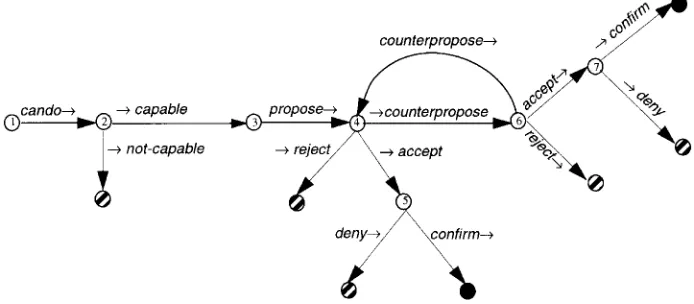
All agents must adhere to ADEPTs negotiation protocol (Figure 8) during service provisioning. The state transition arcs represent the partici± pants’ utterances : ® k primitivel are those of the servers and
k primitivel ® are those of the clients. Negotiation is initiated when a client utters cando (state 1 to state 2). The server can then either indicate that it is capable (state 2 to 3) or that it is not (state 2 to failure). If the server has acknowledged its capability or if the client knows it is capable because of information contained in its AM, the client may send out a proposal (state 3 to 4). The server can then either reject the proposal (state 4 to failure), accept the proposal (state 4 to 5), or counterpropose (state 4 to 6). If the server accepts, the client may either deny the contract to the server (state 5 to failure) or else conrm the contract (state 5 to success). Otherwise, if the server has counterproposed (state 4 to 6), then the client may either accept the new contract (state 6 to 7), reject it (state 6 to failure), or else counter± propose a new contract (state 6 to 4). There may be several transitions between states 4 and 6. If it is the client who eventually accepts the contact (state 6 to 7), then the server may decide to either award the contract to the client (state 7 to success) or else deny it to that client (state 7 to failure). The Negotiation Issues
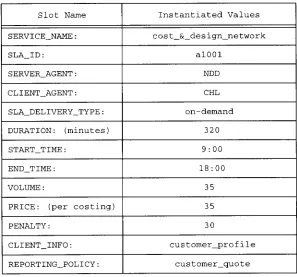
[image:25.419.36.383.389.541.2]SLAs are the structures about which the agents negotiate (Figure 9). They represent the bid on the table during negotiation and the nal contract
FIGURE 8.ADEPTs negotiation protocol. Numbered ovals represent states during the negotiation
process and nonnumbered ovals represent states associated with the outcome of negotiation. Shaded ovals represent unsuccessful negotiation states arrived at by the edges (primitives)not±capable, reject or deny and lled ovals represent successful negotiation state arrived by the primitive
170 N.R.Jennings et al.
FIGURE 9.Sample service level agreement.
at the end of a successful negotiation. The SLA structure is derived from the types of legal contract that are often used to regulate current business trans± actions. The values contained in the slots represent the conditions for pro± viding and consuming a service by a server and a client agent, respectively. Agents can negotiate over multiple issues (values in diŒerent slots) at any
one time.
In more detail, service–name is the service to which the agreement
refers and sla–id is the SLAs unique identier (covering the case where there are multiple agreements for the same service). Server–agent and
client–agent represent the agents that are party to the agreement.
between the start and end times, the price paid per invocation, and the penalty the server incurs for every violation.1 1 Client
–info species the information the client must provide to the server at service invocation (in
this case CHL must provide the customer prole) and
reporting–policy species the information the server returns upon
completion.
The Negotiation Reasoning Model
The reasoning model determines the agent’s behavior in a given negotia± tion context. It is responsible for initiating negotiation to obtain a desired service, responding to proposals from other agents, determining when pro± posals should be accepted or rejected, and determining when counter± oŒers
should be made and what these counter oŒers should be. All this reasoning
is undertaken within the IMM (Figure 10).
[image:27.419.43.378.398.579.2]In more detail, the IMM has three reasoning components (see Sierra et al. (1997) for a formal specication) that are supported by information main± tained in the agent models and the agent’s working memory. The evaluation reasoner takes proposals or counter± proposals coming in from other agents and determines whether they should be accepted, rejected, or whether a counter± proposal should be generated. If a counter± proposal is appropriate, control is handed to the strategic and tactical reasoners to produce a response. The strategic reasoner decides, at a coarse level of granularity, how the agent should approach the particular negotiation. For example, whether it should be cooperative or competitive, whether time or resources is the primary consideration, etc. Finally, the tactical reasoner lls in the slots of the SLA in a way that enacts the chosen strategy.
172 N.R.Jennings et al.
Information used in negotiation. The reasoning components have two main repositories for information± the working memory and the agent models. The former represents transitory information related to ongoing negotiations, while the latter represents persistent storage of more stable information.
Information stored in the working memory is structured around the notion of a negotiation thread. A thread is essentially a record or history of utterances related to a particular negotiation need (i.e., nding a server for a particular service). It includes all the messages the agent has sent, all the messages the other agents have sent, which strategies and tactics the agent has deployed, the current status of all negotiation threads (in cases where the agent is managing multiple threads of negotiation for the same service), and the service’s earliest start and latest end times.
In the context of supporting negotiation, the agent models represent the agent’s (private) beliefs about itself and its environment. The AM includes : agency agents± unique names of individual members of the agent’s agency ; agency typology± the agent’s relationships (peer, subsidiary agent, etc.) with other community members ; agency status± which agents are in the same organization and which are external ; agency capacity± which agents can provide services the agent needs ; the negotiation protocol (Figure 8); and interaction histories± persistent records of negotiation threads. The SM includes : service descriptions for the services the agent can perform itself, together with an indication of the number of concurrent invocations that are permissible; the commitments the agent has already made through its SLAs ; the agent’s reservation values for the services it consumes and provides; and the agent’s preferences for the various issues under negotiation (expressed as a scoring function).
The evaluation reasoner. The evaluation reasoner becomes active when an agent receives a proposal or counter± proposal from another agent. Upon receipt of such a message, the agent computes the utility it attains for the proposal. It uses an additive scoring function (RaiŒa, 1982) over each slot in
the SLA, where each slot is assigned a weight representing the relative importance of that issue to that agent. For example, consider the case depicted in Figure 10 where the NDD agent receives the SLA proposal a1001. NDD goes through each slot in the proposal and assigns a measure of desirability (a utility rating (JeŒrey, 1983) between 0 and 1) to the value
contained therein. The raw utility values are then multiplied by a weighting factor (that indicates their relative importance) and then summed over all the slots. This process produces a single utility value for the proposed SLA. In parallel, the agent sends the oŒer that has just been received to the tacti± cal reasoner to see what oŒer the agent would produce next using its current
reasoner and rated using the aforementioned scoring function. If the utility of the oŒer the agent would have sent is less than or equal to the utility of
the oŒer just received, the oŒer is accepted (provided it meets the scheduling
constraints coming from SAM). Acceptance involves a conditional com± mitment by the server that it will execute the specied service under the SLAs terms and conditions. The commitment is conditional in that the client still has to conrm or deny the contract (Figure 8). Assuming the client conrms the contract, it then terminates all other negotiation threads for the same service instance. The second out± come of the SLAs evaluation is that the proposal is rejected. This occurs either when the deadline for reaching an agreement has been reached or when another agent has been selected to perform the service. The nal evaluation outcome is that the oŒer
is neither accepted nor rejected. In this case, the agent generates a counter oŒer.
If a counter oŒer is to be made, the evaluation reasoner also makes an
assessment of the opponent’s negotiation behavior in the current thread. Thus, evaluation is not only conned to the current oŒer instance, it also
incorporates the relationship of that oŒer to previous ones in the thread. In
particular, the agent classies the behavior of its opponent into one of three mutually exclusive states : i)CONCEDING± the utility to the recipient of the last oŒer is greater than the previous oŒer received from that agent ; ii)
EXPLOITING± the utility to the recipient of the last oŒer is less than the
previous oŒer received from that agent ; or iii) STALEMATE± the utility to the recipient of the last oŒer is the same as the previous oŒer received from
that agent. As well as the direction of change, the agent uses the negotiation thread history to determine the rate of change of that state. Thus, the agent calculates whether this conceding/exploiting isINTENSIFYING, LESSEN±
ING,or CONSTANT. These two pieces of information are then passed onto the strategic reasoner which uses them to determine whether its present strategy is being successful or whether a change is needed.
The strategic reasoner. The strategic reasoner is invoked by the evalu±
ation reasoner in the case of an ongoing negotiation or by the SAM for new negotiations. In either case, the purpose of the reasoning at this level is to set broad guidelines about how the agent should behave in a particular negotia± tion context. In the current implementation, these guidelines relate to deter± mining the relative importance of the three classes of behavior that take time, resources, and an opponent’s behavior as the primary basis for com± puting an oŒer. Time is important when the negotiation has a deadline.
174 N.R.Jennings et al.
weights to the alternatives.
For new negotiations, the agent receives information from the SAM about when the service is required (HAVE±TIME, NOW), uses AM informa± tion about the number of known suppliers of the service (ONE, MANY), and uses AM information about the agent’s relationship with the potential service provider (SAME±ORGANIZATION, EXTERNAL±ORGANIZATION) to set the strategy.
The rst strategic decision relates to the logistics of the negotiation: who to negotiate with ; whether to negotiate with more than one agent ; and if more than one agent is to be negotiated with, then should the negotiation proceed sequentially or in parallel. If there is only one service provider then the agent has no real choice to make at this level. However, when there are several providers, the agent uses the following heuristics to manage this aspect of the process (Figure 11).
Having decided upon the logistics, the agent must determine how it is to behave. Example rules for setting an agent’s strategy, along with their justi± cation, are shown in Figure 12. In addition to setting the strategy, the agent records its expectation of how the negotiation should develop in terms of the speed at which it will converge and the likely response of the opponent. This information is then used to monitor the progress of the ongoing negotiation.
For ongoing negotiations, the role of the strategic reasoner is to deter± mine whether the current strategy is being successful (in terms of the agent’s predictions about its development and the utility the agent is obtaining from the deal) in fullling the agent’s negotiation objectives. Such monitoring is needed because the world in which the agent is operating is subject to
FIGURE 12.Setting the negotiation strategy.
176 N.R.Jennings et al.
LESSENING, CONSTANT). Example rules illustrating such strategy moni± toring and modication are given in Figure 13.12
The tactical reasoner. The role of the tactical reasoner is to enact the high± level behavior set by the strategic reasoner. The output of this level is a SLA which has values in each of its slots. Thus a tactic is a function which acts in line with the set strategy, to set a value for each SLA slot. For quan± titative slot parameters, tactics have to select a value in between the allow± able minimum and maximum value for that issue. For qualitative values, the tactics have to choose from a discrete range of alternatives± a process achieved by mapping the qualitative values onto the quantitative scoring function (Faratin et al., 1998).
The way in which tactics diŒer is in how they go about computing a slot
value. There are three main ways of coming to a value (more details of the operation and variety of tactics can be found in (Sierra et al., 1997) and in
Section 4.3 of the companion paper):
tactics : This family of tactics base their behavior on the d Time± dependent
time remaining until an agreement must be in place. At their negotiation deadline all these tactics put forward their reservation values. However, the way in which they concede to reach these values diŒers. There are two
broad patterns of concession: (i) boulware (RaiŒa, 1982): maintain the
oŒer until the time is almost exhausted and then begin to concede up to
the reservation value; and (ii) conceder : move rapidly to the reservation value.
tactics : This family of tactics base their behavior on d Resource± dependent
the amount of a given resource remaining. The property of these tactics is that they model the urgency of the deal as: i) the resources become scarcer, ii) the willingness of other parties in negotiation decreases (measured as an increase in the length of the negotiation thread) and iii) the computational load on the agent increases. The actual relationship is that the quantity of time left in negotiation is proportional to the number of agents in the negotiation and inversely proportional to the length of the negotiation thread. Thus, the more agents who are potentially available to perform the service, the longer the agent can aŒord to negotiate. But the
longer the duration of the negotiation, the more urgent the need for an agreement becomes.
tactics : This family of tactics base their behavior on d Behavior± dependent
how their opponent behaves during the ongoing negotiation thread (Axelrod, 1984). The tactics within this family diŒer in which aspect of
their opponent’s behavior they imitate, and to what degree. There are three ways in which behavior can be imitated: i) Relative Tit± For± Tat ; ii) Absolute Tit± for± Tat ; and iii) Averaged Tit± For± Tat, where other’s behav± ior is, respectively, imitated proportionality, absolutely, and in an aver± aged fashion.
Each of the families computes a value for each of the negotiation issues based upon their particular perspective (Figure 14). The three values for each issue are then combined, according to the relative weightings set by the strategic reasoner, to provide a single value which is the one put forward for that issue.
Service Management
178 N.R.Jennings et al.
FIGURE 14.Negotiation tactic rules.
When an agent agrees to provide a service to an acquaintance under a specic SLA, the 2 SAM performs line grain scheduling to determine when each of the service’s constituent components should be executed and which problem± solving resources should be deployed.13 The SAM uses two tech± niques to proactively schedule tasks and services before they are required : i) sequential scheduling and ii) look± ahead scheduling. The former is used in association with on± demand provisioning. Each on± demand task or sub± service associated with an agreed service is scheduled according to the service description before the service is executed for the rst time. The latter is associated with the scheduling of component parts of one± oŒservices. As a
For both sequential and look± ahead scheduling, the SAM sets up reser± vations that are used by the SEM for the actual execution of a service or task. A reservation principally associates a particular task instance or service with a unique SLA. The SAM sets up reservations to provide sufficient resources to comply with this agreement, considering components such as the agreed volume of invocations and the permissible degree of concurrency. Each agent may have its own scheduling methodology and could be linked to a generally available or legacy scheduler. The reservations are processed in two ways according to whether the service is one± oŒor on± demand. In the former case, the SEM invokes the resource that has been set aside in the ne grain scheduling phase and on completion informs the SAM of the service’s end result. The SAM then removes the reservation and frees up the resource. In the latter case, a number of reservations (based on the agreed volume of invocations) are initially set up and noted as earmarked. This implies that the resources can be used with priority given to the associated SLA. When the SEM uses one of these resources, the reservation is set to committed, thus barring any other process instance from using it. On completion, the reservation is reset to embarked ready for reuse. Only when the associated on± demand SLA is completed is the SAM informed and the reservations removed and the resources freed.
Due to the dynamic nature of the domain, exceptions often arise during service execution. The SEM monitors the execution of tasks and detects when something has gone wrong. If the exception can be handled by the SEM then it is. Otherwise, the SEM informs the SAM of the problem. These exceptions can be of two types : (i) functional or (ii) resource related. A func± tional exception indicates that the particular activity being performed by a resource has gone into a state of error. In this case, the SAM can either attempt to reschedule the same task instance or reresource the task by scheduling another instance of the same task type. Both options are usually considered and the SAM decides which is likely to be the most eŒective in a
180 N.R.Jennings et al.
RELATED WORK
There are a number of research areas that impact upon, and are related to, the work described in this article. This section focuses on the three that are most closely related to ADEPTs key components ; namely : (i) extant workow systems; (ii) automated negotiation by autonomous agents and ; (iii) techniques for allowing agents with heterogeneous information models to interoperate. These areas are dealt with in turn.
Extant Workow Systems
At the time of writing, there are no commercial systems that support business process management using a meaningful notion of agenthood. Existing workow management systems oŒer limited support and minimal
exibility during process enactment. In situations where a business process is fully resourced (dimensioned) and every conceivable outcome can be con± sidered and controlled, then conventional distributed computing techniques and traditional workow systems are adequate. If, however, the system has to cope with undened errors or failures, and there is a need for dynamic reconguration of resources, then the ADEPT approach is more exible and robust.
The core functionality of a traditional workow system is to automate the execution of a sequence of tasks in support of a business process. Typi± cally, workow systems consist of an engine that executes business tasks in a predened order (as specied in a script [Hollingworth, 1994]). The ADEPT system subsumes this functionality in its SDL and in the SEMs execution of these service descriptions. However, unlike workow management systems, ADEPT also performs both resource management and sophisticated excep± tion handling :
agents have the ability to perform explicit resource management ;
d ADEPT
they control and reason about the systems, databases, equipment, and people that make up an organization. Traditionally business process man± agement systems do not provide an inbuilt capability for such direct resource management. Instead, processes have to be resourced and dimen± sioned prior to enactment. The ADEPT approach means the system can be far more responsive to unexpected or unusual patterns of resource availability.
in workow systems, exception handling is managed by explic± d Presently
to react in a context dependent manner to circumstances where the type of corrective action might vary depending upon the availability of resources and the task’s criticality within the process.
The nal diŒerentiator is that workow management systems tend to
operate with a central workow engine that monitors all the events in the system. This type of architecture is limiting when a business process spans a large enterprise. ADEPT takes a distributed, and, hence, more robust and scalable approach, where the disparate components of a business process are each represented by an agent. Agents can be distributed either logically or physically throughout an organization.
Given the limitations of current generation workow systems, a number of researchers have considered using multiagent systems for various aspects of business process management. Hall and Shahmchri (1996) use agent tech± nology to enable both expert (e.g., a manager or business process engineer) and nonexpert users involved in a business process to inuence the design and modication of that process. A language is presented for the description of processes and tasks to enable automatic reasoning about the operation of the business process, and hence, facilitate the reuse of existing processes. A task is represented by a role that indicates who should execute the task, a set of preconditions, a task description, and a set of stop conditions. This is similar to the structure of a service description in the ADEPT model : the mandatory inputs to the service are preconditions for the execution of the service, a description of the processes involved in executing that service is provided in the body, and the completion conditions have a similar role to stop conditions. Such a rigorous description of processes and tasks provides an agent± based business process management system with the potential to modify the business process (possibly with reference to an expert) in response to changing circumstances. Therefore, the use of agent technology to enable modication of a business process is complimentary to agent± based business process management systems such as ADEPT.
A federation± type architecture (Genesereth & Ketchpel, 1994 ; Takeda et al., 1995 ; Tenenbaum et al., 1992) provides an alternative method for organizing multiagent systems for the management of business processes. Agents are organized into groups, each group being associated with a single ‘‘facilitator’’14 to which an agent surrenders a degree of autonomy. A facili±
182 N.R.Jennings et al.
tion models, problem decomposition and distribution of subproblems to agents unspecied by the original sender, and delayed communications in the event of an agent being temporarily oŒ± line. This architecture enables agents to communicate without concern for the particular syntactic and semantic requirements of the recipient. An agent may also send a message without specifying the recipient, the content± based routing of these messages being performed by its facilitator. During negotiation, participating agents require secure communication, but this direct communication is enabled and managed by one or more facilitators. These facilitators represent the inter± ests of many diŒerent agents. Therefore, a facilitator that is managing direct
communication between negotiating agents must be trusted to act in the interests of these agents, even if this conicts with other interests it is rep± resenting. At present, the federation architecture has been used predomi± nantly for the interoperation of purely cooperative agents at the team level of an organization (e.g., SHADE and PACT [Tennenbaum et al., 1992]). Such security issues must be addressed if this architecture is to be employed in business process management where more than one organization is involved. An additional difficulty with the federation architecture is that it does not support the encapsulation of services. The ability to model both peer and hierarchical structures in ADEPT is founded in organizational models where an enterprise is logically divided into a collection of services. The agent± agency concept in ADEPT draws on this principle to group ser± vices within the system where it makes pragmatic sense, a exibility that is not available in the federation architecture.