Wilton Park House Wilton Place Dublin 2 Ireland
Tel: + 353 1 607 3000 Fax: + 353 1 607 3030 Website: www.forfas.ie Email: [email protected]
In accordance with the Official Languages Act 2003 this publication is also available in Irish
F
o
rf
á
s
A
n
n
u
a
l
R
e
p
o
rt
2
0
0
Mission
To the Minister for Enterprise, Trade and Employment
Pursuant to the Industrial Development Act, 1993, Forfás herewith presents its report and accounts for the year ended 31 December 2007.
Do Aire Fiontar, Trádála agus Fostaíochta
De bhun an Achta um Fhorbairt Tionscail, 1993, tá a thuarascáil agus a chuntais don bhlian dar chríoch 31 Nollaig, 2007, a dtíolacadh leis seo ag Forfás.
Martin Cronin Eoin O’Driscoll
The NCC reports to the Taoiseach on key competitiveness issues
D E P A R T M E N T O F EDUCATION A N D S C I E N C E A N R O I N N
OIDEACHAIS AGUS EOLAÍOCHTA
The EGFSN also reports to the Minister for Education and Science
Forfás, the advisory councils
to which it provides research
and administrative support and
its sister agencies engaged in
enterprise development and
research funding
Office of the Chief Scientific
Adviser to the Government
Independent Advisory Groups
Sister Agencies
Research and Administrative
Functions of Forfás
Forfás is the national policy and advisory board for enterprise, trade, science, technology and innovation. It is the body in which the State’s legal powers for industrial promotion and technological development have been vested. It is also the body through which powers are delegated to Enterprise Ireland for the promotion of indigenous industry and to IDA Ireland for the promotion of inward investment. Science Foundation Ireland was established as a third agency of Forfás in July 2003. The broad functions of Forfás are to:
n advise the Minister on matters relating to the development of industry in the State;
n advise on the development and coordination of policy for Enterprise Ireland, IDA Ireland, Science Foundation Ireland and such other bodies (established or under statute) as the Minister may by order designate;
n encourage the development of industry, science and technology, innovation, marketing and human resources in the State;
n encourage the establishment and development in the State of industrial undertakings from outside the State; and
n advise and coordinate Enterprise Ireland, IDA Ireland and Science Foundation Ireland in relation to their functions.
Feidhmeanna
Is é Forfás an bord comhairleach agus polasaí náisiúnta do fhiontar, thráchtáil, eolaíocht, theicneolaíocht agus nuálaíocht. Is é an comhlacht ina bhfuil cumhacht dlíthiúil an Stáit dílsithe i leith tionscail a chur chun cinn agus forbairt teicneolaíochta. Is é an comhlacht freisin trína thiomnaítear cumhachtaí go Enterprise Ireland chun tionscal dúchais a chur chun cinn agus do IDA Ireland chun infheistíocht isteach a chur chun cinn. Bunaíodh Science Foundation Ireland mar thríú gníomhaireacht de Forfás in Iúil 2003. Is iad na feidhmeanna leathana de Forfás ná chun:
n comhairle a thabhairt don Aire ó thaobh cúrsaí a bhaineann le forbairt tionscail sa Stát;
n comhairle a thabhairt maidir leis an bhforbairt agus an gcomhordú de pholasaí do Enterprise Ireland, IDA Ireland, Science Foundation Ireland agus d’aon chomhlacht eile dá leithéid (bunaithe nó faoi reacht) mar a d’fhéadfadh an tAire a thiomnú de réir ordaithe;
n an fhorbairt de thionscal, theicneolaíocht, mhargaíocht agus acmhainní daonna a spreagadh sa Stát;
n an bunú agus an fhorbairt sa Stát de ghnóthais tionsclaíochta a spreagadh ó áiteanna lasmuigh den Stát; agus
Contents
Forfás Board Members
6
Statement of the Chairman and Chief Executive
7
Statistical Overview
11
Activities
19
The Irish National Accreditation Board
58
Forfás Management and Advisory Councils
63
Corporate Governance
71
Forfás Board Members
Prof. Mark Keane, former Director General, Science Foundation Ireland, resigned from the Forfás Board in February 2007. Prof. Frank Gannon, Director General, Science Foundation Ireland, joined the Forfás Board from July 2007.
Mr Sean Dorgan, former Chief Executive Officer, IDA Ireland resigned from the Forfás Board in December 2007. Mr Barry O’Leary, Chief Executive Officer, IDA Ireland, joined the Forfás Board from January 2008.
Mr Eoin O’Driscoll and Mr Sean Gorman retired from the Forfás Board on a rota basis in December 2007 and were both reappointed in January 2008.
Forfás Audit Committee
Ms Jane Williams, Chairman Dr Rosheen McGuckian Mr William O’Brien Mr Eoin O’Driscoll
Forfás Management Development Committee
Mr Eoin O’Driscoll Mr Pat Barry Dr Don Thornhill Mr Eoin O’Driscoll
Chairman
Managing Director, Aderra
Mr Martin Cronin
Chief Executive, Forfás Mr Barry O’LearyChief Executive Officer, IDA Ireland
Mr Sean Gorman Secretary General, Department of Enterprise, Trade and Employment
Prof. Frank Gannon Director General, Science Foundation Ireland
Mr Pat Barry
Communications Advisor Dr Rosheen McGuckianChief Executive Officer, GE Money
Mr Rody Molloy Director General, FÁS
Mr William O’Brien Managing Director, William O’Brien Plant Hire Limited
Ms Anne Heraty Chief Executive, CPL (Computer Placement Ltd)
Mr Frank Ryan Chief Executive Officer, Enterprise Ireland
Dr Don Thornhill Chairman, National Competitiveness Council
Ms Jane Williams Managing Director, The Sia Group
Statement of the Chairman and Chief Executive
Mr Eoin O’Driscoll
Chairman Mr Martin CroninChief Executive
Overview
The Irish economy is now one of the most globalised in Europe. As a consequence, uncertainty created by the international financial crisis has led to lower than expected growth levels and a decrease in domestic demand.
Despite difficult conditions Ireland’s economy continued to perform reasonably well over the last year. Even after recent increases, unemployment remains low in comparison to other developed economies, at 5.5%. GDP growth is expected to be 2.5% for 2008 and exports of goods and services from Ireland grew by 6.4% in 2007. Our indigenous companies continue to internationalise and outward direct investment exceeded inward investment for the first time in recent years.
Employment continued to rise in 2007 with an additional 68,000 jobs created in the economy. Investment in R&D reached its highest ever level up from €2.3 billion in 2006 to €2.5 billion in 2007.
The economic environment, however, is more challenging than we have seen for many years. But we have the foundations in place for long term economic growth through proactive policies and initiatives such as the Strategy for Science Technology and Innovation, the National Skills Strategy and the National Development Plan. Ireland is well placed to tackle the challenges presented with a strong base of modern industry, a highly skilled and flexible workforce, a positive fiscal environment and a pro-business culture.
Our experience, flexibility and adaptability will continue to be crucial differentiators in the continued development of Ireland as a knowledge driven, high value economy, provided we respond appropriately to the current challenging economic environment.
Addressing Current Challenges
We need to maintain an intensive focus on reinforcing our competitiveness and on proactively addressing immediate economic challenges including cost competitiveness, infrastructure deficits and a slower pace of productivity growth. It is essential that we maintain investment (whether public or private) in the critical areas of education, science, technology, innovation and infrastructure, which will be the enablers of growth in the longer term.
Underpinning our success as a high income economy must remain at the top of the Government agenda and the strategies and actions outlined in the Strategy for Science Technology and Innovation, National Skills Strategy and National Development Plan must be implemented effectively.
Cost Competitiveness
A major issue which needs to be addressed is Ireland’s cost competitiveness, which is vital to the success of our exporting sector. Over the last year we have seen a significant loss in Ireland’s international price competitiveness due to the appreciation of the euro, pay increases ahead of productivity growth rates and high inflation levels. Non-pay costs compare unfavourably with other European countries, and property costs, utilities (including waste, water and electricity) and domestic services costs are significantly higher.
prices, it is important that we act now to reduce costs in the areas we control. The management of inflation should be complemented with a drive towards raising productivity and improving our overall competitive position. Forfás supports the proposal by the National Competitiveness Council to develop a national programme to restore cost competitiveness, which includes setting a national inflation target close to the ECB 2% target. A key challenge for the Government and the Social Partners is to work towards a mix of pay growth, inflation and productivity growth which will strengthen and safeguard competitiveness.
Infrastructure
Substantial progress has already been made in improving Ireland’s infrastructure. Well developed infrastructure, however, is no longer a differentiator, but is fundamental to the needs of enterprise. It is important that Government meets the targets set out in the NDP to complete the infrastructural transformation of Ireland and to underpin the development of cities and regions
We need also to look beyond the immediate and plan for future needs so that we remain attractive for sectors and companies as they evolve in this increasingly technology enabled global environment. We continue to play catch up in broadband technologies and we should ensure that Ireland becomes one of the leading European locations for next generation broadband technologies.
Productivity
International competition is creating pressure for greater efficiency, quality and productivity in both indigenous and foreign owned firms in Ireland. Achieving higher relative productivity growth rates will be important for future international competitiveness and securing sustainable wage growth. Continued investment in innovation across all aspects of business activities, including new technologies and re-skilling will enable a shift toward higher value added activities and improved productivity.
Opportunities
The profile of Ireland’s enterprise base comprises successful internationally trading firms in many dynamic fields of business such as ICT, life sciences, financial services, food, web based services, property and construction services, specialised engineering, headquarter functions and locally delivered services.
The long term outlook for the continued development and expansion of these sectors in Ireland is good, with strong levels of new product and services development. There is also potential as opportunities arise where previously distinct and separate sectors begin to come together.
Forfás Corporate Strategy
The global business environment is changing rapidly and it impacts on how organisations do business. Forfás is no different. We recognise the need to adapt and review our strategic direction in response to these economic shifts.
Forfás has worked closely with government and stakeholders to develop a new strategy to optimise our effectiveness. Forfás is recognised for its successful delivery of excellent policy analysis, advice and outputs. Utilising our skills and expertise we will continue to deliver this work and will also work to build shared understanding of issues, highlighting what we believe are the key issues for enterprise and science and influencing action with policy makers.
Our work will be guided by areas of emphasis:
n Identifying Key Strategic Issues;
n Focusing on Engagement and Output; and
n Achieving Outcomes.
Identifying Key Strategic Issues
Forfás, in consultation with key stakeholders, has defined five key questions facing enterprise and science today. We will address these questions and identify policy options to respond and prepare Ireland for the next wave of economic development.
n Ensuring the right policies for future enterprise Considering the likely shape of the future enterprise base ten years from now are the current enterprise strategies relevant and complementary?
n Optimising the impact of science/R&D investments How should emerging research strengths evolve to maximise the development of high value added enterprise, and of a high productivity economy?
n Achieving OECD top-decile education and training outcomes
Building on our current education and training systems, how can we ensure that they will be a major source of future competitive advantage by achieving “top decile in OECD” outputs?
n Environmental/Energy opportunities and challenges How can we realise the opportunities and address the challenges for enterprise which will be presented by environmental and energy related issues?
n Developing competitive regions
What needs to be done to ensure Ireland continues to build competitive regions?
Focusing on Engagement and Output
We will employ a broad range of operating techniques in our work. In addition to undertaking detailed, high quality analysis and delivering recommendations as required we will place emphasis on working with a range of stakeholders to frame issues to be addressed, develop policy options, and support implementation of policy change. It is by working proactively with others that Forfás can best achieve its objectives of providing robust advice which influences outcomes.
Achieving Outcomes
In addition to the rigorous, detailed reports required by policymakers we will employ a range of other appropriate methods to communicate with important influencers of policy. Success in meeting the challenges of our Strategy hinges on our ability to bring our thinking to the right audiences in the right way and to work with individuals and groups to gain a shared understanding of the issues and what is required to tackle them. We will devote time to understanding our audience’s requirements and delivering our messages to them in the right way.
0
Acknowledgements
Throughout the year Forfás has been supported in its role by Government, stakeholders and the development agencies. This partnership approach is central to our success in developing relevant policy advice. We would like to acknowledge the contributions and assistance provided throughout the year from the former Minister for Enterprise, Trade and Employment, Micheál Martin TD and the Department of Enterprise, Trade and Employment and other Government Ministers and Departments.
Forfás continues to work closely with the development agencies Enterprise Ireland, FÁS, IDA Ireland, Shannon Development and Údarás na Gaeltachta in supporting enterprise in Ireland and Science Foundation Ireland on issues relating to science and technology. Forfás also acknowledges the contribution of groups and individuals in business, government, employer organisations and trade unions to the development of policy advice and recommendations.
We would particularly like to thank the independent advisory groups which Forfás has worked closely with throughout the year including the:
n Advisory Science Council, chaired by Mary Cryan;
n Discover Science and Engineering Programme, chaired by Leo Enright;
n Expert Group on Future Skills Needs, chaired by Anne Heraty;
n Management Development Council, chaired by Prof. Frank Roche;
n National Competitiveness Council, chaired by Dr Don Thornhill;
and also the steering groups which provided valuable guidance to major projects:
n Business Regulation Forum, chaired by Donal de Buitléir;
n Services Strategy Group, chaired by Tony Keohane;
n Enterprise Tax Advisory Group, chaired by Paul Haran; and
n Project Advisory Board and Working Groups on the Socio-Economic Scenarios Project.
We would also like to thank the Board of the Irish National Accreditation Board, chaired by Dr Máire C. Walsh, for their continued support and contributions.
Forfás would like to welcome two new members to its Board, Barry O’Leary, Chief Executive, IDA Ireland and Frank Gannon, Director General, Science Foundation Ireland. We would like to extend our thanks and
appreciation to Sean Dorgan, former Chief Executive of IDA Ireland, who resigned from the Board in December 2007.
Forfás collects and analyses a range of data on employment and expenditure by agency-supported firms and Ireland’s performance in R&D and innovation. This section provides an overview of these indicators.
Value for Money Indicators
Forfás undertakes an annual review of value for money indicators to provide information on the financial inputs and the nature of the outputs from the activities of the development agencies. The review is submitted to the Department of Enterprise, Trade and Employment. Despite the intensification of global competition for foreign direct investment and the erosion of cost competitiveness, positive trends in agency activities continued in 2006.
The key findings emerging from the data analysis of the period 2003 – 2006 are:
n State expenditure on enterprise development through the development agencies (IDA Ireland and Enterprise Ireland) increased by approximately 26% over the four year period 2003–2006. This includes expenditure on the development of strategic sites and R&D commercialisation infrastructures. Direct supports to companies increased marginally over the period.
n Strong increases continued in the levels of sales and exports in indigenous firms and in gross value added per employee in both indigenous and foreign firms.
n Positive trends continued in terms of investment and numbers of supported companies engaging in R&D, high potential start ups and in foreign direct investment projects. Overall employment numbers continue to increase, albeit marginally.
n Irish economy expenditure increased by 3.5% with corporation tax receipts accounting for most of the increase. Though growing slowly, Irish economy expenditure remains at a high level.
Expenditure by Agency-Supported Firms
in the Irish Economy
The Forfás Annual Business Survey of Economic Impact
presents results relating to all manufacturing and internationally-traded services firms that are under the remit of Enterprise Ireland, IDA Ireland, Shannon Development and Údarás na Gaeltachta. The survey tracked the 2006 performance of agency-assisted client companies in terms of outputs (sales, exports, net output) and monitored the direct expenditure of these companies in the Irish economy in terms of payroll spend and purchases of Irish-supplied materials and services.
In 2007, almost 3,900 companies were surveyed and approximately 750 were foreign-owned firms. Approximately 2,700 of the companies surveyed were in the manufacturing sector and 1,100 were in the internationally-traded services sector.
The overall output of agency-assisted firms in manufacturing and internationally-traded services increased by 5.4% in 2006 (in nominal terms), while direct expenditure in the economy increased by 4.1% (Table 1).
Direct expenditure by these firms in the economy totalled
€34.8 billion (bn) in 2006. In total, Irish-owned firms spent €16.6bn in the domestic economy in 2006, comprising €4.8bn on payroll costs, €8.6bn on Irish raw materials,
and €3.2bn on Irish services. This direct expenditure has
increased from €8bn in 1990. Direct expenditure by
foreign-owned firms amounted to €18.2bn in 2006, comprising €7.6bn on payroll costs, €4.3bn on materials produced in
Ireland and €6.4bn on services purchased in Ireland. This
[image:14.595.60.542.669.796.2]is up 7.2% on the 2005 returns for direct expenditure and indicates a recovery of direct expenditure levels compared with the downward trend of the previous two years.
Table 1
Contribution of Agency-Supported Firms in the Irish Economy
Irish-Owned Firms Foreign-Owned Firms All Firms
2005 2006 2005 2006 2005 2006 CHANGE
Sales €m 24,675 25,914 96,655 102,021 121,330 127,935 5.4%
Payroll Costs €m 4,753 4,795 6,809 7,577 11,562 12,371 7.0%
Irish Raw Materials €m 8,423 8,572 4,047 4,251 12,470 12,822 2.8%
Services bought in Ireland €m 3,226 3,186 6,149 6,397 9,375 9,583 2.2%
Direct Expenditure in the Economy €m 16,402 16,552 17,005 18,224 33,406 34,776 4.1%
Direct Expenditure as % Sales % 66.5 63.9 17.6 17.9 27.5 27.2 -0.4%
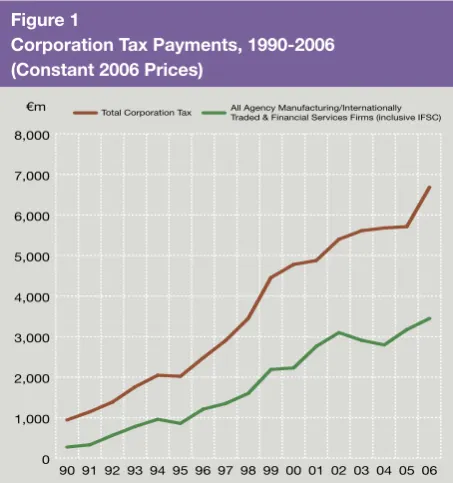
Corporation Tax Payments, 1990-2006 (Constant 2006 Prices)
0 1,000 2,000 3,000 4,000 5,000 6,000 7,000 8,000 06 05 04 03 02 01 00 99 98 97 96 95 94 93 92 91 90
Total Corporation Tax All Agency Manufacturing/Internationally Traded & Financial Services Firms (inclusive IFSC)
€m
Source: Exchequer Returns for 2006, Department of Finance. Forfás Annual Business Survey of Economic Impact 2006
Corporation Tax Payments
In addition to their expenditure in the economy, manufacturing and internationally-traded and financial services companies provide a very significant direct return to the Exchequer by way of corporation tax payments.
The total corporation tax yield from all sources was €6.7
billion in 2006 (Figure 1), an increase of 21% in real terms on the previous year. It is estimated that agency-supported firms in the manufacturing and internationally traded services sectors accounted for €2.3 billion, with an additional €1.1
billion from international financial services firms, amounting to €3.4 billion (51%) of the €6.7 billion total corporation tax
paid in the economy.
Agency-assisted companies in chemicals/pharmaceuticals and internationally traded services accounted for 39% and 24% of the €2.3 billion respectively, with the food and drink
[image:15.595.308.538.228.427.2]sector accounting for 14% of the total.
Figure 2
Permanent Full-Time Employment (1998-2007)
0 50,000 100,000 150,000 200,000 250,000 300,000 350,000 07 06 05 04 03 02 01 00 99 98
All Ownership Foreign Irish
Source: Forfás, Annual Employment Survey 2007
Employment in Agency-Supported
Companies
Figure 2 shows total full-time employment in companies under the remit of Enterprise Ireland, IDA Ireland, Shannon Development and Údarás na Gaeltachta. In 2007, the total number employed was 305,121, a net increase of 1,115 on the previous year. This increase comprises 2,340 more jobs in Irish-owned companies and 1,225 fewer jobs among foreign-owned companies in manufacturing and internationally-traded services. Approximately 25,355 jobs were created in manufacturing and internationally-traded services in 2007 with 24,240 job losses during the year.
Figure 3
Job Gains, Losses and Net Change in Permanent Full-Time Employment (1998-2007)
-40,000 -20,000 0 20,000 40,000 60,000 07 06 05 04 03 02 01 00 99 98
Job Gains (Full-time) Job Losses (Full-time) Job Change (Full-time)
Source: Forfás, Annual Employment Survey 2007
Figure 3 highlights the trend in the number of jobs being created and lost over the 1998-2007 period and shows that the rate of job losses has fallen significantly since 2002.
Net job losses between 2006-2007 were concentrated in traditional manufacturing sectors such as machinery and equipment (-1,190), transport equipment (-542) and basic and fabricated metal products (-517), reflecting ongoing restructuring and competition from lower-cost locations. There were overall net job increases in sectors such as non-metallic minerals (+654), mining, quarrying and indigenous services (+634) and chemicals (+184).
There were significant net job gains in the internationally traded services sector, which includes international financial services and international services. Total employment in this sector increased to 82,060 in 2007 (up 3,455). Net job creation was highest in the international financial services sector (1,982). The second largest net increase in employment was in the international services sector which saw an increase of 1,473, which is largely accounted for by firms in consulting, software and other computer-related services.
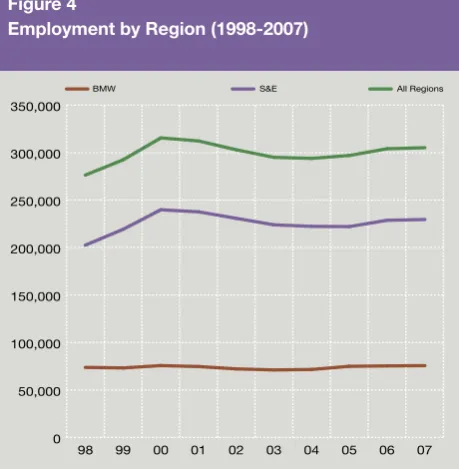
Figure 4
Employment by Region (1998-2007)
0 50,000 100,000 150,000 200,000 250,000 300,000 350,000 07 06 05 04 03 02 01 00 99 98
BMW S&E All Regions
Source: Forfás, Annual Employment Survey 2007
Regional Distribution of Employment
5
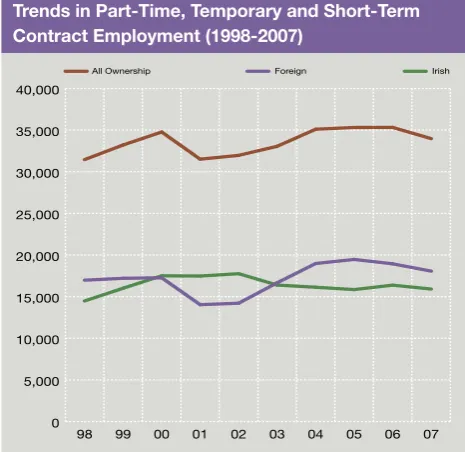
Figure 5Trends in Part-Time, Temporary and Short-Term Contract Employment (1998-2007)
0 5,000 10,000 15,000 20,000 25,000 30,000 35,000 40,000
07 06 05 04 03 02 01 00 99 98
All Ownership Foreign Irish
Source: Forfás, Annual Employment Survey 2007
Part-Time, Temporary and Short-Term
Contract Employment
Figure 5 focuses on the number of part-time, temporary and short-term contract positions in manufacturing and internationally-traded services. In 2007 the number
employed was 33,975, a fall of 1,347 on the previous year’s results. Employment in this category has remained relatively steady over the past decade and currently accounts for about 10% of all jobs in agency-assisted companies.
Figure 6
Total R&D Expenditure by Sector of Performance 1997-2007 (€m)
0 500 1,000 1,500 2,000 2,500 3,000 07 (e) 06 05 04 03 02 01 00 99 98 97
Business Higher Education Government
Sources: Forfás, derived from the Survey of Business Expenditure on R&D 2005/6; Survey of R&D in the Higher Education Sector 2006; State Expenditure on S&T and R&D 2006 and 2007
Research and Development
Overall Research & Development (R&D) performance continued to improve in 2007, maintaining the positive growth trends seen over recent years. Evidence from Forfás’ latest R&D performance surveys in the higher education and government sectors confirms that the increased State funding
available through the Government’s Strategy for Science, Technology and Innovation dedicated to R&D projects across the country strongly contributed to an improved R&D performance in these sectors during the year.
Total expenditure on R&D across all sectors of the economy continued to grow in 2007. Total R&D spending grew to an estimated €2.5 billion during 2007 from the confirmed €2.3
billion spent on R&D activities in 2006. Overall increases in R&D spending are being driven by strong spending growth in the business and higher education R&D performing sectors.
Overall R&D expenditure has almost trebled in the last decade, from €855m in 1997 (Figure 6). The average annual growth
rate in R&D spending activity performed in the State over the last decade was 11.3%. This strong growth rate placed Ireland among the top R&D growth performing countries in the OECD, labelled as “R&D catching-up” countries.
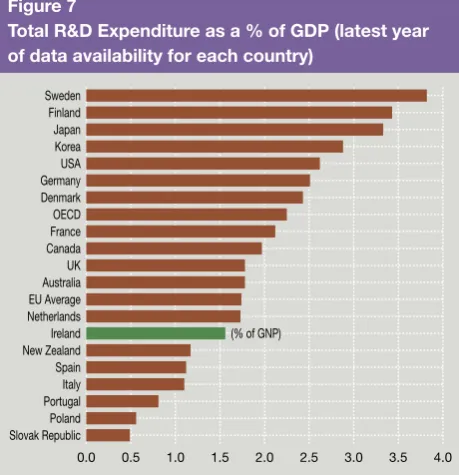
Figure 7
Total R&D Expenditure as a % of GDP (latest year of data availability for each country)
0.0 0.5 1.0 1.5 2.0 2.5 3.0 3.5 4.0 Slovak Republic Poland Portugal Italy Spain New Zealand
Ireland (% of GNP)
Netherlands EU AverageAustralia UK Canada FranceOECD Denmark Germany USA Korea Japan Finland Sweden
Sources: Forfás, derived from the Survey of Business Expenditure on R&D 2005/6; Survey of R&D in the Higher Education Sector 2006; State Expenditure on S&T and R&D 2006 and 2007 and the Main Science & Technology Indicators, 2007 (OECD)
One of the key indicators identified by the European Commission and the OECD in measuring a country’s progress toward building a stronger knowledge economy is R&D expenditure intensity. This is defined as the ratio of total R&D expenditure in all R&D performing sectors of the economy to overall economic activity, as measured by Gross Domestic Product (GDP) or Gross National Product (GNP). Figure 7
shows Ireland’s total R&D intensity ratio was estimated to be 1.56% of GNP in 2007. This was marginally ahead of the 1.55% of GNP ratio figure recorded in 2006. Ireland is in the third tier of countries in relation to performance in this R&D metric.
Ireland’s R&D performance has grown strongly in the last decade during a period of robust economic growth. As a result, the ratio of total R&D spending to economic activity has only been able to progress slowly. If the R&D spending growth rates of the past decade are maintained, alongside an expected easing in economic growth, then the overall intensity ratio could rise strongly over the coming years, moving closer to the OECD average R&D intensity of 2.2% of economic activity.
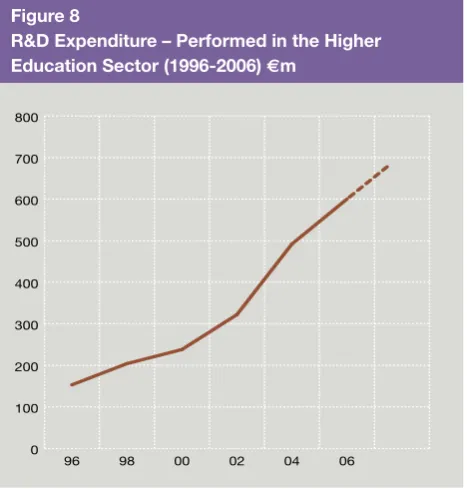
R&D Expenditure – Performed in the Higher Education Sector (1996-2006) €m
0 100 200 300 400 500 600 700 800 06 04 02 00 98 96
Source: Forfás, Survey of R&D in the Higher Education Sector 2006
Figure 8 shows that R&D performed in the higher education sector (HERD) has been increasing steadily over the past ten years, with overall R&D spending almost quadrupling in current spending terms. From 1998 to 2000 the increase was 16.6%, but from 2000 onwards growth began to accelerate. From 2000 to 2002 there was a 35% increase, and between 2002 and 2004 there was a substantial rise in HERD of 52.8%, underpinned by new public funding from Science Foundation Ireland, the Programme for Research for Third Level Institutes and other R&D funding agencies. Since 2005 growth rates have begun to ease, with a 22% increase in HERD spending since the previous survey in 2004.
[image:19.595.307.539.189.431.2]There has been a rapid catch up in the relative performance of HERD spending between 1996 and 2006. From 1996 to 1998, Ireland’s spending intensity ratio of 0.30% of GNP was below the EU average intensity ratio of 0.36% of GDP. The gap widened in 2000, when Ireland’s HERD intensity ratio fell to 0.27% of GNP. Since 2002, however, Ireland has rapidly caught up with the EU 25 as a result of the significant increases in R&D spending in the Irish higher education sector. Between 2004 and 2006 the HERD spending intensity ratio for Ireland, at 0.40% of GNP, has matched the overall EU-25 average HERD intensity ratio.
Figure 9
Researchers by Qualification (2002-2006), Full-Time Equivalents in Higher Education
0 500 1,000 1,500 2,000 2,500 3,000 06 04 02 00
PhD Qualified (FTE) Other Qualified (FTE)
Source: Forfás, Survey of R&D in the Higher Education Sector 2006
Figure 9 shows the growth in researcher numbers working in universities, institutes of technology and other R&D active academic departments in the State between 2000 and 2006. Data refers only to full-time equivalents (FTE), as while headcount data is an important variable to measure it does not give a full picture of the actual time spent on research by people who have other responsibilities in their jobs alongside their research.
FTE researchers increased rapidly from 2000 to 2006. The total number of FTE researchers has more than doubled from the 2,148 recorded in 2000 to 4,689 in 2006. The increase has been driven by rising numbers of both PhD qualified researchers and other qualified researchers.
Figure 10
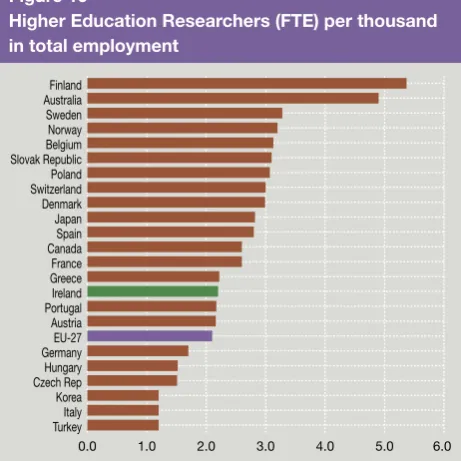
Higher Education Researchers (FTE) per thousand in total employment
0.0 1.0 2.0 3.0 4.0 5.0 6.0
TurkeyItaly Korea Czech RepHungary GermanyEU-27 Austria PortugalIreland GreeceFrance CanadaSpain Japan Denmark SwitzerlandPoland Slovak RepublicBelgium Norway Sweden AustraliaFinland
Source: Forfás, Survey of R&D in the Higher Education Sector 2006 and Main Science and Technology Indicators 2007 (OECD)
When compared internationally Ireland performs reasonably well in terms of researcher numbers employed in Ireland’s third level institutes. In international terms the 4,689 FTE researchers recorded in the 2006 HERD survey equated to a ratio of 2.2 FTE researchers per thousand in total employment in 2006. This is the key internationally comparable metric used by the OECD to benchmark progress in developing researcher numbers (Figure 10). The ratio increased rapidly from 1.2 in 2000 to 2.2 in 2004, as the growth in FTE researcher numbers outpaced the increase in overall employment gains in all sectors of the economy. The ratio remained static between 2004 and 2006, as FTE researcher growth was matched by the overall robust employment gains measured in the overall economy.
It should also be noted that Ireland does not count PhD students as staff-employed ‘researchers’ unlike some other EU countries. In 2000 Ireland was ranked 24th out of 29 benchmarked OECD states. By 2006 Ireland’s position had moved to 13th place.
Figure 11
Average Annual Growth Rates of Civil GBAORD for selected countries (2002-2007)
0 5 10 15 20 25
France United Kingdom Germany Finland Portugal Australia Denmark Austria United States Czech Republic Spain Korea Greece Ireland Luxembourg
Sources: Forfás, State Expenditure on S&T and R&D 2006/2007 and Main Science and Technology Indicators 2007 (OECD)
[image:20.595.308.539.221.429.2]Between 2006 and 2007, R&D spending growth (GBAORD) by government across all performing sectors increased by an estimated 16% in current price terms representing an increase in R&D funding growth from the 8.2% gains posted in 2006. GBAORD, as defined in the OECD Frascati Manual, includes all exchequer and EU funding for R&D projects and also R&D spending on the arts and humanities. R&D spending by government has more than quadrupled from €221 million in 1997 to over €900 million in 2007.
Figure 11 shows the average growth rates of civil GBAORD (excluding defence R&D spending) from 2002-2007 for a number of OECD countries. The average growth rate in civil GBAORD in Ireland over the last 10 years has been 16%. Ireland ranks second out of 15 countries for the highest average annual growth rate of civil GBAORD from 2002 to 2007.
0
Knowledge
Strategy for Science, Technology and Innovation 2006-2013 23
NanoIreland Technology Assessment 23
Value for Money Review of Science Foundation Ireland 24
Advisory Council for Science, Technology and Innovation 24
— Researcher Careers 24
— Internationalisation Strategies 25
— Health Research 25
— Promoting Enterprise-Higher Education Relationships 25
— Competence Centres 25
IP Template Collaboration Agreements 26
European Research Area 26
Seventh EU Framework Programme 26
Research and Development Statistics 27
Role of the Institutes of Technology in Enterprise Development 27
People
Expert Group on Future Skills Needs 29
— National Skills Strategy 29
— Future Skills Needs of the International Financial Services Industry 29
— Future Skills Needs of the Medical Devices Sector 30
— Future Requirement for High Level ICT Skills in the ICT Sector 30
— Survey of Selected Multi-National Employers’ Perceptions of Certain Graduates from Irish Higher Education 31
— North/South Cooperation on Skills Policy 31
— FÁS Skills and Labour Market Research Unit 31
Submission by Forfás on Education Priorities for Enterprise 32
The Management Development Council 32
Discover Science and Engineering 32
Enterprise
High Level Group on Manufacturing 37
Services Strategy Group 37
Services and Innovation 38
Outward Direct Investment 39
Entrepreneurship Policy Statement 39
Life Sciences 39
Sectoral Study on Enterprise Opportunities in Environmental Goods and Services in Ireland 40
eBusiness Monitor 40
Regional Strategic Agendas 41
Enterprise Areas Certification 41
Business Networks Forum 42
Budget Submission 2008 42
Enterprise Statistics at a Glance 42
Competitiveness
National Competitiveness Council 45
— Annual Competitiveness Report 2007: Volume 1, Benchmarking Ireland’s Performance 45
— Annual Competitiveness Report 2007: Volume 2, Competitiveness Challenge 2007 45
— Costs of Doing Business in Ireland, 2007 46
— Wellbeing Review 47
— Review of International Assessments of Ireland’s Competitiveness 47
— Conference – Re-conceptualising Ireland’s Competitiveness 48
Review of the European Single Market 49
Trade Facilitation 49
International Trade Negotiations 49
Perspectives on Irish Productivity 49
Productivity Studies 50
Socio-Economic Scenarios 50
Ireland’s Co-operative Sector 51
Business Regulation Forum 51
Sustainability
5
Assessing the Implications for Irish Industry of Revisions to the EU Emissions Trading Scheme 53
Incorporating Environmental Costs from Greenhouse Gases into the Development Agencies’ Investment Appraisal Model 53
National Allocation Advisory Group (NAAG) 54
Carbon/CO2 Tax 54
IEA Climate Change Working Group 54
Infrastructure Policy 55
— Electricity Benchmarking Analysis and Priorities 55
— Ireland’s Broadband Performance and Policy Requirements 55
— Waste Management in Ireland: Benchmarking Analysis and Policy Requirements 56
— Seaports 56
Long-term Framework for Energy Policy 57
Knowledge
Ireland’s economic development depends on exploiting
opportunities to innovate, facilitated by a strong research
and development base.
Ireland has made significant steps in establishing
a strong research environment, based on building
scientific excellence in potentially strategic areas. Our
objective now is to ensure that science and technology
work for enterprise and Ireland, using innovation
and R&D capabilities to enhance productivity and to
commercialise new products and bring them to market.
Forfás continues to work with the Government, SFI, IDA
Ireland and Enterprise Ireland to achieve the investment
and commitments set out in the Strategy for Science,
Technology and Innovation 2006-2013.
Strategy for Science, Technology and
Innovation 00-0
Throughout 2007, Forfás worked intensively with the Department of Enterprise, Trade and Employment (DETE), the Higher Education Authority (HEA), the Office of the Chief Scientific Adviser and other government departments in the support of the Strategy for Science, Technology and Innovation.
The Strategy for Science, Technology and Innovation 2006-2013, was approved by the Government in June 2006. The Strategy sets out specific targets for Ireland’s research and development growth to 2013.
NanoIreland Technology Assessment
During 2007, Forfás completed an assessment of
nanotechnology for the Department of Enterprise, Trade and Employment. Forfás undertook the Technology Assessment to identify investment and policy options for the successful development and application of nanotechnology in Ireland.
A Steering Group (chaired by Mike Devane of Lucent Technologies) and comprising representatives from industry, research and government, supported Forfás in the scoping and implementation of the project which was undertaken on an all-island basis. Three expert working panels undertook the development of future-oriented scenarios in the area of nano-electronics, nano-biotechnology and nano-materials. The scenarios integrated key social, technological, economic, environmental, political, values, scientific (STEEP_V_S) drivers.
The Technology Assessment examined key areas for development in nanoscience and nanotechnology in Ireland and highlighted the requirement for:
n Sufficient people with expertise, who can work in specialist and converging technology fields, and who can bring the creativity on which future developments depend;
n Growing our knowledge base and building on existing local academic expertise and facilities to become an international focus for the best and brightest researchers;
Cabinet Sub Committee on STI
Taoiseach and Ministers*
Interdepartmental Committee on STI:
Government Departments**
Enterprise Feedback Group Advisory Science Council Chief Scientific AdvisorJoint Secr
etariat
DETE / DES, / HEA / Forfás
Higher Education Research Group DES / DETE / HEA /Enterprise Ireland
Technology Ireland DETE / Forfás /
EI / IDA / SFI
Health Research Group
* Ministers for Enterprise, Trade and Employment; Minister for Finance; Minister for Health and Children; Minister for Education and Science; Minister for Communications, Energy and Natural Resources; Minister for Agriculture Fisheries and Food; and Minister for Environment, Heritage and Local Government.
** Department of the Taoiseach; Department of Enterprise, Trade and Employment (DETE); Department of Finance; Department of Health and Children; Department of Education and Science (DES); Department of Communications, Energy and Natural Resources; Department of Agriculture Fisheries and Food; and Department of Environment, Heritage and Local Government.
n An enhanced physical infrastructure that can support the R&D that will underpin innovation;
n A supportive environment for enterprise development in companies that can develop and produce
nanotechnology-enabled products;
n The cultivation of an educated and science-literate public that can engage in open and informed dialogue about the potential of nanotechnology to enhance our quality of life, and to manage any parallel risks; and
n National support systems of funding, governance, regulation and communication to shape the social, economic and business environment for creative R&D and market building.
The report presented options to ensure that Ireland is well positioned to exploit the potential offered by nanoscience and nanotechnology. These options are now being further developed at the request of the Interdepartmental Committee for Science and Technology (IDC).
Value for Money Review of Science
Foundation Ireland
Forfás is participating in the Value for Money Review of Science Foundation Ireland, at the request of the Department of Enterprise, Trade and Employment. Forfás is a member of the Review Steering Committee, which is chaired by the Department of Enterprise, Trade and Employment, and includes the Department of Finance, the Irish Universities Association and Science Foundation Ireland.
The review is principally concerned with SFI’s two major funding programmes – the Principal Investigators Schemes and the Centres for Science, Engineering and Technology (CSETs). It will make recommendations, where appropriate, on the overall effectiveness of SFI’s supports in building a world-class research system in Ireland, with a focus on whether the programmes, as operated, constitute value for money and efficient use of public funds.
The outcomes of the review will complement the policy evaluation of SFI carried out by Forfás for the Department of Enterprise, Trade and Employment in 2005, SFI – The First Years. The final Review is due to be completed in the first half of 2008.
Advisory Council for Science Technology
and Innovation
The Advisory Council for Science, Technology and
Innovation (ASC) is the Irish Government’s high-level advisory body on science, technology and innovation (STI) policy issues. It is the primary interface between stakeholders and policymakers in the STI arena. The Council forms part of the STI governance structure in Ireland which includes the Inter-Departmental Committee for STI and the Chief Scientific Adviser to the Government, Professor Patrick Cunningham. The governance structure is overseen by the Cabinet Committee for STI, chaired by the Taoiseach. (See page 23).
The Council’s remit is to contribute to the development and delivery of a coherent and effective national strategy for STI, and to provide advice to Government on medium and long-term policy for STI and related matters. During 2007 the Council worked on the following priority areas to contribute to this goal:
Researcher Careers
Internationalisation Strategies
Health Research
Promoting Enterprise – Higher Education Relationships
Competence Centres
Researcher Careers
This study by the ASC, led by Prof. Dolores Cahill, focuses on the barriers to career development for researchers within the academic, public research and enterprise environment.
5
The study examines how research careers develop in Ireland, looks at research career paths, including issues of gender and mobility and compares the Irish situation with other countries including Korea, Sweden and the UK. A large scale consultation with the Irish research community, using an internet based survey, was conducted and the study also includes a series of interviews and illustrative case studies.
The study will be published in 2008.
Internationalisation Strategies
During 2007 the ASC began a study to examine the nature and strength of Ireland’s formal and informal international STI linkages and assess the contribution of these linkages to the achievement of goals set out in the Strategy for STI. It is envisaged that the study will assist decision making on:
n International STI organisations and facilities to which Irish researchers and enterprise should be associated;
n Countries that Ireland should nurture STI linkages with; and
n Other collaborations (at national and institutional level) that should be facilitated.
Health Research
Following a recommendation in the Council’s report
Towards Better Health: Achieving a Step Change in Health Research in Ireland, launched in 2006, a Health Research Group (HRG) has been established under the auspices of the Inter-Departmental Committee for STI. Forfás provides secretariat support to the Group, which is chaired by the Department of Health and Children.
The HRG advises the IDC on the formulation and implementation of a comprehensive health research strategy including:
n Working closely with appropriate enterprise development agencies and key stakeholders in the health sector in the formulation of its proposals; and
n Facilitating a coherent departmental and cross-agency approach on issues relating to health research.
The HRG, in conjunction with Forfás, is currently working on a project to assess the nature, quality and extent of health research conducted in Ireland including expenditure and the potential for the establishment of a National Health Research Register.
Promoting Enterprise – Higher Education Relationships Promoting Enterprise-Higher Education Relationships was launched by the Advisory Science Council in 2007. The report reviewed the relationship between enterprise and higher education institutions in Ireland and in a number of comparable countries.
This review found that the two key constraints to the deepening of enterprise-higher education collaborations in Ireland are the low absorptive capacity of enterprises for research and a gap in the availability of applied research that enterprises can readily access. The Council’s recommendations were presented to the Inter-Departmental Committee on Science and Technology. The Council has since set up a task force to address the low absorptive capacity of enterprise for PhD researchers. Technology Ireland, which is part of the SSTI implementation structure, has developed a model for industry-led applied research competence centres, which is now being implemented by IDA Ireland and Enterprise Ireland.
Competence Centres
During 2007, Forfás supported IDA Ireland and Enterprise Ireland in the implementation of the Competence Centre Initiative, building on a key recommendation by the ASC in its Report, Promoting Enterprise-Higher Education Relationships. Competence Centres are collaborative entities established and led by industry and resourced by highly-qualified researchers associated with research institutions who undertake market focused strategic research for the benefit of industry. The primary objective of the Competence Centre Initiative is to build competitive advantage for industry in Ireland by accessing the innovative capacity of the research community. The centres will have a physical focus, independence and a long-term funding commitment of approximately €2 million per annum from the State for
Competence Centres will engage in high quality research on an enterprise agenda, generating intellectual property and knowledge, which can be commercialised for the benefit of its members and the local economy. In addition, through its activities it will train and transfer skills to researchers and increase the technological competence of its membership and the wider enterprise community. Five centres are currently being established, and are in the planning stages.
IP Template Collaboration Agreements
The National Code of Practice for Managing and Commercialising Intellectual Property from Public-Private Collaborative Research, published by the ASC in November 2005, presents the national policy position in relation to managing intellectual property in collaborative research arrangements.
In line with the Code, Forfás developed and published bi-lateral template collaboration agreements for use by industry and academic partners in collaborative research projects. The Template Agreement is designed to assist and enable the parties reach agreement in an efficient manner using suggested clauses and information accompanied by detailed explanatory notes.
European Research Area
Forfás provided support to the Department of Enterprise, Trade and Employment in 2007 to help prepare Ireland’s response to a Green Paper on the European Research Area (ERA). Published by the European Commission, the Green Paper will lead to a range of initiatives in the years ahead to further develop Europe’s research system and encourage member states to coordinate their investment in research. In the context of the Lisbon Strategy, the European Commission is placing renewed focus on the ERA. The ERA aims to address fragmentation in Europe’s research system so that research deficits with major global players can be addressed and to ensure that Europe can continue to respond to important societal challenges.
Forfás consulted with the Irish research community in academia and industry to prepare inputs to a national response to the Green Paper. The consultation included a stakeholder workshop in July 2007. Based on feedback received, Forfás helped to prepare a response to the Green Paper which was subsequently endorsed by the Inter-Departmental Committee on Science, Technology and Innovation.
The national response points to a high level of similarity between the ERA vision and Ireland’s Strategy for Science, Technology and Innovation. It is in Ireland’s interests to be part of a well-functioning European Research Area and Ireland is open to most of the ideas put forward by the Commission. In responding to the Green Paper, Ireland highlighted certain principles that should underpin research policy at the European level including:
n The need for a clear demonstration of the value added of any new initiatives being proposed at the European level bearing in mind the principle of subsidiarity that guides policy in all domains.
n The need for flexible approaches in all cases to take into account the different priorities of member states and the fact that member states are competing globally for the best science and the best researchers.
n The ability of research funding organisations, the research community and the enterprise sector to absorb new instruments and initiatives at European level, especially in light of the wide range of initiatives already being launched within the context of FP7.
n The importance of considering the enterprise dimension in European research policy (where enterprise will be expected to account for two-thirds of the overall 3% target) and in particular the coherence between research policy and innovation policy.
Seventh EU Framework Programme
FP7, the Seventh EU Framework Programme, was launched at the end of 2006 with a budget of over €50 billion covering
Joint Technology Initiatives (JTIs) are multi-billion euro public-private partnerships to tackle research agendas in areas of strategic importance for European competitiveness. In 2007, JTIs were agreed in the areas of innovative medicines, nanoelectronics, embedded systems and aeronautics. It is expected that further JTIs will be proposed by the European Commission in the years ahead.
Forfás provided support to OSTI on these and other aspects of FP7 which were the subject of political negotiation in 2007.
Forfás also worked with the National Director for FP7, based in Enterprise Ireland, to develop targets for Ireland’s participation in the Programme. Based on this work, the Cabinet Sub-Committee on STI endorsed a recommendation that Ireland should increase its target drawdown from FP7 from €400 million to €600 million over the lifetime of the
Programme. The revised target has been incorporated into a wider set of targets associated with the Strategy for STI.
Initial indications from the funding allocated in 2007 point to a strong participation by Irish researchers and enterprises. The Irish success rate (proportion of projects funded) at 23.4% is ahead of the EU average (21.2%). The funding secured by Irish researchers in the first year of the Programme (over 1.1% of funds allocated) is consistent with the raised target that has been set for the overall Programme.
Research and Development Statistics
Forfás collates a series of statistics in relation to research and development activity in Ireland on behalf of the Department of Enterprise, Trade and Employment. In 2007, Forfás released figures on the levels of R&D investment by business in Ireland in Research and Development Performance in the Business Sector 2005/6. The Higher Education R&D Survey 2006 recorded the research and development spend by the higher education sector and State expenditure on science and technology research was outlined in The Science Budget 2006/2007. Forfás also published a booklet, Research and Development Statistics in Ireland, at a Glance, which collates all key R&D statistics. An overview of the data is provided in the Statistical Overview section of this Annual Report (page 11).
Role of the Institutes of Technology in
Enterprise Development
Forfás published, Review of the Role of the Institutes of Technology in Enterprise Development, in 2007. The aim of the Review was to develop a comprehensive picture of the initiatives and activities available in the institutes of technology (IoT) to support enterprise growth.
The report presented detailed profiles of each region and assessed the activities in each IoT under the following headings:
n Strategic Planning;
n Education and Training;
n Research;
n Collaboration;
n Company Formation; and
n Resources.
The study also identified a number of issues for further consideration which could enhance the role of the institutes’ in enterprise development:
n Recognition of all levels of IoT engagement with enterprise including graduate recruitment, training for company personnel, R&D and spin-off activities;
n The need to improve IoT flexibility in meeting industry requirements;
n The need for a more strategic approach to ensuring industry input to IoT planning processes, and the critical role of the enterprise development agencies in this; and
People
The skills, flexibility and knowledge of our people is one
of Ireland’s most important competitive advantages and
continued investment in the development of our people
is essential to our growth. The success of firms and the
economy in the years ahead will hinge on knowledge
and the people who disseminate, adapt and use data,
insights, intuition and experience to create value.
The National Skills Strategy sets out the targets and
objectives which must be achieved to meet the needs
of a changing labour market. Achieving the goals set out
in the strategy will ensure Ireland can respond rapidly in
a changing economic environment and have the skills
to shape tomorrow’s enterprise.
Forfás continues to support the development of our
people and the implementation of the National Skills
Strategy through the work of the Expert Group on Future
Skills Needs, the Management Development Council and
the Discover Science and Engineering Programme.
Expert Group on Future Skills Needs
Forfás provides research and secretariat support to the Expert Group on Future Skills Needs (EGFSN).
In May 2007, former Minister for Enterprise, Trade & Employment, Micheál Martin TD, announced the new membership of the EGFSN. A new mandate was also agreed for the EGFSN by former Minister Martin and the Minister for Education and Science, Mary Hanafin TD, covering the term 2007-2009. The Group will ensure in its advice to Government that labour market needs are provided for by:
n Identifying any emerging need for policy or structural changes;
n Reviewing the effectiveness and value of operational programmes and delivery systems in place to meet national skills needs;
n Progressively promoting lifelong learning; and
n Capitalising on relevant developments internationally.
During 2007 the EGFSN worked on:
National Skills Strategy
Future Skills and Research Needs of the International Financial Services Industry
Future Skills Needs of the Medical Devices Sector
Future Requirement for High Level ICT Skills in the ICT Sector
Survey of Selected Multi-National Employers’ Perceptions of Certain Graduates from Irish Higher Education
North/South Cooperation on Skills Policy
FÁS Skills and Labour Market Research Unit
National Skills Strategy
In March 2007, Minister Martin and Minister Hanafin jointly launched the EGFSN report, Tomorrow’s Skills: Towards a National Skills Strategy. The Report sets out a vision of skills and educational attainment up to 2020 which would help to secure the future competitive advantage of enterprise in Ireland and enhance future growth in productivity and living standards.
The Report sets out specific targets for Ireland’s skills profile in 2020, with a target of 45% of the population with third or fourth level qualifications. The EGFSN outlined specific objectives, which included the upskilling of 500,000 people within the labour force by at least one level on the National Framework of Qualifications, increasing the Leaving Certificate completion rate to 90% by 2020 and increasing the progression rate from second to third level to 72% by 2020.
Throughout 2007, Forfás, through its work with the EGFSN, continued to support the Department of Enterprise, Trade and Employment and the Department of Education and Science, and bodies under their aegis involved in State funded education and training provision, on the implementation of the National Skills Strategy.
At the request of the Department of Enterprise, Trade and Employment, Forfás has undertaken further research into potential mechanisms to incentivise employers and employees to engage in education and training and will report to the Minister for Enterprise, Trade and Employment in 2008.
Future Skills and Research Needs of the International Financial Services Industry
0
The Report identifies a number of priority areas for skills development in the future including:
n Ensuring that undergraduate courses are up to date and relevant to industry needs and developing greater specialisation at postgraduate level. High level mathematics, quantitative, risk management and actuarial skills are in particular demand.
n Addressing the staff retention issue in some sub-sectors, which negatively affects costs and efficiency.
n Increasing the research capacity of international financial services in Ireland.
n Increasing the alignment between education and training providers and industry needs, with greater focus on niche areas which could deliver distinctive competences.
The Report set out clearly defined next steps associated with each recommendation and the implementation of these recommendations has begun. The Higher Education Authority has sought responses from higher education institutions involved in this area of activity. This will be followed by a forum bringing together industry and academia in 2008.
Future Skills Needs of the Medical Devices Sector
In 2007, Forfás, on behalf of the EGFSN, undertook extensive research to identify the future skills needs of the Medical Devices Sector in Ireland up to 2013. Future Skills Needs of the Medical Devices Sector, published in 2008, makes recommendations to ensure that skills will underpin the continued development and growth of the industry. This research was undertaken at the request of Enterprise Ireland and the Irish Medical Technologies Council.
The research indicates that the requirement for people with engineering, scientific, technician, sales and purchasing skills will continue to rise and the demand for those qualified to Masters and PhD level will also increase. The Expert Group makes a number of specific recommendations to ensure the sector is equipped with the right level of skills and expertise to meet the challenges of a changing industry:
n Establish a Centre of Medical Device Manufacturing Excellence in the higher education system to assist industry to develop skills required for automation, lean manufacturing and quality management;
n Upskill operators, assemblers and technicians over the next three years through industry-led training initiatives supported by the State;
n Higher education institutions to work towards the development of a fourth level Graduate Education Institute in medical devices innovation;
n Introduce a Masters Course in Regulatory Affairs and a Graduate Diploma or Masters qualification in the design, management and conduct of clinical trials;
n Develop a part-time professional development course for medical device professionals covering topics such as healthcare economics and reimbursement, regulatory affairs and intellectual property; and
n Boost the supply of effective entrepreneurs through the provision of education and training programmes based on best practice Irish and US models.
Future Requirement for High Level ICT Skills in the ICT Sector
During 2008, the EGFSN will publish its Report, The Future Requirement for High Level ICT Skills in the ICT Sector. The aim of this study is to determine the future requirements for high level skills in the sector, in terms of quantity, quality and diversity, and to identify the actions required to ensure that the supply of these skills will support its potential growth.
The Report finds that the projected domestic supply of high-skilled computing and electronic engineering graduates alone will not be sufficient to meet future demand to 2013. Migration will continue to be an important source of labour force supply into the future. The EGFSN proposes a number of actions which can be implemented in the short, medium and long-term, to ensure that the future skills needs of the ICT sector will be met.
Survey of Selected Multi-National Employers’ Perceptions of Certain Graduates from Irish Higher Education
Forfás, the EGSFN and the Higher Education Authority jointly undertook a survey of multi-national employers in Ireland in 2007, to benchmark Irish graduates from the higher education system against graduates from other countries and to provide feedback on the suitability of Irish graduates for employment compared to their international counterparts.
Published in December 2007, the final Report, Survey of Selected Multi-National Employers’ Perceptions of Certain Graduates from Irish Higher Education, provides feedback on the suitability for employment of Irish graduates compared to their peers internationally across the disciplines of science, engineering, humanities, and business and finance.
The main findings of the Report indicate that:
n Overall, employers perceive very little difference in quality between Irish and other graduates; and
n Irish graduates appear to compare favourably in soft/ generic skills.
The report recommends:
n Introduction of more placements to third level courses;
n There is a need for Irish students to have better management and business knowledge to understand their role in the workplace; and
n Increased use of continuous assessment in third and fourth level courses with particular focus on building team skills and confidence.
North/South Cooperation on Skills Policy
The Joint Communiqué of the British-Irish Intergovernmental Conference 2006 identified the potential to enhance North/South collaboration in the area of skills and the labour market. During 2007, dialogue commenced between the EGFSN and the Northern Ireland Skills Expert Group to identify areas of potential cooperation.
Both groups have agreed to work collaboratively to produce an All-Island Statement on Skills Demand in 2008, which will provide a comprehensive analysis of current demand for skills across the island of Ireland, how the skills base has evolved and how it is likely to change in the future. In addition, it has been agreed to hold an All-Island Conference on Skills in October 2008.
Forfás is working with the Department of Enterprise, Trade and Employment, FÁS and the Department of Employment & Learning in Northern Ireland to progress these initiatives.
FÁS Skills and Labour Market Research Unit
During 2007, Forfás continued to work closely with the FÁS Skills and Labour Market Research Unit which operates the National Skills Database on behalf of the EGFSN. Both organisations have worked together with relevant stakeholders to identify and develop useful sources of data which help build a profile of Ireland’s current and future skills capability.
FÁS has provided Forfás with statistical and data support for many of the EGFSN reports published during 2007 and also produce two annual reports on behalf of the EGFSN.
n The National Skills Bulletin provides a detailed overview of the Irish labour market in terms of employment trends by sector and occupation and latest statistics on outputs in education and training.
Submission by Forfás on Education Priorities
for Enterprise
During 2007, Forfás, on behalf of IDA Ireland, Enterprise Ireland and Science Foundation Ireland, made a submission to the Department of Education and Science in relation to its Departmental Statement of Strategy 2008–2010.
The Agencies highlighted the following key priorities:
n The development and articulation of a clear policy statement for education at all levels with associated measurable objectives and outcomes;
n The implementation of the Strategy for Science, Technology and Innovation; and
n The implementation of the National Skills Strategy.
The Management Development Council
The Management Development Council (MDC) was established in May 2007 by former Minister for Enterprise, Trade and Employment, Micheál Martin TD. The MDC advises the Government on actions to support SMEs in developing and enhancing their management abilities. Forfás provides research and secretariat support to the Council.
The MDC was established as a response to recommendations made by the Small Business Forum and the EGFSN, who published studies in 2006 identifying the need for such a council to coordinate the supply of and stimulate demand for management development programmes.
The Council is chaired by Professor Frank Roche, the Deputy Principal of the UCD College of Business and Law, and includes representatives from business, enterprise development agencies, government departments and higher education institutions.
The Council has agreed an ambitious work programme to 2009 which has been endorsed by Minister Martin. In 2007 research began on a number of issues including:
n A detailed profile of the provision of management development programmes available to SMEs;
n A quantitative and qualitative study to understand the management development demands and needs of SMEs, and the barriers which inhibit SME participation in management development; and
n A review of best practice internationally in the provision and promotion of SME management development.
Discover Science and Engineering
Discover Science & Engineering (DSE) is an integrated national science awareness programme managed by Forfás on behalf of the Office of Science, Technology and Innovation in the Department of Enterprise, Trade and Employment. It brings together many science and engineering awareness activities that were previously managed by different public and private bodies. DSE aims to build and expand on these activities and to deliver a focused, strategic and quantifiable awareness campaign.
DSE’s overall objectives are to:
n Increase the number of students studying the physical sciences;
n Promote a positive attitude to careers in science, engineering and technology; and
n Foster a greater public understanding of science and engineering and their value to Irish society.
General Awareness
Science Week Ireland
Science Week Ireland is one of the key events in the DSE calendar. Surrounded by Science was the theme of Science Week 2007. The event has grown significantly with 450 events held nationwide this