Effect of low temperature in the first development stage
for five red raspberry genotypes
Elida Contreras
1*, Javiera Grez
1, José A. Alcalde
1, Davide Neri
2,
Marina Gambardella
11Department of Fruticulture and Oenology, Faculty of Agronomy and Forestry,
Pontificia Universidad Católica de Chile, Macul, Santiago, Chile
2Department of Agricultural, Food and Environmental Sciences,
Faculty of Agriculture, Marche Polytechnic University, Ancona, Italy *Corresponding author: [email protected]
Citation: Contreras E., Grez J., Alcalde J.A., Neri D., Gambardella M. (2019): Effect of low temperature in the first development stage for five red raspberry genotypes. Hort. Sci. (Prague), 46: 9–16.
Abstract: In raspberry, the expression of the primocane fruiting trait is influenced by the environment. Although there are several factors that influence the expression of this character, it is well known that low temperatures that occur during the growth season of the primocane, are important and affect the flowering. In this study, plants in their early stages of development were exposed to low temperatures (2°C) for one month, in a dark cold chamber. The following genotypes primocane and floricane were used: ‘UC103’, ‘Autumn Bliss’, ‘Heritage’, ‘Meeker’ and ‘Tula-meen’. Flowering and growth were recorded until the end of the season and the morphology of the meristem was characterized in this moment. Interaction between cold and genotype was detected in all parameters studied. In ‘Heritage’, a slight primocane, growth and flowering were favoured by exposure to cold. Thereby, low temperature affects flowering, but this effect depends on primocane fruiting degree of each genotype, slight primocane the cold favored flowering and growth. However, strongly primocane the cold had no effect on flowering and growth.
Keywords: flowering; induction; primocane fruiting; vernalization
The red raspberry (Rubus idaeus L.) has different flowering habits, and two groups of cultivars can be identified: primocane and floricane. The primo-cane cultivars can bloom both on lignified primo-canes in the early summer and on the new growing shoots in late summer and autumn. In contrast, floricane cultivars bloom only on lignified canes and produce fruit once during the early summer. Thus, commer-cially, the primocane cultivars are called annual raspberry, whereas the floricane cultivars are called biennal raspberry (Heide, Sønsteby 2011).
Currently, primocane cultivars are of greater eco-nomic importance because this character extends the harvest; therefore, these cultivars can be more
productive than floricane. Primocane cultivars are also better adapted to warm climate regions (Pritts 2008). Thus, several breeding programs are focused on obtaining new cultivars of the primocane type.
The expression of the primocane fruiting trait or autumn fruiting is strongly influenced by the en-vironment, and depending on the geographic lo-cation of cultivation this character is expressed in different degree. The percentage of the buds that differentiate into flowers on the growing shoots de-termines the degree of primocane fruiting (Gam-bardella et al. 2016. Some cultivars have been observed with an intermediate behaviour; thus, some cultivars classified as floricane can flower
at the tip of the shoot by the end of the growing period, before the winter rest, when the genotype is exposed to different environmental conditions. Studies have described this behaviour in the culti-vars ‘Glen Clova’ (Dale, Daubeny 1987) and ‘Glen Moy’ (Ourecky 1976; Carew et al. 2000).
The aim of several studies has been to understand the physiological basis of the different flowering habits of raspberry by identifying the environmen-tal factors that lead to floral induction. Temperature and photoperiod are the primary environmental factors that influence the induction process (Heide, Sønsteby 2011). However, a genetic component with great diversity among cultivars and a strong genotype x environment interaction has been dis-covered. The process of floral induction/differen-tiation is flexible in raspberry, resulting in complex, scarcely predictable and difficult to handle behav-iour (Neri et al. 2012). This flexibility leads to a dif-ferent response of the flowering habit that is depen-dent on the environmental conditions of cultivation; therefore, raspberry cultivars cannot be definitively classified as primocane or floricane (Carew et al. 2000), based on exposure to only one environment.
In primocane cultivars floral induction, differen-tiation and floral development occur early in the season and are favoured at temperatures higher than 20°C (Vasilakakis et al. 1980; Lockshin, Elfving 1981; Sønsteby, Heide 2009); thus, flow-ering occurs in the summer and fruits are produced in the early autumn. By contrast, in floricane culti-vars, buds of the shoot of the season are induced to flower under short-day conditions and when tem-peratures are below 13°C and therefore bloom the next spring. Nevertheless, when days are long and temperatures are low, below 13°C, floral induction may also occur (Sønsteby, Heide 2008). In this case, the effect of temperature is greater than that of photoperiod, and these cultivars are not strictly dependent on day length.
Although low temperatures (< 18°C) are a prerequisite for floral induction in floricane culti-vars, also a positive effect of cold (2°C) has been observed in some primocane cultivars, such as ‘Heritage’ (Takeda 1993) and two genotypes of primocane blackberry (Rubus spp.), studied by López-Medina and Moore (1999). In both cases was observed an increase of flowering in plants subjected to cold. In other primocane cultivars, such as ‘Polka’, flowering and growth improves their response with exposure to high temperatures
(Sønsteby, Heide 2009). However, some primo-cane cultivars show a vernalization-type, because the flowering was stimulated at low temperature, (Sønsteby, Heide 2009; Carew et al. 2001).
The vernalization process defined by Chouard (1960) as “the acquisition or acceleration of the ability to flower by chilling treatment” it could be of the primary differences between the two groups of raspberry cultivars, in relation to the requirement of cold, as a stimulus for floral induction. So, the cold requirements for flower induction could be an important factor for the differences in the expres-sion of primocane fruiting trait for each cultivar. Thus, the purpose of this study was to evaluate the response of flowering and growth in plants sub-jected to cold treatment at early stages of develop-ment using five raspberry genotypes with different degrees of primocane fruiting.
MATERIAL AND METHODS
Five raspberry genotypes were selected accord-ing to the degree of primocane fruitaccord-ing trait, based previous observations in the field. The primocane cultivars were ‘Heritage’ ‘Autumn Bliss’, and UC103 selection from the breeding program of Univer-sidad Católica de Chile, and the floricane cultivars were ‘Meeker’ and ‘Tulameen’. In our experiment the primocane fruiting trait was evaluated accord-ing to the classification of “degrees of primocane fruiting” described by Gambardella et al. (2016).
Plants were obtained from roots through etiolated shoots and were established in 6.5-l pots with a sub-strate mixture of 30% peat and 70% coconut fibre in a greenhouse at temperatures that ranged from 25 to 27°C, and without artificial light. The plants were obtained during September and, on October 1, 2014, 12 plants of each genotype were subjected to a cold treatment. Plants were placed in a cold cham-ber at 2°C in the dark for 30 consecutive days with a total of 720 artificial chilling hours. The control plants were obtained during October, without the cold treatment, under the same propagation condi-tion of plant for cold treatment. The objective was to obtain plants that were at the same stage of develop-ment, with an average of four expanded leaves at the establishment of the trial on November 6, 2014.
climate with maritime influence, with an average summer temperature of 20°C and an average winter temperature of 7°C. The maximum, minimum and mean temperatures during the test period are pre-sented in Table 1. In relation to the photoperiod, the light hours during the trial evaluation period ranged from 10–15 hours (Fig. 1). Fertilization was applied weekly through irrigation at doses used in commercial production systems.
Days to the first visible floral button, number of flo-ral lateflo-ral shoots, number of flowers per plant, height and number of nodes were recorded weekly. These evaluations were conducted from the establishment of the trial in November 2014 to the end of the sea-son in April 2015. Moreover, after the plants entered winter rest on April 30. 2015, the state of differentia-tion of buds was determined with a stereomicroscope (63× magnification). Classification of buds as vegeta-tive or reproducvegeta-tive was performed according to the scale published by Neri et al. (2012).
The experimental design consisted of completely randomized blocks with four replications, with an experimental unit of three plants. All evaluated pa-rameters, except the meristems, were analyzed us-ing a factorial analysis, with genotype and cold treat-ment as the factors. For the comparison of averages among genotypes according to treatments, the
Tuk-ey test was performed, with a level of significance of P = 0.05. The Statistix-9 program (Thomas, Mau-rice 2009) was used for statistical analyses.
RESULTS
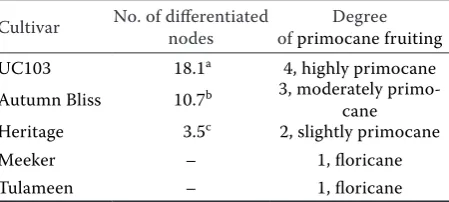
The primocane cultivars showed different degrees of primocane fruiting, according to the number of flo-ral lateflo-ral shoots developed from the apex to the base of the shoot, in the case of control plants (Table 2). ‘UC103’ selection had the highest number of floral lateral shoots (18.1), followed by ‘Autumn Bliss’ (10.7) and ‘Heritage’ (3.5). These differences were signifi-cant (P < 0.05). The two floricane cultivars ‘Tulameen’ and ‘Meeker’ did not develop flowers in local climatic conditions. The studied genotypes had degrees of pri-mocane fruiting between 4 and 1 (Table 2).
The factorial analysis showed that both, cold and genotype factors, induced statistically significant differences (P < 0.05) in each parameter studied. The interaction of these factors also showed sta-tistically significant differences (P < 0.05) for each parameter, except in the number of days to the first visible floral button P = 0.0977 (Table 3).
[image:3.595.63.530.114.171.2]For ‘UC103’ selection and ‘Autumn Bliss’, the cold treatment did not significantly affect the number of floral lateral shoots and number of flowers. In
Table 1. Temperatures (°C) recorded during the red raspberry trial evaluation period in Santo Domingo, Chile
Temperature November December January February March April
Minimal 3.9 4.0 6.0 4.0 4.1 3.8
Maximal 26.9 27.2 27.1 29.4 30.4 30.9
Mean 14.2 15.9 17.8 16.0 16.8 14.6
*evaluation period: November 2014 to April 2015
Li
gh
t h
ou
rs
[image:3.595.64.286.556.724.2]Fig. 1. Light hours in Santo Domingo, during evaluation period of trial
Table 2. Number of floral lateral shoots developed and evaluation of “degree of primocane fruiting” (1–5) accord-ing to the scale of Gambardella et al. (2016)
Cultivar No. of differentiated nodes of primocane fruitingDegree
UC103 18.1a 4, highly primocane
Autumn Bliss 10.7b 3, moderately
primo-cane
Heritage 3.5c 2, slightly primocane
Meeker – 1, floricane
Tulameen – 1, floricane
*all data correspond to averages of four replications, each repre-sented by three plants; different letters within the column indi-cate significant differences (P < 0.05) according to the Tukey test
Nov 9 Feb 2
2
Date Ap
r 25 Apr 4 Mar 1
4 Feb 1
Jan 11 Dec 2
1 Nov 3
0 16
14
12
[image:3.595.306.531.616.717.2]contrast, for ‘Heritage’, the values of both parame-ters were significantly higher in cold-treated plants than in those without cold storage.
Although a genotype × cold interaction was not de-tected for the number of days to the first visible floral button, an effect of the cold was observed in ‘Heritage’.
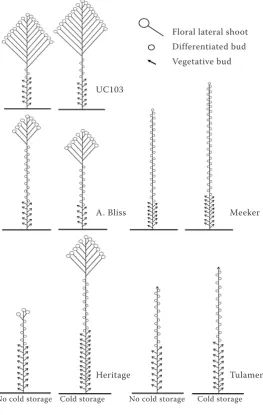
The treated plants of this cultivar had significantly ear-lier onset of flowering than the control plants (Table 3). The meristematic characterization of buds ac-cording to genotype and cold treatment is illus-trated in Fig. 2. For the three primocane cultivars, a differentiation in the basipetal direction was
ob-Table 3. Effect of cold on flowering of the three primocane genotypes
Cultivar Treatment No. of floral lateral shoots No. of total flowers No. of days visible floral buttonto the first
UC 103 no cold storagecold storage 18.318.7aa 96.492.8aa 99.894.8bcab
Autumn Bliss no cold storagecold storage 10.712.4bb 46.372.5bab 97.388.8abca
Heritage no cold storagecold storage 11.83.4cb 51.78.3cb 148.0110.8dc
[image:4.595.62.536.114.227.2]*all data correspond to averages of four replications, each represented by three plants; different letters within the columns indicate significant differences (P < 0.05) according to the Tukey test; **data adapted from Gambardella et al. (2016)
Fig. 2. Plant architecture and state of floral differentiation at the entry into winter rest, according to genotype and cold treatment
Floral lateral shoot Differentiated bud Vegetative bud
UC103
A. Bliss
Heritage
Meeker
Tulamen
[image:4.595.67.331.352.768.2]served. In ‘UC103’ selection, in plants with and without cold, a similar number of nodes and few differentiated buds were observed at the entry of winter rest. ‘Autumn Bliss’ developed fewer floral lateral shoots than ‘UC103’ but a larger proportion of differentiated buds with and without cold. In this genotype, plant architecture was similar under dif-ferent conditions. In ‘Heritage’, plants without cold had fewer nodes, little development of floral lateral shoots, and fewer differentiated buds than plants that received cold treatment.
‘Meeker’ (Fig. 2) had several differentiated buds along the shoot before entering dormancy, for both cases, with and without treatment whereas ‘Tula-meen’ showed similar numbers of differentiated buds and vegetative buds. For ‘Tulameen’, the apex was vegetative for both cases.
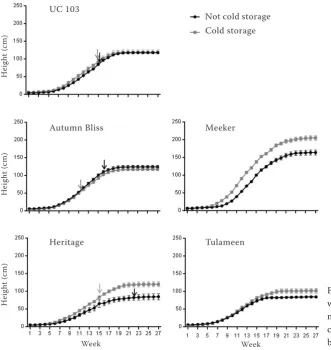
In relation with the growth and development, the growth pattern of plants was adjusted to a normal sigmoid curve, with some differences observed among cultivars. As shown in Fig. 3, for ‘UC103’ and ‘Autumn Bliss’, no difference was detected in
total shoot height, and the growth rates were simi- lar with and without cold treatment. In ‘Heritage’, cold-treated plants reached a larger height,
where-Table 4. Effect of cold treatment on height and number of nodes in the five genotypes
Cultivar Treatment Height (cm) of nodesNo.
UC 103 no cold storagecold storage 118.9119.7cc 35.336.4decde
Autumn Bliss no cold storagecold storage 124.9118.0cc 35.731.7dee
Heritage no cold storagecold storage 120.585.2dc 31.342.1ebc
Meeker no cold storagecold storage 164.4205.7ba 45.253.8ba
Tulameen no cold storagecold storage 102.185.0dcd 32.338.8ebcd
[image:5.595.305.532.127.295.2]*all data correspond to averages of four replications, each represented by three plants; different letters within the col-umns indicate significant differences (P < 0.05) according to the Tukey test; **data adapted from Gambardella et al. (2016)
Figure 3. Plant height of cultivars with and without cold storage: pri-mocane and floricane. Arrows indi-cate the time when the first flower buds were observed at the apex
H
ei
gh
t (
cm
)
H
ei
gh
t (
cm
)
H
ei
gh
t (
cm
)
UC 103
Autumn Bliss
Heritage
Meeker
Tulameen Not cold storage Cold storage
[image:5.595.63.395.407.758.2]as control plants stopped growth earlier. Floricane cultivars showed differences between treated and untreated plants, with taller cold-treated plants. Comparatively, ‘Meeker’ achieved a larger height than that of ‘Tulameen’, cultivar that had a growth rate like that of the three primocane genotypes.
Table 4 shows results for shoot height and num-ber of nodes according to genotype and cold treat-ment. For both parameters, the interaction was significant. Cold-treated plants of Meeker and Her-itage had higher growth rates and therefore were significantly taller by the end of the season than not treated plants. A similar response was observed for the number of nodes in both genotypes. ‘Tulameen’ plants did not show a difference in height, but a sig-nificant increase in the number of nodes was ob-served.
DISCUSSION
Low temperature removes the effects of dorman-cy but may also have a vernalization effect on floral development in some species. The response to chill-ing treatments could depend physiological stage it has been applied, knowing that cold is necessary for breaking dormancy, as well as for vernalization process (Metzger 1996). The developmental stage when plants are exposed to low temperatures and duration of the exposure will determine whether the result is a stimulus for satisfying the chilling requirement for breaking dormancy or a vernaliza-tion effect on flower development.
In these studies, the objective was evaluated the low temperatures as a vernalization effect. For this, plants in their early stages with four development nodes were exposed to low temperatures. Interac-tion between cold and genotype was found for most of the parameters analysed, related to both flower-ing and growth. The significant interaction found between low temperature and genotypes was con-sistent with work by López-Medina and Moore (1999) on blackberry (Rubus spp.), in which cold im-proved flowering and favoured growth in the shoot of the season in 2 of the 3 primocane genotypes stud-ied. This led them to conclusion that the response to low temperatures is genotype dependent.
Genotype ‘UC103’, classified as strongly primo-cane, showed the greatest development of floral lat-eral shoots compared with the two other primocane cultivars studied (Table 3). However, the cold had
no effect on any flowering or growth parameters, being this cultivar insensible to the cold. Sønste-by and Heide (2009) observed a similar response in ‘Polka’, which did not require low temperatures for flower formation; by contrast, the response im-proved at high temperatures. In ‘UC103’, the pro-portion of floral lateral shoots and differentiated buds was not modified by cold application, and in both treated and control, plants entered winter rest with a small proportion of differentiated buds (between 9% and 16%), because many of them had previously developed. The early floral differentia-tion is consistent with that observed by Neri et al. (2012) in primocane genotypes, such as ‘Dolomia’, ‘Erika’ and ‘L03’, on similar dates. The absence of a response to cold suggests that flowering of the pri-mocane fruiting in this genotype is not determined by exposure to cold. Therefore, flowering may be induced early in the season, and with high tempera-tures plants can develop abundant flowering before winter rest. The response observed in the ‘UC103’ is of great interest, because this genotype could be used to either expand the cultivation in higher tem-perature growing areas or reduce the effect of high temperatures due to the climate changes that are occurring in many areas of cultivation.
With a similar response to ‘UC103’, the effect of cold in ‘Autumn Bliss’ was not significant for any of the parameters evaluated, related to both flow-ering and growth. Nevertheless, the total number of flowers was approximately 10% higher in plants subjected to cold treatment than in those without this treatment. Plants treated with artificial cold produced the same number of floral lateral shoots but these shoots had more flowers on average. Carew et al. (2001) studied the effect of tempera-tures between 6 and 7°C on new shoots from roots from 2 to 10 weeks in ‘Autumn Bliss’. The authors observed a shorter period to anthesis in plants from roots treated with cold, associating this result with a vernalization response. In our studies, plants treated with artificial cold initiated flowering 9 days before control plants; however, the difference was not significant, and plant height was not affected. In combination with the bud analysis, in this study ‘Autumn Bliss’ is not induced of vernalization pro-cess and is also not favoured by the cold.
other studies performed using this genotype, which show that although cold is not mandatory for the beginning of flowering, such treatment acceler-ates the process and shortens the time to anthe-sis (Vasilikakis et al. 1980; Takeda 1993). Once induced, high temperatures are better for flower differentiation, as reported by Lockshin and Elf-ving (1981). These authors grew plants of ‘Heri-tage’ under 16-hour photoperiod and 29/24°C and 25/20°C day/night temperatures. They found that plants in the high temperature treatment flower two weeks earlier and produce more flowers. Be-cause of the diversity of responses of this genotype to temperature, further studies are required.
Results of meristem dissection showed a differ-entiation in the basipetal direction for the three primocane genotypes, as described for other culti-vars of this type (Heide, Sønsteby 2011). The re-sults indicated that floral differentiation of control plants of ‘Heritage’ was later in relation with that in the two other primocane genotypes. In treated plants low temperatures promoted floral induction, because was observed more buds differentiate so, when are favourable the temperatures for flower development, the production of flower will be high-er. The above results confirmed that a period of low temperatures was a determining factor in the pro-cess of floral induction in this genotype, unlike the process that occurred in the two other primocane genotypes. Despite this promote of flowering, the proportion of differentiated buds was lower than that reported by Neri et al. (2012) in ‘Dolomia’, ‘Erika’ and ‘L03’, that did not undergo artificial cold treatment but were cultivated in an alpine climate with low night temperatures during the spring/ear-ly summer period. Of note, in this study ‘Heritage’ showed intermediate behaviour between strongly primocane and floricane cultivars, like the behav-iour observed by Neri et al. (2012) in the ‘Lagorai’ cultivar.
Under conditions of this study, control plants of the ‘Heritage’ cultivar, usually classified as primo-cane, presented a low proportion of floral lateral shoots. This behaviour has been referred to as “pri-mocane fruiting tip” by several authors, although described in floricane cultivars (Ourecky 1976; Carew et al. 2000; Sønsteby, Heide 2008). The response observed in control plants was consistent with the response to cold treatment, because at the locality in which the study was conducted, temper-atures are moderate (average minimum
tempera-ture of 7°C and average maximum temperatempera-ture of 20°C) with low thermal oscillation. The lack of cold in this cultivar is known to have little effect on flower-ing, however, in conditions of cold temperatures or greater daily oscillation, this cultivar would be classi-fied as highly primocane.
For the growth response of shoots, only the ‘Heri-tage’ cold-exposed individuals had an increase in growth rate, like the response observed by López-Medina and Moore (1999) in 2 of 3 blackberry pri-mocane genotypes. Takeda (1993) observed a differ-ent effect in ‘Heritage’ plants and found a reduction of growth in response to low temperatures. These ante-cedents suggest that when plants are exposed to low temperatures is a key factor for the effect on growth, which may be fostered when this exposure occurs in early stages of development. In full growth cold could be a factor inducing dormancy, resulting in a decrease of activity. Takeda (1993) also noted that cold-ex-posed adult plants had reduced height and number of nodes, suggesting there may be an optimum cold ex-posure depending on the genotype. Further research in this area is required.
Plants of ‘Meeker’ and ‘Tulameen’, treated and not treated with artificial cold, did not flower on the growing shoot. However, ‘Meeker’ presented more differentiated buds before the entry into win-ter rest than the ‘Tulameen’, in which the vegetative apex continued to be observed. This characteriza-tion indicated that ‘Meeker’ was most likely less floricane than ‘Tulameen’ and could be potentially primocane under conditions of greater exposure to cold during the growth period, like of the behav-iour of tip flowering observed in others floricane cultivars (Ourecky 1976; Dale, Daubeny 1987; Carew et al. 2000; Sønsteby, Heide 2008).
In ‘Tulameen’, the undifferentiated apex at the beginning of the winter rest is consistent with the description by Heide and Sønsteby (2011). They noted that floricane cultivars have a differentiation that begins from bud five to ten below the apex, and therefore, the process advances in two directions, basipetal and acropetal.
CONCLUSIONS
This study demonstrated that cold applied in early stages of plant development had a favourable effect on flowering of ‘Heritage’, because of the reduction in days to anthesis, the increase in the number of floral lateral shoots, and the increase in the number of flow-ers per plant, in addition to an increase in growth rate and larger height and number of nodes in the shoot in ‘Heritage’ and ‘Meeker’. The cold was applied to young plants, therefore, this effect of cold could be at-tributed to vernalization.
Low temperatures stimulated flowering primarily in genotypes with an intermediate behaviour, such as ‘Heritage’, suggesting that a different vernalization requirement between primocane and floricanes cul-tivars may be involved. These requirements are likely quantitative and would generate gradualness in the expression of primocane fruiting in accordance with the environmental conditions of the locality in which the crop is grown. ‘UC103’ and ‘Autumn Bliss’ require little or no cold to flower and are insensitive to this factor in the flowering process, whereas in ‘Heritage’, the exposure to cold increases degree of primocane fruiting. It is possible that the amount of cold ap-plied to ‘Meeker’ and ‘Tulameen’ was insufficient to observe a difference in the sprouting of flower buds, which should be considered in future studies. A quan-titative expression of the primocane fruiting trait in raspberry cultivars can be hypothesized, with higher sensitivity to low temperature in weak primocane types or with an intermediate behaviour.
References
Carew J., Gillespie T., White T., Wainwright H., Brennan R., Battey N. (2000): The control of the annual growth cycle in raspberry. Journal of Horticultural Science & Biotechnol-ogy, 75: 495–503.
Carew J., Mahmood K., Darby J., Hadley P., Battey N. (2001): The effects of low temperatures on the vegetative growth and flowering of the primocane fruiting raspberry ‘Autumn Bliss’. Journal of Horticultural Science & Biotechnology, 76, 264–270. Chouard P. (1960): Vernalization and its relation to dormancy.
Annual Review of Plant Physiology, 11: 191–237.
Dale A., Daubeny H. (1987): Flower-bud initiation in red raspberry (Rubus idaeus L.) in two environments. Crop Research, 27: 61–66.
Gambardella M., Contreras E., Alcalde J., Neri D. (2015): Phenotyping primocane fruiting trait in raspberry (Rubus idaeus). Acta Horticulturae (ISHS): 1133: 67–74.
Heide O., Sønsteby A. (2011): Physiology of flowering and dormancy regulation in annual – and biennial-fruiting red raspberry (Rubus idaeus L.) – a Review. Journal of Horti-cultural Science & Biotechnology, 86: 433–442.
Lockshin, L., Elfving D. (1981): Flowering response of Herit-age red raspberry to temperature and nitrogen. HortSci-ence, 16: 527–528.
López-Medina J., Moore J. (1999): Chilling enhances cane elongation and flowering in primocane-fruiting blackber-ries. Hortscience, 34: 638–640.
Metzger J. (1996): A physiological comparison of vernaliza-tion and dormancy chilling requirement. In: Lang G. (ed.): Plant Dormancy Physiology, Biochemistry and Molecular Biology. CAB International: 147–155.
Neri D., Massetani F., Zucchi P., Giacomelli M., Savini G. (2012): Flower differentiation and plant architecture of raspberry, blackberry and currant. Acta Horticulturae (ISHS), 28th International Horticultural Congress, 926: 243–250 Ourecky D. (1976): Fall-bearing red raspberries, their future
and potential. Acta Horticulturae (ISHS), 60: 135–136. Pritts M. (2008): Primocane-fruiting raspberry production.
HortScience, 43: 1640–1641.
Sønsteby A. Heide O.M. (2008): Environmental control of growth and flowering of Rubus idaeus L. cv. Glen Ample. Scientia Horticulturae, 117: 249–256.
Sønsteby A., Heide O.M. (2009): Effects of photoperiod and temperature on growth and flowering in the annual (primocane) fruiting raspberry (Rubus idaeus L.) cultivar ’Polka’. Journal of Horticultural Sciencie & Biotechnology, 84: 439–446.
Takeda F. (1993): Chilling effects flowering of primocane fruiting Heritage raspberry. Acta Horticulturae (ISHS), 352: 247–52.
Thomas C.R., Maurice S.C. (2009): Statistix 9. In: Managerial Economics, 9th Ed., McGraw-Hill/Irwin.
Vasilakakis M., McCown B., Dana M. (1980): Low tempera-ture and flowering of primocane-fruiting red raspberry. HortScience, 15: 750–751.