Plant growth regulators are synthetic compounds used to reduce the shoot length of plants. This is achieved primarily by decreasing cell elongation, but also by diminishing the rate of cell division. In their effect on the morphological structure of plants, growth regulators are antagonistic to gibberellins and auxins, which are the plant hormones primarily responsible for shoot elongation (Rademacher 2000).
Sunflower is disadvantaged by its tallness and relatively limited root system. This manifests in a tendency for lodging and especially in stands under irrigation and in areas with strong wind at the time of flower heads mature. Reducing sunflower height can be beneficial for these reasons, and it would also facilitate mechanized harvest (Weiss 2000).
Physiologically, regulation of root growth and germination depends on the use of gibberellin and
its antagonist 2-chloroethyltrimethylammonium chloride (CCC) (Bianco et al. 1996). Although germination is not itself inhibited in its first phase by CCC, once the lengthening phase occurs, the presence of CCC does have an inhibitory effect that relates to the growth of fine roots. The influence of CCC on sunflower morphology and productiv-ity was also studied by Koutroubas and Damalas (2016) in field experiments. When using a high CCC rate 3000 g/ha in a single or double applica-tion, they determined a substantial influence on height reduction and increase the number of flo- wer heads, albeit with a negative impact on yield.
The influence of gibberellins, growth stimulators, and substances acting against gibberellin (CCC and paclobutrazol) on seed germination of sunflower was studied by Kuryata et al. (2017). Their objective
Effect of using selected growth regulators to reduce
sunflower stand height
Tomáš SPITZER
1,*, Jan BÍLOVSKÝ
1, Jan KAZDA
21Agrotest Fyto, Ltd., Kroměříž, Czech Republic
2Department of Plant Protection, Faculty of Agrobiology, Food and Natural Resources, Czech University of Life Sciences Prague, Prague, Czech Republic
*Corresponding author: [email protected]
ABSTRACT
Spitzer T., Bílovský J., Kazda J. (2018): Effect of using selected growth regulators to reduce sunflower stand height. Plant Soil Environ., 64: 324–329.
Influence of plant growth regulators chlormequat chloride, chlormequat chloride + ethephon, ethephon, and mepi-quat chloride + prohexadione-Ca + pyraclostrobin + ammonium sulphate (BAS67800F + BAS00800D) on decreas-ing sunflower height was evaluated. It was determined that sunflower height can be reduced by as much as 30 cm. In the case of BAS67800F + ammonium sulphate, there was a slight difference between application at BBCH 31–33 and BBCH 50–51, whereas for ethephon better application time was at BBCH 50–51. For chlormequat chloride, application at BBCH 31–33 was better, but height reduction did not endure until harvest. Flower head diameter shortly before harvest was not affected at any tested regulator. Flowering was delayed primarily at applications at BBCH 50–51.
Keywords: Helianthus annuus; shoot growth; phytohormone; shortening; wind damage
was to determine the role of phytohormones in using stored compounds in the seed germination stage. It was determined that gibberellin and pa-clobutrazol have an antagonistic effect and cause stimulation or inhibition of free higher fatty acids utilization during morphogenesis.
Information about possibilities for using plant growth regulators in sunflower is very sparse. Nevertheless, in order to achieve an economical and stable yield, as well as to sustain oil quality, it is often necessary to utilize fungicide treat-ment after flowering or desiccation before harvest. Because sunflower height in the period from the end of florescence until harvest is commonly in the range of 180–200 cm, these treatments can-not be carried out without damaging the stand.
A number of substances with plant growth regu-latory effect are used in cereals and oil crops. In winter rape, these are most frequently metcona-zole and tebuconametcona-zole (Balodis and Gaile 2009), used to improve overwintering after application in autumn and to decrease rape height in spring. In cereals, examples include CCC and ethephon (Rajala and Peltonen-Sanio 2001) to support tiller-ing and preventtiller-ing lodgtiller-ing of wheat and barley.
Another plant growth regulatory substance in sunflower was studied by Polat et al. (2017). They examined the influence of mepiquat chloride against lodging of non-oilseed sunflower and also evaluated the influence of this substance on growth, yield, and qualitative parameters. This resulted in the finding that 60 g a.i. (active ingredient)/ha of mepiquat chlo-ride applied at an early stage of sunflower (BBCH 14–16) was optimal for reducing plant height.
The objective of our study was to determine whether it is possible to decrease sunflower height by application of selected substances having plant growth regulatory effect and if this will have a negative effect on plants and production.
MATERIAL AND METHODS
Field experiments were conducted at a loca-tion ranking among the most fertile lands in the Czech Republic (49°48'13.55''N, 15°28'29.69''E). The climatic conditions at the research location show it be a warm and slightly humid area with a mean annual temperature of 8.7°C and total annual precipitation of 599 mm. By FAO classification, the examined soil belongs to the type Luvi-Haplic
Chernozem with deep, structural, clay loam topsoil. The course of weather in the experimental years is shown in Figure 1.
The experiments were conducted during 2013– 2015. Sowing was performed using a HEGE 95 sower and with final plant spacing of 21 cm. Plot size was 20 m2 and plots were randomly arranged within the
experimental block. Each plot included 4 rows with an inter-row span of 75 cm and each application variant had 4 repetitions. The cv. Novamis CL was sown in all experimental years (9.5.2013, 17.4.2014 and 21.4.2015). Growth regulators were applied in two terms – at BBCH 31–33 (1–3 visible internodes) and at BBCH 50–51 (inflorescence emergence). In the year 2013 it was on 6.6.2013 and 20.6.2013, in the year 2014 it was on 2.6.2014 and 17.6.2014 and in the year 2015 on 3.6.2015 and 16.6.2015.
Applications were made using a small-plot backpack sprayer (R&D Sprayers) and water rate was 350 L/ha. For experiments in all years, we used the following materials having plant growth regulatory effect: Retacel Extra R68 (chlormequat chloride (720 g/L)) (CH), Terpal C (chlormequat chloride (305 g/L) + ethephon (155 g/L)) (CH + E), Cerone 480 SL (ethephon (480 g/L)), and BAS 67800F + BAS 008 00D (mepiquat chloride, prohex-adione-Ca, pyraclostrobin + ammonium sulphate (MPPA)), the content levels of which are subject to corporate secrecy).
Measurements of plant height and determined differences between the control and treatment groups after the individual applications were made at inflorescence emergence (BBCH 61) and shortly before harvest (BBCH 89). Plant height was meas-ured in five places on each plot.
Achenes were not harvested due to technical reasons. Instead, flower head diameters were meas-ured before harvest on the individual experimen-tal treatments. For each plot, the diameters of 20 consecutive plants in central two rows in the middle of the plot were measured. Plants on the edge were excluded from evaluation.
The influence on inflorescence emergence after application of plant growth regulators and potential phytotoxicity effects were also evaluated.
The entire experiment was uniformly treated against weeds in all tested years using the her-bicide Cleravis + Dash (1.25 + 1 L/ha), applied post-emergence at growth stage BBCH 12–14 (Clearfield cultivar of sunflower Novamis CL used in all tested years).
Plant Soil Environ. Vol. 64, 2018, No. 7: 324–329
Statistica 7.0 software (StatSoft, Tulsa, USA) was used for statistical analysis. Analysis of variance (ANOVA) and Tukey’s test (P < 0.05 and P < 0.01) were performed based on differences between untreated control and experimental treatments.
RESULTS AND DISCUSSION
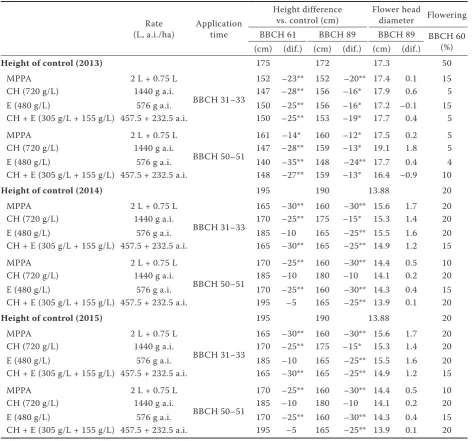
The results for the years 2013–2015 are sum-marized in Table 1.
The height of sunflower plants. Substantial sun-flower shortening occurred after application of all plant growth regulators. On untreated control, the plants reached a height of 175 cm at inflorescence emergence and 172 cm at the end of the growing season. After application of chlormequat chloride at both tested application terms, the shortening ranged around 28 cm during inflorescence and between 13 cm and 16 cm shortly before harvest. A greater height reduction was achieved at earlier
application than at the later application. Etephon and chlormequat chloride + etephon achieved greater height reduction with shortening by 25 cm and 27 cm during inflorescence and 13 cm and 24 cm shortly before harvest. Etephon achieved a greater height reduction at the later application date, whereas chlormequat chloride + etephon did so with the earlier application. BAS 67800F + ammonium sulphate reduced sunflower height at inflorescence growth stage by 14 cm and 23 cm, and at the end of growing season by 12–20 cm. Application at BBCH 31–33 provided a greater height reduction. Application of all plant growth regulators in this year was significant.
[image:3.595.88.509.95.444.2]In 2014, the untreated plants reached a height of 185 cm at inflorescence and 175 cm at the end of the growing season. Application of chlormequat chloride at BBCH 31–33 brought shortening rang-ing around 26 cm significant at inflorescence and 10 cm insignificant shortly before harvest, and for the later application time these values were Figure 1. Temperature and precipitation at Agrotest Fyto, Ltd., Kroměříž, Czech Republic research institute (2013–2015) -10-9 -8 -7 -6 -5 -4 -3 -2 -10 1 2 3 4 5 6
I II III IV V VI VII VIII IX X XI XII
Te m pe ra tur e de vi at ion f rom nor m al ( ° C)
2013 2014 2015
extraordinarily warm very warm warm cold very cold extraordinarily cold 0 20 40 60 80 100 120 140 160 180 200 220 240 260 280 300
I II III IV V VI VII VIII IX X XI XII
Per cen tag e o f n or m al
2013 2014 2015
very dry extraordinarily wet very wet wet dry extraordinarily dry -10-9 -8 -7 -6 -5 -4 -3 -2 -10 1 2 3 4
I II III IV V VI VII VIII IX X XI XII
Te m pe ra tur e de vi at ion f rom nor m al very warm warm cold very cold extraordinarily cold 0 20 40 60 80 100 120 140 160 180 200 220 240 260 280 300
I II III IV V VI VII VIII IX X XI XII
Per cen tag e o f n or m al
2013 2014 2015
very dry extraordinarily wet very wet wet dry extraordinarily dry Te m pe ra tu re d ev ia tio n fr om n or m al (°C ) Pe rc en ta ge o f n or m al -10-9 -8 -7 -6 -5 -4 -3 -2 -10 1 2 3 4 5 6
I II III IV V VI VII VIII IX X XI XII
Te m pe ra tur e de vi at ion f rom nor m al ( ° C)
2013 2014 2015
extraordinarily warm very warm warm cold very cold extraordinarily cold 0 20 40 60 80 100 120 140 160 180 200 220 240 260 280 300
I II III IV V VI VII VIII IX X XI XII
Per cen tag e o f n or m al
2013 2014 2015
very dry extraordinarily wet very wet wet dry extraordinarily dry extraordinarily warm very warm warm cold very cold extraordinarily cold extraordinarily wet very wet wet dry very dry extraordinarily dry
Vol. 64, 2018, No. 7: 324–329 Plant Soil Environ.
10 cm resp. 5 cm insignificant. Etephon resulted shortening by 17 cm at inflorescence and 20 cm shortly before harvest significant, and with the later application term, these values were 24 cm at inflorescence and 25 cm significant before harvest. For chlormequat chloride + etephon, shortening was 30 cm at inflorescence and 20 cm shortly before harvest significant in the case of earlier application and 4 cm insignificant resp. 20 cm significant in later application term. BAS 67800F + ammonium sulphate reduced sunflower height at inflorescence by 30 cm and shortly before harvest by 24 cm when applied at BBCH 31–33, and for
the later application these values were 20 cm resp. 24 cm – all significant.
[image:4.595.63.536.112.553.2]In 2015, the untreated plants reached a height of 195 cm at the beginning of flowering and 190 cm at the end of the growing season. Application of chlormequat chloride at BBCH 31–33 brought shortening ranging around 25 cm at inflorescence and 15 cm significant shortly before harvest, and for the later time, these values were 10 cm at inflores-cence and 10 cm shortly before harvest insignificant. Etephon resulted shortening by 10 cm insignificant at inflorescence and 25 cm significant shortly before harvest for the early application time and
Table 1. Experimental findings for 2013–2015
Rate
(L, a.i./ha) Application time
Height difference
vs. control (cm) Flower head diameter Flowering
BBCH 61 BBCH 89 BBCH 89 BBCH 60
(%) (cm) (dif.) (cm) (dif.) (cm) (dif.)
Height of control (2013) 175 172 17.3 50
MPPA 2 L + 0.75 L
BBCH 31–33
152 –23** 152 –20** 17.4 0.1 15
CH (720 g/L) 1440 g a.i. 147 –28** 156 –16* 17.9 0.6 5
E (480 g/L) 576 g a.i. 150 –25** 156 –16* 17.2 –0.1 15
CH + E (305 g/L + 155 g/L) 457.5 + 232.5 a.i. 150 –25** 153 –19* 17.7 0.4 5
MPPA 2 L + 0.75 L
BBCH 50–51
161 –14* 160 –12* 17.5 0.2 5
CH (720 g/L) 1440 g a.i. 147 –28** 159 –13* 19.1 1.8 5
E (480 g/L) 576 g a.i. 140 –35** 148 –24** 17.7 0.4 4
CH + E (305 g/L + 155 g/L) 457.5 + 232.5 a.i. 148 –27** 159 –13* 16.4 –0.9 10
Height of control (2014) 195 190 13.88 20
MPPA 2 L + 0.75 L
BBCH 31–33
165 –30** 160 –30** 15.6 1.7 20
CH (720 g/L) 1440 g a.i. 170 –25** 175 –15* 15.3 1.4 20
E (480 g/L) 576 g a.i. 185 –10 165 –25** 15.5 1.6 20
CH + E (305 g/L + 155 g/L) 457.5 + 232.5 a.i. 165 –30** 165 –25** 14.9 1.2 15
MPPA 2 L + 0.75 L
BBCH 50–51
170 –25** 160 –30** 14.4 0.5 10
CH (720 g/L) 1440 g a.i. 185 –10 180 –10 14.1 0.2 20
E (480 g/L) 576 g a.i. 170 –25** 160 –30** 14.3 0.4 15
CH + E (305 g/L + 155 g/L) 457.5 + 232.5 a.i. 195 –5 165 –25** 13.9 0.1 20
Height of control (2015) 195 190 13.88 20
MPPA 2 L + 0.75 L
BBCH 31–33
165 –30** 160 –30** 15.6 1.7 20
CH (720 g/L) 1440 g a.i. 170 –25** 175 –15* 15.3 1.4 20
E (480 g/L) 576 g a.i. 185 –10 165 –25** 15.5 1.6 20
CH + E (305 g/L + 155 g/L) 457.5 + 232.5 a.i. 165 –30** 165 –25** 14.9 1.2 15
MPPA 2 L + 0.75 L
BBCH 50–51
170 –25** 160 –30** 14.4 0.5 10
CH (720 g/L) 1440 g a.i. 185 –10 180 –10 14.1 0.2 20
E (480 g/L) 576 g a.i. 170 –25** 160 –30** 14.3 0.4 15
CH + E (305 g/L + 155 g/L) 457.5 + 232.5 a.i. 195 –5 165 –25** 13.9 0.1 20 *P < 0.05; **P < 0.01; MPPA – mepiquat chloride + prohexadione-Ca + pyraclostrobin + ammonium sulphate; CH – chlormequat chloride; E – ethephon; a.i. – active indredient
Plant Soil Environ. Vol. 64, 2018, No. 7: 324–329
25 cm at inflorescence and 30 cm significant shortly before harvest for the later application. For chlor- mequat chloride + etephon, shortening was 30 cm at inflorescence and 25 cm significant shortly be-fore harvest when application was made at BBCH 31–33 and 5 cm insignificant at inflorescence and 25 cm shortly before harvest in later application term. BAS 67800F + ammonium sulphate reduced sunflower height at inflorescence by 30 cm and shortly before harvest by 30 cm when applied at BBCH 31–33, and, for the later application these values were 24 cm all significant.
The height of sunflower plants was reduced by 10–30 cm with a single application, depending upon growth regulator used and term of applica-tion. Almost identical results had been reported by Koutroubas et al. (2004). In experiments by Lovett and Campell (1973), the influence was evaluated for three growth regulators (paclobutrazol, mepiquat chloride, and chlormequat chloride) on sunflower plant height, yield, and number of achenes per flower head. Mepiquat chloride and paclobutrazol had reduced plant height after application up to the time of maturity. Height reduction had been very substantial, within the range of 9.5–11.7% compared to the untreated control. Shortening had come at the expense of intermodal length. Moreover, in the cases of these two plant growth regulators, there also had occurred a decrease in achene yield by 26% and 29%, respectively. In the case of applying chlormequat chloride, there had occurred an achene yield reduction for the rate of 3 kg/ha, but when rates of 1.5 kg/ha and 4.5 + 4.5 kg/ha (two application times) were applied this yield was higher than in the untreated control while plant height was reduced by 12–15 cm.
The influence of paclobutrazol, mepiquat chlo-ride, and chlormequat chloride – on sunflower morphology and yield was studied by Koutroubas et al. (2014). In single applications of paclobutrazol (12.5 g a.i./ha), mepiquat chloride (25 g a.i./ha), and chlormequat chloride (1500 g a.i./ha), there had occurred no negative influence of above-ground biomass or yield of fertile flowers per head even as paclobutrazol reduced height by 11.1% and mepiquat chloride by 11.7%.
Flower head diameter. Due to technical issues, we did not evaluate yield in our experiments. In place of yield, we measured flower head diameters at time of harvest maturity. Measuring flower head diameters in our experiments identified no
nega-tive influences on this parameter. It can therefore be concluded that application of chlormequat chloride and chlormequat chloride + ethephon, ethephon, and BAS 67800F + ammonium sulphate in tested application rates does not affect yield directly. In a study by Baylis and Dicks (1983), a mixture of mepiquat chloride and ethephon had shortened sunflower stem very well in contrast to daminozide, which had had a very uneven ef-fect. The timing of growth regulator application should be regarded as very important, because it may influence yield.
Influence on flowering. In the cases of all tested growth regulators applied, there occurred a delay in inflorescence. In 2013 at a time when 50% of plants on untreated plots already had flowered, just 5% had done so in the treatments with chlormequat chloride at both application timings. At the same time, 15% of plants had flowered in plots treated by the etephon 480 SL at BBCH 31–32 and 5% at BBCH 50–51. In the case of chlormequat chloride + etephon, those values were 5% and 10% for earlier and later applications time, respectively. For BAS 67800F + ammonium sulphate, 15% of plants had flowered on plots treated at BBCH 31–32 and 5% at BBCH 50–51.
In the 2014 occurred a delay in inflorescence too. At a time when 20% of plants had flowered in the untreated plots, just 10% of plants were flowering in treated by chlormequat chloride + etephon at earlier application. On plots treated by etephon 480 SL at BBCH 50–51, 15% of plants were flow-ering at that time, and on plots treated by BAS 67800F + ammonium sulphate at BBCH 50–51, 5% of plants were flowering. Other tested treat-ments demonstrated no influence on flowering.
Again in 2015, for some growth regulator ap-plications there occurred a delay in flowering. At a time when 20% of plants had flowered in the untreated plots, 15% of plants in the treated plots by chlormequat chloride + etephon applied at BBCH 31–33 were flowering. On plots treated by etephon 480 SL at BBCH 50–51, 15% of plants were flowering at that time and on plots treated by BAS 67800F + ammonium sulphate at BBCH 50–51, only 10% of plants were flowering. Other tested treatments did not influence flowering.
These markings vanished very quickly, however, and no harmful effect on sunflower growth was recorded. In their experiments using a single or double application of chlormequat chloride at high rates of 3000 g a.i./ha, however, those au-thors detected substantial decrease of yield, and they do not recommend this substance as suitable for use as a plant growth regulator in sunflower. Koutroubas and Damalas (2015) also do not rec-ommend repeated applications of paclobutrazol for reducing sunflower height. Although in their experiments, double and triple application did substantially decrease plant height, they also re-duced flower head yield. Damage to sunflower plants (specifically flower deformation) grown in a hydroponic solution had been recorded by Wanderley et al. (2007) at higher rates of the ac-tive ingredient paclobutrazol.
In certain cases, during our experiments, appli-cation of plant growth regulators influenced the onset of inflorescence as compared to untreated control. Delayed of beginning of flowering was determined for all tested growth regulators, and particularly so when applied at BBCH 50–51. However, inflorescence duration was not influ-enced. Side effects of growth regulators were de-scribed by Rademacher (2000). He mentions their influences on, for example, biosynthesis of sterols, carotenoids, cytokinins, and abscisic acid. The later beginning of inflorescence determined in our experiments could be result from metabolic reactions after applications of tested substances. Spitzer et al. (2011) had determined a delay in the beginning of inflorescence after application of growth regulators in sunflower, and especially so in double applications of chlormequat chloride and ethephon. They had observed no influence on overall flowering duration or flower head diameter.
Acknowledgement
The authors would like to thank English Editorial Services, s.r.o. for translation of the manuscript.
REFERENCES
Balodis O., Gaile Z. (2009): Influence of agroecological factors on winter oilseed rape (Brassica napus L.) autumn growth. In:
Proceedings of the 15th Annual International Scientific Con-ference Research for Rural Development. Jelgava, University of Agriculture.
Baylis A.D., Dickst J.W. (1983): Investigations into the use of plant growth regulators in oil-seed sunflower (Helianthus annuus) husbandry. The Journal of Agricultural Science, 100: 723–730. Bianco J., Daymond J., LePage-Degivry M.T. (1996): Regulation
of germination and seedling root growth by manipulations of embryo GA levels in sunflower. Acta Physiologiae Plantarum, 18: 59–66.
Koutroubas S.D., Damalas C.A. (2015): Sunflower response to repeated foliar applications of Paclobutrazol. Planta Daninha, 33: 129–135.
Koutroubas S.D., Damalas C.A. (2016): Morpho-physiological responses of sunflower to foliar applications of chlormequat chloride (CCC). Bioscience Journal, 32: 1493–1501.
Koutroubas S.D., Vassiliou G., Damalas C.A. (2014): Sunflower morphology and yield as affected by foliar applications of plant growth regulators. International Journal of Plant Production, 8: 215–230.
Koutroubas S.D., Vassiliou G., Fotiadis S., Alexoudis C. (2004): Re-sponse of sunflower to plant growth regulators. New directions for a diverse planet. In: Proceedings of the 4th International Crop Science Congress, 26 Sep–1 Oct 2004, Brisbane, Australia. Kuryata V.G., Poprotska I.V., Rogach T.I. (2017): The impact of growth stimulators and retardants on the utilization of reserve lipids by sunflower seedlings. Regulatory Mechanisms in Bio-systems, 8: 317–322.
Lovett J.V., Campbell D.A. (1973): Effects of CCC and moisture stress on sunflower. Experimental Agriculture, 9: 329–336. Polat T., Ozer H., Öztürk E., Sefaoğlu F. (2017): Effects of mepi-
quat chloride applications on non-oilseed sunflower. Turkish Journal of Agriculture and Forestry, 41: 472–479.
Rademacher W. (2000): Growth retardants: Effects on gibberellin biosynthesis and other metabolic pathways. Annual Review of Plant Physiology and Plant Molecular Biology, 51: 501–531. Rajala A., Peltonen-Sainio P. (2001): Plant growth regulator effects
on spring cereal root and shoot growth. Agronomy Journal, 93: 936–943.
Spitzer T., Matušinský P., Klemová Z., Kazda J. (2011): Manage-ment of sunflower stand height using growth regulators. Plant, Soil and Environment, 57: 357–363.
Wanderley C.S., Rezende R., Andrade C.A.B. (2007): Effect of paclobutrazol as regulator of growth in production of flowers of sunflower in cultivo hidropônico. Ciencia E Agrotechnolo-gia, 31: 1672–1678.
Weiss E.A. (2000): Oilseed Crops. 2nd Edition. London, Blackwell Science.
Received on March 29, 2018 Accepted on June 1, 2018 Published online on June 12, 2018
Plant Soil Environ. Vol. 64, 2018, No. 7: 324–329