In recent years, the Czech agriculture has been suffering from increasing soil degradation due to farming methods, such as non-compliance with crop rotation practice or insufficient supply of stable manure. In the coming years, this trend in agriculture can be expected to continue, as well as an increase in temperature associated with more intensive evaporation and greater fluctuations in precipitation. More often than before, there will be an increased risk of soil erosion and loss of organic matter in soil and problems with water shortages may occur. Drought will threaten a number of the most productive areas in the Czech Republic (Lobell and Field 2007, Žalud et al. 2009). Possible measures may include cultivation of catch crops.
Catch crops enrich the soil with organic matter, reduce wind and water erosion, as well as nutri-ent leaching, and facilitate moisture retnutri-ention in soil. Catch crops act as interrupters of cereal sequences in crop rotation. They suppress weeds and reduce the spread and incidence of diseases and pests (Murakami et al. 2000, Sparow 2015). Growth and development of catch crops can be suppressed particularly by low rainfall and its im-proper distribution (Arlauskienė and Maikštėnienė 2006, Constantin et al. 2015). The efficiency of catch crops depends on the choice of the species (Talgre et al. 2011). In drier areas, water use by catch crops may outweigh their positive effects. Saptoka et al. (2012) reported in their study that
Yield and soil coverage of catch crops and their impact
on the yield of spring barley
Martina HANDLÍŘOVÁ*, Vojtěch LUKAS, Vladimír SMUTNÝ
Department of Agrosystems and Bioclimatology, Mendel University in Brno,
Brno, Czech Republic
*Corresponding author: [email protected]
ABSTRACT
Handlířová M., Lukas V., Smutný V. (2017): Yield and soil coverage of catch crops and their impact on the yield of spring barley. Plant Soil Environ., 63: 195–200.
The aim of experiment was to evaluate the impact of catch crops on the yield of spring barley. An assessment of the suitability of catch crops in relation to their yield and soil coverage was made. The field experiment was set up in a corn-growing area (south Moravia, Czech Republic). The results show a statistically significant difference in yield of dry matter and soil coverage among catch crops as well as among years. The most appropriate was the cultivation of
Phacelia tanacetifolia Bentham and Sinapis alba L., which regularly provided the highest yields and soil coverage.
In some years, similar results were also achieved for Fagopyrum esculentum Moench and Carthamus tinctorius L.
Less suitable catch crops are Secale cereale var. multicaule L.,which ensured lower yield and good soil coverage, but
reduced the yield of spring barley, and Panicum miliaceum L.Yield of spring barley was affected by year and
spe-cies of catch crops. The lowest yield of barely was in the year with unfavourable rainfall. The yield decreased with increasing quantities of catch crop matter. In the case of favourable rainfall year, there was no risk of lower yield of spring barley after monitored catch crops in one of the driest and warmest places in the Czech Republic.
Keywords: intercrop; grain; dry conditions; cereals; biomass
catch crops reduced barley yield probably due to competition among the catch crop and barley for nitrogen, water, and light. However, Gaweda (2012) found that Sinapis alba L. and Phacelia tanacetifolia Bentham did not significantly change the grain yield of spring barley. As stated by Bodner (2013), only in extreme years with low winter precipitation, there may be a reduction of yields of subsequent crops. The aim of experiment was to evaluate the impact of selected species of catch crops on the yield of spring barley in an area that is among the driest and warmest areas in the Czech Republic. An assessment of the suitability of catch crops in relation to their yield and coverage of the soil was made.
MATERIAL AND METHODS
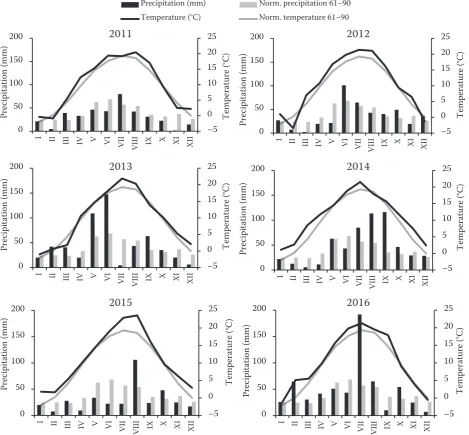
The field experiment was carried out on clay-loam fluvisols at the field experimental station in Žabčice (south Moravia, Czech Republic). The average annual rainfall is 480 mm and the average annual temperature is 9.2°C. This is one of the driest and warmest areas in the Czech Republic. Figure 1 summarizes total rainfall and the average temperature for the analysed years. The experi-ment was established by a randomized block design with four replications. The experiment included six species of catch crops, namely Sinapis alba L., Phacelia tanacetifolia Bentham, Fagopyrum escu-lentum Moench, Secale cereale var. multicaule L.,
–5 0 5 10 15 20 25 0 50 100 150 200
I II III IV V VI
V
II
V
III IX X XI XII
T em pe ra tu re (° C) Pr ec ip ita tio n (m m )
Precipitation (mm) Norm. precipitation 61–90 Temperature (°C) Norm. temperature 61–90
2011 –5 0 5 10 15 20 25 0 50 100 150 200
I II III IV V VI
V
II
V
III IX X XI XII
T em pe ra tu re (° C) Pr ec ip ita tio n (m m ) 2012 –5 0 5 10 15 20 25 0 50 100 150 200
I II III IV V VI
V
II
V
II
I IX X XI
X II T em pe ra tu re (° C) Pr ec ip ita tio n (m m
) 2013
–5 0 5 10 15 20 25 0 50 100 150 200
I II III IV V VI
V
II
V
III IX X XI XII
T em pe ra tu re (° C) Pr ec ip ita tio n (m m
) 2014
–5 0 5 10 15 20 25 0 50 100 150 200
I II III IV V VI
V
II
V
III IX X XI XII
T em pe ra tu re (° C) Pr ec ip ita tio n (m m ) 2015 –5 0 5 10 15 20 25 0 50 100 150 200
I II III IV V VI
V
II
V
III IX X XI XII
[image:2.595.65.535.306.741.2]T em pe ra tu re (° C) Pr ec ip ita tio n (mm ) 2016
Figure 1. Monthly precipitation and average monthly temperature in Žabčice in the years 2011–2016
–5 0 5 10 15 20 25 0 50 100 150 200
I II III IV V VI
V
II
V
III IX X XI XII
T em pe ra tu re (° C) Pr ec ip ita tio n (m m )
Precipitation (mm) Norm. precipitation 61–90 Temperature (°C) Norm. temperature 61–90
2011 –5 0 5 10 15 20 25 0 50 100 150 200
I II III IV V VI
V
II
V
III IX X XI XII
T em pe ra tu re (° C) Pr ec ip ita tio n (m m ) 2012 –5 0 5 10 15 20 25 0 50 100 150 200
I II III IV V VI
V
II
V
II
I IX X XI
X II T em pe ra tu re (° C) Pr ec ip ita tio n (m m
) 2013
–5 0 5 10 15 20 25 0 50 100 150 200
I II III IV V VI
V
II
V
III IX X XI XII
T em pe ra tu re (° C) Pr ec ip ita tio n (m m
) 2014
–5 0 5 10 15 20 25 0 50 100 150 200
I II III IV V VI
V
II
V
III IX X XI XII
Te m pe ra tu re (° C) Pr ec ip ita tio n (m m ) 2015 –5 0 5 10 15 20 25 0 50 100 150 200
I II III IV V VI
V
II
V
III IX X XI XII
Panicum miliaceum L., and Carthamus tincto-rius L. The experiment also included a control variant without a catch crop. Catch crops were planted after the winter wheat harvest in mid-August. Shallow ploughing was carried out after harvest of winter wheat. After ploughing, pri-mary tillage seedbed preparation and sowing fol-lowed. The catch crop sowing was carried out by a small-plot Wintersteiger seeder. To deter-mine the catch crop yield, traditional harvest-ing of fresh plant matter of catch crops was used in October, about 70 days after sowing. Table 1 summarizes the dates of sowing and harvest of the aboveground mass of catch crops. The harvest of fresh plant matter of catch crops was conducted from 0.25 m2 plot with four replications for each variant of catch crops and subsequent drying to a constant value. At the same time, the soil coverage was evaluated. Evaluation of soil cover by catch crops plants was carried out by image analysis. Three orthogonal images of all experimental plots and all repetitions were taken. The images were then ana-lysed using the ESRI ArcGIS 10 software (Redlands, USA). The method used was supervised classifica-tion, where the pixels, based on their digital values, were assigned to one of the classification classes – in this case to two, namely soil and vegetation. The catch crops were left in the field until spring. In the spring, after the catch crops, spring barley was planted. Spring barley was sown directly into catch crops with a drilling machine with rotary harrows. Mulching was carried out in the years with more biomass of catch crops. The size of the experimen-tal plot was 7.5 m2. Before the planting of spring barley, the plot of each catch crop was fertilized with nitrogen (60 kg N/ha). The harvest of spring
barley was done in July. The results were statisti-cally processed by the analysis of variance (ANOVA, Statistica 12, Tulsa, USA) and were subsequently evaluated by the Fisher’s LSD (least significant dif-ference) post-hoc test at the 0.05 significance level.
RESULTS AND DISCUSSION
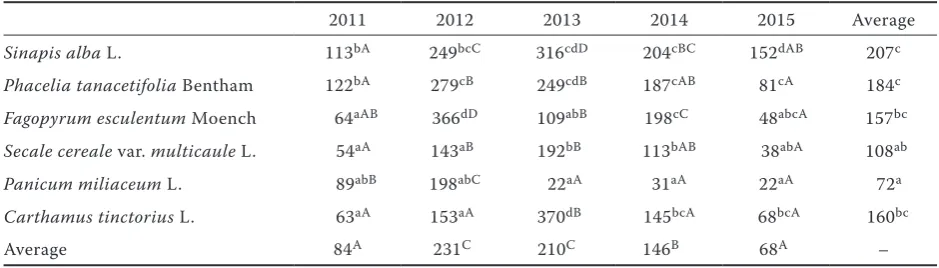
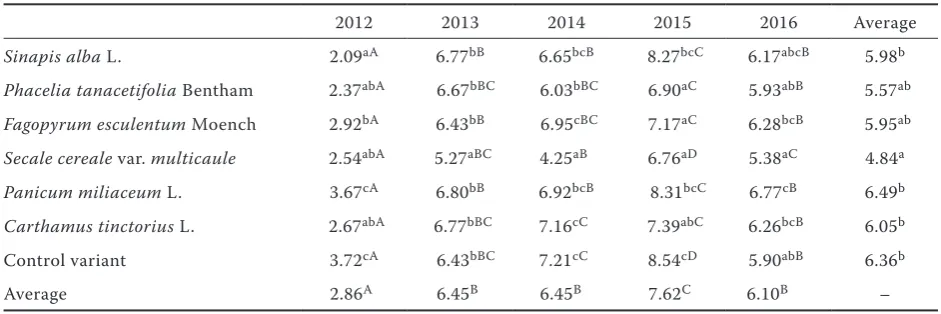
The results of dry matter yield of catch crops and their soil coverage and the impact of catch crops on grain yield of subsequent spring barley in the monitored years are summarized in the following Tables 2 to 4.
[image:3.595.304.533.140.267.2]The yield of dry matter of catch crops is illustrat-ed in Table 2. A statistically significant difference in dry matter of catch crops was observed among years. Growth and development of catch crops depended on weather conditions in a given year, which agrees with Constantin et al. (2015). The lowest yields in the studied species of catch crops
Table 1. Date of sowing and sampling and measurement of aboveground matter of catch crops in 2011–2015 in Žabčice (Czech Republic)
Year
Date of
sowing fresh mattersampling of measurement of soil coverage
2011 12.8. 19.10.
2012 10.8. 22.10.
2013 16.8. 29.10.
2014 12.8. 22.10.
2015 17.8. 22.10.
Table 2. Yield of dry matter of catch crops (g/m2) in the years 2011–2015
2011 2012 2013 2014 2015 Average
Sinapis alba L. 113bA 249bcC 316cdD 204cBC 152dAB 207c
Phacelia tanacetifolia Bentham 122bA 279cB 249cdB 187cAB 81cA 184c
Fagopyrum esculentum Moench 64aAB 366dD 109abB 198cC 48abcA 157bc
Secale cereale var. multicaule L. 54aA 143aB 192bB 113bAB 38abA 108ab
Panicum miliaceum L. 89abB 198abC 22aA 31aA 22aA 72a
Carthamus tinctorius L. 63aA 153aA 370dB 145bcA 68bcA 160bc
Average 84A 231C 210C 146B 68A –
[image:3.595.62.532.596.730.2]were achieved in 2011 (average 84 g/m2) and 2015 (average 68 g/m2). This was due to lower quantities and inappropriate distribution of precipitation over a longer part of their growing season. Catch crops were primarily limited by the available supply of water in the soil and the amount and distribution of rainfall over the growing season. These results are consistent with the conclusions by Brant et al. (2011), and Arlauskienė and Maikštėniene (2006). Statistically significant differences in dry matter among species of catch crops in each year are shown in Table 2. Consistently higher yields and better stability of production were observed in Sinapis alba L. and Phacelia tanacetifolia Bentham. The highest yields were achieved in the favourable rainfall years of 2012 and 2013, when Phacelia tanacetifolia Bentham achieved the highest yields 279 g/m2 in 2012 and Sinapis alba L. 316 g/m2 of
dry matter in 2013. In some years, higher yields were also reached by Fagopyrum esculentum and Carthamus tinctorius L. In all the monitored years, lower biomass occurred in Secale cereale var. mul-ticaule L. and Panicum miliaceum L.
[image:4.595.60.540.112.268.2]Table 3 gives the soil coverage of catch crops. There is a statistically significant difference in soil coverage among years and even among different species of catch crops. Soil coverage corresponds with the produced fresh matter of catch crops, as stated by Lukas et al. (2013). In all the moni-tored years, the highest values of soil coverage were recorded for Sinapis alba L. (average 70%), Phacelia tanacetifolia Bentham (average 69%), and Carthamus tinctorius L. (average 70%). Secale cereale var. multicaule L. (average 60%) reached slightly lower value of soil coverage. The lowest soil coverage occurred in Panicum miliaceum L.
Table 3. Soil coverage of catch crops (%) in the years 2011–2015
2011 2012 2013 2014 2015 Average
Sinapis albaL. 64bcAB 87cC 74dB 65abAB 59deA 70c
Phacelia tanacetifolia Bentham 63bcB 83cC 65cdB 88bC 46bcA 69bc Fagopyrum esculentum Moench 22aAB 22aAB 7aA 61abC 32aB 29a Secale cereale var. multicauleL. 53bA 81bcB 61cA 52aA 52cdA 60b
Panicum miliaceumL. 31aA 28aA 43bA 46aA 40abA 38a
Carthamus tinctoriusL. 68cA 75bA 70cdA 73abA 66eA 70c
Control variant 32aA 25aA 40bA 51aA 38abA 37a
Average 47A 57AB 51AB 62B 48A –
Different small letters indicate significant differences at the level of α = 0.05 among species of catch crops in the indi-vidual years and different uppercase letters indicate significant differences at the level of α = 0.05 among indiindi-vidual years
Table 4. Grain yield of spring barley after catch crops (t/ha) in the years 2012–2016
2012 2013 2014 2015 2016 Average
Sinapis alba L. 2.09aA 6.77bB 6.65bcB 8.27bcC 6.17abcB 5.98b
Phacelia tanacetifolia Bentham 2.37abA 6.67bBC 6.03bBC 6.90aC 5.93abB 5.57ab
Fagopyrum esculentum Moench 2.92bA 6.43bB 6.95cBC 7.17aC 6.28bcB 5.95ab
Secale cereale var. multicaule 2.54abA 5.27aBC 4.25aB 6.76aD 5.38aC 4.84a
Panicum miliaceum L. 3.67cA 6.80bB 6.92bcB 8.31bcC 6.77cB 6.49b
Carthamus tinctorius L. 2.67abA 6.77bBC 7.16cC 7.39abC 6.26bcB 6.05b
Control variant 3.72cA 6.43bBC 7.21cC 8.54cD 5.90abB 6.36b
Average 2.86A 6.45B 6.45B 7.62C 6.10B –
[image:4.595.62.533.572.729.2](average 38%) and Fagopyrum esculentum Moench (average 29%). Higher values in soil coverage by catch crops occurred in 2011 and 2015, when catch crops reached the lowest overall dry matter yields, and in the control variant without catch crops, they can be related to the occurrence of weeds.
Sinapis alba L. and Phacelia tanacetifolia Bentham were the least sensitive to different tem-perature and rainfall conditions. Both catch crops not only produced higher yields but also sufficient soil coverage, which also agrees with findings of Brust et al. (2014) and Ramírez-García et al. (2015). Fagopyrum esculentum Moench was characterised by a rapid and aggressive start as well as strong plant coverage in the beginning of the growing season, and also reached higher yields of dry matter, as also stated by Clark (2008), Brust et al. (2014) and Ziech et al. (2015). In some years, its lower yields and low soil coverage can be explained by higher sensitivity to the irregular distribution of rainfall and low ground temperatures that prematurely end its growth so Fagopyrum esculentum Moench loses the ability to cover the soil. Panicum miliaceum L. was also more sensitive to low ground tempera-tures and reached lower levels of soil coverage as well. Carthamus tinctorius L., especially during germination, needed plenty of water, which also coincides with findings by Mündel et al. (2004). It belonged to catch crops with higher soil coverage. Although Secale cereale var. multicaule L. was characterized by good soil coverage, nonetheless in order to achieve higher yields of dry matter, it needed greater amounts of water for its growth and development. It coincides well with Ziech et al. (2015). To exploit the potential of cultivated catch crops, it is necessary to select crops with high biomass production and good soil coverage. A favourable option seems to be growing a mixture of catch crops. Clark (2008) proposed that growing a mixture of catch crops can link together their multiple benefits.
Yield of spring barley was mainly affected by year and also species of catch crops (Table 4). The lowest yield of spring barley was in a very unfavourable rainfall year in 2012. In that year, with the exception of Panicum miliaceum L., a statistically significant difference in the yields of spring barley after catch crops and control variant was recorded. Reduction of spring barley yield was extraordinary; after Sinapis alba L. was as much as 44% down when compared to the control
tincto-rius L. and Panicum miliaceum L. when compared to the control variant in one of the driest and warmest places in the Czech Republic.
REFERENCES
Arlauskiene A., Maikšteniene S. (2006): Improvement of clay loam cambisol properties by cover crops. Zemdirbyste-Agriculture, 93: 240–251.
Bodner G. (2013): Hydrologische Effekte des Zwischenfruch-tanbaus im Trockengebiet. Innovation – Das Magazin für die Landwirtschaft, 2: 18–20.
Brant V., Pivec J., Fuksa P., Neckář K., Kocourková D., Venclová V. (2011): Biomass and energy production of catch crops in areas with deficiency of precipitation during summer period in central Bohemia. Biomass and Bioenergy, 35: 1286–1294. Brust J., Claupein W., Gerhards R. (2014): Growth and weed
supp-ression ability of common and new cover crops in Germany. Crop Protection, 63: 1–8.
Clark A. (2008): Managing Cover Crops Profitably. Darby, Diane Publishing.
Constantin J., Dürr C., Triboullois H., Justes E. (2015): Catch crop emergence success depends on weather and soil seedbed conditions in interaction with sowing date: A simulation study using the SIMPLE emergence model. Field Crops Research, 176: 22–33.
Gaweda D. (2012): Yield and yield structure of spring barley ( Ho-deum vulgare L.) grown in monoculture after different stubble crops. Acta Agrobotanica, 64: 91–98.
Lobell D.B., Field C.B. (2007): Global scale climate-crop yield re-lationships and the impacts of recent warming. Environmental Research Letters, 2: 014002.
Lukas V., Procházková B., Smutný V., Dryšlová T., Neudert L. (2013): Estimation of coverage of soil by the catch crops using grand-truth paging in virble spektrum. Növénytermelés, 62: 425–428.
Malecka I., Blecharczyk A. (2008): Effect of tillage systems, mul-ches and nitrogen fertilization on spring barley (Hordeum vulgare). Agronomy Research, 6: 517–529.
Murakami H., Tsushima S., Akimoto T., Murakami K., Goto I., Shishido Y. (2000): Effects of growing leafy daikon (Raphanus sativus) on populations of Plasmodiophora brassicae (clubroot). Plant Pathology, 49: 584–589.
Mündel H., Blacksaw R.E., Byers J.R., Huang H.C., Johnson D.L., Keon R., Kubík J., McKenzie R., Otto B., Roth B., Standford K. (2004): Carthamus tinctorius Production on the Canadian Prairies: Revisited in 2004. Ottawa, Agriculture and Agri-Food Canada, Lethbridge Research Center.
Ramírez-Garcia J., Gabriel J.L., Alonso-Ayuso M., Quemada M. (2015): Quantitative characterization of five cover crop species. The Journal of Agricultural Science, 153: 1174–1185. Rinnofner T., Friedel J.K., de Kruijff R., Pietsch G., Freyer B.
(2008): Effect of catch crops on N dynamics and following crops in organic farming. Agronomy for Sustainable Development, 28: 551–558.
Sapkota T.B., Askegaard M., Lægdsmand M., Olesen J.E. (2012): Effects of catch crop type and root depth on nitrogen leaching and yield of spring barley. Field Crops Research, 125: 129–138. Sparrow L.A. (2015): Six years of results from a potato rotation
and green manure trial in Tasmania, Australia. ISHS Acta Horticulturae, 1076: 29–35.
Talgre L., Lauringson E., Makke A., Lauk R. (2011): Biomass production and nutrient binding of catch crops. Zemdirbys-te=Agriculture, 98: 251–258.
Ziech A.R.D., Conceicao P.C., Luchese A.V., Balin N.M., Candiotto G., Garmus T.G. (2015): Soil protection by winter-cycle cover crops in South Brazil. Pesquisa Agropecuaria Brasileira, 50: 347–382.
Žalud Z., Trnka M., Dubrovský M., Hlavinka P., Semerádová D., Kocmánková E. (2009): Climate change impacts on selected aspects of the Czech agricultural production. Plant Protection Science, 45: S11–S19.