Comparison of qualitative and quantitative properties
of the wings, necks and offal of chicken broilers
from organic and conventional production systems
F.A.A. Abdullah, H. Buchtova
University of Veterinary and Pharmaceutical Sciences Brno, Brno, Czech Republic
ABSTRACT: The aim of the present study was to investigate qualitative and quantitative properties of wings, offal (liver, heart and gizzard) and necks of chickens from organic and conventional production systems, currently avail-able on the market for Czech consumers. Production properties (yield and weight), surface colour (lightness, red-ness, yellowness) and chemical indicators (dry matter, total protein, net protein, collagen, hydroxyproline, fat, ash and phosphorus) were evaluated in fresh chicken broilers. Conventionally produced chickens had higher carcass yields but higher wing yields and weights were observed in organic broilers. The skin, bones, tip (left wings) and the meat with skin (right wings) of organic broilers were heavier (P < 0.05) than those of conventional chickens. The dry matter and total protein content of deboned organic broiler wings (meat with skin) was greater (P < 0.01) than those of conventional wings. Similarly as for yields, the offal (heart, gizzard) and necks of organic chickens had significantly (P < 0.01) higher weights in comparison with conventional chickens. Colour indicators showed that the external surface of the livers, necks and gizzards (muscle) from organic chickens were darker (lightness; P < 0.01). Total protein content in livers, hearts and necks of organic chickens was greater; fat content in the livers and necks of organic broilers was also higher (P < 0.05) than those of conventional broilers. The ash and phosphorus in the necks of conventional broilers was higher (P < 0.05) than in organic chickens. This study indicates that the quantity and quality of offal and neck from organic broilers are slightly superior compared to conventional chickens.
Keywords: meat quality; broiler; chemical indicators; liver; heart; gizzard
One of the fastest growing segments of the European food market is organic food (Lawlor et al. 2003). Consumption of organic food in the Czech Republic is rising despite the economic challenges (Zivelova and Crhova 2013). It is believed that or-ganic food contains no harmful ingredients and thus is healthier for consumers than conventionally pro-duced food (Grashorn and Serini 2006). According to Council Regulation (EC) No. 834/2007, the rules of organic livestock production include a high level of animal welfare (access to open air areas, prefer-ably pasture, stocking densities) and organic feed that meets the animal’s nutritional requirements (growth promoters and synthetic amino-acids should not be used). In the last few decades, the amount of available edible meat offal has increased considerably from slaughterhouses, meat proces-sors and wholesalers (Darine et al. 2010).
and have focused only on meat quality evaluation and processing methods. Very few studies were published on the quality of chicken offal (Seong et al. 2015), particularly those from organic produc-tion systems. Quality parameters of organic and conventional broilers are affected by many factors, e.g. hybrid genotype, nutrition, age, sex, season as well as production methods (organic/conventional) (Fanatico et al. 2007; Ponte et al. 2008). There is a large price difference between edible by-product organs of organic and conventional chickens. It is, therefore, important that consumers should receive objective information about quality parameters, especially because no similar data have been pub-lished so far to the best of our knowledge.
The objective of this study was to evaluate the qualitative and quantitative characteristics of wings, necks and giblets of broilers from organic and conventional production systems as they are currently sold in retail markets.
MATeRiAl And MeThodS
Production properties. This experimental anal-ysis was carried out at the Department of Meat Hygiene and Ecology (DMHE) of the Faculty of Veterinary Hygiene and Ecology, University of Veterinary and Pharmaceutical Sciences Brno (Czech Republic). A total of 15 organic broiler chicken (OC) and 20 conventional broiler chicken (CC) carcasses were obtained directly from farms utilising organic production systems (Biopark s.r.o., Lipova, Czech Republic) meeting requirements laid down in Commission Regulation (EC) No. 889/2008 and from conventional production systems (Vodnanska drubez, a.s., Vodnany, Czech Republic) meeting requirements for safety and product qual-ity according to the Regulation (EC) No. 852/2004 and the Regulation (EC) No. 853/2004. The con-ditions for breeding were as follows: (1) organic production system – Colour yield hybrid, age at slaughter 81 days, stocking density was 10 birds/m2, birds had access to a free range area during the summer period, weight of the birds at the time of slaughter was 2379 ± 384.80 g; (2) conventional production system – Ross 308 hybrid, age at slaugh-ter 38 days, stocking density was 18 birds/m2, birds did not have access to a free range area, weight of the birds at the time of slaughter was 2284 ± 235.51 g.
Chickens slaughter and processing was carried out by both producers in compliance with Council Regulations (EC) No. 1099/2009 and 853/2004. The samples (packed cold carcasses) were transported from both farms to DMHE at temperature of be-tween 2 ± 2 °C. In the DMHE, the samples were stored in a refrigerator with controlled temperature (2 ± 2 °C) until analysis. Dissection of the carcasses was done according to the Commission Regulation (EC) No. 543/2008.
The eviscerated carcass (without neck, feet and gut), wings, neck and giblets (liver, heart and giz-zard) were weighed and yields were calculated ac-cording to Decree of the Ministry of Agriculture No. 471/2000. The wings were dissected from the carcasses at the shoulder joint, and then weighed as pairs and singly. The wings (drumette and wing flat) were deboned after dissection of the wing tip. The remaining meat (triceps, biceps and fore-arm muscles) of the wing and skin were weighed separately, whereas the meat and skin of the right wing were weighed together. The wing bones (hu-merus, radius, and ulna) and tip were weighed as well. Yield measurement: (1) yield of whole eviscer-ated carcass, pair of wings, neck and giblets were measured mathematically by the formula: yield = (weight of the aforementioned carcass cuts/live weight) × 100; (2) the yield of wing components – meat, skin, (meat with skin), bone and tip; yield = (weight of the aforementioned wing components/ wing weight) × 100.
Colour indicators. The colour indicators (light-ness, L*; redness, a*; yellowness, b*) of raw exter-nal surfaces (liver, heart, gizzard and neck) were measured according to the CIE L*a*b* system us-ing a Minolta CM 2600d (Konica Minolta, Japan). Spectra Magic 3.61 Software was used for calcu-lating the parameters and the mean ± SD of five measurements of each sample was reported.
ISO 937 (1978), net protein content was deter-mined as the amount of nitrogen that was organi-cally bound using the Kjeltec 2300 (Foss Analytical AB, Hoganas, Sweden) after precipitation with hot tannin solution (SOP 2000); the collagen content was computed (coefficient factor f = 8) from the content of the amino acid hydroxyproline (SOP 2000). The quantity of hydroxyproline was evalu-ated by photometric measurement of absorbance at 550 nm on a GenesysTM 6 (Thermo Electron Corporation, USA) spectrophotometer (SOP 2000). The fat content was analysed on a Soxtec 2055 (Foss Analytical AB, Hoganas, Sweden) with petrol ether as extraction agent (ISO 1443 1973). Ash was de-tected gravimetrically by burning the sample at 550 °C until black carbon particles disappeared in a muffle oven (Elektro LM 212.11, Germany) accord-ing to ISO 936 (1978). The amount of phosphorus was determined gravimetrically after conversion to orthophosphate and was precipitated as chinolin-phosphomolybdenate (SOP 2009).
Statistical analysis. Statistical analysis of data was conducted using Microsoft Office Excel 2003. Student’s t-test was used for determination of dif-ferences between OC and CC samples. The 0.05 and 0.01 levels of significance were used.
ReSulTS
The results are summarised in Tables 1–5. As shown in Table 1, no differences were observed be-tween the weights of organic and conventional live broilers in this study. The eviscerated carcasses of CC yielded more than OC, whereas no differences were observed between their weights. The wings (pair) of OC yielded more than the wings of CC and were heavier. The results associated with the yield and weight of wing components indicated the following: the meat with skin of from the OC wings (right) weighed more than the wings of chickens from conventional production systems; the skin of wings (left) from OC had higher yields and weights than those from CC. The bones of the left wing (hu-merus, radius, and ulna) of OC were heavier than those of CC. The tips of the wings (left) of the OC yielded and weighed more than in CC. Hearts, giz-zards and necks of OC yielded and weighed more, whereas no differences were observed in yield and liver weights.
[image:3.595.63.534.476.699.2]The surface colour of liver, neck and gizzard (muscle) was darker (L*) in OC in comparison with the CC. The heart of OC was lighter (L*) and was less yellow (b*) than in CC. No difference in redness
Table 1. Production properties (yield and weight of carcass portions) of organic chickens (OC, n = 15) and conven-tional chickens (CC, n = 20), values are presented as mean ± SD
Carcass part Yield (%) P Weight (g) P
OC CC OC CC
Live bird – – 2379 ± 384.80 2284 ± 235.51 NS
Eviscerated carcass 69.22 ± 2.10a 73.12 ± 1.54b ** 1630.36 ± 274.81 1671.86 ± 182.43 NS Pair wings1 8.75 ± 0.54b 7.90 ± 2.32a ** 200.39 ± 24.36b 182.78 ± 18.40a * RW (meat + skin)2 56.82 ± 3.28 57.22 ± 3.13 NS 57.76 ± 10.96b 51.35 ± 6.76a ** LW (meat)2 39.14 ± 3.65 40.66 ± 3.79 NS 40.86 ± 8.06 36.24 ± 6.47 NS LW (skin)2 19.57 ± 2.39b 16.46 ± 1.13a ** 20.29 ± 3.32b 14.57 ± 1.83a ** LW (bones)2 29.87 ± 3.22 29.02 ± 2.08 NS 30.11 ± 4.83b 25.98 ± 3.26a ** LW (tip)2 11.82 ± 0.75b 10.21 ± 0.84a ** 11.96 ± 1.92b 9.11 ± 0.98a ** Neck1 2.14 ± 0.09b 1.82 ± 0.50a ** 50.96 ± 8.80b 39.70 ± 9.10a ** Liver1 1.89 ± 0.43 1.85 ± 0.41 NS 44.11 ± 8.67 41.65 ± 7.79 NS Heart1 0.57 ± 0.13b 0.39 ± 0.06a ** 13.32 ± 3.15b 8.71 ± 0.99a ** Gizzard1 1.75 ± 0.58b 1.16 ± 0.22a ** 36.65 ± 9.65b 26.12 ± 3.76a ** Giblets1 4.21 ± 0.72b 3.40 ± 0.66a * 94.08 ± 14.59b 76.48 ± 14.39a *
LW = left wing,NS = not significant, P = statistical significance, RW = right wing 1Yield from whole alive chicken, 2yield from single wing
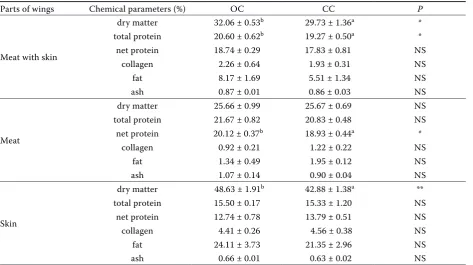
(a*) was indicated between organic and conven-tional livers, hearts, gizzards and necks (Table 2). The wings (meat with skin) from OC had higher dry matter and total protein content in comparison
[image:4.595.61.536.125.280.2] [image:4.595.64.538.445.710.2]with CC. Although OC wings harboured higher levels of net protein, collagen, fat, ash and phospho-rus content, these differences were not significant (Table 3).
Table 2. Colour indicators of giblets and necks from organic chickens (OC, n = 15) and conventional chickens (CC, n = 20), values are presented as mean ± SD
Carcass part Type L* P a* P b* P
Liver OCCC 36.05 ± 1.2438.84 ± 0.84ab ** 14.83 ± 0.1616.37 ± 1.76 NS 11.46 ± 0.3112.93 ± 1.50 NS
Heart OCCC 40.38 ± 2.4144.22 ± 1.62ab * 15.55 ± 0.7415.96 ± 1.91 NS 11.12 ± 1.2512.97 ± 0.73ab *
Gizzard
OC1 64.11 ± 1.51b
** 4.01 ± 0.91 NS 13.19 ± 0.95 NS CC1 59.99 ± 0.60a 5.30 ± 2.69 12.95 ± 1.54
OC2 34.23 ± 1.51a
** 11.73 ± 0.56 NS 6.71 ± 0.52a ** CC2 42.14 ± 1.22b 15.17 ± 3.80 11.30 ± 2.79b
Neck OCCC 55.23 ± 1.4559.27 ± 1.20ab ** 8.98 ± 1.87 7.19 ± 0.72 NS 14.24 ± 1.8711.58 ± 1.12 NS
a* = redness, b* = yellowness, L* = lightness, NS = not significant, P = statistical significance 1Mucosa, 2muscle
a,bValues in the same column with different letters between two groups (e.g. liver OC/liver CC) are significantly different *P < 0.05, **P < 0.01
Table 3. Chemical indicators of wings from organic chickens (OC, n = 15) and conventional chickens (CC, n = 20), values are presented as mean ± SD
Parts of wings Chemical parameters (%) OC CC P
Meat with skin
dry matter 32.06 ± 0.53b 29.73 ± 1.36a * total protein 20.60 ± 0.62b 19.27 ± 0.50a * net protein 18.74 ± 0.29 17.83 ± 0.81 NS
collagen 2.26 ± 0.64 1.93 ± 0.31 NS
fat 8.17 ± 1.69 5.51 ± 1.34 NS
ash 0.87 ± 0.01 0.86 ± 0.03 NS
Meat
dry matter 25.66 ± 0.99 25.67 ± 0.69 NS total protein 21.67 ± 0.82 20.83 ± 0.48 NS net protein 20.12 ± 0.37b 18.93 ± 0.44a *
collagen 0.92 ± 0.21 1.22 ± 0.22 NS
fat 1.34 ± 0.49 1.95 ± 0.12 NS
ash 1.07 ± 0.14 0.90 ± 0.04 NS
Skin
dry matter 48.63 ± 1.91b 42.88 ± 1.38a ** total protein 15.50 ± 0.17 15.33 ± 1.20 NS
net protein 12.74 ± 0.78 13.79 ± 0.51 NS collagen 4.41 ± 0.26 4.56 ± 0.38 NS
fat 24.11 ± 3.73 21.35 ± 2.96 NS
ash 0.66 ± 0.01 0.63 ± 0.02 NS
NS = not significant, P = statistical significance
Total protein and fat contents of neck from the OC were higher than that of CC. The necks of CC contained more ash and phosphorus than OC (Table 4).
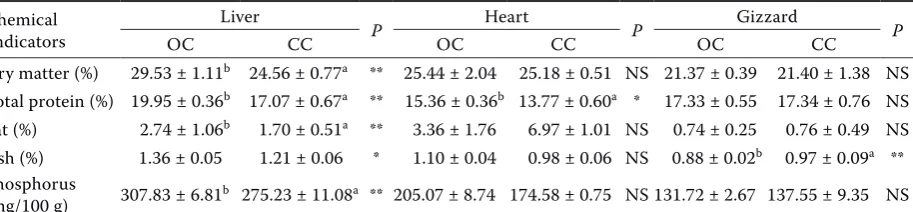
The content of dry matter, total protein, fat, ash and phosphorus in the livers of OC was higher than that of CC. Hearts of OC had higher total protein content than the hearts of CC. On the other hand, ash content of the gizzards of CC was higher than that of organically produced chickens (Table 5).
diSCuSSion
The results of our study showed that the yield of conventionaleviscerated carcass was higher than OC carcasses, which could be due to the greater physical activity and larger energy expenditures related to thermoregulation of organic poultry
(Rembialkowska and Badowski 2012). In contrast, the wings and necks of OC yielded more than CC, which is in agreement with the results found by Fanatico et al. (2005) indicating that birds with slow- and medium-growing genotypes had higher wing yields than chickens with fast-growing geno-types. The increase in breast yield, which is the result of fast-growing genotype selection, leads to a decreased yield of other chicken parts.
More usage of wings by chickens promotes an increase in bone and muscle masses. Lower stock-ing density of free-range production systems did not have an effect on the wing yield due to forced motor activity (Wang et al. 2009). Generally the yield of deboned meat is an important economical factor for consumers and producers (Nakano et al. 2012). The bones of the wing (humerus, radius, and ulna) from OC were heavier than CC. Fanatico et al. (2005) reported that the lower density of chickens in the raised area in organic production systems and intensive exercise in free-ranging birds (out-door system) led to stronger bones. In contrast, Wang et al. (2009) found that the strength of tibia bones in birds reared in free-range systems was tenderer than the tibia of broilers from indoor rais-ing systems, which was a result of the low calcium level in the diet.
The percentage of offal yield from OC was great-er than from CC. Murawska et al. (2011) obsgreat-erved the influence of chicken age and the percentage content of giblets. They found a relationship be-tween increased muscle tissue weights and de-creased giblet contents. The average yield of the chicken giblets of the OC was 4.21% whereas in CC the value was 3.40%. However, Somsen et al.
Table 5. Chemical indicators of giblets from organic chickens (OC, n = 15) and conventional chickens (CC, n = 20), values are presented as mean ± SD
Chemical indicators
Liver
P Heart P Gizzard P
OC CC OC CC OC CC
Dry matter (%) 29.53 ± 1.11b 24.56 ± 0.77a ** 25.44 ± 2.04 25.18 ± 0.51 NS 21.37 ± 0.39 21.40 ± 1.38 NS Total protein (%) 19.95 ± 0.36b 17.07 ± 0.67a ** 15.36 ± 0.36b 13.77 ± 0.60a * 17.33 ± 0.55 17.34 ± 0.76 NS Fat (%) 2.74 ± 1.06b 1.70 ± 0.51a ** 3.36 ± 1.76 6.97 ± 1.01 NS 0.74 ± 0.25 0.76 ± 0.49 NS Ash (%) 1.36 ± 0.05 1.21 ± 0.06 * 1.10 ± 0.04 0.98 ± 0.06 NS 0.88 ± 0.02b 0.97 ± 0.09a ** Phosphorus
(mg/100 g) 307.83 ± 6.81b 275.23 ± 11.08a ** 205.07 ± 8.74 174.58 ± 0.75 NS 131.72 ± 2.67 137.55 ± 9.35 NS
NS = not significant, P = statistical significance
a,bValues in the same row with different letters are significantly different
[image:5.595.72.529.600.706.2]*P < 0.05, **P < 0.01
Table 4. Chemical indicators of necks from organic chickens (OC, n = 15) and conventional chickens (CC, n = 20), values are presented as mean ± SD
Chemical parameters OC CC P Dry matter (%) 29.09 ± 0.98 27.45 ± 0.83 NS Total protein (%) 17.61 ± 0.66b 16.59 ± 0.25a * Fat (%) 7.52 ± 0.90b 3.60 ± 0.26a ** Ash (%) 2.58 ± 0.90a 4.77 ± 0.20b ** Phosphorus
(mg/100 g) 356.26 ± 111.41a768.81 ± 28.36b **
NS = not significant, P = statistical significance
a,bValues in the same row with different letters are
(2004) reported that the average yield of chicken giblets was 4.36% at an average live weight prior to slaughtering of 1898 g in the case of conventional broilers. Dal Bosco et al. (2014) affirmed rapid muscular-skeletal development in fast-growing birds as well as excessive development of the car-diovascular system in slow-growing chickens; in line with these observations, OC showed higher heart percentages than CC. The gizzards of OC were heavier and yielded more due to differences in feeding (access to grassy paddock) which could include various kinds of forage, insects, worms and sand particles. Furthermore, the diet of organically and free-range system-produced chickens is rich in crude fibre and could stimulate the development of the gizzard (Dou et al. 2009). In agreement with our findings, Skomorucha et al. (2008) reported that the type of rearing system affected the pro-duction properties of chicken giblets; however, the observations of Poltowicz and Doktor (2011) in-dicated no differences in giblet yields. The results obtained in our study are in agreement with the findings of Adedeji et al. (2014), who found that the livers, hearts and gizzards of organically raised chicken broilers were heavier than conventionally fed birds.
Feeding and housing conditions are considered as environmental conditions, and may affect the colour of meat (Du and Ahn 2002). The colour of meat depends on many factors including myoglo-bin concentration and the degree of its oxidation as well as the structure of meat (Ruiz de Huidobro et al. 2005). The L* values of organic giblets in the present study (liver, heart, muscular surface of giz-zard) and necks were significantly lower than those of CC, which could be ascribed to poor bleed-ing of OC. Previous studies (Fanatico et al. 2007; Mikulski et al. 2011; Chen et al. 2013), suggested that outdoor access had a positive effect on L* val-ues, producing darker meat. Trampel et al. (2005) reported that lighter liver colours were associated with more total liver lipid. In contrast, we found that livers of CC were lighter in colour and con-tained lower fat. There is a relationship between low pH values on the one hand and poor water retention capacity and meat colour on the other (Woelfel et al. 2002; Husak et al. 2008). According to Castellini et al. (2002), the higher levels of wel-fare provided for birds in organic farming reduce stress conditions leads to reduced pH (lower levels of glycogen catabolised to lactic acid), and as a
result the lightness value (L*) of meat products increases. The hearts of broilers that were reared conventionally in our study were more yellow (b*
P < 0.05) than OC, probably due to their higher lipid content resulting from storage of lipophilic pigments (Sirri et al. 2010) However, factors that were not monitored in the present study such as pH values, feeding, pre-slaughter stress conditions and bleeding efficiency could affect the colour of giblets.
Generally, the wings are eaten by consumers as meat together with skin. The proportion of skin in the wings is the highest among all culinary chicken meat portions, representing about 22%, i.e., twice the amount present in thighs (Tomaszewska-Gras and Konieczny 2010). Generally, the data of the present study indicate that the higher dry matter and protein (total and net) content in the wing parts from OC could be due to high dietary calorie-pro-tein ratios (Faria Filho et al. 2005) associated with the ingestion of insects and worms in the yard. Higher contents of total protein (in meat with skin) and net protein (in meat) in organic wings could be due to the higher levels of motor activity that is characteristic of birds in organic production sys-tems; levels of myogenesis are higher than those of lipogenesis in the muscles of these birds (Castellini et al. 2002; Husak et al. 2008). Higher protein con-tent on one hand, and lower ash and phosphorus content in OC on the other, could be explained by an increase in muscle mass and a decrease in bone mass in the neck.
Higher protein and lower fat contents in the hearts of OC can be due to the effect of motor activity on the hearts of organically reared birds (Castellini et al. 2002). Chickens reared in organic systems have more chance to ingest organic and inorganic substances from soil which may explain the higher ash content in the livers of OC.
eviscer-ated carcass yields; OC had higher wing yields, were heavier and contained more total protein; the giblets (heart, liver and gizzard) and necks of OC had higher yields and protein content, making this edible offal more valuable. Generally, the yield of edible offal in chickens is low. Yield improve-ment is beneficial for consumers, both quantita-tively and qualitaquantita-tively and may lead to consumers reconsidering the inclusion of these products in their diet, making it more versatile.
Acknowledgement
Financial support for this study was provided by the University of Veterinary and Pharmaceutical Sciences Brno, Czech Republic (Institutional re-search for year 2014).
ReFeRenCeS
Adedeji OS, Amao SR, Oguntunde MM, Dada ID (2014): evaluation of general performance and carcass qualities of organically raised broiler chickens from day old to 12 weeks of age. International Journal of Agriculture Inno-vations and Research 2, 466–471.
Alvarez-Astorga M, Capita R, Alonso-Calleja C, Moreno B, Garcia-Fernandez C (2002): Microbiological quality of retail chicken by-products in Spain. Meat Science 62, 45–50.
Castellini C, Mugnai C, Dal Bosco A (2002): Effect of or-ganic production system on broiler carcass and meat quality. Meat Science 60, 219–225.
Chen X, Jiang W, Tan HZ, Xu GF, Zhang XB, Wei S, Wang XQ (2013): Effects of outdoor access on growth perfor-mance, carcass composition, and meat characteristics of broiler chickens. Poultry Science 92, 435–443.
Commission Regulation (EC) No. 543/2008 of 16 June 2008 laying down detailed rules for the application of Council Regulation (EC) No. 1234/2007 as regards the marketing standards for poultry meat. Official Journal of the Euro-pean Union L 157, 46–87.
Commission Regulation (EC) No. 889/2008 of 5 Septem-ber 2008 laying down detailed rules for the implementa-tion of Council Regulaimplementa-tion (EC) No. 834/2007 on organic production and labelling of organic products with regard to organic production, labelling and control. Official Journal of the European Union L 250, 1–84.
Council Regulation (EC) No. 834/2007 of 28 June 2007 on organic production and labelling of organic products and
repealing Regulation (EEC) No. 2092/91. Official Journal of the European Union L 189, 1–23.
Council Regulation (EC) No. 1099/2009 of 24 September 2009 on the protection of animals at the time of killing. Official Journal of the European Union L 303, 1–30. Dal Bosco A, Mugnai C, Guarino Amato M, Piottoli L,
Car-toni A, Castellini C (2014): Effect of slaughtering age in different commercial chicken genotypes reared according to the organic system: 1. Welfare, carcass and meat traits. Italian Journal of Animal Science 13, 467–472.
Darine S, Christophe V, Gholamreza D (2010): Production and functional properties of beef lung protein concen-trates. Meat Science 84, 315–322.
Decree of the Ministry of Agriculture No. 471/2000 Coll., implementing some provisions of Act No. 154/2000 Coll., on breeding and registration of livestock and amending certain related laws (Breeding Act), Annex 1, Section 2, part C Slaughter analysis of poultry. Czech Republic. Dou TC, Shi SR, Sun HJ, Wang KH (2009): Growth rate,
carcass traits and meat quality of slow-growing chicken grown according to three raising systems. Animal Science Papers and Reports 27, 361–369.
Du M, Ahn DU (2002): Effect of dietary conjugated linoleic acid on the growth rate of live birds and on the abdomi-nal fat content and quality of broiler meat. Poultry Science 81, 428–433.
Fanatico AC, Pillai PB, Cavitt LC, Owens CM, Emmert JL (2005): Evaluation of slow-growing broiler genotypes grown with and without outdoor access: growth perfor-mance and carcass yield. Poultry Science 84, 1321–1327. Fanatico AC, Pillai PB, Emmert JL, Owens LM (2007): Meat
quality of slow- and fast-growing chicken genotypes fed low-nutrient or standard diets and raised indoors or with outdoor access. Poultry Science 86, 2245–2255.
Faria Filho DE, Rosa PS, Vieira BS, Macari M, Furlan RL (2005): Protein levels and environmental temperature effects on carcass characteristics, performance, and ni-trogen excretion of broiler chickens from 7 to 21 days of age. Brazilian Journal of Poultry Science 7, 247–253. Grashorn MA, Serini C (2006): Quality of chicken meat
from conventional and organic production. Proceedings of the XII. European Poultry Conference, Verona, Italy. 268–269.
Husak RL, Sebranek JG, Bregendahl KA (2008): Survey of commercially available broilers marketed as organic, free-range, and conventional broilers for cooked meat yields, meat composition, and relative value. Poultry Science 87, 2367–2376.
ISO 937 (1978): Meat and meat products – Determination of nitrogen content (Reference method). Czech National Standard CSN, Czechoslovakia.
ISO 1442 (1997): Meat and meat products – Determination of moisture content (Reference method). Czech National Standard CSN, Czech Republic.
ISO 1443 (1973): Meat and meat products – Determination of total fat (Reference method). Czech National Standard CSN, Czechoslovakia.
Kokoszynski D, Bernacki Z, Korytkowska H, Krajewski K, Skrobiszewska L (2013): Carcass composition and phys-icochemical and sensory properties of meat from broiler chickens of different origin. Journal of Central European Agriculture 14, 303–315.
Lawlor JB, Sheehan EM, Delahunty CM, Kerry JP, Morrisse PA (2003): Sensory characteristics and consumer prefer-ence for cooked chicken breasts from organic, corn-fed, free-range and conventionally reared animals. Interna-tional Journal of Poultry Science 2, 409–416.
Mikulski D, Celej J, Jankowski J, Majewska T, Mikulska M (2011): Growth performance, carcass traits and meat quality of slower-growing and fast-growing chickens raised with and without outdoor access. Asian-Austral-asian Journal of Animal Sciences 24, 1407–1416. Murawska D, Kleczek K, Wawro K, Michalik D (2011):
Age-related changes in the percentage content of edible and non-edible components in broiler chickens. Asian-Aus-tralasian Journal of Animal Sciences 24, 532–539. Nakano T, Ozimek L, Betti M (2012): Deboning broiler
chicken legs and wings by dislocation of articular cartilage followed by stripping periosteum. Poultry Science 91, 2938–2941.
Nollet LML, Toldra F (2011): Introduction – offal meat: definitions, regions, cultures, generalities. In: Nollet LML, Toldra F (eds): Handbook of Analysis of Edible Animal By-Products. CRC Press, Boca Raton. 3–11. Poltowicz K, Doktor J (2011): Effect of free-range raising
on performance, carcass attributes and meat quality of broiler chickens. Animal Science Papers and Reports 29, 139–149.
Ponte PIP, Rosado CMC, Crespo JP, Crespo DG, Mourao JL, Chaveiro-Soares MA, Bras JL, Mendes I, Gama LT, Prates JAM, Ferreira LMA, Fontes CMGA (2008): Pasture intake improves the performance and meat sensory at-tributes of free-range broilers. Poultry Science 87, 71–79.
Regulation (EC) No. 852/2004 of the European Parliament and of the Council of 29 April 2004 on the hygiene of foodstuffs. Official Journal of the European Union L 139, 1–54.
Regulation (EC) No. 853/2004 of the European Parliament and of the Council of 29 April 2004 laying down specific
hygiene rules for food of animal origin. Official Journal of the European Union L 139, 55–205.
Rembialkowska E, Badowski M (2012): 14. Nutritional value of organic meat and potential human health re-sponse. In: Ricke SC, Van Loo EJ, Johnson MG, O’Bryan CA (eds): Organic Meat Production and Pro-cessing. 1st edn. Wiley Scientific/IFT, New York. 239–252.
Ruiz de Huidobro F, Miguel E, Blazquez B, Onega E (2005): A comparison between two methods (Warner-Bratzler and texture profile analysis) for testing either raw meat or cooked meat. Meat Science 69, 527–536.
Seong PN, Cho SH, Park KM, Kang GH, Park BY, Moon SS, Ba HV (2015): Characterization of chicken by-products by mean of proximate and nutritional compositions. Ko-rean Journal for Food Science of Animal Resources 35, 179–188.
Sirri F, Castellini C, Roncarati A, Franchini A, Meluzzi A (2010): Effect of feeding and genotype on the lipid profile of organic chicken meat. European Journal of Lipid Sci-ence and Technology 112, 994–1002.
Skomorucha I, Muchacka R, Sosnowka-Czajka E, Herbut E (2008): Effects of rearing with or without outdoor access and stocking density on broiler chicken productivity. An-nals of Animal Science 8, 387–393.
Somsen D, Capelle A, Tramper J (2004): Production yield analysis in the poultry processing industry. Journal of Food Engineering 65, 479–487.
SOP – Standard Operating Procedure (2000): 8.8. Deter-mination of net muscle protein content (in Czech). De-partment of Food Preservation and Meat Technology, University of Chemistry and Technology Prague, Czech Republic. 1–7.
SOP – Standard Operating Procedure (2009): 2.3.1. Deter-mination of phosphorus (in Czech). Department of Chemistry, State Veterinary Institute in Jihlava, Czech Republic. 79–81.
Toldra F, Aristoy MC, Mora L, Reig M (2012): Innovations in value-addition of edible meat by-products. Meat Sci-ence 92, 290–296.
Tomaszewska-Gras J, Konieczny P (2010): A DSC study on the effect of marination on the stability of skin collagen from chicken. Acta Scientiarum Polonorum. Technologia Alimentaria 9, 413–423.
Trampel DW, Sell JL, Ahn DU, Sebranek JG (2005): Prehar-vest feed withdrawal affects liver lipid and liver color in broiler chickens. Poultry Science 84, 137–142.
Corresponding Author:
Fouad Ali Abdullah Abdullah, University of Veterinary and Pharmaceutical Sciences Brno, Palackeho 1946/1, 612 42 Brno, Czech Republic
E-mail: [email protected]
Woelfel R, Owens C, Hirschler E, Martinez-Dawson R, Sams A (2002): The characterization and incidence of pale, soft, and exudative broiler meat in a commercial processing plant. Poultry Science 81, 579–584.
Zivelova I, Crhova M (2013): Organic food market in the Czech Republic. Acta Universitatis Agriculturae et Silvi-culturae Mendelianae Brunensis 61, 539–546.