Abstract— Government-run public venture capital (GPVC),
especially in developing countries is often beset with challenges compared to private venture capital initiatives. In particular, selection of early stage but high-potential start-ups in GPVCs often fail rigorous scrutiny because decisions are sometimes influenced by peripheral considerations of political and social affiliations. This phenomenon results in low capital recovery rate and a mischance in choosing deserving start-ups. With a numerical example, this paper adopts an intuitionistic fuzzy TOPSIS framework to demonstrate the selection of start-up businesses in a government high priority area such as in Information and Communications Technology. The Intuitionistic Fuzzy Weighted Averaging (IFWA) Operator is used to aggregate individual ratings into composite group decisions. The framework could serve as a useful tool for decision makers to scrutinize selection of start-ups in other government priority areas.
Index Terms— Public Venture Capital, Start-Up companies,
Intuitionistic fuzzy sets, Fuzzy MCDM, IFWA aggregator.
I. INTRODUCTION
he growing importance of venture capital in the life of start-up businesses especially technologically-focused ones cannot be overemphasized. For instance, [1],[2],[3],[4], state that there is enough body of research to show that start-ups that are supported by Venture Capital (VC) generally tend to succeed more than those that do not receive VC support. However, a major challenge for start-up companies especially in developing countries is the lack of opportunities at securing funds through traditional investment sources such as the banks [5].
Manuscript received June 11, 2015; revised July 01, 2015. This work was supported by Grant Agency of the Czech Republic-GACR P103/15/06700S, further by financial support of research project NPU I No. MSMT-7778/2014 by the Ministry of Education of the Czech Republic and also by the European Regional Development Fund under the Project CEBIA-Tech No. CZ.1.05/2.1.00/03.0089. Further, this work was supported by Internal Grant Agency of Tomas Bata University under the project Nos. IGA/FAI/2015/054, IGA/FaME/2014/007 and IGA/FaME/2015/023.
Eric Afful-Dadzie is with the Faculty of Applied Informatics, Tomas Bata University in Zlin, T.G Masaryka 5555, 760 01, Zlin - Czech Republic (phone: +420777546790; fax: +42057-603-5279; e-mail: afful@ fai.utb.cz).
Zuzana Komínková Oplatková is with the Faculty of Applied Informatics, Tomas Bata University in Zlin, T.G Masaryka 5555, 760 01, Zlin - Czech Republic (e-mail: [email protected]).
Stephen Nabareseh is with the Faculty of Management and Economics, Tomas Bata University, T.G Masaryka 5555, 760 01, Zlin - Czech Republic (e-mail: [email protected]).
Roman Šenkeřík is with the Faculty of Applied Informatics, Tomas Bata University in Zlin, T.G Masaryka 5555, 760 01, Zlin - Czech Republic (e-mail [email protected]).
Additionally, lending rates for Small Medium Enterprises (SMEs) in developing countries tend to be relatively high partly due to non-performing loans [5]. This phenomenon among others make Public Venture Capital (PVCs), especially those run by Governments, pivotal in meeting the financial demands of early-stage young entrepreneurs. Government intervention in venture capital especially in developing countries has had its share of challenges. Some of these challenges are low capital recovery rates and undefined exit paths [6]. Besides these challenges are also the criticisms of an apparent lack of robust selection criteria [1], lack of due diligence in the selection process [7], poor design and implementation challenges [8]. Additionally, it is also realized that government led VCs perform poorly in developing countries compared to developed countries partly because selection of candidates for such capital financing schemes are sometimes clouded by political and social affiliations [32]. In view of this, this paper proposes an intuitionistic fuzzy TOPSIS MCDM framework to help solve some of the challenges in the selection of start-ups especially in a government high priority area such as in the Information Systems/Information Communication Technology (IS/ICT) sectors. We first designed a selection criteria for start-ups in the IS/ICT sectors and subsequently proposed an MCDM framework based on intuitionistic fuzzy TOPSIS to be used in selecting potential candidates in a highly competitive but limited funds situation in a government venture capital programme. This methodological approach is considered suitable because in a high risk area such as public venture capital financing, selecting the right candidate can be very challenging and complex since most of the criteria involved are subjective or hold uncertain data. The criteria considered in this research were culled from [9], [10], [11], [12],[13], [14], [15] together with experts knowledge and are largely considered the main criteria in selecting start-up businesses in a publicly run venture capital. The rest of the paper is organized as follows. A brief introduction of classical fuzzy set theory and intuitionistic fuzzy sets especially as used in decision making are presented. Next is a systematic outline with definitions and formulas of intuitionistic fuzzy TOPSIS method. Finally, a numerical example of how intuitionistic fuzzy TOPSIS could be used to rank and select high-potential start-ups in a government backed venture capital is illustrated.
Selecting Start-up Businesses in a Public
Venture Capital with Intuitionistic Fuzzy
TOPSIS
Eric Afful-Dadzie, Zuzana Komínková Oplatková, Stephen Nabareseh and Roman Šenkeřík
II. MODELLING SUBJECTIVITY WITH INTUITIONISTIC FUZZY SETS
The concept of Fuzzy set theory was proposed by Zadeh [16] as a mathematical tool in dealing with issues of uncertainty, subjectivities, vagueness and imprecision in human judgements [17]. Since the conception of fuzzy set theory, it has successfully been applied in many useful applications including situations that demand efficient modeling of human decisions and judgments [18], [19], [20]. In such situations involving decision making, several extensions and modifications have been proposed to the original fuzzy set construct. One of such extensions is Atanasov’s [21] intuitionistic fuzzy sets (IFS) proposed in 1986 to improve the modelling of uncertain information. Generally, intuitionistic fuzzy sets (IFS) differ from classical fuzzy sets in terms of the approach in that, IFS introduces three functions that express the degree of membership, non-membership and hesitancy [22]. The IFS approach gives a different dimension to human decision modelling by introducing three states of fuzzy constructs to characterize the extent to which decision-makers support, oppose and are hesitant or neutral about their decisions [27]. In the following, we present basic definitions of fuzzy set and intuitionistic fuzzy sets.
Definition 1. Fuzzy sets
In classical fuzzy set, a fuzzy set A in X characterized by membership functions is expressed as A
x,A
x xX
whereA:X[0,1]describes the membership function of thefuzzy set A within the interval of [0, 1].
Definition 2. Intuitionistic fuzzy sets
In intuitionistic fuzzy sets, a set
A
inX
is defined asA
x,A x ,vA x xX
whereA,vA
x :X[0,1]respectively represent membership and non-membership functions on condition that
0
A
v
A
x
1
. Additionally, IFS introduces a third construct
A
x
, the intuitionistic indexwhich expresses whether or notxbelongs toA.
1
A A
x
v
Ax
(1) The intuitionistic index in Eq. 1 measures the hesitancy degree of element xinAwhere it becomes obvious that
0
Ax
1
for eachx
X
.
A small value of
A
x
implies that information aboutxis more certain [23]. On the other hand, a higher value of the hesitancy degree
A
x
means the information thatxholds is more uncertain. An intuitionistic fuzzy set can therefore fully be defined asA
x,A
x v, A x ,A
x xX
(2)
whereA[0,1];vA[0,1];A[0,1].
Definition 3.Operations of intuitionistic fuzzy sets.
Let A
x,A
x v, A x xX
and B
x,B
x v x x X, B
be two intuitionistic fuzzy numbers. Two basic operations on these intuitionistic fuzzy numbers (IFNs) A and B applied in this research are expressed as follows:
A( )
B( )
A( )
B( ), ( )
A B( ) ,|
A B
x
x
x
x
x v x v x
x X
(3)
A( )
B( ), ( )
A B( )
A( )
B( ) ,|
A B
x
x
x v x
v x
v x v x
x X
(4)III. INTUITIONISTIC FUZZY TOPSIS (IF-TOPSIS)
The Technique for Order Preference by Similarity to Ideal Solution (TOPSIS) method was proposed in 1981 by Hwang and Yoon [24] and has since become one of the popular techniques in Multiple Criteria Decision Making (MCDM) [25],[26]. The fuzzy extension of the original TOPSIS method also introduces simultaneously the shortest distance from the Fuzzy Positive Ideal Solution (FPIS) and the farthest distance from the Fuzzy Negative Ideal Solution (FNIS), in determining the best alternative. The FNIS maximizes the cost criteria and minimizes the benefit criteria, whiles FPIS maximizes benefit criteria and minimizes cost criteria. The alternatives are ranked and selected according to their relative closeness combining two distance measures. In the following, we outline the proposed method that incorporates intuitionistic fuzzy sets with fuzzy TOPSIS.
Steps for Intuitionistic fuzzy TOPSIS
Step 1.Alternatives, criteria and decision-makers.
As usual with MCDM methods, the alternatives to be ranked, the criteria to be used in the ratings and the group of decision-makers are determined. In view of this, let
1,
2,...,
m
A
A A
A
be the set of alternatives to beconsidered,
C
C C
1,
2,...,
C
n
, the set of criteria and
1,
2,...,
d
k
D D
D
, the sets of decision makers. In Eq. 5,the matrix embodies the sets of alternatives, criteria and a decision-maker k=1,2,…,d.
(5)
, i = 1, 2, …,m; j = 1, 2, …,n
where
x
ijis the rating of alternativeA
i with respect to criterionCjboth expressed in intuitionistic fuzzy sets (IFS). This implies that the rating of a decision makerk
is expressed as k k, k, kij ij ij ij
x u v .
Step 2. Determining importance weights of decision-makers
In this step, the importance of the decision makers are determined by weighting their importance contribution to the final decision to be made. This is premised on the assumption that not all the decision-makers are equal in
importance. Let Dk
u vk, k,k
be an intuitionistic fuzzynumber expressing the rating of a kth decision maker. Then
1 11 12 1
2 21 22 2
1 2
n
n
m m m mn
A
x
x
x
A
x
x
x
k
A
x
x
x
1 2 n
the importance weight of kth decision may be defined as [23], [29]:
1
k
k k
k k
k d
k
k k
k k k
u u
u v u u
u v
[23] (6)
Step 3.Determining weights of each criterion
In this step, decision makers rate to determine the importance or the weight of each criterion with the help of the linguistic terms in Table 1. In the following,
w
j denotes the weight of the jth criterionC
j based on the linguistic preference assigned by a decision maker. It is noted that the weightW
w w
1,
2,
,
w
n
j=1, 2,…, n is expressed as an intuitionistic fuzzy set k, kj j j
w v .
Step 4. Aggregation of decisions
The ratings of the decision makers expressed in intuitionistic
fuzzy sets are aggregated. Let k
ijkm n
S
x
express theintuitionistic fuzzy matrix of each of the decision makers and
1,
2,...,
d
, the importance weight of eachdecision maker where
1 1
d k k
,k[0,1]. In this paper, we use the Intuitionistic Fuzzy Weighted Averaging (IFWA) aggregation operator introduced by Xu [28]. The IFWA operator is preferred in this paper because it is simplistic yet efficient [27]. The IFWA operator is defined with the decision of each decision maker considered.
(1) (2) ( )
,
,...,
dij ij ij ij
S
IFWA
S
S
S
(1) (2) ( )
1 2
...
d
ij ij d ij
S
S
S
d( )
k=1 1
= 1- 1- k, k
d k ij
k v
(7)Step 5.Weighted aggregation of intuitionistic fuzzy sets
The next step computes the aggregated weighted intuitionistic fuzzy set by multiplying the weight vector in step 4 by the aggregated decision matrix. The weighted decision matrix is expressed in Eq. 8 below.
W
S
W
T
ijk,
v
ijk
ijk,
v
ijk (8)Step 6. Intuitionistic positive
A
and negativeA
ideal solutionsAt this stage, the criteria are separated into a so-called
benefit and cost criteria. Let
B
andC
respectivelyrepresent the benefit and cost criteria. Then
A
which maximizes the cost criteria while minimizing benefit criteria,and
A
that maximizes the benefit criteria and minimizes cost criteria are computed as follows:
A W j , A W j
A x v x
and A
A W
xj ,vA W
xj
(9) where
j
max A Wi.
j |
, min
A Wi.
j |
A W x i x j B i x j C
(10)
j
min A Wi.
j |
, max
A Wi.
j |
A W i i
v x v x jB v x j C (11)
j
min A Wi.
j |
, max
A Wi.
j |
A W x i x j B i x j C
(12)
j
max A Wi.
j |
, min
A Wi.
j |
A W i i
v x v x jB v x j C (13)
Step 7. Computing separating measures
The distances
d
IFS andd
IFS , which define the distances of each alternative fromA
andA
, are calculated asshown in Eq. (14) and (15) respectively. These distances from each alternative to the fuzzy positive and negative ideal solutions are computed as intuitionistic sets.
2
2
21
, i i i
m
IFS i AW j A W j AW j A W j AW j A W j
j
d A A x x v x v x x x
(14)
2
2
2 1,
i i i
m
IFS i AW j A W j AW j A W j AW j A W j j
d A A x x v x v x x x
(15)
Step 8.Computing relative closeness coefficient and ranking The relative closeness coefficient also known as relative gaps degree CCi , is used to determine the ranking of the ith alternative. This is computed using Eq. (16) below:
|
,
, ,
IFS i i
IFS i IFS i
d A A
CC
d A A d A A
(16)
The highest value of CCi determines the best alternative implying that the chosen alternative is concurrently closer to
A+ and farther away from A-
IV. APPLICATION
The Government of South Africa has a number of investment initiatives run by the department of Trade and Industry (DTI) and the Economic Development department. One of such initiatives is the Technology Venture Capital
Fund (TVC), a government publicly run venture capital
The six main criteria considered in the selection of start-up businesses in a government run public venture capital are listed below. The set of criteria were arrived at with the help of experts working in government venture capital programs and from literature. The following are the six set criteria.
C1: Product or service characteristics C2: Employment Creation
C3: Entrepreneur / Management team personality C4: Entrepreneur / Management team experience C5: Market characteristics
[image:4.595.306.547.143.172.2]C6: Financial characteristics
Table 1. Linguistic scale for the importance of criterion and
alternative ratings
Linguistic terms IFN Ratings of Alternatives Very Low (VL) 0.05,0.95 Not Feasible (NF)
Low (L) 0.2,0.75 Feasible with changes (FC)
Medium(M) 0.55,0.4 Likely to be achieved (LA)
High (H) 0.75,0.2 Feasible (F)
Very High (VH) 0.95,0.05 Highly Achievable (HA)
The alternatives are judged based on the six set of criteria using the following remark sets to describe the potential or the feasibility of each start-up business. The remark sets used to linguistically describe the alternatives are “not feasible”, “feasible with changes”, “likely to be achieved”,
“feasible” and “highly achievable”.
Step 1.Alternatives, criteria and decision-makers.
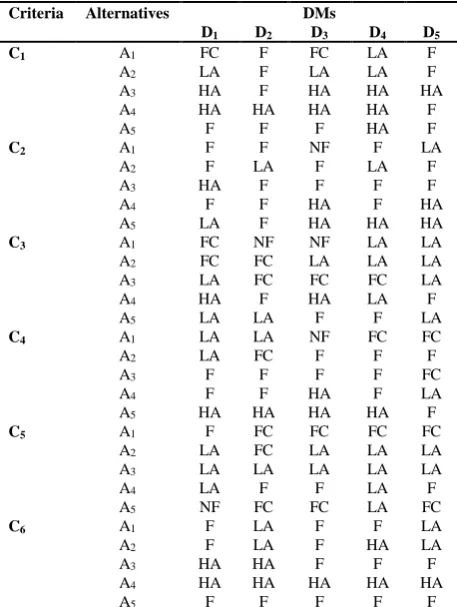
[image:4.595.48.288.228.313.2]The numerical example uses 5 alternatives, 6 criteria and 5 decision makers as shown in Table 2 below depicting the ratings of decision makers.
Table 2. Alternative Ratings by Decision-Makers
Criteria Alternatives
D1 D2
DMs
D3 D4 D5
C1 A1
A2 A3 A4 A5 FC LA HA HA F F F F HA F FC LA HA HA F LA LA HA HA HA F F HA F F
C2 A1
A2 A3 A4 A5 F F HA F LA F LA F F F NF F F HA HA F LA F F HA LA F F HA HA
C3 A1
A2 A3 A4 A5 FC FC LA HA LA NF FC FC F LA NF LA FC HA F LA LA FC LA F LA LA LA F LA
C4 A1
A2 A3 A4 A5 LA LA F F HA LA FC F F HA NF F F HA HA FC F F F HA FC F FC LA F C5 C6 A1 A2 A3 A4 A5 A1 A2 A3 A4 A5 F LA LA LA NF F F HA HA F FC FC LA F FC LA LA HA HA F FC LA LA F FC F F F HA F FC LA LA LA LA F HA F HA F FC LA LA F FC LA LA F HA F
Step 2.Determining importance weights of decision-makers
Operating on the assumption that all the decision makers are not equal in importance, we assign importance weight to each of the decision makers using Eq. (6). This stage results in Table 3.
Table 3. Importance weights of decision makers
D1 D2 D3 D4 D5
Weight 0.301 0.243 0.211 0.125 0.120
Step 3. Determining weights of each criterion
[image:4.595.312.544.275.376.2]The decision makers make their linguistic judgements about the importance weights of each criterion as shown in Table 4 using the linguistic terms in Table 1. In Table 4, it is shown that criterion 3 is considered the most important.
Table 4. Criterion importance weight
D1 D2 D3 D4 D5 Weight Priority
C1 H H H VH H 0.796,0.168 2
C2 H M H M M 0.667,0.280 3
C3 VH VH VH H VH 0.939,0.059 1
C4 VL M L M L 0.318,0.629 6
C5 L L H M M 0.456,0.486 5
C6 M H M H M 0.638,0.310 4
Step 4. Aggregation of decisions
[image:4.595.307.547.468.586.2]The intuitionistic fuzzy ratings assigned to the alternatives are aggregated using Eq. (7). The resulting values are shown in Table 5 below.
Table 5. Aggregated intuitionistic fuzzy decision matrix
C1 C2 C3 C4 C5 C6
A1 0.51,0.43 0.64,0.30 0.25,0.72 0.39,0.56 0.44,0.50 0.69,0.26
A2 0.64,0.31 0.69,0.26 0.38,0.56 0.60,0.34 0.48,0.46 0.75,0.22
A3 0.93,0.07 0.85,0.13 0.37,0.0.57 0.71,0.23 0.55,0.40 0.89,0.09
A4 0.94,0.060 0.85,0.13 0.88,0.11 0.81,0.16 0.68,0.27 0.95,0.05
A5 0.79,0.17 0.86,0.13 0.63,0.32 0.94,0.06 0.22,0.74 0.75,0.20
Step 5. Weighted aggregation of intuitionistic fuzzy sets
[image:4.595.57.286.478.782.2]The weighted intuitionistic fuzzy matrix is computed using Eq. (8). The results are as shown in Table 6 below.
Table 6. Aggregated weighted intuitionistic fuzzy decision matrix
C1 C2 C3 C4 C5 C6
A1 0.41,0.53 0.43,0.49 0.23,0.73 0.12,0.84 0.20,0.74 0.44,0.48
A2 0.51,0.43 0.46,0.47 0.36,0.59 0.19,0.75 0.22,0.73 0.48,0.46
A3 0.74,0.23 0.56,0.37 0.35,0.60 0.23,0.72 0.25,0.69 0.57,0.37
A4 0.75,0.22 0.57,0.37 0.83,0.16 0.26,0.69 0.31,0.62 0.61,0.34
[image:4.595.312.546.665.780.2]Step 6. Fuzzy positive
A
and negativeA
ideal solutionsThe fuzzy positive-ideal solution (FPIS) and the fuzzy negative-ideal solution (FNIS), defined respectively as A+ and A−, are presented in Eqns. (17) and (18) respectively. In
determining A+and A−, the first 5 sets of criteria (C1 to C5)
are considered benefits whiles C6 is designated as a cost.
0.747,0.217 , 0.572,0.374 , 0.83,0.163 , 0.30,0.65 , 0.31,0.62 , 0.44,0.49
A (17)
0.41,0.52 , 0.43,0.49 , 0.23,0.73 , 0.12,0.84 , 0.09,0.86 , 0.61,0.34
A (18)
Step 7. Computing separating measures
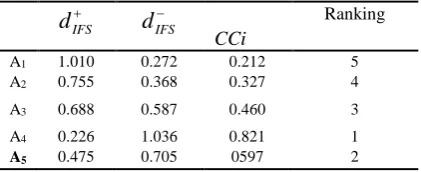
[image:5.595.52.263.338.424.2]The distances
d
IFS andd
IFS , computes the distance measure from each alternative to the fuzzy positive and negative ideal solutions using Eqns. (14) and (15) respectively. This results in Table 7 below. Additionally, the closeness coefficient that ultimate determines the ranking order of the alternatives are calculated using Eq. (16). It can be seen that per the numerical example, alternative 4 (A4) happens to be the best start-up business followed by A5, A3, A2 and A1 in that order.Table 7. Separation measures, closeness coefficient and ranking IFS
d
d
IFS
CCi
Ranking
A1 1.010 0.272 0.212 5
A2 0.755 0.368 0.327 4
A3 0.688 0.587 0.460 3
A4 0.226 1.036 0.821 1
A5 0.475 0.705 0597 2
V. EVALUATION
The numerical example provided in this paper was constructed with inputs from venture capital experts and is meant to test the robustness of the proposed methodology to allow for subsequent adoption by the South African department of Trade and Industry (DTI) and the Economic Development department for the selection of candidates in their Technology Venture Capital Fund (TVC).
The result from using intuitionistic fuzzy TOPSIS was compared with similar evaluations from fuzzy TOPSIS and fuzzy VIKOR and found to have the same order of ranking. However, intuitionistic fuzzy TOPSIS offers more in terms of determining the level of confidence or doubt in an expert’s rating.
VI. CONCLUSION
Government backed start-up businesses financing schemes especially to technologically-focused firms are increasingly becoming popular around the world. However, their effectiveness as far as capital recovery and exit plans have particularly been poor in developing countries. This is partly because the decision making structure that selects start-up firms in most developing countries tend to be influenced by political and social considerations.
In view of this, the research aimed at designing an intuitionistic fuzzy TOPSIS framework for selecting and evaluating start-up businesses in a government run public venture capital scheme. The proposed method seeks to
minimize the occurrences of low capital recovery rate as a result of selecting unsuitable candidates especially in a micro financing scheme. The intuitionistic Fuzzy TOPSIS method was chosen primarily because of its ability to introduce a neutral state or a hesitancy degree to practically define the extent of certainty or uncertainty in decisions. This decision making method proposed in this study demonstrates how in a highly uncertain field such as venture capital schemes, an intuitionistic fuzzy TOPSIS method can be handy in choosing businesses that have the high propensity to succeed. The criteria and the decision making approach could be reviewed in future and extended to evaluate start-up businesses in a private venture capital.
REFERENCES
[1] Y. Alperovych, G. Hübner, and F. Lobet. "How does governmental versus private venture capital backing affect a firm's efficiency? Evidence from Belgium." Journal of Business Venturing, vol. 30, no. 4, Jul. 2014.
[2] P.A. Gompers, and J. Lerner. The venture capital cycle. MIT press, 2004.
[3] Chemmanur, T. J., Krishnan, K., & Nandy, D. K. “How does venture capital financing improve efficiency in private firms? A look beneath the surface”. Review of financial studies, hhr096, 2011
[4] F. Bertoni, M.G. Colombo, and L. Grilli. "Venture capital financing and the growth of high-tech start-ups: Disentangling treatment from selection effects." Research Policy, vol. 40, no. 7, 1028-1043, Sept. 2011
[5] M. Nkusu, "Nonperforming loans and macrofinancial vulnerabilities in advanced economies." IMF Working Papers, 1-27, 2011
[6] N. Biekpe, "Financing small businesses in Sub-Saharan Africa: Review of some key credit lending models and impact of venture capital provision." Journal of African Business vol. 5, no. 1, 29-44, 2004.
[7] K. Baeyens, T. Vanacker, and S. Manigart. "Venture capitalists' selection process: the case of biotechnology proposals." International
Journal of Technology Management vol. 34, no. 1, 28-46, 2006. [8] J. Lerner, “Boulevard of broken dreams: why public efforts to boost
entrepreneurship and venture capital have failed--and what to do about it”. Princeton University Press, 2009.
[9] V.H. Fried, and R.D. Hisrich. "Toward a model of venture capital investment decision making." Financial management, 28-37, 1994 [10] I.C MacMillan, R. Siegel, and P.S. Narasimha. "Criteria used by
venture capitalists to evaluate new venture proposals." Journal of Business venturing, vol. 1, no. 1, 119-128, 1986.
[11] J. Hall, and C.W. Hofer, "Venture capitalists' decision criteria in new venture evaluation." Journal of Business Venturing, vol. 8, no. 1, 25-42, 1993.
[12] W.A. Wells, "Venture capital decision-making." PhD diss., Carnegie-Mellon University, 1973.
[13] Petty, Jeffrey S. "The dynamics of venture capital decision making." In Academy of Management Proceedings, no. 1, pp. 1-6, 2009. [14] B. Mainprize, K. Hindle, and R. Mitchell. "Toward the
standardization of venture capital investment evaluation: decision criteria for rating investee business plans." In Proceedings of the 22rd Frontiers of Entrepreneurship Research conference, pp. 1-16. Babson College, 2002.
[15] Mainprize, Brent, Kevin Hindle, and Ron Mitchell. "Toward the standardization of venture capital investment evaluation: decision criteria for rating investee business plans." In Proceedings of the 22rd Frontiers of Entrepreneurship Research conference, pp. 1-16. Babson College, 2002.
[16] L.A Zadeh, "Fuzzy sets." Information and control, vol. 8, no. 3, 338-353, 1965.
[17] A. Afful-Dadzie, E. Afful-Dadzie, S. Nabareseh, and Z. K. Oplatková. "Tracking progress of African Peer Review Mechanism (APRM) using fuzzy comprehensive evaluation method." Kybernetes
43, no. 8, 1193-1208, 2014.
[18] G. Klir, and B. Yuan. “Fuzzy sets and fuzzy logic”. Vol. 4. New Jersey: Prentice Hall, 1995.
[20] Afful-Dadzie, E., Afful-Dadzie, A., & Oplatková, Z. K., “Measuring progress of the millennium development goals: A fuzzy comprehensive evaluation approach”. Applied Artificial Intelligence, vol. 28, no. 1, 1-15, 2014.
[21] K.T Atanassov, "Intuitionistic fuzzy sets." Fuzzy sets and Systems, vol. 20, no. 1, 87-96, 1986.
[22] T.Y. Chen, "IVIF-PROMETHEE outranking methods for multiple criteria decision analysis based on interval-valued intuitionistic fuzzy sets." Fuzzy Optimization and Decision Making, vol. 14, no. 2, pp 173-198, Jun. 2015.
[23] F.E. Boran, S. Genç, M. Kurt, and D. Akay. "A multi-criteria intuitionistic fuzzy group decision making for supplier selection with TOPSIS method." Expert Systems with Applications, vol. 36, no. 8 11363-11368, Oct. 2009.
[24] C. Hwang, K. Yoon, “Multiple attribute decision making methods and application”. Springer, New York, 1981.
[25] E. Afful-Dadzie, S. Nabareseh, A. Afful-Dadzie, and Z.K. Oplatková. "A fuzzy TOPSIS framework for selecting fragile states for support facility." Quality & Quantity, 1-21, 2014.
[26] Y.J. Lai, T.Y. Liu, and C.L. Hwang. "TOPSIS for MODM."
European Journal of Operational Research, vol. 76, no. 3, 486-500, 1994.
[27] D.F. Li, “Decision and game theory in management with intuitionistic fuzzy sets”. Vol. 308. Springer, 2014.
[28] Z. Xu, "Intuitionistic fuzzy aggregation operators." Fuzzy Systems, IEEE Transactionson, vol. 15, no. 6, 1179-1187, 2007.
[29] A. Maldonado-Macías, A. Alvarado, J.L. García, and C.O. Balderrama. "Intuitionistic fuzzy TOPSIS for ergonomic compatibility evaluation of advanced manufacturing technology."
The International Journal of Advanced Manufacturing Technology,
vol. 70, no. 9-12, 2283-2292, Feb. 2014.
[30] Government of South Africa. “The Venture Capital Trust Fund (VCTF)” . http://www.venturecapitalghana.com.gh/?launch=aboutus [31] D.J. Koekemoer, and M. O. Kachieng'a. "Technological
entrepreneurship: financing new technology based enterprises in South Africa." In Engineering Management Conference, 2002. IEMC'02. 2002 IEEE International, vol. 1, pp. 437-442. IEEE, 2002. [32] S.G. Knoesen, "The Politics of Distribution in South Africa."
presentation at WGPE, May, 15-16, 2009.