Abstract— Internal combustion engine research community has been exploring seriously on the best alternative fuels due to the vigorous effect of automotive emissions on the environment, without compromising on power and environmental friendliness. Among such alternatives, acetylene has proved to be a better fuel for internal combustion engines due to its low cost, easy availability and excellent combustion characteristics. Compared to other fuels, acetylene emits less carbon, which plays a major role in environmental degradation. However, the desired alternative fuel must be safe and also readily usable in existing engines without any significant modifications. It is proposed in the present work that acetylene is safe and have all the key qualities an alternative fuel should have; which is ascertained by testing the fuel on a compression ignition engine with minor design modifications. A diesel engine with a subsidiary mixing box for a homogeneous mixture of air and acetylene was selected first. The experiments were conducted with consistent acetylene flow rates from 0.1Lit/min to 5Lit/min with an increase of 0.5Lit/min in every step. The engine was tested at various loads, keeping track of combustion performance parameters to find out optimum fuel flow rates and also to have reduced emissions. The results show that the performance characteristics of the acetylene-enriched engine is nearer to the pure diesel engine with reduced emissions. It is concluded that acetylene could be the better alternative fuel without compromising brake thermal efficiency and safe operation with a moderate increment of smoke and NOx. Exhaust gas recirculation technique is implemented to safely get NOx exhaled off the engine to acceptable limits.
Index Terms— Acetylene, Combustion, hydrocarbon,carbon monooxide, carbondioxide, NOx, EGR
I. INTRODUCTION
mong the internal combustion engines, compression ignition (CI) engines are widely used.These engines give superior power output and consistent performance at all loads. Diesel is the prime fuel for CI engines. In the search of alternative fuels for diesel engines many fuels were experimented and successfully replaced, but at the
*corresponding author:
Shaik Khader Basha, Department of Mechanical Engineering, Al-Habeeb College of Engineering & Technology.
Email: [email protected]
1Dr. P. Srinivasa Rao, Curl Vee Technolabs, Hyderabad, India.
Email: [email protected]
2Dr. K. Rajagopal, Vice-Chancellor, Sri Krishna Devaraya University,
Anantapur, Andhra Pradesh, India. Email:[email protected]
3K. Ravi Kumar, Department of Mechanical Engineering, Al-Habeeb
College of Engineering & Technology, Hyderabad, India. Email: [email protected]
sake of performance and emissions. The self ignition temperature of acetylene which is actually drawn from the energy sources that are renewable is really exceptional and therefore more explicitly suitable for spark ignition engines. But in case of compression ignition engines they are not generally designed for gaseous fuels. Nevertheless duel fuel suitability and design modifications are being done and implemented successfully. The Engines were also designed and used with gaseous fuels in dual fuel mode but were not successful. Emergent industrialization, limited reserves of fossil fuels and alarming environmental pollution necessitated to search for some more alternatives of conventional fuels. This ultimately resulted in fuels like CNG, LPG, Acetylene, ethanol, methanol, biodiesel, some vegetable oils and other such biomass resources. Alternative fuels should be easily available, should also have higher calorific value and should be non-polluting. Good quality fuel should fulfil environmental and energy needs without compromising the performance of the engine. Acetylene has many such qualities to be a good fuel among other alternative fuels because of its calorific value and combustion efficiency. NOx emission is a significant challenge for such an engine. Lean-burn technology with conventional and modified diesel combustion strategies would give encouraging results. Recent technologies like advanced combustion strategies which makes use of high levels of intensity to reduce the in-cylinder NOx formation. and post-combustion emissions control devices can be opted. Nevertheless, carrying cylinder and arresting the backfiring restricted the use of acetylene as a fuel in automobiles. We have worked out a system with which the acetylene can be used as an automobile fuel with better performance on par with Diesel engine.
II. LITERATURE REVIEW
The available research material on acetylene combustion and use of alternative fuels in IC engine is extensive. It is actually started related to the present work with Sharma P.K. et al. [1]Explained the method to employ acetylene as
an alternative energy source IC engines. They have conducted experiments on SI engine using acetylene as a primary and alcohol as a secondary fuel. Final results showed that alcohol can be introduced so as to reduce the in cylinder temperatures of the engine. Nagarajan G and Lakshamanan [2] studied about the performance and also the emission quality of a compression ignition engine suitable for multi fuel operation, by timed manifold injection to induct acetylene at different flow rates. Results show that best possible condition as manifold injection with 10° ATDC with the injection interval of 90° crank angle.
Evaluation of Performance & Emission
Characteristics of an Acetylene Aspirated Diesel
Engine
Shaik Khader Basha*, P.Srinivasa Rao1, K. Rajagopal2, K. Ravi Kumar3
Fixed quantity of 3L/m of acetylene is supplied to the inlet manifold in dual fuel mode. The results on the internal combustion engines with a primary fuel as diesel under different working loads during experiments were encouraging. The diesel engine working on dual or multi fuel system is noticed to give a lesser thermal efficiency at full load. The experiments conducted by Nagarajan and Lakshamanan on acetylene aspirated engine reported optimistic results. It was really interesting under a duel fuel system operating at higher loads. The experiment was performed on a single cylinder engine with direct injection system at rated power at different loads. The air aspirated with acetylene resulted with lower thermal efficiency. But the amount of smoke declined, CO and HC emissions were comparable to the baseline diesel engine. The accelerated combustion rate and higher temperatures NOx formations are significantly increase as acetylene was inducted into the cylinder. As the flame travelled very rapidly the peak pressure rises in the case of the acetylene aspirated engine. It is experimentally proved that the emissions of such engines are quite encouraging since the smoke, hydrocarbon and carbon monoxide levels are noticed to be lower. However the efficiency of the engine is sacrificed in such case.
Mahla S.K. et al. [3] Experimented on diesel engine with
acetylene aspiration and blended it with diethyl ether at a rate of 12L/m into the inlet manifold. In search engine the source of ignition was diesel, which was the primary fuel. The functioning of the diesel engine which used pilot fuel and Di Ethyl Ether (DEE) showed better thermal efficiency and hence the performance was better compared to the standard diesel engine. Acetylene as a sole fuel in HCCI mode resulted in higher thermal efficiencies, and it is also better suited for a wide spectrum of brake mean effective pressure. If the inlet charge temperature is increased the brake thermal efficiency reaches its maximum at certain exhaust gas recirculation condition in addition to the temperatures of the inlet air. At higher brake mean effective pressures the re-circulated exhaust gas is normally at higher temperatures, and that in turn causes uncontrolled combustion or detonation. Therefore the amount of EGR is controlled accordingly. The experiments conducted on direct injection single cylinder engine by Gunea, Razavi and Karim et.al [4] has been verified experimentally. Another important case is the nature of the pilot fuel system and its importance on the delay period of engine. This was also investigated for wide ranges of cetane numbers.The ignition delay time, mainly depends on fuel quality and quantity of the pilot fuel in the engine. If high cetane number fuels are used, then the performance of the engine improves.
John W.H. Price [5] described the explosion of a cylinder containing acetylene gas, which occurred in 1993 in Sydney. In this paper, he describes the failure and the conditions that affected with it. The assessment says that the explosion, which occurred needs an explanation of the events. In the experimental investigations by S.Swami nathan, et.al [6] mainly on HCCI engine with charge consisting acetylene has shown better thermal efficiency for a wide spectrum of mean effective pressure. It has been proved that such an engine is able to reach the same efficiency levels as that of the baseline diesel engine. With
exhaust gas recirculation it has been experimentally proven that there is an improvement in the thermal efficiency of such HCCI engines. In accordance of the output of the engine at high BMEP and EGR, the temperature of the intake charge and quantity of EGR can also be controlled which generally leads to knocking. However, it is clear that acetylene is used as a homogeneous charge in CI engines and that it reduces the smoke and NOx. However, when there is an increase in hydrocarbons in the flue gases as compared to the standard diesel engine.
III. POSSIBLE ALTERNATIVE FUELS
Many fuels are tested and made available to replace the fossil fuels in IC Engines. Fuels can be classified into three types 3 forms, viz. solid, liquid and gaseous fuels.
ACETYLENE GAS
Acetylene is a colourless and highly combustible gas with a pungent odour. If it is compressed, heated or mixed with air, it becomes highly explosive. It is produced by a chemical process in which, calcium carbide reacts with water and generates acetylene gas and slurry of calcium carbonate. It needs no sophisticated apparatus or equipment and the reaction is spontaneous. It was widely used in acetylene lamps, to light homes and mining tunnels during the 1980s. It is a gaseous hydrocarbon highly combustible and unstable. It also produces high temperature flames ranging from 3000°C to 5400°C when combined with oxygen. Acetylene has been commonly used for lighting in mining areas by street vendors, Industrial uses of acetylene are many, out of which, one is its ability to act as a fuel for motors or lighting sources. The use of acetylene as a fuel has been largely limited in recent times to acetylene torches for welding or welding-related applications.
IV. METHODOLOGY
The specifications of the engine which was selected for the experiment are tabulated in Table.1 and Table.2. It lists the physical properties of acetylene. The experimental setup is as shown in fig.1 which illustrates the setup clearly.
TABLE I PROPERTIES OF GASES
Properties Acetylene Hydrogen CNG
Composition C2H2 H2 CH4:86.4-90%
C2H6:3-6% C3H8 Density(kg/m3) at
1atm &200C 1.092 0.08 0.72 Autoignition temp(K) 598 845 723 Stoichiometric A/F
ratio(kg/kg) 13.2 34.3 17.3
Flammability limit(vol %)
2.5-8.1 4-74.6 5.3-15
Lower Calorific Value(kJ/kg)
48,225 120000 45800
Ignition energy(mJ) 0.019 0.02 0.28 Adiabatic flame
temperature(K) 2500 2400 2214
The tests were conducted on naturally aspirated single cylinder, four-stroke, direct-injection, water-cooled engine. The nominal injection timing of the engine is 19 crank-degrees before top dead center and fixed throughout the test. The experimental setup also comprises a data acquisition system to measure the in cylinder pressure within the cylinder. Diesel was injected and acetylene was supplied separately with air, through the flow control valve in order to attain the controlled flow. Proper acetylene to diesel ratio could give better performance characteristics and thus lead to higher thermal efficiency. The experiment was conducted for different compression ratios starting from 6.5 with fixed acetylene gas flow rates at 0.1L/m, 0.5L/m, 1.0L/m, 2.0L/m, 3.0L/m, 4.0L/m and 5.0L/m. The optimum flow rate was experimentally found and based on the nature of proper combustion, and emission characteristics at different loads for optimum performance was noted. Acetylene flow was controlled and gauged by a flow control valve and was calibrated by a gas flow meter. Rate of quantity of diesel fed to the engine was measured at regular intervals and it is made sure that fixed amount of fuel is supplied to the engine.
Fig 1: Experimental setup
To determine the pressure variation, a transducer was used. With a thermocouple we found out the temperature of exhaust gases from the engine. The heat release rate and other combustion parameters were calculated using software in order to get the accurate results.
TABLE 2:
SPECIFICATIONS OF THE ENGINE
Equipment Specification
Engine Single Cylinder 4-stroke Diesel Engine
Kirloskar AV- 1
Rated Power 3.7 kW, 1500 RPM
Bore-Stroke 80mm x 110mm
Compression Ratio 16.5 : 1 range14.3 to 20
Cubic Capacity 553 CC
Dynamometer Alternator
In Cyl-Pressure Piezo Sensor, Range : 2000 PSI Software Used Lab View
Type 4-Stroke Single Cylinder Diesel
Engine, Water cooled
Using the smoke meter, engine exhaust smoke was determined from the combustion chamber. The engine
performance and emission characteristics of acetylene enriched modified engine was evaluated and compared with the basic diesel engine working on the simple diesel engine.
V. RESULTSANDDISCUSSION
In the present work, acetylene aspirated diesel engine is tested with EGR, and diesel as the ignition source. The performance and emission characteristics are compared with standard diesel engine without EGR.
PRESSURE CRANK ANGLE DIAGRAM
Figure 2 portrays the variation of cylinder pressure with crank angle. The peak pressure is about 71bar at maximum power with baseline diesel operation. Peak pressure is further increased in dual fuel operation with exhaust gas recirculation (EGR) using acetylene induction at maximum load. In dual fuel engine, the trend of increase in peak pressure is due to increased ignition delay and rapidity of combustion. There is an increase of about 3bar when acetylene is inducted. The peak pressure for acetylene inducted dual fuel engine is advanced by 8°C. A compared to peak pressure of diesel engine at full load. The advance in peak pressure for acetylene combustion is perhaps due to higher rate of combustion of acetylene as compared to diesel. The rate of pressure rise is also high for acetylene operated dual fuel engine compared to diesel-operated engine due to instantaneous combustion of acetylene fuel.
Fig. 2 Pressure Crank Angle Diagram HEAT RELEASE RATE
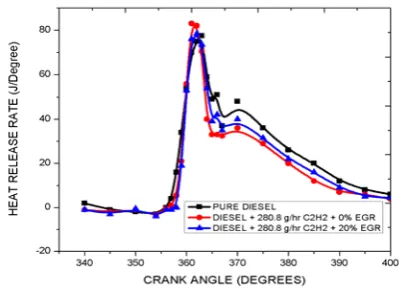
[image:3.595.319.519.625.770.2]Figure 3 indicates the rate of heat release for acetylene operated dual fuel engine at 3 lpm flow rate and diesel engine at full load as well. The burning rate diagram can be divided into four distinct phases, namely ignition delay, premixed combustion phase, mixing controlled combustion phase, and late combustion phase [1]. The energy release has increased to 86J per degree of crank angle with EGR. The heat release rate for acetylene aspiration shows distinct characteristics of explosion, premixed type combustion followed by a brief second phase dip in burning rate and then a rapid increase during the third phase of combustion of the gas mostly diffusion type of combustion.
VI. PERFORMANCE PARAMETERS BRAKE THERMAL EFFICIENCY
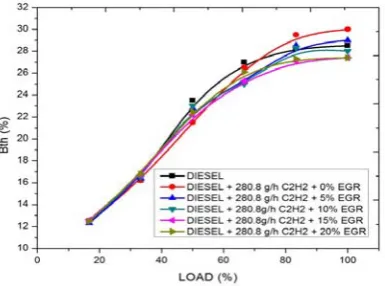
The variation of brake thermal efficiency versus load is depicted in fig. 4. The brake thermal efficiency in acetylene induction technique is found to be 11.23% lower as compared to the baseline engine. The raise in the efficiency due to acetylene aspiration is about 28.84% at full load with zero percent of EGR. In general, it may be noted that in the dual-fuel engines, the thermal efficiency decreases at low loads and increases above the baseline at full load operation with addition of inducted gas fuels like LPG, CNG etc. Nonetheless, acetylene because of its wide flammability limit and high combustion rate is an exception where brake thermal efficiency is lower throughout the load spectrum. At near the full load the brake thermal efficiency falls because of high diffusion rate and faster rate of energy release. This infers that faster energy release occurs with acetylene introduction but controlled partly by EGR and maximum cycle pressure is also observed. However, the EGR technique lowers the brake thermal efficiency by ~2% although high pressures will have deterrent effects on fuel burning.
[image:4.595.322.529.269.416.2]
Fig. 4. Brake thermal efficiency Vs Load
At partial loads with a small quantity of injected fuel, the flame front propagating from ignition point do not advance to all the regions of the combustion chamber and leaves some of the homogeneously dispersed acetylene unburned causing low thermal efficiency at low loads.
EXHAUST GAS TEMPERATURE
It is an interesting fact to notice that the exhaust gas recirculation is considerably reduces the exhaust gas temperature. The exhaust gas temperature at full load is depicted in fig. 5. The aspirated diesel engine’s exhaust gas temperature reaches 328oC in acetylene induction technique and 442oC in the case of baseline diesel operation. Acetylene induction decreased the exhaust gas temperature at all loads, indicating the efficient energy release in the cycle with higher flame speed. Moreover, the EGR reduces the exhaust gas temperature further. The cylinder pressure diagram confirmed the same, in which maximum pressure was observed to occur earlier in the cycle when acetylene was introduced along with the intake air intake. The maximum temperature recorded at 0% of EGR is 3180C whereas 20% of EGR reduces the exhaust gas temperature still further to 2680C.
Fig.5. Exhaust gas temperature Vs Load OXIDES OF NITROGEN (NOX,)
[image:4.595.74.267.505.648.2]It is observed from fig. 6 that NOx emission is 15g/kWh at maximum output with pure diesel operation. In aspirated engine operation with acetylene, NOx emission is increased by 18% when compared to baseline diesel operation. According to Zeldovich mechanism model, the formation of NOx depends on the reaction temperature, reaction duration, and the availability of oxygen. When acetylene is inducted, increase in NOx may be attributed to the increased peak cycle temperature level because of faster energy release, which is also reflected in the peak cycle pressure in a rising trend with EGR the NOx emissions are increased to 14g/kWh at peak load.
[image:4.595.321.547.620.756.2]SMOKE
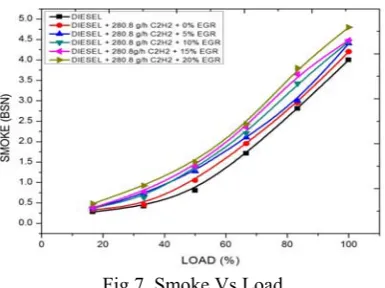
[image:5.595.332.529.288.696.2]The variation of smoke level with brake power is shown in fig. 7. The exact mechanism of smoke formation is still unknown. Generally speaking, smoke is formed by the pyrolysis of HC in the fuel rich zone, mainly under load conditions. In diesel engines operated with heterogeneous mixtures, most of the smoke is formed during the diffusion of flame. The amount of smoke in the exhaust gas depends on the mode of creating fuel mixture, the combustion processes and quantity of fuel injected before ignition [2]. The smoke level increases with increase in diesel flow rate, and at full load it is 4.7 BSN in case of diesel fuel operation. Dual-fuel operation with any gaseous fuel proves to be a potential way of reducing the smoke density as compared to diesel operation. A reduction in smoke level is noticed. The smoke level is reduced by 14% in induction technique at full load when compared to baseline diesel operation. This may be attributed to the fact that combustion of acetylene-diesel fuel is faster, contributing to complete combustion, and triple bond in acetylene which is unstable.
Fig.7. Smoke Vs Load HYDROCARBON EMISSIONS
In the process of EGR the variation of hydrocarbon emissions with load. The HC emissions are 25 ppm in baseline diesel operation and 23 ppm when acetylene is aspirated at full load in induction technique. The reduction in HC emission in the case of dual fuel mode is due to the higher burning velocity of acetylene which enhances the burning rate.
CARBON MONOXIDE EMISSIONS
[image:5.595.338.531.305.464.2]The variation of carbon monoxide emissions with load exhibits similar trend of HC emission. This is shown in figure 7.The CO emissions are lower compared to the base line diesel. The peak point is 0.01% by volume in induction technique followed by base line diesel of 0.02% at full load. The CO emissions are lower due to the complete burning of the fuel, and is also due to the reduction in the overall C/H ratio of total fuel inducted into the engine.
CARBON DIOXIDE EMISSIONS
The CO2 emissions are lower compared to the base line diesel engine, the minimum being 8.5% by volume at full load in acetylene induction technique and 9.0% by volume
in baseline diesel operation, as shown in figure 8. The CO2 emission of acetylene is less because of lower hydrogen to carbon ratio.
VII. EMISSION PARAMETERS
The main pollutants from automobiles are carbon monoxide (CO), unburned hydrocarbons (HC) and oxides of nitrogen (NOX). In the acetylene aspirated engines the CO, CO2 and HC emission are minimized to a greater extent than the conventional engines, it is almost 30-34% less polluting than the conventional diesel engines. The results showing the behaviour of NOx emission which completely fluctuates between 220 to 520ppm is more compared with baseline diesel engine. However the NOx is controlled with the technique of EGR to the possible extent in aspirated engine. FUEL SAVED
Fig. 8. Load Vs mf EGR
Fig. 9. Load Vs mf EGR
[image:5.595.72.265.323.467.2] [image:5.595.335.528.492.697.2]load. At 100% load the variations are negligible irrespective of rate of EGR, almost no variations in mass of fuel saved with EGR to without EGR
VIII. CONCLUSION
Experiments were conducted to study the performance and emission characteristics of DI diesel engine with acetylene aspirated mode, the following conclusions have been arrived at, based on the experimental results:
Brake thermal efficiency in aspirated engine mode is lower than pure diesel operation at full load, as a result of continuous induction of acetylene in the intake. Dual fuel operation of acetylene exhibits lower exhaust gas temperature of about 76°C as compared to diesel operation.
There is an appreciable reduction in smoke level. It dropped from 7 to 6.50 BSU when compared to neat diesel operation.
A perceivable reduction in HC, CO and CO2 emissions was observed with acetylene operated dual fuel mode engine. The reduction in HC and CO2 emissions at maximum load is of 8 % and 3% respectively when compared to diesel operation.
The major issue of NOx emission however is reduced with EGR. However other such techniques like TMI, TPI can also be implemented which also increases the efficiency and reduces NOx emissions.
EGR is effectively giving good results for acetylene aspirated diesel engine.
There is an increase in the peak cylinder pressure and rate of pressure rise, when parallel acetylene is inducted. It is clearly concluded that acetylene induction is resulting in an increase in thermal efficiency compared to baseline diesel operation. Exhaust temperature, HC, CO, CO2 and smoke emissions were less when compared to the conventional diesel engine. However, a significant increase in the NOx
emission is observed in the exhaust. This has been reduced with the technique of EGR to the normal limits successfully. To conclude, we state that acetylene would be a better option as an alternative supplement fuel which can even compete with hydrogen as an alternative fuel in internal combustion engine.
REFERENCES
[1] N. Samec, K. Breda, R.W. Dibble, Numerical and Experimental Study of Water/Oil Emulsified Fuel Combustion in a Diesel Engine,
Fuel,Vol.81, 2002,pp.2035-2044.
[2] F. Bedford, C. Rutland, P. Dittrich, A. Raab, F. Wirbelit,Effects of direct water injection on DI Diesel Engine Combustion, SAE paper, 2000- 01-2938.
[3] Beatric C et al. Influence of high EGR rate on emissions of a DI Diesel engine. ASME ICE Div 1998;ICE 22: 193–201.
[4] C.Y. Lin, K.H. Wang, Diesel Engine Performance and Emission Characteristics Using Three-Phase Emulsions as Fuel, Fuel,Vol.83, 2004,pp.537-545.
[5] X. Tauzia, A. Maiboom, S.R. Shah, Experimental Study of Inlet Manifold Water Injection on Combustion and Emissions of an Automotive Direct Injection Diesel Engine, Energy,Vol.35,
2010,pp.3628-3639.
[6] Rolf Egnell. The influence of EGR on heat release rate and NO formation in a D.I. diesel engine. SAE Transactions 2000-01-1807
[7] M. Abu-Zaid, Performance of Single Cylinder, Direct Injection Diesel Engine Using Water Fuel Emulsion, Energy Conversion and Management, Vol.45, 2004, pp. 697-705.
[8] Mohamed Selim YE. A study of some combustion characteristics of dual fuel engine using EGR. SAE Paper No 2003-01-0766
[9] A. Alahmer, J. Yamin, A. Sakhrieh, M.A. Hamdan, Engine Performance using Emulsified Diesel Fuel, Energy Conversion and Management,Vol.51, 2010,pp.1708-1713.
[10] G.H. Abd-Alla, H.A., Soliman, O.A. Badr, M.F. Abd-Rabbo, Effects of Diluent Admissions and Intake Air Temperature in Exhaust Gas Recirculation on the Emissions of an Indirect Injectıon Dual Fuel Engine, EnergyConversion and Management,Vol.42,
2001,pp.1033-1045.
[11] A. Parlak, V. Ayhan, Y. Ust, B. Sahin, Đ.Cesur, B. Boru, G. Kokkulunk, New method to reduce NOx emissions of diesel engines: electronically controlled steam injection system, Journal of the Energy Institute,Vol.85, 2012,pp.135-139.
[12] Y.V.V.S. Murthy, G.Y.K. Sastry, M.R.S. Satyanaryana, Experimental Investigation of Performance and Emissions on low Speed Diesel Engine with Dual Injection of Solar Generated Steam and Pongamia Methyl Ester, Indian Journal of Science and Technology,Vol.4, 2011,pp.29-33.
[13] G.H. Abd-Alla, H.A. Soliman, O.A. Badr, M.F.Abd-Rabbo, Effects of Diluent Admissions and Intake Air Temperature in Exhaust Gas Recirculation on the Emissions of an Indirect Injectıon Dual Fuel Engine, Energy Conversion and Management, Vol. 42,
2001,pp.1033-1045.
[14] J.W. Heffel, NOx Emission Reduction in a Hydrogen fuelled Internal Combustion Engine at 1500 rpm using Exhaust Gas Recirculation,
International Journal of Hydrogen Energy, Vol.28, 2003,pp.901-908.
[15] J.W. Heffel, NOx Emission Reduction in a Hydrogen fuelled Internal Combustion Engine at 3000 rpm using Exhaust Gas Recirculation, International Journal of Hydrogen Energy, Vol.28,
2003,pp.1285-1292.
[16] O. Angrill, H.Geitlinger, T. Streibel, R.Suntz, H.Bockhorn, Influence of Exhaust Gas Recirculation on Soot Formation in Diffusion Flames, Proceedings of the combustion Institute, Vol. 28, 2000,
pp.2643-2649.
[17] A. Maiboom, X.Tauzia, J-F.Hetet, Experimental Study of Various Effects of Exhaust Gas Recirculation (EGR) on Combustion and Emissions of an Automotive Direct Injection Diesel Engine, Energy, Vol.33,2008, pp.22-34.
[18] H.E. Saleh, Experimental Study on Diesel Engine Nitrogen Oxide Reduction Running with Jojoba Methyl Ester by Exhaust Gas Recirculation, Fuel, Vol.88, 2009, pp.1357- 1364.
[19] R. Kiplimo, E. Tomita, N. Kawahara, S.Yokobe, Effects of Spray Impingement, Injection Parameters, and EFR on the Combustion and Emission Characteristics of a PCCI Diesel Engine, Applied Thermal Engineering,2011,doi:10.1016/j.applthermalen g.2011.11.011.
[20] S.S. Nathan, J.M.Mallikarjuna, A.Ramesh, Effects of Charge Temperature and Exhaust Gas Re-Circulation on Combustion and Emission Characteristics of an Acetylene Fuelled HCCI Engine,