IEEE ICCSnSPACS '96 1369
Hz61 AND H263-BASED PROGRAMABLE VIDEO TRANSCEIVERS
P. Cherriman, L. Hanzo
Dept. of Electr. and Comp. Sc., Univ. of Southampton, SO17 I B J , UK.
Tel: +44-703-593 125, Fax:
+44-703-594 508
Email: [email protected], [email protected]
http://www-mobi-le.ecs.soton.ac.uk
ABSTRACT
The video quality versus bitrate performance of the ~ ~
HmYH
a w u~ ~ K X H . % ~ ~
H.261 and H.268codecs is characterised and a bitrate
I
control algorithm is proposed in order to maintain a selectable near-constant video bitrate. The source codecs are operated at four different bitrates, which
result in a constant symbol rate after error correc-
I
tion coding. This system constellation allowed us to
1
maintain a constant video user bandwidth require-
+ - q - k w
,"%,
~ ~ a ~ ~ ~ l ~ ~ ~ l
ment, but benefit from improving channel condi- tions in terms of better video quality, when invoking more bandwidth efficient modem schemes ranging from 1 to 6 bits per symbol.
1. MOTIVATION, SCOPE AND BACKGROUND
Motivated by the rapid emergence of wireless visual com- munications as a major research area [I] -[8], in this treatise we set out to contrive and investigate an intelligent, adapt- ively re-configurable wireless video transceiver. The pro- posed wireless video communicator can adapt to a range of service requirements, video quality, bitrate and robustness constraints by invoking the best possible system configura- tion under time-variant optimisation criteria.
Although the main target of the recently formed MPEG4 working group is to standardise a very low-rate videophone codec suitable also for mobile applications, currently no wireless video standard exists. In our former work we con- trived a range of proprietary video codecs and embedded them in appropriate wireless transceivers [4]-[a]. In this treatise we embarked on investigating the feasibility of and documenting the performance of two wireless candidate sys- tems based on the standard H261 and H263 ITU codecs.
The challenge of these endeavours was to overcome the deficiencies of these codecs due the fact that they were de- signed for benign Additive White Gaussian Noise (AWGN) channels, while maintaining compatibility with the Recom- mendations. Hence both the HZ61 and the H263 video co- decs were subjected to rigorous bit sensitivity analysis and their robustness was improved using sensitivity-matched em- bedded binary Bose-Chaudhuri-Hocquenghem (BCH) cod-
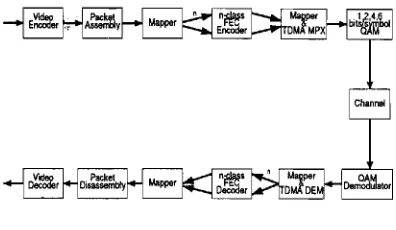
Figure 1: System's Schematic
ing combined with a re-configurable Pilot Symbol Assisted (PSA) and Automatic Repeat Request (ARQ) aided Quad- rature Amplitude Modulation (QAM) modem [9].
The proposed system shown in Figure 1 can re-configure itself under network control in a variety of modes of oper- ation, which span a wide range in terms of video quality, bit rate, robustness against channel errors and implement- ational complexity. Specifically, the transceiver operates using highly bandwidth efficient 64-level Pilot Symbol As- sisted Quadrature Amplitude Modulation (64-PSAQAM) in a benign indoors cordless environment, where high signal- to-noise ratio (SNR) and signal-to-interference ratio (SIR) prevail. The number of modulation levels is dropped from 64 to 16, when the portable station (PS) is handed over to an outdoors street microcell, and can be further reduced to 4 in less friendly propagation scenarios.
2. PERFORMANCE OF THE H.261 A N D H.263 CODECS
For reasons of space economy here we refrain from detail- ing the H.261 and H.263 coding algorithms and rather con- centrate on the associated transceiver aspects. The H.263 standard supports five different video resolutions. In ad- dition to the 288x352 pixel Common Intermediate Format (CIF) the so-called Quarter CIF (QCIF) Sub-QCIF (SQ- CIF), 4x CIF and 16 x C I F formats can be used. Table 1 THIS TREATISE IS COMPLEMENTED BY A DEMON- summarises the legitimate video formats and the associated STR.4TION PACKAGE PORTRAYING VIDEO SEQUENCES 'Ource rates the H.261 and H.263 standards' AT VARIOUS BIT RATES, WHICH IS DOWN-LOADABLE In our comparative studies the H.261 simulatior~s w e r ~ FROM HTTP://WWW-MOBILE.ECS.SOTON.AC.UK carried out with and without motiorl compensation. When
[image:1.555.311.509.228.343.2]1370
IEEE ICCSASPACS '96Table 1: Picture Format supported
I . I
10' r 1 I$ I
[image:2.551.80.515.64.353.2]Compression Ratio
Figure 2: Image quality (PSNR) versus coded bitrate, for Figure 3: Image quality (PSNR) versus compression ra-
H.261 and H.263 simulations using grey scale QCIF "Miss tio, for H.261 and H.263 simulations using grey scale QCIF
America" video sequences a t 10 and 30 frames/s "Miss America" video sequences at 10 and 30 frames/s
ing was turned on in order to reduce the effects of block
edge artifacts. In our H.263 simulations we used none of
the so-called advanced negotiable options, but the codec em- ployed motion vectors and inter-frame prediction for motion
com~ensation. Our simulations were carried out. at 10 and
30 frames/s, using different resolution versions of the same
video sequence, resulting in a wide range of bitrates, in order to quantify the useful operating bitrate range of the codecs.
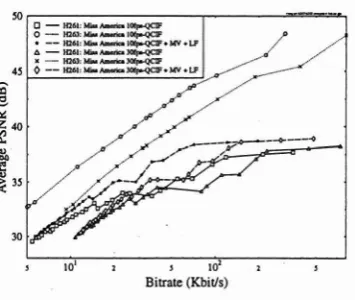
Figure 2 shows a comparison of the H.261 and H.263
video codecs in terms of image quality expressed in Peak Signal-to-Noise Ratio (PSNR) versus bitrate (Kbit/s). As the pair-wise comparisons reveal, irrespective of the bitrate,
the performance of the H.263 codec is significantly higher
than that of H.261 scheme in all scenarios.
Table 2 shows the bitrate reduction achieved for the same
PSNR, when using the H.263 scheme instead of the H.261
arrangement. The reductions are relative to the H.261 sim-
ulations a t 10 frames/s without motion compensation. The
Table includes a column for the best H.261 performance,
which uses motion vectors (MV) and loop filtering. Our
next results summarised in Table 3 show the increase in im-
age quality (PSNR) achieved at the same bitrate. The gains
are relative to the H.261 simulations at 10 frames/s without
motion compensation.
Figure 3 provides a comparison of the H.261 and H.263
video codecs from a different perspective, a s image quality
(PSNR) versus compression ratio. As can be seen from
the Figure, the H.263 codec is significantly more efficient
than the H.261 scheme in all investigated scenarios. Let us
now highlight the concept of controlling the bitrate of the source codec in order to maintain a near-constant channel signalling rate.
3. BITRATE CONTROL
As with most video codecs using variable-length coding tech-
niques, the bitrate of the H.263 codec is inherently time vari-
ant. However, most existing mobile radio systems transmit at a fixed bitrate. Our proposed multi-mode system m i n - tains a constant signalling rate or symbol rate, leading to a different constant bitrate for each of the modulation schemes invoked.
The PSNR versus bitrate performance of the video co-
decs was quantified in Figure 2 and the portrayed relation-
ship plays an important role in the codecs' bitrate control. The control algorithm modifies the quantiser in the video co- dec in order to maintain the target framerate and bitrate. In
these investigations a fixed framerate of 10 frames/s was em-
ployed. The target bitrate was set according to the the past history of the modulation schemes used and to the packet
dropping frequency experienced. The target bitrate R was
updated after every dropped packet or successful transmis-
sion according to Equation 1:
[image:2.551.84.262.198.348.2]IEEE ICCSASPACS 696
1371
Table 2: Percentage reduction in bitrate required .to achieve the same PSNR for the H.261 and H.263 schemes, compared with the H.261 performance at 10 frames/s using no motion compensation
Fixed PSNR(dB)
33 35 37
Table 3: PSNR(dB) improvement achieved at given bitrates by .the H.261,,and H.263 schemes, compared with the H.261 PSNR at 10 frames/s without motion compensation
when using the n-QAM modulation scheme.
D,
is the num-Pe~centage Bitrate Reduction (%)
, .-
ber of droiped p&kets in the n-QAM mode of operition, an
-..-
while B, represents the various fixed bitrates for error-free &I
a s W A M Q a F
transmission, again, using the n-QAM modulation scheme. Eats Y u
If, for example, the videophone system is restricted to op- &I
a s -lOfps+MV+LF
19.53 60.57 59.46
erate in the ~ Q A M mode,-the target bitrate is simplified
&
shown in Equation 2:
When the channel is near error-free, then the number
of dropped packets
D4
will be virtually zero and the tar-get bitrate will tend to the fixed bitrate
B4
stipulated forthe 4QAM transmission mode. If however the channel was
causing 50% frame errors then the number of dropped trans-
missions
D4
would be similar to the number of successfultransmissions, namely to
S4.
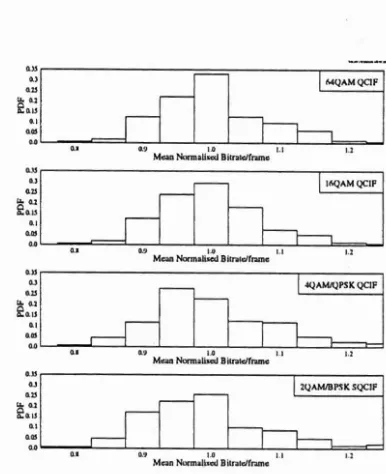
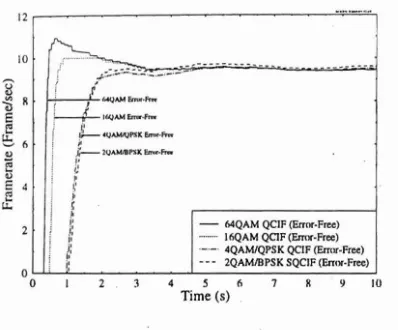
This would cause the tragetbitrate to reduce to approx. 50% of the fixed bitrate for the 4QAM scheme. Therefore the target bitrate reduces in proportion to the channel frame error rate. If the video codec can meet the target bitrate requirements, the frame rate of the transmitted video becomes also nearly constant, although under severe channel conditions the system may have to reduce the video frame rate, in order to arrive at a constant bitrate. The operation of this bitrate control algorithm is characterised by the normalised bitrate histo- grams of Figures 4 in the transceiver's different modes of operation using 64QAM, 16QAM, 4QAM and Binary Phase Shift Keying (BPSK), respectively. Observe in the Figure that in the lowest capacity BPSK mode due to the stringent bitrate constraint we opted for transmitting in the SQCIF image format. The corresponding frame-rate versus time
behaviour of the system is characterised by Figure 5. Ob-
serve that after a slight initial delay, which is essentially due to the intra-frame coded bitrate surge of the first frame, the frame rate reaches the target of 10 frames/s, typically within less than 1s. Let us now focus our attention on some of the error control issues.
H263-10fps 62.28 82.99 87.86
L1 L1 10 8.3 I
Man h . l W .PIll"wlm
Figure 4: Bitrate control histogram for transmissions at 4,16, and 64QAM using the QCIF resolution Miss Amer- i6a Sequence, and 2QAM using the SQCIF resolution Miss America Sequence, both in error-free conditions
30fps+NoMC -61.08 -85.16 -72.33
4. FORWARD ERROR CORRECTION CODING
Again, let us consider transmitting QCIF images, where the video cpdecs were programmed to generate 3560, 235'2 and
1176 bits per frame, which at a scanning rate of 10 frames/s
resulted in bitrates of 35.6 kbps, 23.52 kbps and 11.76 kbps, respectively, when using GlQAM, 16QAM and 4QAM.
30fps+MV+LF -41.31
33.34 10.19
In our earlier work we have shown that in QAM schemes the bits can be assigned to a number of different integrity
classes [9]. The number of integrity classes depends on the
number of modulation-levels, and in 4-Q.4M there is only
one integrity class, in 16-QAM there are 2 , while in 64-QAM
[image:3.553.104.464.63.112.2] [image:3.553.101.462.170.228.2] [image:3.553.309.502.274.511.2]1372 IEEE ICCSnSPACS '96
i I
i h : I,
i I:
-
MQAM QCIF (Ennr.Fm)i 11
-
IIIQAM QCIF ( E m - F m )4QAWQPSK QCIF (Em-Free)
! 10 20AMIBPSK SOCIF (Fnnr.Fm)
0 1 2 3 4 5 h 7 R Y I O
Time (s)
Figure 5: Framerate versus time behaviour of the frame-rate control algorithm, for transmissions a t 4,16, and 64QAM using QCIF resolution Miss America Sequence, and 2QAM using SQCIF resolution Miss America Sequence, both in error-free conditions
16 QAM
64 QAM 445
Modulation scheme 4 QAM 16 QAM
64 QAM
Table 5: H.263 packet size in terms of bits and initial quant- iser used for 4, 16, and 64 QAM
FEC codes used BCH(255,147,14) Class 1: BCH(255,179,10) Class 2: BCH(255,115,21) Class 1: BCH(255,199,7) Class 2: BCH(255,155,13)
Class 3: BCH(255,91,25)
-
" s Ib 2 5 2< 30 35
Channel SNR (dB)
Figure 6: Frame Error Rate (FER) versus Channel SNR (dB) for 2, 4, 16, and 64QAM over both Gaussian and
Table 4: FEC codes used for 4, 16 and 64 QAM Rayleigh fading channels
there are 3 classes, often also referred to as sub-channels. By using different strength FEC codes on each QAM sub- channel it is possible to equalise the probability of errors on the sub-channels. This means that all FEC-protected sub-channels will exhibit similar BERs. This is desirable, if all bits to be transmitted are equally important. Since our datastreams are variable length coded, one error can cause a loss of synchronisation. Therefore in this case most bits are equally important, and so equalisation of the QAM sub-channels' BER is desirable. The FEC codes used in our system are summarised in Table 4, while the corresponding transmission packet sizes are highlighted in Table 5 along with the initial quantiser identifiers, which predetermine the achieveable bitrate. After including a control header, pilot and ramp symbols 191, the FEGcoded single-user signalling rates became 11.84 kBd in all three operating modes. In case of a Nyquist excess bandwidth of 50% this implies a single- user bandwidth requirement of 17.74 kHz. For example in the 200 kHz bandwidth of the Pan-European GSM system 8 voice-only users or supported, which corresponds to a 25 kHz user bandwidth. Consequently, our videophone stream can replace a speech stream, making wireless videophony realistic, if the cost of an additional timeslot is acceptable to the users.
2 6 l . . . .
o s 10 1 5 zn u 3n 5 4 0 4 s so
Packet hopping (%)
Figure 7: Average PSNR of decoded video versus Frame
Error Rate (FER), for 2, 4, 16, and 64QAM overover
[image:4.582.86.285.70.235.2] [image:4.582.330.545.81.127.2] [image:4.582.322.529.195.373.2] [image:4.582.330.530.480.633.2]IEEE ICCSASPACS '96
1373
pected, the H263 codec again exhibited always higher video quality at the same bitrate or system bandwidth.
Our current endeavours are focussed on exploring the quality versus bitrate performance of both systems for vari- ous image resolutions, in order to be able to provide the required video quality, bit rate, frame rate, image size and resolution on a demand basis in intelligent adaptive mul- timode transceivers.
6. ACKNOWLEDGEMENT
,
I32 . 1 ; j ! I
I
*
! 1I
The financial support of the EPSRC, UK in the framework
j i i i
1
of the contract GR/K74043 is gratefully acknowledged.30 I I i
5 10 15 20 25 30
Channel SNR (dB)
7. REFERENCES
[I] IEEE Transactions on Circuits and Systems for Video
Figure 8: Performance comparison of the proposed adaptive Technology, Special issue on Very 'LOW Bit Rate Video
H261 and H263 transceivers over AWGN channels Coding, vol. 4, pp. 213-357, June 1994.
[2] M. Khansari, A. Jalali, E. Dubois, and P. Mermelstein, "Robust low bit-rate video transmission over wire-
Figure 9: Performance comparison of the proposed adaptive H261 and H263 transceivers over Rayleigh channels
5. SYSTEM PERFORMANCE
The video system performance was evaluated under the pro- pagation conditions of a vehicular speed of 30 mph, sig- nalling rate of 11.84 kBd and propagation frequency of 1.9 GHz. Figure 6 displays the Frame Error Rate (FER) versus channel SNR performance of the system for 2, 4, 16, and 64QAM over both Gaussian and Rayleigh fading channels. The graphs clearly indicate that extremely robust system performance can be maintained upon invoking the more ro- bust modes of operation, when the channel conditions de- grade. The performance curves can be related to the video quality 'exressed in terms of PSNR using Figure 7.
Finally, in the various operating modes investigated the PSNR versus channel SNR curves of Figures 8 and 9 were obtained for Additive White Gaussian Noise (AWGN) and Rayleigh channels, respectively. Since both the H.261 and H.263 source codecs have had similar robustness against channel errors, and their transceivers were identical, the as- sociated 'corner SNR' values, where unimpaired communic- ations broke down were virtually identical for both systems over both AWGN and Rayleigh channels. However, as ex-
less access systems," in Proc. of International Comms.
Conf. (ICC), pp. 571-575, 1994.
[3]
R.
M. Pelz, "An un-equal error protected px8 kbit/s video transmission for dect," in Proceedings of IEEEV T C '94 [lo], pp. 1020-1024.
[4] R. Stedman, H. Gharavi, L. Hanzo, and R. Steele, "Transmission of subband-coded images via mobile channels," IEEE Tk. on Circuits and Systems for Video
Technology, vol. 3, pp. 15-27, Feb 1993.
[5] J. Streit and L. Hanzo, "Vector-quantised low-rate cordless videophone systems." submitted to IEEE VT, 1995.
[6] L. Hanzo and J . Streit, "Adaptive low-rate wireless videophone systems," IEEE Tk. on Video Technology,
Aug 1995.
[7] R. Stedman, H. Gharavi, L. Hanzo, and R. Steele, "A 22 kbd microcellular video telephone scheme," in Pro-
ceedings of IEEE VTC '92, (Denver, U.S.A.), pp. 251-
254, 1992.
[8] J . Streit and L. Hanzo, "A fractal video communic- ator," in Proceedings of IEEE V T C '94 [lo], pp. 1030- 1034.
[9] W. Webb and L. Hanzo, Modern Quadrature Amp- litude Modulation: Principles and Applications for
Wireless Communications. IEEE Press-Pentech Press,
1994.
[image:5.589.63.242.70.214.2] [image:5.589.57.244.286.430.2]