Contact Problem for a Foundation
with a Rough Coating
Alexander V. Manzhirov,
Member, IAENG,
Kirill E. Kazakov
Abstract—We study the contact interaction between a rigid punch and a viscoelastic foundation with a thin rough coating. The case in which the punch and the coating surfaces are conformal (mutually repeating) is under consideration. Such problems can arise, for example, when the punch immerses into a solidifying coating before its complete solidification, e.g. into some sort of glue or new concrete. The shape of the coating roughness as well as the shape of the punch surface may be described by fast oscillating functions. We obtain basic integral equation and construct its solution by using a projection method. We also discuss qualitative behavior of main contact characteristics.
Index Terms—conformal contact, foundation, coating, rough-ness, projection method
INTRODUCTION
T
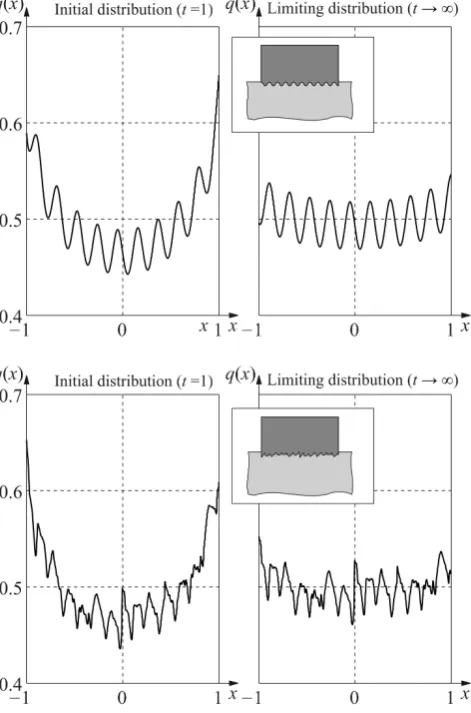
HE shape of real contacting surfaces is always definitely rough. Such a roughness can be efficiently described only by rapidly oscillating functions. We develop a projection method for solving multidimensional integral equations with rapidly oscillating function in initial data. This method allows us to solve the governing integral equation with high accuracy in the case when the classical method of separation of variables gives up to 100% mistake. A model contact problem for a coating with experimental profilogram for the shape of its surface is solved. Plots for the distribution of contact stress are presented.I. STATEMENT OF THE PROBLEM
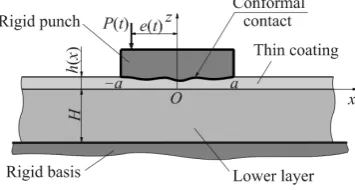
We assume that a viscoelastic layer with a coating lies on a rigid basis. At timeτ0, the forceP(t)with eccentricitye(t)
starts to indent a smooth rigid punch of width2a(Fig. 1) into the surface of such a foundation. A specific characteristic of this contact interaction is the fact that the coating shape (the shape of the surface of the layer packet) coincides with the punch base shape. Such a contact interaction will be called conformal. The coating is assumed to be thin compared with the contact area, i.e., its thickness satisfies the condition h(x) 2a. Both the thin coating and the lower layer of an arbitrary thicknessH are made of viscoelastic materials. We denote the moments of their production by τ1 and τ2,
Manuscript received March 16, 2016; revised March 29, 2016. This work was financially supported by the Russian Science Foundation under Project No. 14-19-01280.
A. V. Manzhirov is with the Ishlinsky Institute for Problems in Mechanics of the Russian Academy of Sciences, Vernadsky Ave 101 Bldg 1, Moscow, 119526 Russia; the Bauman Moscow State Technical University, 2nd Bau-manskaya Str 5/1, Moscow, 105005, Russia; the National Research Nuclear University ”MEPhI” (Moscow Engineering Physics Institute), Kashirskoye shosse 31, Moscow, 115409, Russia; the Moscow Technological University, Vernadsky Ave 78, Moscow, 119454, Russia; e-mail: [email protected].
[image:1.595.333.511.166.261.2]K. E. Kazakov is is with the Ishlinsky Institute for Problems in Mechanics of the Russian Academy of Sciences, Vernadsky Ave 101 Bldg 1, Moscow, 119526 Russia; the Bauman Moscow State Technical University, 2nd Bau-manskaya Str 5/1, Moscow, 105005, Russia; e-mail: [email protected]
Fig. 1. Basic scheme of contact interaction
respectively. We assume that the coating rigidity is less than the rigidity of the lower layer or they are of the same order of magnitude [1–12]. We consider the case of plane strain.
We note that the simple case of conformal contact is the contact of a punch with a plane base and a plane part of a solid (including basements with coating of constant thickness).
To obtain the integral equation of the problem, we replace the punch by some normally distributed load p(x, t) = −q(x, t) acting upon the same region (−a ≤ x ≤ a) and equal to zero outside this region. Then the vertical displacement of the upper face of the foundation described above under the action of the normal force q(x, t) can be written in the form [1, 4, 5]:
uz(x, t) = (I−V1)
θq(x, t)h(x)
E1(t−τ1)
+ (I−V2)F
2(1−ν22)q(x, t) πE2(t−τ2) , (1)
Ff(x, t) =
Z a
−a kpl
x−ξ H
f(ξ, t)dξ,
Vkf(x, t) =
Z t
τ0
K(k)(t−τk, τ−τk)f(x, τ)dτ,
K(k)(t, τ) =Ek(τ) ∂
∂τ h 1
Ek(τ)+C
(k)(t, τ)i, k= 1,2,
whereEk(t) are the Young moduli of the coating (k = 1) and the lower layer (k= 2) andν2 is Poisson’s ratio of the lower layer; Iis the identity operator; Vk are the Volterra integral operators with tensile creep kernelsK(k)(t, τ)(k=
1,2); C(k)(t, τ) (k = 1, 2) are the tensile creep functions; θ is a dimensionless coefficient depending on the contact conditions between coating and lower layer; in the case of a smooth coating-layer contact, we have
θ= 1−ν12,
and in the case of an perfect contact,
θ= 1−ν1−2ν
2 1
whereν1 is Poisson’s ratio of the coating;Fis the integral operator with the known kernel of the plane contact problem kpl[(x−ξ)/H], which has the form [1]
kpl(s) =
Z ∞
0 L(u)
u cos(su)du,
and, in the case of a smooth contact between the lower layer and the rigid base,
L(u) = cosh 2u−1 sinh 2u+ 2u,
and in the case of a perfect contact,
L(u) = 2κsinh 2u−4u
2κcosh 2u+ 4u2+ 1 +κ2, κ= 3−4ν2.
By equating the vertical displacements of the upper face of the coating with the displacement of the rigid punch and taking into account (1) and the fact that the contact interaction is conformal, we obtain the integral equation of our problem in the form
(I−V1)
θq(x, t)h(x)
E1(t−τ1)
+ (I−V2)F
2(1−ν2 2)q(x, t) πE2(t−τ2)
=δ(t) +α(t)x (−a6x6a), (2) whereδ(t)is the punch settlement andα(t)is its tilt angle. We supplement Eq. (2) with the condition of the punch equilibrium on the foundation
Z a
−a
q(ξ, t)dξ=P(t), Z a
−a
ξq(ξ, t)dξ =M(t). (3)
Here M(t) = e(t)P(t) denotes the moment of application of the forceP(t).
In (2) and (3), we make the change of variables by the formulas
x∗=x/a, ξ∗=ξ/a, t∗=t/τ0, τ∗=τ /τ0,
τ1∗=τ1/τ0, τ2∗=τ2/τ0, λ=H/a,
δ∗(t∗) =δ(t)
a , α
∗(t∗) =α(t), c∗(t∗) =E2(t−τ2) E1(t−τ1) ,
m∗(x∗) = θ 1−ν2
2 h(x)
2a , q
∗(x∗, t∗) = 2(1−ν22)q(x, t) E2(t−τ2) ,
P∗(t∗) = 2P(t)(1−ν
2 2) E2(t−τ2)a , M
∗(t∗) =2M(t)(1−ν22) E2(t−τ2)a2 ,
V∗kf(x∗, t∗) =
Z t∗
1
Kk(t∗, τ∗)f(x∗, τ∗)dτ∗, k= 1,2, (4)
K1(t∗, τ∗) =
E1(t−τ1)
E1(τ−τ1)
E2(τ−τ2)
E2(t−τ2)
K(1)(t−τ1, τ −τ1)τ0,
K2(t∗, τ∗) =K(2)(t−τ2, τ−τ2)τ0,
F∗f(x∗, t∗) =
Z 1
−1
k∗pl(x∗, ξ∗)f(ξ∗, t∗)dξ∗,
kpl∗(x∗, ξ∗) =1
πkpl x−ξ
H
=1
πkpl
x∗−ξ∗ λ
.
Then, omitting the asterisks, we obtain a mixed integral equation in the form
c(t)m(x)(I−V1)q(x, t) + (I−V2)Fq(x, t)
=δ(t) +α(t)x (−16x61) (5)
with the auxiliary conditions
Z 1
−1
q(ξ, t)dξ=P(t), Z 1
−1
ξq(ξ, t)dξ =M(t). (6)
Now we divide Eq. (5) by pm(x) and introduce the notation
Q(x, t) =pm(x)q(x, t), k(x, ξ) = p kpl(x, ξ)
m(x)pm(ξ),
AQ(x, t) =
Z 1
−1
k(x, ξ)Q(ξ, t)dξ.
Then integral equation (5) can be reduced to the following integral equation with the Hilbert–Schmidt kernel k(x, ξ)
(see, e.g. [13]):
c(t)(I−V1)Q(x, t) + (I−V2)AQ(x, t)
=pδ(t)
m(x)+
α(t)x p
m(x) (−16x61). (7)
The auxiliary conditions (6) have the form
Z 1
−1 Q(ξ, t)
p
m(ξ)dξ=P(t),
Z 1
−1 Q(ξ, t)
p
m(ξ)ξ dξ=M(t). (8)
In what follows, we construct the solution of the two-dimensional equation (7), which contains integral operators with constant as well as variable limits of integration, with the auxiliary conditions (8) taken into account.
There exist four different versions of the substitution: 1) the settlement and the tilt angle of the punch are known (i.e., the right-hand side of the integral equation is given); 2) the punch settlement and the force moment are known; 3) the tilt angle of the punch and the indenting force are known; 4) the indenting force and its moment application are known. Each of these statements is a separate problem with its specific integral operator, and it is necessary to construct four systems of eigenfunctions for these problems.
In what follows we will construct the solution of the third problem.
II. SOLUTION FOR KNOWN FORCE AND TILT ANGLE
Consider the following statement of a problem: it is neces-sary to find the eccentricitye(t)of the indenting forceP(t)
in order to provide the prescribed tilt angle α(t). It is considered that the forceP(t)is known.
We assume that function α(t) in (7) is given and the first auxiliary condition (8) holds and the second auxiliary condition (8) leads to the formula
e(t) = 1
P(t)
Z 1
−1 Q(ξ, t)
p
m(ξ)ξ dξ. (9)
We seek the solution of Eq. (7) under the first condition (8) using (9) in the class of functions continuous in timetin the Hilbert spaceL2[−1,1](e.g., see [4]). To this end, we at first construct an orthonormal system of functions in L2[−1,1]
which satisfies the above conditions can be obtained by the following formulas [14]:
Z 1
−1
pi(ξ)pj(ξ)dξ=δij, pn(x) = pPn(x)
m(x),
P0(x) = √1
J0, Jn= Z 1
−1 ξn m(ξ)dξ,
Pn(x) = p 1 ∆n−1∆n
J0 J1 · · · Jn J1 J2 · · · Jn+1
..
. ... . .. ...
1 x · · · xn
, (10)
∆−1= 1, ∆n=
J0 J1 · · · Jn J1 J2 · · · Jn+1
..
. ... . .. ... Jn Jn+1 · · · J2n
.
Note that if m(x) = const then the polynomials pn(x) are the orthonormal Legendre polynomials.
The Hilbert spaceL2[−1,1]can be presented as the direct sum of orthogonal subspaces L2[−1,1] = L(1)2 [−1,1]⊕
L(2)2 [−1,1], where L(1)2 [−1,1] is the Euclidean space with the basis {p0(x)} andL
(2)
2 [−1,1]is the Hilbert space with the basis {p1(x), p2(x), p3(x), . . .}. The integrand and the right-hand side of (7) can also be presented in the form of the algebraic sum of functions continuous in timetand ranging inL(1)2 [−1,1]andL(2)2 [−1,1], respectively, i.e.,
Q(x, t) =Q1(x, t) +Q2(x, t),
f(x, t) =f1(x, t) +f2(x, t),
Q1(x, t) =z0(t)p0(x),
f1(x, t) = δ(t)
p
m(x) =
p
J0δ(t)p0(x),
f2(x, t)≡ pα(t)x
m(x).
Note that the formula for Q(x, t) contains known term Q1(x, t)which is determined by the first auxiliary condition (1.8)
z0(t) = P√(t)
J0,
and the term Q2(x, t) must be found. Conversely, for the right-hand side, one should findf1(x, t), whilef2(x, t)≡0. These peculiarities permit one to class the resulting problem as a specific case of the generalized projection problem stated in [15].
We can introduce the orthogonal projection operator map-ping the space L2[−1,1]onto subspaceL
(1) 2 [−1,1]
P1φ(x, t) =
Z 1
−1
φ(ξ, t)[p0(x)p0(ξ)]dξ.
Obviously, the orthoprojector P2 = I − P1 maps the space L2[−1,1]ontoL(2)2 [−1,1]. In addition, the following relations hold
Pif(x, t) =fi(x, t), PiQ(x, t) =Qi(x, t), i= 1, 2. Using [15], we apply the orthogonal projection operator
P2 to Eq. (7). As a result, we obtain the equation for
determiningQ2(x, t)with a known right-hand side
c(t)(I−V1)Q2(x, t) + (I−V2)P2AQ2(x, t)
=−(I−V2)P2AQ1(x, t). (11) It is necessary to construct its solution in the form of an expansion in the eigenfunctions of the operatorP2Awhich is a compact, strong positive, and self-adjoint operator from L(2)2 [−1,1] into L(2)2 [−1,1]. The system of eigenfunctions of such an operator is a basis in the spaceL(2)2 [−1,1]. The spectral problem for the operatorP2Acan be written in the form
P2Aϕk(x) =γkϕk(x), ϕk(x) =
∞
X
i=1
ϕ(k)i pi(x), k= 1, 2, . . . ,
k(x, ξ) =
∞
X
m=0 ∞
X
n=0
Rmnpm(x)pn(ξ),
Rmn= Z 1
−1 Z 1
−1
k(x, ξ)pm(x)pn(ξ)dx dξ,
Rnm=Rmn, m, n= 0,1, . . . ,
and hence ∞
X
n=1
Rmnϕ(k)n =γkϕ(k)m , k, m= 1,2, . . .
We expand the functionQ2(x, t)with respect to the new basis functionsϕk(x)(k= 1,2, . . .) inL(2)2 [−1,1], i.e.,
Q2(x, t) = ∞
X
k=1
zk(t)ϕk(x).
Substituting this equation into (11) and taking into account that the unknown expansion functionszk(t)(k= 1,2, . . .) can be determined by the formula
zk(t) =−(I+Wk)
−α(t)gα
k + (I−V2)z0(t)Kkα c(t) +γk
,
Kkα=
∞
X
n=1
R0nϕ(k)n ,
gkα=
s
J0J2−J2 1 J0
Z 1
−1
p1(ξ)ϕk(ξ)dξ=ϕ(k)1 s
J0J2−J2 1 J0
,
Wkf(x, t) =
Z t
1
R∗k(t, τ)f(x, τ)dτ,
whereR∗
k(t, τ)(k= 1,2, . . .) is the resolvent of the kernel
Kk∗(t, τ) = c(t)K1(t, τ) +γkK2(t, τ)
c(t) +γk .
Note that the final solution has the following structure
q(x, t) = 1
m(x)
z0(t)P0(x) +. . . ,
i.e., one can explicitly write out the weight functionm(x)in the solution. Note that the coating thickness functionh(ax)
Hence, we have found the contact pressure q(x, t) under the punch and now can find the load eccentricity using (9):
e(t) = 1
P(t)
" J1
√
J0z0(t) + ∞
X
i=1 giαzi(t)
#
= J1
J0 +
1
P(t)
∞
X
i=1 ϕ(i)1
s
J0J2−J12 J0 zi(t).
In particular it is possible to obtain the absence of the tilt of the punch at any instant (α(t)≡0).
In order to find the unknown punch settlement we act Eq. (1.7) by operator P1
δ(t) =√1
J0
−α(t)√J1
J0 +c(t)(I−V1)z0(t)+
(I−V2)
R00z0(t) +
∞
X
k=1
Kkαzk(t)
.
III. SOLUTION FOR A GIVEN SETTLEMENT AND MOMENT
We consider one more version of the problem statement. Let the punch settlement δ(t) and moment M(t) (or ec-centricity e(t))are prescribed. It is necessary to find the forceP(t), the tilt angleα(t)and the contact pressureq(x, t). The second auxiliary condition (8) gives the formula for the force
P(t) =
Z 1
−1 Q(ξ, t)
p
m(ξ)dξ, (12)
and the first auxiliary condition (8) holds.
The Hilbert spaceL2[−1,1]can be represented as the di-rect sum of orthogonal subspacesL2[−1,1] = ˜L
(1)
2 [−1,1]⊕
˜
L(2)2 [−1,1], where L˜(1)2 [−1,1] is the Euclidean space with basis{p˜0(x)}andL˜
(2)
2 [−1,1]is the Hilbert space with basis
{p˜1(x),p˜2(x),p˜3(x), . . .}. Here the basis functions can be found as follows:
˜
p0(x) =p x
J2m(x),
˜
p1(x) =
J2−J1x p
J2(J0J2−J2 1)m(x)
,
˜
pk(x)≡pk(x), k= 2, 3, . . .
For the integrand and the right-hand side of (7):
Q(x, t) = ˜Q1(x, t) + ˜Q2(x, t),
f(x, t) = ˜f1(x, t) + ˜f2(x, t),
˜
f1(x, t) =pα(t)x
m(x), ˜
f2(x, t) = pδ(t)
m(x),
where Qi˜ (x, t), fi˜(x, t) are functions continuous in time t and ranging in L˜(1)2 [−1,1]andL˜(2)2 [−1,1], respectively.
The representation for Q(x, t) contains the known first term, and the second term is to be found. Conversely, for the right-hand side, one should find f1˜(x, t), while f2˜(x, t)
in unknown.
The orthogonal projection operator, mapping the space L2[−1,1]ontoL˜(1)2 [−1,1]can be introduced by formulas
˜
P1φ(x, t) =
Z 1
−1
φ(ξ, t)˜p0(x)˜p0(ξ)dξ.
The orthoprojector P˜2=I−P˜1 maps the space L2[−1,1] ontoL˜(2)2 [−1,1].
We apply the orthogonal projection operatorP˜2to Eq. (7). As a result, we obtain the equation for determiningQ˜2(x, t) with a known right-hand side. It is necessary to construct its solution in the form of a series in the eigenfunctions of the operatorP˜2A. The spectral problem for this operator can be written in the form
˜
P2Aϕk˜ (x) = ˜γkϕk˜ (x),
˜
ϕk(x) = ∞
X
i=1
˜
ϕ(k)i p˜i(x), k= 1, 2, . . . ,
k(x, ξ) =
∞
X
m=0 ∞
X
n=0
˜
Rmnpm˜ (x)˜pn(ξ),
˜
Rmn= Z 1
−1 Z 1
−1
k(x, ξ)˜pm(x)˜pn(ξ)dx dξ,
˜
Rnm= ˜Rmn, m, n= 0,1, . . . ,
and, hence,
∞
X
n=1
˜
Rmnϕ˜(k)n = ˜γkϕ˜(k)m , k, m= 1,2, . . .
Final formulas for contact pressure under the punch have the form
q(x, t) = pQ(x, t)
m(x),
Q(x, t) = ˜z0(t)˜p0(x) +
∞
X
k=1
˜
zk(t) ˜ϕk(x),
˜
z0(t) = M√(t)
J2 ,
˜
zk(t) =−(I+Wfk)
−δ(t)gδ
k+ (I−V2)˜z0(t)Kkδ c(t) + ˜γk ,
Kkδ =
∞
X
n=1
˜
R0nϕ˜(k)n ,
gδk=
s
J0J2−J2 1 J2
Z 1
−1
˜
p1(x) ˜ϕk(ξ)dξ= ˜ϕ(k)1 s
J0J2−J2 1 J2
,
f
Wkf(x, t) = Z t
1
˜
R∗k(t, τ)f(x, τ)dτ.
Kernels Rˇ∗k(t, τ) (k = 1,2, . . .) are the resolvents of the kernels
˜
Kk∗(t, τ) = c(t)K1(t, τ) + ˜γkK2(t, τ)
c(t) + ˜γk
.
So, having defined the contact pressure q(x, t) under the punch, using (12) we can find the force
P(t) =√J1
J2z0˜ (t) + ∞
X
i=1 giδ˜zi(t)
= J1
J2M(t) + ∞
X
i=1
˜
ϕ(i)1 s
J0J2−J2 1
J2 zi˜(t). (13)
materials. In this case
c(t)≡c,
Vi=Wfk =0, i= 1,2, k= 1,2, . . . , K1(t, τ) =K2(t, τ)≡0.
and we can write formula (13) in the form
P(t) =J1
J2 M(t) +
∞
X
i=1 gδizi˜(t)
=J1
J2M(t) + ∞
X
i=1
gδiδ(t)g δ
i −z˜0(t)Kiδ c+ ˜γi
=J1
J2M(t) +δ(t) ∞
X
i=1
(gδ i)2 c+ ˜γi −
M(t) √
J2 ∞
X
i=1 gδ
iKiδ c+ ˜γi.
=M√(t)
J2 J1
√
J2 − ∞
X
i=1 giδKiδ c+ ˜γi
+δ(t)
∞
X
i=1
(gδi)2
c+ ˜γi.
Using notationM(t) =P(t)e(t)one can obtain equation for the force P(t)
P(t) = P(√t)e(t)
J2 J1
√
J2
−
∞
X
i=1 gδ
iKiδ c+ ˜γi
+δ(t)
∞
X
i=1
(gδ i)2 c+ ˜γi .
Hence, we obtain
P(t) =
δ(t)
∞
X
i=1
(giδ)2
c+ ˜γi
1−e(t)
J1 J2 −
1 √
J2 ∞
X
i=1 giδKiδ c+ ˜γi
. (14)
This relation allows one to define the magnitude of the indenting force using measured force eccentricity and punch settlement.
Note that the expansion coefficients Rmn˜ of the ker-nel k(x, ξ) can be written through coefficients Rmn. Basis functions p˜k(x) (k = 0,1) can be written through pk(x) (k= 1,2),
˜
p0(x) =k (0)
0 p0(x) +k (0) 1 p1(x),
˜
p1(x) =k0(1)p0(x) +k1(1)p1(x),
k(0)0 =−k(1)1 = √J1
J0J2,
k(0)1 =k0(1)=
s
1− J
2 1 J0J2,
and expansion coefficientsRmn˜ can be written in the form
˜
Rmn=
2 X
i,j=1
k(m)i k(n)j Rij =k0(m)k0(n)R00
+ [k0(m)k1(n)+k1(m)k0(n)]R01+k (m) 1 k
(n) 1 R11, m, n= 0,1,
˜
Rnk= ˜Rkn=
2 X
i=1
ki(n)Rik=k(n)0 R0k+k1(n)R1k,
n= 0,1, k= 2,3, . . . ,
˜
Rkl=Rkl, k, l= 2, 3, . . .
Now we can find the unknown tilt angle
α(t) =√1
J2
−δ(t)√J1
J2 +c(t)(I−V1)˜z0(t)
+ (I−V2)
˜
R00z0˜ (t) +
∞
X
k=1
Kkδzk˜ (t)
.
In the case of elastic layers and given eccentricity we obtain the formula
α(t) =
δ(t)
1
√
J2 ∞
X
k=1 gδ
kKkδ c+ ˜γk
−J1
J2
+P(t)e(t)
J2
c+ ˜R00−
∞
X
k=1
(Kkδ)2
c+ ˜γk
.
Using equation (14) one can obtain the following formula
α(t) =δ(t)
k2+
k1e(t)
J2[1+k2e(t)]
c+ ˜R00− ∞
X
k=1
(Kδ k)2 c+ ˜γk
,
where
k1=
∞
X
i=1
(gδi)2
c+ ˜γi, k2=
1 √
J2 ∞
X
i=1 gδiKiδ c+ ˜γi −
J1 J2
IV. SOLUTION FOR A GIVEN SETTLEMENT AND TILT ANGLE
This method allowed us to construct the solution of the problem with given right-hand side, i.e., when the settle-ment δ(t) and tilt angle α(t) of the punch are given. It is necessary to define the forceP(t)and the eccentricitye(t)
(or the momentM(t)).
Auxiliary conditions (8) allow to obtain formulas for definition of functionsP(t)ande(t):
P(t) =
Z 1
−1 Q(ξ, t)
p
m(ξ)dξ,
e(t) = 1
P(t)
Z 1
−1 Q(ξ, t)
p
m(ξ)ξ dξ.
(15)
The right-hand side of Eq. (7) is known and Pˆ1 = 0. It is quite clear thatPˆ2 = I. The spectral problem for the operatorPˆ2Acan be written in the form
ˆ
P2Aϕkˆ (x) = ˆγkϕkˆ (x),
ˆ
ϕk(x) = ∞
X
i=1
ˆ
ϕ(k)i pi(x), k= 0, 1, . . . ,
k(x, ξ) =
∞
X
m=0 ∞
X
n=0
Rmnpm(x)pn(ξ),
Rmn= Z 1
−1 Z 1
−1
k(x, ξ)pm(x)pn(ξ)dx dξ,
Rnm=Rmn, m, n= 0,1, . . . ,
and hence
∞
X
n=1
We avoid technical details and give the final formulas for contact pressure under the punch
q(x, t) =pQ(x, t)
m(x),
Q(x, t) =
∞
X
k=0
ˆ
zk(t) ˆϕk(x),
ˆ
zk(t) = (I+Wck) δ(t)ˆgδ
k+α(t)ˆg α k c(t) + ˆγk ,
c
Wkf(x, t) =
Z t
1
ˆ
Rk∗(t, τ)f(x, τ)dτ,
ˆ
gkα=√J1
J0 Z 1
−1
p0(ξ) ˆϕk(ξ)dξ
+
s
J0J2−J2 1 J0
Z 1
−1
p1(ξ) ˆϕk(ξ)dξ
= ˆϕ(k)0 √J1
J0 + ˆϕ (k) 1
s
J0J2−J2 1 J0 ,
ˆ
gkδ =pJ0 Z 1
−1
p0(ξ) ˆϕk(ξ)dξ = ˆϕ(k)0 pJ0.
The functionspk(x)can be calculated using Eq. (10) where
ˆ
R∗k(t, τ)(k= 0,1, . . .) is resolvent of the kernel
ˆ
Kk∗(t, τ) =c(t)K1(t, τ) + ˆγkK2(t, τ)
c(t) + ˆγk
.
Hence, the contact pressure q(x, t) under the punch has been obtained using (15) and one can find the force P(t)
and the eccentricitye(t):
P(t) =
∞
X
i=0
ˆ
ϕ(i)0 pJ0ziˆ(t),
e(t) = 1
P(t)
∞
X
i=0
ˆ
ϕ(i)0 √J1
J0 + ˆϕ (i) 1
s
J0J2−J12 J0
ˆ
zi(t).
V. CONCLUSIONS
In the present paper, we consider the conformal contact of solids which is the generalization of the interaction between a flat punch and a plane surface. We pose and solve plane problems of conformal contact between viscoelastic aging foundations with rough coatings and rigid punches. We show that it is important to take the conformal contact into account. We also demonstrate the efficiency of the projection method for solving multidimentional integral equations of contact mechanics. The solution of the contact problem has been obtained in analytic form and the formula for the contact stress contains the shape function of the coating surface in explicit form. The latter allows one to perform computations for the actual shape of the coating roughness which usually can be described by rapidly oscillating function (Fig. 2).
REFERENCES
[1] V.M. Alexandrov and S.M. Mkhitaryan,Contact Problems for Bod-ies with Thin Coatings and Interlayers [in Russian]. Nauka Publ., Moscow, 1983.
[2] I. G. Goryacheva, Contact Mechanics in Tribology. Springer, Dor-drecht, 1998.
[image:6.595.308.544.57.414.2][3] N. Kh. Arutyunyan, A. V. Manzhirov, and V. E. Naumov Contact Problems in Mechanics of Growing Bodies [in Russian]. Nauka Publ., Moscow, 1991.
Fig. 2. Contact stress for a model and true roughness of the coating
[4] N. Kh. Arutyunyan and A. V. Manzhirov,Contact Problems in the Theory of Creep [in Russian]. Izd-vo Inst. Mekaniki NAN Armenii, Yerevan, 1999.
[5] A. V. Manzhirov, “Contact Problems for Inhomogeneous Aging Viscoelastic Solids,” in Mechanics of Contact Interactions, Ed. by I. I. Vorovich and V. M. Alexandrov. Fizmatlit, Moscow, 2001, pp. 607–621.
[6] A. V. Manzhirov, “Axisymmetric contact problems for non-uniformly aging layered viscoelastic foundations.”J Appl Math Mech, vol. 47, no. 4, pp. 558–566, 1983.
[7] A. V. Manzhirov, “On a method of solving two-dimensional integral equations of axisymmetric contact problems for bodies with complex rheology.”J Appl Math Mech, vol. 49, no. 6, pp. 777–782, 1985. [8] V. M. Alexandrov and A. V. Manzhirov, “Two-dimensional integral
equations in applied mechanics of solids.”J Appl Mech Tech Phys, vol. 28, no. 5, pp. 781–786, 1987.
[9] A. V. Manzhirov and V. A. Chernysh, “On the interaction of a rigid reinforcing sleeve and inhomogeneous aging high-pressure pipes.”
Mech Solids, vol. 22, no. 6, 1988.
[10] A. V. Manzhirov and V. A. Chernysh, “Contact problem for a layered inhomogeneous aging cylinder reinforced by a rigid ring.”J Appl Mech Tech Phys, vol. 30, no. 6, pp. 894–900, 1990.
[11] K. E. Kazakov and A. V. Manzhirov, “Conformal contact between layered foundations and punches.”Mech Solids, vol. 32, no. 3, pp. 512– 524, 2008.
[12] K. E. Kazakov, “Modeling of contact interaction for solids with inhomogeneous coatings.”J Phys Conf Ser, vol. 181(012013), 2009. [13] E. Goursat, Cours d’Analyse Math´ematique, Tome III. Int´egrales
Infiniment Voisines; ´Equations aux D´eriv´ees Partielles du Second Ordre; ´Equations Int´egrales; Calcul des Variations. Gauthier–Villars, Paris, 1927.
[14] G. Szeg¨o, Orthogonal Polynomials. Amer. Math. Soc, Providence, 1959.