ISSN Online: 2159-4481 ISSN Print: 2159-4465
DOI: 10.4236/jsip.2018.92006 May 31, 2018 92 Journal of Signal and Information Processing
DM-L Based Feature Extraction and Classifier
Ensemble for Object Recognition
Hamayun A. Khan
Faculty of Computer Studies, Arab Open University, Industrial Ardiya, Kuwait
Abstract
Deep Learning is a powerful technique that is widely applied to Image Recog-nition and Natural Language Processing tasks amongst many other tasks. In this work, we propose an efficient technique to utilize pre-trained Convolu-tional Neural Network (CNN) architectures to extract powerful features from images for object recognition purposes. We have built on the existing concept of extending the learning from pre-trained CNNs to new databases through activations by proposing to consider multiple deep layers. We have exploited the progressive learning that happens at the various intermediate layers of the CNNs to construct Deep Multi-Layer (DM-L) based Feature Extraction vec-tors to achieve excellent object recognition performance. Two popular
pre-trained CNN architecture models i.e. the VGG_16 and VGG_19 have
been used in this work to extract the feature sets from 3 deep fully connected multiple layers namely “fc6”, “fc7” and “fc8” from inside the models for object recognition purposes. Using the Principal Component Analysis (PCA) tech-nique, the Dimensionality of the DM-L feature vectors has been reduced to form powerful feature vectors that have been fed to an external Classifier En-semble for classification instead of the Softmax based classification layers of the two original pre-trained CNN models. The proposed DM-L technique has been applied to the Benchmark Caltech-101 object recognition database. Conventional wisdom may suggest that feature extractions based on the
deepest layer i.e. “fc8” compared to “fc6” will result in the best recognition
performance but our results have proved it otherwise for the two considered models. Our experiments have revealed that for the two models under con-sideration, the “fc6” based feature vectors have achieved the best recognition performance. State-of-the-Art recognition performances of 91.17% and 91.35% have been achieved by utilizing the “fc6” based feature vectors for the VGG_16 and VGG_19 models respectively. The recognition performance has been achieved by considering 30 sample images per class whereas the pro-posed system is capable of achieving improved performance by considering all
How to cite this paper: Khan, H.A. (2018) DM-L Based Feature Extraction and Classifier Ensemble for Object Recognition. Journal of Signal and Information Processing, 9, 92-110.
https://doi.org/10.4236/jsip.2018.92006
Received: July 7, 2017 Accepted: May 28, 2018 Published: May 31, 2018
Copyright © 2018 by author and Scientific Research Publishing Inc. This work is licensed under the Creative Commons Attribution International License (CC BY 4.0).
DOI: 10.4236/jsip.2018.92006 93 Journal of Signal and Information Processing
sample images per class. Our research shows that for feature extraction based on CNNs, multiple layers should be considered and then the best layer can be selected that maximizes the recognition performance.
Keywords
Deep Learning, Object Recognition, CNN, Deep Multi-Layer Feature Extraction, Principal Component Analysis, Classifier Ensemble, Caltech-101 Benchmark Database
1. Introduction
Deep Learning is one of the most important areas of research that is currently
finding adoption in wide and diverse fields [1][2][3]. Deep Learning techniques
and models exist for Image Recognition tasks, Natural Language Processing (NLP) tasks, Control Systems Applications, Medical Applications and many other diverse tasks. Traditionally, Neural Networks have been the mainstay of Machine Learning algorithms and applications to solve complex classification and recognition problems. Due to the recent advancement in the field of Neural Networks, Deep Learning has become one of the most rapidly developing area in the general domain of Artificial Intelligence (AI) and Machine Learning (ML). A large number of frameworks and libraries exist for deep learning research and
development such as Tensorflow, Theano, Torch, Caffe and Keras etc. [1] [2]
[3]. Some of the popular Deep Learning systems and architectures include
CNNs, the Recurrent Neural Networks (RNNs), Long Short-Term Memory (LSTM), Deep Belief Networks (DBNs), Deep Stacking Networks (DSNs) and Generative Adversarial Networks (GANs). Many large international corpora-tions are involved in the research and development of deep learning systems in-cluding Google, IBM, Microsoft, Amazon, Apple, Facebook, Baidu and others. Along with the enthusiasm for advancement in AI and ML research, there are concerns about the social, ethical and possible job loss issues due to expected rapid automation and deployment of intelligent machines and robots in the work place. Concerns about possible safety issues related to AI have also been raised by professionals and researchers of this field stressing for the advance-ment of safe AI research and developadvance-ment.
Object recognition is an important area of research in the field of ML since it forms an essential part of intelligent systems related to Computer Vision, Ro-botics and Autonomous Vehicles. Conventional Object Recognition systems generally employ Neural Networks to make decision about object recognition based on feature sets that have been extracted from the object images. Deep Learning systems are also being used for Object Recognition tasks. For Image and Object Recognition purposes, the most popular Deep Learning techniques
are based on the Convolution Neural Networks (CNNs) [4]-[13]. The CNN
DOI: 10.4236/jsip.2018.92006 94 Journal of Signal and Information Processing
Rectified Linear Unit (ReLU) layers, Fully Connected layers and Softmax layers to achieve recognition.
In this work we have built on the concept of extending the learning
capabili-ties of pre-trained deep networks to other datasets, as proposed in [14] [15] by
considering multiple deep layers for this purpose. Specifically, we have proposed
to use Deep Learning systems i.e. pre-trained CNN models, to extract feature
sets from object databases along with employing an external ensemble of clas-sifiers to make decisions about object recognition. By utilizing pre-trained CNN models for feature extraction, we exploit the learning capabilities that pre-trained models possess and which they have acquired through the long training times on very large databases. Our proposed system uses multiple layers of CNN models for feature extraction and then it selects the best layer based on the classification performance. By employing the Classifier Ensemble technique for classification purposes, our proposed system exploits the power of group of classifier for decision making instead of a single classifier. By exploiting the aforementioned capabilities, our proposed object recognition system has achieved State-of-the-art recognition performance. Hence this work is an im-portant contribution towards highlighting the significance of considering mul-tiple layers of deep CNNs for feature extraction purposes and then selecting the best layer based feature vector that maximizes the classification performance.
The breakdown of this paper is as follows. Review of related work about Im-age and Object recognition has been provided in Section 2. Our proposed DM-L based Feature Extraction and Classifier Ensemble system has been introduced and discussed in Section 3 of this paper. Section 4 presents the experimental se-tup of the proposed system for simulations and the achieved results are also pre-sented in this section. The summary of the results is discussed in Section 5 and Comparison of the results with the State-of-the-Art is presented in Section 6. Finally the Conclusions and Future Research Directions have been discussed in Section 7.
2. Related Work
Object Recognition is an essential task associated with Computer Vision, Robot-ics, Autonomous Vehicle Control or Driverless Cars and many other important tasks. Traditional Object Recognition techniques are based on the conventional ML strategy employing feature extraction from object images and performing recognition by using a standard classifier on the extracted features. The recogni-tion performance of tradirecogni-tional approaches depends on the quality of extracted features as well as on the quality of the classifier system. Apart from traditional approaches, Deep Learning has also been extensively employed for Object Rec-ognition using CNNs. CNNs are usually employed in two roles for object
recog-nition purposes i.e. either as complete object recognition system or as feature
DOI: 10.4236/jsip.2018.92006 95 Journal of Signal and Information Processing
LeCun et al. have applied CNNs to the task of object recognition in [4] and
they have shown that CNNs performed the best compared to other object
recog-nition techniques. Hinton et al. [5] have applied deep CNNs to the task of image
classification on the Imagenet database and they have achieved the best perfor-mance on the ImageNet Large Scale Visual Recognition Challenge (ILSVRC).
The work of Hinton et al. thus ushered a flurry of research activities in the field
of deep learning using deep CNNs for image recognition and classification tasks
[6]-[12]. Gu et al. have presented a good survey on recent advances in CNNs in
[13]. Since we have considered the benchmark Caltech101 database in this work,
we discuss here a review of the major research efforts conducted by researchers
using this database. Simonyan et al. have applied very deep convolutional
net-works for large scale image recognition purposes and they have made their best
performing deep learning networks i.e. the VGG-16 and VGG-19 public for
other researchers [14]. They have also shown in their work that their pre-trained
models generalize well to other datasets such as Caltech-101 and Caltech-256. For generalization purposes, they have considered the penultimate layer for fea-ture extraction and have used an SVM based external classifier to achieve a mean
class recall of 92.7 ± 0.5 on the Caltech-101 database [14]. Zeiler et al. [15] have
reported a classification accuracy of 86.5% on the Caltech-101 database in their work on visualization and understanding convolutional networks. They have presented strong useful feature visualizations and activations in their work. They have also discussed the strong generalization of features from one system trained on the ImageNet database to other databases such Caltech-101. Our current work builds on these concepts by considering multiple deeper layers of pre-trained CNN models for feature extraction, their subsequent dimensionality reduction and by selecting the best layer features based on performance of our
Classifier Ensemble. He et al. [16] have considered the problem of visual
recog-nition by applying Spatial Pyramid Pooling to Deep Convolutional Networks. They have applied their technique to the Caltech-101 database and have achieved a classification accuracy of 91.44%. Convolutional nets have been
ap-plied by Chatfield et al. in [17] to Caltech-101 database and a recognition
accu-racy of 88.4% has been achieved by their system. Object categorization through
Group-Sensitive Multiple Kernel Learning has been considered by Yang et al. in
[18]. They have reported a recognition performance of 84.3% on the Caltech-101
database.
DOI: 10.4236/jsip.2018.92006 96 Journal of Signal and Information Processing
training time of a Deep Learning system. It will be shown in this work that a State-of-the-Art classification accuracy is achievable on the Benchmark Cal-tech-101 dataset using the Feature Set extracted from pre-trained CNN archi-tectures and the Classifier Ensemble technique.
3. The Proposed System
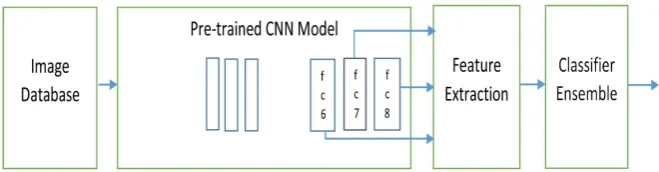
We propose a new Deep Multi-Layer (DM-L) Based Feature Extraction and Classifier Ensemble system for object recognition in this work. Our proposed
system builds on the concepts in [14][15] and it is based on utilizing the
learn-ing capabilities of advanced pre-trained CNN architectures by uslearn-ing deep mul-tiple layers to extract features from image databases for Object Recognition purposes. Hence our system exploits the learning achieved by the various deep layers contained in a Convolutional Neural Network (CNN) for feature extrac-tion. Since our proposed system makes use of the available pre-trained CNN models therefore it achieves substantial savings on the long training times asso-ciated with Deep Learning systems. It also uses a separate Ensemble of Classifi-ers approach to the classification task using the features extracted from the mul-tiple layers namely “fc6”, “fc7” and “fc8” layers of the CNN models instead of a single deepest fully connected layer. The block diagram of the proposed new
DM-L based object recognition system is shown in Figure 1 below with feature
extraction from multiple layers. The main characteristics and major sub-blocks of the proposed system are discussed below.
3.1. Image Database
The Benchmark Object Recognition database that we have considered in this
work is the Caltech-101 database from the Caltech object category datasets [19]
[20]. This database consists of various objects of 102 classes, including the
Google background object, and majority of the images in this database are of size 300 × 200 pixels. Most of the classes have about 50 images in the database while
some classes have more number of images. As suggested by Fie Fei Li in [19], we
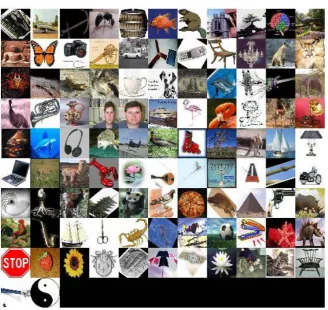
have considered 30 images per class in all of our simulations and experiments. This restriction on the unified number of images per class ensures unified treat-ment of each class without preferential treattreat-ment of class with large number of images such as the “airplanes” category. A montage of various classes of objects
[image:5.595.208.538.620.706.2]from this benchmark database is shown in Figure 2.
DOI: 10.4236/jsip.2018.92006 97 Journal of Signal and Information Processing
Figure 2. Montage of selected object images from Benchmark Caltech-101 database.
3.2. The Pre-Trained CNN Model
The CNNs are powerful Deep Learning systems that achieve learning by utilizing their deep architecture and extensive training on huge data sets. Our proposed system employs pre-trained CNN models to exploit their learning capabilities by using their deep layers for feature extraction from new databases through the
process of activations. Our approach thus builds on the work of Simonyan et al.
[14] and Zieler et al.[15] who studied the generalization of learning from one
trained system to new databases through activations. We have extended this concept to extracting features from multiple layers, their Dimensionality Reduc-tion and the subsequent use of a Classifier Ensemble instead of the Softmax layer for classification purposes. In order to overcome the shortcoming of very long training time required to train Deep Learning systems, the proposed DM-L based object recognition system makes use of popular pre-trained CNN models for Feature Extraction purposes. The pre-trained CNN models used in this work
include the VGG_16 and VGG_19 models [14] and these are available as Matlab
support packages [21][22]. These models have been trained extensively on the
ImageNet Benchmark object recognition database. The ImageNet database con-sists of about one million images of 1000 object classes and it is considered as a premier database in object recognition research. Since these models have already been trained on the ImageNet database, these models will be used in this work to
Cal-DOI: 10.4236/jsip.2018.92006 98 Journal of Signal and Information Processing
tech-101 database. This methodology enables us to use the learning of the pre-trained models to extract features from the Caltech-101 database.
3.3. Feature Extraction Stage
The Feature Extraction stage consists of two major processes i.e. the DM-L based
Feature Extraction and the subsequent Dimensionality Reduction of the ex-tracted feature vectors.
3.3.1. DM-L Based Feature Extraction
A conventional Deep Learning system used for image object recognition pur-poses, such as a CNN, consists of a large number of deep layers through which learning is achieved. The learning achieved by the various layers is progressive in nature with the earlier layers learning certain basic characteristics of the images while the deeper layers achieve learning about more detailed characteristics of the images. The proposed system extracts features from the deepest 3 fully con-nected layers of a pre-trained CNN model. These multiple layers are named as “fc6”, “fc7” and “fc8” with “fc8” being the deepest fully connected layer before the classification stage of the CNN. These DM-L based features are extracted from the pre-trained models using the “activations” function available in Matlab
[21][22]. It is emphasized here that conventional wisdom about CNNs suggests
using the deepest fully connected layer for feature extraction but we are propos-ing to use multiple deep layers for feature extraction and then selectpropos-ing the one that maximizes recognition performance. We use the Caltech-101 Benchmark Database to extract the feature vectors from the 3 mentioned deep multiple lay-ers of the pre-trained CNN models. These features capture the learning achieved by the pre-trained CNN models on the new Caltech-101 database. As mentioned earlier, the fully connected layers of CNNs have been used before for recognition
purposes [14] [15] but in this work we are proposing to use multiple layers of
CNNs for feature extraction along with an external Classifier Ensemble for rec-ognition purposes and this is a new novel approach that we have proposed in this work.
3.3.2. Dimensionality Reduction
DOI: 10.4236/jsip.2018.92006 99 Journal of Signal and Information Processing
system since the extracted feature vectors are of high dimension and their use without dimensionality reduction will overburden and confuse the system.
3.4. The Classifier Ensemble Stage
The use of the external classifier ensemble in this work is a novel approach to CNN based feature extraction and object recognition system’s implementation. The classification stage of a conventional CNN is based on the Softmax layer but our proposed system implements this stage through the use of the powerful en-semble of classifier technique available for classification purposes. The features extracted from the 3 deep multiple layers of the CNN Model are fed to the ex-ternal classifier ensemble. Our proposed system uses an ensemble of 15 base classifiers based on Linear Discriminant Analysis (LDA) technique to achieve excellent classification performance as will be demonstrated in the experimental
section. For training the Classifier Ensemble [23] we have used the popular
Bag-ging technique for ensemble training. For validation purposes, we have used the 10-fold cross validation strategy and have taken the average of 25 simulation runs as the recognition performance of the proposed system. Based on the rec-ognition performance, the system identifies the best feature vector from amongst the three multiple layer vectors for recognition purposes.
4. Experimental Setup and Results
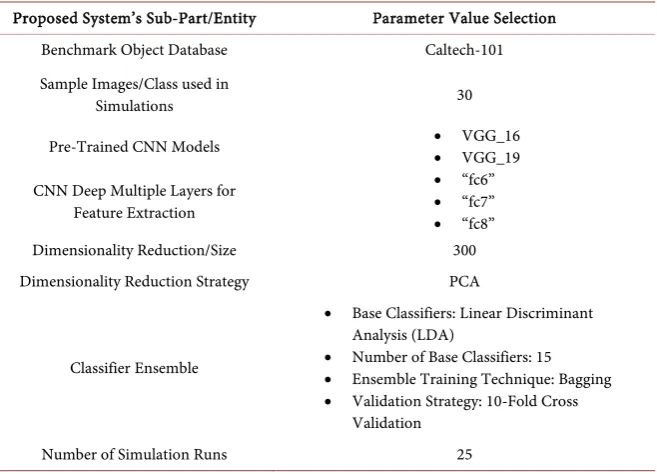
The experimental setup of the proposed DM-L based object recognition system consists of the selection of benchmark object recognition database, the pre-trained CNN models, the selection of deep multiple layers for feature extrac-tion, the dimensionality reduction size selection and the selection of the various parameters of the classifier ensemble that is used at the last stage of the proposed recognition system. The experimental setup of our proposed system is given in
Table 1.
We have performed a number of simulations to assess the recognition per-formance of the proposed system and the results of the experiments have been presented in the sub-sections given below.
4.1. Results of the Proposed System Using the Pre-Trained
VGG_16 Model
The VGG_16 Model [14] is a popular Deep Learning system that was originally
trained on some one million object images consisting of 1000 classes of the Im-ageNet benchmark database. This pre-trained model is available as Matlab
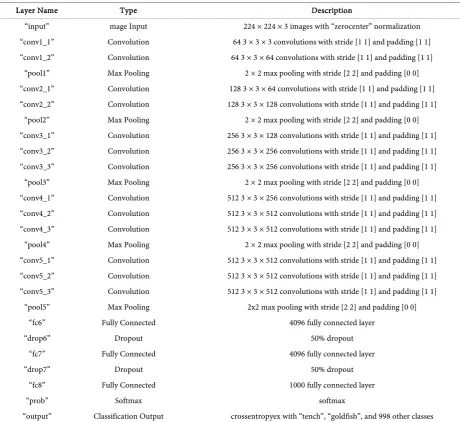
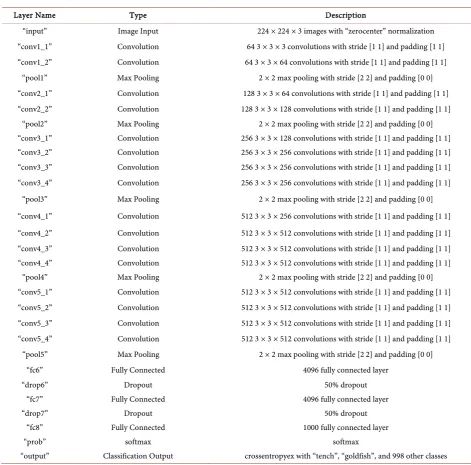
sup-port package [21]. The various layers of the VGG_16 Model are shown in Table
2. This model consists of a number of Convolution layers, Pooling layers, ReLU
layers and 3 Fully Connected layers. The ReLU layers have been customarily omitted from the table in order to present a concise representation of the model.
The 3 Fully Connected layers i.e. “fc6”, “fc7” and “fc8” are present in the last or
DOI: 10.4236/jsip.2018.92006 100 Journal of Signal and Information Processing
Table 1. System setup for the proposed DM-L based feature extraction and classifier
en-semble.
Proposed System’s Sub-Part/Entity Parameter Value Selection
Benchmark Object Database Caltech-101
Sample Images/Class used in
Simulations 30
Pre-Trained CNN Models •• VGG_16 VGG_19
CNN Deep Multiple Layers for Feature Extraction
• “fc6” • “fc7” • “fc8”
Dimensionality Reduction/Size 300
Dimensionality Reduction Strategy PCA
Classifier Ensemble
• Base Classifiers: Linear Discriminant Analysis (LDA)
• Number of Base Classifiers: 15 • Ensemble Training Technique: Bagging • Validation Strategy: 10-Fold Cross
Validation
Number of Simulation Runs 25
4.1.1. Visualization of the Achieved Learning by Layers of VGG_16 on Caltech-101
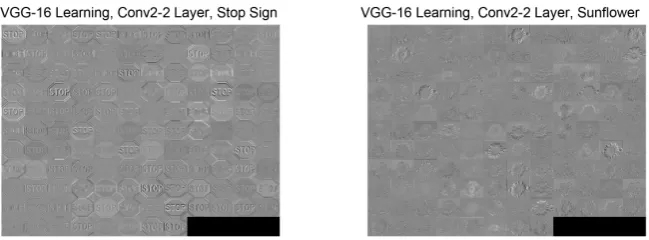
We highlight the learning achieved by various layers of the pre-trained VGG_16 model on the Caltech-101 by computing the relevant activations of these layers. The activations computed from convolutional layers named
“conv1_2” and “conv2_2” have been plotted as montage in Figure 3 and Figure
4 respectively.
It is clear from figures that the VGG_16 model’s initial layers have achieved learning about the shapes of various classes of the Caltech-101 database. The subsequent layers learn more detailed features from images as they travel through the deeper layers of the system.
4.1.2. DM-L Based Feature Vector Construction from VGG_16
The features extracted from the three fully connected multiple layers i.e. “fc6”,
“fc7” and “fc8” of VGG_16 pre-trained model are denoted as “Fea-tures_VGG_16_FC6”, “Features_VGG_16_FC7” and “Features_VGG_16_FC8” respectively. In order to reduce the dimensionality of the feature vectors we use the PCA technique which results in the following reduced dimensionality feature vectors:
DOI: 10.4236/jsip.2018.92006 101 Journal of Signal and Information Processing
Table 2. Pre-trained VGG_16 model for deep learning with “fc6”, “fc7” and “fc8”.
Layer Name Type Description
“input” mage Input 224 × 224 × 3 images with “zerocenter” normalization
“conv1_1” Convolution 64 3 × 3 × 3 convolutions with stride [1 1] and padding [1 1] “conv1_2” Convolution 64 3 × 3 × 64 convolutions with stride [1 1] and padding [1 1]
“pool1” Max Pooling 2 × 2 max pooling with stride [2 2] and padding [0 0]
“conv2_1” Convolution 128 3 × 3 × 64 convolutions with stride [1 1] and padding [1 1] “conv2_2” Convolution 128 3 × 3 × 128 convolutions with stride [1 1] and padding [1 1]
“pool2” Max Pooling 2 × 2 max pooling with stride [2 2] and padding [0 0]
“conv3_1” Convolution 256 3 × 3 × 128 convolutions with stride [1 1] and padding [1 1] “conv3_2” Convolution 256 3 × 3 × 256 convolutions with stride [1 1] and padding [1 1] “conv3_3” Convolution 256 3 × 3 × 256 convolutions with stride [1 1] and padding [1 1]
“pool3” Max Pooling 2 × 2 max pooling with stride [2 2] and padding [0 0]
“conv4_1” Convolution 512 3 × 3 × 256 convolutions with stride [1 1] and padding [1 1] “conv4_2” Convolution 512 3 × 3 × 512 convolutions with stride [1 1] and padding [1 1] “conv4_3” Convolution 512 3 × 3 × 512 convolutions with stride [1 1] and padding [1 1]
“pool4” Max Pooling 2 × 2 max pooling with stride [2 2] and padding [0 0]
“conv5_1” Convolution 512 3 × 3 × 512 convolutions with stride [1 1] and padding [1 1] “conv5_2” Convolution 512 3 × 3 × 512 convolutions with stride [1 1] and padding [1 1] “conv5_3” Convolution 512 3 × 3 × 512 convolutions with stride [1 1] and padding [1 1]
“pool5” Max Pooling 2x2 max pooling with stride [2 2] and padding [0 0]
“fc6” Fully Connected 4096 fully connected layer
“drop6” Dropout 50% dropout
“fc7” Fully Connected 4096 fully connected layer
“drop7” Dropout 50% dropout
“fc8” Fully Connected 1000 fully connected layer
“prob” Softmax softmax
[image:10.595.213.537.524.664.2]“output” Classification Output crossentropyex with “tench”, “goldfish”, and 998 other classes
Figure 3. Learning exhibited by VGG_16’s “conv1_2” layer on Caltech-101.
DOI: 10.4236/jsip.2018.92006 102 Journal of Signal and Information Processing
Figure 4. Learning Exhibited by VGG_16’s “conv2_2” Layer on Caltech-101.
feature vectors. These feature vectors are expressed as:
Features_VGG_16_FC6_Dropped = Features_ VGG_16_FC6[1: 10: end] (4) Features_VGG_16_FC7_ Dropped = Features_ VGG_16_FC7[1: 10: end] (5) Features_VGG_16_FC8_ Dropped = Features_ VGG_16_FC8[1: 3: end] (6) The simulations for the PCA based dimensionality reduced feature vectors use a size of 300 for all 3 feature vectors.
4.1.3. Proposed System’s Performance Using DM-L Based Features Extracted from VGG_16 Model
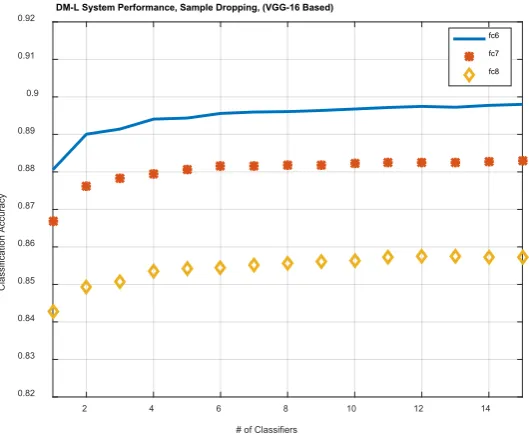
Instead of using the original Softmax Layer based classification scheme of the VGG-16 model, the proposed system uses an external Ensemble of Classifiers for final recognition decision. The multiple feature vectors are fed to the Classifier Ensemble system consisting of 15 base classifiers and the best layer feature vec-tor is identified based on the recognition performance. The Ensemble uses Li-near Discriminant Analysis (LDA) base classifiers and it uses the Bagging tech-nique for ensemble training. We have performed 10-fold cross validation and have taken average of 25 runs as the system’s recognition accuracy. Excellent recognition accuracy of 91.17% has been achieved for feature vectors extracted from the “fc6” layer. This performance has been achieved by using the PCA technique for dimensionality reduction thus enabling the classifier ensemble to achieve excellent results. The recognition performance of the new proposed DM-L based feature extraction and classifier ensemble technique using the
pre-trained VGG-16 model is listed in Table 3.
The plots of the proposed system’s recognition performance on the
Cal-tech-101 database using the pre-trained VGG-16 Model are shown in Figure 5
and Figure 6.
DOI: 10.4236/jsip.2018.92006 103 Journal of Signal and Information Processing
Figure 5. Performance using DM-L based features, sample dropping
(VGG_16).
Figure 6. Performance using DM-L based features, dimensionality
re-duction (VGG_16).
Table 3. Proposed system’s performance using DM-L based features extracted from
VGG_16.
Feature Type Recognition Accuracy (%)
Features_VGG_16_FC6_Dropped 89.80
Features_VGG_16_FC7_Dropped 88.29
Features_VGG_16_FC8_Dropped 85.72
Features_VGG_16_FC6_Reduced 91.17
Features_VGG_16_FC7_Reduced 88.69
Features_VGG_16_FC8_Reduced 86.04
2 4 6 8 10 12 14
# of Classifiers 0.82
0.83 0.84 0.85 0.86 0.87 0.88 0.89 0.9 0.91 0.92
Classification Accuracy
DM-L System Performance, Sample Dropping, (VGG-16 Based)
fc6 fc7 fc8
2 4 6 8 10 12 14
# of Classifiers 0.82
0.83 0.84 0.85 0.86 0.87 0.88 0.89 0.9 0.91 0.92
Classification Accuracy
DM-L System Performance, PCA Dimensionality Reduction, (VGG-16 Based)
[image:12.595.243.487.342.538.2] [image:12.595.197.540.619.732.2]DOI: 10.4236/jsip.2018.92006 104 Journal of Signal and Information Processing
not the “fc8” layer.
4.2. Results of the Proposed System Using the Pre-Trained
VGG_19 Model
The second pre-trained CNN Model that we have considered in this work is the
VGG-19 Model [14]. The VGG_19 Model is also another popular Deep Learning
system that was originally trained on some one million object images consisting of 1000 classes of the ImageNet benchmark database. This pre-trained model is
also available as Matlab support package [21]. The various layers of the
pre-trained VGG_19 Model, with the ReLU layers omitted for concise
[image:13.595.55.527.260.725.2]represen-tation, are shown in Table 4 below. The 3 Fully Connected layers i.e. “fc6”, “fc7”
Table 4. The pre-trained VGG_19 model for deep learning with “fc6”, “fc7” and “fc8”.
Layer Name Type Description
“input” Image Input 224 × 224 × 3 images with “zerocenter” normalization
“conv1_1” Convolution 64 3 × 3 × 3 convolutions with stride [1 1] and padding [1 1] “conv1_2” Convolution 64 3 × 3 × 64 convolutions with stride [1 1] and padding [1 1]
“pool1” Max Pooling 2 × 2 max pooling with stride [2 2] and padding [0 0]
“conv2_1” Convolution 128 3 × 3 × 64 convolutions with stride [1 1] and padding [1 1] “conv2_2” Convolution 128 3 × 3 × 128 convolutions with stride [1 1] and padding [1 1]
“pool2” Max Pooling 2 × 2 max pooling with stride [2 2] and padding [0 0]
“conv3_1” Convolution 256 3 × 3 × 128 convolutions with stride [1 1] and padding [1 1] “conv3_2” Convolution 256 3 × 3 × 256 convolutions with stride [1 1] and padding [1 1] “conv3_3” Convolution 256 3 × 3 × 256 convolutions with stride [1 1] and padding [1 1] “conv3_4” Convolution 256 3 × 3 × 256 convolutions with stride [1 1] and padding [1 1]
“pool3” Max Pooling 2 × 2 max pooling with stride [2 2] and padding [0 0]
“conv4_1” Convolution 512 3 × 3 × 256 convolutions with stride [1 1] and padding [1 1] “conv4_2” Convolution 512 3 × 3 × 512 convolutions with stride [1 1] and padding [1 1] “conv4_3” Convolution 512 3 × 3 × 512 convolutions with stride [1 1] and padding [1 1] “conv4_4” Convolution 512 3 × 3 × 512 convolutions with stride [1 1] and padding [1 1]
“pool4” Max Pooling 2 × 2 max pooling with stride [2 2] and padding [0 0]
“conv5_1” Convolution 512 3 × 3 × 512 convolutions with stride [1 1] and padding [1 1] “conv5_2” Convolution 512 3 × 3 × 512 convolutions with stride [1 1] and padding [1 1] “conv5_3” Convolution 512 3 × 3 × 512 convolutions with stride [1 1] and padding [1 1] “conv5_4” Convolution 512 3 × 3 × 512 convolutions with stride [1 1] and padding [1 1]
“pool5” Max Pooling 2 × 2 max pooling with stride [2 2] and padding [0 0]
“fc6” Fully Connected 4096 fully connected layer
“drop6” Dropout 50% dropout
“fc7” Fully Connected 4096 fully connected layer
“drop7” Dropout 50% dropout
“fc8” Fully Connected 1000 fully connected layer
“prob” softmax softmax
DOI: 10.4236/jsip.2018.92006 105 Journal of Signal and Information Processing
and “fc8” are present in the last part of the model. Some of the architectural dif-ferences between the pre-trained VGG_16 and VGG_19 Models are evident in
the deeper convolutional layers as shown in Table 3 and Table 4.
4.2.1. Visualization of the Achieved Learning by Layers of VGG_19 for Caltech-101
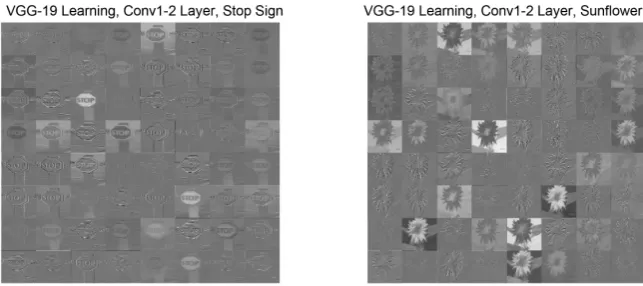
Similar to the previous pre-trained CNN model, the activations computed from convolutional layers named “conv1_2” and “conv2_2” for the Caltech-101
[image:14.595.209.531.384.527.2]data-base using the VGG-19 Model have been plotted as montage in Figure 7 and
Figure 8 respectively.
The figures show the learning that has been achieved by the pre-trained VGG-19 based object recognition system’s initial layers. More detailed learning is achieved as images travel through the deeper layers of the system.
4.2.2. DM-L Based Feature Vector Construction from VGG_19
Similar to the previous model, the features extracted from the three fully
con-nected multiple layers i.e. “fc6”, “fc7” and “fc8” of VGG_19 pre-trained model
are denoted as “Features_VGG_19_FC6”, “Features_VGG_19_FC7” and “Fea-tures_VGG_19_FC8” respectively. Similarly, in order to reduce the dimensional-ity of the feature vectors we use the PCA technique which results in the follow-ing reduced dimensionality feature vectors:
[image:14.595.211.535.561.704.2]Figure 7. Learning exhibited by VGG_19’s “conv1_2” layer on Caltech-101.
DOI: 10.4236/jsip.2018.92006 106 Journal of Signal and Information Processing
Features_VGG_19_FC6_Reduced = PCA(Features_ VGG_19_FC6) (7) Features_VGG_19_FC7_Reduced = PCA(Features_ VGG_19_FC7) (8) Features_VGG_19_FC8_Reduced = PCA(Features_ VGG_19_FC8) (9) In this case too, the dimensions of the feature vectors extracted from the “fc6” and “fc7” layers are 4096x1 per example and those of the “fc8” are of dimension 1000x1. Here too, we have also computed the recognition performance of the system for these feature vectors by dropping every tenth value for the “fc6” and “fc7” layers based feature vectors and every third value for the “fc8” layer based feature vectors. These feature vectors are expressed as:
Features_VGG_19_FC6_Dropped = Features_ VGG_19_FC6[1: 10: end] (10) Features_VGG_19_FC7_Dropped = Features_ VGG_19_FC7[1: 10: end] (11) Features_VGG_19_FC8_Dropped = Features_ VGG_19_FC8[1: 3: end] (12) Like the previous model, the simulations for the PCA based dimensionality reduced feature vectors for the VGG-19 model also use a size of 300 for all 3 feature vectors.
4.2.3. Classifier Ensemble Performance Using DM-L Based Features Extracted from VGG_19 Model
Similar to the previous model, the feature vector extracted from the three
mul-tiple layers i.e. “fc6”, “fc7” and “fc8” of the VGG_19 pre-trained model are fed to
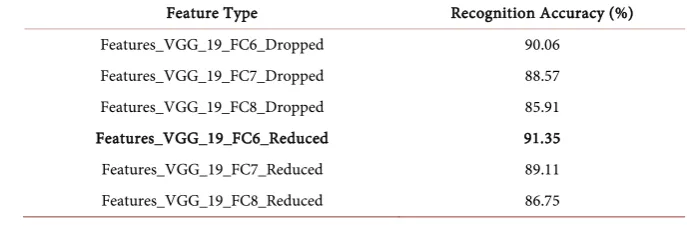
the Classifier Ensemble consisting of 15 base classifiers. Similarly, the best layer feature vector is identified based on the recognition performance. Once again, the feature vectors extracted from the “fc6” layer have achieved excellent recog-nition accuracy of 91.35%. The recogrecog-nition performance of the new proposed
system using the pre-trained VGG-19 model is listed in Table 5 below.
Figure 9 and Figure 10 show the plots of the proposed system’s recognition
[image:15.595.195.539.616.734.2]performance using the pre-trained VGG-19 Model on the Caltech-101 database. Once again, it is clear from the plots that “fc6” layer based feature vector has outperformed other layers based feature vectors in the object recognition task. For the VGG-19 Model also, the above results highlight that the best layer to be considered for feature extraction is “fc6” layer and not the last fully connected layer. It is mentioned here that VGG-19 is a deeper network compared to VGG-16 and hence it has achieved better performance compared to VGG-16
Table 5. Proposed system’s performance using DM-L based features extracted from
VGG_19.
Feature Type Recognition Accuracy (%)
Features_VGG_19_FC6_Dropped 90.06
Features_VGG_19_FC7_Dropped 88.57
Features_VGG_19_FC8_Dropped 85.91
Features_VGG_19_FC6_Reduced 91.35
Features_VGG_19_FC7_Reduced 89.11
DOI: 10.4236/jsip.2018.92006 107 Journal of Signal and Information Processing
Figure 9. Performance using DM-L based features, sample dropping
(VGG_19).
Figure 10. Performance using DM-L based features, dimensionality
re-duction (VGG_19).
based feature extraction.
5. Summary of Results
The results obtained from our simulations have been summarized in Table 6. It
is clear from the results that the fully connected layer “fc6” has outperformed the other two deeper layers of the 2 pre-trained CNN models that we have consi-dered in this work. The achieved results highlight the importance of considering multiple deeper layers for feature extraction purposes and then selecting the
2 4 6 8 10 12 14
# of Classifiers 0.82
0.83 0.84 0.85 0.86 0.87 0.88 0.89 0.9 0.91 0.92
Classification Accuracy
DM-L System Performance, Sample Dropping, (VGG-19 Based)
fc6 fc7 fc8
2 4 6 8 10 12 14
# of Classifiers 0.82
0.83 0.84 0.85 0.86 0.87 0.88 0.89 0.9 0.91 0.92
Classification Accuracy
DM-L System Performance, PCA Dimensionality Reduction, (VGG-19 Based)
[image:16.595.242.487.344.551.2]DOI: 10.4236/jsip.2018.92006 108 Journal of Signal and Information Processing
Table 6. Summary of results of the proposed system’s performance.
Feature Type Recognition Accuracy (%)
Features_VGG_16_FC6_Dropped 89.80
Features_VGG_16_FC7_Dropped 88.29
Features_VGG_16_FC8_Dropped 85.72
Features_VGG_16_FC6_Reduced 91.17
Features_VGG_16_FC7_Reduced 88.69
Features_VGG_16_FC8_Reduced 86.04
Features_VGG_19_FC6_Dropped 90.06
Features_VGG_19_FC7_Dropped 88.57
Features_VGG_19_FC8_Dropped 85.91
Features_VGG_19_FC6_Reduced 91.35
Features_VGG_19_FC7_Reduced 89.11
Features_VGG_19_FC8_Reduced 86.75
layer that gives the best recognition performance.
6. Comparison of Results with State-of-the-Art
We have obtained results of 91.17% and 91.35% for the VGG-16 and VGG-19 pre-trained models respectively and our results are comparable with the
state-of-the-art in [14][15]. Our research has shown that it is prudent to use the
multiple layers for feature extraction since the earlier fully connected layers may contain valuable information about the features of the images. The state-of-the-art
in [14] has also removed the last fully connected layer i.e. the “fc8” in their work
and our results also highlights this phenomena since the “fc6” based feature ex-traction has outperformed the last layer based feature vectors for object recogni-tion purposes. Extracting feature vectors based on multiple layers of CNNs may be computationally expensive but the higher accuracies achievable by selecting the best layer for recognition may be worth the computational burden. The same is true for the classifier ensemble usage but the accuracy of the achieved results validates the use of the classifier ensemble for classification and recognition tasks.
7. Conclusions and Future Research Directions
DOI: 10.4236/jsip.2018.92006 109 Journal of Signal and Information Processing
the fusion of feature vectors from various layers may enhance the recognition performance of the system. We also plan to consider other pre-trained CNN models for feature extraction and compare the performance of subject feature vectors on other Benchmark Databases.
Acknowledgements
The research support and research opportunities provided by the Arab Open University (AOU) are highly appreciated and acknowledged by the author. This work has been made possible due to the positive research environment at AOU and a great desire on part of the management to develop a thriving research cul-ture at AOU.
References
[1] Buduma, N. (2017) Fundamentals of Deep Learning Designing Next-Generation Machine Intelligence Algorithms. O’Reilly Media, Sebastopol, CA.
[2] Bengio, Y.I., Goodfellow, J. and Courville, A. (2016) Deep Learning. MIT Press, Cambridge, MA. http://www.deeplearningbook.org
[3] Nielsen, M.A. (2015) Neural Networks and Deep Learning.
http://neuralnetworksanddeeplearning.com/
[4] LeCun, Y., Bottou, L., Bengio, Y. and Haffner, P. (1998) Gradient-Based Learning Applied to Document Recognition. Proceedings of the IEEE, 86, 2278-2324.
https://doi.org/10.1109/5.726791
[5] Krizhevsky, A., Sutskever, I. and Hinton, G.E. (2012) Imagenet Classification with Deep Convolutional Neural Networks. In: Advances in Neural Information
Processing Systems, 1097-1105.
[6] Simonyan, K., Vedaldi, A. and Zisserman, A. (2013) Deep Inside Convolutional Networks: Visualising Image Classification Models and Saliency Maps. arXiv pre-print arXiv:1312.6034.
[7] Karpathy, A., Toderici, G., Shetty, S., Leung, T., Sukthankar, R. and Fei-Fei, L. (2014) Large-Scale Video Classification with Convolutional Neural Networks.
Pro-ceedings of the IEEE Conference on Computer Vision and Pattern Recognition,
1725-1732. https://doi.org/10.1109/CVPR.2014.223
[8] Wei, Y., Xia, W., Huang, J., Ni, B., Dong, J., Zhao, Y. and Yan, S. (2014) CNN: Sin-gle-Label to Multi-Label. arXiv preprint arXiv:1406.5726.
[9] Sermanet, P., Eigen, D., Zhang, X., Mathieu, M., Fergus, R. and LeCun, Y. (2013) Overfeat: Integrated Recognition, Localization and Detection Using Convolutional Networks. arXiv preprint arXiv:1312.6229.
[10] Szegedy, C., Liu, W., Jia, Y., Sermanet, P., Reed, S., Anguelov, D., et al. (2015) Going Deeper with Convolutions. CVPR.
[11] He, K., Zhang, X., Ren, S. and Sun, J. (2016) Deep Residual Learning for Image Recognition. Proceedings of the IEEE Conference on Computer Vision and Pattern
Recognition, 770-778. https://doi.org/10.1109/CVPR.2016.90
[12] Girshick, R., Donahue, J., Darrell, T. and Malik, J. (2014) Rich Feature Hierarchies for Accurate Object Detection and Semantic Segmentation. Proceedings of the IEEE
Conference on Computer Vision and Pattern Recognition, 580-587.
DOI: 10.4236/jsip.2018.92006 110 Journal of Signal and Information Processing
[13] Gu, J., Wang, Z., Kuen, J., Ma, L., Shahroudy, A., Shuai, B. and Wang, G. (2015) Recent Advances in Convolutional Neural Networks. arXiv preprint arXiv:1512.07108 [14] Simonyan, K. and Zisserman, A. (2014) Very Deep Convolutional Networks for
Large-Scale Image Recognition. arXiv preprint arXiv:1409.1556.
[15] Zeiler, M.D. and Fergus, R. (2013) Visualizing and Understanding Convolutional Networks. arXiv preprint arXiv:1311.2901
[16] He, K., Zhang, X., Ren, S. and Sun, J. (2014) Spatial Pyramid Pooling in Deep Con-volutional Networks for Visual Recognition.arXiv preprint arXiv:1406.4729 [17] Chatfield, K., Simonyan, K., Vedaldi, A. and Zisserman, A. (2014) Return of the
Devil in the Details: Delving Deep into Convolutional Nets. arXiv preprint ar-Xiv:1405.3531
[18] Yang, J., Li, Y., Tian, Y., Duan, L. and Gao, W. (2009) Group-Sensitive Multiple Kernel Learning for Object Categorization. 12th International Conference on
Computer Vision, Kyoto, 29 September-2 October 2009, 436-443.
[19] Fei-Fei, L., Fergus, R. and Perona, P. (2007) Learning Generative Visual Models from Few Training Examples: An Incremental Bayesian Approach Tested on 101 Object Categories. Computer Vision and Image Understanding, 106, 59-70.
https://doi.org/10.1016/j.cviu.2005.09.012
[20] Griffin, G., Holub, A. and Perona, P. (2007) Caltech-256 Object Category Dataset.
http://authors.library.caltech.edu
[21] MATLAB Neural Network Toolbox. https://www.mathworks.com/help/nnet/ref/ [22] Machine Learning with MATLAB, MathsWorks.
http://www.mathworks.com/solutions/machine-learning.html
[23] Zhou, Z., Wu, J. and Tang, W. (2002) Ensembling Neural Networks: Many Could Be Better than All. Artificial Intelligence, 137, 239-263.