CANCER PREDICTION TECHNIQUE USING FUZZY LOGIC
1
Poongodi, M.,
2Manjula, L.,
1Department of CSE, Rajalakshmi Institution of
2Department of Maths, Rajalakshmi Institution of Technology
ARTICLE INFO ABSTRACT
Thousands of people die every year because of cancer due to limitation of medical sources and unable to use the existing sources effectively. Loss of patients can be reduced by using the numerical (quantitative) techniques in the system of Medical and Health. Cancer is a genetic disease which is developed by the abnormal cell increase and cell grow
damage and cells being out of the Program.
would be that successful. In this study, the risks of getting cancer for selected pilot people will be discovered by applying the mamdani Fuz
persons to eliminate these risks. In order to resolve the problem, the available figures have been evaluated; leading method and sample have been presented together with fuzzy logic model as a new mod
fuzzy logic model enables to provide effective results depending on uncertain verbal knowledge just like logic of human being. When received good results from the st
prediagnosis for the people who possibly can have risk of getting cancer due to working conditions or living standards therefore; this will enable these people to take precautions to the risk of cancer. Besides, the contribution
intelligence will also be examined in this study.
INTRODUCTION
Fuzzy logic is a logic structure that emerged as a result of an article published by Lütfi Askerzade published in 1961. Fuzzy logic is based on fuzzy cluster and sub-clusters. In classical approach, an existence is either an element of a cluster or is not. If expressed in mathematical terms, when an existence is an element of a cluster in terms of membership relation with the cluster, it takes a value of “1" and when it is not an element of the cluster, it takes a value of “0". Fuzzy logic is an expansion of classical cluster indication. Each existence has a membership degree in fuzzy existence cluster Membership degree of existences may range between (0, 1).Contrary to classical clusters, membership degrees of fuzzy cluster elements [0, 1 interval] may vary at infinite num
are a cluster together with their constant and uninterrupted integrity of their membership degrees. Binary variables such as cold-hot, fast-slow, light-dark in precise clusters are softened by flexible qualifiers such as slightly cold, slightly hot, slightly dark and they are simulated to real world. The most important difference is that there are no precisely defined preconditions of cluster membership, which is at the source of information under this umbrella, and there are mor
and random variables. Bit characteristic of fuzzy logic is that
*Corresponding author:[email protected]
ISSN: 0975-833X
International Journal of Current Research
Vol.
Article History: Received 25th
November, 2011 Received in revised form 24th
December, 2011 Accepted 28th
January, 2011 Published online 29th
February, 2012 Key words: Fuzzy logic, Cancer, Risk, Analysis, Mamdani..
RESEARCH ARTICLE
CANCER PREDICTION TECHNIQUE USING FUZZY LOGIC
Manjula, L.,
1Pradeepkumar, S. and
3Umadevi, M.
Department of CSE, Rajalakshmi Institution of Technology Department of Maths, Rajalakshmi Institution of Technology
3
Department of IT, AEC
ABSTRACT
Thousands of people die every year because of cancer due to limitation of medical sources and unable to use the existing sources effectively. Loss of patients can be reduced by using the numerical (quantitative) techniques in the system of Medical and Health. Cancer is a genetic disease which is developed by the abnormal cell increase and cell grow
damage and cells being out of the Program. The earlier cancer is diagnosed, so the treatment would be that successful. In this study, the risks of getting cancer for selected pilot people will be discovered by applying the mamdani Fuzzy Logic Model and suggestions will be submitted to the persons to eliminate these risks. In order to resolve the problem, the available figures have been evaluated; leading method and sample have been presented together with fuzzy logic model as a new modality. The reason for selection of fuzzy logic model in this study is that the system uses fuzzy logic model enables to provide effective results depending on uncertain verbal knowledge just like logic of human being. When received good results from the study; our system will make a prediagnosis for the people who possibly can have risk of getting cancer due to working conditions or living standards therefore; this will enable these people to take precautions to the risk of cancer. Besides, the contribution of fuzzy logic model in the field of health and topics of artificial intelligence will also be examined in this study.
Copy Right, IJCR, 2012, Academic Journals
Fuzzy logic is a logic structure that emerged as a result of an article published by Lütfi Askerzade published in 1961. Fuzzy clusters. In classical approach, an existence is either an element of a cluster or is If expressed in mathematical terms, when an existence is an element of a cluster in terms of membership relation with the cluster, it takes a value of “1" and when it is not an element of the cluster, it takes a value of “0". Fuzzy logic is an f classical cluster indication. Each existence has a membership degree in fuzzy existence cluster Membership degree of existences may range between (0, 1).Contrary to classical clusters, membership degrees of fuzzy cluster at infinite num-bers. They are a cluster together with their constant and uninterrupted integrity of their membership degrees. Binary variables such dark in precise clusters are y cold, slightly hot, slightly dark and they are simulated to real world. The most important difference is that there are no precisely defined preconditions of cluster membership, which is at the source of information under this umbrella, and there are more problems and random variables. Bit characteristic of fuzzy logic is that
data are taken by sampling and it is assumed that they represent the whole and a probability is obtained accordingly. Thousands of people die every year because of cancer due to limitation of medical sources and unable to use the existing sources effectively. Loss of patients can be reduced by using the numerical (quantitative) techniques in the system of Medical and Health. The mathematical models can be used in any place where decision making problem is appeared. Cancer is a genetic disease which is developed by the abnormal cell increase and cell growth as a result of DNA damage and cells being out of the Program.The earlier cancer is diagnosed, so the treatment would be that successful. If the medical manage to use the techniques such as fizzy logic in t
many diseases like cancer could reach to the condition of treatment owing to early diagnosis or be prevented. So there would not be a necessity for expensive operations. Nowadays, most people who have cancer; apply to hospitals at the stage of disease progression and therefore the disease is not diagnosed earlier. So the treatments are usually useless and the patient dies at short time. One of the important issues is to focus on prospective cancer disease diagnosis for fit people.The purpose of this study is to identify a type of cancer, risk for fit people who can possibly get cancer and to make early diagnosis. Based on this, the type of cancer for upcoming study will be identified then the factors which develop the cancer type; will be exa
ternational Journal of Current Research
Vol. 4, Issue, 02, pp.106-110, February,2012
INTERNATIONAL
OF CURRENT RESEARCH
Umadevi, M.
Thousands of people die every year because of cancer due to limitation of medical sources and unable to use the existing sources effectively. Loss of patients can be reduced by using the numerical (quantitative) techniques in the system of Medical and Health. Cancer is a genetic disease which is developed by the abnormal cell increase and cell growth as a result of DNA The earlier cancer is diagnosed, so the treatment would be that successful. In this study, the risks of getting cancer for selected pilot people will be zy Logic Model and suggestions will be submitted to the persons to eliminate these risks. In order to resolve the problem, the available figures have been evaluated; leading method and sample have been presented together with fuzzy logic model as a ality. The reason for selection of fuzzy logic model in this study is that the system uses fuzzy logic model enables to provide effective results depending on uncertain verbal knowledge udy; our system will make a prediagnosis for the people who possibly can have risk of getting cancer due to working conditions or living standards therefore; this will enable these people to take precautions to the risk of cancer. of fuzzy logic model in the field of health and topics of artificial
, Academic Journals. All rights reserved.
data are taken by sampling and it is assumed that they represent the whole and a probability is obtained accordingly. Thousands of people die every year because of cancer due to limitation of medical sources and unable to use the existing ly. Loss of patients can be reduced by using the numerical (quantitative) techniques in the system of Medical and Health. The mathematical models can be used in any place where decision making problem is appeared. Cancer oped by the abnormal cell increase and cell growth as a result of DNA damage and cells being out of the Program.The earlier cancer is diagnosed, so the treatment would be that successful. If the medical manage to use the techniques such as fizzy logic in their own field, many diseases like cancer could reach to the condition of treatment owing to early diagnosis or be prevented. So there would not be a necessity for expensive operations. Nowadays, most people who have cancer; apply to hospitals at the stage of disease progression and therefore the disease is not diagnosed earlier. So the treatments are usually useless and the patient dies at short time. One of the important issues is to focus on prospective cancer disease diagnosis for fit of this study is to identify a type of cancer, risk for fit people who can possibly get cancer and to make early diagnosis. Based on this, the type of cancer for upcoming study will be identified then the factors which develop the cancer type; will be examined. After the
implications are made, these factors will be used in the model of fuzzy logic Mamdani type. As a result with the fuzzy logic model: the risk for the identified type of cancer of person has been analysed and made early diagnosis. Within this scope, breast cancer has been selected as a pilot cancer type. The reason for selection of Breast cancer is that this cancer is appropriate for this study and frequency of this cancer. In this study, the risks for people who possibly can get cancer will be discovered by applying Mamdani Fuzzy Logic Model and suggestions will be submitted to persons to eliminate these risks. In order to resolve the problem, the available figures have been evaluated; leading method and sample have been presented together with fuzzy logic model as a new modality. The reason for selection of fuzzy logic model in this study is that the system uses fuzzy logic model enables to provide effective results depending on uncertain verbal information just like logic of human being. The purpose of this study is to examine the usability of Fuzzy Logic Model in the light of existing figures and to evaluate the obtained results and share.
FUZZY LOGIC
Fuzzy logic aims to model human thinking and reasoning and to apply the model to problems according to needs. It tries to equip computers with the ability to process special data of humans and to work by making use of their experiences and insights. When human logic solves problems, it creates verbal rules such as “if <event realized> is this, the <result> is that". Fuzzy logic tries to adapt these verbal rules and the ability to make decisions of humans to machines/computers. It uses verbal variables and terms together with verbal rules. Verbal rules and terms used in human decision-making process are fuzzy rather than precise. Adapting human logic system to computers/machines will increase problem-solving ability of computers/machines. Verbal terms and variables are expressed mathematically as membership degrees and membership functions. Fuzzy decision- making mechanisms use symbolic verbal phrases instead of numeric values. Trans-ferring these symbolic verbal phrases to computers are based on mathematics. This mathematical basis is fuzzy logic. Sys-tems that use fuzzy logic are alternatives to the difficulty of mathematical modelling of complex non-linear problems and fuzzy logic meets mathematical modelling requirement of a system. Systems that use fuzzy logic can produce effective results based on indefinite verbal knowledge like humans. In fuzzy logic, information is verbal phrases such as big, small, very, few etc. instead of numeric values. If a system’s behaviour can be expressed by rules or requires very complex non-linear processes, fuzzy logic approach can be applied in this system.
A. Mamdani’s Fuzzy Inference Method
Mamdani’s fuzzy inference method is the most commonly seen fuzzy methodology. Mamdani’s method was among the first control systems built using fuzzy set theory. It was proposed by Mamdani as an attempt to control a steam engine and boiler combination by synthesizing a set of linguistic control rules obtained from experienced human operators. Mamdani’s effort was based on Zadeh’s (1973) paper on fuzzy algorithms for complex systems and decision processes. Mamdani type inference, as defined it for the Fuzzy Logic Toolbox, expects the output membership functions to be fuzzy
sets. After the aggregation process, there is a fuzzy set for each output variable that needs defuzzification. It is possible, and in many cases much more efficient, to use a single spike as the output membership function rather than a distributed fuzzy set. This is sometimes known as a singleton output membership function, and it can be thought of as a pre-defuzzified fuzzy set. It enhances the efficiency of the defuzzification process because it greatly simplifies the computation required by the more general Mamdani method, which finds the centroid of a two-dimensional function. Rather than integrating across the two-dimensional function to find the centroid, the weighted average of a few data points. Sugeno type systems support this type of model. In general, Sugeno type systems can be used to model any inference system in which the output membership functions are either linear or constant.
III. CANCER
Cancer is a class of diseases in which a group of cell display uncontrolled growth through division beyond normal limits, invasion that intrudes upon and destroys adjacent tissues, and sometimes metastasis, which spreads the cells to other loca-tions in the body via lymph or blood. These three malignant properties of cancers differentiate them from benign tumours, which are self-limited, and do not invade or metastasize. Cancers are primarily an environmental disease with 90-95% of cases due to lifestyle and environmental factors and 5-10% due to heredity.[1] Common environmental factors leading to cancer death include: tobacco (25-30%), diet and obesity (30-35%), infections (15-20%), radiation, stress, lack of physical activity, and environmental pollutants. These environmental factors cause abnormalities in the genetic material of cells. Genetic abnormalities found in cancer typically affect two general classes of genes ontogenesis and tumour suppressor genes. Definitive diagnosis requires the examination of a biopsy specimen, although the initial indication of malignancy can be symptomatic or radiographic. Most cancers can be treated and this may include chemotherapy and radiotherapy and/or surgery. The prognosis is most influenced by the type of cancer and the extent of disease. While cancer can affect people of all ages the risk typically increasing with age. In 2004 cancer caused about 13% of all human deaths (7.6 million).
A. Breast Cancer
Breast cancer is the most common cancer type in the world excepting skin cancer and it takes the second place after the lung cancer between the deaths of cancer. The frequency of breast cancer changes from country to country. It is argued that the following factors play role in developing of breast cancer.
Gender: Being a woman is already a factor for breast cancer.
The breast cancer is seen 99% in women, 1% in men.
Age: The risk of breast cancer increases as the age goes by.
77% of patients who are just diagnosed by breast cancer, 84% of them who die from breast cancer are over-50-year-old people.
other one as 2-6 times; atopic hyperplasia as 4-5 times.
Genetic: having a history of cancer in the family, mutation in
BRCA-1 and BRCA-2 genes and P53 gene increases the cancer risk. While the occurrence risk of cancer in a mother of someone has a breast cancer is 8,8; this ratio for her sister 2,7, daughter 4,6. Only 10-15% of breast cancers is based on genetic.
Menarche Age: It is shown that early menarche (period) is a
risky factor in development of breast cancer. Regular menstruation starting period is also important following to the menarche. Risk of getting breast cancer for people who have early Menarche (before 12) and go through the regular menstruation in short time; is 4 times more than others.
Menopause Age: There is relation between Breast Cancer
risk and Menopause Age. Breast cancer risk in women who are in menopause before the age of 45 is as much menopause as half of in women who are in menopause after the age of 55.
Pregnancy Age: Never getting pregnant and getting preg-nant
the first time over the age of 30 increases the risk of breast cancer. The cancer risk for women who give birth after the age of 30 is 4 times more than the women before 20.
Nutrition: It is explained that nourishing with higher
consumption of oil increases the risk of breast cancer, low consumption from tendon is subject to discussion.
Body Weight: The low body weight in Pre-menopause period
and high body weight in post menopause period increase the risk of breast cancer.
Alcohol Consumption: Alcohol increases the breast can-cer
risk.
Exercise: It is explained that exercise made in the period of
Adolescence and adulthood by the women under the age of 40 decreases the breast cancer risk
Radiation Exposure: Radiation exposure especially under the age of 30 and before puberty increases the breast cancer risk.
Risk Factors in Breast Cancer:
Being a woman Being at the old age
History of breast cancer in first degree relative Cancer in the breast before or atopic hyperplasia
Mutation in genes of BRCA-1 and BRCA-2 Menarche under the age of 12
Menopause period over the age of 55 Giving first birth over the age of 30 Daily Alcohol Usage
Fat Diet
Prevention from Breast Cancer: It is not in question to full prevention from cancer as the etiology of breast cancer is not really clear and risk factors are not really controllablefactors. However the following precautions may decrease the breast cancer risk.
Breast-Feeding :Giving birth to first child before the age of 30 Exercising 3 times a week
Tamoxifen Usage: One of the methods applied in breast cancer prevention is tamoxifen usage. The studies show that usage of tamoxifen especially appropriate for the women in menopause and the ones who have the highest risk of breast cancer.
Prophylactic Mastectomy: One of the other methods is Prophylactic Mastectomy. It is explained that this method decreases the breast cancer development 90% in women who have high risk.
IMPLEMENTATION
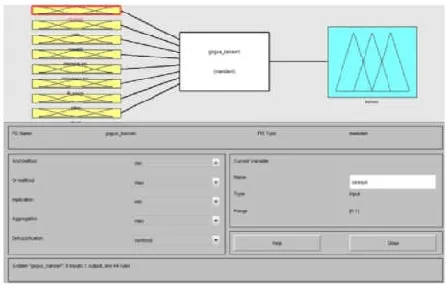
After the identification of cancer type and risk factors of this cancer; model design has been initiated. The Fuzzy Logic model in type of Mamdani for Breast Cancer has been devel oped. Gender, age, genetic status, menarche age, is not really clear and risk factors are not really controllable age, first birth age, alcohol consumption and nutrition habit as factors have been identified in the model of Breast Cancer. In accordance with these factors, membership degree of 8 different factors has been determined. As a result of outcome from these 8 factors, the risk status of this person to that type of cancer has been analysed within the model. (Extremely risky, risky, low risk and healthy) (see Figures 1 and 2)
[image:3.612.326.549.362.507.2]
Fig. 1. Fuzzy Logic Breast Cancer Model
After the determination of Membership Functions and De-grees, the model principle has been done in the direction of current figures and learned opinion. Model with 44 principles has been tested with the available figures and to reach the optimum level. (see Figures 3 and 4). It is seen that it has been reached to optimum level by testing our system analyses the cancer risk with the figures of available patients and healthy people for respective cancer type and model. It has been calculated that the performance of the system in this task is 87%.
CONCLUSION
of cancer type. The reason for selection of fuzzy logic model in this study is that the system uses fuzzy logic model enables to provide effective results depending on uncertain verbal knowledge just like logic of human being. The quality of fuzzy logic model usage here is to reach a general solution by doing only limited experiments. It takes long time to use the other methods for such problem. The fuzzy logic provides the quickest solution to the problem prevents to lose. Mamdani has been designed in this study .As a result of the implementation; system has become successful between the rates of 80%-85%. The risk analysis has been tested on the system by using the figures of patient and healthy people in order to measure the performance and acceptability of the
study. But, it could not be verified 100% accuracy on the system as the risk status of the person who has the lower risk ; may change in the future together with different living conditions and factors. In the direction of risk analysis made to 97 of 120 people in test set, the system has correctly conducted. At the end of the study, it has achieved to the success of 81% with the system.
REFERENCES
[1] S. N. Sivanandam, S. Sumathi and S. N. Deepa,
[2] T. J. Ross, Fuzzy Logic with Engineering Applications, USA, 2004.
[3] G. J. Klir and B. Yuan, Fuzzy Sets and Fuzzy Logic -
Theory and Applications, USA 1995.
[4] F. M. McNeill and E. Thro, Fuzzy Logic - Practical
Approach, USA, 1994
[5] J. M. Mendel, Fuzzy Logic Systems for Engineering: A
Tutorial, Pro-ceedings of the IEEE Vol:83 No: 3, 1995.
[6] E.Pi¸skin, Meme Kanseri ve Kendi Kendine Meme
Muayenesi, Bursa Saglikˇ Müdürlügüˇ.
[7] A.Özdemir, Meme Radyolojisi, Tanisal ve Giri¸silimsel
Radyoloji, 2000.
[8] A.Aydiner,E.Topuz, Meme Kanseri Tani-Tedavi-Takip,
Istanbul Konsen-susu, 2006.