Statement Voting
Bingsheng ZhangLancaster University [email protected]
Hong-Sheng Zhou
Virginia Commonwealth University [email protected]
December 29, 2018
Abstract
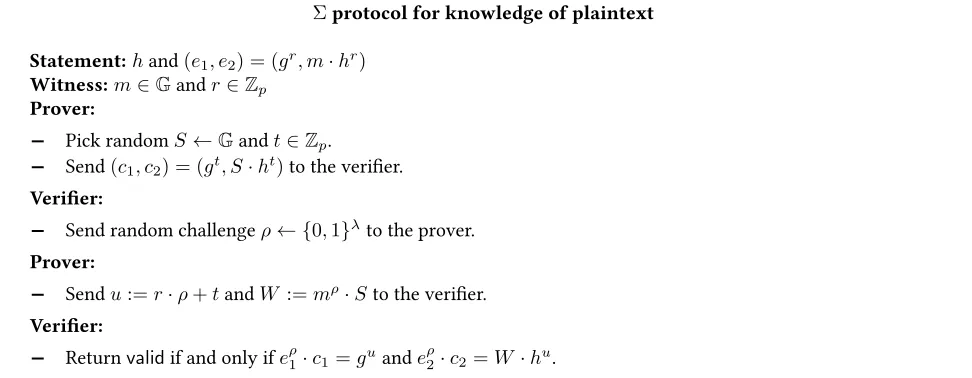
In this work, we introduce a new concept,statement voting. Statement voting can be viewed as a natural extension of traditional candidate voting. Instead of defining a fixed election candidate, each voter can define a statement in his or her ballot but leave the vote “undefined” during the voting phase. During the tally phase, the (conditional) actions expressed in the statement will be carried out to determine the final vote.
Contents
1 Introduction 1
2 Preliminaries 4
2.1 The UC framework . . . 4
2.2 Ideal functionalities . . . 5
2.3 Non-interactive zero-knowledge proofs/arguments . . . 5
3 Modeling 6 4 Homomorphic Encryption based construction 8 4.1 Key-homomorphic threshold fully homomorphic encryption . . . 9
4.2 Protocol description . . . 10
4.3 Security. . . 13
5 MPC based construction 13 5.1 Threshold PKE . . . 13
5.2 Protocol description . . . 15
5.3 Security. . . 17
6 Mix-net based construction 17 6.1 Threshold re-randomizable encryption . . . 18
6.2 Protocol description . . . 19
6.3 Security. . . 22
7 Application to Liquid Democracy 24 A Supplementary material for Section 4 28 A.1 Proof for Theorem 4.2 . . . 28
A.2 Instantiation of TFHE via GSW . . . 31
A.3 Fully homomorphic encryption . . . 33
A.4 Gentry-Sahai-Waters (GSW) construction. . . 34
A.5 LWE assumption. . . 36
B Supplementary material for Section 5 37 B.1 Proof for Theorem 5.2 . . . 37
C Supplementary material for Section 6 40 C.1 Proof for Theorem 6.2 . . . 40
C.2 Instantiation of TRE . . . 44
1
Introduction
Elections/Referendums provide people in each society with the opportunity to express their opinions in the collective decision making process. Unfortunately, the existing election/voting systems have many limitations and it often fails to serve the best interest of the people. For example, to make correct decisions, the voters have to invest tremendous effort to analyze the issues. The cost of identifying the best voting strategy is high, even if we assume that the voter has collected accurate information. In addition, misinformation campaigns often influence the voters to select certain candidates which could be against the voters’ own interests. We here ask the following challenging question:
Is it possible to introduce new technologies to circumvent the implementation barriers so that more effective democracy can be enabled?
We very much expect an affirmative answer because from a societal perspective, we need to ensure that these unmotivated/misinformed voters to participate in the process of decision making.
A new concept.We could approach the above problem via multiple angles. In this paper, we propose a new and clean concept: statement voting. Statement voting can be viewed as a natural extension of traditional candidate voting. Instead of defining a fixed election candidate, each voter can define a statement in his or her ballot but leave the vote “undefined” during the voting phase. During the tally phase, the (conditional) actions expressed in the statement will be carried out to determine the final vote. Single Transferable Vote (STV) is a special case of statement voting, where the voters rank the election candidates instead of naming only one candidate in their ballots. The ranked candidate list together with the STV tally rule can be viewed as an outcome-dependent statement. Roughly speaking, the statement declares that if my favorite candidate has already won or has no chance to win, then I would like to vote for my second favorite candidate, and so on.
Liquid democracy [For02], a hybrid of direct democracy and representative democracy, is another special case of statement voting; there, the voters can either vote directly on issues, or they can delegate their votes to representatives who vote on their behalf. The vote delegation can be expressed as a target-dependent statement, where a voter can define that his/her ballot is the same as the target voter’s ballot.
Careful readers may wonder why this type of natural voting idea has never appeared in thephysical world. First of all, conventional paper-voting ballot cannot handle complex statements. Moreover, in the reality, the voters care about privacy and anonymity. To ensure anonymity, the voters are not willing to leave their identities in the ballots. If no identities (or equivalences) are included in the ballots, then it is difficult for a statement refers to and depends on a particular voter’s ballot, such as liquid democracy. The election committees might assign each voter a temporal ID to achieve anonymity, but a voter needs to obtain the target voter’s temporal ID in order to delegate his vote. This requires secure peer-to-peer channels among all the voters, which is not practical. Before presenting our constructions, we first need to clearly define and model our security goal.
Modeling statement voting. We provide a rigorous modeling for statement voting. More concretely, we model statement voting in the well-known Universal Composability (UC) framework, via an ideal function-alityFSV. The functionality interacts with a set of voters, trustees, and consists of preparation phase, ballot
casting phase, and tally phase. During the preparation phase, the trustees, need to indicate their presence to
FSV. The election/voting will not start until all the trustees have participated in the preparation.
In our formulation, we introduce a working table W to trace the voters’ behavior. Each entry of the
working table is saved for storing one voter’s information including the voter’s original ID, his alternative ID, and the voting statement he submitted; During the ballot casting phase, each voter can submit his voting statement. These voting statements will be collected and recorded in working tableW. If a voter is corrupt,
The collected information in the working tableWwill be used in the tally phase for defining the privacy
leakage as well as the final result. More concretely, we compute a new tableUby first eliminating allVi’s in W, and then sorting all the entries lexicographically. This carefully defined tableUcan now be used to
define (1) the final result via applying a circuitTallyProcessonU, and (2) certain level of privacy leakageL.
Our formulation here allows us to define aclass of statement voting functionalities. For example, to define a functionality with strong privacy, we can setL := TallyProcess(U); we can also set L := Uto define a
functionality with relatively weaker privacy, or setL:=Wto define a functionality without privacy.
We emphasize that in practice, virtually all threshold cryptographic systems cannot achieve fairness; namely, during the opening process of a threshold cryptographic system, the last several share holders can jointly see the content to be opened themselves before hand. Hence, they can decide if they want to actually open the content. However, surprisingly, this subtle issue was rarely modeled in the literature. For instance, the only previously known e-voting functionality [Gro04] fails to address it. During the tally phase, the tally will be released if all the trustees agree to proceed.
Constructions. Our statement voting concept can be implemented via the following different approaches. We assume a trustedRegistration Authority (RA) to ensure voter eligibility and a consistentBulletin Board (BB) where the voting transactions and result will be announced to.
A fully/somewhat homomorphic encryption based scheme. In this scheme, the trustees first run a distributed key generation protocol to setup the voting public key pk. Each voterVithen encrypt, sign and submit their voting statements,xi(in forms of(PIDi,Encpk(xi))) to the BB. To present re-play attacks, zero-knowledge (ZK) proofs are necessary to ensure the voter knows the plaintext included in his/her submitted ciphertext. After that, the tally processing circuit is evaluated over{(PIDi,Encpk(xi))}i∈[n]by every trustee. The final tally
ciphertext is then decrypted by the trustees and the result will be announced on the BB. To ensure universal verifiability, the circuit evaluation and ZK proofs shall be publicly auditable.
A verifiable MPC based scheme. In this scheme, we can adopt BDO publicly auditable MPC [BDO14], where the trustees form the MPC system. They pre-compute sufficiently many correlated randomness (e.g., Beaver triples), and also set up a voting public key. Each voterVithen encrypt, sign and submit theirvoting statements,
xi (in forms of(PIDi,Encpk(xi))) to the BB. Again, to present re-play attacks, ZK proofs are necessary to ensure the voter knows the plaintext included in his/her submitted ciphertext. After that, the trustees perform MPC online computation to first decrypt those encrypted ballots and then evaluate the tally processing circuit over the shared ballots. Finally, the tally result will be posted on the BB. Note that during the online phase, BDO MPC scheme also posts audit information on the BB to enable public verifiability.
A mix-net based scheme.In this scheme, the trustees first run a distributed key generation protocol to set up the public key pk of a re-randomizeable encryption scheme. Each voterVi then encrypt, sign and submit a random temporal IDwi, in forms of(PIDi,Encpk(wi))to the BB. After that each voter will submit an encrypted voting statement wherePIDj are replaced with re-randomized encryptionτj, for allj ∈[n]. The encrypted statement together with the voter’s encrypted temporal ID will then be shuffled via a mix-net. The resulting ciphertexts will be decrypted by the trustees and evaluated by every voter themselves. Note that the tally processing function must be symmetric, otherwise we cannot use mix-net. The privacy that this construction achieves is relatively weaker. However, we emphasize that this level of privacy has been widely accepted and is consistent with all the existing paper-based voting systems.
An immediate application: liquid democracy. In the past decades, the concept of liquid democ-racy [For02] has been emerging as an alternative decision making model to make better use of collective intelligence. Due to its advantages, liquid democracy has received high attentions since the spread of its concept; however, there is no satisfactory solution in the form of either paper-voting or e-voting yet1.
1All the existing liquid democracy implementations, e.g., Google Votes and Decentralized Autonomous Organization (DAO) do not
Extensions and further remarks. In this work, we initiate the study of statement voting. We remark that our statement voting concept can be significantly extended to support much richer ballot statements. It opens a door for constructing a new class of e-voting schemes. We also remark that this area of research is far from being completed, and our design and modeling ideas can be further improved. Nevertheless, designing useful and acceptable statement policy is a topic in the computational social choice theory, which is outside the scope of this paper. We finally remark that, voting policies can be heavily influenced by local legal and societal conditions. How to define “right” voting policy itself is a very interesting question. We believe our techniques here have the potential to help people to identify suitable voting policies which can further eliminate the barriers to democracy.
Related work. The concept of liquid democracy (a.k.a. delegative democracy) is emerging over the last decades [Mil69,Alg06,BZ16]. To our best knowledge, Ford [For02] first officially summarized the main char-acteristics of liquid democracy and brought it to the vision of computer science community. However, in terms of implementation/prototyping, there was no system that can enable liquid democracy until very re-cently. Google Votes [HL15] is a decision-making system that can support liquid democracy, and it is built on top of social networks, e.g., the internal corporate Google+ network. Decentralized Autonomous Orga-nization (DAO) [DAO17] realized liquid democracy using the blockchain technology, and it has been widely used to vote on expenses and actions of various contracts. Recently, Merkle [Mer16] provide a comprehensive review on DAO, collective intelligence, and liquid democracy. He believes that liquid democracy can utilize the expertise of all the citizens to make high-quality decisions. Nevertheless, all the existing liquid democ-racy voting systems only focus on the functionality aspect of liquid democdemoc-racy, and no privacy or some other advanced security properties were considered.
With regards to conventional security oriented e-voting systems, Chaum [Cha81] proposed to use anony-mous channels and pseudonyms to achieve voter privacy and verifiability. Benaloh and Yung later showed how to distribute the centralized election authority using threshold cryptography [BY86]. Sako and Kil-ian [SK95] minimized the assumption needed for a mix-type voting system to achieve so-call receipt-freeness, where the voters can simulate/hide their votes to the coercers. Groth [Gro04] gave the first UC definition for an e-voting system, and he proposed a protocol using (threshold) homomorphic encryption. Moran and Naor [MN06] later studied the privacy and receipt-freeness of an e-voting system in the stand-alone setting. Unruh and Muller-Quade [UMQ10] gave a formal study of e-voting coerciability in the UC framework. Alwen et al.[AOZZ15] considered stronger versions of coerciability in the MPC setting under UC framework.
The most widely used e-voting system in practice is Helios [Adi08]. Almost all the end-to-end verifiable e-voting systems [CRS05,CEC+08,KZZ15b,KZZ15a] requires a consistent bulletin board (BB). However, none
of them gives a practical realization of BB. Meanwhile, there is some work [KMNV16] on extending Helios to support proxy voting, where the voters can delegate their votes to some pre-defined proxies. Each voter can only delegate once.
On the other hand, Kiayias, Zhou, and Zikas [KZZ16] gives a UC model of the global ledger and discuss about how to use such a ledger to enable fair and robust MPC.
Organization. In Section 2, we present the required preliminaries including a brief overview of UC frame-work and some useful ideal functionalities. In Section3, we rigorously model statement voting. In Section4, we present the details of our statement voting construction via threshold fully homomorphic encryption; ad-ditional information such as security proof and building block instantiation can be found in Supplemental materialA. In Section5, we present a statement voting construction via verifiable MPC; additional informa-tion can be found in in Supplemental materialB. Then in Section6, we present a more efficient solution via mix-net; additional information can be found in in Supplemental materialC. Finally, our application to liquid democracy can be found in Section7.
2
Preliminaries
2.1 The UC framework
Following Canetti’s framework [Can01,Can00], a protocol is represented as interactive Turing machines (ITMs), each of which represents the program to be run by a participant. Protocols that securely carry out a given task are defined in three steps, as follows. First, the process of executing a protocol in an adversarial environment is formalized. Next, an “ideal process” for carrying out the task at hand is formalized. The parties have access to an “ideal functionality,” which is essentially an incorruptible “trusted party” that is programmed to capture the desired functionality of the task at hand. A protocol is said to securely realize an ideal functionality if the process of running the protocol amounts to “emulating” the ideal process for that ideal functionality. Below we overview the model of protocol execution (called thereal-world model), the ideal process, and the notion of protocol emulation.
The model for protocol execution. The model of computation consists of the parties running an instance of a protocolπ, a network adversaryAthat controls the communication among the parties, and an environ-mentZ that controls the inputs to the parties and sees their outputs. The execution consists of a sequence
of activations, where in each activation a single participant (eitherZ, A, or some other ITM) is activated,
and may write on a tape of at mostoneother participant, subject to the rules below. Once the activation of a participant is complete, the participant whose tape was written on is activated next.
Let EXECπ,A,Z(λ, z, r) denote the output of the environment Z when interacting with parties
run-ning protocol π on security parameter λ, input z and random input r = rZ, rA, r1, r2, ... as described
above (z and rZ for Z; rA for A, ri for party Pi). Let EXECπ,A,Z(k, z) denote the random
vari-able describing EXECπ,A,Z(k, z, r) when r is uniformly chosen. Let EXECπ,A,Z denote the ensemble {EXECπ,A,Z(k, z)}k∈N,z∈{0,1}∗.
Ideal functionalities and ideal protocols. Security of protocols is defined via comparing the protocol execution to an ideal protocol for carrying out the task at hand. A key ingredient in the ideal protocol is the ideal functionality that captures the desired functionality, or the specification, of that task. The ideal functionality is modeled as another ITM (representing a “trusted party”) that interacts with the parties and the adversary. More specifically, in the ideal protocol for functionalityF all parties simply hand their inputs
to an ITM instance runningF.
Securely realizing an ideal functionality. We say that a protocolπemulatesprotocolφif for any network
adversary A there exists an adversary (also known as simulator) S such that no environment Z, on any
input, can tell with non-negligible probability whether it is interacting withAand parties runningπ, or it is
interacting withSand parties runningφ. This means that, from the point of view of the environment, running
protocolπis “just as good” as interacting withφ. We say thatπsecurely realizesan ideal functionalityF if it
emulates the ideal protocol forF. More precise definitions follow. A distribution ensemble is calledbinaryif
it consists of distributions over{0,1}.
Definition 2.1. Letπandφbe protocols, andFbe an ideal functionality. We say thatπUC-emulatesφif for
any adversaryAthere exists an adversarySsuch that for any environmentZthat obeys the rules of interaction
for UC security we haveEXECφ,S,Z ≈ EXECπ,A,Z. We say thatπ UC-realizesF ifπUC-emulatesthe ideal
protocol for functionalityF.
assumptionson the underlying network. They are also instrumental in stating the universal composition the-orem. Specifically, in anF-hybrid protocol(i.e., in a hybrid protocol with access to an ideal functionalityF),
the parties may give inputs to and receive outputs from an unbounded number of copies ofF. The definition
of a protocol securely realizing an ideal functionality is extended to hybrid protocols in the natural way.
2.2 Ideal functionalities
Bulletin board functionality The public bulletin board (BB) is modeled as a global functionality G¯BB.
Formal description can be found in Fig.1. The functionality is parameterized with a predicateValidatethat ensures all the newly posted messages are consistent with the existing BB content w.r.t.Validate. Any party can use(submit,sid,msg)and(read,sid)to write/read the BB. We remark that ourG¯BBcan be much
simpli-fied version of the global public ledger functionalityG¯ledgerrecently defined by Kiayias et al [KZZ16].
FunctionalityG¯BB
The shared functionalityG¯
BBis globally available to all the parties and the adversaryS. It is parameterized with
a predicateValidate, and variablestate. Initially,state:=ε.
Upon receiving(submit,sid,msg)from a partyP or the adversaryS, ifValidate(state,msg) = 1, then set state:=state||msg.
Upon receiving(read,sid)from a partyPor the adversaryS, return(read,sid,state)to the requestor.
Figure 1: The public bulletin board functionality.
Certificate functionality We present the multi-session version of certificate functionality following the modeling of [Can03]. The multi-session certificate functionalityFbCertcan provide direct binding between a
signature for a message and the identity of the corresponding signer. This corresponds to providing signatures accompanied by “certificates” that bind the verification process to the signers’ identities. For completeness, we recapFbCertin Fig.2.
2.3 Non-interactive zero-knowledge proofs/arguments
Here we briefly introduce non-interactive zero-knowledge (NIZK) schemes in the Random Oracle (RO) model. LetRbe an efficiently computable binary relation. For pairs(x, w) ∈ Rwe callxthe statement andwthe
witness. LetLRbe the language consisting of statements inR, i.e.LR={x|∃ws.t.(x, w)∈ R}. An NIZK
scheme includes following algorithms: a ppt algorithmProvthat takes as input(x, w) ∈ R and outputs a
proof π; a polynomial time algorithm Verifytakes as input(x, π)and outputs1if the proof is valid and 0
otherwise.
Definition 2.2(NIZK Proof of Membership in the RO Model). NIZKroR.{Prov,Verify,Sim,Ext}is an NIZK
Proof of Membership scheme for the relationRif the following properties hold:
• Completeness: For any(x, w)∈ R,
Pr ζ ← {0,1}λ;π←ProvRO(x, w;ζ) :VerifyRO(x, π) = 0
≤negl(λ).
• Zero-knowledge: If for any ppt distinguisherAwe have
Pr[ARO,O1(1λ) = 1]−Pr[ARO,O2(1λ) = 1]
≤negl(λ).
The oracles are defined as follows:O1 on query(x, w) ∈ Rreturnsπ, where(π, aux) ← SimRO(x);O2
FunctionalityFbCert
The functionalityFbCertinteracts with a set of signers{S1, . . . ,Sk}, and a set of verifiers{R1, . . . ,Rn}, and the adversaryS.
• Upon receiving(Sign,sid,ssid, m)from a signer P ∈ {S1, . . . ,Sk}, verify that ssid = (P,ssid0) for somessid0. If not, ignore the request. Otherwise, send (SignNotify,sid,ssid, m)to the adversaryS.
Upon receiving(Signature,sid,ssid, m, σ)fromS, verify that no entry(ssid, m, σ,0)is recorded. If it is, then return(Error)toP and halt. Else, return(Signature,sid,ssid, m, σ)toP, and record the entry (ssid, m, σ,1).
• Upon receiving (Verify,sid,ssid, m, σ) from any party P ∈ {R1, . . . ,Rn}, send (VerifyNotify,sid,ssid, m) to the adversary S. Upon receiving (Verified,sid,ssid, m, b∗) from S,
do:
If(ssid, m, σ,1)is recorded then setb= 1.
Else, if the signer of subsessionssidis not corrupted, and no entry(ssid, m,·,1)is recorded, then set b= 0and record the entry(ssid, m, σ,0).
Else, if there is an entry(ssid, m, σ, b0)recorded, then setb:=b0. Else, setb:=b∗, and record the entry(ssid, m, σ, b∗).
Output(Verified,sid,ssid, m, b)toP.
Figure 2: The multi-session functionality for certificate.
• Soundness: For all ppt adversaryA,
Pr
(x, π)← ARO(1λ) :x6∈ L
R∧VerifyRO(x, π) = 1
≤negl(λ).
Definition 2.3 (NIZK Proof of Knowledge in the RO Model). NIZKroR.{Prov,Verify, Sim,Ext} is an NIZK
Proof of Knowledge scheme for the relationRif the completeness, zero-knowledge, and extraction properties hold,
where the extraction is defined as follows.
• Extractability: For all ppt adversaryA,
Pr
(x, π)← ARO(1λ);w←ExtRO(x, π) : (x, w)∈ RifVerifyRO(x, π) = 1
≥1−negl(λ).
We need non-interactive knowledge proofs/arguments of knowledge and non-interactive zero-knowledge proofs/arguments of membership. For simplicity, we will drop RO from the superscript if the context is clear.
We use (NIZKRi.Verify,NIZKRi.Sim) to denote the corresponding verification algorithm and simulator.
3
Modeling
Our statement voting system consists of a set of trustees T := {T1, . . . ,Tk}, and a set of votersV :=
V1, . . . ,Vn . In this section, we will define an ideal functionality for statement voting. In next sections (Sections4,5and6), we will construct several protocols for realizing the ideal statement voting functionality. The statement voting functionality. The ideal functionality for statement voting, denoted asFSV, is
for-mally described in Fig.3. The functionality interacts withnnumber of voters,knumber of trustees. It consists
FunctionalityFSV
The functionalityFSVinteracts with a set of votersV:={V1, . . . ,Vn}, a set of trusteesT:={T1, . . . ,Tk}, and the adversaryS. LetVhonest,Vcorrupt andThonest,Tcorruptdenote the set of honest/corrupt voters and trustees,
respectively.
FunctionalityFSVis parameterized by an algorithmTallyProcess(see Figure4), a working tableW, and variables result,T1,T2, andBifor alli∈[n].
Initially, setresult :=∅,T1:=∅,T2:=∅; fori∈[n], setBi:=∅.
TableWconsists ofnentries, and each entry consists of voter’s real ID, voter’s alternative ID, and the statement
that the voter submitted; for alli ∈ [n], theith entryW[i] := (Vi, wi, statementi), wherewi ← {0,1}λ, statementi :=∅.
Preparation:
1. Upon receiving input(InitialTrustee,sid)from the trusteeTj ∈ T, setT1 :=T1∪ {Tj}, and send a notification message(InitialTrusteeNotify,sid,Tj)to the adversaryS.
Ballot Casting:
1. Upon receiving input(Cast,sid,(si, w∗i))from the voterVi ∈V, if|T1|< k, ignore the input. Otherwise,
ifViis honest (noww∗i :=⊥), then updateW[i] := (Vi, wi, si); send a message(CastNotify,sid,Vi) to the adversaryS.
ifViis corrupt, then updateW[i] := (Vi, wi∗, si).
If|Tcorrupt|=k, then additionally send a message(Leak,sid,W[i])to the adversaryS.
Tally:
1. Upon receiving input(Tally,sid)from the trusteeTj ∈T, setT2:=T2∪ {Tj}and do the following: setU:=W; then eliminate allVi’s inU; finally sort the entries inUlexicographically.
defineL. For example, setL:=TallyProcess(U)orL:=UorL:=W. Send a notification message(TallyNotify,sid,Tj)toS.
If|T2∩Thonest|+|Tcorrupt|=k, send a leakage message(Leak,sid, L)toS.
If|T2|=k, computeresult←TallyProcess(U).
2. Upon receiving input(ReadResult,sid)from a voterVi∈V, ifresult =∅, ignore the input.
Else, return(ResultReturn,sid,result)toVi.
voters’ behavior during the entire ideal execution. Each entry of the working table is saved for storing one voter’s information including the voter’s original ID, his alternative ID, and the voting statement that he submitted;
Preparation phase. During the preparation phase, the trustees, playing the role of voting organizers, need to indicate their presence toFSVby sending(InitialTrustee,sid)to it. The election/voting will not start until
all the trustees have participated in the preparation.
Ballot Casting phase. During the ballot casting phase, each voter can submit his voting statement, and this voting statement will be recorded in the corresponding entry. If a voter is corrupt, then he is also allowed to revise his own alternative ID in the working table. More concretely, based on the input(Cast,sid,(si, w∗i)) from voterVi, the corresponding entry will be updated, i.e.,W[i] := (Vi, wi, si) if the voter is honest, and W[i] := (Vi, wi∗, si) ifVi is corrupt. When all the trustees are corrupted, the functionality FSV leaks the voters’ information (i.e.,W), to the adversary.
Tally phase. Voters’ information in the working tableWwill be used in the tally phase for defining the privacy
leakage as well as the final result. More concretely, we compute a new tableUby first eliminating allVi’s in W, and then sorting all the entries lexicographically. This carefully defined tableUcan now be used to
define (1) the final result via applying a circuitTallyProcessonU, and (2) certain level of privacy leakageL.
Our formulation here allows us to define aclass of statement voting functionalities. For example, to define a functionality with strong privacy, we can setL := TallyProcess(U); we can also set L := Uto define a
functionality with relatively weaker privacy, or setL:=Wto define a functionality without privacy.
LetTallyAlgbe a deterministic symmetric election tally function that takesVand outputs the tally result.
The concrete functionality ofTallyAlgdepends on the actual election, and we do not have any restriction on TallyAlg. Take a simple1-out-of-melection where there aremcandidatesC:= (C1, . . . , Cm)as an example. Each votevi ∈ V is an element inC. The tally result is anm-vectorZm+ whosei-th coordinate is equal to
the number of timesCiwas chosen inV. In the rest of this paper, we usevi =⊥to indicateblankvote, and TallyAlgshould ignore those inputs.
TallyProcess
Input:a set of ballotsB:= (B1, . . . , Bn) Output:the tally resultresult
Statement interpretation:
• Compute(v1, . . . , vn)←StatementProcess(B1, . . . , Bn), whereStatementProcesstakes input as the set of
state-ments and outputs the voters’ final votes.
Tally computation:
• Computeresult ←TallyAlg(v1, . . . , vn), whereTallyAlg(·)is the tally algorithm that takes input as the votes and
outputs the tally result. • Returnresult.
Figure 4: The extended tally processing algorithm.
4
Homomorphic Encryption based construction
key generation. In a nutshell, the scheme works as follows. During the preparation phase, each trusteeTj ∈T
generates a public keypkjand posts it on theG¯BB. The votersVi∈Vcan then combine the postedpkj’s to the election public keypk. During the ballot casting phase, the votersVi ∈Vsubmit their encrypted statement
to the G¯BB. After that, all the parties can evaluate the (public deterministic)TallyProcess circuit over the
encrypted data. During the tally phase, the trusteesTj ∈Tthen jointly decrypt the final tally ciphertext(s) to
reveal the election outcome. We will now introduce the main primitive, publicly-evaluable key-homomorphic threshold fully homomorphic encryption(TFHE).
4.1 Key-homomorphic threshold fully homomorphic encryption
A publicly evaluable key-homomorphic threshold fully homomorphic encryption schemeTFHEconsists of a tuple of algorithms: (Setup,Keygen,Enc,Eval,Dec,CombinePK,CombineSK,ShareDec,ShareCombine)as
follows.
• param←Setup(1λ). The algorithmSetuptakes input as the security parameterλ, and outputs public
parametersparam. All the other algorithms implicitly takeparamas input.
• (pk,sk) ← Keygen(param). The algorithm Keygentakes input as the public parameter param, and outputs a public keypk, a secret keysk.
• c←Enc(pk, m). The algorithmEnctakes input as the public keypkand the messagem, and outputs
the ciphertextc.
• c0 := Eval(pk,F, c1, . . . , cn). The algorithm Eval takes input as the public/evaluation key pk, the description of the evaluation function (circuit)F, and a set of ciphertexts c1, . . . , cn, and outputs the result ciphertextc0.
• m ← Dec(sk, c). The algorithmDectakes input as the secret keyskand a ciphertextc, and outputs
the decrypted plaintextm.
• pk := CombinePK(pk1, . . . ,pkk). The algorithm CombinePK takes input as a set of public keys
(pk1, . . . ,pkk), and outputs a combined public keypk.
• sk ← CombineSK(sk1, . . . ,skk). The algorithm CombineSK takes input as a set of secret key (sk1, . . . ,skk), and outputs combined secret keysk.
• µi ← ShareDec(ski, c). The algorithmShareDectakes input as the secret keyski and a ciphertextc, and outputs a decryption shareµi.
• m ← ShareCombine(c, µ1, . . . , µk). The algorithmShareCombinetakes input as a ciphertextcandk decryption shares(µ1, . . . , µk), and outputs a plaintextm.
• c0 ←Trans(c,{ski}i∈[k]\{j}). The algorithmTranstakes input as a ciphertextc←TFHE.Enc(pkj, m) and a set of secret keys{ski}i∈[k]\{j}, and outputs a ciphertextc0.
• {µj}j∈[k]\I ←SimShareDec(c, m,{µi}i∈I). The algorithmSimShareDectakes as input a ciphertextc,
a plaintextm, and a set of decryption shares{µi}i∈Iand outputs a set of decryption shares{µj}j∈[k]\I.
HereI([k].
Definition 4.1. We say TFHE = {Setup,Keygen,Enc,Eval,Dec,CombinePK,CombineSK,ShareDec,
ShareCombine}is a securekey-homomorphic threshold fully homomorphic encryption if the following
• Key combination correctness: If {(pki,ski)}i∈[k] are all valid key pairs, pk :=
TFHE.CombinePK({pki}i∈[k]) and sk := TFHE.CombineSK({ski}i∈[k]), then (pk,sk) is also a
valid key pair.
For all ciphertextc∈ Cpk, whereCpkis the ciphertext-space defined bypk, we have
TFHE.Dec(sk, c) =TFHE.ShareCombine(c,TFHE.ShareDec(sk1, c), . . . ,TFHE.ShareDec(skk, c)) .
• Ciphertext transformative indistinguishability: We say that aTFHEscheme achievesciphertext trans-formative indistinguishability, if for all messagem, for anyj ∈ [k], there exists a ppt algorithmTrans such that
param,TFHE.Trans(c,{ski}i∈[k]\{j})
≈ param,TFHE.Enc(pk, m)
where {(pki,ski)}i∈[k] are all valid key pairs, pk := TFHE.CombinePK({pki}i∈[k]) and sk :=
TFHE.CombineSK({ski}i∈[k]).
• Share-simulation indistinguishability: We sayTFHEscheme achievesshare-simulation indistinguisha-bilityif there exists a ppt simulatorSimShareDecsuch that for all valid key pairs {(pki,ski)}i∈[k], all
subsetsI ([k], all messagem, the following two distributions are computationally indistinguishable:
param, c,SimShareDec(c, m,{µi}i∈I)
≈ param, c,{µj}j∈[k]\I
whereparam←TFHE.Setup(1λ),c←TFHE.Enc(pk, m)and
µj ←TFHE.ShareDec(skj, c)forj∈[k]\ I.
The above TFHE is adopted from Lopez-Alt et al. [LTV11, AJL+12], with the following modifica-tion: we use pk as the evaluation key. This modification allow us to evaluate the ciphertexts publicly. In [LTV11,AJL+12], only distinguished players (i.e., the ones with secret keys) after a joint protocol, can obtain
the evaluation key. This feature of public evaluation of ciphertexts is critical for e-voting. We also provide instantiation in Supplementary materialA.2. Our instantiation is based on the well-known FHE construction by Gentry, Sahai and Waters [GSW13].
4.2 Protocol description
In this section, we formally describe our TFHE-based construction for statement voting. The protocol is designed in the {G¯BB,FbCert}-hybrid world and it consists of three phases: preparation, ballot casting, and
tally. For the sake of notation simplicity, we omit the processes of filtering invalid messages on G¯BB. In
practice,G¯BBcontains many messages with invalid signatures, and all those messages should be ignored.
4.2.1 Preparation phase
As depicted in Figure5, in the preparation phase, each trusteeTj, first picks a randomness generatesαj and generates a partial public key using(pkj,skj)←TFHE.Keygen(param;αj). It then generates an NIZK proof
πj(1) ←NIZKR1
(pkj),(αj,skj) : (pkj,skj) =TFHE.Keygen(param;αj)
Preparation:
Upon receiving(InitialTrustee,sid)from the environmentZ, the trusteeTj,j∈[k], operates as the follows: Generate(pkj,skj)←TFHE.Keygen(param;αj)whereαjis the fresh randomness, and then compute
πj(1)←NIZKR1
(pkj),(αj,skj) : (pkj,skj) =TFHE.Keygen(param;αj)
Send(Sign,sid,ssid,(pkj, π(1)j ))toFbCertand receives(Signature,sid,ssid,(pkj, π (1) j ), σ
(1)
j )fromFbCert, wheressid= (Tj,ssid0)for somessid0.
Send(Submit,sid,hssid,(pkj, πj(1)), σj(1)i)toG¯BB.
Figure 5: TFHEbased statement voting schemeΠfhe-SVin the{G¯BB,FbCert}-hybrid world (Part I).
4.2.2 Ballot casting phase
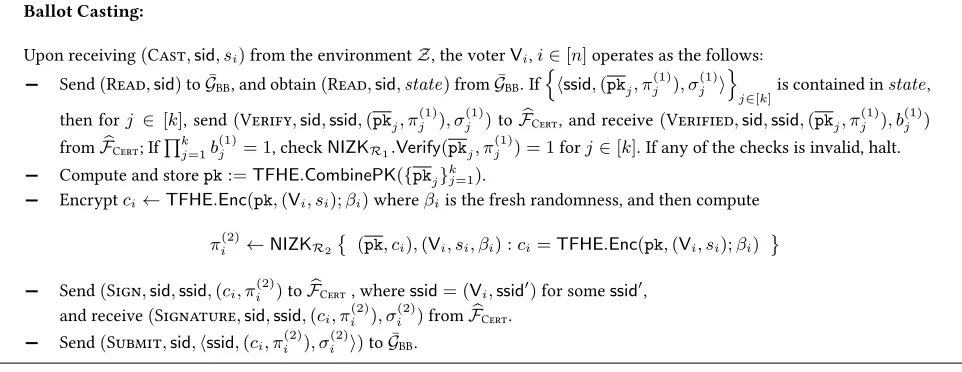
As depicted in Figure 6, in the ballot casting phase, each voterVi, i ∈ [n]first fetches the partial public keys{pkj}j∈[k]fromG¯BB. After checking their corresponding NIZK proofs, the voterVi combines them to the election public key pk := TFHE.CombinePK({pkj}k
j=1). Vi then encrypts his ballot(Vi, si) asci = TFHE.Enc(pk,(Vi, si)). HereViis abused as the voter’s PID and si is her statement. The voter then posts the ciphertextcion theG¯BBtogether with the corresponding NIZK proof showing thatciis indeed generated by the voterVi.
Ballot Casting:
Upon receiving(Cast,sid, si)from the environmentZ, the voterVi,i∈[n]operates as the follows:
Send(Read,sid)toG¯BB, and obtain(Read,sid,state)fromG¯BB. If
n
hssid,(pkj, π(1)j ), σj(1)io
j∈[k]is contained in
state,
then forj ∈ [k], send(Verify,sid,ssid,(pkj, πj(1)), σ
(1)
j )toFbCert, and receive(Verified,sid,ssid,(pkj, π
(1)
j ), b
(1)
j )
fromFbCert; If
Qk
j=1b (1)
j = 1, checkNIZKR1.Verify(pkj, π
(1)
j ) = 1forj∈[k]. If any of the checks is invalid, halt.
Compute and storepk:=TFHE.CombinePK({pkj}k j=1).
Encryptci←TFHE.Enc(pk,(Vi, si);βi)whereβiis the fresh randomness, and then compute
π(2)i ←NIZKR2
(pk, ci),(Vi, si, βi) :ci=TFHE.Enc(pk,(Vi, si);βi)
Send(Sign,sid,ssid,(ci, πi(2))toFbCert, wheressid= (Vi,ssid0)for somessid0,
and receive(Signature,sid,ssid,(ci, π(2)i ), σ
(2)
i )fromFbCert.
Send(Submit,sid,hssid,(ci, π(2)i ), σ
(2)
[image:13.612.69.550.396.582.2]i i)toG¯BB.
Figure 6: TFHEbased statement voting schemeΠfhe-SVin the{G¯BB,FbCert}-hybrid world (Part II).
4.2.3 Tally phase
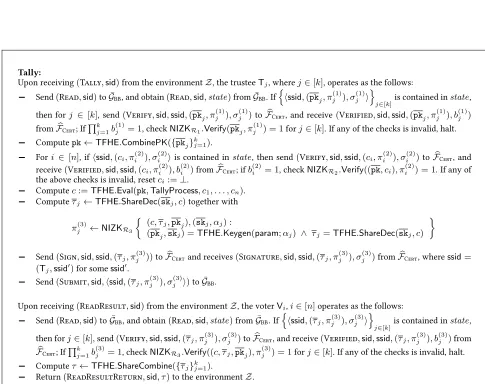
The tally phase is depicted in Figure 7. The trusteeTj ∈ T, j ∈ [k]fetches the posted encrypted ballots {ci}i∈[n] from G¯BB. It checks the corresponding NIZK proofs and removes the invalid ones. Each of the
trustees Tj ∈ T then evaluates the TallyProcesscircuit as c := TFHE.Eval(pk,TallyProcess, c1, . . . , cn). After that, all the trustees jointly decryptcto the final tallyτ, attached with necessary NIZK proofs. Finally,
Tally:
Upon receiving(Tally,sid)from the environmentZ, the trusteeTj, wherej∈[k], operates as the follows:
Send(Read,sid)toG¯BB, and obtain(Read,sid,state)fromG¯BB. If
n
hssid,(pkj, π(1)j ), σ
(1)
j i
o
j∈[k]is contained instate, then forj ∈ [k], send(Verify,sid,ssid,(pkj, π
(1)
j ), σ
(1)
j )toFbCert, and receive(Verified,sid,ssid,(pkj, π
(1)
j ), b
(1)
j )
fromFbCert; If
Qk
j=1b (1)
j = 1, checkNIZKR1.Verify(pkj, π
(1)
j ) = 1forj∈[k]. If any of the checks is invalid, halt.
Computepk←TFHE.CombinePK({pkj}k j=1). Fori ∈ [n], ifhssid,(ci, π
(2)
i ), σ
(2)
i iis contained instate, then send(Verify,sid,ssid,(ci, π
(2)
i ), σ
(2)
i )toFbCert, and
receive(Verified,sid,ssid,(ci, πi(2)), b
(2)
i )fromFbCert; ifb
(2)
i = 1, checkNIZKR2.Verify((pk, ci), π
(2)
i ) = 1. If any of
the above checks is invalid, resetci:=⊥.
Computec:=TFHE.Eval(pk,TallyProcess, c1, . . . , cn).
Computeτj←TFHE.ShareDec(skj, c)together with
π(3)j ←NIZKR3
(c, τj,pkj),(skj, αj) :
(pkj,skj) =TFHE.Keygen(param;αj) ∧ τj=TFHE.ShareDec(skj, c)
Send(Sign,sid,ssid,(τj, π(3)j ))toFbCertand receives(Signature,sid,ssid,(τj, π(3)j ), σ
(3)
j )fromFbCert, wheressid=
(Tj,ssid0)for somessid0.
Send(Submit,sid,hssid,(τj, π
(3)
j ), σ
(3)
j i)toG¯BB.
Upon receiving(ReadResult,sid)from the environmentZ, the voterVi,i∈[n]operates as the follows:
Send(Read,sid)toG¯BB, and obtain(Read,sid,state)fromG¯BB. If
n
hssid,(τj, π
(3)
j ), σ
(3)
j i
o
j∈[k]is contained in
state,
then forj∈[k], send(Verify,sid,ssid,(τj, π(3)j ), σj(3))toFbCert, and receive(Verified,sid,ssid,(τj, π(3)j ), b(3)j )from
b
FCert; IfQkj=1b (3)
j = 1, checkNIZKR3.Verify((c, τj,pkj), π
(3)
j ) = 1forj∈[k]. If any of the checks is invalid, halt.
Computeτ ←TFHE.ShareCombine({τj}k j=1).
[image:14.612.63.548.163.547.2]Return(ReadResultReturn,sid, τ)to the environmentZ.
4.3 Security
Now we show our construction can realize statement voting functionality with strong privacy. That is, the leakageLis minimal (i.e., the tally result). We note that a simplified version of our statement voting
function-ality with strong privacy can be found in Figure16in Supplementary materialA.1. More formally, we have the following the theorem.
Theorem 4.2. ProtocolΠfhe-SVdescribed in Figure5, Figure6and Figure7UC-realizesFSVin the{G¯BB,FbCert}
-hybrid world against static corruption.
The security proof can be found in Supplementary materialA.1.
5
MPC based construction
The presentedTFHE-based construction is used to illustrate the core idea. In practice, FHE schemes may still be hundreds times slower than the state-of-the-art MPC protocols, especially when NIZK proofs are involved. In fact, the construction described in Section4can be viewed as a special case of an MPC protocol in the server-client setting, where the trusteesTform the MPC players. The voters submit their statements, and the
trustees then jointly evaluate theTallyProcesscircuit.
In the following, we show how to eliminate the needs of a FHE using so-called publicly auditable MPC. Note that the main difference between a conventional MPC protocol and an voting system is that the e-voting system should still ensure the integrity of an election process even when all the trustees are corrupted. Whereas, a conventional MPC protocol does not ensure computation correctness when all the players are corrupted.
Baum et al. [BDO14], proposed a publicly auditable MPC in theG¯BB-hybrid model. Their scheme is based
on SPDZ [DPSZ12,DKL+13], but it can be extended to support most other later SPDZ variants along this line
of research. The general idea to make an MPC system publicly auditable is to attach each shared value with a (Pedersen) commitment so that the same linear/opening operations of the shared value can be carried out on the corresponding commitments. Those commitments are posted on theG¯BB, so that everyone can perform
the same MPC online phase circuit on the commitments and check if the opening of the resulting commitment is consistent with the MPC output. Hereby, due to space limitation, we will omit the MPC construction and refer interested readers to [BDO14] for details. In the following, we first give another building block.
5.1 Threshold PKE
We would like to adopt a key-homomorphic threshold PKE schemeTE. It consists of a tuple of algorithms:
(Setup,Keygen,Enc,Dec,CombinePK,CombineSK,ShareDec,ShareCombine)as follows.
• param←Setup(1λ). The algorithmSetuptakes input as the security parameterλ, and outputs public
parametersparam. All the other algorithms implicitly takeparamas input.
• (pk,sk) ← Keygen(param). The algorithm Keygentakes input as the public parameter param, and outputs a public keypk, a secret keysk.
• c←Enc(pk, m). The algorithmEnctakes input as the public keypkand the messagem, and outputs
the ciphertextc.
• c0 ← ReRand(pk, c). The algorithmReRandtakes input as the public keypkand a ciphertext c, and
outputs a re-randomized ciphertextc0.
• m ← Dec(sk, c). The algorithmDectakes input as the secret keyskand a ciphertextc, and outputs
• pk := CombinePK(pk1, . . . ,pkk). The algorithm CombinePK takes input as a set of public keys
(pk1, . . . ,pkk), and outputs a combined public keypk.
• sk ← CombineSK(sk1, . . . ,skk). The algorithm CombineSK takes input as a set of secret key (sk1, . . . ,skk), and outputs combined secret keysk.
• µi ← ShareDec(ski, c). The algorithmShareDectakes input as the secret keyski and a ciphertextc, and outputs a decryption shareµi.
• m ← ShareCombine(c, µ1, . . . , µk). The algorithmShareCombinetakes input as a ciphertextcandk decryption shares(µ1, . . . , µk), and outputs a plaintextm.
• c0 ← Trans(c,{ski}i∈[k]\{j}). The algorithmTranstakes input as a ciphertextc ← TE.Enc(pkj, m) and a set of secret keys{ski}i∈[k]\{j}, and outputs a ciphertextc0.
• {µj}j∈[k]\I ←SimShareDec(c, m,{µi}i∈I). The algorithmSimShareDectakes as input a ciphertextc,
a plaintextm, and a set of decryption shares{µi}i∈Iand outputs a set of decryption shares{µj}j∈[k]\I.
HereI([k].
Definition 5.1. We say TE = {Setup,Keygen,Enc,Dec,CombinePK,CombineSK,ShareDec,
ShareCombine} is a secure key-homomorphic threshold public key encryption if the following properties
hold:
Key combination correctness: If{(pki,ski)}i∈[k]are all valid key pairs,pk:=TE.CombinePK({pki}i∈[k])
andsk:=TE.CombineSK({ski}i∈[k]), then(pk,sk)is also a valid key pair.
For all ciphertextc∈ Cpk, whereCpkis the ciphertext-space defined bypk, we have
TE.Dec(sk, c) =TE.ShareCombine(c,TE.ShareDec(sk1, c), . . . ,TE.ShareDec(skk, c)) .
Ciphertext transformative indistinguishability: There exists a ppt algorithm Trans such that if
{(pki,ski)}i∈[k]are all valid key pairs,
pk := TE.CombinePK({pki}i∈[k])andsk := TE.CombineSK({ski}i∈[k]), then for all messagem, for
anyj∈[k], the following holds.
param,TE.Trans(c,{ski}i∈[k]\{j})
≈ param,TE.Enc(pk, m)
IND-CPA security: We say that aTEscheme achievesindistinguishability under plaintext attacks (IND-CPA) if for any ppt adversaryAthe following advantageAdvCPAis negligible.
ExperimentCPA(1λ)
1. Runparam←TE.Setup(1λ).
2. Run(pk,sk)←TE.Keygen(param);
4. A(pk)outputsm0, m1of equal length;
5. Pickb←
0,1 ; Runc←TE.Enc(pk, mb);
6. A(c)outputsb∗; It returns1ifb=b∗; else, returns0.
We define the advantage ofAas
AdvCPAA(1λ) =
Pr[ExperimentCPA(1λ) = 1]−1 2
Share-simulation indistinguishability: We sayTEscheme achievesshare-simulation indistinguishability if there exists a ppt simulatorSimShareDecsuch that for all valid key pairs{(pki,ski)}i∈[k], all subsets
I([k], all messagem, the following two distributions are computationally indistinguishable:
param, c,SimShareDec(c, m,{µi}i∈I)≈ param, c,{µj}j∈[k]\I
whereparam←TE.Setup(1λ),c←TE.Enc(pk, m)andµj ←TE.ShareDec(skj, c)forj ∈[k]\ I.
5.2 Protocol description
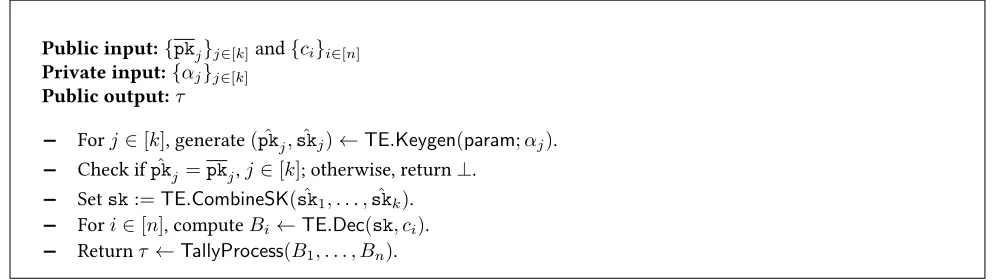
In this section, we formally describe our MPC-based construction for statement voting. we assume there exists an MPC protocolΠMPC that UC-realize FMPCC , whereFMPCC is the MPC functionality (as described in
Fig. 1 of [BDO14]) andCis the statement voting circuit depicted in Fig.8, below.Ctakes public input as each
trusteeTi’s partial public keypki, and a set of encrypted ballots{cj ←TE.Enc(pk,(Vi, si))}j∈[n], wheresi is the voterVi’s statement. Meanwhile, Calso takes private inputs as a random coinαj from each trustee Tj,j ∈ [k]. Cfirst usesαj to generate( ˆpkj,skˆj) ← TE.Keygen(param;αj); it then checks ifpkˆj = pkj,
j ∈ [k]. If verified,Cuses{skˆj}j∈[k]to decrypt the ciphertexts{ci}i∈[n]to obtains the ballots{Bi}i∈[n]. It
then computes and outputs the tallyτ ←TallyProcess(B1, . . . , Bn).
Public input:{pkj}j∈[k]and{ci}i∈[n] Private input:{αj}j∈[k]
Public output:τ
Forj∈[k], generate( ˆpkj,skˆj)←TE.Keygen(param;αj). Check ifpkˆ
[image:17.612.60.558.309.449.2]j=pkj,j∈[k]; otherwise, return⊥. Setsk:=TE.CombineSK( ˆsk1, . . . ,skˆk). Fori∈[n], computeBi←TE.Dec(sk, ci). Returnτ←TallyProcess(B1, . . . , Bn).
Figure 8: Statement voting circuitC
The protocol is designed in the{G¯BB,FbCert,FMPCC }-hybrid world and it consists of three phases:
prepa-ration, ballot casting, and tally. Again, for the sake of notation simplicity, we omit the processes of filtering invalid messages on G¯BB. In practice, G¯BB contains many messages with invalid signatures, and all those
messages should be ignored. We assume all the parties implicitly have a common inputparam←Setup(1λ).
5.2.1 Preparation phase
As depicted in Fig.9, the preparation phase is the same as theTFHEbased construction, except it usesTE instead.
5.2.2 Ballot casting phase
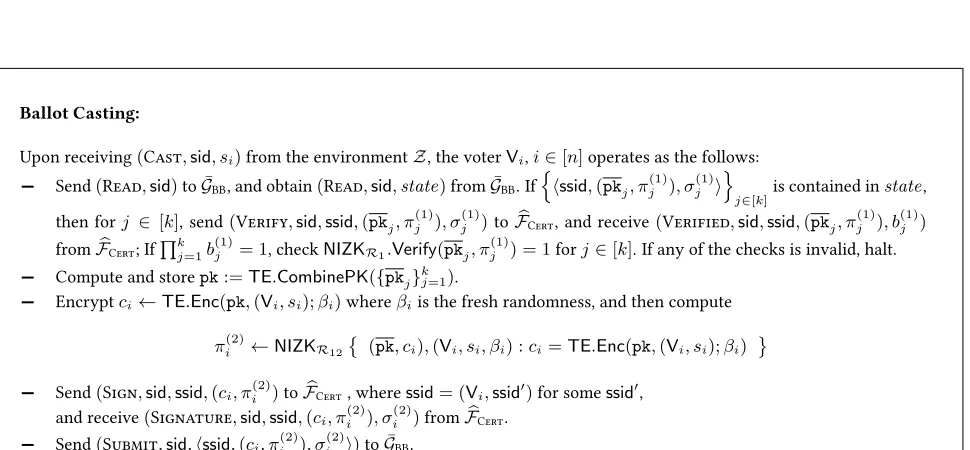
As depicted in Figure10, the ballot casting phase is also the same as the TFHEscheme, exceptTEis used instead.
5.2.3 Tally phase
The tally phase is depicted in Figure11. The trusteesTj ∈Tfetches all the posted encrypted ballots on the ¯
Preparation:
Upon receiving(InitialTrustee,sid)from the environmentZ, the trusteeTj,j∈[k], operates as the follows: Generate(pkj,skj)←TE.Keygen(param;αj)whereαjis the fresh randomness, and then compute
πj(1)←NIZKR11
(pkj),(αj,skj) : (pkj,skj) =TE.Keygen(param;αj)
Send(Sign,sid,ssid,(pkj, π(1)j ))toFbCertand receives(Signature,sid,ssid,(pkj, π (1) j ), σ
(1)
j )fromFbCert, wheressid= (Tj,ssid0)for somessid0.
Send(Submit,sid,hssid,(pkj, πj(1)), σj(1)i)toG¯BB.
Figure 9: MPC based statement voting schemeΠmpc-SVin the{G¯BB,FbCert,FMPCC }-hybrid world (Part I).
Ballot Casting:
Upon receiving(Cast,sid, si)from the environmentZ, the voterVi,i∈[n]operates as the follows:
Send(Read,sid)toG¯BB, and obtain(Read,sid,state)fromG¯BB. If
n
hssid,(pkj, π(1)j ), σ
(1)
j i
o
j∈[k]is contained instate, then forj ∈ [k], send(Verify,sid,ssid,(pkj, π
(1)
j ), σ
(1)
j )toFbCert, and receive(Verified,sid,ssid,(pkj, π
(1)
j ), b
(1)
j )
fromFbCert; If
Qk
j=1b (1)
j = 1, checkNIZKR1.Verify(pkj, π
(1)
j ) = 1forj∈[k]. If any of the checks is invalid, halt.
Compute and storepk:=TE.CombinePK({pkj}k j=1).
Encryptci←TE.Enc(pk,(Vi, si);βi)whereβiis the fresh randomness, and then compute
πi(2)←NIZKR12
(pk, ci),(Vi, si, βi) :ci=TE.Enc(pk,(Vi, si);βi)
Send(Sign,sid,ssid,(ci, πi(2))toFbCert, wheressid= (Vi,ssid0)for somessid0,
and receive(Signature,sid,ssid,(ci, π(2)i ), σ
(2)
i )fromFbCert.
Send(Submit,sid,hssid,(ci, π(2)i ), σ
(2)
[image:18.612.71.556.403.628.2]i i)toG¯BB.
Tally:
Upon receiving(Tally,sid)from the environmentZ, the trusteeTj, wherej∈[k], operates as the follows:
Send(Read,sid)toG¯BB, and obtain(Read,sid,state)fromG¯BB. If
n
hssid,(pkj, π(1)j ), σj(1)io
j∈[k]is contained in
state,
then forj ∈ [k], send(Verify,sid,ssid,(pkj, πj(1)), σ(1)j )toFbCert, and receive(Verified,sid,ssid,(pkj, π
(1)
j ), b
(1)
j )
fromFbCert; If
Qk
j=1b (1)
j = 1, checkNIZKR1.Verify(pkj, π
(1)
j ) = 1forj∈[k]. If any of the checks is invalid, halt.
Fori ∈ [n], ifhssid,(ci, π
(2)
i ), σ
(2)
i iis contained instate, then send(Verify,sid,ssid,(ci, π
(2)
i ), σ
(2)
i )toFbCert, and
receive(Verified,sid,ssid,(ci, πi(2)), b
(2)
i )fromFbCert; ifb
(2)
i = 1, checkNIZKR2.Verify((pk, ci), π
(2)
i ) = 1. If any of
the above checks is invalid, resetci:=⊥.
Send(Input,sid, αj,{pk`}`∈[k],{ci}i∈[n])toFMPCC , and obtainτ.
Send(Sign,sid,ssid, τ)toFbCertand receives(Signature,sid,ssid, τ), σ
(3)
j )fromFbCert, wheressid = (Tj,ssid0)for
somessid0.
Send(Submit,sid,hssid, τ, σj(3)i)toG¯BB.
Upon receiving(ReadResult,sid)from the environmentZ, the voterVi,i∈[n]operates as the follows:
Send(Read,sid)toG¯BB, and obtain(Read,sid,state)fromG¯BB.
Fetchτfromstateand return(ReadResultReturn,sid, τ)to the environmentZ.
Figure 11: MPC based statement voting schemeΠmpc-SVin the{G¯BB,FbCert,FMPCC }-hybrid world (Part III).
sends(Input,sid, αj,{pk`}`∈[k],{ci}i∈[n])toFMPCC . After the computation, the trusteeTj ∈ Treceives the
tally resultτ and posts it to theG¯BB.
5.3 Security
Similar to the TFHE based solution, our construction here can also achieve the statement voting functionality with strong privacy. We have the following the theorem.
Theorem 5.2. Protocol Πmpc-SV described in Figure 9, Figure 10 and Figure 11 UC-realizes FSV in the {G¯BB,FbCert,FMPCC }-hybrid world against static corruption.
The security proof can be found in Supplementary materialB.1.
6
Mix-net based construction
In this section, we will construct a much more efficient statement voting scheme based on mix-net. The privacy that this construction achieves is relatively weaker. However, we emphasize that this level of privacy has been widely accepted and is consistent with all the existing paper-based voting systems.
The intuition is as follows. At the beginning of scheme, each voterVi,i∈[n], is assigned with a temporal random ID, denoted as IDi. LetI := {ID1, . . . ,IDn}be the set of all the voter’s random IDs. The voter’s statement takes input as a subset ofI, denoted asD, and usesID∈ Das references to point to those voters’
ballots. For instance, the statement could be “If both voterIDxand voterIDy vote for ‘Yes’, then my vote is ‘Yes’; otherwise, my vote is ‘No’.” The ballot of a voterVi is in forms ofBi := (IDi,statementi), whereIDi is the voter’s temporal ID, andstatementiis the voter’s statement.
To ensure privacy, the voters cannot post their temporal IDs publicly on the bulletin boardG¯BB; however,
the voters should be allowed to freely refer to any voter’s ID. To address this challenge, we introduce the following technique. At the beginning of the protocol execution, each voter picks a random ID and posts the encryption of the ID on the G¯BB. If a voter wants to refer to another voter in the statement, he/she simply
We emphasize that in practice the mix-net servers can be different from talliers (a.k.a. decrypters). As such, they could have different threshold requirements. For notation simplicity, we combine both roles to the same set of parties, trustees, in the protocol description.
6.1 Threshold re-randomizable encryption
A threshold re-randomizable encryption schemeTREconsists of a tuple of algorithms:(Setup,Keygen,Enc,
Dec,CombinePK,CombineSK,ShareDec,ShareCombine,ReRand)as follows.
• param←Setup(1λ). The algorithmSetuptakes input as the security parameterλ, and outputs public
parametersparam. All the other algorithms implicitly takeparamas input.
• (pk,sk) ← Keygen(param). The algorithm Keygentakes input as the public parameter param, and outputs a public keypk, a secret keysk.
• c←Enc(pk, m). The algorithmEnctakes input as the public keypkand the messagem, and outputs
the ciphertextc.
• c0 ← ReRand(pk, c). The algorithmReRandtakes input as the public keypkand a ciphertext c, and
outputs a re-randomized ciphertextc0.
• m ← Dec(sk, c). The algorithmDectakes input as the secret keyskand a ciphertextc, and outputs
the decrypted plaintextm.
• pk := CombinePK(pk1, . . . ,pkk). The algorithm CombinePK takes input as a set of public keys
(pk1, . . . ,pkk), and outputs a combined public keypk.
• sk ← CombineSK(sk1, . . . ,skk). The algorithm CombineSK takes input as a set of secret key (sk1, . . . ,skk), and outputs combined secret keysk.
• µi ← ShareDec(ski, c). The algorithmShareDectakes input as the secret keyski and a ciphertextc, and outputs a decryption shareµi.
• m ← ShareCombine(c, µ1, . . . , µk). The algorithmShareCombinetakes input as a ciphertextcandk decryption shares(µ1, . . . , µk), and outputs a plaintextm.
• c0 ← Trans(c,{ski}i∈[k]\{j}). The algorithmTranstakes input as a ciphertextc← TRE.Enc(pkj, m) and a set of secret keys{ski}i∈[k]\{j}, and outputs a ciphertextc0.
• {µj}j∈[k]\I ←SimShareDec(c, m,{µi}i∈I). The algorithmSimShareDectakes as input a ciphertextc,
a plaintextm, and a set of decryption shares{µi}i∈Iand outputs a set of decryption shares{µj}j∈[k]\I.
HereI([k].
Definition 6.1. We say TRE = {Setup,Keygen,Enc,Dec,CombinePK,CombineSK,ShareDec,
ShareCombine,ReRand} is a secure threshold re-randomizable public key encryption if the following
properties hold:
Key combination correctness: If {(pki,ski)}i∈[k] are all valid key pairs, pk :=
TRE.CombinePK({pki}i∈[k]) and sk := TRE.CombineSK({ski}i∈[k]), then (pk,sk) is also a
valid key pair.
For all ciphertextc∈ Cpk, whereCpkis the ciphertext-space defined bypk, we have
Ciphertext transformative indistinguishability: There exists a ppt algorithm Trans such that if
{(pki,ski)}i∈[k]are all valid key pairs,
pk := TRE.CombinePK({pki}i∈[k])and sk := TRE.CombineSK({ski}i∈[k]), then for all messagem,
for anyj∈[k], the following holds.
param,TRE.Trans(c,{ski}i∈[k]\{j})
≈ param,TRE.Enc(pk, m)
Unlinkability: We say a TRE scheme is unlinkable if for any ppt adversary A the following advantage
AdvUnlinkis negligible.
ExperimentUnlink(1λ) 1. Aoutputs a setI ⊂
1, . . . , k of up tok−1corrupted indices.
2. Fori= [n], run(pki,ski)←TRE.Keygen(1λ;ωi); 3. A(
pkj j∈[k]\I)outputsc0, c1;
4. b←
0,1 ;c0 ←TRE.ReRand(pk, cb;ω);
5. A(c0)outputsb∗; It returns1ifb=b∗; else, returns0.
We define the advantage ofAas
AdvUnlinkA(1λ) =
Pr[ExperimentUnlink(1λ) = 1]−1 2
.
Share-simulation indistinguishability: We sayTRE scheme achievesshare-simulation indistinguishabil-ityif there exists a ppt simulatorSimShareDecsuch that for all valid key pairs{(pki,ski)}i∈[k], all subsets
I([k], all messagem, the following two distributions are computationally indistinguishable:
param, c,SimShareDec(c, m,{µi}i∈I)≈ param, c,{µj}j∈[k]\I
whereparam←TRE.Setup(1λ),c←TRE.Enc(pk, m)andµj ←TRE.ShareDec(skj, c)forj∈[k]\I.
6.2 Protocol description
In this section, we formally describe our mix-net based construction for statement voting. The protocol is designed in the {G¯BB,FbCert}-hybrid world and it consists of three phases: preparation, ballot casting, and
tally.
We will use threshold re-randomizable encryption (TRE) as building block. A threshold re-randomizable encryption scheme TRE consists of a tuple of algorithms: (Setup,Keygen,Enc,Dec,
CombinePK,CombineSK,ShareDec,ShareCombine,ReRand). TREis related toTFHEexcept that,Eval al-gorithm is disabled inTRE; instead, we will allow the ciphertexts can be re-randomized viaReRandalgorithm. More details can be found in Supporting material6.1.
6.2.1 Preparation phase
As depicted in Fig.12, in the preparation phase, each trusteeTj,j∈[k]first picks a randomness generatesαj and generates a partial public key using(pkj,skj) ← TRE.Keygen(param;αj). It then generates an NIZK proof
π(1)j ←NIZKR4
(pkj),(αj,skj) : (pkj,skj) =TRE.Keygen(param;αj)
Preparation:
Upon receiving(InitialTrustee,sid)from the environmentZ, the trusteeTj,j∈[k], operates as the follows: Generate(pkj,skj)←TRE.Keygen(param;αj)whereαjis the fresh randomness, and then compute
πj(1)←NIZKR4
(pkj),(αj,skj) : (pkj,skj) =TRE.Keygen(param;αj)
Send(Sign,sid,ssid,(pkj, π(1)j ))toFbCertand receives(Signature,sid,ssid,(pkj, π (1) j ), σ
(1)
j )fromFbCert, wheressid= (Tj,ssid0)for somessid0.
Send(Submit,sid,hssid,(pkj, πj(1)), σj(1)i)toG¯BB.
Figure 12: Mix-net based statement voting schemeΠmix-SVin the{G¯BB,FbCert}-hybrid world (Part I).
6.2.2 Ballot casting phase
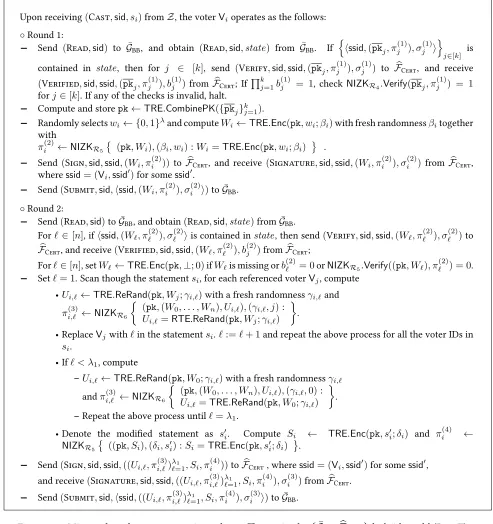
As depicted in Fig. 13, the ballot casting phase consists of two rounds. In the first round, each voter Vi,
i∈[n]first fetches the trustees’ partial public keys{pkj}k
j=1fromG¯BB. She then checks the validity of their
attached NIZK proofs. If all the NIZK proofs are verified, she computes and stores the election public key as pk←TRE.CombinePK({pkj}kj=1). In addition, the voterVipicks a random temporal IDwi← {0,1}λ. She then uses the election public keypkto encryptwi asWi ←TRE.Enc(pk, wi;βi)with fresh randomnessβi. She also computes
πi(2)←NIZKR5
(pk, Wi),(βi, wi) :Wi =TRE.Enc(pk, wi;βi)
to show that she is the creator of this ciphertext. VoterVithen signs and posts(Wi, π(2)i )toG¯BB.
In the second round, each voterVi,i∈[n]first fetches all the posted encrypted temporal IDs fromG¯BB, and checks their attached NIZK proofs. For any missing or invalid (encrypted) temporal IDs, the voters replace them withTRE.Enc(pk,⊥; 0), which is encryption of⊥with trivial randomness. Moreover, the voters also
definesW0 ←TRE.Enc(pk,⊥; 0).
For the sake of uniformity, our scheme restricts that each voter’s statement can refer up toλ1 ∈ Nthe
other voters’ IDs, and the size of the statement should fit in the plaintext space. For a voter Vi, i ∈ [n], denoteDi ⊆ [n]as the set of indices of the referenced voters’ IDs. LetWi := {Wj|j ∈ Di}be the set of ciphertexts of the corresponding referenced voters’ IDs. The voterVire-randomizes all the ciphertexts inWi and pads re-randomizedW0’s to form a ciphertext vector of sizeλ1, denoted as(U1, . . . , Uλ1). The voterVi then replaces the voter IDs in the statement as the pointers toUj,j∈[λ1]. Denote the modified statement as
s0i. It then encryptss0ito ciphertextSi. Of course, to ensure correctness, NIZK proofs are generated to show (i)Uj,j ∈ [λ1]is indeed re-randomized from one of the ciphertexts in(W0, . . . , Wn), and (ii)Si is indeed created by the voter himself/herself. The voterVi then signs and posts(U1, . . . , Uλ1)andSi together with the corresponding NIZK proofs toG¯BB.
6.2.3 Tally phase
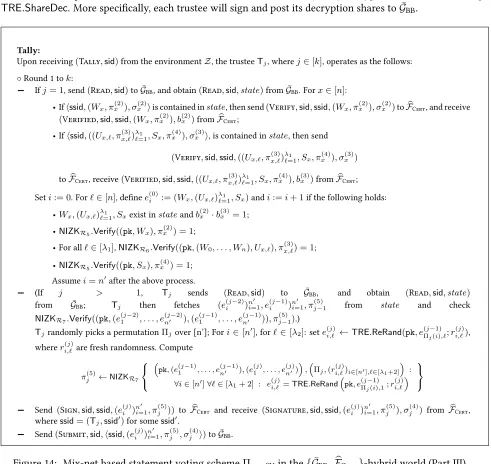
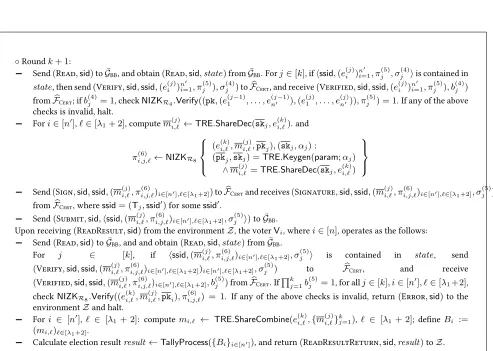
The tally phase is depicted in Fig.14and Fig.15. The trustees first fetches(Wi,(U1, . . . , Uλ1), Si)(which is viewed as the submitted ballot for voterVi) fromG¯BBand check their attached NIZK proofs. All the invalid ballots will be discard. Letn0be the number of valid ballots. All the trustees then jointly shuffle the ballots via
Ballot Casting:
Upon receiving(Cast,sid, si)fromZ, the voterVioperates as the follows:
◦Round 1:
Send (Read,sid) to G¯BB, and obtain (Read,sid,state) from G¯BB. If nhssid,(pkj, πj(1)), σj(1)io
j∈[k] is contained in state, then for j ∈ [k], send (Verify,sid,ssid,(pkj, π(1)j ), σj(1)) to FbCert, and receive (Verified,sid,ssid,(pkj, πj(1)), b(1)j )from FbCert; If
Qk j=1b
(1)
j = 1, checkNIZKR4.Verify(pkj, π (1) j ) = 1 forj∈[k]. If any of the checks is invalid, halt.
Compute and storepk←TRE.CombinePK({pkj}k j=1).
Randomly selectswi← {0,1}λand computeWi←TRE.Enc(pk, wi;βi)with fresh randomnessβitogether with
π(2)i ←NIZKR5
(pk, Wi),(βi, wi) :Wi=TRE.Enc(pk, wi;βi) . Send(Sign,sid,ssid,(Wi, π
(2)
i ))to FbCert, and receive(Signature,sid,ssid,(Wi, π (2) i ), σ
(2)
i )from FbCert, wheressid= (Vi,ssid0)for somessid0.
Send(Submit,sid,hssid,(Wi, πi(2)), σi(2)i)toG¯BB. ◦Round 2:
Send(Read,sid)toG¯BB, and obtain(Read,sid,state)fromG¯BB.
For`∈[n], ifhssid,(W`, π (2) ` ), σ
(2)
` iis contained instate, then send(Verify,sid,ssid,(W`, π (2) ` ), σ
(2) ` )to b
FCert, and receive(Verified,sid,ssid,(W`, π`(2)), b(2)j )fromFbCert; For`∈[n], setW`←TRE.Enc(pk,⊥; 0)ifW`is missing orb
(2)
` = 0orNIZKR5.Verify((pk, W`), π
(2) ` ) = 0. Set`= 1. Scan though the statementsi, for each referenced voterVj, compute
•Ui,`←TRE.ReRand(pk, Wj;γi,`)with a fresh randomnessγi,`and π(3)i,` ←NIZKR6
(pk,(W0, . . . , Wn), Ui,`),(γi,`, j) : Ui,`=RTE.ReRand(pk, Wj;γi,`)
.
• ReplaceVjwith`in the statementsi.`:=`+ 1and repeat the above process for all the voter IDs in si.
• If` < λ1, compute
–Ui,`←TRE.ReRand(pk, W0;γi,`)with a fresh randomnessγi,` andπ(3)i,` ←NIZKR6
(pk,(W0, . . . , Wn), Ui,`),(γi,`,0) : Ui,`=TRE.ReRand(pk, W0;γi,`)
.
–Repeat the above process until`=λ1.
• Denote the modified statement as s0i. Compute Si ← TRE.Enc(pk, s0i;δi) and π(4)i ← NIZKR5
((pk, Si),(δi, s0i) :Si=TRE.Enc(pk, s0i;δi) . Send(Sign,sid,ssid,((Ui,`, π(3)i,`)λ1
`=1, Si, π (4)
i ))toFbCert, wheressid= (Vi,ssid
0
)for somessid0,
and receive(Signature,sid,ssid,((Ui,`, π (3) i,`)
λ1 `=1, Si, π
(4) i ), σ
(3)
i )fromFbCert. Send(Submit,sid,hssid,((Ui,`, π
(3) i,`)
λ1 `=1, Si, π
(4) i ), σ
(3)
[image:23.612.61.554.142.666.2]i i)toG¯BB.
all the trusteesTjcheck the correctness of the entire mix-net and then jointly decrypt the mixed ballots using TRE.ShareDec. More specifically, each trustee will sign and post its decryption shares toG¯BB.
Tally:
Upon receiving(Tally,sid)from the environmentZ, the trusteeTj, wherej∈[k], operates as the follows: ◦Round 1 tok:
Ifj= 1, send(Read,sid)toG¯BB, and obtain(Read,sid,state)fromG¯BB. Forx∈[n]:
• Ifhssid,(Wx, π(2)x ), σx(2)iis contained instate, then send(Verify,sid,ssid,(Wx, πx(2)), σx(2))toFbCert, and receive
(Verified,sid,ssid,(Wx, π(2)x ), b(2)x )fromFbCert;
• Ifhssid,((Ux,`, π
(3)
x,`) λ1 `=1, Sx, π
(4)
x ), σ
(3)
x i, is contained instate, then send
(Verify,sid,ssid,((Ux,`, π
(3)
x,`) λ1 `=1, Sx, π
(4)
x ), σx(3))
toFbCert, receive(Verified,sid,ssid,((Ux,`, π(3)x,`)`λ=11 , Sx, πx(4)), b(3)x )fromFbCert;
Seti:= 0. For`∈[n], definee(0)i := (Wx,(Ux,`)λ`=11 , Sx)andi:=i+ 1if the following holds:
•Wx,(Ux,`)λ`=11 , Sxexist instateandb(2)x ·b(3)x = 1;
•NIZKR5.Verify((pk, Wx), π
(2)
x ) = 1;
• For all`∈[λ1],NIZKR6.Verify((pk,(W0, . . . , Wn), Ux,`), π
(3)
x,`) = 1;
•NIZKR5.Verify((pk, Sx), π
(4)
x ) = 1;
Assumei=n0after the above process.
(If j > 1, Tj sends (Read,sid) to G¯BB, and obtain (Read,sid,state) from G¯BB; Tj then fetches (e(j−2)
i )
n0 i=1, e
(j−1)
i )
n0 i=1, π
(5)
j−1 from state and check
NIZKR7.Verify((pk,(e
(j−2) 1 , . . . , e
(j−2)
n0 ),(e
(j−1) 1 , . . . , e
(j−1)
n0 )), π
(5)
j−1).)
Tjrandomly picks a permutationΠjover [n’]; Fori∈[n0], for`∈[λ2]: sete (j)
i,` ←TRE.ReRand(pk, e
(j−1) Πj(i),`;r
(j)
i,`),
wherer(i,`j)are fresh randomness. Compute
π(5)j ←NIZKR7
pk,(e(1j−1), . . . , en(j0−1)),(e
(j) 1 , . . . , e
(j)
n0)
,
Πj,(r
(j)
i,`)i∈[n0],`∈[λ 1+2]
:
∀i∈[n0]∀`∈[λ
1+ 2] : e(i,`j)=TRE.ReRand
pk, e(Πj−1)
j(i),1;r
(j)
i,`
Send (Sign,sid,ssid,(e(ij)) n0 i=1, π
(5)
j )) to FbCert and receive (Signature,sid,ssid,(e
(j)
i ) n0 i=1, π
(5)
j ), σ
(4)
j ) from FbCert,
wheressid= (Tj,ssid0)for somessid0.
Send(Submit,sid,hssid,(e(ij))n0 i=1, π
(5)
j , σ
(4)
[image:24.612.64.555.78.542.2]j i)toG¯BB.
Figure 14: Mix-net based statement voting schemeΠmix-SVin the{G¯BB,FbCert}-hybrid world (Part III).
Each voter can then compute the tally result as follows. The voter first fetches all the decryption shares and checks their validity usingNIZKR8.Verify. Upon success, the voter usesTRE.ShareCombineto reconstruct the messages. She then useTallyProcessas described in Fig.4to calculate the final tally.
6.3 Security
We have the following the theorem.
Theorem 6.2. ProtocolΠmix-SVdescribed in Figure12, Figure13, Figure14and Figure15UC-realizesFSVin the {G¯BB,FbCert}-hybrid world against static corruption.