International Research Journal of Engineering and Technology (IRJET)
e-ISSN: 2395-0056 Volume: 06 Issue: 09 | Sep 2019 www.irjet.net p-ISSN: 2395-0072Analysis of Student Performance Using Machine Learning Techniques
G.Umadevi
11
Research Scholar, School of Computer Science, Engineering and Applications, Bharathidasan University, Trichy
---***---Abstract -
Educational data has become a vital resource in this modern era, contributing much to the welfare of the society. Educational institutions are becoming more competitive because of the number of institutions growing rapidly. The higher education institutions has potential knowledge such as academic performance of students, administrative accounts, potential knowledge of the faculty, demographic details of the students and many other information in a hidden form. The technique behind the extraction of the hidden knowledge is Knowledge Discovery process. Data mining helps to extract the knowledge from available dataset and should be created as knowledge intelligence for the benefit of the institution. Higher education does categorize the students by their academic performance. In this paper, perform comparative study to various classification algorithms such as J48, Decision table, and K-Nearest neighbor algorithm (K-NN) can be implemented in prediction model for student datasets. The datasets are clustered using K-Means algorithm before classification. Finally compare the results in terms of error rate metrics in data mining and shows that K-NN algorithm can be provide less error rate than the existing algorithmsKey Words: (Prediction analysis, Classification, Nearest Neighbor, Machine learning algorithm, Educational data)…
1. INTRODUCTION
Figure1: Data mining tasks
2. RELATED WORK
Over the last decade ongoing development of statistical modeling tools has led to a growing sophistication in the methods used to analyses relationships between the distributions of species and their environment. We will review the literature of classification analysis and the commonly used techniques in modeling classification problems in this section.
Zacharoula Papamitsiou, et .al [1] provide the reader with a comprehensive background for understanding current knowledge on Learning Analytics (LA) and Educational Data Mining (EDM) and its impact on adaptive learning. It constitutes an overview of empirical evidence behind key objectives of the potential adoption of LA/EDM in generic educational strategic planning. LA and EDM constitute an ecosystem of methods and techniques (in general procedures) that successively gather, process, report and act on machine readable data on an ongoing basis in order to advance the educational environment and reflect on learning processes. In general, these procedures initially emphasize on measurement and data collection and preparation for processing during the learning activities.
Alireza Ahadi, et .al [2] designed Methods for automatically identifying students in need of assistance have been studied for decades. Initially, the work was based on somewhat static factors such as students’ educational background and results from various questionnaires, while more recently, constantly accumulating data such as progress with course assignments and behavior in lectures has gained attention. We contribute to this work with results on early detection of students in need of assistance, and provide a starting point for using machine learning techniques on naturally accumulating programming process data. This study is driven by the question of identifying high and low-performing students as early as possible in a programming course to provide better support for them. By high- and low-performing students, we mean students in the upper- and lower half of course scores, and by early, we mean after the very first week of the programming course. This means that instructors could plan and provide additional guidance to specifically selected students already during the second week of the course.
International Research Journal of Engineering and Technology (IRJET)
e-ISSN: 2395-0056 Volume: 06 Issue: 09 | Sep 2019 www.irjet.net p-ISSN: 2395-0072grade of students and as there are many approaches that are used for data classification, the decision tree (ID3) method is used here.
Christopher G, et.al [4] e discover video watching behavioral quantities that are correlated with student performance, and show that they can be used to enhance CFA prediction. Additionally, we identify the “early detection” capability of clickstream data, showing that the incremental improvement is higher in the first few course weeks. Moreover, this work is the first to study CFA prediction in the context of MOOC. Each of these are important steps in studying the SLN of MOOC users. Student performance prediction is an intriguing research area, and especially so for MOOC because of its potential benefits, such as the definition of different SLN graph structures that can help an instructor manage her course more effectively. In this paper, using data from one of our own MOOC offerings, we applied some standard algorithms to CFA prediction in this setting, and showed how one type of behavioral data collected about students – video-watching clickstream events can be used as learning features to improve prediction quality. Through evaluation, we saw that our scheme outperformed the standards under each dataset partition and metric considered, and that the improvement was particularly pronounced in the beginning of the course. Also, we saw that it is useful to parse the clickstream data into summary quantities for each user video pair, because in doing so is possible to identify intervals for these quantities that indicate a higher likelihood of a user being CFA or not in answering the corresponding question.
Fadhilah Ahmad, et.al [5] studied the classification method is selected to be applied on the students’ data. This research aims to do a comparative analysis among the three selected classification algorithms; Decision Tree (DT), Naïve Bayes (NB), and Rule Based (RB). The comparative analysis is done to discover the best techniques to develop a predictive model for SAP. This pattern will be used to improve the SAP and to overcome the issues of low grades obtained by students. The amount of data stored in an educational database at IHL is increasing rapidly by the times. In order to get the knowledge about student from such large data and to discover the parameter that contributed to the students’ success, the classification techniques are applied to the students’ data. This study also conducts a comparative analysis of three classification techniques; DT, NB, and RB using WEKA tool. The experimental result shows that the RB has the best classification accuracy compared to NB and DT. The model will allow the lecturers to take early actions to help and assist the poor and average category students to improve their results
3. STUDENT PERFORMANCE PREDICTION USING CLASSIFICATION ALGORITHM
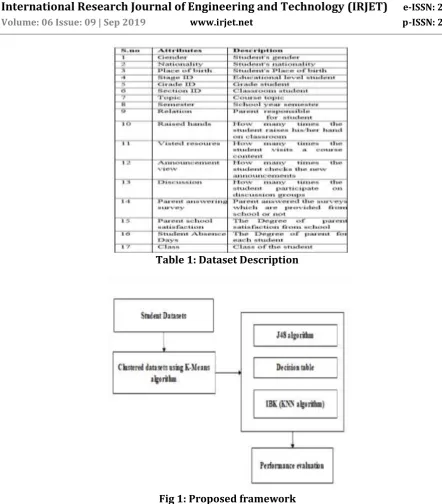
Table 1: Dataset Description
Fig 1: Proposed framework
Fig 1 provide framework for the proposed system include steps such as clustering and classification. K-means clustering can be applied after that applies classification algorithms such as J48 algorithm, Decision table and KNN algorithm. Finally compare the classification algorithm in terms of error rates in performance evaluation
3.1 clustering algorithm
3.1.1 Simple K- Means Clustering algorithm
International Research Journal of Engineering and Technology (IRJET)
e-ISSN: 2395-0056 Volume: 06 Issue: 09 | Sep 2019 www.irjet.net p-ISSN: 2395-0072Choose cluster options and click drop down list to pick simple K means algorithm and then start cluster to group the classes as 0 and 1.
The basic algorithm pseudo code as follows:
Input: X = {x1, x2, x3,…..,xn} be the set of data points ,
Y= {y1,y2,y3…yn} be the set of data points
V = {v1,v2,v3,….,vn} be the set of centers
Step 1: Select ‘c’ cluster centers arbitrarily
Step 2: Calculate the distance between each pixels and cluster centers using the Euclidean Distance metric as follows
X, Y are the set of data points
Step 3: Pixel is assigned to the cluster center whose distance from the cluster center is minimum of all cluster centers
Step 4: New cluster center is calculated using
Where Vi denotes the cluster center, ci denotes the number of pixels in the cluster
Step 5: The distance among every pixel and new obtained cluster facilities is recalculated
Step 6: If no pixels were reassigned then stop. Otherwise repeat steps from 3 to 5
3.2 classification algorithm
3.2.1 J48 algorithm
:Systems that construct classifiers are one of the commonly used tools in data mining. Such systems take as input a collection of cases, each belonging to one of a small number of classes and described by its values for a fixed set of attributes, and output a classifier that can accurately predict the class to which a new case belongs. Like CLS and ID3, C4.5 generates classifiers expressed as decision trees, but it can also construct classifiers in more comprehensible rule set form
3.2.1.1 J48 tree construction:
information mining models. This calculation utilizes a recursive apportioning approach. A decision tree is the prototypical information mining instrument, generally utilized for its simplicity of translation. It comprises a root node split by a solitary variable into two segments. Thus, these two new segments turn out to be new nodes that may then each further split on an individual (and unique) variable. This partitioning proceeds until no further part would enhance the execution of the model. The basic algorithm is shown in fig 1
ALGORITHAM 1 C4.5 (D)
Input: an attribute-value dataset D
1: Tree = {}
2: if D is ”pure” OR other stopping criteria met then
3: terminate 4: end if
5: for all attribute a € D do
6: compute information theoretic criteria if we split on a 7: end for
riteria
9: tree = create a decision node that tests in the root
10:
11: for all do 12: 𝑇𝑟𝑒𝑒𝑣=C4.5 ( 𝜈)
13: Attach 𝑇𝑟𝑒𝑒𝜈 to the corresponding branch of tree 14: End for
15: return Tree Fig 2 J48 Algorithm
3.2.2 DECISION TABLE
Decision tables are a concise visual representation for specifying which actions to perform depending on given conditions. They are algorithms whose output is a set of actions. The information expressed in decision tables could also be represented as decision trees or in a programming approach in terms of if then else rules if-then-else rules. Each decision corresponds to a variable, relation or predicate whose possible values are listed among the condition alternatives. Each action is a procedure or operation to perform, and the entries specify whether (or in what order) the action is to be performed for the set of condition alternatives the entry corresponds to. The algorithm, decision table, is found in the Weka classifiers under Rules. The simplest way of representing the output from machine learning is to put it in the same form as the input. The use of the classifier rules decision table is described as building and using a simple decision table majority classifier. The output will show a decision on a number of attributes for each instance. The number and specific types of attributes can vary to suit the needs of the task.
a) Entropy using the frequency table of one attribute
International Research Journal of Engineering and Technology (IRJET)
e-ISSN: 2395-0056 Volume: 06 Issue: 09 | Sep 2019 www.irjet.net p-ISSN: 2395-00723.2.3 K-Nearest Neighbor algorithm
:
Suppose that an object is sampled with a set of different attributes, but the group to which the object belongs is unknown. Assuming its group can be determined from its attributes; different algorithms can be used to automate the classification process. A nearest neighbor classifier is a technique for classifying elements based on the classification of the elements in the training set that are most similar to the test example. With the k-nearest neighbor technique, this is done by evaluating the k number of closest neighbors. The k-nearest neighbors algorithm is one of the simplest machine learning algorithms. It is simply based on the idea that ―objects that are ‗near‘ each other will also have similar characteristics. Thus if you know the characteristic features of one of the objects, you can also predict it for its nearest neighbor. k-NN is an improvisation over the nearest neighbour technique. It is based on the idea that any new instance can be classified by the majority vote of its ‗k‘ neighbours, - where k is a positive integer, usually a small number. kNN is one of the most simple and straight forward data mining techniques. It is called Memory-Based Classification as the training examples need to be in the memory at run-time. When dealing with continuous attributes the difference between the attributes is calculated using the Euclidean distance. A major problem when dealing with the Euclidean distance formula is that the large values frequency swamps the smaller ones. The algorithm steps as follows:
for all the unknown samples Un Sample(i) for all the known samples Sample(j) compute the distance between Un samples(i) and Sample(j) end for
find the k smallest distances locate the corresponding samples Sample(j1),….,Sample(jK)
assign Un Sample(i) to the class which appears more frequently end for
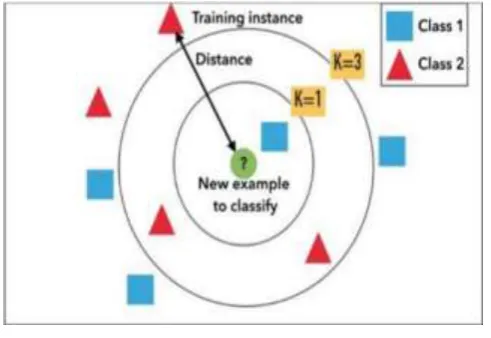
[image:7.595.176.422.446.615.2]The basic diagram of KNN is shown in fig 3
Fig 3: KNN classification
4. EXPERIMENTAL RESULTS
1) MSE:
MEAN SQUARED ERROR (MSE) is by far the most common measure of numerical model performance. It is simply the average of the squares of the differences between the predicted and actual values. It is a reasonably good measure of performance, though it could be argued that it overemphasizes the importance of larger errors. Many modeling procedures directly minimize the MSE.
2) RMSE:
The ROOT MEAN SQUARE ERROR (RMSE) serves to aggregate the magnitudes of the errors in predictions into a
single measure of predictive power. RMSE is a good measure of accuracy, but only to compare forecasting errors of different models for a particular variable and not between variables, as it is scale-dependent.3) RAE:
The RELATIVE ABSOLUTE ERROR (RAE) in some data is the discrepancy between an exact value and some approximation to it. An approximation error can occur because:
1. The measurement of the data is not precise due to the instruments.
2. Approximations are used instead of the real data (e.g., 3.14 instead of π).
In the mathematical field of numerical analysis, the numerical stability of an algorithm indicates how the error is propagated by the algorithm.
4) RRSE:
[image:8.595.171.425.459.530.2]The ROOT RELATIVE SQUARED ERROR (RRSE) is relative to what it would have been if a simple predictor had been used. More specifically, this simple predictor is just the average of the actual values. Thus, the relative squared error takes the total squared error and normalizes it by dividing by the total squared error of the simple predictor. By taking the square root of the relative squared error one reduces the error to the same dimensions as the quantity being predicted.
Table 2: Performance table
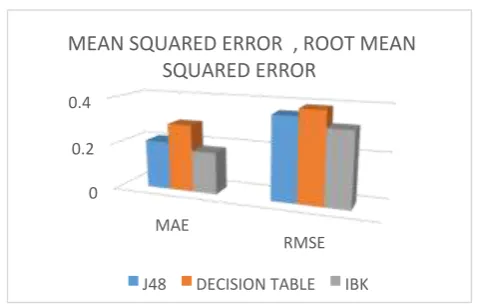
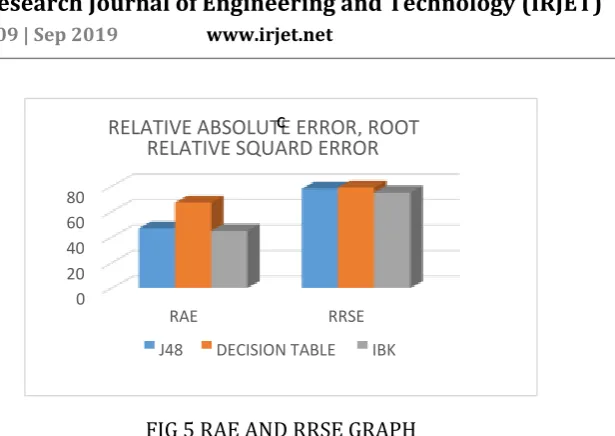
The overall performance of the results is shown as
FIG 4 MSE AND RMSE GRAPH
0 0.2 0.4
MAE
RMSE
MEAN SQUARED ERROR , ROOT MEAN
SQUARED ERROR
[image:8.595.145.384.592.744.2]International Research Journal of Engineering and Technology (IRJET)
e-ISSN: 2395-0056 Volume: 06 Issue: 09 | Sep 2019 www.irjet.net p-ISSN: 2395-0072FIG 5 RAE AND RRSE GRAPH
KNN can be outperforms than the existing algorithms and provides reduce number of error rate values. In this paper, a novel approach based on KNN significant academic attributes for performance predictions. The experiment displays good performance of the proposed algorithm and was compared to similar approaches over the same dataset. By analyzing the experimental results, it is observed that the KNN algorithm turned out to be best classifier for student performance prediction because it contains more accuracy and least error rate.
3. CONCLUSION
Using data mining technology for student performance prediction has become the focus of attention in educational data mining. Data mining technology provides an important means for extracting valuable rules hidden in student data and acts as an important role in student performance prediction. In the current study, have demonstrated, using a large sample of student datasets with classification. In this research work, the classification rule algorithms namely J48 algorithm, Decision table and IBK algorithm are used for classifying datasets which are uploaded by user. By analyzing the experimental results it is observed that the IBK algorithm has yields better result than other techniques. In future we tend to improve efficiency of performance by applying other data mining techniques and algorithms.
REFERENCES
[1]Papamitsiou, Zacharoula, and Anastasios A. Economides. "Learning analytics and educational data mining in practice: A
systematic literature review of empirical evidence." Journal of Educational Technology & Society 17.4 (2014): 49.
[2] Ahadi, Alireza, et al. "Exploring machine learning methods to automatically identify students in need of assistance." Proceedings of the Eleventh Annual International Conference on International Computing Education Research. ACM, 2015.
[3] Ahmed, Abeer Badr El Din, and Ibrahim Sayed Elaraby. "Data Mining: A prediction for Student's Performance Using
Classification Method." World Journal of Computer Application and Technology 2.2 (2014): 43-47.
[4]Brinton, Christopher G., and Mung Chiang. "Mooc performance prediction via clickstream data and social learning
networks." Computer Communications (INFOCOM), 2015 IEEE Conference on. IEEE, 2015.
[5] Ahmad, Fadhilah, NurHafieza Ismail, and Azwa Abdul Aziz. "The prediction of students’ academic performance using
classification data mining techniques." Applied Mathematical Sciences 9.129 (2015): 6415-6426 0
20 40 60 80
RAE RRSE
RELATIVE ABSOLUTE ERROR, ROOT
RELATIVE SQUARD ERROR
J48 DECISION TABLE IBK