
Met Éireann Annual Report 2005
34
0
0
Full text
(2) Valentia Observatory The cover shows Westwood House, the principal building at Valentia Observatory, as it appeared c. 1910 and in 2005 after extensive refurbishment works had been completed. The background detail is reproduced from an Ordnance Survey map dated 1897..
(3) Contents. Foreword. 2. Mission Statement and Organisational Structure. 3. Articles Refurbishment of Westwood House. 4. ISO 9001:2000 Certification. 6. Launch of C41 Report. 8. Weather Review 2005. 9. Strategic Management – Delivering Met Éireann’s High-Level Goals. 13. Appendices I. Forecast Accuracy. 25. II. Publications. 28. III. Met Éireann Finances. 29. Corporate Information. 30. Glossary. 31. Met Éireann – Annual Report 2005. 1.
(4) Foreword Probably the outstanding feature of Met Éireann’s activities in 2005 was the ever-increasing demand on the organisation to deliver additional services – whether developing new forecast products, implementing extensions to the basic infrastructure, or any one of a host of other tasks. It gives me great satisfaction to record that throughout the year Met Éireann maintained all routine operations while at the same time making significant progress across a range of these new undertakings. Changes to the manner in which meteorological services are provided to civil aviation required that Met Éireann implement a certified quality management system for its Aviation Services Division – a goal achieved in September, when the. to end-users. It is clear that in this area too,. Division was awarded ISO 9001:2000 certification.. increased automation will be key if Met Éireann is. In the Instrumentation and IT areas there were. to meet escalating demands for high-quality. particular demands arising from the deployment. weather services. In parallel with these. of automatic weather stations and the. developments a major redesign of Met Éireann’s. enhancement of computer systems. Met Éireann’s. web site is underway, reflecting the Internet’s. response to the growing public awareness of. increasing importance in disseminating weather. climate change and its likely consequences was. information.. underscored by the publication of a major report on future Irish climate conditions for the period. Coping with the fast-changing environment which. 2021–2060. And while looking to the future we. now faces Met Éireann, and indeed all European. were also careful to protect our heritage, as. National Meteorological Services, will present a. evidenced by the completion of a major. major challenge. I have every confidence that, as. refurbishment project at Valentia Observatory.. in 2005, we will successfully adapt our capabilities to meet evolving demands and continue to deliver. The pattern of increasing service requirements. a first-class service to all our clients.. evident in 2005 will undoubtedly continue in the coming years. Already Met Éireann has started planning for the full automation of its weather station network, designed to extend the range of surface weather observations and in due course make additional staff available for support and. Declan Murphy. development activities. Also, a fundamental. Director. review has been initiated of current methods for producing weather forecasts and delivering them. 2. Met Éireann – Annual Report 2005. July 2006.
(5) Mission Statement Our Mission is to monitor, analyse and predict Ireland’s weather and climate, and to provide a range of high quality meteorological and related information to our customers.. Organisational Structure of Met Éireann (December 2005). Director Declan Murphy. Assistant Director Operations and Administration. Assistant Director Scientific and Technical Support. Séamus Ó Laoghóg. Tom Sheridan. Aviation Services. Climatology and Observations. Dave Murphy. Liam Keegan. General Forecasting. Information Technology. Michael Walsh. Paul Halton. Administration and Training. Research and Applications. Eamon Murphy. Ray McGrath. Commercial. Instrumentation and Environmental Monitoring. Liam Campbell. Liam Burke. Met Éireann – Annual Report 2005. 3.
(6) Refurbishment of Westwood House Valentia Island and Cahirciveen, Co. Kerry have a long association with meteorology, stretching back to 1860 when Admiral FitzRoy (famous for captaining HMS Beagle with Charles Darwin on board) set up a telegraphic weather reporting station on the Island. This was followed in 1868 by Valentia Observatory, which was established on the Island by the British Board of Trade and continued in operation there until transferred to Cahirciveen in March 1892. The principal building at Cahirciveen was Westwood House, a Victorian family home built in 1866 by Captain Needham, the local agent for Trinity College Dublin which had major land holdings in the area.. Westwood House in 2005 following completion of restoration works.. with a view to having the facilities and buildings Westwood House in the early years of the 20th century.. modernized and refurbished. The first phase of the project began in October 2002, with the conversion of some old workshops to laboratories,. The Irish Meteorological Service (Met Éireann) was. office space and an archive room. Later, all. established in 1936 and took over responsibility. pathways on the site were kerbed and resurfaced,. for the Observatory in 1937. While some. approach roads were widened and a new entrance. refurbishment work was carried out in the 1950s,. was provided.. by the end of last century the house and its outbuildings, paths, entrances and approach. Refurbishment work on Westwood House itself. roads were all in need of extensive repair and. commenced in November 2003. The roof was. restoration.. replaced and the chimneys, which were removed in the 1950s, were restored. All windows, doors. 4. In February 2000 the Property Maintenance. and wooden surrounds were repaired or replaced.. Section, Office of Public Works (OPW), was invited. The electrical, data and communications systems. to assess the overall condition of the Observatory. were completely rewired and the heating and. Met Éireann – Annual Report 2005.
(7) plumbing systems redesigned. Internally and. Watch programme, designed to make reliable,. externally the house was completely redecorated. comprehensive observations of the chemical. in a style consistent with its status as a listed. composition and selected physical characteristics. building.. of the atmosphere on global and regional scales.. In carrying out the refurbishment project a careful. On October 21st 2005 Batt O’Keeffe T.D., Minister. balance had to be maintained. On the one hand it. of State at the Department of the Environment,. was essential to preserve the integrity of the. Heritage and Local Government, unveiled a. house’s many fine architectural features and to. plaque at Westwood House to commemorate the. give due respect to its historical past. But it was. completion of the refurbishment project. In his. also necessary to cater for the present and future. address he warmly congratulated the OPW on the. demands of a working Observatory. In the event. excellent quality of their restoration work, and. OPW met the challenge with great skill and. recalled the important meteorological heritage. expertise – the house was restored to the highest. that began on Valentia Island in the 1860s and. standards, while providing for present and future. which had made Valentia Observatory an. operational needs. Today the Observatory carries. internationally-important scientific site.. out routine surface weather and upper-air. The distinguished attendance included John. meteorological measurements, as well as a wide. O’Donoghue T.D., Minister for Arts, Sport and. range of programmes including ozone monitoring,. Tourism, and representatives of OPW, the. geomagnetics, seismology, solar radiation and. contractors and of many scientific bodies that. environmental monitoring. The Observatory. co-operate with the Observatory in its monitoring. participates in the WMO’s Global Atmosphere. programmes.. Batt O’Keeffe T.D., Minister of State at the Department of the Environment, Heritage and Local Government, unveiling the plaque at Westwood House watched by John O’Donoghue T.D., Minister for Arts, Sport and Tourism (left), Paul O’Donoghue (Member of Kerry County Council) and Declan Murphy (Director, Met Éireann).. Met Éireann – Annual Report 2005. 5.
(8) ISO 9001:2000 Certification The European Union’s Single European Sky. identification of new requirements, is essential to. regulations, due to be implemented in 2006,. any good QMS. It is only through such a. aim to make air transport in Europe more efficient. procedure that management can develop and. and cost effective. They will also have major. implement continual business improvement.. implications for providers of meteorological services to civil aviation – for example,. Implementation of the QMS in the Aviation. Met Éireann will in future be required to apply to. Services Division was facilitated by its long. a government-appointed Regulator for a licence. tradition in servicing the meteorological needs of. to provide such services. Among the license. aviation. The essential elements of a QMS were. conditions is a requirement that Met Éireann’s. already in place because of the pre-existing strong. Aviation Services Division should operate a. focus on safety and the customer. Nonetheless,. certified quality management system (QMS).. these elements had to be pulled together in the formal implementation of the QMS and this. What is a quality management system? In the past. proved to be a complex and time-consuming task.. quality management systems were often perceived as irrelevant bureaucratic accretions. The International Civil Aviation Organisation. to business. They had a reputation primarily as. (ICAO) recommends that QMS systems. form-filling exercises to facilitate control by. established for aviation services should be in. management. While there may have been a. conformity with the International Standards. certain validity to this perception, in reality good. Organisation (ISO) 9000 series of quality assurance. and well-implemented quality management. standards. In compliance with this. systems enable an organisation to conform to the. recommendation Met Éireann established a. old axiom – if you can’t measure it, you can’t. Project Team to implement the ISO 9001:2000. manage it. And if you can’t manage it, then. QMS in its Aviation Services Division. The myriad. fulfilling customer requirements will only happen. tasks undertaken by the Project Team included:. by accident. -. identifying clearly the core and support. It is the customer that is at the start, finish and. processes of the Division, the external. heart of any modern QMS. An organisation will. supports and their key elements. not exist without customers and the essential business of any organisation is to meet customer. -. needs.. ensuring that customer consultation procedures were formalised and implemented. Having clearly identified customer requirements, it is then necessary to organise the business. identifying and documenting the key Quality Procedures required, such as Document. It is essential to monitor and measure processes. Control, Record Control, Internal Audit,. and outputs to ensure that they meet the set. Corrective Action and Customer Complaints. performance standards. Of course, continuous and effective contact with customers, including the. 6. -. processes to deliver those requirements.. Met Éireann – Annual Report 2005.
(9) -. setting clear and attainable performance. The Project Team comprised a wide cross-section. metrics for processes and outputs and. of staff from Aviation Services Division working. developing automated systems for. with an external Consultant. But it would be fair to. measurement of performance. say that all staff of the Division contributed to the Project’s successful outcome, as well as Senior. -. setting the basis for service level agreements. Management and staff from other Met Éireann. with other Met Éireann Divisions and outside. Divisions.. agencies Met Éireann obtained the ISO 9001:2000 quality -. recommending internal auditors and setting. management certificate for its Aviation Services. internal audit schedules. Division in September 2005. The formal presentation of the certificate was performed by. -. outlining a procedure for management. Michael Ahern T.D. (Minister for Trade and. review of the QMS. Commerce, Dept. of Enterprise, Trade and Employment) at a ceremony in Dublin Castle in October.. Presentation of ISO 9001:2000 Certificate to Aviation Services Division. From left: Pearse Coyle (Met Éireann), John O’Flanagan (Met Éireann), Declan Murphy (Director, Met Éireann), Michael Ahern T.D. (Minister for Trade and Commerce, Dept. of Enterprise, Trade and Employment), Paraic Carrigan (ISO Project Manager, Met Éireann), Dave Murphy (Head of Aviation Services Division, Met Éireann), and Brian Doyle (Met Éireann).. Met Éireann – Annual Report 2005. 7.
(10) Launch of C4I Report The Community Climate Change Consortium for Ireland (C4I) Project was established in 2003 to consolidate and intensify the national effort in climate change research. The leading partners in the Project are Met Éireann and University College Dublin. Funding is provided by the Environmental Protection Agency and Sustainable Energy Ireland (under the National Development Plan), the Higher Education Authority (under the Programme for Research in Third Level Institutions), and by Met Éireann itself. In 2005 C4I completed a major analysis of future Irish climate conditions for the period 2021–2060, based on outputs from a new regional climate modelling facility located in Met Éireann. The Report of this work – ‘Climate Change:. between 1.25°C and 1.5°C. For precipitation,. Regional Climate Model Predictions for Ireland’. the most significant changes occur in the months of. was launched by Dick Roche T.D., Minister for the. June and December; June values show a decrease. Environment, Heritage and Local Government,. of about 10% compared with the current climate,. in the Custom House, Dublin on June 2nd 2005.. noticeably in the southern half of the country; December values show increases ranging between. The Report details the first results in an ambitious. 10% in the south-east and 25% in the north-west.. programme to improve our understanding of climate change and its implications for Ireland.. Minister Roche congratulated all involved in. In the 2021–2060 period projected temperature. producing the Report, and offered his full support. changes show a general warming with mean. to the C4I project as an important new resource in. monthly temperatures increasing typically. the national study of climate change.. At the launch of the C4I Report – Declan Murphy (Director, Met Éireann), Dr. Mary Kelly (Director General of the Environmental Protection Agency), Dick Roche T.D. (Minister for the Environment, Heritage and Local Government) and David Taylor (Chief Executive Officer, Sustainable Energy Ireland).. 8. Met Éireann – Annual Report 2005.
(11) Weather Review 2005 Global Weather The World Meteorological Organisation (WMO) estimates that the global mean surface temperature in 2005 was +0.48°C above the 1961-1990 annual average of 14°C. This makes 2005 the second warmest year on record - 1998 remains the warmest year, when surface temperatures averaged +0.54°C above the same 30-year mean. Since the start of the 20th century, global average surface temperature has risen between 0.6°C and 0.7°C. The 2005 Atlantic Hurricane season brought an unprecedented 26 named tropical storms that caused devastating losses across Central America, the Caribbean and the United States. Seven. False-colour image of Hurricane Katrina in the. storms including four hurricanes made landfall in. Gulf of Mexico at 18.00 UTC on August 28th.. the USA. Hurricane Katrina was the deadliest hurricane to affect the United States since 1928. The storm killed at least 1,300 people, mostly in the southern states of Louisiana and Mississippi and produced widespread devastation along the central US Gulf coast. In Europe rainfall extremes impacted on eastern and western parts of the continent in different ways. Western Europe suffered multi-month drought conditions throughout July, August and September. In the period October 2004 to June 2005 rainfall was less than half the normal in areas of the United Kingdom, France, Spain and Portugal. In France, western parts were most acutely affected. Neighbouring Spain and Portugal experienced the worst drought conditions since the late 1940s and the dry conditions caused extensive wildfires. By contrast, persistent heavy rains during the period May-August led to destructive flooding in eastern Europe, particularly in Romania, Bulgaria and Hungary, causing damage to property, infrastructure and agriculture. Torrential rainfall in mid-August also flooded. sections of Switzerland, Austria, southern Germany and the Czech Republic. In 2005 the size of the Antarctic ozone hole was well above the 1995-2004 average. Based on satellite observations it ranked as the third largest ever recorded, after 2000 and 2003. Significant ozone depletion was also evident in the Arctic during the spring of 2005, in large portions of the Arctic region, average values of total ozone were 30-45 per cent lower than comparable values during the early 1980s. The decline in Arctic sea-ice intensified in 2005, dropping well below average for the fourth successive year. By the end of September typically the month with the least sea-ice extent it was about 20 per cent less than the 1979-2004 average, the lowest observed since satellite records became available in 1979. The main causes for the 2005 decline were warmer-thanaverage Arctic temperatures and an early arrival of the sea-ice melt season.. Met Éireann – Annual Report 2005. 9.
(12) Irish Weather Measurements 2005. TEMPERATURE (°C). County/ Most in a day. SUNSHINE (HOURS). Extremes. Snow. 103. 15.3. 27 Jun. 219. 5. 1191.7. 100. 66.3. 24 Jul 10.3. +0.9. 26.2. -2.2. 3.81. 100. 15.5. 27 Jun. 208. 9. 1086.1. 102. 30.2. 11 Feb 10.4. +1.1. 23.4. -0.8. 3.30. 97. 14.5 13 May. 229. 10. 3 40. Dublin Airport. 683.1. n/a. 32.6. 28 Jul 10.2. n/a. 24.8. -3.4. 3.77. 97. 15.6. 11 Jul. 192. 14. 32 19. 7 32. 68. Casement Aerodrome. 624.2. 88. 31.4. 28 Jul 10.4. +1.1. 27.3. -5.6. 3.55. 98. 15.5. 11 Jul. 181. 16. 42 18. 8 19. 75. 1500.1. 105. 52.0. 2 Dec 11.5. +1.1. 26.2. -1.2. 3.53. 104. 15.2. 11 Jun. 235. 4. 5 19. 3 15. 91. 757.9. 92. 35.8. 21 Mar 10.5. +1.2. 29.2. -5.1. 3.75. 107. 15.4. 27 Jun. 193 n/a. 41 n/a n/a n/a. 33. Belmullet. 1220.1. 107. 31.7. 2 Dec 11.1. +1.5. 24.5. -1.1. 3.48. 99. 14.8. 6 Jun. 255. 12. 7 40. Connaught Airport. 1205.6. n/a. 39.2. 25 May. 9.1. n/a. 25.9. -3.4. 3.10. n/a. 14.5 14 May. 278. 18. 25 13. 852.7. 92. 27.2. 24 Oct 10.0. +1.2. 28.6. -4.6. 3.24. 102. 14.1 14 May. 789.0. 98. 44.9. 7 Jan 10.5. +1.2. 28.4. -4.7. 3.14. 94. 14.8. 866.7. 93. 36.6. 7 Jan. 9.9. +1.1. 27.2. -4.4. 3.68. 105. 853.5. 97. 51.6. 24 Jul 11.2. +1.1. 22.5. 0.0. 4.43. 102. Gale gusts. Rain (>0.1mm). 3.60. Fog. date(s). -2.8. Thunder. amount. 28.0. Hail. % of average. +0.9. Air frost. Daily mean. 7 Jan 11.0. Lowest. 40.0. Highest. 99. Mean. date(s). 914.2. Total. amount. Most in a day. NO. OF DAYS WITH:. % of average. Station. diff. from average. RAINFALL (mm). CO. CLARE Shannon Airport. 20 12. 5 25. 51. 2 113. 69. CO. CORK Cork Airport. 9. 4. CO. DONEGAL Malin Head. 1. 8 140. CO. DUBLIN. CO. KERRY Valentia Observatory CO. KILKENNY Kilkenny CO. MAYO 5 15 113 2 155. 79. 211 n/a. 21 n/a n/a n/a. 39. 11 Jun. 214 n/a. 37 n/a n/a n/a. 28. 15.0. 11 Jul. 216 n/a. 41 n/a n/a n/a. 23. 15.6. 11 Jul. 183. CO. MONAGHAN Clones CO. OFFALY Birr CO. WESTMEATH Mullingar II CO. WEXFORD Rosslare. 10. Met Éireann – Annual Report 2005. 8. 0 12. 4 27 107.
(13) Weather in Ireland Ireland’s weather in 2005 was warmer and drier than normal in most places, with near-average sunshine amounts. Mean air temperatures for the year were around 1°C above the 1961-1990 average. Mean temperature values for May and November were near normal, but were above average for every other month and were particularly high relative to normal for January, March, June and October. The hottest weather of the year occurred during the first half of July, especially between the 10th and 12th, when maxima reached over 25°C in most places; a number of stations measured their highest maxima since 1995 on these days. The lowest air and ground temperatures of the year were recorded during a spell of exceptionally cold weather in early March. Annual rainfall totals were below normal except at Atlantic coastal stations. Although totals in the. at no station was it as dry as in the exceptionally dry year of 2001. February, March and December were the driest months compared to the average, while both April and May were wet. July and October brought some very heavy falls in the east and south; over 50mm was measured near southern coasts on July 24th and another 100mm fell in the same area in the 4-day period between October 17th and 20th. The number of wetdays (days with 1mm or more rainfall) measured during the year was below normal generally; there were between 125 and 160 wetdays recorded in Leinster, and over 180 in Connaught and west Munster. Annual sunshine totals were close to or a little below normal generally. March, June and July were relatively dull, while totals for May, August and particularly November were above normal. More than 15 hours of sunshine were recorded over most of Munster and Leinster on both June 27th and July 11th.. Dublin area were around 10% below normal,. Rainfall Intensity In recent years, Met Éireann has deployed. In analysing intensity of rainfall meteorologists. a number of automatic weather stations, referred. often use the concept of ‘return periods’.. to as the TUCSON network. These stations can. The return period is defined as the average. measure and report weather parameters on. number of years within which a rainfall event of a. timescales significantly shorter than had been. certain magnitude is expected to be equalled or. possible before. For example rainfall amounts,. exceeded. For example, the 100 year return. measured by a pair of ‘tipping bucket’ rain. period amount for daily rainfall at Phoenix Park,. recorders, are reported each time 0.1mm has. Dublin is 91mm – i.e., daily rainfall totals of 91mm. fallen. It is therefore possible to analyse very. are likely to occur on average once every 100. heavy rainfall events which take place over short. years. For hourly rainfall the 100 year return. timescales in much more detail than before.. period amount is 35mm.. Met Éireann – Annual Report 2005. 11.
(14) A very heavy rainfall event in Dublin on the. 1.. The daily rainfall total was over 54mm.. evening of June 29th 2005 provided an interesting. 2.. There was more than 45mm in less than. example of the measurement capability of the. an hour.. new automatic weather stations. The TUCSON. 3.. The 100 year return period rainfall. station in Phoenix Park recorded the following. amount was exceeded for the periods 15. measurements:. minutes, 30 minutes, 1 hour and 2 hours. 4.. The rainfall rate briefly reached. Phoenix Park, Dublin June 29th 2005 Rainfall Rate. 205 mm/hour.. Rainfall Rate (mm/hour). 250 200. Bearing in mind that tipping bucket rain gauges. 150. tend to under-report in heavy rain, the above. 100. figures were probably exceeded in reality.. 50 0 0. 2. 4. 6. 8. 10. 12. 14. 16. 18. 20. 22. 24. Time (Hours). Summer 2005 and the Poulter Index. Mean Poulter Index 1965-2005. 440. The Poulter Index combines measurements of. 420. mean temperature, total rainfall and total sunshine. 400. during the months of June, July and August as a. 380 360. means of quantifying summer weather at a given. 340. location - the higher the index, the ‘better’ the. 320. summer weather.. 300 280. Figure 1 shows the variation of the Poulter Index from 1965-2005 averaged over four locations – Phoenix Park (Co. Dublin), Valentia (Co. Kerry), Malin Head (Co. Donegal) and Birr (Co. Offaly).. 12. Met Éireann – Annual Report 2005. 2005. stations.. 2000. Sunshine totals were below normal at most. 1995. normal amounts in parts of the midlands and east.. 1990. everywhere, with only around three quarters of the. 1985. 1995. Rainfall totals were below normal almost. 1980. summer overall since the record-breaking year of. 1975. normal, in many places resulting in the warmest. 1970. In 2005, all the summer months were warmer than. 1965. 260. Figure 1. As would be expected, the summer of 1995 shows the highest Index value for the period. For 2005, the Index values recorded for Phoenix Park and Valentia were in the top 10% of values over the series dating back more than a century; Malin Head was slightly better than average while Birr was a little below normal due to its relatively low sunshine total. Overall the combined average Poulter Index indicates a somewhat better-thanaverage summer in 2005..
(15) Strategic Management – Delivering Met Éireann’s High-Level Goals Progress in Achieving High-Level Goals. Customised weather services were delivered to energy utilities, the building industry and several. Met Éireann’s Strategy Statement lists ten High-Level Goals which together describe the organisation’s key objectives and strategies. Progress in achieving these Goals during 2005 is detailed below.. other business and commercial interests. In collaboration with the National Roads Authority, winter road maintenance forecasts for over 50 sites were provided to local authorities nationwide. A new SMS-based facility to alert local authority engineers to any changes in forecast conditions was introduced.. HIGH-LEVEL GOAL 1: To make available to the general public of Ireland. The Telephone Consultancy Service (which. an excellent service of high quality general. provides direct customer access to the operational. weather forecasts, warnings of hazardous weather. weather forecasters) continued to prove popular. and other information helpful in the prevention or. with many industrial and commercial clients.. mitigation of environmental disasters.. There was strong demand for Met Éireann’s. General Forecasting Division. premium-rate telephone weather services, which were enhanced through the addition of a Farming. The General Forecasting Division (GFD) supplies a. Analysis linking weather conditions to specific. wide range of forecast services and weather. farming activities.. warnings through the Central Analysis and Forecast Office (CAFO) and the RTÉ Weather Office.. Throughout the year the Division provided. Customers include the general public, Government. updates for Met Éireann’s web site several times. and semi-state bodies, local authorities, the media. daily. Forecasts of pollen count and sunburn index. and a range of business and commercial interests.. were issued during the spring and summer months. The forecast service for Inland Lakes, introduced. During 2005 the volume of routine forecasts. as a pilot project in 2004, continued in 2005. issued by the Division was similar to previous. following very positive feedback from end-users.. years. A total of 398 gale warnings and 355 small craft warnings were issued, along with additional. Recent years have seen a number of severe. specific warnings of particular weather conditions. flooding events in the Dublin area, and in. (see Table). From January 20th the Division used. response Dublin City Council initiated a project to. metric wind speed units (km/hr) for all land based. develop a Coastal Flood Warning System.. forecasts and warnings.. A system named TRITON was implemented by the Council and an evaluation period began in winter. Specific Warnings. Number. Frost / Low Temperature. 16. output from the system, especially at times of. Rain. 63. spring tides, and intervened to modify wind/wave. Snow. 17. predictions and surge forecasts as necessary.. Thunder. 141. Following the evaluation period the overall. Wind. 165. performance of the system, and the impact of. Blight Conditions. 80. GFD’s interventions, will be assessed.. 2005. General Forecasting Division monitored the. Met Éireann – Annual Report 2005. 13.
(16) Numerical Weather Prediction Research and Applications Division continued the development of Met Éireann’s High-Resolution Limited Area Model (HIRLAM), with a particular focus on lateral boundary conditions. HIRLAM, which began in 1985, is a cooperative project between the National Meteorological Services of the Nordic countries, Spain, the Netherlands and Ireland. Throughout 2005 the HIRLAM model ran four times daily on Met Éireann’s computer systems and the output formed the principal basis for short-range forecasting (up to 48 hrs ahead). The Wave Forecast Model (WAM) which forecasts sea conditions such as wave height, swell height etc. ran twice daily in tandem with the HIRLAM model. Both the HIRLAM and WAM systems were ported to a Linux cluster in 2004. During 2005 work continued on resolving a number of cluster-related hardware and software issues, however a full implementation of the operational forecast models was still outstanding at the end of the year. For forecasts in the range 3 to 7 days ahead, Met Éireann relies mainly on guidance provided by the European Centre for Medium-Range Weather Forecasts (ECMWF). Throughout 2005 the numerical model at ECMWF underwent relatively minor changes which nonetheless led to some useful improvements in rainfall and cloud cover forecasts. Plans were well advanced for the implementation of a new model cycle early in 2006 which will see major enhancements to both horizontal and vertical resolution, leading to more accurate forecast guidance. During 2005 Met Éireann engaged an INTRA student to develop an improved graphical editor. 14. Met Éireann – Annual Report 2005. for use in preparing the winter road maintenance forecasts for the National Roads Authority. (INTRA – INtegrated TRAining – is a scheme which enables 3rd-level students to take up paid workplacements in an area relevant to their particular field of study).. HIGH-LEVEL GOAL 2: To fulfil the State’s obligations to provide meteorological services to aviation and to influence future developments in this area in order to achieve the best long-term result for the State and for the aviation sector. The Aviation Services Division (ASD) provides services to civil, military and general aviation, in accordance with ICAO standards and recommendations and national procedures. It comprises the Central Aviation Office at Shannon Airport, at which the Head of the Division is based, together with the Meteorological Offices at Dublin, Cork and Knock Airports and at Casement Aerodrome. Aviation Services Division is the focal point for liaison between Met Éireann and the Irish Aviation Authority, the airport authorities, and the various international agencies insofar as their activities are concerned with aviation meteorology. All routine operations continued as normal throughout the year. Terminal Aerodrome Forecasts (TAFs) were issued for Shannon, Dublin, Cork and Knock Airports and for Casement Aerodrome. Local Aerodrome Warnings were provided for these sites and also for a number of regional airports. A total of 121 SIGMET warnings were issued for the Shannon Flight Information Region, while 234 forecasts were provided to assist Search and Rescue operations. Self-briefing facilities were made available to pilots at Dublin, Cork, Shannon and Knock Airports..
(17) The European Union’s Single European Sky (SES). climatological information or reports. More than. policy aims to make air transport within Europe. 300 meteorologist reports were provided for. more efficient and cost effective. SES seeks to. legal/insurance cases and expert witnesses. rationalise the management of European airspace,. attended in court as required.. reducing the present multiplicity of Flight Information Regions (FIRs) and perhaps ultimately. The Monthly Weather Summary was produced. creating a single unified airspace in Europe. SES. promptly after the end of each month, giving a. also regulates the provision of services to aviation,. preliminary assessment of the month’s weather.. including meteorological services.. The Monthly Weather Bulletin subsequently provided a more comprehensive description of. The impact of SES on Met Éireann, which is. weather conditions with commentary on. currently the designated provider of. significant events, both in Ireland and worldwide.. meteorological services to civil aviation in Ireland, will be significant. In order to obtain a license to. The Division continued to maintain and collect. continue providing such services Met Éireann will. data from almost 600 climatological and rainfall. be required to comply with a number of conditions. stations, assisted by co-operating agencies and. – for example, it will be necessary for the Aviation. private individuals. These data, along with data. Services Division to implement certified quality. from Met Éireann’s own stations, were quality-. assurance procedures. In this regard the ASD. controlled and made available in the. achieved a major milestone in September 2005. climatological database. Over one third of the. when it received certification under the ISO. stations in the observing networks were visited by. 9001:2000 Quality Management System.. Met Éireann inspectors during 2005. Alternative sites were sought for some stations where nearby. HIGH-LEVEL GOAL 3:. building activity was considered a threat to the. To provide a comprehensive range of climate. validity and representativeness of the. services to all sectors based on a high quality,. measurements.. up-to-date national climate archive, and, in collaboration with other centres of expertise,. A new computer was acquired to host. provide an authoritative voice on future climate. climatological data processing and quality control. trends in Ireland.. functions. This will provide increased capacity to cope with the larger volumes of data now. Throughout 2005 the Climatology and. available from automatic weather stations.. Observations Division continued its main tasks of. The time-consuming task of migration to the new. maintaining the National Climate Database,. machine was underway at the end of the year.. managing the observational station networks and operating the Climate Enquiries Office. The Climate Enquiries Office received approximately 4,200 telephone enquiries and 2,300 requests by email/fax/letter for. Met Éireann – Annual Report 2005. 15.
(18) HIGH-LEVEL GOAL 4: To maintain a high level of expertise and involvement in specialised areas such as agricultural, environmental and marine. The National Ploughing Championships have become a major annual event in the Irish agricultural calendar, and provide an important venue for Met Éireann to promote its services and meet with one of its most important user groups.. meteorology and to use this expertise to provide forecast guidance and decision support.. Marine Unit. Agricultural and Environmental Unit. During 2005 the Marine Unit handled routine sea and shipping-related meteorological inquiries and oversaw the operation of Met Éireann’s Wave. During 2005 the Unit maintained its collaboration. Forecast Model (WAM).. with a wide range of agricultural and environmental groups. In partnership with Teagasc (the Irish Agriculture and Food Development Authority) and University College Dublin, work continued on the development of a decision support system for nitrogen/slurry spreading (Met Éireann provided ECMWF ensemble forecast fields for this project and advised on their interpretation and use).. Met Éireann’s network of moored buoys was completed in 2004 with the deployment of the 5th buoy south of Wexford. The first of these buoys (M1), positioned west of the Aran Islands in 2000, has been incorporated into the EUMETNET Composite Observing System (EUCOS), and during the year there were ongoing discussions as to its optimum location. As a result M1 may be relocated to a new position in 2006.. The Agricultural and Environmental Unit supported Met Éireann’s very successful attendance at the National Ploughing Championships at Mogeely, Co. Cork.. Met Éireann continued its involvement in the EU-funded PRISM project, aimed at developing computer models to simulate the impact of increased storminess on the coastlines of the Irish Sea. A range of output data from the numerical weather forecast model (HIRLAM) was made available to the project, which is developing practical web-based tools suitable for use in planning and management decisions.. Met Éireann staff at the National Ploughing Championships.. 16. Met Éireann – Annual Report 2005.
(19) Community Climate Change Consortium for Ireland Project. Customer service was improved through the implementation of a new Customer Relationship Management (CRM) software system. The system. During 2005 ongoing work by the Community. provides instant access to key customer. Climate Change Consortium for Ireland (C4I). information, prioritises activities and tracks all. Project focused on quantifying the error or uncertainty in current climate change projections. The C4I Project also contributed to flooding studies, and results from C4I were used to assess the risk of future flooding in some river catchment areas. Work began on evaluating the impact of climate change on storm surge frequency in. customer-related communications. Operated in tandem with enhancements to Met Éireann’s accounting procedures, the CRM system enabled customer requirements to be managed with improved timeliness and efficiency. Throughout 2005 the Commercial Division. coastal areas.. maintained on-going liaison with all major customer groups and business partners. Marketing. HIGH-LEVEL GOAL 5:. and promotional activities included attendance at. To undertake commercial meteorological activity. a number of shows and exhibitions, most notably. in a way that is consistent with competition law. the Dublin Boat Show in February and the. and with Met Éireann’s other mandates so as to. National Ploughing Championships in September.. reduce overall costs to the exchequer. As in previous years Met Éireann’s principal revenue-earning activities included premium-rate weather forecasts, services to TV and other media, provision of climatological data and reports, and supply of severe weather forecasts (including winter road maintenance) to the National Roads Authority and to local authorities. While the market for commercial meteorological services remained very competitive, overall revenues showed a 10% increase on 2004 levels. At the Dublin Boat Show - Pat the Cope Gallagher T.D., Marine Minister at the Department of Communications, Marine and Natural Resources, and Denis Fitzgerald (Met Éireann).. 1,500 1,000 500. 2005. 2004. 2003. 2002. 2001. 2000. 1999. 1998. 1997. 0 1996. Revenue EUR,000. Annual Revenue 1996 - 2005. Year. Met Éireann – Annual Report 2005. 17.
(20) HIGH-LEVEL GOAL 6:. Laboratory. In association with Met Éireann’s overall. Analysis of the chemical composition of air and. meteorological functions, carry out an appropriate. precipitation samples from selected synoptic. and relevant set of environmental monitoring and. stations continued in 2005, facilitated by the. geophysical programmes.. installation of new equipment which significantly expanded overall capacity. In association with the. Valentia Observatory A new ground station was installed at the Observatory in December 2005 for the upper air programme, measuring the vertical profile of meteorological elements four times a day. This unit is capable of determining wind speeds and directions using the Global Positioning System (GPS). Measurements of ozone and ultra-violet radiation levels continued throughout 2005. The Observatory participated in national and international. Environmental Protection Agency, samples were also analysed from four locations in a project to monitor air quality and acidification linked to trans-boundary pollution. Some initial planning was completed on further extending the range of the atmospheric chemistry programmes.. HIGH-LEVEL GOAL 7: Maintain and enhance a technical infrastructure for Met Éireann that supports the production of its outputs.. atmospheric chemistry, geomagnetic,. Instrumentation. seismological and phenological programmes.. Synoptic Network. The second half of the national repeat station. The Met Éireann network of synoptic weather. geomagnetic survey was completed.. stations, at which hourly observations of weather conditions are made, comprises a mix of manned. The Observatory is a regional station in the Global. and automatic sites. A full programme of. Atmosphere Watch (GAW) programme of WMO.. observations, 24 hours a day, was maintained. On the initiative of the Environmental Protection. throughout the year at all stations.. Agency, a review of the GAW programmes in Ireland was carried out in August by Dr Leonard. Two additional automatic weather stations (AWS). Barrie, Chief of the Environment Division, WMO,. were installed in 2005 in the unified climatological. and Dr Keith Puckett, Director of the Air Quality. and synoptic observations network (TUCSON).. Research Branch, Environment Canada.. These were located at Newport Furnace,. The review validated the current programmes. Co. Mayo, and Markree Castle, Co. Sligo.. and recommended additional monitoring. This brings the number of TUCSON AWSs in. activities. Met Éireann, in co-operation with the. operation to twelve.. National University of Ireland, Galway and the. 18. Atmospheric Research Station at Mace Head,. The Met Éireann observing networks are. Co. Galway, is currently working to implement. supported by essential calibration, maintenance. some of these recommendations.. and repair programmes. A major refurbishment of. Met Éireann – Annual Report 2005.
(21) ECMWF and EUMETSAT ECPDS (ECMWF Product Distribution System) is a general purpose data transmission system developed and deployed at ECMWF to deliver meteorological products to Member States. This new system was implemented by Met Éireann in April with no interruption to routine operations. In August the computers supporting the data transmission system were replaced with faster Linux machines having much greater disk capacity. Mr. Vesa Karhila of ECMWF visited Dublin and assisted Met Éireann staff with the installation of the Magics/Metview graphical system in June.. Met Éireann staff participating in a Mast Climbing Training Course in March.. Data from EUMETSAT’s MSG satellites is in operational use in the forecast offices. Upgrades to the data reception and processing software. the workshops and offices in the Instruments Unit. were completed in July. Additional guidance. was completed in early 2005.. material from the Nowcasting Satellite Application Facility was made available to the operational. Meteorological Radar and Satellite Receiving. forecasters in March.. Systems As in previous years Met Éireann operated two. EUMETSAT data is received at Met Éireann via. networked weather surveillance radars, located at. EUMETCast, a multi-service dissemination system. Dublin and Shannon Airports, and also maintained. based on standard Digital Video Broadcast (DVB). ground station facilities for the reception of data. technology. In addition to receiving EUMETSAT. from meteorological satellites.. services, from the end of August EUMETCast was used in test mode for the reception of some non-. Information and Communications Technology During 2005 the IT Division supported and enhanced the ever-widening range of Met Éireann’s computer systems and applications. Efforts were made to address shortages in staff resources through the recruitment of temporary contractors. New 24-hour rostering arrangements for IT Operations staff were implemented in April.. satellite weather observations and forecasts. The outcome of these tests is currently being evaluated.. Networks Early in April 2005 a new WAN link was successfully installed in Valentia Observatory. This enabled the staff at the Observatory to have direct access to Met Éireann’s Intranet, Internet and e-mail services. A second WAN link was installed in Knock Airport, enabling the transmission of WAFS charts to be replaced by direct printing over the network.. Met Éireann – Annual Report 2005. 19.
(22) Office Systems Recently-acquired servers supporting desktop users continued to work reliably throughout 2005. IT Helpdesk staff moved the personal e-mail archives for each user from their desktop PC to the central servers. Additional software systems were deployed to enhance security reporting. HIGH-LEVEL GOAL 8: To position Met Éireann so as to make the most effective contribution to the achievement of Government objectives in the general environmental area.. facilities and to automatically disseminate. Automation of Observing Network. anti-virus updates to all desktop clients.. Towards the end of 2004 Met Éireann initiated a debate on the future of the synoptic network of. A tender for the supply of 50 replacement PCs. observing stations. This was prompted in part by. was issued in September and the new machines. the increasing impact of automation on what had. were delivered in late November. Throughout. heretofore been a predominantly manual. 2005 the IT Helpdesk and IT Operations staff. operation. Increased use of automatic weather. continued to manage, support and improve e-mail. stations was considered a key factor in achieving. security – the volume of e-mail messages now. maximum efficiency and the most effective. being handled is around 100,000 per month.. deployment of staff resources.. TUCSON. In 2005 the debate continued with further. Support and development of TUCSON. refinement of implementation plans and wide-. applications was given high priority in 2005 but. ranging consultation with staff. A Steering Group. was constrained by staff promotions and. was established to monitor and coordinate. redeployment. At present observation data are. progress and to ensure momentum was. collected on an hourly basis from twelve TUCSON. maintained. Proposals were formulated to address. AWS stations. When a new observation report is. the human resource concerns which would arise. received it undergoes real-time quality control,. from the planned developments, and to take. and pseudo-SYNOP reports are produced for. account of the additional workload falling on the. assimilation into the Numerical Weather Prediction. technical Divisions. By the end of the year good. systems.. progress had been made across a broad range of issues and detailed assessment of some specific. Among the many other tasks addressed by IT. sites for new automatic stations was in hand.. Division in 2005 were on-going work to replace the existing VAX Cluster, taking a lead role in further development of Met Éireann’s web site, supporting the C4I Project and developing facilities to replace T4-FAX charts. The workload involved in routine support of established systems was also very significant.. National Effort to Forecast Flooding Ireland has suffered a number of major flood events during the last decade, and current climate change research indicates that this problem is likely to persist and perhaps worsen in the future. Met Éireann is involved in a number of initiatives to help minimise the risk to life and property.. 20. Met Éireann – Annual Report 2005.
(23) Flood estimation in Ireland has generally been. Co-operation in Meteorology grouping and the. undertaken using the methodologies and data. European Meteorological Network. Met Éireann. provided in the Flood Studies Report, the. also continued its participation in HIRLAM,. outcome of an extensive UK – Irish research. a co-operative project in Numerical Weather. programme dating from the early 1970s. For some. Prediction between the Nordic countries, Spain,. years past Met Éireann has participated in the. the Netherlands and Ireland.. Flood Studies Update project to revise this Report. An initial task, involving extraction of. The European Co-operation in Meteorology. relevant data from the historical rainfall record,. grouping (ECOMET) was established in 1995 in. was completed during 2005, and an expert on. response to the development of commercial. contract to Met Éireann began a second task of. meteorological activities in Europe. Its primary. analysing records of extreme rainfall events.. objectives are to preserve the free and unrestricted exchange of meteorological. Met Éireann also provided data and reports for. information between the European National. the Flood Hazard Mapping project – a programme. Meteorological Services, and to ensure the widest. to systematically map areas of the country prone. availability of basic meteorological data and. to flooding and to disseminate this information via. products for commercial applications.. the Internet. Flood Hazard Maps present in a graphical format the areas of land or property that have historically been flooded, or that are considered to be at risk from flooding. The maps can display a range of parameters and different types of information such as flows, water levels, depths etc.. HIGH-LEVEL GOAL 9: Actively seek collaboration with UK and other European meteorological services in order to improve the effectiveness of Met Éireann and to pursue Government objectives in relation to the British-Irish Agreement.. Declan Murphy (Director, Met Éireann) and René Hoenson (Chief Executive, ECOMET) at the ECOMET General Assembly meeting in Dublin.. Throughout 2005 Met Éireann maintained its. The ECOMET General Assembly meets twice. active involvement in the work of several. yearly and in July 2005 held its 20th meeting in. international organisations including the World. Dublin, attended by delegates from most. Meteorological Organisation, the International. Member States.. Civil Aviation Organisation, the European Centre for Medium-Range Weather Forecasts, the European Organisation for the Exploitation of Meteorological Satellites, the European. Met Éireann – Annual Report 2005. 21.
(24) The HIRLAM project held its annual All Staff Meeting in Dublin in March. The meeting considered several important issues concerning the HIRLAM model itself, working methods within the project and future plans for collaboration with ALADIN, the numerical forecasting model of Météo-France (the National Meteorological Service of France). The meeting also considered an Evaluation of the HIRLAM project which had been compiled earlier in the year by an international group of experts. In February a staff group from the Northern Ireland Branch of the UK Met Office, led by Mr. Graeme Leitch (Principal Met Officer), visited Met Éireann as part of the on-going contacts between the two organisations.. HIGH-LEVEL GOAL 10: To utilise the Civil Service modernisation programme in all its aspects to improve the efficiency of Met Éireann and to develop the potential of its staff.. Met Éireann staff at the Partnership Council meeting in Cork.. 22. Met Éireann – Annual Report 2005. Administration Capital expenditure in 2005 was below expectations mainly due to a slowdown in project implementation which in turn resulted from a shortage of staff resources. The full allocation for salaries was not utilised due to unavoidable delays in filling vacancies which arose during the year. In the absence of a new Administrative Budget agreement between Met Éireann and the parent Department of the Environment, Heritage and Local Government, it was agreed that the guidelines and procedures as outlined in earlier agreements would continue to apply for 2006 and possibly 2007. The implementation of the new Management Information Framework (MIF) system was further progressed in 2005. At the end of the year financial reports for Divisional Managers became available and progress had been made in updating Met Éireann’s Asset Register..
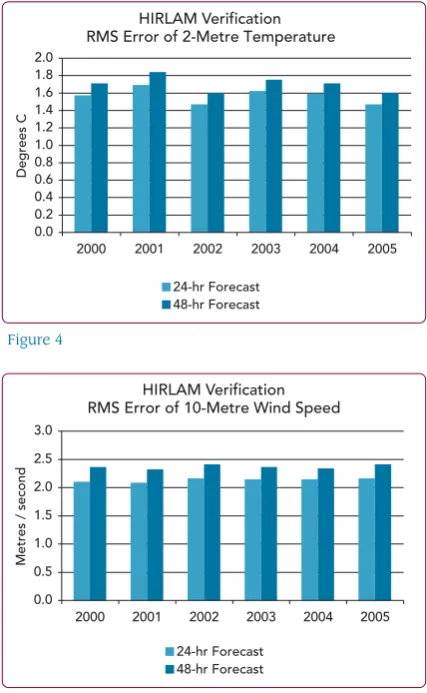
(25) During 2005 one staff member resigned and there. developments the Partnership Council considered. were eleven retirements. The Assistant Director,. a number of health and safety-related issues. Scientific and Technical Support post was filled by. during the year, including first-aid training and. Mr. Tom Sheridan. There were four appointments. office cleaning/maintenance. Among the specific. to the Meteorologist grade and one to a. issues addressed were improvements to the fire. Temporary Contract Meteorologist post; three to. alarm system and monitoring of temperature/. the Meteorological Officer grade and one Services. humidity levels at the Met Éireann offices in. Officer was appointed. Three staff members were. Glasnevin.. on career breaks at various stages during the year. At the end of 2005 there were the equivalent of. The Partnership Council also monitored the. 225.5 staff posts filled in Met Éireann (taking into. operation of the Performance Management and. account work sharing etc.).. Development System (PMDS), considered arrangements for staff availing of Teleworking,. Preparation of the updated Met Éireann Strategy. and reviewed Met Éireann’s Business Plan 2005.. Statement was well advanced with publication. In November, under the auspices of the Council,. expected in the first quarter of 2006.. a very successful social event was organised to mark the contribution of Met Éireann staff members. Partnership The Partnership Council held eight meetings during 2005, two of which were arranged in conjunction with visits by the Council to Met Éireann’s synoptic stations at Casement Aerodrome (Baldonnel) and Cork Airport.. who had completed 25 years service with the organisation. At its meetings in July and November the Merit Awards Group (a subgroup of Partnership) approved awards for two teams and nine individuals, benefiting a total of twelve staff members.. Staff Training and Development. The Partnership Council made important. During 2005 locally-organised courses/training. contributions to Met Éireann’s Human Resources. events were attended by 105 staff, while an. Strategy 2005-2007, which was published in. additional 24 staff attended training courses. March. The Strategy acknowledges the central. abroad. Eleven staff members availed of the. role of staff in achieving Met Éireann’s goals, and. Refund of 3rd Level Fees scheme and a further. analyses the principal HR initiatives which will be. six received pre-payment for 2005/2006 fees.. undertaken in the coming years. The overall aim of the Strategy is to enhance the service delivered. Under an Agreement between Met Éireann and. to customers through ensuring that all staff have a. University College Dublin, two full-time places. fulfilling and rewarding role within the organisation.. (or equivalent) on the M.Sc. Degree course in Meteorology are made available each year to. In recent years Government Departments have. Met Éireann staff. In 2005 this provision was. become more focused on staff health and safety. availed of by four staff members who enrolled for. matters. Risk assessments have been undertaken,. the course on a part-time basis. Two additional. competencies reviewed and the role of safety. staff attended full-time with support from the. representatives clarified. In line with these. Refund of 3rd Level Fees scheme.. Met Éireann – Annual Report 2005. 23.
(26) Initial training was provided in-house for three. good progress was made in developing new. newly-recruited Meteorological Officers. In-house. educational and training material for primary-level. training was also provided for 150 staff in the. schools. The librarian continued to act as content. areas of PMDS (Upward Feedback, Integration. manager for Met Éireann’s website, co-ordinating. with Human Resource Management Procedures),. the implementation of routine changes and. the Official Languages Act 2003, Equality/. upgrades.. Diversity and Quality Customer Service. An initial draft of a Training and Development Strategy for Met Éireann was reviewed by the Management Committee. A revised draft will be considered by the Partnership Council and the Strategy is expected to be finalised early in 2006.. Library & Information Services. Young Scientist and Technology Exhibition In 2005 Met Éireann sponsored a Special Award at the Esat BT Young Scientist and Technology Exhibition for the best project with Irish weather or climate as its central theme. Students from Scariff Community College - Seán Corry, Shane Moroney and José Ramire - won the Award for their project. Two issues of Met Éireann’s staff magazine Splanc. ‘Atmospheric ion counting as an aid to. were produced during the year. In collaboration. meteorology’.. with staff from the General Forecasting Division,. Students from Scariff Community College receiving their award from Evelyn Cusack (Met Éireann).. 24. Met Éireann – Annual Report 2005.
(27) Appendix I – Forecast Accuracy Verification of Public Weather Forecasts During 2005 Met Éireann continued the routine. Max. Temperature Verification 2001 - 2005 RMS Error of Forecast and Persistence. verification of predicted daily maximum 3.00. temperature, minimum temperature and rainfall at on the RTÉ 1 radio forecasts at 7.55 am.. 2.50. Degrees C. four sites (Dublin, Cork, Birr and Belmullet), based. 2.00 1.50 1.00 0.50. Figures 1 and 2 show the mean annual Root Mean. 0.00. Square (RMS) errors for the maximum and minimum. 2001. 2002. temperature forecasts for the years 2001 - 2005. 2004. 2005. Forecast Persistence. (the smaller the RMS error, the better the forecast). Figure 3 shows the mean annual verification of. 2003. Figure 1. rainfall amount by means of Hanssen and Kuipers' Score – this has a value of 1 for a perfect forecast, Min. Temperature Verification 2001 - 2005 RMS Error of Forecast and Persistence. and zero for a random forecast, i.e. one lacking any skill. The Figures also show corresponding. For 2005, the mean Root Mean Square (RMS) error for the maximum temperature forecast is about 1.5°C, and about 1.9°C for the minimum. 3.50. Degrees C. mean annual scores for persistence.. 4.00 3.00 2.50 2.00 1.50 1.00 0.50 0.00 2001. 2002. 2003. 2004. 2005. Forecast Persistence. temperature. For rainfall, the average value of the Hanssen and Kuipers' Score is 0.44. All these scores are similar to the corresponding values for. Figure 2. 2001-2004. Rainfall Verification 2001 - 2005 Hanssen and Kuipers' Score for Forecast and Persistence. An indication of the quality of the forecasts can be got by comparing the forecast scores with the. 1.00. values that would be obtained for a ‘standard’. 0.75. forecast. Persistence is a commonly-used standard. 0.50. for verification purposes - i.e., a forecast that assumes that tomorrow’s weather will be the same. 0.25. as today’s. Figures 1 - 3 show that, as would be. 0.00 2001. expected, the annual forecast scores for the years. 2003. 2004. 2005. Forecast Persistence. 2001-2005 are in all cases much better than the persistence scores.. 2002. Figure 3. Met Éireann – Annual Report 2005. 25.
(28) Numerical Weather Prediction. Figure 5 shows the Root Mean Square error scores. The evolution of the annual verification scores for the HIRLAM forecasts of 2-Metre Temperature and 10-Metre Wind Speed, from 2000 to 2005,. 48 hrs. For the 24 hrs forecast the 2005 RMS error is the same as in 2004, while for the 48 hrs forecast the 2005 RMS error is slightly greater.. is shown in Figures 4 and 5.. Road Surface Temperature. HIRLAM Verification RMS Error of 2-Metre Temperature. Degrees C. of forecast 10-Metre Wind Speed for 24 hrs and. Forecasts of road conditions are provided under. 2.0 1.8 1.6 1.4 1.2 1.0 0.8 0.6 0.4 0.2 0.0. contract to the National Roads Authority. Verification of the Road Surface Temperature (RST) minimum forecasts was carried out during the winter 2004/2005 season for the so-called critical nights (nights on which RSTs less than 5°C were observed) for all available sites. Table 1 shows the 2000. 2001. 2002. 2003. 2004. 2005. Hanssen and Kuipers’ Score and the RMS Error for the 2004/2005 forecasts, along with the. 24-hr Forecast 48-hr Forecast. corresponding values for the winter seasons 2003/2004 and 2002/2003.. Figure 4. Hanssen and Kuipers’ Score. RMS Error. 2004-2005. 0.66. 1.6ºC. 2003-2004. 0.70. 1.5ºC. 2002-2003. 0.68. 1.6ºC. HIRLAM Verification RMS Error of 10-Metre Wind Speed 3.0 Metres / second. 2.5 2.0 1.5. Table 1. 1.0 0.5. For 2004/2005 both the Hanssen and Kuipers’. 0.0 2000. 2001. 2002. 2003. 2004. 2005. 24-hr Forecast 48-hr Forecast. Figure 5. Figure 4 gives the Root Mean Square error scores of forecast 2-Metre Temperature for 24 hrs and 48 hrs, verified against actual temperature reports from the network of Irish observing stations. Both scores show a small improvement in 2005 RMS error compared with corresponding values for 2004.. 26. Met Éireann – Annual Report 2005. Score and the RMS Error show a small disimprovement compared to the 2003/2004 values. However both scores have been quite stable over the past three winter seasons..
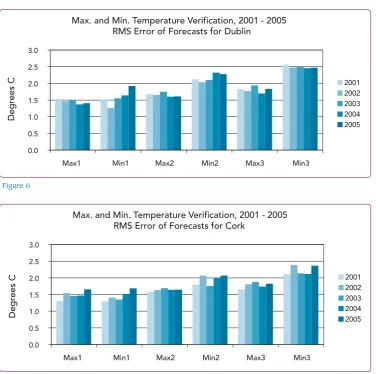
(29) Air Temperature Forecasts Early morning forecasts of maximum and. on current day, Max2 = max. temperature on. minimum temperatures for Dublin and Cork,. following day etc). Figure 7 shows the. for the current day and the subsequent two days,. corresponding RMS error scores for Cork.. are issued by General Forecasting Division. These forecasts are subsequently verified against. Generally speaking the 2005 RMS scores are. observations at Dublin and Cork Airports. Figure 6. comparable with those of 2004, with perhaps. shows the annual RMS error scores for Dublin for. some evidence of a slight disimprovement in the. the period 2001-2005 (Max1 = max. temperature. minimum temperature scores for Cork.. Max. and Min. Temperature Verification, 2001 - 2005 RMS Error of Forecasts for Dublin 3.0. Degrees C. 2.5 2001 2002 2003 2004 2005. 2.0 1.5 1.0 0.5 0.0. Max1. Min1. Max2. Min2. Max3. Min3. Figure 6. Max. and Min. Temperature Verification, 2001 - 2005 RMS Error of Forecasts for Cork 3.0. Degrees C. 2.5 2001 2002 2003 2004 2005. 2.0 1.5 1.0 0.5 0.0. Max1. Min1. Max2. Min2. Max3. Min3. Figure 7. Met Éireann – Annual Report 2005. 27.
(30) Appendix II – Publications Fitzgerald, D.L. 2005: Analysis of extreme rainfall using the log logistic distribution. Stochastic Environmental Research and Risk Assessment (SERRA), 19, 4, 249-257. Fleming, G. et al. 2005: Guidelines on weather broadcasting and the use of radio for the delivery of weather information. World Meteorological Organisation (WMO) Technical Document no. 1278, 54pp. McDonald, A. 2005: Transparent lateral boundary conditions for baroclinic waves: a study of two elementary systems of equations. Tellus 57A, 171-182. McDonald, A. 2005: Transparent lateral boundary conditions for systems of equations which support barotropic, baroclinic, and potential vorticity waves. HIRLAM Technical Report 64, 38pp. McDonald, A. 2005: Progress report on transparent lateral boundary conditions. HIRLAM Newsletter 49, 124-128. McGrath, R., Nishimura, E., Nolan, P., Semmler, T., Sweeney, C. and Wang, S. 2005: Climate Change: Regional Climate Model Predictions for Ireland. Environmental Protection Agency Report prepared by the Community Climate Change Consortium for Ireland, 45pp. Schulte, R.P.O., Diamond, J., Finkele, K., Holden, N.M. and Brereton, A.J. 2005: Predicting the Soil Moisture Conditions of Irish Grasslands. Irish Journal of Agricultural and Food Research 44,1, 95-110.. 28. Met Éireann – Annual Report 2005.
(31) Appendix III – Met Éireann Finances The figures presented below are approximate and for information only. They do not form part of the official annual accounts of Met Éireann.. Income and Expenditure 2005/2004 2005 €,000. 2004 €,000. 2005 €,000. 2004 €,000. Salaries and Related Expenses (A1) Other Operating Expenses Capital Expenditure Contributions to International Organisations. 14,387 13,992 2,705 2,506 602 611 2,945 2,979. Total. 20,639 20,088. Receipts from Eurocontrol (Route Charges) Receipts from Commercial & Cost Recovery Activities. 7,833 1,651. 7,261 1,501. Total Receipts. 9,484. 8,762. Net Cost of Operations. 11,155 11,326. Some details of above A1 Salaries Overtime Payment to Observers Other Allowances. 13,533 13,333 568 489 114 109 172 61. A2 A3 A4 A5 A5 A5 A5 A6 A7. (Travel & Subsistence) (Training/Merit Awards/Cleaning etc.) (Communications & Post) (Computing Capital) (Computing Non-Capital) (Instrumentation Capital) (Instrumentation Non-Capital) (Maintenance/Energy) (Consultancy). 238 506 265 250 564 352 588 525 19. 201 385 223 376 536 235 507 604 50. 17,694 17,109 Some details of commercial/cost recovery receipts Aviation Climatological Information General Forecasting Miscellaneous. 6 181 1,440 24. 13 172 1,237 79. 1,651. 1,501. Met Éireann – Annual Report 2005. 29.
(32) Corporate Information Met Éireann Headquarters. Met Éireann Dublin Airport. Glasnevin Hill. Co. Dublin. Dublin 9, Ireland. Tel:. +353-1-812 0081. Tel:. +353-1-806 4200. Fax:. +353-1-844 4633. Fax:. +353-1-806 4247. e-mail: [email protected] web:. www.met.ie. General Forecasting Tel:. +353-1-806 4255. Fax:. +353-1-806 4275. Met Éireann Shannon Airport Co Clare Tel:. +353-61-712 950. Fax:. +353-61-712 962. e-mail: [email protected]. Climatology and Observations. Met Éireann Cork Airport Cork. Tel:. +353-1-806 4260. Tel:. +353-21-491 7750. Fax:. +353-1-806 4216. Fax:. +353-21-431 7405. e-mail: [email protected]. Commercial Division Tel:. +353-1-806 4244. Fax:. +353-1-806 4247. e-mail: [email protected]. Met Éireann Valentia Observatory Cahirciveen Co. Kerry. 30. Tel:. +353-66-947 3460. Fax:. +353-66-947 2442. Met Éireann – Annual Report 2005. Met Éireann Connaught Airport Knock Co. Mayo Tel:. +353-94-936 7368. Fax:. +353-94-936 7390.
(33) Glossary ALADIN AWS C4I CAFO CRM ECMWF ECOMET ECPDS EUCOS EUMETCast EUMETNET EUMETSAT FIR GAW HIRLAM ICAO INTRA ISO MSG NASA NOAA OPW PRISM PMDS QMS RMS Error RST SAF SES SIGMET SMS SYNOP TAF TUCSON WAFS WAM WAN WMO. Limited-area Numerical Weather Prediction model of Météo-France Automatic Weather Station Community Climate Change Consortium for Ireland Central Analysis and Forecast Office Customer Relationship Management European Centre for Medium-Range Weather Forecasts European Co-operation in Meteorology ECMWF Product Distribution System EUMETNET Composite Observing System EUMETSAT data dissemination system Network of European Meteorological Services European Organisation for the Exploitation of Meteorological Satellites Flight Information Region Global Atmosphere Watch High-Resolution Limited Area Model International Civil Aviation Organisation Integrated Training (3rd-level work experience programme) International Organization for Standardization Meteosat Second Generation National Aeronautics and Space Administration National Oceanic and Atmospheric Administration Office of Public Works Predictive Irish Sea Models Performance Management and Development System Quality Management System Root Mean Square Error Road Surface Temperature Satellite Application Facility Single European Sky Information on occurrence of specified aviation weather phenomena Short Message Service WMO Code for Surface Synoptic Observations Terminal Aerodrome Forecast The Unified Climate and Synoptic Observation Network World Area Forecast System Wave Forecast Model Wide Area Network World Meteorological Organisation. Acknowledgements and photo credits EUMETSAT NOAA National Library of Ireland Met Éireann Staff. Met Éireann – Annual Report 2005. 31.
(34)
(35)
Figure

Related documents