A Memory-Sensitive Classification Model of Errors in Early Second
Language Learning
Brendan Tomoschuk and Jarrett T. Lovelett
Department of Psychology
University of California, San Diego
9500 Gilman Drive, La Jolla, CA, 92093-0109
{btomosch, jlovelet}@ucsd.edu
Abstract
In this paper, we explore a variety of lin-guistic and cognitive features to better un-derstand second language acquisition in early users of the language learning app Duolingo. With these features, we trained a random forest classifier to predict errors in early learners of French, Spanish, and English. Of particular note was our finding that mean and variance in error for each user and token can be a memory efficient replacement for their respective dummy-encoded categorical variables. At test, the-se models improved over the bathe-seline model with AUROC values of 0.803 for English, 0.823 for French, and 0.829 for Spanish.
1
Introduction
Learning a new language is often a challenging task for adults. However, there are many linguis-tic and cognitive factors that can facilitate (or im-pair) acquisition of a non-native language, rang-ing from properties of the languages a learner al-ready knows, to the methods and nature of study. Much work has sought to manipulate these fac-tors in order to both further our understanding of the cognitive systems in play and facilitate learn-ing.
Here, we present a model that explores these factors to predict outcomes for three populations of language learners that use Duolingo, a language learning app that gamifies lessons for a wide vari-ety of to-be-learned languages. We start by de-scribing the various features we developed from the data before describing the random forest mod-el used and the subsequent outcomes.
2
Related Work
Little work has been done building predictive models of adult language acquisition, but many
studies have explored the linguistic factors that impact vocabulary learning in a non-native lan-guage. Semantic properties of nouns, for example, have been found to impact word learning. Cog-nates, or words that overlap in form and meaning in both languages (e.g. lemon in English and limón in Spanish), have been shown to be easier to learn (de Groot & Keijzer, 2000). The same study showed that words that are rated as more concrete (hat as opposed to liberty) are easier to learn. While perhaps more surprising than the cognate result, this effect is often explained by the fact that more concrete words create more perceptual con-nections to their conceptual referents (it is easier to imagine a physical hat than the abstract concept of liberty), and it is therefore easier to connect new words to concepts via those connections.
There are likewise many factors than can hin-der word learning. For example, interlingual hom-ographs, or words that share surface form but have different meanings (pan as something to fry on in English and bread in Spanish) are harder to process and may therefore also be harder to learn (Dijkstra, Timmermans & Schriefers, 2000).
Beyond the linguistic particulars of individual words, the temporal dynamics of learning can powerfully moderate memory. One of the most well established results in cognitive psychology is that two repetitions of a to-be-learned item are best separated by some temporal gap, if the goal is long-term retention (Ebbinghaus 1885/1964, Cepeda, Pashler, Vul, Wixted, & Rohrer, 2006; Cepeda, Vul, Rohrer, Wixted, & Pashler, 2008; Donovan & Radosevich, 1999; T. D. Lee & Genovese, 1988). That is, given a fixed amount of available time to learn something, a learner is bet-ter off distributing that time over multiple learning sessions than cramming it all into a single session. Further, the more time that is allowed to pass be-fore a learner encounters a previously learned item again, the longer into the future the learner can
expect to retain that item (or equivalently, the greater the probability of successful retrieval of that item at a particular future time; but see Cepeda et al. 2008).
Over a century of research has shown this spac-ing effect to be robust across the human lifespan (e.g. Vander Linde, Morrongiello, & Rovee-Collier, 1985; Ambridge, Theakston, Lieven, & Tomasello, 2006; Carpenter, 2009; Cepeda et al., 2008; Balota, Duchek, & Paullin, 1989), over many varieties of learning tasks (Cepeda et al., 2006; Donovan & Radosevich, 1999; T. D. Lee & Genovese, 1988), and perhaps most strikingly, for nearly every inter-repetition temporal gap that has been investigated, from seconds (Ebbinghaus, 1964), to a range of days (e.g. Cepeda et al., 2008), to years (Bahrick & Phelphs, 1987).
Moreover, the advantage of spacing seems to be enhanced when combined with active retrieval from long-term memory (as compared to passive restudy), making it particularly well-suited to a microtesting-based learning platform like Duolingo (Carpenter & DeLosh, 2006; Cull, 2000; Karpicke & Roediger, 2007; Landauer & Bjork, 1978; Rea & Modigliani, 1985). Crucially for our present purpose, a number of studies have examined the efficacy of spaced repetition specif-ically in second language learning, where it seems to be effective at least for vocabulary, and perhaps for grammar as well, although further research is needed (for a review, see Ullman & Lovelett, 2018).
3
Data
The data were collected in 2017 from Duolingo, as part of the NAACL HLT 2018 Shared Task on Second Language Acquisition Modeling (SLAM, Settles, Brust, Gustafson, Hagiwara & Madnani, 2018). The data consisted of exercise and phrase level information for three populations of lan-guage learners in their first 30 days of using the app: English-speaking learners of Spanish and French as well as Spanish-speaking learners of English.
The data were split into a training set, which consisted of each user’s first 80% of sessions, a development set (for testing model generalization before the test phase) that contained the next 10% of each user’s data, and a test set that contained the final 10% of exercises for each user. The train-ing data set consisted of 1,882,701 exercises in to-tal (38.9% from learners of Spanish, 43.8% from
learners of English and 17.3% from learners of French), while the development data contained 255,383 exercises (45.3% from learners of Span-ish, 37.6% learners of from English and 17.1% from learners of French), and the test set con-tained 249,484 exercises (45.9% from learners of Spanish, 37.4% from learners of English and 16.7% from learners of French).
4
Features
Our approach to modeling errors in second lan-guage acquisition was driven primarily by two distinct bodies of research: linguistic effects in se-cond language acquisition, and drivers of robust memory in general. As such we discuss each set of features separately.
4.1 Linguistic features
In this section, we describe the semantic and morpho-syntactic features added to the model. Values for tokens that were not in databases listed below were set to the mean of the feature.
Word length. Orthographic and phonological length (orthoLength and phonLength respectively) are predictive of word difficulty, and longer writ-ten or spoken words generally leave more room for potential errors (Baddeley, Thomon & Bu-chanan, 1975). Phonological length was taken from the CLEARPOND database (Marian, Bartolotti, Chabal & Shook, 2012).
Word neighbors. A greater number of
ortho-graphic and phonological neighbors (orthoNei and phonNei) for a given word in both the to-be-learned and known languages might cause inter-ference leading to errors. These data were also taken from the CLEARPOND database.
Word Frequency. The log transformed frequency (logWordFreq) of the English, Spanish and French words to be learned were also included as predic-tors, as well as the average log frequency of the phonological (logOrthoNeiFreq) and orthographic neighbors (logPhonNeiFreq) in the to-be-learned as well as known language.
Edit Distance. Because cognate status impacts
and limón should have a short edit distance, while words like boy and niño will have relatively long-er distances.
Interlingual homographs. Additionally, the interlingual homograph status for each token (whether or not the token shares its surface form with a translation of a different token) were added for each language by using the Google Translate API.
Morphological Complexity. As a proxy for how
morphologically complex any given word is, the number of morphological features present in the given morphology columns were summed and treated as a proxy for morphological complexity (morphoComplexity).
Concreteness. Mean and standard deviations for concreteness ratings were taken from Brysbaert, Warriner and Kuperman (2014) and added to the model.
4.2 Memory features
Repetition & Experience. Each instance (i.e.,
each token in each exercise for each user) was labeled with (1) the number of times the current user had encountered that token, up to and in-cluding the current instance (nthOccurrence) and (2) the number of instances the user had seen in total, up to and including the current instance (userTrial).
Spaced Repetition. The amount of time that elapses between successive repetitions of a given item strongly moderate memory for that item
(see “Related Work”, above). As such, we e x-tracted a number of spacing-related features. To measure the temporal lag, and to capture the power law relationship between time and forget-ting, we calculated (separately for each user) the log(days) that had elapsed between: (1) each to-ken and its previous occurrence (tokenLag1), (2)
each token’s previous occurrence and its next most recent occurrence (tokenLag2), (3) each
to-ken’s stem (e.g. help, for helping) and its previ-ous occurrence (stemLag1), (4) each token’s
stem’s previous occurrence and its next most r e-cent occurrence (stemLag2), (5) each token’s
combination of several morphological features (number, person, tense, verbform) and the previ-ous occurrence of that particular combination (morphoLag1; to capture any possible spacing effect for verb conjugation skills) and (6) each token’s combination of those same morphologi-cal features and their next most recent occur-rence. Finally, (7) since some evidence suggests that the temporal gap between an item’s first and
second occurrence is particularly important for retention (Karpicke & Roediger, 2007), we also labeled each instance with the log(days) that elapsed between the first and second occurrence
of the token’s stem (lagTr1Tr2).
4.3 Categorical Features
Included in our classifier were a number of cate-gorical features, each encoded as binary indicator variables distributed over a number of columns equal to the number of levels in the category. Importantly, our approach to modeling was con-strained by limited computational power and memory, so we chose to include only categorical features with a relatively small number of levels, to reduce the dimensionality of the data. Those features were: part of speech (pos; 16 levels), countries (94 levels), session (3 levels), format (3 levels), and all of the morphological features available for each language (46 levels for learn-ers of Spanish, 17 levels for learnlearn-ers of English, and 10 levels for learners of French). Client was also included, though we treated iOS and An-droid as equivalent, preserving only the distinc-tion between web and mobile access to the Duolingo application (2 levels).
user and token were chosen to maximize poten-tial differences between accuracy in different modalities. Indeed, to foreshadow our results, these features each ranked among the most im-portant for our random forest classifier.
4.4 Interactions
Several interactions between features were also coded into the model. Due to time constraints, on-ly the following interactions were added: stemLag1 x stemLag2 and stemLag1 x stemLag2 x lagTr1Tr2, to capture spacing effects, lagTr1Tr2 x morphoComplexity and lagTr1Tr2 x morphoLag1 to capture lag differences between morphological features, format x prevFormat to capture possible task switching effects, and orthoNei x format and phonNei x format and for-mat x client to capture differences due to listening vs. typing, and finally morphoComplexity x pos as any complexity effect may be stronger nouns and verbs than function words.
5
Model
In order to focus on feature engineering, ran-dom forest techniques were chosen over gradient boosting, logistic regression or other classification techniques. The random forest classifier scales well to large datasets, is not particularly prone to overfitting problems, and requires less parameter tuning.
Random forest classifiers combine the outputs of multiple decision tree classifiers with random features taken in each decision in order to gener-ate one final prediction (Breiman, 2001). Each de-cision-tree classifier split the data along some number of parameters (equal to the square root of the total number of features in this model) that fits a classifier. Each split of the data was again split along the other included parameters until the leaves of the tree contained only data points with the same label (i.e., only error or only no-error in-stances). For each learner population, we generat-ed 1000 decision trees to generate prgenerat-edictions. Out-of-bag errors were used to estimate errors in training.
6
Results and Discussion
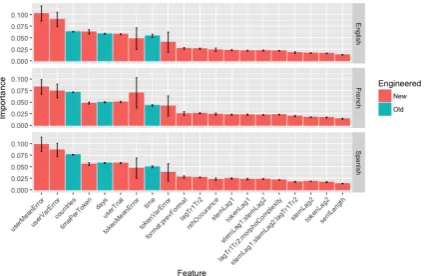
[image:4.595.309.523.82.220.2]Figure 1 shows the top 20 importance scores for each language (out of an across-language total of 174 features or interactions). The importance
Figure 1: Top 20 importance features grouped by to-be-learned language. Error bars represent standard deviation of the importance of each feature across de-cision trees. For categorical features, the importances of each level, and their variances (to generate stand deviations), were summed to calculate the overall im-portance and variability in imim-portance, respectively.
score of a random forest model conveys the pre-dictive power of a given feature relative to the other predictors. Color depicts which features were engineered and which were provided in the raw data. Full importance values, for each lan-guage are listed in Appendix A, including the di-rectionality of the relationship between each con-tinuous feature and the error rate. For example, because userMeanError is higher on incorrect tri-als than correct tritri-als, the directionality is consid-ered positive.
The mean and variance in error rate for each user (userMeanError and userVarError) were the most important features, indicating that each
us-er’s history was strongly predictive of their per-formance at test, and that the variability within each user was nearly as predictive as the differ-ence between users.
Countries, the third most important feature, may have ranked third in all three languages be-cause the importance measure was calculated by summing over each feature level, possibly over-stating the value of that feature in total. Never-theless countries may represent user background information not given in the dataset including their previous language experience (as a Portu-guese speaking user from Brazil may be learning Spanish via English, but would likely make dif-ferent errors than an English monolingual from Canada).
spent on each exercise better because it accounts for the length of the exercise at the token level.
Next is userTrial, which was calculatedly simp-ly as which learning instance a given user is on. This likely captures the experience a user accumu-lates with the language and perhaps the app more generally.
Next of note is the mean and variance in error rate for each token, showing that each token has some properties that capture difficulty. This is es-pecially true for learners of French, as the im-portance of tokenMeanError is ranked fourth in French as compared to eighth in both English and Spanish.
The interaction between format and previous format shows that there is some cost associated with task switching, perhaps to a slightly higher degree in English and Spanish, as this feature did not quite rank among the top ten in French, but was surpassed in that language by the lag between
the first two occurrences of a token’s stem. Finally, the various lag features that reflect re-cent experience and many of their interactions comprise of the next most important features, in-dicating that spacing effects are generally predic-tive of errors of the overall model, the highest of these being the lag between the first two instances of a given token. This is an important and poten-tially useful feature. A measure of this lag is easy to calculate and necessarily occurs early in learn-ing, making it useful in predictions that are memory intensive and catered to particular users or tokens.
Overall these features, and indeed many of the engineered features, improved the models over baseline, as seen in Table 1. This is particularly noteworthy considering user and token were re-moved in our model (and replaced with user- and token-level error rates), but were included in the SLAM baseline provided with the data. Indeed, the mean and variance across users and tokens ac-count for ~25% of the importance across all lan-guages. Though the importance of these features aggregate error rates in the training data, the met-rics did not differ considerably when evaluated with the development data (AUROC = .824, .818, and .802 for English, French and Spanish respec-tively). This shows that aggregating is a feasible approach in cases where computational con-straints prohibit the exact representation of im-portant high dimensional categorical features. No-tably, the within-user variability was an important
AUROC F1 Log-loss SLAM English .7730 .1899 .3580
English .8286 .4242 .3191 SLAM French .7707 .2814 .3952 French .8228 .4416 .3561 SLAM Spanish .7456 .1753 .3862 Spanish .8027 .4353 .3571
Table 1: Final model outcomes in all three metrics as compared to baseline.
feature in our model, but would not automatically be captured by dummy-coding user and token IDs across hundreds or thousands of instances. Thus, substantial computational savings can be achieved using low dimensional summary statistics where significant CPU time and memory resources would be required.
7
Future work
Due to the time-limited nature of this shared mod-eling task, considerable work remains to be done to both optimize the performance of this model and further understand the cognitive processes in-volved in early language learning.
To improve the model, we would first refine the relative importance of the current features, by per-forming ablation tests and model comparisons; some of the current features play little to no role in improving model performance. Furthermore, many interactions in the current feature space,
such as userMeanAcc x tokenMeanAcc, may be important predictors given each individual
fea-ture’s importance, and that each user’s previous
language experience will impact the difficulty as-sociated with any given token. The spacing effect might likewise interact with individual user and token related information.
There is additionally much work to be done in quantifying the benefit of using user- and token-level error rates as opposed to dummy-encoded variables. While these features are a memory and time sensitive solution, we have not yet explored how much model performance is affected by this change relative to a dummy-encoded solution, how much time is saved, and how much data is required to achieve this performance.
Fu-ture work will therefore dedicate more resources to model development. While in the present work only a random forest ensemble classifier was used to generate predictions, logistic regression, deep learning, and/or other modeling approaches may better suit this particular learning task, and should be thoroughly explored.
Finally, there are many more features than can be developed, including word embeddings of to-kens and syntactic structure differences. Our work has scratched the surface of linguistic and cogni-tive theory that might be applied to modeling lan-guage learning, but the vast scientific literatures in those and other fields no doubt offer rich possibili-ties for new features. The relative contribution of all of these features and their interactions to ma-chine learning models of error production is likely to greatly expand our knowledge of early second language learning.
8
Acknowledgements
We thank Ed Vul, Tim Sainburg, Vic Ferreira and the Language Production Lab for their feed-back on this project.
References
Ben Ambridge, Anna L. Theakston, Elena V.m. Lieven, and Michael Tomasello. 2006. The dis-tributed learning effect for children’s acquis i-tion of an abstract syntactic construci-tion. Cog-nitive Development, 21(2), 174–193.
Alan D. Baddeley, Neil Thomson, and Mary Buchan-an. 1975. Word length and the structure of
short-term memory. Journal of verbal learning
and verbal behavior, 14(6), 575-589.
Harry P. Bahrick and Elizabeth Phelphs. 1987. Reten-tion of Spanish vocabulary over 8 years. Jour-nal of Experimental Psychology: Learning, Memory, and Cognition, 13(2), 344–349.
David A. Balota, Janet M. Duchek, and Ronda Paullin. 1989. Age-related differences in the impact of spacing, lag, and retention interval. Psychology and Aging, 4(1), 3–9.
Leo Breiman. 2001. Random forests. Machine
Learn-ing, 45(1), 5-32.
Marc Brysbaert, Amy Beth Warriner, and Victor Kuperman. 2014. Concreteness ratings for 40 thousand generally known English word
lem-mas. Behavior research methods, 46(3),
904-911.
Shana K. Carpenter. 2009. Cue strength as a modera-tor of the testing effect: The benefits of elabora-tive retrieval. Journal of Experimental Psychol-ogy: Learning, Memory, and Cognition, 35(6), 1563–1569.
Shana K. Carpenter and Edward L. DeLosh. 2006. Impoverished cue support enhances subsequent retention: Support for the elaborative retrieval explanation of the testing effect. Memory and Cognition, 268-276.
Nicholas J. Cepeda, Harold Pashler, Edward Vul, John T Wixted, and Doug Rohrer. 2006. Dis-tributed practice in verbal recall tasks: A review and quantitative synthesis. Psychological Bulle-tin, 132(3), 354-380.
Nichlaos J. Cepeda, Edward Vul, Doug Rohrer, John T. Wixted, and Harold Pashler. 2008. Spacing effects in learning: A temporal ridgeline of op-timal retention. Psychological Science, 19(11), 1095-1102.
William L. Cull. 2000. Untangling the benefits of multiple study opportunities and repeated test-ing for cued recall. Applied Cognitive Psychol-ogy, 14(3), 215-235.
Annette De Groot and Rineke Keijzer. 2000. What is hard to learn is easy to forget: The roles of word concreteness, cognate status, and word
frequen-cy in foreign‐language vocabulary learning and
forgetting. Language Learning, 50(1), 1-56.
Ton Dijkstra, Mark Timmermans, and Herbert Schriefers. 2000. On being blinded by your oth-er language: Effects of task demands on
interlingual homograph recognition. Journal of
Memory and Language, 42(4), 445-464.
John J. Donovan and David J. Radosevich. 1999. A meta-analytic review of the distribution of prac-tice effect: Now you see it, now you don't. Journal of Applied Psychology, 84(5), 795-805.
Jeffrey D. Karpicke and Henry L. Roediger. 2007. Expanding retrieval practice promotes short-term retention, but equally spaced retrieval en-hances long-term retention. Journal of Experi-mental Psychology-Learning Memory and Cog-nition, 33(4), 704-719.
Thomas K. Landauer and Robert A. Bjork. 1978. Op-timum rehearsal patterns and name learning In M. M. Gruneberg, P. E. Morris, & R. N. Sykes 632). London: Academic Press.
Timothy D. Lee and Elizabeth D. Genovese (1988). Distribution of practice in motor skill acquisi-tion: Learning and performance effects
recon-sidered. Research Quarterly for Exercise and
Sport, 59(4), 277-287.
Viorica Marian, James Bartolotti, Sarah Chabal, and Anthony Shook. 2012. CLEARPOND: Cross-linguistic easy-access resource for phonological
and orthographic neighborhood densities. PloS
one, 7(8), e43230.
Cornelius P. Rea and Vito Modigliani. 1985. The ef-fect of expanded versus massed practice on the retention of multiplication facts and spelling lists. Human Learning: Journal of Practical Re-search and Applications, 4(1), 11-18.
B. Settles, C. Brust, E. Gustafson, M. Hagiwara, and N. Madnani. 2018. Second Language Acquisi-tion Modeling. In Proceedings of the NAACL-HLT Workshop on Innovative Use of NLP for Building Educational Applications (BEA). ACL.
Michael T. Ullman and Jarrett T. Lovelett. 2016. Im-plications of the declarative/procedural model for improving second language learning: The role of memory enhancement techniques. Se-cond Language Research, 39(1), 39-65.
Appendix A.
English French Spanish
Feature Import. SD Rank Direc. Import. SD Rank Direc. Import. SD Rank Direc.
Case 0.001 0.001 52 0.001 0.000 57
client 0.004 0.001 44 0.005 0.001 41 0.005 0.001 38
Concreteness (M) 0.007 0.001 31 + 0.011 0.004 26 - 0.010 0.001 25 +
Concreteness (SD) 0.007 0.001 34 - 0.009 0.003 31 + 0.010 0.001 27 +
countries 0.063 0.001 3 0.071 0.001 3 0.076 0.001 3
days 0.058 0.001 5 + 0.050 0.001 6 + 0.058 0.001 4 +
Definite 0.000 0.000 55 0.001 0.000 54 0.001 0.000 55
Degree 0.001 0.000 53 0.000 0.000 61
dependencyEdgeHead 0.011 0.001 22 - 0.011 0.001 25 + 0.012 0.001 21 -
editDistance 0.007 0.001 32 - 0.010 0.003 29 - 0.010 0.001 26 +
EngPhos 0.005 0.002 43 - 0.006 0.002 38 - 0.002 0.000 50 -
Foreign 0.000 0.000 63
format 0.006 0.006 36 0.008 0.009 32 0.008 0.008 30
format:client 0.010 0.006 24 0.012 0.009 22 0.012 0.007 22
format:prevFormat 0.027 0.002 10 0.025 0.004 11 0.028 0.003 10
Gender 0.000 0.000 54 0.004 0.001 47 0.004 0.000 42
Homograph 0.002 0.001 49 - 0.002 0.001 51 - 0.002 0.001 49 -
lagTr1Tr2 0.026 0.001 11 + 0.026 0.001 10 + 0.027 0.001 11 +
lagTr1Tr2:morphoComplex 0.022 0.001 16 + 0.023 0.001 13 + 0.022 0.001 16 +
logEngPhoNeiFreq 0.005 0.001 42 - 0.006 0.002 36 - 0.002 0.000 52 +
logOrthoNeiFreq 0.007 0.001 35 - 0.007 0.002 33 - 0.005 0.001 39 -
logPhonNeiFreq 0.006 0.001 37 - 0.006 0.001 37 - 0.005 0.001 40 -
logWordFreq 0.008 0.002 28 - 0.009 0.003 30 - 0.005 0.001 35 -
Mood 0.002 0.000 50 0.001 0.000 56 0.001 0.000 56
morphoComplex 0.002 0.000 48 - 0.003 0.002 50 - 0.003 0.000 46 -
morphoComplex:pos 0.006 0.001 38 0.007 0.002 35 0.006 0.001 33
morphoLag1 0.008 0.000 30 + 0.005 0.000 42 + 0.005 0.000 36 +
morphoLag1:morphoComplex 0.008 0.000 27 + 0.005 0.000 43 + 0.005 0.000 37 +
morphoLag2 0.010 0.000 23 + 0.006 0.000 39 + 0.005 0.000 34 +
nthOccurance 0.024 0.004 12 - 0.024 0.002 12 - 0.023 0.003 15 -
Number 0.002 0.000 47 0.005 0.002 45 0.004 0.001 41
NumType 0.000 0.000 56 0.000 0.000 59
orthoLength 0.004 0.002 45 + 0.005 0.001 46 + 0.003 0.001 47 +
OrthoNei 0.005 0.001 39 - 0.006 0.002 40 - 0.004 0.001 43 -
OrthoNei:format 0.010 0.004 26 0.014 0.008 21 0.008 0.003 31
Person 0.001 0.001 51 + 0.004 0.001 48 0.003 0.000 48
phoLength 0.004 0.001 46 + 0.004 0.001 49 + 0.003 0.001 45 +
PhonNei 0.005 0.001 41 - 0.005 0.002 44 - 0.003 0.000 44 -
Polite 0.000 0.000 64
pos 0.007 0.001 33 0.012 0.004 23 0.009 0.000 29
Poss 0.000 0.000 58
PrepCase 0.000 0.000 60
PronType 0.002 0.001 52 0.002 0.000 51
Reflex 0.000 0.000 62
sentLength 0.013 0.001 20 + 0.014 0.001 20 + 0.013 0.001 20 +
session 0.010 0.001 25 0.011 0.001 28 0.011 0.001 23
stemLag1 0.023 0.001 13 + 0.023 0.001 14 + 0.025 0.001 12 +
stemLag1:stemLag2 0.022 0.001 14 - 0.022 0.001 16 - 0.023 0.001 13 -
stemLag1:stemLag2:lagTr1Tr2 0.018 0.002 17 + 0.020 0.001 17 + 0.017 0.001 18 -
stemLag2 0.017 0.001 18 + 0.018 0.001 18 + 0.018 0.001 17 +
Tense 0.001 0.000 55 0.001 0.000 54
time 0.054 0.003 7 + 0.043 0.002 8 + 0.050 0.002 7 +
timePerToken 0.062 0.005 4 + 0.048 0.002 7 + 0.056 0.003 6 +
tokenIndex 0.012 0.001 21 + 0.011 0.001 27 + 0.011 0.001 24 +
tokenLag1 0.022 0.001 15 + 0.023 0.002 15 + 0.023 0.002 14 +
tokenLag2 0.016 0.001 19 + 0.017 0.001 19 + 0.017 0.001 19 +
tokenMeanError 0.048 0.023 8 + 0.070 0.033 4 + 0.047 0.022 8 +
tokenVarError 0.040 0.022 9 + 0.042 0.022 9 + 0.038 0.019 9 +
userMeanError 0.102 0.016 1 + 0.083 0.016 1 + 0.098 0.016 1 +
userTrial 0.058 0.001 6 + 0.050 0.002 5 + 0.058 0.001 5 +
userVarError 0.090 0.015 2 + 0.074 0.015 2 + 0.086 0.015 2 +
VerbForm 0.001 0.000 53 0.001 0.000 53