Proceedings of the First International Workshop on Spatial Language Understanding (SpLU-2018), pages 41–45
Representing Spatial Relations in FrameNet
Miriam R. L. Petruck Michael Ellsworth International Computer Science Institute
Berkeley, California
{miriamp, infinity}@icsi.berkeley.edu
Abstract
While humans use natural language to express spatial relations between and across entities in the world with great facility, natural lan-guage systems have a facility that depends on that human facility. This position paper presentsFrameNet’s1 approach to represent-ing spatial relations in language, and advocates its adoption for representing the meaning of spatial language. This work shows the impor-tance of axis-orientation systems for captur-ing the complexity of spatial relations, which FrameNet encodes with semantic types.
1 Introduction
While humans use natural language to express spatial relations across entities in the world with great facility, natural language systems have a fa-cility that depends on that human fafa-cility. (See (Mikolov et al.,2013) for a different perspective.) Natural Language Processing (NLP) applications such as robotic systems responding to commands about objects in a scene require accurate infor-mation on the spatial relations among those ob-jects. In addition to determiningwhatinformation to provide is the challenge of determininghowto represent such information. This work presents the Frame Semantics view on representing spatial language, specifically as given in FrameNet (FN). The rest of this position paper is organized as follows; Section 2 presents basic information about FN, including its current status; Section 3 provides a brief overview of related work; Section 4 covers the different kinds of spatial information that FN has recorded, including semantic types for characterizing spatial relation language, two of which constitute innovations over prior work; Section 5 shows how employing FN’s spatial in-formation can benefit NLP; and Section 6 briefly
1http://framenet.icsi.berkeley.edu
discusses FrameNet’s plans for future work on the language of spatial relations. Importantly, expand-ing FN’s coverage for representexpand-ing spatial rela-tions is possible given existing FN infrastructure, i.e. frames, frame elements, and frame-to-frame relations, as well as semantic types.
2 Background to FrameNet
This section provides a very brief overview of FN, with information about its foundational principles and its relatively recent attention to basic linguistic phenomena that pose challenges to NLP, including the language of spatial relations, as well as details about its current status.
2.1 Frame Semantics and FrameNet
Frame Semantics(Fillmore,1985) is the theoreti-cal basis ofFrameNet(Ruppenhofer et al.,2016), a knowledge base building effort, whose product, the FN database, is useful in NLP applications.
Central to the theory is the semantic frame
(Fillmore,1975), a schematic representation of a scene, whose frame elements (FEs), or semantic roles, identify participants and other conceptual entities, and whose underlying conceptual struc-ture humans access for both encoding and decod-ing purposes. FrameNet adopted the lexical unit (LU) as the focus of analysis, defining an LU as a pairing of a lemma and a frame (Cruse,1986).
FrameNet also distinguishes core and non-core frame elements. Thus, core FEs uniquely de-fine a frame: BUYER, SELLER, MONEY, and
GOODS2 uniquely define frames that constitute
the Commercial transaction3 family of frames. In contrast,non-core FEs are relevant to events or situations in general; all events and situ-ations occur at a time and in a place. The non-core
2Frame Element names appear inSMALL CAPS. 3Frame names appear intypewriterfont.
FE PLACE is of particular importance for spatial
relations (and is discussed further below).
FrameNet defines Spatial contact as a scene in which a FIGURE is located in contact
with a GROUND. With some words, the FIGURE
is also asserted as fully or partially supported by the GROUND (e.g. on), while in others a support
relation is denied (e.g.,TO, as inShe put her hand TOthe wall), or unspecified (e.g. against). Some LUs assert a direction in which to find the FIGURE
from the GROUND(e.g.,atop).
Consider the two example sentences below that instantiate theSpatial contactframe, where each realizes the FIGUREand the GROUNDFEs.
1. Then [Maria FIGURE] fell and lay ON[the
floor GROUND].
2. There were [a hat and feathers FIGURE]
ATOP[the lid GROUND].
Contrast onandatop: on allows any direction of contact (on the {ceiling, wall, ground}), while
atopspecifies a particular direction of contact, i.e., above the GROUND. FN encodes such differences
in a set of semantic types that specify axis systems and directions, based on these axis systems.
2.2 Current Status of FrameNet
At the time of this writing, the FN database holds over 1,220 frames, 13,640 LUs, and nearly 202,230 annotated sentences. Of importance here, FrameNet has defined 29 spatial language frames, covering 409 LUs that describe spatial re-lations, and approximately 4,200 annotated sen-tences, along with six semantic types for distin-guishing spatial relation LUs.
3 Related Work
Linguists, computational linguists, and NLP re-searchers in particular, have studied spatial rela-tions in language, and for the sake of develop-ing annotation schema and NLP systems that take such information into consideration.
For example, (Dorr and Voss,1993), addressed spatial relations for defining the relation between an interlingua and a system for representing knowledge in machine translation. Pursuing ma-chine translation (Voss et al., 1998) investigaged
howthe semantics of a spatial expression is allo-cated lexically.
(Jackendoff, 1996) considered how language users talk about what they see, addressing how
the mind might encode spatial information and lin-guistic information, as well how it might commu-nicate between the two. That work also laid out some of the ”boundary conditions for a satisfac-tory answer to these questions” (1996:3), and de-fined an approach to spatial representation. In a somewhat similar vein (as a contributiton to cog-nitive semantic theory of conceptual structure), al-beit from a different perspective, (Talmy, 2003) presented an approach to spatial representation that encompasses spoken and signed language.
More practically-oriented recent work (Kipper et al.,2004) expanded a verb lexicon (Kipper et al.,
2000) using prepositions, i.e., linguistic material that encodes spatial information, extrapolating in-formation about classes of verbs and their syntac-tic frames from (Levin,1993). The annotation of spatial relations in language (Pustejovsky et al.,
2011) constituted the focus of a workshop on inter-operable semantic annotation, and included work on spatial role labeling with an eye toward ex-tracting spatial information from corpora ( Kord-jamshidi et al., 2011) that also led to multimodal spatial role labeling (Kordjamshidi et al.,2017).
4 Spatial Information in FrameNet
This section describes the kind of information that FN provides about spatial relations, i.e., frames that characterize spatial relations, non-core FEs that indicate location of an event or an entity, frame-to-frame relations that link the relevant frames, and semantic types that give specific se-mantic information beyond a frame description or a LU definition.
4.1 Non-Core Frame Elements
An advantage of FrameNet as a resource for spa-tial language is that FN also models non-spaspa-tial language. This feature is especially important since spatial and non-spatial language are not completely separable. Most frames in FrameNet include one or more spatial FEs, the most com-mon of which are PLACE, present in all frames
that inherit from Event, as in # 3, and LOCA -TION OF PROTAGONIST, available in all frames
with a causal entity (e.g. CAUSE) as in # 4, or a
perceiver (e.g. EXPERIENCER).
3. The hikerDIED[in Antarctica PLACE].
4.2 Frames and Frame Relations
Frames represent situations and states of affairs at a level of generalization that recognizes the commonalities within and across sets of seman-tically related lexical items. FN records several frame-to-frame relations to indicate how frames relate to each other in its hierarchy of frames;
Inheritance and Using are the relevant ones for spatial relations language. Frames that inherit
Locative relationcapture the lexical mate-rial for spatial relations in English.4
Inheritance exists between a parent frame and a child frame under specific circumstances: for each FE, frame relation, and semantic charac-teristic in the parent, the same or a more spe-cific corresponding entity in the child exists, as in the relationship betweenLocative relation
andInterior profile relation. Using is a relationship between a child frame and parent frame in which only some of the FEs in the par-ent have a corresponding par-entity in the child; if such exist, they are more specific. Using holds betweenInterior profile relation and
[image:3.595.81.282.409.536.2]Bounded region.
Figure 1: Inheritance and Using Relations
Figure 1 depicts some frames related to the
Locative relation frame via Inheritance, some of which also employ the Using relationship. Note that a frame may inherit one frame and use another: Goal inherits Locative relation
and usesSource path goal.5
The static spatial relations frames inherit from
Locative relation, which defines the basic situation where the FIGURE entity has a location
that is determined by means of a relation to the
4https://tinyurl.com/y7jpt9hd. FN team members are well-aware that the work has only begun.
5The careful reader will note the ”incorrect” direction of the arrows in Figure 1, which follows conventions that FrameNet uses.
GROUND, another entity. These static spatial
rela-tions all share this basic structure; moreover, each specific frame also holds aUsingrelation to an im-age schema6 that defines the relation between the
FIGUREand the GROUND.
FrameNet models the lexical unitinas a mem-ber of the Interior profile relation
frame (which inherits Locative relation). Its frame elements include FIGURE, the located
entity and GROUND, the basis of the
loca-tion.Interior profile relationuses the
Bounded regionimage schema, which defines a boundary, an inside, and an outside. Part of
Usingspecifies that the FIGURE identifies the
in-side region, and the GROUNDidentifies the
bound-ary. FN distinguishes among other LUs by defin-ing them in different related frames in this family (of frames) and via semantic types that cross-cut frame distinctions.
4.3 Semantic Types
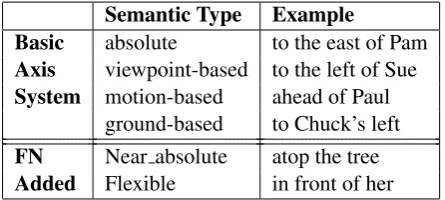
Linguists, anthropologists, and computer scien-tists have studied the cognitive, cultural, linguis-tic, and computational aspects of space and spa-tial relations for decades (Herskovitz,1987; Bow-erman and Pederson,1992;Regier,1996; Levin-son,2003). FrameNet has defined a cognitively-inspired set of semantic types for spatial LUs to indicate (1) with respect to which axis-system(s) (Talmy, 2000) a given LU is defined, and (2) which direction(s) from these axes the active zone a given LU selects.
Semantic Type Example
Basic absolute to the east of Pam
Axis viewpoint-based to the left of Sue
System motion-based ahead of Paul ground-based to Chuck’s left
FN Near absolute atop the tree
[image:3.595.306.529.507.607.2]Added Flexible in front of her
Table 1: Semantic Types for Spatial Relations
As Table 1 shows, the basic axis systems in-clude four types: absolute (to the east of X);
viewpoint-based(to the left of X);motion-based
(ahead of X); and ground-based (to X’s left). FrameNet has defined a semantic type for each of these four possibilities. Besides semantic types
named with the terminology of the basic axis systems, FN has defined two other new seman-tic types: Near absolute(atop) andFlexible (in front). These two semantic types innovate on pre-vious work (Talmy, 2000), and derive from FN’s fairly recent work on spatial relations.
Using semantic types for each direction in each axis system would seem like a simple enough modeling choice. However, LUs exhibit patterns whereby a default axis system is overridden un-der specific conditions. Thus, for example, some LUs inflexibly select an absolute direction (e.g.,
east); some normally select an absolute direc-tion, but allow a ground-based one (atop); and some default to a ground-based direction, but al-low viewpoint-based or motion-based direction (in front). FrameNet’s semantic types specify the pat-tern of axis ambiguity a LU exhibits.
5 Operationalization
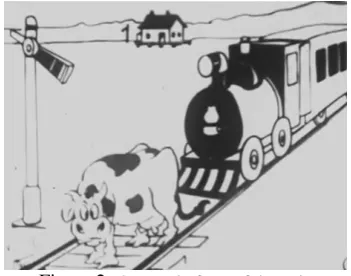
FrameNet’s models of spatial language consist of frames, frame relations, and semantic types, all static and abstract. However, using FrameNet’s models for visual scene understanding requires grounded and flexible implementations. As such, the machinery needed to match a spatial descrip-tion likethe cowIN FRONTof the trainto an im-age requires the following: (1) object recognition of the GROUND(train); (2) image parsing for each
axis system centered on the train (sincein frontis a flexible lexical unit); and (3) recognition of the FIGURE (cow) in the forward-pointing vector for
[image:4.595.93.269.533.671.2]each axis system.
Figure 2: the cow in front of the train
FrameNet contributes in three critical ways to this matching process, by providing the following:
1. training data showing the manifestation of the FIGUREand GROUNDroles in language;
2. an inventory of frames for spatial situa-tions that any system must recognize (e.g.
Containment,Contact);
3. an inventory of semantic types for axis sys-tems and their vectors.
Crucially, FrameNet’s semantic types distinguish the flexible LUin frontfrom a Motion based LU (ahead), where only the motion-based forward zone of the train is scanned.
6 Future Work
This position paper has described FrameNet’s work on static spatial relations. It has shown that FN provides critical information for certain NLP applications that require input for the processing of spatial relations language.
Going forward and with sufficient resources, FrameNet plans to analyze other types of spatial relations language, including the following:
• Dynamic spatial relations language, e.g.to,
from, as in:
She wentTOthe lakeFROMthe house. Pseudo-dynamic spatial relations, e.g.across, as in:
She livesACROSSthe bridge.
• Constructions (Kay and Fillmore,1999; Fill-more, 2013) that license static spatial rela-tions to be construed as GOALs, as in:
I wentUNDERthe bridge.
Preliminary studies of the other types of spatial language indicate that FN’s existing system of frames, frame elements, frame-to-frame relations, and semantic types will serve as a solid foundation for future work.
References
Melissa Bowerman and Eric Pederson. 1992. Topolog-ical relations picture series. In Stephen C. Levinson, editor, Space Stimuli Kit 1.2. Max Planck Institute for Psycholinguistics, Nijmegen.
D.A. Cruse. 1986.Lexical Semantics. Cambridge Uni-versity Press, Cambridge, UK.
Charles J. Fillmore. 1975. An alternative to check-list theories of meaning. Proceedings of the First Annual Meeting of the Berkeley Linguistics Society, 1:123–131.
Charles J Fillmore. 1985. Frames and the semantics of understanding. Quaderni di semantica, 6(2):222– 254.
Charles J. Fillmore. 2013. Berkeley construction gram-mar. In Thomas Hoffmann and Graeme Trousdale, editors, Oxford Handbook of Construction Gram-mar. Oxford University Press, Oxford.
Annette Herskovitz. 1987. Language and Spatial Cog-nition: An interdisciplinary study of the prepositions in English. Studies in Natural Language Processing. Cambridge University Press, Cambridge.
Ray Jackendoff. 1996. The architecture of the linguistic-spatial interface. In P. Bloom, M. Peter-son, L. Nadel, and M. Garrett, editors, Language and Space, pages 1–30. MIT Press, Cambridge.
Paul Kay and Charles J. Fillmore. 1999. Grammati-cal constructions and linguistic generalizations: The what’s x doing y? construction. Language, 75(1):1– 33.
Karin Kipper, Hoa Trang Dang, and Martha Palmer. 2000. Class-based construction of a verb lexicon. InProceedings of the Seventeenth National ence on Artificial Intelligence and Twelfth Confer-ence on Innovative Applications of Artificial Intelli-gence, pages 691–696. AAAI Press.
Karin Kipper, Benjamin Snyder, and Martha Palmer. 2004. Using prepositions to extend a verb lexicon.
Proceedings of the HLT/NAACL Workshop on Com-putational Lexical Semantics, pages 23–29.
Kordjamshidi, Parisa, Martijn Van Otterlo, and Marie-Francine Moens. 2011. Spatial role labeling: To-wards extraction of spatial relations from natural language. ACM Trans. Speech Lang. Process., 8(3):4:1–4:36.
Parisa Kordjamshidi, Taher Rahgooy, Marie-Francine Moens, James Pustejovsky, Umar Manzoor, and Kirk Roberts. 2017. Clef 2017: Multimodal spa-tial role labeling (msprl) task overview. In Jones G. et al., editor, Lecture Notes in Computer Science, vol. 10456, pages 367–377. Springer, Cham.
George Lakoff and Mark Johnson. 1980. Metaphors we Live by. University of Chicago Press, Chicago.
Beth Levin. 1993. English Verb Classes and Alterna-tions: A Preliminary Investigation. University of Chicago Press, Chicago.
Stephen C. Levinson. 2003. Space in Language and Cognition: Explorations in Cognitive Diversity. Language Culture and Cognition. Cambridge Uni-versity Press.
Tomas Mikolov, Ilya Sutskever, Kai Chen, Greg S Cor-rado, and Jeff Dean. 2013. Distributed representa-tions of words and phrases and their composition-ality. In C. J. C. Burges, L. Bottou, M. Welling, Z. Ghahramani, and K. Q. Weinberger, editors, Ad-vances in Neural Information Processing Systems 26, pages 3111–3119. Curran Associates, Inc.
James Pustejovsky, Jessica L Moszkowicz, and Marc Verhagen. 2011. Iso-space: The annotation of spa-tial information in language. Proceedings of the Sixth Joint ISO-ACL SIGSEM Workshop on Interop-erable Semantic Annotation, 6:1–9.
Terry Regier. 1996. The Human Semantic Potential: Spatial Language and Constrained Connectionism. Language, Speech, and Communication. MIT Press, Cambridge, MA.
Josef Ruppenhofer, Michael Ellsworth, Miriam R. L. Petruck, Christopher R. Johnson, Collin F. Baker, and Jan Scheffczyk. 2016. FrameNet II: Extended Theory and Practice. ICSI: Berkeley.
Leonard Talmy. 2000. Toward a Cognitive Semantics. Language, Speech, and Communication. MIT Press, Cambridge, MA.
Leonard Talmy. 2003. The representation of spatial structure in spoken and signed language: A neural model. Language and Linguistics, 4(2):207–250.