Lexical semantic typologies from bilingual corpora — A framework
Steffen Eger
Department of Computer Science / Carnegie Mellon University 5404 Gates Hillman Complex / Pittsburgh, PA 15213, USA
Abstract
We present a framework, based on Sejane and Eger (2012), for inducing lexical semantic ty-pologies for groups of languages. Our frame-work rests on lexical semantic association net-works derived from encoding, via bilingual corpora, each language in a common reference language, the tertium comparationis, so that distances between languages can easily be de-termined.
1 Introduction
Typologocial classifications have a long tradition in linguistics. For example, typologies based on syn-tactic categories have been proposed e.g. by Green-berg (1961), leading a.o. to ‘word order’ catego-rizations of natural languages as belonging to SVO, VSO, etc. types. Relatedly, genealogical classifica-tion systems based on phonological and morpholog-ical similarities date back at least to the compara-tists of the nineteenth centuries, among them Jacob Grimm (1785-1863), Rasmus Rask (1787-1832), and Karl Verner (1846-1896). Typological investi-gations into (lexical) semantic relations across lan-guages have, in contrast, attracted little attention. Still, some results have been established such as classifications based upon treatment of animal con-cepts and corresponding meat concon-cepts (see the ex-cellent introduction to lexical typologies by Koch, 2001). As further exceptions, based on computa-tional principles, may be considered Mehler et al. (2011), who analyze conceptual networks derived from the Wikipedia topic classification systems for
different languages; Gaume et al. (2008), who pro-pose (but do not realize, to the best of our knowl-edge) to compare distances between selected word pairs such as meat/animal, child/fruit, door/mouth
across language-specific monolingual dictionaries in order to categorize the associated languages and, partly, Cooper (2008), who computes semantic dis-tances between languages based on the curvature of translation histograms in bilingual dictionaries.
Recently, Sejane and Eger (2012) have outlined a novel approach to establishing semantic typologies based upon the language-specific polysemy relation of lexical units which entails language-dependent ‘lexical semantic association networks’. To illus-trate, Frenchbœuf has two meanings, which we may gloss as ‘cow’ and ‘beef’ in English. Similarly, French langueand Spanishlinguamean both ‘lan-guage’ and ‘tongue’, whereas Chinese hu`a means both ‘language’ and ‘picture’. Sejane and Eger’s (2012) key idea is then that this language-specific polysemy can be made observable via the trans-lation retrans-lation implied e.g. by a bilingual nary. For instance, using a Chinese-English dictio-nary, one might be able to uncover the polysemy ofhu`aby assessing its two English translations, as given above. More formally, one might create a link (in a network) between two English words if they have a common translation in Chinese (cf. Eger and Sejane, 2010); doing the same with a Spanish-English and French-Spanish-English dictionary, one would obtain three different lexical semantic association networks, all encoded in the English language, the
tertium comparationisorreference languagein this case. In the English networks based upon Spanish
and French — Sejane and Eger (2012) call these net-works the Spanish and Frenchversions of English, respectively — ‘language’ and ‘tongue’ would have a link, whereas in the Chinese version of English, ‘language’ and ‘picture’ would have a link (see also Figure 1 where we illustrate this idea for English and Latin versions of German). Then, comparing these networks across languages may allow establishing a typology of lexical semantic associations.
In the current paper, we deliberate on Sejane and Eger’s (2012) idea, suggesting ways to adequately formalize their approach (Section 2) and propose data sources suitable for their framework (Section 3). Moreover, in Section 4 we shortly discuss how network versions of a given reference language can be formally contrasted and suggest solutions for the
tertium comparationis problem. In Section 5, we conclude.
2 Formal approach to lexical semantic association networks
We propose the following mathematical framework for representing lexical semantic association net-works. Given n languages L1, . . . , Ln, n ≥
2, plus a selected reference language R distinct fromL1, . . . , Ln, and bilingual translation operators
T1, . . . , Tn, whereTi,i= 1, . . . , n, maps (or, trans-lates) from languageLito the reference languageR, create network graphs
Gi = (Vi, Ei)
with
Vi =W[R],
and
Ei ={(u, v)|u, v∈Vi, uTix, xTiv for somex∈W[Li]},
where byW[L]we denote the words of languageL
and byaTibwe denote thatatranslates intobunder
Ti; moreover, we assumeTi to be symmetric such that theGi’s may be considered undirected graphs.
To generalize this a bit, we may considerweighted graphs where for networki,i = 1, . . . , n,Vi is as above, Ei = {(u, v)|u, v ∈ Vi}, and each edge
(u, v)∈Eihas weight (being a function of)
di(u, v) =|{x|uTix, xTiv}|. (1)
Then, if u and v have no common translation x,
di(u, v) = 0and generallydi(u, v)counts the num-ber of common translationsxbetweenuandv, en-tailing a generalization of the setting above, which may allow for a more fine-grained analysis and may be of importance for example for outlining seman-tic many-to-one relationships between a languageLi and the reference languageR.
3 Possible data sources
Sejane and Eger (2012) conduct a preliminary study of their approach on the open-source bilingual dic-tionariesdicts.info(http://www.dicts.info/uddl.php). The disadvantage with using bilingual dictionaries is of course that they are scarcely available (and much less freely available); moreover, for the above de-scribed semantic association networks, it may be of crucial importance to havecomparabledata sources; e.g. using a general-purpose dictionary in one case and a technical dictionary in the other, or using dic-tionaries of vastly different sizes may severely affect the quality of results.1
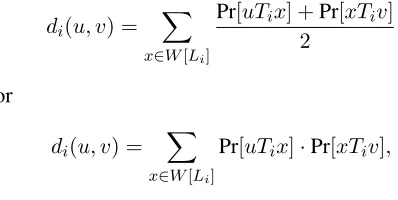
We more generally propose to use bilingual cor-pora for the problem of inducing semantic asso-ciation networks, where we particularly have e.g. sentence-aligned corpora like the Europarl corpus (Koehn, 2005) in mind (see also the study of Rama and Borin (2011) on cognates, with Europarl as the data basis). Then, translation relations Ti may be induced from these corpora by applying a statisti-cal machine translation approach such as the Moses toolkit (Koehn et al., 2007). The translation relations may thus be probabilistic instead of binary, which may either be resolved via thresholding or by modi-fying Equation (1) as in
di(u, v) =
X
x∈W[Li]
Pr[uTix] +Pr[xTiv]
2
or
di(u, v) =
X
x∈W[Li]
Pr[uTix]·Pr[xTiv],
both of which have (1) as special cases.
1As another aspect, Sejane and Eger (2012) concluded that
Figure 1: Bilingual dictionaries German-English and German-Latin and induced lexical semantic association net-works, English and Latin versions of German. Note the similarities and differences;Mann‘man’ andMensch‘human’ have a link in both versions but there is a path betweenMannandFrau‘woman’ only in the English version of Ger-man, whereas there exists e.g. a path betweenMannandHeld‘hero’ only in the Latin version. Reprinted from Sejane and Eger (2012).
Using the Europarl corpus would both address the problem of size and comparability raised above; moreover, corpora may better reflect actual language use than dictionaries, which oftentimes document idiosyncractic, normative or assumed language con-ditions. A problem with the Europarl corpus is that it covers just a very small (and selected) subset of the world’s languages, whereas it might be of particu-lar interest for (semantic) typology to contrast particu-large, heterogeneous classes of languages.
4 Network distance measures and the problem oftertium comparationis
In order to be able to induce a semantic typology from the above described lexical semantic associa-tion networks, a distance metricδon network graphs is required,2 that is, a functionδthat maps network graphsGi,Gj,1≤i, j ≤n, to numbers
δij =δ(Gi, Gj)∈R.
Such distance measures may be derived from gen-eral network statistics such as the number of edges, thediametersof the networks, network den-sity, graph entropyvia information functionals (cf. Dehmer, 2008) orclustering coefficients(cf. Watts and Strogatz, 1998). We believe, however, that such abstract measures can be useful only for a prelimi-nary examination of the data. A more in-depth anal-ysis should be based on comparing individual
net-2
In this context, we identify languages with their lexical se-mantic association networks.
work vertices in two versions of the reference lan-guage. For example, we could ask about the lexi-cal semantic difference between French and Chinese with respect to the lexical unit ‘language’. One way of realizing such an analysis would be by making use ofshortest distancesbetween network vertices. To be more precise, letGi andGj be two lexical se-mantic network versions of a reference languageR. Assume thatGiandGjhave the same number,N, of vertices, with the same labels (i.e. names of vertices such as ‘language’). Letuk,1≤k≤N, be thek-th vertex in both graphs, with identical label across the two graphs. Moreover, letsi(uk)andsj(uk)be vec-tors whosel-th component,1 ≤l ≤ N, is given as the shortest distance between vertex uk and vertex
ulin graphsGi andGj, respectively,
si(uk)
l=shortest distance between
ukandulinGi,
and analogously for sj(uk). We could then define the difference between network versionGi andGj with respect to vertexukas e.g. the Euclidean dis-tance between these two vectors,
ksi(uk)−sj(uk)k.
in Gaume et al., 2008). Therefore, we propose a Page-rank like (see Brin and Page, 1998; Gaume and Mathieu, 2012) procedure to compare network ver-tices of networksGiandGj. To this end, letpi(uk), a vector of dimensionN, denote the probability dis-tribution that if, starting from vertex uk, one may reach any of the other vertices of network Gi (and analogously for network Gj), under the following rules. In each step, starting at vertexuk, with prob-abilityα, a ‘random surfer’ on the networkGi may pass from its current vertexvto any ofv’s neighbors with equal probability (if there are no neighbors, the surfer passes to a random vertex), and with probabil-ity(1−α)the surfer ‘teleports’ to an arbitrary ver-tex. The probability distributionpi(uk), forαclose to1, may then neatly represent topological proper-ties of networkGi, from the ‘perspective’ of vertex
uk. On this basis, we can, as above, determine the difference between network versionsGiandGjwith respect to vertexukas
δuk(Gi, Gj) =kpi(uk)−pj(uk)k. (2)
Finally, we define the (global) distance betweenGi andGjas the average over all such (local) distances,
δij =
1
N
N
X
k=1
δuk(Gi, Gj). (3)
If, as mentioned above, we have weighted graphs, we slightly modify the random surfer’s behavior. In-stead of passing with uniform probability from ver-texvto a neighbor vertexwofv, the surfer passes towwith probability proportional to the weight be-tween v andw; the larger the weight the higher is the probability that the surfer ends up atw.
Then, once distance metric values δij are given, ann×ndistance matrix Dmay be defined whose entry(i, j)is preciselyδij,
Dij =δij.
On D, standard e.g. hierarchical clustering algo-rithms may be applied in order to deduce a lexical semantic typology.
Finally, we address the tertium comparationis
problem: Given a set of languages, which one should be chosen as reference language? It might be tempting to believe that the choice of the reference
language should not matter much for the resulting lexical semantic association networks, but the refer-ence language may certainly havesomeimpact. For example, if English is the reference language, the Chinese version of English might not only have a link between ‘language’ and ‘picture’ but also be-tween ‘language’ and ‘tongue’, because of the pol-ysemy of ‘tongue’ in English. If, in contrast, Ger-man was the reference language, the Chinese version of German should not have a link between Zunge
‘tongue’ andSprache‘language’ becauseZunge, in German, does not mean ‘language’ (any more).
Thus, to avoid misspecifications based on a par-ticular choice of reference language, we propose the following. LetL1, . . . , Ln, Ln+1,n≥2, be(n+ 1) languages for which bilingual translation operators
TA,B exist for any two languages A, B from the
(n+ 1) languages. Then let the distance between languagesiandj,1≤i, j≤n+ 1, be defined as
∆ij =
1
n−1
X
R∈L\{Li,Lj}
δ(GRi , GRj ),
where by GRi we denote the Li version of
R, and by L we denote the set of languages {L1, . . . , Ln, Ln+1}; in other words, we specify the distance between languages i and j as the aver-age distance over all possible reference languaver-ages, which excludes languages i andj themselves. As above, ∆ij induces a distance matrix, with which clustering can be performed.
5 Conclusion
References
S. Brin, and L. Page. 1998. The Anatomy of a Large-Scale Hypertextual Web Search Engine. In Seventh International World-Wide Web Conference (WWW 1998).
M.C. Cooper. 2008. Measuring the Semantic Distance between Languages from a Statistical Analysis of Bilingual Dictionaries. Journal of Quantitative Lin-guistics, 15 (1): 1–33.
M. Dehmer. 2008. Information processing in complex networks: Graph entropy and information functionals.
Applied Mathematics and Computation201: 82–94. S. Eger, and I. Sejane. 2010. Computing semantic
sim-ilarity from bilingual dictionaries. In Proceedings of the 10th International Conference on statistical analy-sis of textual data (JADT 2010): 1217–1225.
B. Gaume, K. Duvignau, and M. Vanhove. 2008. Seman-tic associations and confluences in paradigmaSeman-tic net-works. In From Polysemy to Semantic Change: To-wards a typology of lexical semantic associations, Amsterdam: John Benjamins: 233–267.
B. Gaume, and F. Mathieu. 2012. PageRank Induced Topology for Real-World Networks. To appear. J. H. Greenberg. 1961. Some universals of grammar with
particular reference to the order of meaningful ele-ments. In Universals of language, Joseph H. Green-berg (ed.), Cambridge, MA: MIT Press: 73–113. P. Koch. 2001. Lexical typology from a cognitive and
linguistic point of view. In Language Typology and Language Universals, Martin Haspelmath, Ekkehard Knig, Wulf Oesterreicher, and Wolfgang Raible (eds.), Berlin: Mouton de Gruyter: 1142–1178.
P. Koehn. 2005. Europarl: A Parallel Corpus for Statisti-cal Machine Translation. InMT Summit 2005. P. Koehn, H. Hoang, A. Birch, C. Callison-Burch, M.
Federico, N. Bertoldi, B. Cowan, W. Shen, C. Moran, R. Zens, C. Dyer, O. Bojar, A. Constantin, and E. Herbst. 2007. Moses: Open Source Toolkit for Sta-tistical Machine Translation. In Annual Meeting of the Association for Computational Linguistics (ACL), demonstration session, Prague, Czech Republic, June 2007.
A. Mehler, O. Pustylnikov, and N. Diewald. 2011. Geog-raphy of Social Ontologies: Testing a Variant of the Sapir-Whorf Hypothesis in the Context of Wikipedia.
Computer Speech and Language, 25: 716–740. T. Rama, and L. Borin. 2011. Estimating language
rela-tionships from a parallel corpus. A study of the Eu-roparl corpus. InNEALT Proceedings Series (NODAL-IDA 2011 Conference Proceedings): 161–167. I. Sejane, and S. Eger. 2012. Semantic typologies from
bilingual dictionaries. To appear.