SemEval-2010 Task 9: The Interpretation of Noun Compounds
Using Paraphrasing Verbs and Prepositions
Cristina Butnariu University College Dublin
Su Nam Kim University of Melbourne
Preslav Nakov
National University of Singapore
Diarmuid ´O S´eaghdha University of Cambridge
Stan Szpakowicz University of Ottawa Polish Academy of Sciences
Tony Veale
University College Dublin
Abstract
Previous research has shown that the mean-ing of many noun-noun compoundsN1N2 can be approximated reasonably well by paraphrasing clauses of the form ‘N2that . . . N1’, where ‘. . . ’ stands for a verb with or without a preposition. For exam-ple,malaria mosquitois a ‘mosquito that carriesmalaria’. Evaluating the quality of such paraphrases is the theme of Task 9 at SemEval-2010. This paper describes some background, the task definition, the process of data collection and the task results. We also venture a few general conclusions be-fore the participating teams present their systems at the SemEval-2010 workshop. There were 5 teams who submitted 7 sys-tems.
1 Introduction
Noun compounds (NCs) are sequences of two or more nouns that act as a single noun,1e.g., stem cell,stem cell research,stem cell research organi-zation, etc. Lapata and Lascarides (2003) observe that NCs pose syntactic and semantic challenges for three basic reasons: (1) the compounding process is extremely productive in English; (2) the seman-tic relation between the head and the modifier is implicit; (3) the interpretation can be influenced by contextual and pragmatic factors. Corpus studies have shown that while NCs are very common in English, their frequency distribution follows a Zip-fian or power-law distribution and the majority of NCs encountered will be rare types (Tanaka and Baldwin, 2003; Lapata and Lascarides, 2003; Bald-win and Tanaka, 2004;O S´ eaghdha, 2008). As a´
consequence, Natural Language Processing (NLP) 1We follow the definition in (Downing, 1977).
applications cannot afford either to ignore NCs or to assume that they can be handled by relying on a dictionary or other static resource.
Trouble with lexical resources for NCs notwith-standing, NC semantics plays a central role in com-plex knowledge discovery and applications, includ-ing but not limited to Question Answerinclud-ing (QA), Machine Translation (MT), and Information Re-trieval (IR). For example, knowing the (implicit) semantic relation between the NC components can help rank and refine queries in QA and IR, or select promising translation pairs in MT (Nakov, 2008a). Thus, robust semantic interpretation of NCs should be of much help in broad-coverage semantic pro-cessing.
Proposed approaches to modelling NC seman-tics have used semantic similarity (Nastase and Sz-pakowicz, 2003; Moldovan et al., 2004; Kim and Baldwin, 2005; Nastase and Szpakowicz, 2006; Girju, 2007; O S´ eaghdha and Copestake, 2007)´ and paraphrasing (Vanderwende, 1994; Kim and
Baldwin, 2006; Butnariu and Veale, 2008; Nakov
and Hearst, 2008). The former body of work seeks to measure the similarity between known and
un-seen NCs by considering various features, usually
context-related. In contrast, the latter group uses verb semantics to interpret NCs directly, e.g.,olive
oil as ‘oil that is extracted from olive(s)’, drug deathas ‘death that is caused by drug(s)’,flu shot as a ‘shot that prevents flu’.
The growing popularity – and expected direct utility – of paraphrase-based NC semantics has encouraged us to propose an evaluation exercise
for the 2010 edition of SemEval. This paper gives
a bird’s-eye view of the task. Section 2 presents its objective, data, data collection, and evaluation method. Section 3 lists the participating teams. Section 4 shows the results and our analysis. In Section 5, we sum up our experience so far.
2 Task Description 2.1 The Objective
For the purpose of the task, we focused on two-word NCs which are modifier-head pairs of nouns, such asapple pieormalaria mosquito. There are several ways to “attack” the paraphrabased se-mantics of such NCs.
We have proposed a rather simple problem: as-sume that many paraphrases can be found – perhaps via clever Web search – but their relevance is up in the air. Given sufficient training data, we seek to es-timate the quality of candidate paraphrases in a test set. Each NC in the training set comes with a long list of verbs in the infinitive (often with a prepo-sition) which may paraphrase the NC adequately. Examples of apt paraphrasing verbs: olive oil – be extracted from, drug death –be caused by, flu shot –prevent. These lists have been constructed from human-proposed paraphrases. For the train-ing data, we also provide the participants with a quality score for each paraphrase, which is a simple count of the number of human subjects who pro-posed that paraphrase. At test time, given a noun compound and a list of paraphrasing verbs, a partic-ipating system needs to produce aptness scores that correlate well (in terms of relative ranking) with the held out human judgments. There may be a diverse range of paraphrases for a given compound, some of them in fact might be inappropriate, but it can be expected that the distribution over para-phrases estimated from a large number of subjects will indeed be representative of the compound’s meaning.
2.2 The Datasets
Following Nakov (2008b), we took advantage of theAmazon Mechanical Turk2(MTurk) to acquire paraphrasing verbs from human annotators. The service offers inexpensive access to subjects for tasks which require human intelligence. Its API allows a computer program to run tasks easily and collate the subjects’ responses. MTurk is becoming a popular means of eliciting and collecting linguis-tic intuitions for NLP research; see Snow et al. (2008) for an overview and a further discussion.
Even though we recruited human subjects, whom we required to take a qualification test,3
2www.mturk.com
3We soon realized that we also had to offer a version of our assignments without a qualification test (at a lower pay
rate) since very few people were willing to take a test. Overall,
data collection was time-consuming since many annotators did not follow the instructions. We had
to monitor their progress and to send them timely
messages, pointing out mistakes. Although the MTurk service allows task owners to accept or re-ject individual submissions, rere-jection was the last resort since it has the triply unpleasant effect of (1) denying the worker her fee, (2) negatively af-fecting her rating, and (3) lowering our rating as a requester. We thus chose to try and educate our workers “on the fly”. Even so, we ended up with many examples which we had to correct
manu-ally by labor-intensive post-processing. The flaws were not different from those already described by
Nakov (2008b). Post-editing was also necessary to lemmatize the paraphrasing verbs systematically.
Trial Data. At the end of August 2009, we released as trial data the previously collected para-phrase sets (Nakov, 2008b) for theLevi-250dataset (after further review and cleaning). This dataset consisted of 250 noun-noun compounds form (Levi, 1978), each paraphrased by 25-30 MTurk workers (without a qualification test).
Training Data. The training dataset was an
ex-tension of the trial dataset. It consisted of the same
250 noun-noun compounds, but the number of
an-notators per compound increased significantly. We aimed to recruit at least 30 additional MTurk work-ers per compound; for some compounds we man-aged to get many more. For example, when we added the paraphrasing verbs from the trial dataset
to the newly collected verbs, we had 131 different
workers forneighborhood bars, compared to just 50 fortear gas. On the average, we had 72.7 work-ers per compound. Each worker was instructed to try to produce at least three paraphrasing verbs, so we ended up with 191.8 paraphrasing verbs per compound, 84.6 of them being unique. See Table 1 for more details.
Test Data. The test dataset consisted of 388
noun compounds collected from two data sources:
(1) the Nastase and Szpakowicz (2003) dataset; and (2) the Lauer (1995) dataset. The former contains 328 noun-noun compounds (there are also a number of adjective-noun and adverb-noun pairs), while the latter contains 266 noun-noun
compounds. Since these datasets overlap between
themselves and with the training dataset, we had
to exclude some examples. In the end, we had 388
Training: 250 NCs Testing: 388 NCs All: 638 NCs Total Min/Max/Avg Total Min/Max/Avg Total Min/Max/Avg MTurk workers 28,199 50/131/72.7 17,067 57/96/68.3 45,266 50/131/71.0 Verb types 32,832 25/173/84.6 17,730 41/133/70.9 50,562 25/173/79.3 Verb tokens 74,407 92/462/191.8 46,247 129/291/185.0 120,654 92/462/189.1
Table 1: Statistics about the the training/test datasets. Shown are the total number of verbs proposed as
well as the minimum, maximum and average number of paraphrasing verb types/tokens per compound.
unique noun-noun compounds for testing, distinct
from those used for training. We aimed for 100 human workers per testing NC, but we could only get 68.3, with a minimum of 57 and a maximum of
96; there were 185.0 paraphrasing verbs per
com-pound, 70.9 of them being unique, which is close to what we had for the training data.
Data format.We distribute the training data as a raw text file. Each line has the following tab-separated format:
NC paraphrase frequency
where NC is a noun-noun compound (e.g., ap-ple cake, flu virus), paraphrase is a human-proposed paraphrasing verb optionally followed by a preposition, andfrequencyis the number
of annotators who proposed that paraphrase. Here
is an illustrative extract from the training dataset:
flu virus cause 38
flu virus spread 13
flu virus create 6
flu virus give 5
flu virus produce 5
...
flu virus be made up of 1
flu virus be observed in 1
flu virus exacerbate 1
The test file has a similar format, except that the frequency is not included and the paraphrases for each noun compound appear in random order:
...
chest pain originate chest pain start in chest pain descend in chest pain be in ...
License.All datasets are released under the
Cre-ative Commons Attribution 3.0 Unported license.4
4creativecommons.org/licenses/by/3.0
2.3 Evaluation
All evaluation was performed by computing an
ap-propriate measure of similarity/correlation between system predictions and the compiled judgements of the human annotators. We did it on a compound-by-compound basis and averaged over all compound-by-compounds in the test dataset. Section 4 shows results for three measures: Spearman rank correlation, Pearson cor-relation, and cosine similarity.
Spearman Rank Correlation (ρ)was adopted as the official evaluation measure for the competi-tion. As a rank correlation statistic, it does not use the numerical values of the predictions or human judgements, only their relative ordering encoded as integer ranks. For a sample ofnitems ranked by two methodsxandy, the rank correlationρis calculated as follows:
ρ= n
P
xiyi−(Pxi)(Pyi)
q nPx2
i −(
P xi)2
q nPy2
i −(
P yi)2
(1) wherexi, yiare the ranks given byxandyto the ith item, respectively. The value ofρ ranges be-tween -1.0 (total negative correlation) and 1.0 (total positive correlation).
Pearson Correlation (r)is a standard measure
of correlation strength between real-valued vari-ables. The formula is the same as(1), but with xi, yi taking real values rather than rank values; just likeρ,r’s values fall between -1.0 and 1.0.
Cosine similarityis frequently used in NLP to compare numerical vectors:
cos =
Pn
i xiyi
qPn
i x2iPni y2i
(2)
For non-negative data, the cosine similarity takes values between 0.0 and 1.0. Pearson’sr can be
viewed as a version of the cosine similarity which
performs centering onxandy.
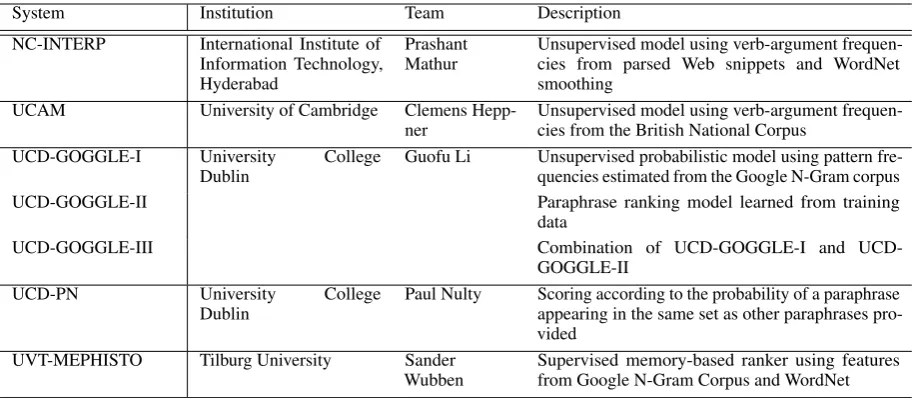
System Institution Team Description NC-INTERP International Institute of
Information Technology, Hyderabad
Prashant
Mathur Unsupervised model using verb-argument frequen-cies from parsed Web snippets and WordNet smoothing
UCAM University of Cambridge Clemens
Hepp-ner Unsupervised model using verb-argument frequen-cies from the British National Corpus UCD-GOGGLE-I University College
Dublin Guofu Li Unsupervised probabilistic model using pattern fre-quencies estimated from the Google N-Gram corpus
UCD-GOGGLE-II Paraphrase ranking model learned from training
data
UCD-GOGGLE-III Combination of GOGGLE-I and
UCD-GOGGLE-II
UCD-PN University College
Dublin Paul Nulty Scoring according to the probability of a paraphraseappearing in the same set as other paraphrases pro-vided
UVT-MEPHISTO Tilburg University Sander
[image:4.595.72.530.61.260.2]Wubben Supervised memory-based ranker using featuresfrom Google N-Gram Corpus and WordNet
Table 2: Teams participating in SemEval-2010 Task 9
summing the frequencies for all compounds in the training dataset, and the paraphrases for the test
ex-amples were scored according to this distribution.
Note that this baseline entirely ignores the identity
of the nouns in the compound.
3 Participants
The task attracted five teams, one of which
(UCD-GOGGLE) submitted three runs. The participants are listed in Table 2 along with brief system de-scriptions; for more details please see the teams’ own description papers.
4 Results and Discussion
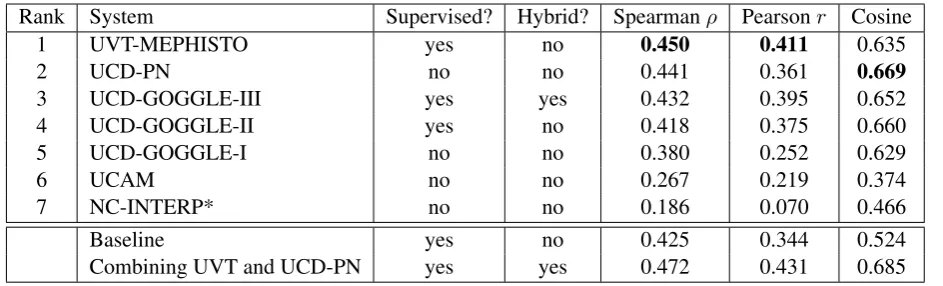
The task results appear in Table 3. In an evaluation by Spearman’s ρ (the official ranking measure), the winning system was UVT-MEPHISTO, which scored 0.450. UVT also achieved the top Pear-son’srscore. UCD-PN is the top-scoring system according to the cosine measure. One participant submitted part of his results after the official dead-line, which is marked by an asterisk.
The participants used a variety of information sources and estimation methods. UVT-MEPHISTO is a supervised system that uses frequency informa-tion from the Google N-Gram Corpus and features
from WordNet (Fellbaum, 1998) to rank candidate
paraphrases. On the other hand, UCD-PN uses no external resources and no supervised training,
yet came within 0.009 of UVT-MEPHISTO in the
official evaluation. The basic idea of UCD-PN – that one can predict the plausibility of a paraphrase simply by knowing which other paraphrases have
been given for that compoundregardless of their frequency– is clearly a powerful one. Unlike the other systems, UCD-PN used information about the test examples (not their ranks, of course) for model estimation; this has similarities to “transductive” methods for semi-supervised learning. However, post-hoc analysis shows that UCD-PN would have
preserved its rank if it had estimated its model on
the training data only. On the other hand, if the task
had been designed differently – by asking systems
to propose paraphrases from the set of all possi-ble verb/preposition combinations – then we would
not expect UCD-PN’s approach to work as well as
models that use corpus information.
The other systems are comparable to UVT-MEPHISTO in that they use corpus frequencies to evaluate paraphrases and apply some kind of semantic smoothing to handle sparsity. How-ever, UCD-GOGGLE-I, UCAM and NC-INTERP are unsupervised systems. UCAM uses the 100-million word BNC corpus, while the other systems use Web-scale resources; this has presumably
ex-acerbated sparsity issues and contributed to a
rela-tively poor performance.
The hybrid approach exemplified by UCD-GOGGLE-III combines the predictions of a sys-tem that models paraphrase correlations and one that learns from corpus frequencies and thus at-tains better performance. Given that the two
top-scoring systems can also be characterized as using
these two distinct information sources, it is natu-ral to consider combining these systems. Simply normalizing (to unit sum) and averaging the two
Rank System Supervised? Hybrid? Spearmanρ Pearsonr Cosine
1 UVT-MEPHISTO yes no 0.450 0.411 0.635
2 UCD-PN no no 0.441 0.361 0.669
3 UCD-GOGGLE-III yes yes 0.432 0.395 0.652
4 UCD-GOGGLE-II yes no 0.418 0.375 0.660
5 UCD-GOGGLE-I no no 0.380 0.252 0.629
6 UCAM no no 0.267 0.219 0.374
7 NC-INTERP* no no 0.186 0.070 0.466
Baseline yes no 0.425 0.344 0.524
[image:5.595.69.541.61.204.2]Combining UVT and UCD-PN yes yes 0.472 0.431 0.685 Table 3: Evaluation results for SemEval-2010 Task 9 (* denotes a late submission).
indeed give better scores: Spearmanρ = 0.472, r= 0.431, Cosine = 0.685.
The baseline from Section 2.3 turns out to be very strong. Evaluating with Spearman’sρ, only
three systems outperform it. It is less competitive
on the other evaluation measures though. This suggests that global paraphrase frequencies may be useful for telling sensible paraphrases from bad ones, but will not do for quantifying the plausibility of a paraphrase for a given noun compound.
5 Conclusion
Given that it is a newly-proposed task, this initial experiment in paraphrasing noun compounds has been a moderate success. The participation rate
has been sufficient for the purposes of comparing
and contrasting different approaches to the role of paraphrases in the interpretation of noun-noun
compounds. We have seen a variety of approaches
applied to the same dataset, and we have been able
to compare the performance ofpureapproaches to
hybridapproaches, and of supervised approaches to unsupervised approaches. The results reported here are also encouraging, though clearly there is considerable room for improvement.
This task has established a high baseline for sys-tems to beat. We can take heart from the fact that the best performance is apparently obtained from a
combination of corpus-derived usage features and
dictionary-derived linguistic knowledge. Although
clever but simple approaches can do quite well on
such a task, it is encouraging to note that the best results await those who employ the most robust and the most informed treatments of NCs and their paraphrases. Despite a good start, this is a chal-lenge that remains resolutely open. We expect that the dataset created for the task will be a valuable resource for future research.
Acknowledgements
This work is partially supported by grants from
Amazon and from the Bulgarian National Science
Foundation (D002-111/15.12.2008 –SmartBook).
References
Timothy Baldwin and Takaaki Tanaka. 2004. Trans-lation by Machine of Compound Nominals: Getting it Right. In Proceedings of the ACL-04 Workshop on Multiword Expressions: Integrating Processing, pages 24–31, Barcelona, Spain.
Cristina Butnariu and Tony Veale. 2008. A Concept-Centered Approach to Noun-Compound Interpreta-tion. InProceedings of the 22nd International Con-ference on Computational Linguistics (COLING-08), pages 81–88, Manchester, UK.
Pamela Downing. 1977. On the creation and use of En-glish compound nouns. Language, 53(4):810–842. Christiane Fellbaum, editor. 1998. WordNet: an
elec-tronic lexical database. MIT Press.
Roxana Girju. 2007. Improving the Interpretation of Noun Phrases with Cross-linguistic Information. In Proceedings of the 45th Annual Meeting of the Association of Computational Linguistics (ACL-07), pages 568–575, Prague, Czech Republic.
Su Nam Kim and Timothy Baldwin. 2005. Automatic interpretation of noun compounds using WordNet similarity. InProceedings of the 2nd International Joint Conference on Natural Language Processing (IJCNLP-05), pages 945–956, Jeju Island, South Ko-rea.
Su Nam Kim and Timothy Baldwin. 2006. Inter-preting Semantic Relations in Noun Compounds via Verb Semantics. In Proceedings of the COLING-ACL-06 Main Conference Poster Sessions, pages 491–498, Sydney, Australia.
European Chapter of the Association for Computa-tional Linguistics (EACL-03), pages 235–242, Bu-dapest, Hungary.
Mark Lauer. 1995. Designing Statistical Language Learners: Experiments on Noun Compounds. Ph.D. thesis, Macquarie University.
Judith Levi. 1978. The Syntax and Semantics of Com-plex Nominals. Academic Press, New York, NY. Dan Moldovan, Adriana Badulescu, Marta Tatu, Daniel
Antohe, and Roxana Girju. 2004. Models for the Se-mantic Classification of Noun Phrases. In Proceed-ings of the HLT-NAACL-04 Workshop on Computa-tional Lexical Semantics, pages 60–67, Boston, MA. Preslav Nakov and Marti A. Hearst. 2008. Solving
Relational Similarity Problems Using the Web as a Corpus. In Proceedings of the 46th Annual Meet-ing of the Association of Computational LMeet-inguistics (ACL-08), pages 452–460, Columbus, OH.
Preslav Nakov. 2008a. Improved Statistical Machine Translation Using Monolingual Paraphrases. In Pro-ceedings of the 18th European Conference on Artifi-cial Intelligence (ECAI-08), pages 338–342, Patras, Greece.
Preslav Nakov. 2008b. Noun Compound Interpreta-tion Using Paraphrasing Verbs: Feasibility Study. In Proceedings of the 13th International Confer-ence on Artificial IntelligConfer-ence: Methodology, Sys-tems and Applications (AIMSA-08), pages 103–117, Varna, Bulgaria.
Vivi Nastase and Stan Szpakowicz. 2003. Exploring noun-modifier semantic relations. In Proceedings of the 5th International Workshop on Computational Semantics (IWCS-03), pages 285–301, Tilburg, The Netherlands.
Vivi Nastase and Stan Szpakowicz. 2006. Matching syntactic-semantic graphs for semantic relation as-signment. In Proceedings of the 1st Workshop on Graph Based Methods for Natural Language Pro-cessing (TextGraphs-06), pages 81–88, New York, NY.
Diarmuid ´O S´eaghdha and Ann Copestake. 2007. Co-occurrence Contexts for Noun Compound Interpre-tation. In Proceedings of the ACL-07 Workshop on A Broader Perspective on Multiword Expressions (MWE-07), pages 57–64, Prague, Czech Republic.
Diarmuid ´O S´eaghdha. 2008. Learning Compound Noun Semantics. Ph.D. thesis, University of Cam-bridge.
Rion Snow, Brendan O’Connor, Daniel Jurafsky, and Andrew Ng. 2008. Cheap and Fast – But is it Good? Evaluating Non-Expert Annotations for Natural Lan-guage Tasks. InProceedings of the 2008 Conference on Empirical Methods in Natural Language Process-ing (EMNLP-08), pages 254–263, Honolulu, HI.
Takaaki Tanaka and Timothy Baldwin. 2003. Noun-noun compound machine translation: A feasibility study on shallow processing. InProceedings of the ACL-03 Workshop on Multiword Expressions (MWE-03), pages 17–24, Sapporo, Japan.