Semantic Language Models for
Topic Detection and Tracking
Ramesh Nallapati
Center for Intelligent Information Retrieval,
Department of Computer Science,
University of Massachusetts,
Amherst, MA 01003.
[email protected]
Abstract
In this work, we present a new semantic lan-guage modeling approach to model news sto-ries in the Topic Detection and Tracking (TDT) task. In the new approach, we build a unigram language model for each semantic class in a news story. We also cast thelink detection sub-task of TDT as a two-class classification prob-lem in which the features of each sample con-sist of the generative log-likelihood ratios from each semantic class. We then compute a lin-ear discriminant classifier using the perceptron learning algorithm on the training set. Results on the test set show a marginal improvement over the unigram performance, but are not very encouraging on the whole.
1 Introduction
TDT is a research program investigating methods for au-tomatically organizing news stories by the events that they discuss (Allan, 2002a). The goal of TDT consists of breaking the stream of news into individual news stories, to monitor the stories for events that have not been seen before and to gather stories into groups that each discuss a single topic.
Several approaches have been explored for compar-ing news stories in TDT. The traditional vector space ap-proach (Yang et al., 1999) using cosine similarity has by far been the most consistently successful approach across different tasks and several data sets.
In the recent past, a new probabilistic approach called Language Modeling (Ponte and Croft, 1998) has proven to be very effective in several information retrieval tasks. One of the attractive features of language models is that they are firmly rooted in the theory of probability thereby allowing a researcher to explore more sophisticated mod-els guided by the theoretical framework.
Allanet al (Allan et al., 1999) applied language mod-els to the first story detection task of TDT and found that its performance is on par with the traditional vector space models, if not better. In the language modeling approach to TDT, we measure the similarity of a news storyDto a topic by the probability of its generation from the topic model M. Using the unigram assumption of indepen-dence of terms, one can compute the probability of gen-eration of a news story as the product of probabilities of generation of the terms in the story, as shown in the fol-lowing equation:
P(D|M) =
|D| Y
i=1
P(wi|M) (1)
wherewiis the i-th term in the story. The topic modelM
is typically evaluated from the statistics of a set of stories that are known to be on the topic in consideration.
One potential drawback of the unigram language model is that it treats all terms on an equal footing and seems to ignore semantic information of the terms. We believe that such information could be useful in determin-ing the relative importance of a term to the topic of the story. For example, terms that belong to the named-entity type such as person, location, organization may convey more information about the topic of the story than other entity types. Likewise, one might expect that nouns and verbs play a more important role than adjectives, adverbs or propositions in determining the topic of the story.
The present work is an attempt to extend the language modeling framework to incorporate a model of the rela-tive importance of terms according to the semantic class they belong to.
its evaluation. Section 5 describes the experiments per-formed and presents the results obtained. In section 6 we analyze the performance of the new model. Section 7 ends the discussion with a few observations and lays down the path to future work.
2 Past work
Traditionally NLP techniques have not met with much success in the IR domain. However, after several ad-vances in tasks such as automatic tagging of text with high level semantics such as parts-of-speech (Ratna-parkhi, 1996), named-entities (Bikel et al., 1999), sentence-parsing (Charniak, 1997),etc., there is increas-ing hope that one could leverage this information into IR techniques. Traditional vector space models (Salton et al., 1975) and the more recent language models (Ponte and Croft, 1998) tend to ignore any semantic information and consider only word-tokens or word-stems as basic features.
We know of no prior work in the language model-ing framework that tries to incorporate semantic informa-tion into IR models. However, in vector space modeling framework, there have been a few attempts. For example, Allan, et al (Allan et al., 1999) use an ad-hoc weight-ing scheme to weight named-entities higher than other tokens in their vector space models for the new event de-tection task of TDT. They do not report any significant improvements in their results. Additionally, the weight-ing scheme is empirical and they present no principled approach to compute the weights.
In the field of ad-hoc retrieval, emerging research on integrating NLP tools into retrieval models seems encour-aging. Mihalcea and Mihalcea (Mihalcea and Mihalcea, 2001) show that retrieval effectiveness can be improved by indexing words with their semantic classes such as parts-of-speech, named-entity-type, WordNet synonyms, hypernyms, hyponyms, etc.
In this work, we present a principled approach to inte-grating semantic information into the language modeling framework and show how to compute the relative impor-tance of various semantic classes automatically.
3 Semantic language models
Recall that our task involves analyzing and comparing the content of news stories by the topics that they discuss. The topic of a news story is typically characterized by an event, one or more key players which may include per-sons or organizations (thewho? of the event), a location to which the event is associated (thewhere?of the event), a time of occurrence of the event (thewhen?of the event) and a description of the event (thewhat? of the event). Hence, when comparing news stories, it makes sense to compare those features between the stories that answer
the above mentioned four ‘wh’ questions (Allan et al., 2002b). However, extracting these features may not be a trivial task. It may need a deep understanding of the semantics of the story.
As a first step towards that end, we can leverage the ability of statistical taggers that can recognize au-tomatically all instances of named-entities such as per-sons, locations, organizations, and parts-of-speech such as nouns, verbs, adjectives,etc., in a news story. As an approximation to our exact answers to the four ‘wh’ ques-tions, we will assume that the set of tokens labeled as per-sons and organizations by the taggers correspond toan
answer to thewho?question, the set of dates correspond to thewhen?question, the set of locations to thewhere?
question and lastly, the set of nouns, verbs and adjectives to thewhat? question. Our hope is that these categories of named-entities and parts-of-speech help us capture the semantics of the news story. Hence we will address these categories as semantic classes in this work and our model assemantic language model. Our model is a two-stage process in which the first stage involves computing class-specific likelihood ratios while the second stage consists of combining the ratios using a weighted perceptron. The ensuing discussion presents the mathematical description of the two stage process.
3.1 Class-specific likelihood ratio
LetC = {C1, .., C|C|} be the set of semantic classes.
LetC(w)be a relation that maps a given occurrence of
a wordwto its semantic class C ∈ C. Then, for any
storyD, we define the list of featuresFi(D)that belong
to classCias follows:
Fi(D) ={w1, .., wn| ∀nj=1(wj∈D)
^
(C(wj) =Ci)}
(2) wheren = |Fi(D)|. In other words, Fi(D)represents
the list of all tokens in the storyDthat fall into the cate-goryCi. Thus, each story is now represented as a set of
feature-lists of all the semantic-classes as shown below:
D≡ {F1(D), ..., F|C|(D)} (3)
For each semantic classCiand storyD, we define the
class-specific semantic language model Mi(D) as
fol-lows:
P(w|Mi(D)) =λ
f(w, Fi(D))
|Fi(D)|
+(1−λ)f(w, Fi(GE))
|Fi(GE)|
(4) where f(w, Fi(D)) is the number of occurrences of a
wordwin a storyD in the classCi andGE is a
gen-eral English collection, whileλis a smoothing parameter that lies between 0 and 1. Thus, the class-specific
distribution of words in classCiof storyD. This is
anal-ogous to the standard document language models used by IR researchers.
Given two storiesD1andD2, the semantic class
spe-cific likelihood ofD2with respect toD1is given by:
Li(D2|D1) = ln(
P(Fi(D2))|Mi(D1)
P(Fi(D2))|Mi(GE)
)
= ln(
n
Y
j=1
(P(wj|Mi(D1))
P(wj|Mi(GE))
)f(wj,Fi(D2)))
(5)
where n = |Fi(D2)|. We compute the
log-likelihood ratio instead of just the generative probability P(D2|M(D1))to overcome the tendency of the
genera-tive probability to favor shorter stories.
The generative semantic-class-specific general English model is given by:
P(w|Mi(GE)) =
f(w, Fi(GE))
|Fi(GE)|
(6)
3.2 Weighted Perceptron approach
Now, all that remains to be done is to com-bine the semantic class-specific log-likelihood scores
[L1(D2|D1), .., L|C|(D2|D1)]T in a principled way to
obtain the overall similarity score ofD1with respect to
D2. Towards that end, we cast the link detection task as
a two-class classification problem, the two classes being ‘on-topic’ and ‘off-topic’. In other words, each story-pair(D1, D2)is a sample and the classification task
in-volves assigning the label ‘on-topic’ or ‘off-topic’ to the story pair. We compute the semantic-class-specific log-likelihood scores for all classes and treat them as com-ponents of the feature vectorxof the sample as shown
below:
xi(D1, D2) =Li(D2|D1) (7)
We use a linear discriminant function that is a linear combination of the components ofxfor classification as
shown in the following equation:
g(y) =wTy (8)
where yis the augmented feature vector given byy = [1,x]T,w = [w
0, w1, .., w|C|]T is the weight vector. In
particularw0is called the bias or threshold weight. For
a discriminant function of the form of equation 8, a two-class two-classifier implements the following decision rule: Decide ‘on-topic’ ifg(y)>0and ‘off-topic’ otherwise.
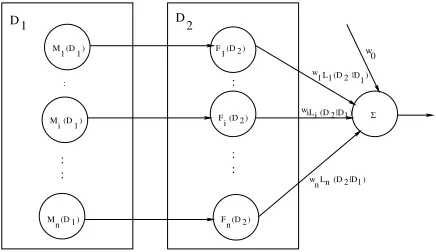
The linear discriminant function clearly constitutes a per-ceptron. Figure 1 shows a graphical representation of the perceptron that takes the semantic-class-specific log-likelihood scores as input.
|D 2 (D 1 L 1 w
) 2 (D n F
) 2 (D i F
) 2 (D
1 0 w
Σ
) 1 |D 2 (D n L n w
) 1 |D 2 (D i iL w
) 1
: : :
: D
F
) 1 (D n M
) 1 (D i M
) 1 (D 1 M
: :
[image:3.612.318.536.71.197.2]2 D 1
Figure 1: A graphical representation of the semantic lan-guage model
As the figure indicates, for each story pair
(D1, D2), we build semantic-class-specific models
[M1(D1), .., M|C|(D1)] from story D1 as given by
equation 4. We also construct the semantic class-specific feature lists {F1(D2), .., F|C|(D2)} from story D2 as
defined in equation 2 and then compute the feature vector
x = [L1(D2|D1), .., L|C|(D2|D1)]T where each
com-ponent likelihood ratio is computed as given in equation 5. We then perform an inner product of the augmented feature vectoryand the weight vectorwof the
percep-tron and the resulting score is output as shown in the figure.
The standard perceptron learns the optimal weight vec-torwby minimizing its misclassification rate on a
train-ing set (Duda et al., 2000). However, in TDT, misses (classification of an on-topic story pair as off-topic) are penalized 10 times more strongly than false alarms (clas-sification of an off-topic story pair as on-topic) (Allan, 2002a). We have therefore incorporated these penalties into the criterion function to force the perceptron learn the optimal classification based on TDT’s cost function.
4 Link Detection task and Evaluation
In this section, we describe one of the tasks called link de-tection, on which we performed the experiments reported in this work.Link detection requires determining whether or not two randomly selected stories(D1, D2)discuss the same
topic. The evaluation methodology of a link detection system requires the system to output a score for each story pair that represents the system’s confidence that both stories in the pair discuss the same topic. The system’s performance is then evaluated using a topic-weighted Detection Error Trade-off (DET) curve (Mar-tin et al., 1997) that plots miss rate against false alarm over a large number of story pairs, at different values of decision-threshold. A Link Detection cost functionClink
proba-bilities at each value of threshold into a single normalized evaluation score (Allan, 2002a). We use the minimum value of Clink as the primary measure of effectiveness
and show DET curves to illustrate the error trade-offs. It may be useful for the reader to remember that, since the DET curve is an error-tradeoff plot, the closer the curve is to the origin, the better is the performance, unlike the standard precision-recall curve familiar to the IR commu-nity.
5 Experiments and results
We have used Identifinder (Bikel et al., 1999) and Jtag (Xu et al., 1994) respectively, to tag each term by its named-entity type and its part of speech category. Addi-tionally, we have used a list of 423 most frequent words to remove stop words from stories. Stemming is done us-ing the Porter stemmer (Porter, 1980) while the model is implemented using Java.
As a training set, we have used a subset of TDT3 corpus that consists of news stories from eight English sources collected roughly from October through Decem-ber 1998. We have used manual transcriptions of stories when the source is audio/video. The training set consists of 7200 story pairs. For the general English model for this set, we have used the same TDT3 natural English manu-ally transcribed set consisting of 37,526 news stories.
For the test set, we have used a randomly chosen sub-set of natural English, manually transcribed stories from TDT2 corpus. It consists of 6,363 story pairs and the gen-eral English statistics are derived from 40,851 stories.
In the unigram language modeling approach to link detection, which we have used as baseline in our ex-periments, we build a topic modelM(D1)from one of
the stories D1 in the pair. We then compute the
log-likelihood ratioL(D2|D1)of the second storyD2 with
respect toM(D1)similar to equation 5 but considering
the entire document as a single feature list. The semantic language model score, on the other hand, is computed as described in section 3.
Sometimes we may use a symmetrized version of the formula, as shown below:
score(D1, D2) =1
2(L(D2|D1) +L(D1|D2)) (9)
However, in this work, we have considered only the asymmetric version of the formula to maintain simplic-ity of the scoring function. For fair comparison, we have used an asymmetric version of the baseline unigram lan-guage model too.
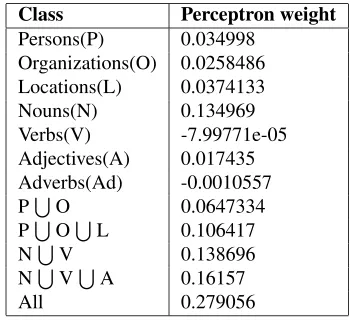
We have considered the categories in figure 2 as our semantic classes. Note that only terms that are not classi-fied as persons, organizations or locations are considered as candidates for nouns. The numbers in the table indi-cate the weight assigned by the perceptron to each class.
We have trained the perceptron using the 7200 labeled story-pairs of the training set.
The classAll corresponds to the unigram model and consists of all the terms of the story. Note that some of the classes are defined as the union of two or more sub-classes. We have done this to nullify the labeling error of the named-entity and parts-of-speech taggers. For exam-ple, we have noticed thatIdentifindermislabelsPersons
as Organizations and vice versa quite frequently. Our hope is that creating a new class that is a union of both
Personsand Organizations will offset such tagging er-rors.
Class Perceptron weight
Persons(P) 0.034998 Organizations(O) 0.0258486 Locations(L) 0.0374133 Nouns(N) 0.134969 Verbs(V) -7.99771e-05 Adjectives(A) 0.017435 Adverbs(Ad) -0.0010557 PSO 0.0647334 PSOSL 0.106417 NSV 0.138696 NSVSA 0.16157
All 0.279056
Figure 2: Semantic classes and their weights
The optimum class-weights as learnt by the Percep-tron offer some interesting insights. First we note that the classAll receives the highest weight and this seems quite intuitive since this class contains all the informa-tion in the story. However, somewhat surprisingly, the classNSVSA receives higher weight than the class PSOSLindicating that the former class contains more topical information than the latter. Also, note that Per-sonsare more important thanLocationswhich are in turn more important thanOrganizationswhich seems to agree with common sense.
Next we trained the unigram model on the training set and found the optimum value of the smoothing parameter λto be0.2. We have used the same value for the
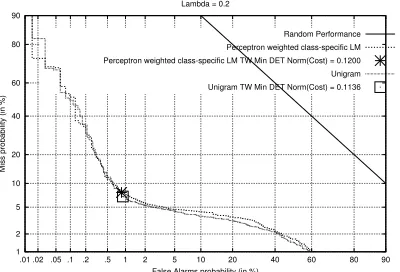
[image:4.612.338.513.225.385.2]smooth-ing parameter in all the classes of the class-specific lan-guage models and combined the class-specific likelihood scores using the perceptron weights. A comparison of the performance of semantic language model and unigram model on the training set is shown in the DET curve of figure 3. Quite disappointingly, the results indicate that the overall performance as indicated by the minimum cost in the DET curve has only worsened.
val-1 2 5 10 20 40 60 80 90
.01 .02 .05 .1 .2 .5 1 2 5 10 20 40 60 80 90
Miss probability (in %)
False Alarms probability (in %) Lambda = 0.2
[image:5.612.87.287.76.212.2]Random Performance Perceptron weighted class-specific LM Perceptron weighted class-specific LM TW Min DET Norm(Cost) = 0.1200 Unigram Unigram TW Min DET Norm(Cost) = 0.1136
Figure 3: Comparison of semantic LM and unigram per-formance on training set
ues learnt on the training set. This time, however, we note that the minimum cost of the semantic language model is slightly lower than that of the unigram model, but the im-provement is very insignificant.
1 2 5 10 20 40 60 80 90
.01 .02 .05 .1 .2 .5 1 2 5 10 20 40 60 80 90
Miss probability (in %)
False Alarms probability (in %) lambda = 0.2
Random Performance Perceptron weighted class-specific LM Perceptron weighted class-specific LM TW Min DET Norm(Cost) = 0.1248 Unigram Unigram TW Min DET Norm(Cost) = 0.1260
Figure 4: Comparison of semantic LM and unigram per-formance on test set
6 Discussion
In this section, we first briefly touch upon the variations in the model we considered and the various experiments we performed, but could not report in detail owing to space constraints. Secondly we discuss why we think the model’s performance is unsatisfactory.
We have considered a simple mixture model to start with, wherein each class-specific modelMi(D1)
gener-ates a list of features in its class Fi(D2)but the model
itself is sampled with a prior probability ofP(Mi(D1))
which we made dependent on |Fi(D1)|. This model’s
performance is found to be far below that of the uni-gram approach and hence we abandoned it to favor the perceptron-weighted likelihood ratios.
In terms of experiments done, we started out with the basic semantic classes ofP, O, L, N, V, AandAd
with-out considering unions of the classes. We found that tak-ing unions improved performance and we report the list of classes whose combination performed the best.
Coming to the second part of our discussion, we are yet to perform exploratory data analysis to understand the reasons behind the unsatisfactory performance of the new approach, but we believe the reasons could be three-fold: Firstly, it is possible that we are operating the semantic language model at a sub-optimal level. For example, we have used the same value of the smoothing parameter that we have learnt for the unigram model in all the classes of the semantic language model. It is possible that different classes may require different levels of smoothing for op-timum performance. We believe one could use a gradient descent algorithm on TDT’s cost function to learn from the training set the optimum values of the smoothing pa-rameters for different classes.
Secondly, a linear discriminant function that a percep-tron implements is an overly simplistic classifier and may not be doing a good job on separating the on-topic pairs from the off-topic ones. A non-linear classifier such as an SVM (Burges, 1998) could help improve our accuracy.
Lastly, it is possible that the unigram model is already capturing the relative importance of terms that we are try-ing to model ustry-ing our semantic language models. The likelihood ratio score we use in the unigram approach be-haves similar to thetf-idf weights, which we know are a powerful statistic to capture the relative importance of terms. If this were true, then the semantic language model may be rendered redundant.
The real reasons will only be revealed by an analysis of the data and we hope to do this as part of our future work.
7 Conclusions and Future work
In this work, we have presented a novel approach for link detection task of TDT. The new approach has three key ideas, namely modeling the relative importance of terms by their semantic classes through a new semantic lan-guage modeling approach, casting the link detection task as a two-class classification problem and learning the op-timum linear discriminant function using the perceptron learning algorithm. We believe this is one of the earli-est works that attempts incorporating semantic informa-tion into the language modeling framework. Although we have built the model specifically for the link detec-tion task, it is general enough to be extended to the other tasks of TDT such as Tracking, New Event Detection and Clustering.
The results on train and test sets indicate that there is a little or no improvement in the performance from the new model as compared to the unigram approach.
[image:5.612.87.288.332.468.2]of the new model and try out a few improvements sug-gested in section 6. The possible improvements could consist of finding the optimal smoothing parameters for each semantic class and using better non-linear classifiers like SVM. Another possible area of improvement is to consider more semantic classes such as dates, numbers,
etc.
We would also like to build systems for other tasks in TDT based on semantic language models and test their performance. We believe that semantic information is more critical in tasks such as New Event Detection which involves identifying the first story that discusses a par-ticular event. New events are typically characterized by mentions of new persons, locations or actions and our se-mantic models are capable of capturing exactly such in-formation.
Additionally, it has been suggested that statistical mod-els such as the aspect model (Hoffman, 1999) and the latent Dirichlet allocation (Blei et al., 2001) which gen-erate words from a mixture of aspect-models can be ex-ploited by modeling semantic classes as the aspects. We will be studying the applicability of these ideas to the cur-rent task as part of our future work.
We believe the main contribution of our work lies in our attempt at incorporating semantic information in the language modeling framework and combining scores in a principled way. We believe we have only taken a first step in this direction and much remains to be done as part of future work.
Acknowledgments
I would like to thank Prof. James Allan for motivating the idea of exploiting semantic information for TDT and Vic-tor Lavrenko for his valuable comments. I am also grate-ful to the anonymous reviewers for their very insightgrate-ful comments and suggestions. This work was supported in part by the Center for Intelligent Information Re-trieval and in part by SPAWARSYSCEN-SD grant num-bers N66001-99-1-8912 and N66001-02-1-8903. Any opinions, findings and conclusions or recommendations expressed in this material are the author’s and do not nec-essarily reflect those of the sponsor.
References
Allan, J., Jin, H., Rajman, M., Wayne, C., Gildea, D., Lavrenko, V., Hoberman, R., Caputo, D., Topic-Based Novelty Detection, Summer Workshop Final Report, Center for Language and Speech Processing, Johns Hopkins University, 1999.
Allan, J., Introduction to Topic Detection and Tracking,
Topic Detection and Tracking: Event-based
Informa-tion OrganizaInforma-tion, James Allan, Editor, Kluwer Aca-demic Publishers, 1-16, 2002a.
Allan, J., Lavrenko, V. and Nallapati, R. UMass at TDT 2002, Topic Detection and Tracking: Workshop, 2002b.
Bikel, D. M., Schwartz, R. L. and Weischedel, R. M., An Algorithm that Learns What’s in a Name, Machine Learning, Vol. 34(1-3), p 211-231, 1999.
Blei, D. M., and Ng, A. Y., and Jordan, M. I., Latent Dirichlet Allocation, Neural Information Processing Systems 14, 2001.
Burges, C. J. C., A Tutorial on Support Vector Machines for Pattern Recognition, Data Mining and Knowledge Discovery, vol. 2(2), p 121-167, 1998.
Charniak, E., Statistical Parsing with a Context-Free Grammar and Word Statistics,AAAI, p 598-603, 1997. Duda, R. O., Hart, P. E. and Stork, D. G., Pattern
Classi-fication, Wiley-Interscience, 2nd edition, 2000. Hoffman, T., Probabilistic Latent Semantic Analysis,
Proc. of Uncertainty in Artificial Intelligence, 1999. Martin, A., Doddington, G., Kamm, T. and Ordowski,
M., The DET curve in assessment of detection task performance,EuroSpeech, 1895–1898, 1997.
Mihalcea R. and Mihalcea, S., Word Semantics for In-formation Retrieval: Moving One Step Closer to the Semantic Web, International Conference on Tools with Artificial Intelligence, 280-287, 2001.
Ponte, J. M. and Croft, W. B., A Language Modeling Approach to Information Retrieval, ACM SIGIR, 275-281, 1998.
Porter, M. F., An algorithm for suffix stripping, Pro-gram, 14(3):130-137, 1980.
Ratnaparkhi, A., A maximum entropy part-of-speech tagger, In Proceedings of the Empirical Methods in Natural Language Processing Conference, University of Pennsylvania, May 1996.
Salton, G., Yang, C., and Wong, A., A vector-space model for information retrieval, Comm. of the ACM, 18, 1975.
Xu, J., Broglio, J. and Croft, W. B., The design and im-plementation of a part of speech tagger for English,
Technical Report IR-52, Center for Intelligent Informa-tion Retrieval, University of Massachusetts, Amherst, 1994.