Using longest common subsequence
and character models to predict word forms
Alexey Sorokin
Moscow State University / GSP-1, Leninskie Gory, 1 Faculty of Mathematics and Mechanics, 119991, Moscow, Russia
Moscow Institute of Physics and Technology / Institutskij per., 9, Faculty of Innovations and High Technologies, 141701, Dolgoprudny, Russia
Abstract
This paper presents an algorithm for au-tomatic word forms inflection. We use the method of longest common subse-quence to extract abstract paradigms from given pairs of basic and inflected word forms, as well as suffix and prefix fea-tures to predict this paradigm automati-cally. We elaborate this algorithm us-ing combination of affix feature-based and character ngram models, which substan-tially enhances performance especially for the languages possessing nonlocal phe-nomena such as vowel harmony. Our sys-tem took part in SIGMORPHON 2016 Shared Task and took 3rd place in 17 of 30 subtasks and 4th place in 7 substasks among7participants.
1 Introduction
Automatic paradigm detection has attracted ex-tensive attention in recent years. The most valu-able works include (Ahlberg et al., 2014; Ahlberg et al., 2015), which pursue a classification-based approach, encoding every inflection paradigm by a single label, and (Dreyer and Eisner, 2011; Nicolai et al., 2015) applyng transduction-base techniques. The representation of morphological paradigms in (Ahlberg et al., 2014) is based on the longest common subsequence (LCS) method, suggesting that the common material in the LCS is the “stem” and the symbols not in the LCS are inflection markers. This approach actually goes back to the 60s and was first applied in the seminal work of Andrey A. Zaliznyak “Russkoe imennoe slovoizmenenie” (“Russian nominal in-flection”, Zaliznyak (2002)). From the lingustic point of view, transduction-based techniques are more relevant, since when inflection is realised
by several simultaneous modifications (say, pre-fix and sufpre-fix changes and vowel alterations in the stem), it is more natural to represent it by multi-ple operations, not by a single label. Nevertheless we decide to use the first approach: firstly, ma-chine learning algorithms used for classification are more simple computationally than the ones for string transformations and require less param-eter tuning. Secondly, our work was initially con-ducted for Russian, where most morphological al-terations occur in affixes with the exception of sev-eral patterns. Our method is based on the one of Ahlberg et al. (2015) with several technical modi-fications.
Our system participated in SIGMORPHON-2016 Shared Task on morphological inflection (Cotterell et al., 2016). This task required one to guess a single word form of a given category, not the whole paradigm, which is a reverse for one of the standard NLP tasks: lemmatization, where the goal is to predict a basic form of the word (the lemma) given its inflected form. Lemmati-zation is rarely considered as labeling task, the only exception being Gesmundo and Samardˇzi´c (2012). However, the latter work considers only alterations at the edges of the word, while the LCS method allows one to address internal changes as well. A more general method of edit trees used in Chrupala et al. (2008) and M¨uller et al. (2015) is another realization of the LCS approach. How-ever, lemmatization algorithms extensively exploit context to discriminate between candidate forms which is irrelevant for SIGMORPHONchallenge.
Our paper consists of5parts, including the in-troduction. The second part briefly explains how abstract paradigms are induced from data. It also introduces the techniques used for their automatic detection. The third part outlines SIGMORPHON
SHARED TASK and the methods we proposed to
solve it. The fourth part describes different
ants of our system and compares their relative per-formance. We conclude with the error analysis and future work directions.
2 Abstract paradigms
A standard task of paradigm learning is to guess an inflection table given a source form. In the classification approach, this task is solved by en-coding the complete table with a label and then predicting this label using standard machine learn-ing technique. The predicted values in our method are abstract paradigms introduced in Ahlberg et al. (2014). Informally speaking, an abstract paradigm is a list of patterns, where common parts of word forms are replaced by variables. These variables correspond to maximal contigu-ous segments of the longest common subsequence of these forms. For example, paradigms sing-sanganddrink-drankboth share the same abstract paradigm1+i+2#1+a+2. The same approach can be applied not only to complete paradigms, but also to the pairs (source form, inflected form).
Following Ahlberg et al. (2014), we use finite automata to extract LCS. However, our implemen-tation has several technical differences, mentioned below. When several variants of the same length exist, we extract the one with the least total num-ber of gaps and the least total length of these gaps. These two quantities being equal, the number of zero-length gaps is minimized. For example, given Arabic verb imt¯aza “to be distinguished” and its inflected formtamtaz, the best LCS is mt-z, not
mt-a since it has two gaps of length1 instead of one gap of length2and one of length0. We also restrict the maximal length of gaps in the middle and in the beginning of the word to prevent spuri-ous matches. When the language lacks prefix in-flection, we simply set the maximal initial gap to 0.
After enumerating all possible abstract paradigms, the task of automatic inflection be-comes a standard classification problem. Our basic system uses lemma suffixes and prefixes as features, following the scheme of Ahlberg et al. (2014). We bound their length by some number (usually 5 for suffixes and 3 for prefixes) and encode them as binary features. We also remove frequent affixes before extracting the features, attaching them afterwards. Since the number of possible features can reach several thousands, we perform extensive feature selection. For the
competition we enriched the model by character ngram scores which is our main contribution and significantly boosted performance. Details are given in Section 4.
3 Sigmorphon Shared Task
First SIGMORPHON SHARED TASK (Cotterell et
al., 2016) was held for 10 languages of differ-ent genealogy and morphological structure. There were several agglutinative languages (Finnish and Turkish), two Semitic languages (Arabic and Maltese) with “root-and-pattern” morphology, some languages are more difficult to characterize (Navajo). We refer the reader to the organizers’ article for a complete description of the task. The competition consisted of3parts. In the first partic-ipants were asked to construct a word form given its lemma and morphological tag. In the second task the source form was not required to be the lemma, but its tag was also given. In the third task the tag of the source form was unknown.
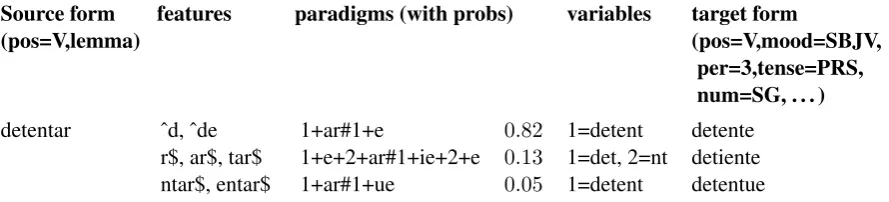
In the first task our system was trained for each morphological tag separately. Every lemma-form pair was treated as an abstract paradigm contain-ing two cells. Given a lemma at test time, the classifier uses its suffixes and prefixes to detect the most probable abstract paradigm. A paradigm be-ing known, we determine the variable values. Sub-stituting this values for the variables in the second cell of the paradigm, we calculate the target form. The scheme of the process described is presented in Figure 1.
In the second task we first map the form of the source category to its lemma, training on the reverse pairs from the first task, then apply a direct classifier from Task 1. Since our sys-tem assigns probabilities, for every source form
w1 of the category c1 we calculate a set of
possible lemmas l1, . . . , lm with their probabil-ities; afterwards for every lemma we construct its possible forms of target category c2 and
se-lect the forms with the highest total probability
P(w2|w1, c1, c(w2) =c2) =P
i p(w2|lem(w2) =
li, c(w2) =c2)p(lem(w1) =li). The algorithm is depicted on Figure 2.
Source form features paradigms (with probs) variables target form
(pos=V,lemma) (pos=V,mood=SBJV,
per=3,tense=PRS, num=SG, . . . ) detentar ˆd, ˆde 1+ar#1+e 0.82 1=detent detente
[image:3.595.78.523.62.163.2]r$, ar$, tar$ 1+e+2+ar#1+ie+2+e 0.13 1=det, 2=nt detiente ntar$, entar$ 1+ar#1+ue 0.05 1=detent detentue
Figure 1: How we model inflection (Task 1). For each lemma in the test set we predict an abstract paradigm, which consists of lemma and target form patterns. Fitting the lemma to its guessed pattern, we find the variables in the paradigm. Using these variables, the target word form is constructed.
Source form Lemmas Target forms Target forms
(with probs) (for each lemma) (with probs)
pos=V,polar=POS, pos=V,mood=IND,tense=PST,
mood=IMP,per=1,num=PL per=1,num=SG,aspect=PFV
vaguemos vagar 0.83 vagu´e 0.90 vagu´e 0.92 vag´e 0.10 vag´e 0.08 vaguar 0.17 vagu´e 0.97
[image:3.595.88.520.227.340.2]vaguu´e 0.03
Figure 2: How we model reinflection (Task 2). First, for the source form a list of possible lemmas is constructed. Second, for each potential lemma all possible target forms are predicted. The probabilities of these forms are calculated using chain rule.
probability formula. Our system essentially re-lies on2 basic components: forward transforma-tion from lemma to its inflected form and the cor-responding backward transformation. Therefore in what follows we focus on implementation is-sues and evaluate performance mainly for these two problems.
We deliberately refrain from using any external sources including linguistic information and cor-pus statistics. Nevertheless, our method could be easily extended with corpora features, see Ahlberg et al. (2014) and Sorokin and Khomchenkova (2016) for possible strategies.
4 Performing classification
In this section we present some details of our sys-tem used to solve Task 1 and its reverse, for the general description see Section 2. Each inflec-tion/lemmatization task was solved without any information about other forms of the given lemma. We applied a logistic regression classifier using suffixes and prefixes as features. Usually the length of suffixes was 5 for inflection and 6 for lemmatization, the maximal length of prefix fea-tures was 3. However, prefix features were not
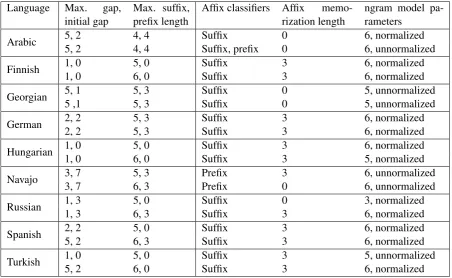
used for Turkish and Finnish, while for Navajo we used prefixes of length up to 5and the length of suffixes was bounded by3. In all languages words were classified by their last (first for Navajo) letter and a separate classifier was trained for each let-ter. To avoid data sparsity we performed extensive feature selection, keeping only best 10% of fea-tures according to an ambiguity measure (?) and disregarding features observed less than3times in the training set. If an affix of length up to 3 un-ambigiously predicts the paradigm labelπ, we as-signπfor any lemma ending by (beginning with) this affix. We also experimented with removing frequent suffixes before extracting features and at-taching them afterwards, which slightly improved the results for most of the languages. Language-dependent parameters are given in the Appendix.
We report the results of our system evaluation in Table 1, column SIMPLE. We used the train-dev split provided by the workshop organizers after re-moving all the duplicates from the development set.1 For most of the tasks it outperforms the
base-line which uses the transductive approach with an averaged perceptron as the classifier. However, for
1Actually, it was not done in the submission version,
Language JOINT SIMPLE BASE JOINT SIMPLE BASE JOINT SIMPLE BASEVerbs Adjectives Nouns Arabic 80.9 66.0 65.5 94.4 87.2 63.2 76.2 73.4 76.3 Finnish 94.0 93.4 58.4 62.9 62.9 14.3 87.8 87.2 77.9 Georgian 42.3 32.1 48.7 100.0 100.0 100.0 97.6 96.6 95.3 German 90.0 89.3 85.5 97.2 96.7 91.0 91.2 91.2 89.2
Hungarian 92.5 89.8 78.7 75.9 71.4 58.0
Navajo 94.5 93.4 84.6 56.4 47.9 53.9
Russian 83.2 82.8 81.2 95.8 95.8 95.8 91.9 91.5 91.9 Spanish 98.6 98.6 96.2 100.0 100.0 99.1 100.0 100.0 99.5
Turkish 83.5 74.4 61.2 87.3 78.4 56.3
Table 1: Performance quality for inflection (Task 1).
Russian and Arabic there is a marginal gap, while for Georgian and Navajo verbs our results are not satisfying enough.
We try to close this gap using character models. We learn an ngram model on the set of word forms in the train data. Model counts are smoothed us-ing Witten-Bell smoothus-ing. We integrate ngram probabilities in our model via standard reranking scheme: the SIMPLE model is used to generate the n-best list. Then for every form in this list we calculate its log-probability according to SIM-PLE model as well as language model logarith-mic score normalized by word length. These two features are passed to a logistic regression classi-fier and the hypothesis with highest decision score is returned. To learn the weights of the scores we apply the following procedure from Joachims (2002): suppose three hypothesesw1,w2 andw3
were generated for the lemmalin the training set ,
w2being the correct word form. If their log
prob-abilities are p1, p2, p3 and n-gram log scores are
s1, s2, s3 respectively, we include in the training
set vectors[p2−p1, s2−s1]and[p2−p3, s2−s3]
as positive instances and [p1 −p2, s1 −s2] and
[p3−p2, s3−s2]as negative. Note that this
rank-ing scheme allows for integration of other task-dependent features as well which might be helpful in lemmatization or POS-tagging.
The results of the improved system are also given in Table 1, column JOINT. We observe that for most of the tasks the combined system confi-dently beats the baseline, except Georgian verbs. Arabic nouns and Russian nouns and adjectives are on par with the baseline system. Character ngram models are the most helpful for the lan-guages with developed vowel harmony, such as Turkish (the impact for Finnish is more modest
since the performance quality of the SIMPLE sys-tem was already high). In case of Arabic SIMPLE model often generates about ten forms of approx-imately the same probability; the character model helps to select the best one and rule out the words which do not satisfy local phonological require-ments.
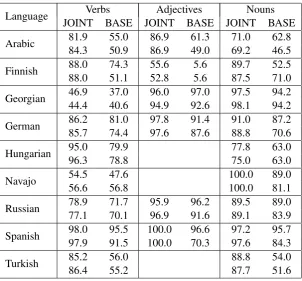
Table 2 contains results for the reverse task of lemmatization used as the first stage in Tasks 2 and3. There was no baseline available, therefore we compare only performance of the SIMPLE sys-tem and the JOINT syssys-tem using character ngram models. We observe that ngram statistics produce more substantial gain in this task than for inflec-tion. We also provide evaluation results on Tasks 2and3of the Shared Task (Table 3, first line for each language stands for Task 2 and second for Task3). Since accuracy for these tasks is deter-mined by lemmatization and inflection quality, we will not discuss them further. For the results of the competition itself we refer the reader to organiz-ers’ article (Cotterell et al., 2016), we just mention that our system was ranked the3rd17times of30, 5times for Task1and6times for Tasks2and3. 5 Error analysis and discussion
Language JOINT SIMPLE JOINT SIMPLE JOINT SIMPLEVerbs Adjectives Nouns Arabic 76.1 56.7 94.5 93.6 83.1 63.6 Finnish 92.7 85.0 62.9 48.7 90.7 84.7 Georgian 51.3 34.6 99.2 98.4 99.4 96.6 German 94.3 92.1 98.1 96.8 94.1 90.7
Hungarian 98.7 96.1 99.1 98.2
Navajo 65.6 44.2 64.2 52.2
Russian 87.5 82.8 97.1 96.8 93.6 89.7 Spanish 98.5 96.5 100.0 99.1 97.2 98.2
[image:5.595.128.470.61.216.2]Turkish 93.8 91.3 97.0 96.4
Table 2: Performance quality for lemmatization.
Language JOINT BASE JOINT BASE JOINT BASEVerbs Adjectives Nouns
Arabic 81.984.3 55.050.9 86.986.9 61.349.0 71.069.2 62.846.5
Finnish 88.088.0 74.351.1 55.652.8 5.65.6 89.787.5 52.571.0
Georgian 46.944.4 37.040.6 96.094.9 97.092.6 97.598.1 94.294.2
German 86.285.7 81.074.4 97.897.6 91.487.6 91.088.8 87.270.6
Hungarian 95.096.3 79.978.8 77.875.0 63.063.0
Navajo 54.556.6 47.656.8 100.0100.0 89.081.1
Russian 78.977.1 71.770.1 95.996.9 96.291.6 89.589.1 89.083.9
Spanish 98.097.9 95.591.5 100.0100.0 96.670.3 97.297.6 95.784.3
Turkish 85.286.4 56.055.2 88.887.7 54.051.6
Table 3: Performance quality on Tasks2and3.
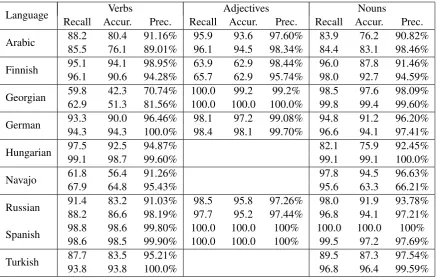
correct word form was ranked the first provided it was in the candidate list) for the overwhelm-ing majority of tasks is over 90% which shows that affix features and character models are in-deed effective in discriminating between candidate paradigms. Omitting Georgian verbs and Finnish adjectives, where the classifier suffers from the lack of training data, we observe two problematic languages: Arabic demonstrates decent recall and moderate precision in both tasks, while results on Navajo degrade mostly due to extremely low recall except the lemmatization of nouns, where preci-sion drops to66%.
As a key example, consider the
Pres+2+Sg+Masc form of Arabic verbs, for which the percentage of correctly predicted forms was only 62% (8 of 13). In 4 of 5 erroneous cases the algorithm fails to even suggest the correct transformation (1+¯a+2+a#ta+1+¯u+2+u, e. g. d¯ama“to last” –tad¯umu“you (Masc) last”) because it was never observed in the training set for this particular task and was observed only once at all. The fact that in other forms ¯a was often replaced by ¯u also does not help since transformations are considered “as a whole”, not as a sequence of local edits. The remaining mistake (tad.ra¯git.t.u instead of tad.ri¯gat.t.u for
[image:5.595.148.451.251.532.2]algo-Language Recall Accur.Verbs Prec. Recall Accur.Adjectives Prec. Recall Accur.Nouns Prec.
Arabic 88.285.5 80.476.1 91.16%89.01% 96.195.9 93.694.5 97.60%98.34% 84.483.9 83.176.2 90.82%98.46%
Finnish 95.196.1 94.190.6 98.95%94.28% 65.763.9 62.962.9 98.44%95.74% 98.096.0 92.787.8 91.46%94.59%
Georgian 59.862.9 42.351.3 70.74% 100.081.56% 100.0 100.0 100.0%99.2 99.2% 98.599.8 97.699.4 98.09%99.60%
German 93.394.3 90.094.3 96.46%100.0% 98.498.1 97.298.1 99.08%99.70% 96.694.8 94.191.2 96.20%97.41%
Hungarian 97.599.1 92.598.7 94.87%99.60% 82.199.1 75.999.1 92.45%100.0%
Navajo 61.867.9 56.464.8 91.26%95.43% 97.895.6 94.563.3 96.63%66.21%
Russian 91.488.2 83.286.6 91.03%98.19% 97.798.5 95.895.2 97.26%97.44% 96.898.0 94.191.9 93.78%97.21%
Spanish 98.898.6 98.698.5 99.80% 100.099.90% 100.0 100.0100.0 100%100% 100.099.5 100.097.2 97.69%100%
[image:6.595.81.519.61.340.2]Turkish 87.793.8 83.593.8 95.21%100.0% 89.596.8 87.396.4 97.54%99.59%
Table 4: Recall and precision on inflection (upper) and lemmatization (lower) tasks.
rithm correctly predicts the paradigm description i+1+a+2+a#ta+1+i+2+ubut erroneously replaces the first root syllable instead of the second. In the case of ambiguity the position of alteration is determined by calculating the probability of “local” transformation a → i in both locations and choosing the most probable according to its immediate context. Since local features cannot distinguish first and second syllables of the root and paradigm description contains no information on the number of vowels in variables, our system cannot avoid such mistakes. However, their percentage can be lowered by allowing the system to predict several surface variants for one abstract paradigm (in current architecture this decision is made before calculating ngram scores).
Another difficult problem for our approach is fusion. Consider the REAL+Pl+1 form of the Navajo verbs, where only 2 predictions of 7 are correct and in 5 remaining cases the correct paradigm label was not even in the list of possible paradigms. For example, the plural form deiiji¸i¸’
of the verbyiiji¸i¸h“to stand up” is produced using the pattern y+1+h#de+1+’ while the training set contained only the transformationy+1+h#dei+1+’ foryik’e¸e¸h→deiik’e¸e¸’, where the prefixde-was fused with initial y. That explains the low per-formance on Navajo inflection in terms of
re-call. The opposite problem holds for lemmatizing Navajo nouns. For example, all4-th person forms start with ha-, however, it can be obtained from the lemma form either by adding initialh( ataa’-hataa’) or by substitutiing for initial bi- ( bijaa’-hajaa’). This ambiguity cannot be resolved with dictionary or corpus; fortunately, when reinflect-ing other forms all the potential lemmas generate the same form so the performance on Tasks2and 3is unaffected.
Summarizing, our classification-based ap-proach meets difficulties when faced with ‘too local’ phenomena like fusion of ‘too global’ like vowel harmony. Indeed, there is no way to predict vowels in the middle of the word observing only its edges. This difficulty is resolved using character ngrams, which can capture the interdependency between nearby vowels in the word stem. Using models of order up to 6 significantly improves performance on Arabic, Turkish and Finnish. When applying ngram models in the lemmatization stage we observe consistent improvement practically for all languages. Character models cannot help when a correct paradigm was not generated as a candidate
1Generally, our system was ranked higher on Tasks2and
(recall the discussion on Arabic verbs above). There are two possible strategies in this case: first, a deterministic postprocessing step could be applied to “harmonize” vowels or make other phonetic transformations. Another variant is to create with every abstract paradigm its “phonetic variants” and perform the classification step on the extended set of paradigms. We plan to address this question in future research.
The last thing to say, one of the important mer-its of our system is mer-its simplicity. It does not re-quire complex techniques for parameter tuning; training the model also relies on well-established algorithms. The features we use are also very simple and they could be easily extended, for ex-ample, to capture the context information. Tak-ing into account the solid performance of our sys-tem in SIGMORPHON SHARED TASK, we think
that classification-based approaches could be use-ful in a couple of tasks including paradigm in-duction, morphological parsing and lemmatization for languages of arbitrarily complex morphologi-cal structure.
References
Markus Dreyer and Jason Eisner. 2011. Discover-ing morphological paradigms from plain text usDiscover-ing a dirichlet process mixture model. InProceedings of the Conference on Empirical Methods in Natural Language Processing, pages 616–627. Association for Computational Linguistics.
Thomas M¨uller, Ryan Cotterell, Alexander Fraser, and Hinrich Sch¨utze. 2015. Joint lemmatization and morphological tagging with Lemming. In Proceed-ings of the 2015 Conference on Empirical Methods in Natural Language Processing. Association for Computational Linguistics, Lisbon, Portugal, pages 2268–2274. Association for Computational Linguis-tics.
Alexey Sorokin and Irina Khomchenkova. 2016. Au-tomatic detection of morphological paradigms using corpora information. In Dialogue. 22nd Interna-tional Conference on ComputaInterna-tional Linguistics and Intellectual Technologies, pages 604–616, Moscow, Russia, June. RSUH.
Malin Ahlberg, Markus Forsberg, and Mans Hulden. 2014. Semi-supervised learning of morphological paradigms and lexicons. InProceedings of the 14th Conference of the European Chapter of the Associa-tion for ComputaAssocia-tional Linguistics, pages 569–578, April.
Malin Ahlberg, Markus Forsberg, and Mans Hulden. 2015. Paradigm classification in supervised learning
of morphology. InProceedings of the Conference of the North American Chapter of the Association for Computational Linguistics Human Language Tech-nologies (NAACL-HLT 2015), Denver, CO, pages 1024–1029, June.
Garrett Nicolai, Colin Cherry, and Grzegorz Kondrak. 2015. Inflection generation as discriminative string transduction. InProceedings of the Conference of the North American Chapter of the Association for Computational Linguistics Human Language Tech-nologies (NAACL-HLT 2015), Denver, CO, pages 923–931, June.
Andrea Gesmundo and Tanja Samardˇzi´c. 2012. Lem-matisation as a tagging task. InProceedings of the 50th Annual Meeting of the Association for Compu-tational Linguistics: Short Papers-Volume 2, pages 368–372. Association for Computational Linguis-tics.
Grzegorz Chrupala, Georgiana Dinu, and Josef van Genabith. 2008. Learning morphology with Mor-fette. In Proceedings of the Sixth International Conference on Language Resources and Evalua-tion (LREC’08), pages 2362–2367, Marrakech, Mo-rocco, May. European Language Resources Associ-ation (ELRA).
Ryan Cotterell, Christo Kirov, John Sylak-Glassman, David Yarowsky, Jason Eisner, and Mans Hulden. 2016. The SIGMORPHON 2016 shared task— morphological reinflection. In Proceedings of the 2016 Meeting of SIGMORPHON, Berlin, Germany, August. Association for Computational Linguistics. Thorsten Joachims. 2002. Optimizing search en-gines using clickthrough data. InProceedings of the eighth ACM SIGKDD international conference on Knowledge discovery and data mining, pages 133– 142. ACM.
Andrey A. Zaliznyak. 2002. Russian nominal inflec-tion. Yazyki slavyanskoj kultury, Moscow, Russia.
Acknowledgements
The author thanks Irina Khomchenkova for care-ful assistance during the research. I am also very grateful to anonymous ACL SIGMORPHON
re-viewers whose detailed comments were very help-ful in improving this paper. This work is a part of General Internet Corpus of Russian (http:
//www.webcorpora.ru/) project.
Language Max. gap,
initial gap Max. suffix,prefix length Affix classifiers Affixrization lengthmemo- ngram model pa-rameters Arabic 5, 25, 2 4, 44, 4 SuffixSuffix, prefix 00 6, normalized6, unnormalized
Finnish 1, 01, 0 5, 06, 0 SuffixSuffix 33 6, normalized6, normalized
Georgian 5, 15 ,1 5, 35, 3 SuffixSuffix 00 5, unnormalized5, unnormalized
German 2, 22, 2 5, 35, 3 SuffixSuffix 33 6, normalized6, normalized
Hungarian 1, 01, 0 5, 06, 0 SuffixSuffix 33 6, normalized5, normalized
Navajo 3, 73, 7 5, 36, 3 PrefixPrefix 30 6, unnormalized6, unnormalized
Russian 1, 31, 3 5, 06, 3 SuffixSuffix 03 3, normalized6, normalized
Spanish 2, 25, 2 5, 06, 3 SuffixSuffix 33 6, normalized6, normalized
[image:8.595.73.526.261.539.2]Turkish 1, 05, 2 5, 06, 0 SuffixSuffix 33 5, unnormalized6, normalized