1
Talking about what is not there:
Generating indefinite referring expressions in Minecraft
Arne K¨ohn and Alexander Koller Department of Language Science and Technology
Saarland University
{koehn|koller}@coli.uni-saarland.de
Abstract
When generating technical instructions, it is often necessary to describe an object that does not exist yet. For example, an NLG system which explains how to build a house needs to generate sentences like “builda wall of height five to your left” and “now build a wall on the other side.” Generating (indefinite) refer-ring expressions to objects that do not exist yet is fundamentally different from generating the usual definite referring expressions, because the new object must be distinguished from an infinite set of possible alternatives. We for-malize this problem and present an algorithm for generating such expressions, in the context of generating building instructions within the Minecraft video game.
1 Introduction
Everyone who has ever had to assemble a piece of furniture knows the importance of clearly worded technical instructions. Ideally, such instructions should be personalized to the current user and their level of expertise, and should be rephrased if the user has trouble with some instruction.
In this paper, we explore the challenge of auto-matically generating personalized building instruc-tions in the context of the video game “Minecraft”. Minecraft is a game in which players can explore an open world, mine materials, and build complex structures such as houses and technical devices. By situating the NLG task in Minecraft, we retain the challenge of generating complex technical in-structions, within the context of a fully observable virtual environment. Minecraft is an extremely pop-ular game, with 50 million active users, which facil-itates access to experimental subjects for evaluation. There are currently about 130 million Minecraft-related videos on YouTube, many of which have humans explain how to construct complex objects;
thus there is a clear interest in building instructions for Minecraft.
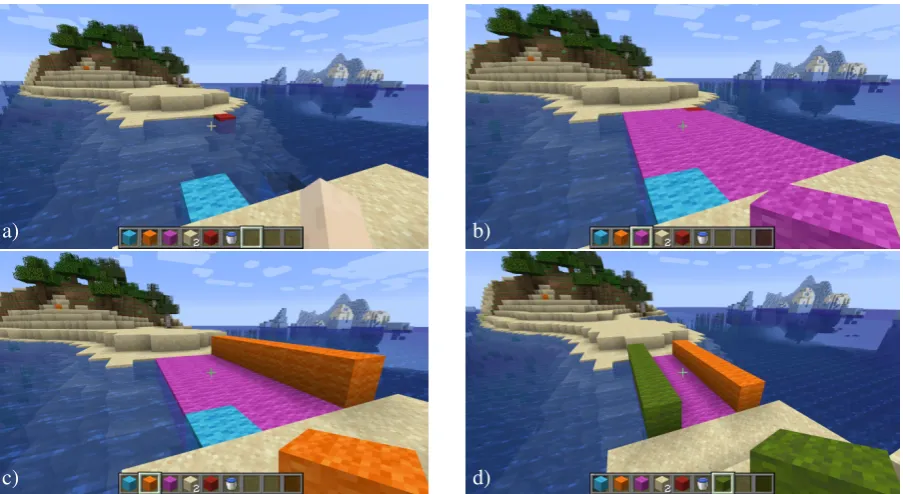
One challenge in generating building instruc-tions for Minecraft is to refer to objects that do not exist yet. For instance, in order to instruct the player to build the left railing of the bridge in Fig.2c, the NLG system might say “builda railing on the left side of the bridge”. When this instruction is uttered, there is no left railing yet; thus one uses the indefinite referring expression (RE) in italics to refer to a non-existing object. Generating such in-definite NPs is a fundamentally different task than the more established task of generating definite NPs, in which the target referent only needs to be distinguished from a finite set of distractors. In gen-erating indefinite REs, the target referent needs to be distinguished from an infinite set of alternatives, such as railings of different lengths and in different locations. This makes it infeasible to use existing generation algorithms for definite REs.
In this paper, we show how to generate indef-inite REs for objects in Minecraft which do not exist yet. We proceed in two steps. First, we will show how to generate definite and indefinite REs to individual blocks in Minecraft, in a way which makes it possible to generate REs for locations in the environment, in addition to REs for objects. We will then build a method for generating definite and indefinite REs to complex objects (such as railings) upon this. The basic idea is to precompute possi-ble sets of features which will uniquely identify the complex object by specifying all of its rele-vant attributes. We implement our RE generation method in terms of Semantically Interpreted Gram-mars (SIGs) (Koller and Engonopoulos,2017) and use their chart-based sentence generator to perform the actual RE generation.
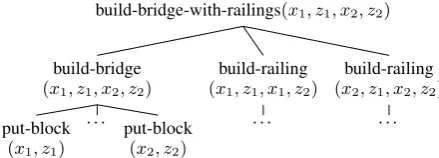
build-bridge-with-railings(x1, z1, x2, z2)
build-railing
(x2, z1, x2, z2)
. . . build-railing
(x1, z1, x1, z2)
. . . build-bridge
(x1, z1, x2, z2)
put-block
(x2, z2) . . .
put-block
[image:2.595.74.294.65.144.2](x1, z1)
Figure 1: A construction plan.
sketch chart generation with SIGs in Section3. We will then show how to refer to individual blocks in Section4and to complex objects in Section5. Section6concludes and discusses future work.
2 Background
There is an extensive literature on the generation of definite REs to objects which exist in the envi-ronment. These algorithms typically aim to dis-tinguish the target referent from the other existing objects, and can thus assume that the denotations of all properties are subsets of the (finite) set of existing objects. They then intersect denotations of properties in some way, keeping track of the (finite) set of possible referents in the intersection, until the set of referents becomes singleton. The classi-cal reference for this approach is the Incremental Algorithm ofDale and Reiter(1995); other meth-ods for generating definite REs follow the same perspective (Krahmer et al.,2003). See (Krahmer and van Deemter,2012;van Deemter,2016) for an overview. To our knowledge, there is no ac-cepted method for systematically generating indefi-nite REs.
There is also an extensive literature on the mean-ing of indefinites in theoretical semantics. Classi-cal theories (Heim,1982;Kamp and Reyle,1993) focus on the ability of indefinites to update the dis-course context with new referents; their ability to refer to objects in the world is only a byproduct of this.von Heusinger(2000) describes the referential potential of indefinites in terms of choice functions, i.e. the referent of “a bridge” is an arbitrary bridge. In either case, there is no requirement that an in-definite noun phrase should refer uniquely, as we require in Minecraft building instructions.
2.1 Instruction generation in Minecraft
Generating indefinite referring expressions is a sub problem of instruction generation, for which we
first sketch the overall setting. In the instruction giving task, anarchitectobserves the actions of a (human) builder and sends real-time instructions to the builder. The architect has to solve several tasks: First, it needs to generate aconstruction plan
which describes the actions the player needs to take in the Minecraft environment in order to construct the goal object (seeWichlacz et al.(2019)). For instance, a possible construction plan for the bridge in Fig.2is shown in Fig.1. Observe that the con-struction plan ishierarchical: Higher-level actions such as “build bridge with railings” are recursively decomposed into lower-level actions; this hierar-chical decomposition is present an most instruction giving tasks. At the lowest level of abstraction, each action consists of the placement of individual blocks. As the actions become more fine-grained, so do the types of objects they manipulate (the com-plete bridge down to the individual blocks). This construction plan can be computed by a hierarchi-cal planner.
The architect then decides at which level of abstraction each construction step should be de-scribed; for instance, it might decide to describe the construction in terms of the individual blocks, or it might decide to instruct the player to build a bridge and then the two railings. This decision depends on whether the architect can assume that the builder understands the concept “railing” in the same way the architect intends it: as a single row of blocks along the bridge. The result is aninstruction plan. Finally, asentence generatortranslates each step of the instruction plan to a natural-language sentence. For instance, it might map the instruction step ’build-railing(x2, z1, x2, z2)’ to the sentence “build a railing on the other side of the bridge”. This paper is concerned with this sentence generation task – more precisely, with the referring expression part.
2.2 Reference in the Minecraft environment
a) b)
[image:3.595.75.527.61.308.2]c) d)
Figure 2: Instructing a user to build a bridge. Left: current state, right: target state. For the first task, the user could be instructed by saying “build a bridge from the blue block to the red block”, for the second by “build a railing on the other side of the bridge”.
will call a value associated with a feature a prop-erty. Each object – whether it already exists or not – has a propertyp(f)for each featurefof its type.1 For instance, a block b at the location (1,1,1) has the two properties[position = (1,1,1)]and [type =block].
These properties are not necessarily independent: the width and length of a bridge are determined uniquely by the positions of the corners. Features are modeled in such a way that there is only one possible object of each type with a certain prop-erty tuple, and we identify the objects with their property tuples.
We follow the mainstream literature on RE gen-eration by assuming that the purpose of a referring expression is to uniquely distinguish an object from all alternatives. Technically, we assume a setP of properties; each propertyp∈ P denotes a subset R(p) of objects in the world. For example, the property[width = 3]denotes only those objects whose width is 3; the property [type = bridge] only those objects which are bridges; and so on. When generating a referring expression, we can keep track of which features are specified by de-scribing the corresponding property of the target object. While it might seem unintuitive to keep
1
Note that type itself is also a feature to distinguish objects of different types.
track of the features and not of the corresponding properties, but this approach will come in handy when generating indefinite REs. We denote the properties of an objectocorresponding to a spe-cific set of featuresF asPo(F). For the blockb
introduced above,Pb({location,type})would be
{[position = {1,1,1}],[type = block]}. When trying to refer to an objecto, we need to find a set of features which together distinguish this object from all other objects. We say that a finite setF
of features is distinguishingfor a specific target objecttiftis the only object with all the properties
D=Pt(F), i.e.Tp∈DR(p) ={t}.
2.3 Referring to objects that do not exist
The starting point of this paper is the observation that indefinite reference to objects which do not ex-ist yet differs fundamentally from definite reference to existing objects. In the extensive literature on generation of definite REs, it is customary to limit the denotation of each property to objects which already exist in the environment. This makes these denotations finite, and thus a definite RE can be computed by keeping explicit track of (finite) sets of possible referents and intersecting properties until the set becomes singleton.
type distinguishing features
bridge {type,corner1,corner3} {type,corner1,width,length} railing {type,corner1,corner2}
{type,corner1,length,orientation}
Figure 3: Examples for distinguishing feature sets.
the entire infinite set of other objects which do not exist yet. For instance, in the example of Fig.2a, it would be insufficient to say “build a bridge”: There are infinitely many places at which a bridge could be built, and it could potentially point in an arbitrary direction2. Thus, algorithms which are based on intersecting denotations of properties will not generalize to indefinites.
We therefore choose a different approach. We predefine, for each type of object, a number of distinguishing sets of features (see Figure3). By definition, if an RE realizes such a feature set by describing the corresponding properties of the target object, the target referent will be de-scribed uniquely, even among a potentially infi-nite set of alternative referents. For instance, “a bridge from the blue block to the red block” is a unique RE because it expresses the feature set {type,corner1,corner3}, which is distinguishing. Similarly, “a bridge of width three and length five, starting at the blue block” is also a unique RE.
There is one way in which generating indefi-nite REs is easier than generating defiindefi-nite ones: Because there is always an infinite set of alterna-tive referents, no matter what the actual Minecraft world looks like, the distinguishing feature sets are always the same. Thus, unlike in definite RE gener-ation, we do not have to recalculate which feature sets are distinguishing for each world, but can sim-ply reuse feature sets as in Fig.3. This makes it feasible to shift some of the complexity of generat-ing an indefinite RE from intersectgenerat-ing properties at sentence generation time to a preprocessing mod-ule.
2
Even when considering saliency for an object’s properties (bridges are usually built over water, walls on the ground), there is still no straight-forward way to distinguish the (possi-bly finite) set of plausible property tuples from the implausible ones.
3 Semantically Interpreted Grammars
In this paper, we build upon the chart generation algorithm of (Koller and Engonopoulos,2017) for Semantically Interpreted Grammars (SIGs, ( En-gonopoulos and Koller, 2014)). SIGs are syn-chronous grammars which compositionally relate natural-language expressions with their possible referents; they are a special case of IRTGs (Koller and Kuhlmann,2011). The K&E algorithm per-forms surface realization together with the gener-ation of definite REs; we extend it to indefinites here.
top
blue
Figure 4: Derivation tree tfor “The block on top of the blue block”.
At the core of a SIG is a regular tree gram-mar (RTG, (Comon et al., 2007)) which generates a language of
derivation trees. These derivation trees rep-resent the underlying
structure of the referring expression; Fig.4shows such a derivation tree. Derivation trees are built by repeatedly replacing nonterminal symbols using the production rules of the RTG (see the first lines in the toy grammar in Fig. 5), starting from a designated start symbol. For instance, the ruleRefBlock→ top(RefBlock)replaces an occurrence of the nonterminalRefBlockby a node which has the labeltop and a child labeled with the nonterminalRefBlock. This new nonterminal occurrence will again be replaced by the right-hand side of a production rule, and so on until no nonterminals are left. We writeLS(G)for the set
of derivation trees which can be derived from the start symbolS. If we assume thatRefBlockis the start symbol, the tree in Fig.4is in the language
LRefBlock(G)of the toy grammar.
Interpretations SIGs describek-ary relations by taking the derivation treestdescribed by the RTG andinterpretingeachtinkdifferent ways. Techni-cally, if the derivation trees have node labels in the ranked signatureΣ, we say that an interpretationI consists of a domain∆I, a set of functionsΣI over this domain (∆nI → ∆I), and a homomorphism from Σ to these functions. By evaluating these functions recursively along t, we obtain a value
JtKI ∈∆I oftin the interpretationI.
RefBlock→top(RefBlock)
IS(top)(A) =The block on top of•A
IR(top)(A) = [topof∩2A]1 IF(top)(A) ={location} ∪A
RefBlock→blue
IS(blue) =the blue block IR(blue) =uniq(blue) IF(blue) ={location}
Figure 5: A grammar for referring to a block. The ex-ample is greatly simplified, see Figures7and9and En-gonopoulos and Koller(2014) for more realistic gram-mars.
domain∆S consists of strings such as “the” and “the block”. The functionsΣsonly use string
con-catenation•and string literals. In our toy example,
JtKSis computed by first obtaining a value forblue: IS(blue) =“the blue block” and based on that ob-taining the value of the whole tree: IS(top)(“the blue block”) =“the block on top of”•“the blue block” = “the block on top of the blue block”.
Referential interpretation Second, the referen-tial interpretationRmaps (partial) derivation trees
tto sets of objects to whichtmight refer.
The definition of the referential interpretation relies on amodelmof the current world state. We take a model to be a relational structure which maps names of relations to n-ary relations over some universe W. For the toy example, let’s assume a model with two relations: the unary relation blue ⊆ W1 and the binary relation
topof ⊆W2; we will work with the modelm = {blue:{(b1)};topof:{(b2, b1)}}.
The domain of the referential interpretation is the set of tuples of objects in the universe, i.e.W∗. The functionsΣrperform set operations utilizing
the model of the world. Constants such asblue
denote the corresponding set of tuples of the model.
uniq(A)returnsAif the setAcontains exactly one tuple, and the empty set otherwise. Its use in the second rule ensures that one can only say “the blue block” to refer to a block if there is exactly one blue block in the world:JblueKR=uniq(blue) =
uniq({(b1)}) ={(b1)}.
A∩2B filtersA:A∩iB :={a∈A: (a[i])∈ B}, i. e. only those tuples of A are retained for
which thei-th element is an element of B. The operator[A]iprojects all tuples of A to theiri-th
element:[A]i :={(a[i])|a∈A}. The
interpreta-tion oftis thus
JtKR= [topof∩2{(b1)}]1 = [{(b2, b1)} ∩2{(b1)}]1
= [{(b2, b1)}]1
={(b2)}
Note that because tdenotes a singleton set of objects, it represents a unique RE forb2.
The language of a SIG A SIGGuses a string and a referential interpretation to define a relation between natural-language expressions and the ob-jects they may denote. Given a start symbolS, we define
L(G, S) ={(JtKS,JtKR)|t∈LS(G)}.
In the example outlined above, L(G,RefBlock) contains, among others, the pair (“the block on top of the blue block”,{b2}).
In an NLG scenario, we assume that we are given a target referentbfor which we should generate an RE. We can restrict the language to trees that evaluate to a specific value in certain interpretations and in this way define the language of derivation trees which refer tob:
L(G, S,R:{b}) ={t∈LS(G)| {JtKR={b}}}.
In the example, L(G,RefBlock,R:{b2}) con-tains e.g. the derivation treet in Fig.4. We can read off the actual referring expression JtKS via the string interpretation. The chart generation al-gorithm ofKoller and Engonopoulos(2017) effi-ciently computes a compact representation of the languageL(G, S,R:{b}).
Feature interpretation In this paper, we add a third interpretation to SIGs, which maps derivation treestto the set of features for whichtdetermines a property value. In the toy example, there is only one feature: location. The domain ofF are sets of features, andΣF are functions performing set
union. For our toy example, this yields
JtKF ={location} ∪JblueKF ={location} ∪ {location}
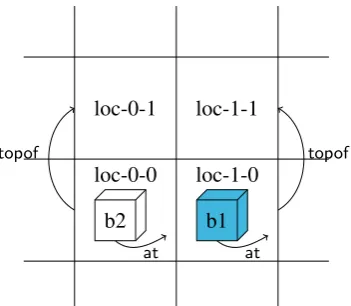
b1 b2
at at
topof topof
loc-1-1 loc-0-1
[image:6.595.94.270.60.213.2]loc-1-0 loc-0-0
Figure 6: A small world model. The blocks are in an
atrelation to the locations, the locations are linked via spatial relations such astopof
Thus, we know thattexpresses thelocationof its referent (it is on top of the blue button). We can extend the above definition to the set of derivation trees which refer to a givenband express a given setF of features:
L(G, S,R:{b},F:F) =
{t∈LS(G)|JtKR={b} ∧JtKF =F}.
The chart generation algorithm generalizes eas-ily to computingL(G, S,R:{b},F:F)for a given
G,b, andF.
4 Referring expressions for locations
When we want to instruct a user to place a block at the location loc-1-1 in Fig.6, we can say
(1) put a block on top of the blue block
which is a straightforward description of the in-tended action. This instruction uses the ditransitive verb “put” and the second argument to it subcate-gorizes a location, which is also the referring part of the instruction. In this section we will discuss how to generate these referring expressions to loca-tions. However, the expressions still need to work with blocks to anchor the expression. We therefore model the world using a duality between blocks and locations; both blocks and locations are entities of the world. Consider these referring expressions in the world depicted in Figure6:
(2) the blue block
(3) left of the blue block
DetRefBlock→drb(RefBlock)
IS(drb)(Ref Block) =the•Ref Block
IR(drb)(Ref Block) =uniq(Ref Block)
IF(drb)(Ref Block) ={location} ∪Ref Block
RefBlock→blue(RefBlock)
IS(blue)(Ref Block) =blue•Ref Block
IR(blue)(Ref Block) =blue∩Ref Block
IF(blue)(Ref Block) =Ref Block∪color
RefBlock→block
IS(block) =block
IR(block) =block
IF(block) ={type}
RefLoc→top(DetRefBlock) IS(top)(A) =on top of•A
IR(top)(A) = [topof∩2[at∩1A]2]1 IF(top)(A) ={location,type}
RefBlock→blockloc(RefLoc) IS(blockloc)(A) =block•A
IR(blockloc)(A) = [at∩2A]1 IF(blockloc)(A) ={type}
Figure 7: A subset of the block laying grammar.
(4) the block left of the blue block
Sentence2refers to the blue blockb1, Sentence3to the location loc-0-0 to the left ofb1, and Sentence4
to the block at the location loc-0-0.
Locations are connected with spatial relations such astopof and blocks are anchored in the world by defining at which location they are using theat
relation. While Figure6 shows only a small 2D slice of a Minecraft world, the principles extend to a 3D Minecraft world and all these relations can be captured from a Minecraft world state.
4.1 Formalizing the block laying instruction
can be seen in the last two rules of the grammar in Fig.7:[at∩1b]2obtains the location of the block band[at∩2l]1obtains the block at the locationl.
We will illustrate how this grammar works by generating a RE to refer to loc-1-1 in the world shown in Figure6. A model is sketched with ar-rows in Figure6; the relevant subset of the model is{at:{(b1, loc-1-0)};block:{(b1)};topof: {(loc-1-1, loc-1-0)}}. With this model, a RE to loc-1-1 can be obtained with the derivation tree t = top(drb(blue(block))) because it is in
L(G,RefLoc,R:{loc-1-1}):
JblockKR ={(b1),(b2)}
Jblue({(b1),(b2)})KR=blue∪ {(b1),(b2)} ={(b1)}
Jdrb({(b1)})KR=uniq({(b1)}) ={(b1)}
Jtop({(b1)})KR= [topof∩2[at∩1{(b1)}]2]1 = [topof∩2[{(b1,loc-1-0)}]2]1
= [topof∩2{(loc-1-0)}]1
= [{(loc-1-1, loc-1-0)}]1 ={(loc-1-1)}
The referring expression to loc-1-1 is obtained by computingJtKS, which is “on top of the blue block”. On the feature interpretation, the features being described are collected. Note that when using a relation such astopofto switch the referent, the features from the sub-expression are discarded.
5 Indefinite REs to complex objects
Now we extend the RE generation to complex ob-jects. The first step is to convert the coordinate-based representation which can be easily obtained from the 3D world to relations between the objects of the world similar to the one in the previous sec-tion. This step is more complex than for simple blocks as COs have no one-to-one correspondence to locations. To generate the instruction for build-ing the second railbuild-ing in Figure 2d, we want to generate the following model, withitdenoting the salient object, i. e. the one that can be referred to as “it”:
{bridge:{(b)};
it:{(r1)};
railing:{(r1),(r2)}; block:{(bb),(rb)};
from:{(b, bb)}};
to:{(b, rb)}};
sameshape:{(r1, r2)}};
otherside:{(r1, b, r2)}};
The object are the blocks rb(the red block) and
bb(the blue one), the railingsr1andr2(r2is the railing that should be built) and the bridge b If the target object is a CO that does not exist yet, it is added to the objects from which the model is built so that relations between the target and the other objects are generated; this can be seen in the relations above containingr2.
We can assume that the input to the NLG sys-tem are descriptions of the COs in some fitting 3D description because the NLG system is embedded into an architect which reasons about construction plans containing these COs (compare Figure 1). Each object is described using properties in 3D space: the bridge bin Figure 2, for example, is described using the coordinates of its corners. In contrast to the simple block laying in Section 4, the relations can also be between several objects and not only between an object and a location. The type of relations expressed can be rather diverse: Besides basic spatial relations such as “left of” and unary relations such as the color, more complex relations were expressed when asked humans to instruct other humans in the Minecraft domain ( Os-melak,2018), such as “other side of” (with respect to an unnamed anchor object) or “same shape as” to express the shape of an object, modulo orientation.
To extract these relations from 3D space, a pre-processor iterates over all tuples of objects and checks which of these should be part of one or several relations. For example, each object is added to the unary relation with the name of its type;
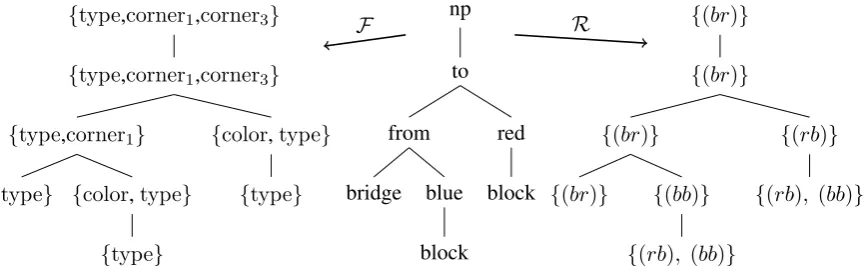
{type,corner1,corner3}
{type,corner1,corner3}
{color,type}
{type} {type,corner1}
{color,type}
{type} {type}
np
to
red
block from
blue
block bridge
{(br)}
{(br)}
{(rb)}
{(rb), (bb)} {(br)}
{(bb)}
{(rb), (bb)} {(br)}
[image:8.595.85.519.64.197.2]F R
Figure 8: Derivation tree generating “a bridge from the blue block to the red block” (middle), values of the feature interpretation (left) and the referential interpretation (right). The model corresponds to the setting in Figure2a), br= bridge,bb= blue block,rb= red block.
5.1 Indefinite reference
As discussed in Section2, when generating a refer-ring expression for a given object, our aim is to find a set of features which distinguish this object from all other objects we currentlycouldbut do not want to refer to; for indefinite referents, this set is pre-computed (cmp. Figure3and Section2.2). With these distinguishing features setsD, the feature sets that are admissible to be described are all supersets of each of these sets: Dˆ = {x|∃d ∈ D.x ⊇ d}, and the derivation trees for the indefinite REs to a target objectoare:
Lo= [
d∈Dˆ
L(G,IndefNP,R:{(o)},F:d)
Internally, the languages do not have to be com-puted independently; the underlying SIG formal-ism allows to define a disjunction of target values for interpretations. As before, the REs describingo
are the string interpretations of the derivation trees ofLo. Figure8shows a derivation tree to generate
a RE to the bridgebto generate an instruction from Figure2a) to b).
In the SIG (Figure9), the feature interpretation F keeps track of which features have been cov-ered: in each rule, the feature interpretation per-forms a union of the currently described feature with the other features described in child nodes of the derivation tree. Therefore, in the interpretations forf rom, the features from the child noun node are incorporated, but not the features expressed for the blocks used as anchor, as can be seen in Fig-ure 8(left). F keeps track about which features are described but not whether their values actu-ally correspond to the target object. Therefore, the referential interpretationRkeeps track of what a
IndefNP→np(N) IS(np)(N) =a•N
IR(np)(N) =N
IF(np)(N) =N
DefNP→dnp(N) IS(np)(N) =the•N
IR(np)(N) =uniq(N) IF(np)(N) =N
N→f rom(N,DetRefBlock) IS(f rom)(N, B) =N•from•B
IR(f rom)(N, B) = [from∩2B]1∩N IF(f rom)(N, B) =N ∪ {corner1}
N→to(N,DetRefBlock) IS(to)(N, B) =N•to•B
IR(to)(N, B) = [to∩2B]1∩N IF(to)(N, B) =N ∪ {corner3}
N→otherside(N,DefNP)
IS(width)(N, P) =N •on the other side of•P
IR(width)(N, P) = [(otherside∩2P)∩3it]1∩N IF(width)(N, P) =N ∪ {corner1,corner2}
N→bridge
IS(bridge) =bridge
IR(bridge) =bridge
IF(bridge) ={type}
N→railing
IS(railing) =railing IR(railing) =railing
IF(railing) ={type}
sub-expression refers to when referring to objects in the world (i.e. when generating definite referring expressions such as “the blue block”) and evaluates to the indefinite object if it describes a property of that object. On the referential interpretation, all sets of objects are intersected. If the referential in-terpretation of a derivation treetis the target object (JtKR = {(o)}), we can be sure that each feature described was a property ofoas otherwise the in-terpretation would be empty. This can be observed in Figure8(right).
Finally, the RE to instruct the user to build the second railing (Figure2c) to d)) is defined by the following derivation tree:
t=np(otherside(railing, dnp(bridge)))
It refers to the correct object (JtKR={(r2)}) and describes a distinguishing set of features:JtKF = {type, corner1, corner2}. The resulting RE is
JtKS =“a railing on the other side of the bridge”.
6 Conclusion
We have introduced a formalization for indefinite referring expressions and exemplified it in the Minecraft instruction giving domain. This formal-ization is able to generate definite referring expres-sions for locations and for objects, as well as indef-inite referring expressions, which contain defindef-inite referring sub-expressions. For this, we have ex-tended a system for generating REs based on SIGs to produce relational definite REs for objects in the world and uses these as building blocks for in-definite REs, as they anchor the target object into the world. The method proposed allows to both keep track of the properties described for the target object to generate indefinite REs and to generate definite REs by intersecting sets of possible refer-ents until only one object is left.
The grammar itself only defines which REs are legal, it does not define any preferences. It is possi-ble to define functions scoring certain rules appli-cations and we implemented a preference for the smallest derivation tree, but this is clearly not suffi-cient. For example, “twenty blocks left of the blue block” and “to the right of the red block” might de-note the same target and their derivation trees have the same size but using the first RE is probably less likely to succeed than one using the second. These differences can be captured by a scoring model for the grammar (Garoufi and Koller,2014) and we
will work on learning one from interactions with players.
Our grammar and code is available at
https://minecraft-saar.github.io.
Acknowledgments We would like to thank Paula Stadnikowa for working on early versions of these ideas. This work was supported by the German Research Foundation (DFG), SFB/CRC 1102 “Information density and linguistic encoding” (Project A7).
References
Hubert Comon, Max Dauchet, R´emi Gilleron, Flo-rent Jacquemard, Denis Lugiez, Sophie Tison, Marc Tommasi, and Christof L¨oding. 2007. Tree Au-tomata techniques and applications. published on-line -http://tata.gforge.inria.fr/.
Robert Dale and Ehud Reiter. 1995. Computational interpretations of the gricean maxims in the gener-ation of referring expressions. Cognitive Science, 19(2):233 – 263.
Kees van Deemter. 2016.Computational Models of Re-ferring: A study in cognitive science. MIT Press.
Nikos Engonopoulos and Alexander Koller. 2014. Gen-erating effective referring expressions using charts. InProceedings of the 8th International Conference on Natural Language Generation (INLG), Philadel-phia.
Konstantina Garoufi and Alexander Koller. 2014. Gen-eration of effective referring expressions in situated context. Language, Cognition, and Neuroscience, 29(8):986–1001.
Irene Heim. 1982. The semantics of definite and in-definite noun phrases. Ph.D. thesis, University of Massachusetts, Amherst.
Klaus von Heusinger. 2000. The reference of indefi-nites. In Klaus von Heusinger and Urs Egli, editors, Reference and Anaphoric Relations, pages 247–265. Springer Netherlands, Dordrecht.
Hans Kamp and Uwe Reyle. 1993. From Discourse to Logic. Springer.
Alexander Koller and Nikos Engonopoulos. 2017. Inte-grated sentence generation with charts. In Proceed-ings of the 10th International Conference on Natu-ral Language Generation (INLG), Santiago de Com-postela.
Emiel Krahmer and Kees van Deemter. 2012. Compu-tational generation of referring expressions: A sur-vey.Computational Linguistics, 38(1):173–218.
Emiel Krahmer, Sebastiaan van Erk, and Andr´e Verleg. 2003. Graph-based generation of referring expres-sions.Computational Linguistics, 29(1):53–72.
Doreen Osmelak. 2018. Human experiments in minecraft. Master’s thesis, Universit¨at des Saarlan-des.