258
Personalized Substitution Ranking for Lexical Simplification
John Lee, Chak Yan Yeung
Department of Linguistics and Translation City University of Hong Kong
[email protected], [email protected]
Abstract
A lexical simplification (LS) system substi-tutes difficult words in a text with simpler ones to make it easier for the user to under-stand. In the typical LS pipeline, the Substi-tution Ranking step determines the best sub-stitution out of a set of candidates. Most cur-rent systems do not consider the user’s vocab-ulary proficiency, and always aim for the sim-plest candidate. This approach may overlook less-simple candidates that the user can under-stand, and that are semantically closer to the original word. We propose a personalized ap-proach for Substitution Ranking to identify the candidate that is the closest synonym and is non-complex for the user. In experiments on learners of English at different proficiency lev-els, we show that this approach enhances the semantic faithfulness of the output, at the cost of a relatively small increase in the number of complex words.
1 Introduction
A lexical simplification (LS) system aims to make a text easier to understand for users such as lan-guage learners (Petersen and Ostendorf, 2007), children (Belder and Moens,2010;Kajiwara et al., 2013), those with language disabilities (Devlin and Tait, 1998;Carroll et al., 1999; Rello et al., 2013), as well as those without the background needed for understanding the text in a specialized domain (Zeng et al.,2005;Elhadad,2006). Given an input text, the system substitutes difficult words with simpler words or phrases, in such a way as to satisfy two requirements:
Semantic faithfulness The output text should preserve the meaning of the input as much as possible;
Word complexity The output text should min-imize the number of complex words, i.e., words that the user cannot understand.
These two goals are often in conflict. To reduce word complexity, the system should make substi-tutions with the simplest words possible. How-ever, when limited to simple words, it is more challenging to find a close synonym for the orig-inal word. In general, the larger the vocabulary pool, the better the simplified text can semanti-cally approximate the original.
The trade-off between these two goals is best resolved with respect to the user’s vocabulary knowledge. For example, to simplify the word “obnoxious”, the word “offensive” would be the best substitutionif the user knows it; otherwise, a looser synonym but simpler word such as “bad” should be preferred. Human editors follow this principle when composing graded versions of a text: they stick to simple substitutions (“bad”) in basic versions, but allow more difficult words (“offensive”) in more advanced versions, if these words better reflect the original meaning.
Current LS approaches do not mimic this strat-egy. The typical system offers the same substitu-tions, regardless of individual users’ language pro-ficiency, because it is trained on simple-complex text pairs that do not specify the target reader. With the notable exception of the Newsela cor-pus (Xu et al.,2015), annotators for LS corpora are not typically given precise guidelines on the vo-cabulary proficiency of the intended user, making it difficult to make optimal or consistent trade-off between semantic faithfulness and word complex-ity.
Word User A User B User C
liberal × × √
open √ √ √
progressive √ × √
[image:2.595.84.280.63.134.2]relaxed √ √ √
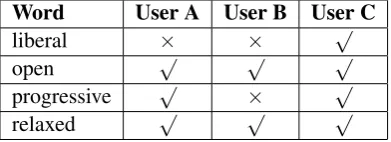
Table 1: Example CWI model predictions on three users’ vocabulary knowledge. Complex words are marked with a cross (×), and non-complex ones with a tick (√).
linguistics. We propose a novel, two-step Sub-stitution Ranking algorithm for the LS pipeline, by combining lexical substitution (McCarthy and Navigli, 2009)1 and personalized complex word identification (CWI) (Ehara et al.,2014). This al-gorithm first ranks the substitution candidates ac-cording to semantic proximity to the target word; it then selects as output the highest-ranked candi-date that is non-complex for the user.
We make two main contributions. First, in terms of evaluation methodology, we present the first LS evaluation that explicitly takes into account the trade-off between semantic faithfulness and word complexity for users at different proficiency lev-els. Second, we show that our proposed Substitu-tion Ranking algorithm leads to substituSubstitu-tions that are more meaning-preserving, with a relatively small increase in word complexity.
The goal of this paper is not to advance the state-of-the-art for lexical substitution or for CWI. Instead, we aim to show that, by combining ex-isting methods in these two tasks, an LS sys-tem achieves superior trade-off between semantic faithfulness and word complexity, compared to the conventional approach of optimizing on word sim-plicity alone.
The rest of the paper is organized as follows. After a presentation of the general LS system ar-chitecture in the next section, Section 3 summa-rizes previous research in Substitution Ranking. Section4 describes our proposed approach. Sec-tion5gives details on our datasets. Section6 de-fines the evaluation metrics. Section 7discusses the experimental set-up, and Section8presents ex-perimental results. Finally, Section9concludes.
1In this paper, the abbreviation LS always refers to
“Lex-ical Simplification”, and not to “Lex“Lex-ical Substitution.”
2 Background: LS pipeline
The most common LS architecture is a pipeline ar-chitecture with three steps: Complex Word Iden-tification, Substitution Generation, and Substitu-tion Ranking (Shardlow,2014;Paetzold and Spe-cia,2016c).
2.1 Complex Word Identification (CWI)
CWI classifies each word in an input text as either “complex” (i.e., difficult to understand) or “non-complex” (i.e., not difficult to understand) (Paet-zold and Specia, 2016c; Yimam et al., 2017). Complex words become target words for substi-tution in the rest of the pipeline.
Most CWI approaches adopt a generic defini-tion of “complexity”, without catering to variadefini-tion in proficiency level among users. Some studies have begun to build personalized CWI models to predict whether a word can or cannot be under-stood by an individual user (Ehara et al.,2014;Lee and Yeung,2018). For example, the top row in Ta-ble1shows the predictions for the word “liberal” for three users. Given these predictions, the sys-tem would atsys-tempt to simplify the word “liberal” in the sentence in Table2for Users A and B, but would not do so for User C.
2.2 Substitution Generation
For each target word, the Substitution Genera-tion step identifies possible substituGenera-tion candi-dates, without assessing the simplicity of the can-didates.2 In our running example in Table 2, the system generates three possible synonyms — “open”, “progressive”, and “relaxed” — as substi-tution candidates for “liberal”.
2.3 Substitution Ranking
As the final step, Substitution Ranking chooses the best simplification among the generated can-didates. The next section review previous research on this step, as well as previous work that we use as the basis for personalizing it.
3 Previous work
Substitution Ranking is “the task of ranking a set of selected substitutions for a target complex word with respect to their simplicity.” (Paetzold and Specia, 2015). As this definition suggests, most
2Some systems take a separate Substitution Selection step
Input sentence: She is a product of a tremendously unorthodox family withliberalviews toward sex, marriage, religion and child-rearing.
Substitution Ranking algorithm User Ranked substitution candidates forliberal
(a) Simplicity ranking n/a 1. open 2. relaxed 3. progressive
(b) Similarity ranking n/a 1. progressive 2. relaxed 3. open
(c) Personalized ranking User A 1. progressive 2. relaxed 3. open User B 1. progressive 1. relaxed 2. open
Table 2: Gold ranking of substitution candidates for the target word “liberal” by optimizing on (a) lexical sim-plicity; (b) semantic similarity to the target word; (c) both user vocabulary knowledge (Table 1)and semantic similarity to the target word.
LS systems use simplicity, or word complexity, as the basis for ranking (Section3.1). In contrast, we will propose an approach that takes into account both word complexity and semantic faithfulness, by building on previous research on ranking by semantic similarity (Section3.2) and personalized CWI (Section3.3).
3.1 Simplicity ranking
Various statistical models have been trained to rank substitution candidates by “simplicity”, us-ing a wide range of features includus-ing the number of syllables, word frequencies, n-gram language model scores, word embeddings, as well as rela-tive frequencies in standard Wikipedia and Sim-ple Wikipedia (Carroll et al.,1999;Ligozat et al., 2012;Horn et al.,2014;Glava˘s and ˘Stajner,2015; Pavlick and Callison-Burch, 2016). Among the three candidates in our running example, “open” would be ranked first, and thus chosen to substi-tute for “liberal” (Table2a).
Researchers have recognized that the “one-size-fits-all” approach does not adequately cater to users at different vocabulary proficiency levels, since they do not share the same notion of “sim-plicity”. Some have begun to explore adapta-tion of the ranking through user feedback (Paet-zold and Specia, 2016a; Yimam and Biemann, 2018). For example, the Lexi system asks the user whether the original word or a candidate sub-stitution makes the sentence easier to understand, and then uses pairwise online logistic regression to adapt its simplicity ranking (Bingel et al.,2018).
3.2 Similarity ranking
Another possible criterion for ranking substitution candidates is their semantic similarity, or proxim-ity, to the target word. On this criterion,
“progres-sive” would be ranked first among the three candi-dates in our running example (Table2b).
Similarity ranking has been intensively stud-ied for the task of lexical substitution (McCarthy and Navigli, 2009). To find the most appropri-ate paraphrases, PPDB uses a scoring model that estimates semantic distance between two words with WordNet, and also considers lexical overlap, distributional similarity, as well as cosine simi-larity of word embeddings (Pavlick et al., 2015). The SALSA system performs similarity ranking through latent semantic analysis, explicit seman-tic analysis and n-gram scores (Sinha and Mihal-cea,2014). It has been deployed in a reading as-sistance tool that displays synonyms for difficult words (Azab et al.,2015), but it does not attempt LS.
3.3 Personalized CWI
The first studies on personalized CWI were re-ported by Ehara et al. (2012; 2014). They proposed a graph-based active learning method, trained on word frequencies from various corpora, to select the most informative words for user anno-tation. A label propagation algorithm achieved an accuracy of 76.4% for English CWI on a 50-word training set (Ehara et al.,2014).
output text. Although their approach is similar to our CWI filtering step (Section4), they did not in-corporate similarity ranking or evaluate its effect on semantic faithfulness in the LS output.
4 Proposed Approach
In the Substitution Ranking step, the optimal can-didate is often not the simplest one. A more per-tinent criterion is whether the candidate is non-complex, i.e., whether it can be understood by the user. This is because a non-complex candidate that is more similar in meaning to the target word should be preferred, even if it is less simple. Our proposed algorithm selects the candidate that is se-mantically closest to the target word (to maximize semantic faithfulness), with the constraint that the candidate be non-complex for the user (to mini-mize word complexity). More concretely, it con-sists of two steps:
Similarity ranking Rank the substitution candi-dates according to semantic proximity, as a lexical substitution system would do.
CWI filtering Personalize the ranking by remov-ing candidates that the user cannot under-stand, according to the prediction of the per-sonalized CWI model.
Note that while CWI filtering employs the same CWI model as the one used in the first step in the LS pipeline (Section2.1), it predicts user knowl-edge on the substitution candidates, rather than on the target word.
In our running example, for the word “liberal”, the similarity ranking step would yield the ranked list “1. progressive; 2. relaxed; 3. open” (Ta-ble2b), since “progressive” is semantically closest to the target word “liberal”. The CWI filtering step then produces a personalized ranking for each user (Table2c). Based on the personalized CWI model (Table 1), the ranked list for User A remains un-changed, since all three candidates are known to User A. The word “progressive” is removed from the ranked list for User B, however, since User B does not understand it. The second-best synonym, “relaxed”, is instead offered to User B.
5 Data
Standard LS datasets, such as BenchLS (Paetzold and Specia, 2016b) and the Newsela corpus (Xu et al., 2015), are not suitable for evaluating our
proposed ranking approach (Section4) since they do not offer human judgment on semantic similar-ity between target words and their substitutions. We instead took an existing paraphrase dataset as our starting point (Section 5.1), and then ex-ploited a language learner dataset (Section5.2) to construct personalized substitution rankings (Sec-tion5.3).
5.1 Similarity rankings
During the development of PPDB 2.0 (Pavlick et al., 2015), human judgment on similarity was collected for 40,410 phrase pairs. Five human raters assigned a similarity score on a 5-point scale to each pair. For each target word, we computed the similarity ranking of its candidates according to their average score. While other lexical sub-stitution corpora such as the 2007 English Lexi-cal Substitution shared task (McCarthy and Nav-igli,2009) and CoInCo (Kremer et al.,2014) could also serve as evaluation data, we chose PPDB be-cause it offers a much larger number of substi-tution candidates per word, and thus facilitates a clear comparison between the simplicity-based ap-proach and ours. We will refer to this dataset as “PPDB Set”.
5.2 Personalization dataset
We used a personalized CWI dataset annotated by 15 learners of English as a foreign lan-guage (Ehara et al.,2010). Each learner rated their knowledge of 12,000 English words on a five-point scale. FollowingEhara et al.(2014), we col-lapsed these five categories into either “complex” (score 1 through 4) or “non-complex” (score 5). For analysis purposes, we define the seven more advanced students as “high-proficiency”, and the remaining students as “low-proficiency”.
A disadvantage of this dataset is that it does not situate the target words in sentences. As a result, it is not possible to evaluate an in-context CWI model in this study. We decided to use this dataset because of its scale and wide representa-tion: no other existing personalized CWI dataset approaches its size, with over 180K annotations by language learners spanning a wide range of profi-ciency levels.
5.3 Personalized rankings
the 15 users in the personalized CWI dataset (Sec-tion5.2), as follows:
• We excluded target words that are not present in the CWI dataset;
• We excluded target words that are annotated as non-complex for the user, since simplifica-tion is not needed;
• We removed substitution candidates from the ranked list if they are annotated as complex for the user, since they are not acceptable LS output for that user. For example, since User B does not understand the word “progres-sive” (Table1), it is removed from his list and his optimal substitution becomes “relaxed”.
Hence, each target word has 15 different per-sonalized rankings of substitution candidates, de-rived from the original similarity ranking in the PPDB Set. These personalized rankings serves as the gold answer (Table2c).
After these processing steps, our final dataset contains an average of 64.5 instances of word sim-plification for each of the 15 users; each target word has an average of 22.1 substitution candi-dates.
6 Evaluation metrics
Since the proposed algorithm aims to optimize the trade-off between word complexity and semantic faithfulness, we need to define metrics for both of these qualities.
6.1 Word complexity
We use the standard metric, Precision, to measure the simplicity of the output text.3 Precision is de-fined as the ratio of correct simplifications out of all simplifications made by an LS system (Horn et al.,2014;Glava˘s and ˘Stajner,2015). All candi-dates in the personalized ranking, without regard to its semantic faithfulness, are considered “cor-rect”. Thus, the higher the precision, the lower the word complexity of the output, i.e., fewer words are complex for the user.
We will rename Precision as Precisionall for
reasons to be described in the next subsection. 3
Another standard metric, accuracy, is defined as the ratio of correct simplifications out of all target words that should be simplified (Horn et al.,2014;Glava˘s and ˘Stajner,2015) Since we are concerned only with Substitution Ranking, the system attempts to simplify all complex words. Therefore, accuracy is always the same as precision in our experiments.
6.2 Semantic faithfulness
It is not straightforward to draw a line on what suf-fices as a semantically “similar” substitution, or to specify the minimum level of semantic faith-fulness. Extending the definition of Precision, we introduce the metricPrecisionr to express the
degree of semantic similarity between the target word and its substitution, where the parameterr specifies the maximum position in the personal-ized ranking for the candidate to be considered “correct”. More specifically, Precisionris the
per-centage of substitutions made by the system that are rankedr or above. The larger the value ofr, the less strict the metric is on semantic faithful-ness.
As an illustration, consider User A in Table2c. The Precision1 metric (i.e., r = 1) counts as
correct only the first-ranked substitution in the gold ranking, i.e., “progressive”. In contrast, the
Precision2 metric (i.e.,r = 2) counts both
“pro-gressive” and “relaxed” as correct.
In this context, then, the standard definition of Precision (Section 6.1) can be viewed as Precisionrwhereris allowed to be any value. For
clarity, we will refer to Precision as Precisionall
in the rest of this paper.
7 Experimental set-up
This section describes the experimental design to evaluate the two-step Substitution Ranking ap-proach proposed in Section4.
7.1 Ranking methods
In the first step, our proposed approach performs similarity ranking on the candidates:
Similarity Ranking (Automatic) We ranked the substitution candidates according to path similarity between the candidates and the tar-get word using WordNet 3.0. The path sim-ilarity score denotes how similar two words are based on the shortest path that connects them. WordNet synsets have been found to be more coarse-grained, but consistent with lexical substitute sets (Kremer et al.,2014).
Our baseline ranks candidates with respect to sim-plicity, which is the prevalent approach in current LS systems:
Simplicity Ranking (Gold) We could not use the human judgement on simplicity col-lected during the construction of Simple PPDB (Pavlick and Callison-Burch, 2016), since it was performed on a set of word pairs that do not overlap with the gold similarity rankings in the PPDB Set. Instead, we de-rived the gold simplicity ranking from the personalization dataset (Section 5.2) by av-eraging the 15 subjects’ annotations on each word.
Simplicity Ranking (Automatic) We ranked the substitution candidates according to their gold scores in the probabilistic track of the 2018 CWI shared task (Yimam and Biemann, 2018). The score is defined as the propor-tion of annotators who marked the word as “complex”. The use of CWI gold scores, rather than an actual system output, ensured a strong baseline for comparison against our proposed approach.
7.2 CWI filtering methods
In the second step, the proposed approach uses a personalized CWI model to remove complex words from the ranked list. If all candidates are predicted to be complex, the first-ranked candidate is proposed as the substitution.
Gold Personalized CWI (Gold PCWI) This ceiling establishes the maximum perfor-mance of the proposed approach, by looking up the actual CWI annotation for each user (Section5.2). In other words, the system can perfectly predict whether a particular user knows a particular word.
Automatic Personalized CWI (Auto PCWI)
This model automatically predicts a word as complex or non-complex, based on graded vocabulary lists. We initially created four word lists with the 6,777 words covered by the New General Service List (NGSL).4 Further, we split them into 222 groups of 25 words each, by sorting the words within each list according to frequency in the Google
4The composition of these four lists followed the
specifi-cations in Lee and Yeung (2018).
Web Trillion Word Corpus (Brants and Franz,2006). Next, we constructed 222 CWI models corresponding to these groups: each model predicts the words in its group and the preceding ones to be “non-complex”, and all other words to be “complex”.
We then randomly selected 50 words as the training set.5For each user, we computed the precision and recall of each of the 222 CWI models on this training set, and then selected the model with the highest F-score.
Our baselines for CWI filtering are as follows6:
No CWI This baseline predicts all words to be non-complex; in other words, the system al-ways returns the top-ranked candidate as out-put.
Generic CWI This baseline optimizes its predic-tion on the learner dataset (Secpredic-tion 5.2); in other words, it predicts a word to be complex if and only if a majority of the 15 users an-notated it to be so. This baseline establishes the maximum performance of the generic, or user-independent CWI approach.
8 Experiments
We performed two experiments on the Substitu-tion Ranking approach proposed in SecSubstitu-tion4.
8.1 Results with gold similarity ranking
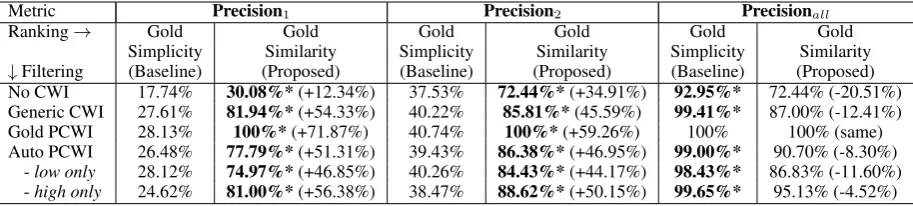
In this first experiment, the system used the gold similarity ranking and performed automatic CWI filtering only. This set-up is designed to provide a controlled contrast between similarity ranking and simplicity ranking by excluding noise from auto-matic semantic analysis. In the remainder of this subsection, please refer to the results in Table3.
Word complexity. We first consider the Precisionall results. When assuming perfect
pre-diction of users’ vocabulary knowledge (Filter-ing=“Gold PCWI”), all simplifications were by definition non-complex, resulting in 100% preci-sion for both ranking methods.
With automatic prediction of the users’ vocabu-lary knowledge (Filtering=“Auto PCWI”), the use of similarity ranking led to more complex words
5In actual deployment, this set-up means that each user
would be required to annotate 50 words.
6We did not evaluate the model proposed by Ehara et
Metric Precision1 Precision2 Precisionall
Ranking→ Gold Gold Gold Gold Gold Gold
Simplicity Similarity Simplicity Similarity Simplicity Similarity
↓Filtering (Baseline) (Proposed) (Baseline) (Proposed) (Baseline) (Proposed)
No CWI 17.74% 30.08%*(+12.34%) 37.53% 72.44%*(+34.91%) 92.95%* 72.44% (-20.51%)
Generic CWI 27.61% 81.94%*(+54.33%) 40.22% 85.81%*(45.59%) 99.41%* 87.00% (-12.41%)
Gold PCWI 28.13% 100%*(+71.87%) 40.74% 100%*(+59.26%) 100% 100% (same)
Auto PCWI 26.48% 77.79%*(+51.31%) 39.43% 86.38%*(+46.95%) 99.00%* 90.70% (-8.30%)
[image:7.595.74.531.63.166.2]-low only 28.12% 74.97%*(+46.85%) 40.26% 84.43%*(+44.17%) 98.43%* 86.83% (-11.60%) -high only 24.62% 81.00%*(+56.38%) 38.47% 88.62%*(+50.15%) 99.65%* 95.13% (-4.52%)
Table 3: LS performance using gold ranking and various CWI filtering methods on the dataset in Section5.3. An asterisk means the improvement over the other ranking is significant (p<0.05 by McNemar’s test).
(-8.30% Precisionall) than simplicity ranking. The
degradation is also observed for “No CWI” and “Generic CWI”. This is because similarity ranking prioritizes semantically closer synonyms, which tend to be more difficult and therefore more likely to produce a complex output in the face of CWI er-ror. In contrast, by always aiming for the simplest words, simplicity ranking reduced the chance of producing complex words in the output.
Semantic faithfulness. We next consider re-sults with the Precisionr metric. With perfect
prediction of users’ vocabulary knowledge (Fil-tering=“Gold PCWI”), gold similarity ranking by definition chose the best non-complex synonym, hence achieving perfect semantic scores. In con-trast, gold simplicity ranking rarely picked the best synonym (28.13% at Precision1), and most of the
time did not pick either of the top two synonyms (40.74% at Precision2).
With automatic prediction of vocabulary knowl-edge (Filtering=“Auto PCWI”), even gold similar-ity ranking was liable to selecting complex can-didates. Its performance degraded to 77.79% for Precision1, and 86.38% for Precision2. It still
out-performed gold simplicity ranking by large mar-gins, with an absolute improvement of +51.31% for Precision1and +46.95% for Precision2.
Impact of language proficiency. We now ex-amine how language proficiency affects LS perfor-mance, using results obtained with automatic pre-diction of vocabulary knowledge (Filtering=“Auto PCWI”). Overall, the similarity ranking method led to a 51.31% gain in semantic faithfulness (in terms of Precision1), at the expense of a 8.3%
in-crease in word complexity (i.e., a 8.3% loss in terms of Precisionall).
In terms of semantic faithfulness, high-proficiency users (as defined in Section 5.2) ex-perienced a gain of 56.38% in Precision1
(Fil-tering=“Auto PCWI - high only”), compared to a gain of only 46.85% for low-proficiency users (Filtering=“Auto PCWI - low only”). This is be-cause a larger vocabulary pool resulted in more instances where a non-complex and better syn-onym was available. The trend was similar for Precision2, though the absolute gains were smaller
for both groups of users.
In terms of word complexity, our proposed method also led to a smaller increase in un-known words for high-proficiency users than low-proficiency users. The former experienced a loss of 4.52% in Precisionall (Filtering=“Auto PCWI
- high only”), while the latter suffered a loss of 11.60% (Filtering=“Auto PCWI - low only”). This is because similarity ranking, being more ag-gressive in utilizing more difficult words, is less likely to produce a complex word for a higher-proficiency user.
Thus, generally speaking, the higher the users’ language proficiency, the more they benefited from the proposed method. For more proficient users, the LS output shows increasing gain in se-mantic faithfulness and diminishing degradation in word complexity.
8.2 Fully automatic ranking
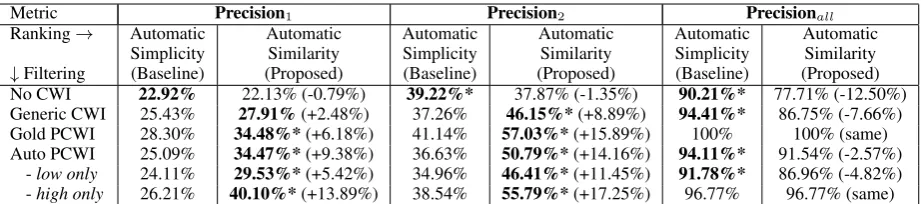
The second experiment adopted the realistic set-ting, with the system performing automatic pro-cessing for both steps in Substitution Ranking. Overall, results followed the same trends as ob-served in Section8.1, but with lower performance in all settings. In the remainder of this subsection, please refer to the results in Table4.
Word complexity. We first consider the results in Precisionall. Given perfect prediction of users’
vocabulary knowledge (Filtering=“Gold PCWI”), all simplifications were non-complex, resulting in 100% precision for both ranking methods.
previ-Metric Precision1 Precision2 Precisionall
Ranking→ Automatic Automatic Automatic Automatic Automatic Automatic
Simplicity Similarity Simplicity Similarity Simplicity Similarity
↓Filtering (Baseline) (Proposed) (Baseline) (Proposed) (Baseline) (Proposed)
No CWI 22.92% 22.13% (-0.79%) 39.22%* 37.87% (-1.35%) 90.21%* 77.71% (-12.50%)
Generic CWI 25.43% 27.91%(+2.48%) 37.26% 46.15%*(+8.89%) 94.41%* 86.75% (-7.66%)
Gold PCWI 28.30% 34.48%*(+6.18%) 41.14% 57.03%*(+15.89%) 100% 100% (same)
Auto PCWI 25.09% 34.47%*(+9.38%) 36.63% 50.79%*(+14.16%) 94.11%* 91.54% (-2.57%)
[image:8.595.73.534.61.163.2]-low only 24.11% 29.53%*(+5.42%) 34.96% 46.41%*(+11.45%) 91.78%* 86.96% (-4.82%) -high only 26.21% 40.10%*(+13.89%) 38.54% 55.79%*(+17.25%) 96.77% 96.77% (same)
Table 4: LS performance using automatic ranking and various CWI filtering methods on the dataset in Section5.3. An asterisk means the improvement over the other ranking is significant (p<0.05 by McNemar’s test).
ous experiment, when using automatic predictions of vocabulary knowledge, similarity ranking pro-duced more complex words than simplicity rank-ing. The noise in ranking, however, reduced the performance gap between them. Similarity rank-ing trailed simplicity rankrank-ing by only -2.57% (Fil-tering=“Auto PCWI”), compared to -8.30% in the first experiment in Table3.
Semantic faithfulness. As can be expected, the use of automatic similarity ranking in this experi-ment led to a substantial drop in semantic faithful-ness. With gold vocabulary knowledge prediction (Filtering=“Gold PCWI”), the proposed method yielded 34.48% for Precision1 and 57.03% for
Precision2. Even though similarity ranking was
performed with a simple WordNet-based method, it still significantly outperformed a strong base-line of simplicity ranking; the absolute improve-ment was +6.18% for Precision1 and +15.89%
for Precision2. When using automatic vocabulary
knowledge prediction (Filtering=“Auto PCWI”), performance degraded for both ranking methods, but similarity ranking continued to significantly outperform simplicity. It secured an absolute im-provement of +9.38% for Precision1and +14.16%
for Precision2.
Impact of language proficiency. As seen from the results obtained with automatic prediction of vocabulary knowledge (Filtering=“Auto PCWI”), the effect of language proficiency is similar to the trend observed in the first experiment. Overall, the similarity ranking method led to a +9.38% gain in semantic faithfulness (in terms of Precision1), at
the cost of a 2.57% increase in word complexity (i.e., a 2.57% loss in Precisionall).
In terms of semantic faithfulness, high-proficiency users (as defined in Section 5.2) ex-perienced a gain of 13.89% in Precision1
(Filter-ing=“Auto PCWI - high only”), compared to a gain of only 5.42% for low-proficiency users
(Fil-tering=“Auto PCWI - low only”). This gap also held for Precision2.
In terms of word complexity, similarity rank-ing caused no degradation in Precisionallfor
high-proficiency users (Filtering=“Auto PCWI - high only”), but a 4.82% loss for low-proficiency users (Filtering=“Auto PCWI - low only”).
Thus, the overall impact of language profi-ciency remained the same with automatic rank-ing. Similar to the first experiment, the higher the users’ language proficiency, the more they bene-fited from the proposed method. More advanced users generally experienced larger gains in seman-tic faithfulness, with a relatively small trade-off in word complexity. Both the gain and degradation are however smaller in magnitude.
9 Conclusion
We have proposed a novel, two-step Substitution Ranking algorithm that optimizes the trade-off be-tween semantic faithfulness and word complexity for the lexical simplification (LS) task, by select-ing the non-complex candidate that is the closest synonym to the target word. Experiments suggest that this algorithm leads to significantly enhanced semantic faithfulness in the LS system output, at the price of a relatively small increase in word complexity. For higher-proficiency users, this ap-proach is especially beneficial because their larger vocabulary makes it more likely that the system can select a high-quality synonym that is more dif-ficult but still known to them.
Acknowledgment
References
Mahmoud Azab, Chris Hokamp, and Rada Mihalcea. 2015. Using Word Semantics To Assist English as a Second Language Learners. InProc. HLT-NAACL: Demonstrations.
J. De Belder and M. F. Moens. 2010. Text Simplifi-cation for Children. In Proc. SIGIR Workshop on Accessible Search Systems.
Joachim Bingel, Gustavo H. Paetzold, and Anders Søgaard. 2018. Lexi: A Tool of Adaptive, Personal-ized Text Simplification. InProc. COLING.
Thorsten Brants and Alex Franz. 2006. The google web 1t 5-gram corpus version 1.1. InLDC2006T13.
John Carroll, Guido Minnen, Darren Pearce, Yvonne Canning, Siobhan Devlin, and John Tait. 1999. Sim-plifying Text for Language-Impaired Readers. In
Proc. 9th EACL.
Siobhan Devlin and John Tait. 1998. The Use of a Psy-cholinguistic Database in the Simplification of Text for Aphasic Readers. Linguistic Databases, pages 161–173.
Yo Ehara, Yusuke Miyao, Hidekazu Oiwa, Issei Sato, and Hiroshi Nakagawa. 2014. Formalizing Word Sampling for Vocabulary Prediction as Graph-based Active Learning. In Proc. Conference on Em-pirical Methods in Natural Language Processing (EMNLP).
Yo Ehara, Issei Sato, Hidekazu Oiwa, and Hiroshi Nak-agawa. 2012. Mining words in the minds of second language learners: learner-specific word difficulty. InProc. International Conference on Computational Linguistics (COLING).
Yo Ehara, Nobuyuki Shimizu, Takashi Ninomiya, and Hiroshi Nakagawa. 2010. Personalized Reading Support for Second-Language Web Documents by Collective Intelligence. InProc. 15th International Conference on Intelligent User Interfaces, pages 51– 60.
Noemie Elhadad. 2006. Comprehending technical texts: Predicting and defining unfamiliar terms. In AMIA annual symposium proceedings, volume 2006, page 239. American Medical Informatics As-sociation.
Goran Glava˘s and Sanja ˘Stajner. 2015. Simplifying Lexical Simplification: Do We Need Simplified Cor-pora? InProc. ACL.
Colby Horn, Cathryn Manduca, and David Kauchak. 2014. Learning a Lexical Simplifier Using Wikipedia. InProc. ACL.
Tomoyuki Kajiwara, Hiroshi Matsumoto, and Kazuhide Yamamoto. 2013. Selecting Proper Lexical Paraphrase for Children. In Proc. 25th Conference on Computational Linguistics and Speech Processing (ROCLING), pages 59–73.
Gerhard Kremer, Katrin Erk, Sebastian Pad´o, and Ste-fan Thater. 2014. What Substitutes Tell Us – Anal-ysis of an “All-Words” Lexical Substitution Corpus. InProc. EACL.
John Lee and Chak Yan Yeung. 2018. Personalizing Lexical Simplification. InProc. International Con-ference on Computational Linguistics (COLING).
Anne-Laure Ligozat, Anne Garcia-Fernandez, Cyril Grouin, and Delphine Bernhard. 2012. Annlor: A Naive Notation-System for Lexical Outputs Rank-ing. InProc. 6th International Workshop on Seman-tic Evaluation.
Diana McCarthy and Roberto Navigli. 2009. The English Lexical Substitution Task. Language Re-sources and Evaluation, 43:139–159.
Gustavo H. Paetzold and Lucia Specia. 2015. LEXen-stein: A Framework for Lexical Simplification. In
Proc. ACL-IJCNLP System Demonstrations.
Gustavo H. Paetzold and Lucia Specia. 2016a. Anita: An Intelligent Text Adaptation Tool. InProc. COL-ING: System Demonstrations.
Gustavo H. Paetzold and Lucia Specia. 2016b. Bench-marking Lexical Simplification Systems. In Proc. LREC.
Gustavo H. Paetzold and Lucia Specia. 2016c. Se-mEval 2016 Task 11: Complex Word Identification. In Proc. 10th International Workshop on Semantic Evaluation (SemEval-2016).
Ellie Pavlick and Chris Callison-Burch. 2016. Simple PPDB: A Paraphrase Database for Simplification. In
Proc. ACL.
Ellie Pavlick, Pushpendre Rastogi, Juri Ganitkevitch, Benjamin Van Durme, and Chris Callison-Burch. 2015. PPDB 2.0: Better Paraphrase Ranking, Fine-grained Entailment Relations, Word Embeddings, and Style Classification. InProc. ACL.
Sarah E. Petersen and Mari Ostendorf. 2007. Text Sim-plification for Language Learners: A Corpus Analy-sis. InProc. SlaTE.
Luz Rello, Ricardo Baeza-Yates, Stefan Bott, and Ho-racio Saggion. 2013. Simplify or Help? Text Sim-plification Strategies for People with Dyslexia. In
Proc. 10th International Cross-Disciplinary Confer-ence on Web Accessibility.
Matthew Shardlow. 2014. Out in the Open: Finding and Categorising Errors in the Lexical Simplifica-tion Pipeline. InProc. LREC.
Ravi Sinha and Rada Mihalcea. 2014. Explorations in Lexical Sample and All-words Lexical Substitution.
Wei Xu, Chris Callison-Burch, and Courtney Napoles. 2015. Problems in Current Text Simplification Re-search: New Data Can Help. Transactions of the Association for Computational Linguistics, 3:283– 297.
Seid Muhie Yimam and Chris Biemann. 2018. Par4Sim — Adaptive Paraphrasing for Text Simpli-fication. InProc. COLING.
Seid Muhie Yimam, Sanja Stajner, Martin Riedl, and Chris Biemann. 2017. Multilingual and Cross-Lingual Complex Word Identification. In Proc. Recent Advances in Natural Language Processing (RANLP).