Towards Effective Tutorial Feedback for Explanation Questions:
A Dataset and Baselines
Myroslava O. Dzikovska∗ and Rodney D. Nielsen† and Chris Brew‡ ∗School of Informatics, University of Edinburgh, Edinburgh, EH8 9AB, UK
†Computational Language & Education Research Center
University of Colorado at Boulder, Boulder, CO 80309-0594, USA ‡Educational Testing Service, Princeton, NJ 08451, USA
[email protected],[email protected],[email protected]
Abstract
We propose a new shared task on grading stu-dent answers with the goal of enabling well-targeted and flexible feedback in a tutorial di-alogue setting. We provide an annotated cor-pus designed for the purpose, a precise speci-fication for a prediction task and an associated evaluation methodology. The task is feasible but non-trivial, which is demonstrated by cre-ating and comparing three alternative baseline systems. We believe that this corpus will be of interest to the researchers working in tex-tual entailment and will stimulate new devel-opments both in natural language processing in tutorial dialogue systems and textual entail-ment, contradiction detection and other tech-niques of interest for a variety of computa-tional linguistics tasks.
1 Introduction
In human-human tutoring, it is an effective strategy to ask students to explain instructional material in their own words. Self-explanation (Chi et al., 1994) and contentful talk focused on the domain are cor-related with better learning outcomes (Litman et al., 2009; Chi et al., 1994). There has therefore been much interest in developing automated tutorial dia-logue systems that ask students open-ended expla-nation questions (Graesser et al., 1999; Aleven et al., 2001; Jordan et al., 2006; VanLehn et al., 2007; Nielsen et al., 2009; Dzikovska et al., 2010a). In order to do this well, it is not enough to simply ask the initiating question, because students need the experience of engaging in meaningful dialogue
about the instructional content. Thus, systems must respond appropriately to student explanations, and must provide detailed, flexible and appropriate feed-back (Aleven et al., 2002; Jordan et al., 2004).
In simple domains, we can adopt a knowledge en-gineering approach and build a domain model and a diagnoser, together with a natural language parser to produce detailed semantic representations of student input (Glass, 2000; Aleven et al., 2002; Pon-Barry et al., 2004; Callaway et al., 2006; Dzikovska et al., 2010a). The advantage of this approach is that it allows for flexible adaptation of feedback to a va-riety of factors such as student performance. For example, it is easy for the system to know if the student made the same error before, and adjust its feedback to reflect it. Moreover, this approach al-lows for easy addition of new exercises : as long as an exercise relies on the concepts covered by the do-main model, the system can apply standard instruc-tional strategies to each new question automatically. However, this approach is significantly limited by the requirement that the domain be small enough to allow comprehensive knowledge engineering, and it is very labor-intensive even for small domains.
Alternatively, we can adopt a data-driven ap-proach, asking human tutors to anticipate in ad-vance a range of possible correct and incorrect an-swers, and associating each answer with an appro-priate remediation (Graesser et al., 1999; Jordan et al., 2004; VanLehn et al., 2007). The advantage of this approach is that it allows more complex and interesting domains and provides a good framework for eliciting the necessary information from the hu-man experts. A weakness of this approach, which
also arises in content-scoring applications such as ETS’s c-rater (Leacock and Chodorow, 2003), is that human experts find it extremely difficult to predict with any certainty what the full range of student re-sponses will be. This leads to a lack of adaptivity and generality – if the system designers have failed to predict the full range of possibilities, students will often receive the default feedback. It is frustrating and confusing for students to repeatedly receive the same feedback, regardless of their past performance or dialogue context (Jordan, 2004).
Our goal is to address the weaknesses of the data-driven approach by creating a framework for sup-porting more flexible and systematic feedback. Our approach identifies general classes of error, such as omissions, incorrect statements and off-topic state-ments, then aims to develop general remediation strategies for each error type. This has the potential to free system designers from the need to pre-author separate remediations for each individual question. A precondition for the success of this approach is that the system be able to identify error types based on the student response and the model answers.
A contribution of this paper is to provide a new dataset that will enable researchers to develop clas-sifiers specifically for this purpose. The hope is that with an appropriate dataset the data-driven approach will be flexible and responsive enough to maintain student engagement. We provide a corpus that is la-beled for a set of five student response types, develop a precise definition of the corresponding supervised classification task, and report results for a variety of simple baseline classifiers. This will provide a ba-sis for the development, comparison and evaluation of alternative approaches to the error classification task. We believe that the natural language capabil-ities needed for this task will be directly applicable to a far wider range of tasks in educational assess-ment, information extraction and computational se-mantics. This dataset is publicly available and will be used in a community-wide shared task.
2 Corpus
The data set we developed draws on two established sources – a data set collected and annotated during an evaluation of the BEETLEII tutorial dialogue sys-tem (Dzikovska et al., 2010a) (henceforth, BEETLE
corpus) and a set of student answers to questions from 16 science modules in the Assessing Science Knowledge (ASK) assessment inventory (Lawrence Hall of Science, 2006) (henceforth, the Science En-tailments Bank or SCIENTSBANK).
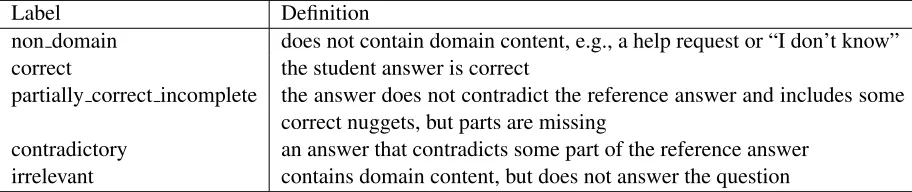
In both corpora, each question was associated with one or more reference answers provided by the experts. Student answers were evaluated against these reference answers and, using corpus-specific annotation schemes, assigned labels for correct-ness. In order to reconcile the two different schemes and to cast the task in terms of standard supervised machine classification at the sentence level, we de-rived a new set of annotations, using the annotation scheme shown in Figure 1.
Our label set has some similarity to the RTE5 3-way task (Bentivogli et al., 2009), which used “en-tailment”, “contradiction” and “unknown” labels. The additional distinctions in our labels reflect typi-cal distinctions made by tutorial dialogue systems. They match our human tutors’ intuitions about the general error types observed in student answers and corresponding teaching tactics. For example, a likely response to “partially correct incomplete” would be to tell the student that what they said so far was correct but it had some gaps, and to encourage them to fill in those gaps. In contrast, the response to “contradictory” would emphasize that there is a mistake and the student needs to change their an-swer rather than just expand it. Finally, the response to “irrelevant” may encourage the student to address relevant concepts. The “non domain” content could be an indicator that the student is frustrated or con-fused, and may require special attention.
Label Definition
non domain does not contain domain content, e.g., a help request or “I don’t know” correct the student answer is correct
partially correct incomplete the answer does not contradict the reference answer and includes some correct nuggets, but parts are missing
[image:3.612.77.533.55.151.2]contradictory an answer that contradicts some part of the reference answer irrelevant contains domain content, but does not answer the question
Figure 1: The set of answer labels used in our task
We further discuss the relationship with the task of recognizing textual entailment in Section 5. In the rest of this section, we describe our corpora and discuss how we obtained these labels from the raw data available in our datasets.
2.1 BEETLEIIdata
The BEETLE corpus consists of the interactions be-tween students and the BEETLEII tutorial dialogue system (Dzikovska et al., 2010b). The BEETLE II system is an intelligent tutoring system that teaches students with no knowledge of high-school physics concepts in basic electricity and electronics. In the first system evaluation, students spend 3-5 hours go-ing through prepared readgo-ing material, buildgo-ing and observing circuits in the simulator and interacting with a dialogue-based tutor. The interaction was by keyboard, with the computer tutor asking ques-tions, receiving replies and providing feedback via a text-based chat interface. The data from 73 under-graduate volunteer participants at southeastern US university were recorded and annotated to form the BEETLEhuman-computer dialogue corpus.
The BEETLEII lesson material contains two types of questions. Factual questions require them to name a set of objects or a simple property, e.g., “Which components in circuit 1 are in a closed path?” or “Are bulbs A and B wired in series or in parallel”. Explanation and definition questions require longer answers that consist of 1-2 sentences, e.g., “Why was bulb A on when switch Z was open?” (expected answer “Because it was still in a closed path with the battery”) or “What is voltage?” (expected answer “Voltage is the difference in states between two ter-minals”). From the full BEETLEevaluation corpus,
we automatically extracted only the students’ an-swers to explanation and definition questions, since reacting to them appropriately requires processing
more complex input than factual questions.
The extracted answers were filtered to remove du-plicates. In the BEETLE II lesson material there
are a number of similar questions and the tutor ef-fectively had a template answer such as ”Terminal X is connected to the negative/positive battery ter-minal”. A number of students picked up on this and used the same pattern in their responses (Stein-hauser et al., 2011). This resulted in a number of an-swers to certain questions that came from different speakers but which were exact copies of each other. We removed such answers from the data set, since they were likely to be in both the training and test set, thus inflating our results. Note that only exact matches were removed: for example, answers that were nearly identical but contained spelling errors were retained, since they would need to be handled in a practical system.
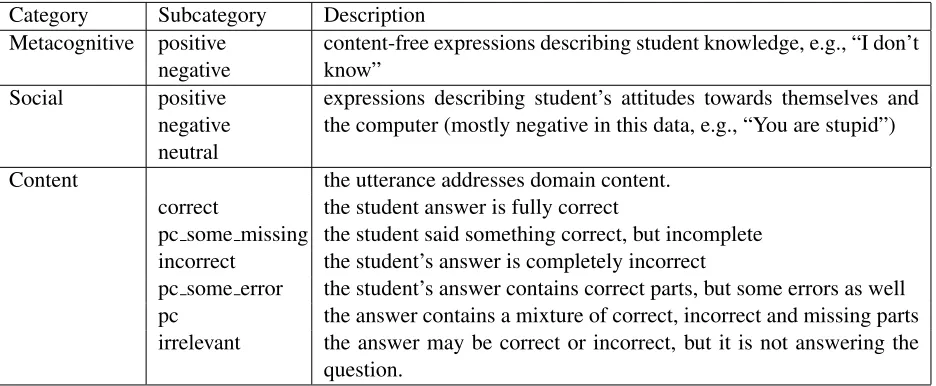
Student utterances were manually labeled using a simplified version of the DEMAND coding scheme (Campbell et al., 2009) shown in Figure 2. The utter-ances were first classified as related to domain con-tent, student’s metacognitive state, or social inter-action. Utterances addressing domain content were further classified with respect to their correctness as described in the table. The Kappa value for this annotation effort wasκ= 0.69.
This annotation maps straightforwardly into our set of labels. The social and metacognitive state-ments are mapped to the “non domain” label; “pc some error”, “pc” and “incorrect” are mapped to the “contradictory” label; and the other classes have a one-to-one correspondence with our task la-bels.
2.2 SCIENTSBANKdata
Category Subcategory Description Metacognitive positive
negative
content-free expressions describing student knowledge, e.g., “I don’t know”
Social positive negative neutral
expressions describing student’s attitudes towards themselves and the computer (mostly negative in this data, e.g., “You are stupid”)
Content the utterance addresses domain content. correct the student answer is fully correct
pc some missing the student said something correct, but incomplete incorrect the student’s answer is completely incorrect
pc some error the student’s answer contains correct parts, but some errors as well pc the answer contains a mixture of correct, incorrect and missing parts irrelevant the answer may be correct or incorrect, but it is not answering the
[image:4.612.74.542.54.247.2]question.
Figure 2: Annotation scheme used in the BEETLEcorpus
questions. Specifically, around 16k answers were collected spanning 16 distinct science subject ar-eas within physical sciences, life sciences, earth sciences, space sciences, scientific reasoning and technology. The tests were part of the Berke-ley Lawrence Hall of Science Assessing Science Knowledge (ASK) standardized assessments cover-ing material from their Full Option Science System (FOSS) (Lawrence Hall of Science, 2011). The an-swers came from students in grades 3-6 in schools across North America.
The tests included a variety of questions includ-ing “fill in the blank” and multiple choice, but the SCIENTSBANK corpus only used a subset that re-quired students to explain their beliefs about top-ics, typically in one to two sentences. We reviewed the questions and a sample of the responses and decided to filter the following types of questions from the corpus, because they did not mesh with our goals. First, we removed questions whose ex-pected answer was more than two full sentences (typically multi-step procedures), which were be-yond the scope of our task. Second, we removed questions where the expected answer was ill-defined or very open-ended. Finally, the most frequent rea-son for removing questions was an extreme imbal-ance in the answer classifications (e.g., for many questions, almost all of the answers were labeled “partially correct incomplete”). Specifically, we re-moved questions where more than 80% of the
an-swers had the same label and questions with fewer than three correct answers, since these questions were unlikely to be useful in differentiating between the quality of assessment systems.
The SCIENTSBANKcorpus was developed for the
purpose of assessing student responses at a very fine-grained level. The reference answers were broken down into several facets, which consisted roughly of two key terms and the relation connecting them. Nielsen et al. annotated student responses to indicate for each reference answer facet whether the response 1) implied the student understood the facet, 2) im-plied they held a contradictory belief, 3) included a related, non-contradicting facet, or 4) left the facet unaddressed. Reported agreement was 86.2% with a kappa statistic (Cohen, 1960) of 0.728, which is in the range of substantial agreement.1
Because our task focuses on answer classifica-tion rather than facet classificaclassifica-tion, we developed a set of rules indicating which combinations of facets constituted a correct answer. We were then able to compute an answer label from the gold-standard facet annotations, as follows. First, if any facet was annotated as contradictory, the answer was also labeled “contradictory”. Second, if all of the ex-pected facets for any valid answer were annotated as being understood, the answer was labeled
rect”. Third, the remaining answers that included some but not all of the expected facets were la-beled “partially correct incomplete”. Fourth, if an answer matched none of the expected facets, and had not been previously labeled as “contradictory” it was given the label “irrelevant”. Finally, all “irrele-vant” answers were reviewed manually to determine whether they should be relabeled as “non domain”. However, since Nielsen et al. had already removed most of the responses that originally fell into this category, we only found 24 “non domain” answers.
3 Baselines
We established three baselines for our data set – a straightforward majority class baseline, an existing system baseline (BEETLE II system performance, which we report only for the BEETLEportion of the
dataset), and the performance of a simple classifier based on lexical similarity, which we report in order to offer a substantial example of applying the same classifier to both portions of the dataset.
3.1 BEETLEIIsystem baseline
The interpretation component of the BEETLE II system uses a syntactic parser and a set of hand-authored rules to extract the domain-specific se-mantic representations of student utterances from the text. These representations were then matched against the semantic representations of expected cor-rect answers supplied by tutors. The resulting sys-tem output was automatically mapped into our target labels as discussed in (Dzikovska et al., 2012).
3.2 Lexical similarity baseline
To provide a higher baseline that is compara-ble across both subsets of the data, we built a simple decision tree classifier using the Weka 3.6.2 implementation of C4.5 pruned decision trees (weka.classifiers.trees.J48 class), with default pa-rameters. As features, we used lexical similar-ity scores computed by theText::Similarity
package with default parameters2. The code com-putes four similarity metrics – the raw number of overlapping words, F1 score, Lesk score and cosine score. We compared the learner response to the ex-pected answer(s) and the question, resulting in eight
2http://search.cpan.org/dist/Text-Similarity/
total features (the four values indicated above for the comparison with the question and the highest of each value from the comparisons with each possible expected answer).
This baseline is based on the lexical overlap base-line used in RTE tasks (Bentivogli et al., 2009). However, we measured overlap with the question text in addition to the overlap with the expected answers. Students often repeat parts of the ques-tion in their answer and this needs to be taken into account to differentiate, for example, “par-tially correct incomplete” and “correct” answers.
4 Results
4.1 Experimental Setup
We held back part of the data set for use as standard test data in the future challenge tasks. For BEETLE, this consisted of all student answers to 9 out of 56 explanation questions asked by the system, plus ap-proximately 15% of the student answers to the re-maining 47 questions, sampling so that the distribu-tion of labels in test data was similar to the training data. For SCIENTSBANK, we used a previous train-test split (Nielsen et al., 2009). For both data sets, the data was split so that in the future we can test how well the different systems generalize: i.e., how well they perform on answers to questions for which they have some sample student answers vs. how well they perform on answers to questions that were not in the training data (e.g., newly created questions in a deployed system). We discuss this in more detail in Section 5.
In this paper, we report baseline performance on the training set to demonstrate that the task is suf-ficiently challenging to be interesting and that sys-tems can be compared using our evaluation met-rics. We preserve the true test data for use in the planned large-scale system comparisons in a com-munity shared task.
For the lexical similarity baseline, we use 10-fold cross-validation.3 For the BEETLE II system
base-line, the language understanding module was
veloped based on eight transcripts, each taken from the interaction of a different student with an earlier version of the system. These sessions were com-pleted prior to the beginning of the experiment dur-ing which the BEETLEcorpus was collected, and are not included in the corpus presented here. Thus, the dataset used in the paper constitutes unseen data for the BEETLEII system.
We process the two corpora separately because the additional system baseline is available for bee-tle, and because the corpora may be different enough that it will be helpful for shared task participants to devise processing strategies that are sensitive to the provenance of the data.
4.2 Evaluation Metrics
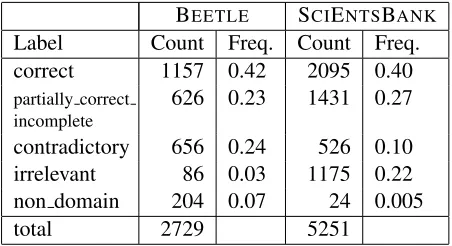
Table 1 shows the distribution of codes in the anno-tated data. The distribution is unbalanced, and there-fore in our evaluation results we report per-class pre-cision, recall andF1scores, plus the averaged scores using two different ways to average over per-class evaluation scores, micro- and macro- averaging.
For a set of classes C, each represented withNc
instances in the test set, the macro-averaged recall is defined as
Rmacro=
1 |C|
X
cC
R(c)
and the micro-averaged recall as
Rmicro=
X
cC
1
Nc
R(c)
Micro- and macro-averaged precision andF1are
de-fined similarly.
Micro-averaging takes class sizes into account, so a system that performs well on the most common classes will have a high micro-average score. This is the most commonly used classifier evaluation met-ric. Note that, in particular, overall classification accuracy (defined as the number of correctly clas-sified instances out of all instances) is mathemat-ically equivalent to micro-averaged recall (Abuda-wood and Flach, 2011). However, macro-averaging better reflects performance on small classes, and is commonly used for unbalanced classification prob-lems (see, e.g., (Lewis, 1991)). We report both val-ues in our results.
BEETLE SCIENTSBANK
Label Count Freq. Count Freq. correct 1157 0.42 2095 0.40
partially correct incomplete
626 0.23 1431 0.27
[image:6.612.314.540.54.177.2]contradictory 656 0.24 526 0.10 irrelevant 86 0.03 1175 0.22 non domain 204 0.07 24 0.005 total 2729 5251
Table 1: Distribution of annotated labels in the data
In addition, we report the system scores on the bi-nary decision of whether or not the corrective back should be issued (denoted “corrective feed-back” in the results table). It assumes that a tutoring system using a classifier will give corrective feed-back if the classifiers returns any label other than “correct”. Thus, every instance classified as “par-tially correct incomplete”, “contradictory”, “irrele-vant” or “non domain” is counted as true positive if the hand-annotated label also belongs to this set (even if the classifier disagrees with the annotation); and as false positive if the hand-annotated label is “correct”. This reflects the idea that students are likely to be frustrated if the system gives corrective feedback when their answer is in fact a fully accurate paraphrase of a correct answer.
4.3 BEETLEbaseline performance
The detailed evaluation results for all baselines are presented in Table 2.
The majority class baseline is to assign “correct” to every test instance. It achieves 42% overall ac-curacy. However, this is obviously at the expense of serious errors; for example, such a system would tell the students that they are correct if they are say-ing somethsay-ing contradictory. This is reflected in a much lower macro-averagedF1score.
The BEETLEII system performs only slightly bet-ter than the baseline on the overall accuracy (0.44 vs. 0.42 micro-averaged recall). However, the macro-averagedF1 score of the BEETLE II system is substantially higher (0.46 vs. 0.12). The micro-averaged results show a similar pattern, although the majority-class baseline performs slightly better than in the macro-averaged case, as expected.
similarity baseline, BEETLEII has lower overall ac-curacy, but performs similarly on micro- and macro-averaged scores. BEETLEII precision is higher than
that of the classifier in all cases except for the binary decision as to whether corrective feedback should be issued. This is not unexpected given how the sys-tem was designed – since misunderstandings caused dialogue breakdown in pilot tests, the parser was built to prefer rejecting utterances as uninterpretable rather than assigning them an incorrect class, lead-ing to a considerably lower recall. Around 31% of utterances could not be interpreted.
Our recent analysis shows that both incorrect interpretations (in particular, confusions between “partially correct incomplete” and “contradictory”) and rejections have significant negative effects on learning gain (Dzikovska et al., 2012). Classifiers can be tuned to reject examples where classification confidence falls below a given threshold, resulting in precision-recall trade-offs. Our baseline classifier classified all answer instances; exploring the possi-bilities for rejecting some low-confidence answers is planned for future work.
4.4 SCIENTSBANKbaseline performance
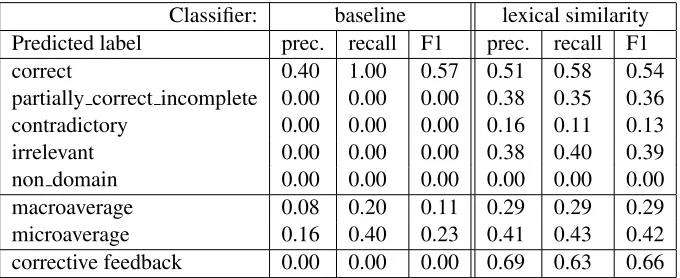
The accuracy of the majority class baseline (which assumes all answers are “correct”) is 40% for SCI
-ENTSBANK, about the same as it was for BEE
-TLE. The evaluation results, based on 10-fold cross-validation, for our simple lexical similarity classi-fier are presented in Table 3. The lexical similar-ity based classifier outperforms the majorsimilar-ity class baseline by 0.18 and 3% on the macro-averaged
F1-measure and accuracy, respectively. The F1
-measure for the two-way classification detecting an-swers which need corrective feedback is 0.66.
The scores on SCIENTSBANK are noticeably lower than those for BEETLE. The SCIENTSBANK
includes questions from 12 distinct science subject areas, rather than a single area as in BEETLE. This decision tree classifier learns a function from the eight text similarity features to the desired answer label. Because the features do not mention particular words, the model can be applied to items other than the ones on which it was trained, and even to items from different subject areas. However, the correct weighting of the textual similarity features depends on the extent and nature of the expected textual
over-Predictn correct pc inc contra irrlvnt nondom
correct 1213 553 209 392 2
pc inc 432 497 128 241 2
contra 115 109 58 74 3
irrlvnt 335 272 131 468 17
[image:7.612.317.539.54.125.2]nondom 0 0 0 0 0
Figure 4: Confusion matrix for lexical classifier on SCI -ENTSBANK. Predictions in rows, gold labels in columns
lap, which does vary from area to subject-area. We suspect that the differences between sub-ject areas made it hard for the decision-tree classi-fier to find a single, globally appropriate strategy. Nielsen (2009) reported the best results for classify-ing facets when trainclassify-ing separate question-specific or even facet-specific classifiers. Although separate training for each item reduces the amount of relevant training data for each classifier, it allows each clas-sifier to learn the specifics of how that item works. A comparison using this style of training would be a reasonable next step,
5 Discussion and Future Work
The results presented satisfy two critical require-ments for a challenge task. First, we have shown that it is feasible to develop a system that performs sig-nificantly better than the majority class baseline. On the macro-averaged F1-measure, our lexical clas-sifier outperformed the majority-class baseline by 0.33 (on BEETLE) and 0.18 (on SCIENTSBANK) and by 13% and 3% on accuracy. Second, we have also shown, as is desired for a challenge task, that the task is not trivial. With a system specifically designed to parse the BEETLE corpus answers, the macro-averaged F1-measure was just 0.46 and on
the binary decision regarding whether the response needed corrective feedback, it achieved just 0.63.
Classifier: majority lexical similarity BEETLEII Predicted label prec. recall F1 prec. recall F1 prec. recall F1 correct 0.42 1.00 0.60 0.68 0.75 0.72 0.93 0.53 0.68 partially correct incomplete 0.00 0.00 0.00 0.41 0.38 0.39 0.43 0.53 0.47 contradictory 0.00 0.00 0.00 0.39 0.34 0.36 0.58 0.23 0.33 irrelevant 0.00 0.00 0.00 0.05 0.02 0.03 0.23 0.17 0.20 non domain 0.00 0.00 0.00 0.66 0.82 0.73 0.92 0.46 0.61 macroaverage 0.09 0.20 0.12 0.44 0.46 0.45 0.62 0.39 0.46 microaverage 0.18 0.42 0.25 0.53 0.55 0.54 0.71 0.44 0.53 corrective feedback 0.00 0.00 0.00 0.80 0.74 0.77 0.73 0.56 0.63
Table 2: Evaluation results for BEETLEcorpus
Classifier: lexical similarity BEETLEII
Predicted label corrct pc inc contra irrlvnt nondom corrct pc inc contra irrlvnt nondom
correct 870 187 199 20 2 617 20 23 0 3
part corr incmp 138 239 178 24 11 249 332 146 29 20 contradictory 139 153 221 33 22 68 38 149 3 0
irrelevant 3 20 12 2 1 4 22 23 15 1
non domain 7 27 46 7 168 3 3 1 1 94
[image:8.612.76.537.313.427.2]uninterpretable n/a n/a n/a n/a n/a 216 211 314 38 86
Figure 3: Confusion matrix for BEETLEcorpus. Predictions in rows, gold labels in columns
[image:8.612.137.477.515.654.2]Classifier: baseline lexical similarity Predicted label prec. recall F1 prec. recall F1 correct 0.40 1.00 0.57 0.51 0.58 0.54 partially correct incomplete 0.00 0.00 0.00 0.38 0.35 0.36 contradictory 0.00 0.00 0.00 0.16 0.11 0.13 irrelevant 0.00 0.00 0.00 0.38 0.40 0.39 non domain 0.00 0.00 0.00 0.00 0.00 0.00 macroaverage 0.08 0.20 0.11 0.29 0.29 0.29 microaverage 0.16 0.40 0.23 0.41 0.43 0.42 corrective feedback 0.00 0.00 0.00 0.69 0.63 0.66
for general research purposes and forms the basis of SEMEVAL-2013 shared task “Textual entailment and paraphrasing for student input assessment”.4
A third contribution of this work was to provide basic evaluation benchmark metrics and the corre-sponding evaluation scripts (downloadable from the site above) for other researchers, including shared task participants. This will facilitate the comparison and, hence, the progress, of research.
The work reported here is based on approximately 8000 student responses to questions covering 12 dis-tinct science subjects and coming from a wide range of student ages. These responses comprise the train-ing data for our task. The vast majority of prior work, including BEETLE II, which was included as a benchmark here, has been designed to provide ITS feedback for relatively small, well-defined domains. The corpus presented in this paper is intended to en-courage research into more generalizable, domain-independent techniques. Following Nielsen (2009), from whom the SCIENTSBANKcorpus was adapted, our shared task evaluation corpus will be composed of three types of data: additional student responses for all of the questions in the training data (Un-seen Answers), student responses to questions that were not seen in the training data, but that are from the same subject areas (Unseen Questions), and re-sponses to questions from three entirely different subject areas (Unseen Domains), though in this case the questions are still from the same general domain – science. Unseen Answers is the typical scenario for the vast majority of prior work – training and testing on responses to the same questions. Unseen Questions and Unseen Domains allow researchers to evaluate how well their systems generalize to near and far domains, respectively.
The primary target application for this work is in-telligent tutoring systems, where the classification of responses is intended to facilitate specific pedagogic feedback. Beneath the surface, the baseline systems reported here are more similar to grading systems that use the approach of (Leacock and Chodorow, 2003), which uses classifier technology to detect ex-pressions of facet-like concepts, then converts the result to a numerical score, than to grading systems like (Mohler et al., 2011), which directly produces a
4See http://www.cs.york.ac.uk/semeval-2013/task4/
numerical score, using support vector regression and similar techniques. Either approach is reasonable, but we think that feedback is the more challeng-ing test of a system’s ultimate abilities, and there-fore a better candidate for the shared task. The pora from those systems, alongside with new cor-pora currently being collected in BEETLE and SCI -ENTSBANK domains, can serve as sources of data for future tasks extensions.
Future systems developed for this task can benefit from the large amount of existing work on recog-nizing textual entailment (Giampiccolo et al., 2007; Giampiccolo et al., 2008; Bentivogli et al., 2009) and on detecting contradiction (Ritter et al., 2008; De Marneffe et al., 2008). However, there are sub-stantial challenges in applying the RTE tools directly to this data set. Our set of labels is more fine-grained than RTE labels to reflect the needs of intelligent tu-toring systems (see Section 2). In addition, the top-performing systems in RTE5 3-way task, as well as contradiction detection methods, rely on NLP tools such as dependency parsers and semantic role la-belers; these do not perform well on specialized terminology and language constructs coming from (typed) dialogue context. We chose to use lexical similarity as a baseline specifically because a simi-lar measure was used as a standard baseline in RTE tasks, and we expect that adapting the more complex RTE approaches for purposes of this task will result in both improved results on our data set and new de-velopments in computational linguistics algorithms used for RTE and related tasks.
Acknowledgments
References
Tarek Abudawood and Peter Flach. 2011. Learn-ing multi-class theories in ilp. In The 20th Interna-tional Conference on Inductive Logic Programming (ILP’10). Springer, June.
V. Aleven, O. Popescu, and K. R. Koedinger. 2001. Towards tutorial dialog to support self-explanation: Adding natural language understanding to a cogni-tive tutor. In Proceedings of the 10th International Conference on Artificial Intelligence in Education (AIED ’01)”.
Vincent Aleven, Octav Popescu, and Koedinger Koedinger. 2002. Pilot-testing a tutorial dialogue system that supports self-explanation. Lecture Notes in Computer Science, 2363:344–354.
Luisa Bentivogli, Ido Dagan, Hoa Trang Dang, Danilo Giampiccolo, and Bernando Magnini. 2009. The fifth PASCAL recognizing textual entailment challenge. In
Notebook papers and results, Text Analysis Confer-ence (TAC).
Charles Callaway, Myroslava Dzikovska, Colin Mathe-son, Johanna Moore, and Claus Zinn. 2006. Using dialogue to learn math in the LeActiveMath project. In Proceedings of the ECAI Workshop on Language-Enhanced Educational Technology, pages 1–8, Au-gust.
Gwendolyn C. Campbell, Natalie B. Steinhauser, My-roslava O. Dzikovska, Johanna D. Moore, Charles B. Callaway, and Elaine Farrow. 2009. The DeMAND coding scheme: A “common language” for represent-ing and analyzrepresent-ing student discourse. InProceedings of 14th International Conference on Artificial Intelli-gence in Education (AIED), poster session, Brighton, UK, July.
Michelene T. H. Chi, Nicholas de Leeuw, Mei-Hung Chiu, and Christian LaVancher. 1994. Eliciting self-explanations improves understanding. Cognitive Sci-ence, 18(3):439–477.
Jacob Cohen. 1960. A coefficient of agreement for nom-inal scales. Educational and Psychological Measure-ment, 20(1):3746.
M.C. De Marneffe, A.N. Rafferty, and C.D. Manning. 2008. Finding contradictions in text. Proceedings of ACL-08: HLT, pages 1039–1047.
Myroslava Dzikovska, Diana Bental, Johanna D. Moore, Natalie B. Steinhauser, Gwendolyn E. Campbell, Elaine Farrow, and Charles B. Callaway. 2010a. In-telligent tutoring with natural language support in the Beetle II system. InSustaining TEL: From Innovation to Learning and Practice - 5th European Conference on Technology Enhanced Learning, (EC-TEL 2010), Barcelona, Spain, October.
Myroslava O. Dzikovska, Johanna D. Moore, Natalie Steinhauser, Gwendolyn Campbell, Elaine Farrow, and Charles B. Callaway. 2010b. Beetle II: a system for tutoring and computational linguistics experimen-tation. InProceedings of the 48th Annual Meeting of the Association for Computational Linguistics (ACL-2010) demo session, Uppsala, Sweden, July.
Myroslava O. Dzikovska, Peter Bell, Amy Isard, and Jo-hanna D. Moore. 2012. Evaluating language under-standing accuracy with respect to objective outcomes in a dialogue system. InProceedings of the 13th Con-ference of the European Chapter of the Association for computational Linguistics, Avignon, France, April. Danilo Giampiccolo, Bernardo Magnini, Ido Dagan, and
Bill Dolan. 2007. The third PASCAL recognizing tex-tual entailment challenge. InProceedings of the ACL-PASCAL Workshop on Textual Entailment and Para-phrasing, pages 1–9, Prague, June.
Danilo Giampiccolo, Hoa Trang Dang, Bernardo Magnini, Ido Dagan, Elena Cabrio, and Bill Dolan. 2008. The fourth PASCAL recognizing textual entail-ment challenge. InProceedings of Text Analysis Con-ference (TAC) 2008, Gaithersburg, MD, November. Michael Glass. 2000. Processing language input in the
CIRCSIM-Tutor intelligent tutoring system. In Pro-ceedings of the AAAI Fall Symposium on Building Di-alogue Systems for Tutorial Applications.
A. C. Graesser, P. Hastings, K. Wiemer-Hastings, and R. Kreuz. 1999. Autotutor: A simu-lation of a human tutor. Cognitive Systems Research, 1:35–51.
Pamela W. Jordan, Maxim Makatchev, and Kurt Van-Lehn. 2004. Combining competing language un-derstanding approaches in an intelligent tutoring sys-tem. In James C. Lester, Rosa Maria Vicari, and F´abio Paraguac¸u, editors,Intelligent Tutoring Systems, volume 3220 of Lecture Notes in Computer Science, pages 346–357. Springer.
Pamela Jordan, Maxim Makatchev, Umarani Pap-puswamy, Kurt VanLehn, and Patricia Albacete. 2006. A natural language tutorial dialogue system for physics. InProceedings of the 19th International FLAIRS conference.
Pamela W. Jordan. 2004. Using student explanations as models for adapting tutorial dialogue. In Valerie Barr and Zdravko Markov, editors, FLAIRS Confer-ence. AAAI Press.
Lawrence Hall of Science. 2006. Assessing Science Knowledge (ask). University of California at Berke-ley, NSF-0242510.
Claudia Leacock and Martin Chodorow. 2003. C-rater: Automated scoring of short-answer questions. Com-puters and the Humanities, 37(4):389–405.
David D. Lewis. 1991. Evaluating text categorization. In
Proceedings of the workshop on Speech and Natural Language, HLT ’91, pages 312–318, Stroudsburg, PA, USA.
Diane Litman, Johanna Moore, Myroslava Dzikovska, and Elaine Farrow. 2009. Using natural language pro-cessing to analyze tutorial dialogue corpora across do-mains and modalities. InProceedings of 14th Interna-tional Conference on Artificial Intelligence in Educa-tion (AIED), Brighton, UK, July.
Michael Mohler, Razvan Bunescu, and Rada Mihalcea. 2011. Learning to grade short answer questions using semantic similarity measures and dependency graph alignments. InProceedings of the 49th Annual Meet-ing of the Association for Computational LMeet-inguistics: Human Language Technologies, pages 752–762, Port-land, Oregon, USA, June. Association for Computa-tional Linguistics.
Rodney D. Nielsen, Wayne Ward, James H. Martin, and Martha Palmer. 2008. Annotating students’ under-standing of science concepts. In Proceedings of the Sixth International Language Resources and Evalua-tion Conference, (LREC08), Marrakech, Morocco. Rodney D. Nielsen, Wayne Ward, and James H. Martin.
2009. Recognizing entailment in intelligent tutoring systems. The Journal of Natural Language Engineer-ing, 15:479–501.
Heather Pon-Barry, Brady Clark, Karl Schultz, Eliza-beth Owen Bratt, and Stanley Peters. 2004. Advan-tages of spoken language interaction in dialogue-based intelligent tutoring systems. In Proceedings of ITS-2004, pages 390–400.
A. Ritter, D. Downey, S. Soderland, and O. Etzioni. 2008. It’s a contradiction—no, it’s not: a case study using functional relations. InProceedings of the Con-ference on Empirical Methods in Natural Language Processing, pages 11–20.
Natalie B. Steinhauser, Gwendolyn E. Campbell, Leanne S. Taylor, Simon Caine, Charlie Scott, My-roslava O. Dzikovska, and Johanna D. Moore. 2011. Talk like an electrician: Student dialogue mimicking behavior in an intelligent tutoring system. In Proceed-ings of the 15th International Conference on Artificial Intelligence in Education (AIED-2011).