RoBox: CCG with Structured Perceptron for Supervised Semantic
Parsing of Robotic Spatial Commands
Kilian Evang University of Groningen
Johan Bos University of Groningen
Abstract
We use a Combinatory Categorial Gram-mar (CCG) parser with a structured per-ceptron learner to address Shared Task 6 of SemEval-2014, Supervised Semantic Parsing of Robotic Spatial Commands. Our system reaches an accuracy of 79% ignoring spatial context and 87% using the spatial planner, showing that CCG can successfully be applied to the task. 1 Introduction
When interpreting utterances, humans use world knowledge whereas most semantic parsers to date rely purely on linguistic clues. Shared Task 6 in the SemEval 2014 campaign for semantic evalua-tion aims to integrate reasoning about microworlds with semantic parsing. In this task, a system is given an instruction for a robot and has to produce an executable semantic representation in Robot Control Language (Dukes, 2013a, RCL). The Robot Commands Treebank (Dukes, 2013b) is used for training and evaluation. We partici-pated in this shared task with a system rooted in Combinatory Categorial Grammar (CCG). In par-ticular, we were interested in finding out whether existing techniques for automatically deriving cat-egorial grammars with semantics could be moved easily to the new domain of robot commands and integrated with the provided spatial reasoning component. In this paper we outline our method and present the results for this shared task.1 2 Extracting a CCG from RCL
CCGs (Steedman, 2001) use a small set of atomic constituent categories such as S (sentence), NP This work is licensed under a Creative Commons At-tribution 4.0 International Licence. Page numbers and pro-ceedings footer are added by the organisers. Licence details: http://creativecommons.org/licenses/by/4.0/
1Our code is available at http://www.let.rug.
nl/evang/RoBox.zip
(noun phrase) orPP (prepositional phrase). Con-stituents that take other conCon-stituents as arguments have complex categories describing their combi-natory potential. For example, an intransitive En-glish verb has category S\NP, meaning that it forms a sentence by combining with an NP to its left. Similarly,modifiersalso have complex cate-gories. For example, a pre-sentential adverb might have category S/S because it combines with a sentence to its right to form a modified sentence. The combinatory rules that license these exam-ple combinations are calledbackward application
andforward application. They and other combi-natory rules also allow for constituents to be asso-ciated with semantic expressions, and specify how to form a combined semantic expression for the derived larger constituent.
In this section, we describe a process that takes an RCL corpus as input and produces a set of CCG lexical entries, i.e. natural-language words paired with categories and semantic expressions. The goal is for these lexical entries to produce the cor-rect semantics under CCG combinatory rules also for unseen robotic commands.
2.1 Transforming the Trees
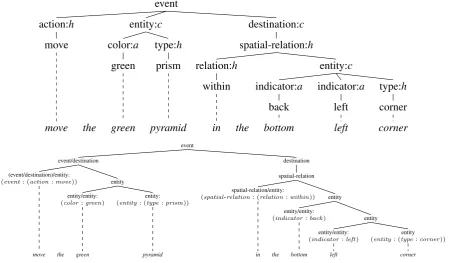
RCL expressions are rooted ordered trees whose nodes are labeled withtags. We will write them in the form(t:h)wheretis the root tag andhis the sequence of subtrees of the root’s children. Leaves are abbreviated as just their tags. In each training example, each pre-terminal (parent of a leaf) can be aligned to one or more words in the correspond-ing natural language expression. An example is shown in Figure 1. Since the alignments to words are not crossing, we can interpret the RCL tree as a phrase structure tree for the sentence and use the algorithm of (Hockenmaier and Steedman, 2007) to translate it to CCG. We extend the algorithm with a semantic step that makes sure the deriva-tions would produce the original RCL expressions.
(event:(action:move)(entity:(color:green)(type:prism))(destination:(spatial-relation:(relation: within)(entity:(indicator:back)(indicator:left)(type:corner))))
event action:h
move
move the
entity:c
color:a
green
green
type:h
prism
pyramid
destination:c
spatial-relation:h
relation:h
within
in the
entity:c
indicator:a
back
bottom
indicator:a
left
left
type:h
corner
corner
event
event/destination (event/destination)/entity:
(event: (action:move))
move the
entity
entity/entity:
(color:green)
green
entity:
(entity: (type:prism))
pyramid
destination
spatial-relation spatial-relation/entity:
(spatial-relation: (relation:within))
in the
entity
entity/entity:
(indicator:back)
bottom
entity entity/entity:
(indicator:left)
left
entity
(entity: (type:corner))
[image:2.595.75.527.97.360.2]corner
Figure 1: Top: an RCL expression. Middle: its representation as a tree diagram. Internal nodes are annotated with constituent types. Pre-terminals are aligned to words in a corresponding natural-language expression. Bottom: result of the CCG transformation.
The procedure is as follows:
1. Determine constituent types. We treat action, relation andtype constituents asheads, entitys and destinations as complements (i.e. arguments) and cardinals, colors, indicators, measures and spatial-relations as adjuncts (i.e. modifiers). Forsequencenodes that have multiple event children, we treat the first as head and the rest as adjuncts. A correspondingconstituent type labelh,aorcis added to the label of each internal node (cf. Figure 1, middle).
2. Assign lexical semantics. To the label of each pre-terminal, add an RCL expression which is a copy of a connected subgraph of the tree itself (without the constituent type labels). For a-type and c-type pre-terminals, the subgraph includes only the pre-terminal and its daughter. Forh-type pre-terminals the parent is also included, as well as any subtrees with root tag id or reference-id the parent may have.To illustrate, the label of the action:h node in our example becomes ac-tion:h:(event: (action:move)), and color:a be-comes color:a:(color:green). The leaves are now no longer needed, so we remove them.
3. Add sequence nodes. If the root is tagged sequence, add an additional node taggedsequence between each child and the root.
4. Binarize the tree. Each local tree with more than two daughters is binarized by insert-ing dummy nodes, provisionally labeled C :h
where C is the tag of the parent. Left adjuncts (such as the first indicator in Figure 1) are split off first, followed by right adjuncts (such as the destination in Figure 1), left complements and right complements.
5. Assign CCG categories. Starting from the root, the tag of each node is replaced by a CCG category. For simplicity, we directly use RCL tags as atomic categories rather than mapping them to standard CCG categories:
The root gets its tag (event orsequence) as cat-egory.
c-type nodes get their tag as category. Their sib-ling gets categoryP/Tif it is on the left andP\T
there-fore getsevent/destination because the parent’s category isevent.
a-type nodes such as the twoindicators in Fig-ure 1 get category P/P if they are on the left of their sibling and P\P if they are on its right, whereP is the category of their parent. The sib-ling gets categoryP.
Nodes without siblings get their tag as category. Constituent type labels are dropped. The result for our example is shown at the bottom of Figure 1.
2.2 The Lexicon
For each leaf in the transformed corpus that is aligned to one or more words, a lexical item is ex-tracted containing the words, category and RCL. For single-word items, we also add part-of-speech tags, obtained using the C&C POS tagger (Curran and Clark, 2003), to reduce overgeneration. Ex-amples of lexical items are:
• hblock/NNi ` entity : (entity : (type : (block))i
• hon,top,ofi ` spatial-relation/entity : (spatial-relation : (relation :above))
2.3 Combinatory Rules
Given the extracted lexical items, the corpus derivations are licensed by standard CCG rules (Steedman, 2001), using a modified semantics that keeps things simple and ensures that the semantics of (most) intermediate constituents are themselves RCL subexpressions, which is important for inter-facing with the spatial planner during parsing. The most important two rules are forward and back-ward application:
(X/Y):f Y:g⇒X:FAPP(X/Y, f, g) (>)
Y:g (X\Y):f ⇒X:BAPP(X\Y, g, f) (<)
whereFAPPandBAPPare defined as follows:
FAPP(X/Y,a,(t:h)) = (t:ah)ifX=Y FAPP(C,(t:h),c) = (t:hc)otherwise BAPP(X\Y,(t:h),a) = (t:ha)ifX=Y BAPP(C,c,(t:h)) = (t:ch)otherwise
In words, the semantics of the adjunct or comple-ment is added as a subtree under the root of the semantics of the head.
We also use a restricted form of the CCG rule
forward composition to form chains of entity ad-juncts:
(entity/entity):a (entity/entity):b
⇒(entity/entity):ab (>B)
This is motivated by our use of the spatial plan-ner. Without forward composition, we would, e.g., not be able to build a constituent with the seman-tics (entity : (color :green)(color :red)(type : cube-group))in the context of a stack consisting of green and red cubes, but no stack consisting exclusively of red cubes – the planner would fil-ter out the infil-termediate constituent with semantics (entity:(color:red)(type:cube-group)).
Finally, we use type-changing rules, which is standard practice in CCG parsing (Clark and Curran, 2007; Zettlemoyer and Collins, 2007). They are automatically extracted from the training data. Some of them account for unary productions within RCL expressions by introducing an addi-tional internal node, such as thedestinationnode in Figure 1. For example:
sp-relation:h⇒
destination:(destination:h) (∗1)
Others account for RCL leaves that are not linked to any words. For example, the RCL expression for the commandtake the light blue prism from the blue cube renders the from-phrase as an adjunct to the prism node: (spatial-relation: (relation: above)(entity:(color:blue)(type:cube))), where above is not linked. Rules like the following deal with this by not only introducing an internal node, but also a branch leading to the unlinked leaf:
entity:h⇒entity/entity:
(sp-relation:(relation:above)h) (∗2)
2.4 Anaphora
Anaphora are marked in RCLentity expressions by the subexpression (id : 1) for antecedent en-tities and (reference-id : 1) for anaphoric enti-ties. The latter have the special type reference, in which case they are typically linked to the word
anaphora, but merely generate versions both with and without theid subexpression for eachentity lexical item seen in training as an antecedent. We then rely on the parser and spatial planner to find a parse with the correct item marked as antecedent. If the spatial planner rejects a subexpression be-cause it contains an unknown reference ID, we ac-cept it anyway because the expression can later combine with another one that contains the an-tecedent. However, at the level of complete parses, those containing areference-id expression but no id expression – or vice versa – are rejected. As a heuristic, we also reject parses wherereference-id precedesid because we found this to be a notice-able source of errors, and no cataphora in the train-ing data.
3 Training and Decoding
Following (Zettlemoyer and Collins, 2007), we use a CKY CCG parser in combination with sim-ple perceptron updates: iterate over the training corpus T times, for each sentence producing all parses. Each parse is characterized by a num-ber of features and scored using a global weight vector. The weight vector is updated by sub-tracting the feature vector of the highest-scoring parse and adding the feature vector of the highest-scoring correct parse. No update is performed if the highest-scoring parse is correct, or no correct parse was found. Since for the present task the training data already induces a lexicon, we treat the lexicon as fixed and perform no lexical update. We parallelize training using iterative parameter mixing (McDonald et al., 2010) with 12 shards.
3.1 Semantically Empty and Unknown Words
The parser initially considers each contiguous sub-sequence of words in the sentence and adds all matching lexical items to the chart. In order to allow for words that are not linked to the seman-tics, we simply add two additional lexical items to the chart for each word w in the sentence:
hwi ` X/X:nil and hwi ` X\X:nil where
Xis a variable that can be bound to any category during rule application. We modify the combina-tory rules above to require that at least one of the input items has non-nil semantics and to use that as output semantics if the other isnil.
In decoding, the parser also has to deal with words not seen in training. For one, there are the
nil items, so it is possible to treat the unknown words as semantically empty. In addition, we look at other single-word lexical items with the same POS tag and generate corresponding lexical items for the unknown word on the fly, hoping that fea-tures and the spatial planner will guide the parser to the right choice. To limit the search space, this is currently only done for nouns since we found the greatest lexical variance to occur with them. 3.2 Features
Each chart edge is characterized by the following local features:
• each lexical itemw`c:sused.
• each instance of a combinatory rule used, e.g.
>.
• hp, c, si for each lexical item used where p
is the POS tag (or empty for multiwords). This allows to learn correlations between cat-egory/semantics pairs and particular parts of speech, primarily for unknown words.
• each instance of a type-changing rule used, together with the semantic head word of the constituent it roots, e.g. h∗1,ini. This helps
to learn not to use type-changing rules where they don’t make sense. E.g. the word
squares often heads entity descriptions that type-change into measure phrases but the wordcubedoesn’t.
• the root tag of the semantics of each con-stituent, together with the word to its immedi-ate left, e.g.hdestination,fromi. This exam-ple feature is indicative of typical erroneous parses where spatial adjuncts corresponding tofrom-phrases are misparsed as destination complements. The word from provides a strong clue against such a parse but would be ignored without such a feature because it is not aligned to any RCL node.
• the root tag of the semantics of each con-stituent, together with the first word in it, e.g.
hspatial-relation,abovei. 3.3 The Spatial Planner
the gripper of the robot being instructed. It can tell us for some RCL subexpressions, chiefly entity descriptions, whether they “make sense” given the context. For example, if the parser builds an edge with semantics(entity:(type:cube)(color: red)) but there is no red cube anywhere on the board, we can immediately reject the edge (pro-vided no negations or hypothetical descriptions are used, which is the case for the commands in this task) and thereby avoid errors and reduce the search space. The planner also helps resolve attachment ambiguities early: in the command
put the prism on the cube, a constituent with se-mantics(entity: (type:prism)(spatial-relation: (relation:above)(entity:(type:cube))))is a pos-sible but incorrect parse. If we are lucky enough that no prism is actually sitting on a cube in the microworld, the planner will weed it out.
We have not yet explored making the fullest possible use of the spatial planner for checking the validity ofevent orsequence expressions, which would involve simulating changing the state of the world as a sequence of event instructions is car-ried out. Currently we only filter out initialevent instructions with actiondrop for scenes in which there is nothing initially in the robot’s gripper to be dropped. RCL requires the action move here instead, a distinction which is often not made in the natural language commands.
4 Experiments and Results
We carried out two experiments, one using the spa-tial planner and one not using it. In each case, we trained on training examples shorter than 16 words to speed up training and evaluated on the full test set. In both training and decoding, a beam search strategy keeps only the 60 highest-scoring edges per chart cell. The weights of non-nillexical items were initialized to1, those ofnil items to0.5, all other feature weights to0. The number of training epochsT was set to3. These values were chosen experimentally using 80% of the training data and another 10% for testing.
Of the 909 test sentences, 720 (79.21%) were parsed exactly correctly when not using the plan-ner, and 789 (86.80%) when using it, making third place among the six participating systems. The result shows that standard CCG-based techniques for semantic parsing can be successfully applied to the domain of robotic spatial commands and profit from the integration of a spatial planner.
A preliminary analysis suggests most errors are related to pronoun ellipsis, the ambiguous word
one, anaphora or attachment ambiguity. We be-lieve some further careful feature engineering and extended use of the spatial planner could go a great length to improve accuracy further.
References
Stephen Clark and James R. Curran. 2007. Wide-coverage efficient statistical parsing with CCG and log-linear models. Computational Linguistics, 33(4):493–552.
James R. Curran and Stephen Clark. 2003. Inves-tigating GIS and smoothing for maximum entropy taggers. InProceedings of the 11th Meeting of the European Chapter of the Association for Compu-tational Linguistics (EACL-03), pages 91–98, Bu-dapest, Hungary.
Kais Dukes. 2013a. Semantic annotation of robotic spatial commands. In Language and Technology Conference (LTC), Poznan, Poland.
Kais Dukes. 2013b. Train robots: A dataset for natu-ral language human-robot spatial interaction through verbal commands. In International Conference on Social Robotics (ICSR). Embodied Communication of Goals and Intentions Workshop, Bristol, United Kingdom.
J. Hockenmaier and M. Steedman. 2007. CCGbank: a corpus of CCG derivations and dependency struc-tures extracted from the Penn Treebank. Computa-tional Linguistics, 33(3):355–396.
Ryan McDonald, Keith Hall, and Gideon Mann. 2010. Distributed training strategies for the structured per-ceptron. In Human Language Technologies: The 2010 Annual Conference of the North American Chapter of the Association for Computational Lin-guistics, HLT ’10, pages 456–464, Stroudsburg, PA, USA.
Mark Steedman. 2001. The Syntactic Process. The MIT Press.