T
REET
ALK: Composition and Compression of Trees for Image Descriptions
Polina Kuznetsova†
†Stony Brook University Stony Brook, NY
pkuznetsova @cs.stonybrook.edu
Vicente Ordonez‡ Tamara L. Berg‡
‡UNC Chapel Hill Chapel Hill, NC {vicente,tlberg}
@cs.unc.edu
Yejin Choi††
††University of Washington Seattle, WA
Abstract
We present a new tree based approach to composing expressive image descriptions that makes use of naturally occuring web images with captions. We investigate two related tasks: image captiongeneralizationand
gen-eration, where the former is an optional
sub-task of the latter. The high-level idea of our approach is to harvest expressive phrases (as tree fragments) from existing image descrip-tions, then to compose a new description by selectively combining the extracted (and op-tionally pruned) tree fragments. Key algo-rithmic components aretree compositionand
compression, both integrating tree structure
with sequence structure. Our proposed system attains significantly better performance than previous approaches for both image caption
generalization and generation. In addition,
our work is the first to show the empirical ben-efit of automatically generalized captions for composing natural image descriptions.
1 Introduction
The web is increasingly visual, with hundreds of bil-lions of user contributed photographs hosted online. A substantial portion of these images have some sort of accompanying text, ranging from keywords, to free text on web pages, to textual descriptions di-rectly describing depicted image content (i.e. cap-tions). We tap into the last kind of text, using natu-rally occuring pairs of images with natural language
descriptions to composeexpressivedescriptions for
query images via tree composition and compression. Such automatic image captioning efforts could potentially be useful for many applications: from
automatic organization of photo collections, to facil-itating image search with complex natural language queries, to enhancing web accessibility for the vi-sually impaired. On the intellectual side, by learn-ing to describe the visual world from naturally exist-ing web data, our study extends the domains of lan-guage grounding to the highly expressive lanlan-guage that people use in their everyday online activities.
There has been a recent spike in efforts to au-tomatically describe visual content in natural lan-guage (Yang et al., 2011; Kulkarni et al., 2011; Li et al., 2011; Farhadi et al., 2010; Krishnamoorthy et al., 2013; Elliott and Keller, 2013; Yu and Siskind, 2013; Socher et al., 2014). This reflects the long standing understanding that encoding the complex-ities and subtleties of image content often requires more expressive language constructs than a set of tags. Now that visual recognition algorithms are be-ginning to produce reliable estimates of image con-tent (Perronnin et al., 2012; Deng et al., 2012a; Deng et al., 2010; Krizhevsky et al., 2012), the time seems ripe to begin exploring higher level semantic tasks.
There have been two main complementary direc-tions explored for automatic image captioning. The first focuses on describing exactly those items (e.g., objects, attributes) that are detected by vision
recog-nition, which subsequently confineswhatshould be
described andhow(Yao et al., 2010; Kulkarni et al.,
2011; Kojima et al., 2002). Approaches in this direc-tion could be ideal for various practical applicadirec-tions such as image description for the visually impaired. However, it is not clear whether the semantic expres-siveness of these approaches can eventually scale up to the casual, but highly expressive language
peo-351
Transactions of the Association for Computational Linguistics, 2 (2014) 351–362. Action Editor: Hal Daume III.
Target'Image'
A"cow!standing!in!the!
water! I!no/ced!that!this!funny!cow!was"staring"at"me" A!bird!hovering!grass" in"the" beau/ful!hills!only!You!can!see!these!in" the"countryside"
[image:2.612.78.533.58.153.2]Object' Ac/on' Stuff' Scene'
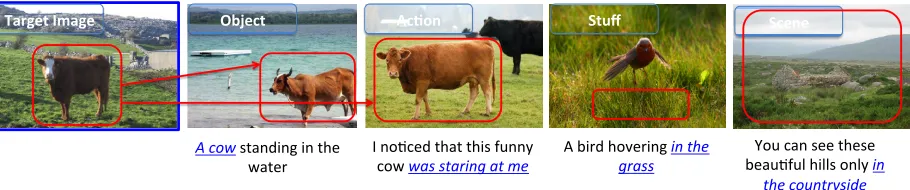
Figure 1: Harvesting phrases (as tree fragments) for the target image based on (partial) visual match.
ple naturally use in their online activities. In
Fig-ure 1, for example, it would be hard to compose“I
noticed that this funny cow was staring at me” or
“You can see these beautiful hills only in the
coun-tryside”in a purely bottom-up manner based on the
exact content detected. The key technical bottleneck is that the range of describable content (i.e., objects, attributes, actions) is ultimately confined by the set of items that can be reliably recognized by state-of-the-art vision techniques.
The second direction, in a complementary avenue to the first, has explored ways to make use of the rich spectrum of visual descriptions contributed by online citizens (Kuznetsova et al., 2012; Feng and Lapata, 2013; Mason, 2013; Ordonez et al., 2011).
In these approaches,the set of what can be described
can be substantially larger thanthe set of what can be
recognized, where the former is shaped and defined by the data, rather than by humans. This allows the resulting descriptions to be substantially more ex-pressive, elaborate, and interesting than what would be possible in a purely bottom-up manner. Our work contributes to this second line of research.
One challenge in utilizing naturally existing mul-timodal data, however, is the noisy semantic align-ment between images and text (Dodge et al., 2012; Berg et al., 2010). Therefore, we also
investi-gate a related task of image captiongeneralization
(Kuznetsova et al., 2013), which aims to improve the semantic image-text alignment by removing bits of text from existing captions that are less likely to be transferable to other images.
The high-level idea of our system is to harvest useful bits of text (as tree fragments) from exist-ing image descriptions usexist-ing detected visual content similarity, and then to compose a new description by selectively combining these extracted (and op-tionally pruned) tree fragments. This overall idea
of composition based on extracted phrases is not
new in itself (Kuznetsova et al., 2012), however, we make several technical and empirical contributions.
First, we propose a novel stochastic tree
compo-sition algorithm based on extracted tree fragments
that integrates both tree structure and sequence co-hesion into structural inference. Our algorithm per-mits a substantially higher level of linguistic expres-siveness, flexibility, and creativity than those based on rules or templates (Kulkarni et al., 2011; Yang et al., 2011; Mitchell et al., 2012), while also address-ing long-distance grammatical relations in a more principled way than those based on hand-coded con-straints (Kuznetsova et al., 2012).
Second, we address image captiongeneralization
as an optional subtask of image captiongeneration,
and propose atree compression algorithm that
per-forms a light-weight parsing to search for the op-timal set of tree branches to prune. Our work is the first to report empirical benefits of automatically compressed captions for image captioning.
The proposed approaches attain significantly
bet-ter performance for both image caption
generaliza-tionandgenerationtasks over competitive baselines
and previous approaches. Our work results in an im-proved image caption corpus with automatic
gener-alization, which is publicly available.1
2 Harvesting Tree Fragments
Given a query image, we retrieve images that are vi-sually similar to the query image, then extract po-tentially useful segments (i.e., phrases) from their corresponding image descriptions. We then com-pose a new image description using these retrieved
text fragments (§3). Extraction of useful phrases
is guided by both visual similarity and the syn-tactic parse of the corresponding textual
descrip-1http://ilp-cky.appspot.com/
tion. This extraction strategy, originally proposed by Kuznetsova et al. (2012), attempts to make the best use of linguistic regularities with respect to objects, actions, and scenes, making it possible to obtain richer textual descriptions than what cur-rent state-of-the-art vision techniques can provide in isolation. In all of our experiments we use the captioned image corpus of Ordonez et al. (2011), first pre-processing the corpus for relevant content by running deformable part model object detec-tors (Felzenszwalb et al., 2010). For our study, we run detectors for 89 object classes set a high confi-dence threshold for detection.
As illustrated in Figure 1, for a query image de-tection, we extract four types of phrases (as tree fragments). First, we retrieve relevant noun phrases from images with visually similar object detections. We use color, texture (Leung and Malik, 1999), and shape (Dalal and Triggs, 2005; Lowe, 2004) based features encoded in a histogram of vector quantized responses to measure visual similarity. Second, we extract verb phrases for which the corresponding noun phrase takes the subject role. Third, from
those images with “stuff”detections, e.g.“water”,
or“sky”(typically mass nouns), we extract
preposi-tional phrases based on similarity of both visual ap-pearance and relative spatial relationships between detected objects and “stuff”. Finally, we use global
“scene”similarity2 to extract prepositional phrases
referring to the overall scene, e.g., “at the
confer-ence,”or“in the market”.
We perform this phrase retrieval process for each detected object in the query image and generate one sentence for each object. All sentences are then combined together to produce the final description. Optionally, we apply image caption generalization
(via compression) (§4) to all captions in the corpus
prior to the phrase extraction and composition.
3 Tree Composition
We model tree composition as constraint optimiza-tion. The input to our algorithm is the set of re-trieved phrases (i.e., tree fragments), as illustrated
in §2. Let P = {p0, ..., pL−1} be the set of all
phrases across the four phrase types (objects, ac-tions, stuff and scene). We assume a mapping
func-2L2 distance between classification score vectors (Xiao et
al., 2010)
tion pt : [0, L) → T, whereT is the set of phrase
types, so that the phrase type ofpi is pt(i). In
ad-dition, let R be the set of PCFG production rules
and N T be the set of nonterminal symbols of the
PCFG. The goal is to find and combine a good
se-quence of phrasesG, |G| ≤ |T| = N = 4, drawn
fromP, into a final sentence. More concretely, we
want to select and order a subset of phrases (at most one phrase of each phrase type) while considering both the parse structure and n-gram cohesion across phrasal boundaries.
Figure 2 shows a simplified example of a com-posed sentence with its corresponding parse struc-ture. For brevity, the figure shows only one phrase for each phrase type, but in actuality there would be a set of candidate phrases for each type. Figure 3 shows the CKY-style representation of the internal mechanics of constraint optimization for the
exam-ple composition from Figure 2. Each cellij of the
CKY matrix corresponds toGij, a subsequence of
Gstarting at positioniand ending at positionj. If
a cell in the CKY matrix is labeled with a
nontermi-nal symbols, it means that the corresponding tree of
Gij hassas its root.
Although we visualize the operation using a CKY-style representation in Figure 3, note that composi-tion requires more complex combinatorial decisions than CKY parsing due to two additional
considera-tions. We are: (1) selecting a subset of candidate
phrases, and (2) re-ordering the selected phrases
(hence making the problem NP-hard). Therefore, we encode our problem using Integer Linear Pro-gramming (ILP) (Roth and tau Yih, 2004; Clarke and Lapata, 2008) and use the CPLEX (ILOG, Inc, 2006) solver.
3.1 ILP Variables
Variables for Sequence Structure:Variablesα en-code phrase selection and ordering:
αik= 1 iff phrasei∈Pis selected (1) for positionk∈[0, N)
Wherekis one of the N=4 positions in a sentence.3
Additionally, we define variables for each pair of ad-jacent phrases to capture sequence cohesion:
3The number of positions is equal to the number of phrase
types, since we selectat mostone from each type.
A"cow in"the"countryside was"staring"at"me in#the#grass
NP PP VP PP
NP
S
i=0$ k=1$ j=2$
0 1 2 3
level and each node of that level, algorithm has to decide, which parse tag to choose. This process is represented by assignment of a particular tag to a matrix cell. The chosen tag must be a head of a rule, fi example cell12is assigned tagV P, correspond-ing to ruleV P !V P P P. This rule connects leafs “going out to sea” and “in the ocean”. The prob-lem is to find tag assignment for each cell of the ma-trix, given some cells can be empty, if they do not connect children cells. latter correspond to children branches of the tree and belong to the previous diag-onal in the left-to-right order. Also we do not try all possible pairs5 of children from previous diagonal. We use technique similar to the one used in CKY parsing approach. Matrix cell pairs corresponding to<right,left>children pairs are< ik,(k+ 1)j >, wherek 2 [i, j). Here and for the remainder of the paper, notation[i, j)means{i, i+ 1, ..., j 1}and
rish pqunless otherwise stated.
The problem of choosing phrase order together with the best parse tree of the description is a com-plex optimization problem, which we solve using Integer Linear Programming (ILP). We use a sepa-rate ILP formulation for for sentence reordering and salient object selection, which we omit for brevity. As mentioned earlier, overall for each object we have four types of phrases. We use CKY-driven ILP formulation to combine them together into a plausi-ble descriptions which obeys PCFG rules. For the remainder of the paper we will call our ILP
formu-lation ILP-TREE. We exploit Cplex (ILOG, Inc,
2006) to solve ILP problem.
Todo:[mention cplex parameters. For instance, 30sec limit on generation]
3.0.2 ILP variables
Phrase Indicator Variables:We define variables↵ which indicate phrase selection and phrase ordering.
↵ijk= 1 iff phraseiof typej (1) is selected
for positionk
5There is only two children as we use Chomsky Normal
Form
↵ij0= 1
↵ij1pq2 = 1
02S = 1
010(N P!N P P P)= 1
021= 1
Wherek 2 [0, N)Todo:[check for the whole
pa-per if k ranges from 0]indexes one of N=4 positions in a sentence6.
Phrase ordering is captured by indicator variables for adjacent pairs of phrases:
↵ijkpq(k+1)= 1 iff ↵ijk=↵pq(k+1)= 1 (2)
An example of ILP-CKY at Figure 3 shows selec-tion of phrases and their ordering: “The little boat”, “going out to sea” and “in the ocean”.
Tree Indicator Variables:We also define variables , which are indicators of CKY matrix content (Fig-ure 3).
ijs= 1 iff cellijof the matrix is assigned (3) parse tree symbols
Todo:[Rename symbols to tags throughout the pa-per]
Wherei 2[0, N)indexes CKY matrix diagonals
andj 2[0, N i)indexes elements of diagonali.
In order to model rule selection at each CKY step, we define variables, which correspond to a PCFG rule used at the given cellijof CKY matrix:
ijkr= 1 iff ijh= ikp (4)
= (k+1)jq= 1,
Wherer = h pq2 Randk 2 [i, j). Valuek
corresponds to the choice of children for the current cell.
6The number of positions is equal to the number of phrase
types
Figure 2: An example scenario of tree composition. Only the first three phrases are chosen for the composition.
αijk= 1 iff αik=αj(k+1)= 1 (2) Variables for Tree Structure: Variables β encode the parse structure:
βijs = 1 iff the phrase sequenceGij (3) maps to the nonterminal symbols∈N T
Wherei ∈ [0, N) andj ∈ [i, N) index rows and
columns of the CKY-style matrix in Figure 3. A cor-responding example tree is shown in Figure 2, where
the phrase sequenceG02corresponds to the cell
la-beled with S. We also define variables to indicate
selected PCFG rules in the resulting parse:
βijkr= 1 iff βijh=βikp (4)
=β(k+1)jq = 1,
Wherer = h → pq ∈ R andk ∈ [i, j). Indexk
points to the boundary of split between two children
as shown in Figure 2 for the sequenceG02.
Auxiliary Variables: For notational convenience, we also include:
γijk= 1 iff P s∈N T
βijs (5)
= P
s∈N T
βiks
= P
s∈N T
β(k+1)js= 1
3.2 ILP Objective Function
We model tree composition as maximization of the following objective function:
F = X
i
Fi× NX−1
k=0
αik (6)
+X
ij
Fij× NX−2
k=0 αijk
+X
ij j−1
X
k=i
X
r∈R
Fr×βijkr
NP NP S
A"cow PP PP-VP
in"the"
countryside VP VP was"staring"
at"me PP
in#the#grass
00" 01" 02" 03"
11" 12" 13"
33"
22" 23"
k=1$ k=0$
level and each node of that level, algorithm has to decide, which parse tag to choose. This process is represented by assignment of a particular tag to a matrix cell. The chosen tag must be a head of a rule, fi example cell12is assigned tagV P,
correspond-ing to ruleV P !V P P P. This rule connects leafs
“going out to sea” and “in the ocean”. The prob-lem is to find tag assignment for each cell of the ma-trix, given some cells can be empty, if they do not connect children cells. latter correspond to children branches of the tree and belong to the previous diag-onal in the left-to-right order. Also we do not try all possible pairs5of children from previous diagonal.
We use technique similar to the one used in CKY parsing approach. Matrix cell pairs corresponding to<right,left>children pairs are< ik,(k+ 1)j >, wherek2[i, j). Here and for the remainder of the paper, notation[i, j)means{i, i+ 1, ..., j 1}and
rish pqunless otherwise stated.
The problem of choosing phrase order together with the best parse tree of the description is a com-plex optimization problem, which we solve using Integer Linear Programming (ILP). We use a sepa-rate ILP formulation for for sentence reordering and salient object selection, which we omit for brevity. As mentioned earlier, overall for each object we have four types of phrases. We use CKY-driven ILP formulation to combine them together into a plausi-ble descriptions which obeys PCFG rules. For the remainder of the paper we will call our ILP formu-lation ILP-TREE. We exploit Cplex (ILOG, Inc,
2006) to solve ILP problem.
Todo:[mention cplex parameters. For instance, 30sec limit on generation]
3.0.2 ILP variables
Phrase Indicator Variables:We define variables↵
which indicate phrase selection and phrase ordering.
↵ijk= 1 iff phraseiof typej (1)
is selected for positionk
5There is only two children as we use Chomsky Normal
Form
↵ij0= 1
↵ij1pq2= 1
02S= 1
010(N P!N P P P)= 1
021= 1
Wherek2[0, N)Todo:[check for the whole
pa-per if k ranges from 0]indexes one of N=4 positions in a sentence6.
Phrase ordering is captured by indicator variables for adjacent pairs of phrases:
↵ijkpq(k+1)= 1 iff ↵ijk=↵pq(k+1)= 1 (2)
An example of ILP-CKY at Figure 3 shows selec-tion of phrases and their ordering: “The little boat”, “going out to sea” and “in the ocean”.
Tree Indicator Variables:We also define variables , which are indicators of CKY matrix content (Fig-ure 3).
ijs= 1 iff cellijof the matrix is assigned (3)
parse tree symbols
Todo:[Rename symbols to tags throughout the pa-per]
Wherei2[0, N)indexes CKY matrix diagonals andj2[0, N i)indexes elements of diagonali.
In order to model rule selection at each CKY step, we define variables, which correspond to a PCFG rule used at the given cellijof CKY matrix:
ijkr= 1 iff ijh= ikp (4)
= (k+1)jq= 1,
Wherer=h pq2Randk2[i, j). Valuek
corresponds to the choice of children for the current cell.
6The number of positions is equal to the number of phrase
types
level and each node of that level, algorithm has to decide, which parse tag to choose. This process is represented by assignment of a particular tag to a matrix cell. The chosen tag must be a head of a rule, fi example cell12is assigned tagV P, correspond-ing to ruleV P !V P P P. This rule connects leafs “going out to sea” and “in the ocean”. The prob-lem is to find tag assignment for each cell of the ma-trix, given some cells can be empty, if they do not connect children cells. latter correspond to children branches of the tree and belong to the previous diag-onal in the left-to-right order. Also we do not try all possible pairs5of children from previous diagonal.
We use technique similar to the one used in CKY parsing approach. Matrix cell pairs corresponding to<right,left>children pairs are< ik,(k+ 1)j >, wherek2[i, j). Here and for the remainder of the paper, notation[i, j)means{i, i+ 1, ..., j 1}and
rish pqunless otherwise stated.
The problem of choosing phrase order together with the best parse tree of the description is a com-plex optimization problem, which we solve using Integer Linear Programming (ILP). We use a sepa-rate ILP formulation for for sentence reordering and salient object selection, which we omit for brevity. As mentioned earlier, overall for each object we have four types of phrases. We use CKY-driven ILP formulation to combine them together into a plausi-ble descriptions which obeys PCFG rules. For the remainder of the paper we will call our ILP formu-lation ILP-TREE. We exploit Cplex (ILOG, Inc, 2006) to solve ILP problem.
Todo:[mention cplex parameters. For instance, 30sec limit on generation]
3.0.2 ILP variables
Phrase Indicator Variables:We define variables↵
which indicate phrase selection and phrase ordering.
↵ijk= 1 iff phraseiof typej (1)
is selected for positionk
5There is only two children as we use Chomsky Normal Form
↵ij0= 1
↵ij1pq2= 1
02S= 1
010(N P!N P P P)= 1
021= 1
Wherek2[0, N)Todo:[check for the whole
pa-per if k ranges from 0]indexes one of N=4 positions in a sentence6.
Phrase ordering is captured by indicator variables for adjacent pairs of phrases:
↵ijkpq(k+1)= 1 iff ↵ijk=↵pq(k+1)= 1 (2)
An example of ILP-CKY at Figure 3 shows selec-tion of phrases and their ordering: “The little boat”, “going out to sea” and “in the ocean”.
Tree Indicator Variables:We also define variables , which are indicators of CKY matrix content (Fig-ure 3).
ijs= 1 iff cellijof the matrix is assigned (3)
parse tree symbols
Todo:[Rename symbols to tags throughout the pa-per]
Wherei2[0, N)indexes CKY matrix diagonals
andj2[0, N i)indexes elements of diagonali. In order to model rule selection at each CKY step, we define variables, which correspond to a PCFG rule used at the given cellijof CKY matrix:
ijkr= 1 iff ijh= ikp (4)
= (k+1)jq= 1,
Wherer=h pq2Randk2[i, j). Valuek
corresponds to the choice of children for the current cell.
6The number of positions is equal to the number of phrase types
level and each node of that level, algorithm has to decide, which parse tag to choose. This process is represented by assignment of a particular tag to a matrix cell. The chosen tag must be a head of a rule, fi example cell12is assigned tagV P,
correspond-ing to ruleV P !V P P P. This rule connects leafs “going out to sea” and “in the ocean”. The prob-lem is to find tag assignment for each cell of the ma-trix, given some cells can be empty, if they do not connect children cells. latter correspond to children branches of the tree and belong to the previous diag-onal in the left-to-right order. Also we do not try all possible pairs5 of children from previous diagonal. We use technique similar to the one used in CKY parsing approach. Matrix cell pairs corresponding to<right,left>children pairs are< ik,(k+ 1)j >, wherek2[i, j). Here and for the remainder of the paper, notation[i, j)means{i, i+ 1, ..., j 1}and
rish pqunless otherwise stated.
The problem of choosing phrase order together with the best parse tree of the description is a com-plex optimization problem, which we solve using Integer Linear Programming (ILP). We use a sepa-rate ILP formulation for for sentence reordering and salient object selection, which we omit for brevity. As mentioned earlier, overall for each object we have four types of phrases. We use CKY-driven ILP formulation to combine them together into a plausi-ble descriptions which obeys PCFG rules. For the remainder of the paper we will call our ILP formu-lation ILP-TREE. We exploit Cplex (ILOG, Inc,
2006) to solve ILP problem.
Todo:[mention cplex parameters. For instance, 30sec limit on generation]
3.0.2 ILP variables
Phrase Indicator Variables:We define variables↵
which indicate phrase selection and phrase ordering.
↵ijk= 1 iff phraseiof typej (1)
is selected for positionk
5There is only two children as we use Chomsky Normal
Form
↵ij0= 1
↵ij1pq2= 1
02S= 1
010(N P!N P P P) = 1
021= 1
Wherek 2[0, N)Todo:[check for the whole
pa-per if k ranges from 0]indexes one of N=4 positions in a sentence6.
Phrase ordering is captured by indicator variables for adjacent pairs of phrases:
↵ijkpq(k+1)= 1 iff ↵ijk=↵pq(k+1)= 1 (2)
An example of ILP-CKY at Figure 3 shows selec-tion of phrases and their ordering: “The little boat”, “going out to sea” and “in the ocean”.
Tree Indicator Variables:We also define variables , which are indicators of CKY matrix content (Fig-ure 3).
ijs= 1 iff cellijof the matrix is assigned (3)
parse tree symbols
Todo:[Rename symbols to tags throughout the pa-per]
Wherei2[0, N)indexes CKY matrix diagonals andj2[0, N i)indexes elements of diagonali.
In order to model rule selection at each CKY step, we define variables, which correspond to a PCFG rule used at the given cellijof CKY matrix:
ijkr= 1 iff ijh= ikp (4)
= (k+1)jq= 1,
Wherer=h pq2Randk2[i, j). Valuek
corresponds to the choice of children for the current cell.
6The number of positions is equal to the number of phrase
types
k=0$ of two variables have been discussed by Clarke and
Lapata (2008). For Equation 2, we add the follow-ing constraints (similar constraints are also added for Equations 4,5).
8ijkpqm, ↵ijk↵ik (7)
↵ijk↵j(k+1)
↵ijk+ (1 ↵ik) + (1 ↵j(k+1)) 1
Consistency between Tree Leafs and Sequences:
The ordering of phrases implied by↵ijk must be
consistent with the ordering of phrases implied by the variables. This can be achieved by aligning the leaf cells (i.e., kks) in the CKY-style matrix with↵
variables as follows:
8ik, ↵ik
X
s2Si
kks (8)
8k,
X
i
↵ik=
X
s2S
kks (9)
WhereSi refers to the set of PCFG nonterminals
that are compatible with the phrase type ofpi. For
example, Si = {NN,NP, ...} if pi corresponds to
an “object” (noun-phrase). Thus, Equation 8 en-forces the correspondence between phrase types and nonterminal symbols at the tree leafs. Equation 9 enforces the constraint that the number of selected phrases and instantiated tree leafs must be the same.
Tree Congruence Constraints: To ensure that each CKY cell has at most one symbol we require
8ij,
X
s2S
ijs1 (10)
We also require that
8i,j>i,h, ijh=
j 1
X
k=i
X
r2Rh
ijkr (11)
WhereRh ={r 2R: r = h!pq}. We enforce
these constraints only for non-leafs. This constraint
forbids instantiations where a nonterminal symbolh
is selected for cellijwithout selecting a correspond-ing PCFG rule.
We also ensure that we produce a valid tree struc-ture. For instance, if we select 3 phrases as shown in Figure 3, we must have the root of the tree at the corresponding cell02.
8k2[1,N), X
s2S
kks
NX1
t=k
X
s2S
0ts (12)
We also require cells that are not selected for the resulting parse structure to be empty:
8ijX
k
ijk1 (13)
↵i0= 1 (14)
↵ij1= 1 (15)
Additionally, we penalize solutions without the S
tag at the parse root as a soft-constraint.
Miscellaneous Constraints: Finally, we include several constraints to avoid degenerate solutions or otherwise to enhance the composed output: (1) en-force that a noun-phrase is selected (to ensure se-mantic relevance to the image content), (2) allow at most one phrase of each type, (3) do not allow mul-tiple phrases with identical headwords (to avoid re-dundancy), (4) allow at most one scene phrase for all sentences in the description. We find that han-dling of sentence boundaries is important if the ILP formulation is based only on sequence structure, but with the integration of tree-based structure, we need not handle sentence boundaries.
3.4 Discussion
An interesting aspect of description generation ex-plored in this paper is that building blocks of com-position are tree fragments, rather than individual
words. There are three practical benefits: (1)
syn-tactic and semantic expressiveness, (2)correctness,
and (3) computational efficiency. Because we
ex-tract nice segments from human written captions, we are able to use expressive language, and less likely to make syntactic or semantic errors. Our phrase extraction process can be viewed at a high level as visually-grounded or visually-situated paraphrasing. Also, because the unit of operation is tree frag-ments, the ILP formulation encoded in this work is computationally lightweight. If the unit of compo-sition was words, the ILP instances would be sig-nificantly more computationally intensive, and more likely to suffer from grammatical and semantic er-rors.
of two variables have been discussed by Clarke and Lapata (2008). For Equation 2, we add the follow-ing constraints (similar constraints are also added for Equations 4,5).
8ijkpqm, ↵ijk ↵ik (7)
↵ijk ↵j(k+1) ↵ijk+ (1 ↵ik) + (1 ↵j(k+1)) 1
Consistency between Tree Leafs and Sequences: The ordering of phrases implied by ↵ijk must be
consistent with the ordering of phrases implied by the variables. This can be achieved by aligning the leaf cells (i.e., kks) in the CKY-style matrix with↵
variables as follows:
8ik, ↵ik X s2Si
kks (8)
8k,X i
↵ik =X
s2S
kks (9)
Where Si refers to the set of PCFG nonterminals that are compatible with the phrase type ofpi. For
example, Si = {NN,NP, ...} if pi corresponds to
an “object” (noun-phrase). Thus, Equation 8 en-forces the correspondence between phrase types and nonterminal symbols at the tree leafs. Equation 9 enforces the constraint that the number of selected phrases and instantiated tree leafs must be the same. Tree Congruence Constraints: To ensure that each CKY cell has at most one symbol we require
8ij, X s2S
ijs1 (10)
We also require that
8i,j>i,h, ijh = j 1 X
k=i X
r2Rh
ijkr (11)
WhereRh = {r 2R :r =h ! pq}. We enforce
these constraints only for non-leafs. This constraint forbids instantiations where a nonterminal symbolh is selected for cellijwithout selecting a correspond-ing PCFG rule.
We also ensure that we produce a valid tree struc-ture. For instance, if we select 3 phrases as shown in Figure 3, we must have the root of the tree at the corresponding cell02.
8k2[1,N), X
s2S kks
NX1
t=k X
s2S
0ts (12)
We also require cells that are not selected for the resulting parse structure to be empty:
8ijX k
ijk 1 (13)
↵i0 = 1 (14)
↵ij1 = 1 (15)
Additionally, we penalize solutions without the S tag at the parse root as a soft-constraint.
Miscellaneous Constraints: Finally, we include several constraints to avoid degenerate solutions or otherwise to enhance the composed output: (1) en-force that a noun-phrase is selected (to ensure se-mantic relevance to the image content), (2) allow at most one phrase of each type, (3) do not allow mul-tiple phrases with identical headwords (to avoid re-dundancy), (4) allow at most one scene phrase for all sentences in the description. We find that han-dling of sentence boundaries is important if the ILP formulation is based only on sequence structure, but with the integration of tree-based structure, we need not handle sentence boundaries.
3.4 Discussion
An interesting aspect of description generation ex-plored in this paper is that building blocks of com-position are tree fragments, rather than individual words. There are three practical benefits: (1) syn-tactic and semantic expressiveness, (2)correctness, and (3) computational efficiency. Because we ex-tract nice segments from human written captions, we are able to use expressive language, and less likely to make syntactic or semantic errors. Our phrase extraction process can be viewed at a high level as visually-grounded or visually-situated paraphrasing. Also, because the unit of operation is tree frag-ments, the ILP formulation encoded in this work is computationally lightweight. If the unit of compo-sition was words, the ILP instances would be sig-nificantly more computationally intensive, and more likely to suffer from grammatical and semantic er-rors.
of two variables have been discussed by Clarke and
Lapata (2008). For Equation 2, we add the
follow-ing constraints (similar constraints are also added for
Equations 4,5).
8ijkpqm, ↵ijk↵ik (7) ↵ijk ↵j(k+1)
↵ijk+ (1 ↵ik) + (1 ↵j(k+1)) 1
Consistency between Tree Leafs and Sequences:
The ordering of phrases implied by
↵
ijkmust be
consistent with the ordering of phrases implied by
the variables. This can be achieved by aligning the
leaf cells (i.e.,
kks) in the CKY-style matrix with
↵
variables as follows:
8ik, ↵ik
X
s2Si
kks (8)
8k,
X
i
↵ik =
X
s2S
kks (9)
Where
S
irefers to the set of PCFG nonterminals
that are compatible with the phrase type of
p
i. For
example,
S
i=
{
NN
,
NP
, ...
}
if
p
icorresponds to
an “object” (noun-phrase). Thus, Equation 8
en-forces the correspondence between phrase types and
nonterminal symbols at the tree leafs. Equation 9
enforces the constraint that the number of selected
phrases and instantiated tree leafs must be the same.
Tree Congruence Constraints:
To ensure that
each CKY cell has at most one symbol we require
8ij,
X
s2S
ijs1 (10)
We also require that
8i,j>i,h, ijh = j 1 X
k=i
X
r2Rh
ijkr (11)
Where
R
h=
{
r
2
R
:
r
=
h
!
pq
}
. We enforce
these constraints only for non-leafs. This constraint
forbids instantiations where a nonterminal symbol
h
is selected for cell
ij
without selecting a
correspond-ing PCFG rule.
We also ensure that we produce a valid tree
struc-ture. For instance, if we select 3 phrases as shown
in Figure 3, we must have the root of the tree at the
corresponding cell
02
.
8k2[1,N), X
s2S
kks NX1
t=k
X
s2S
0ts (12)
We also require cells that are not selected for the
resulting parse structure to be empty:
8ijX k
ijk1 (13)
Fi (14)
Fij (15)
Additionally, we penalize solutions without the
S
tag at the parse root as a soft-constraint.
Miscellaneous Constraints:
Finally, we include
several constraints to avoid degenerate solutions or
otherwise to enhance the composed output: (1)
en-force that a noun-phrase is selected (to ensure
se-mantic relevance to the image content), (2) allow at
most one phrase of each type, (3) do not allow
mul-tiple phrases with identical headwords (to avoid
re-dundancy), (4) allow at most one scene phrase for
all sentences in the description. We find that
han-dling of sentence boundaries is important if the ILP
formulation is based only on sequence structure, but
with the integration of tree-based structure, we need
not handle sentence boundaries.
3.4 Discussion
An interesting aspect of description generation
ex-plored in this paper is that building blocks of
com-position are tree fragments, rather than individual
words. There are three practical benefits: (1)
syn-tactic and semantic expressiveness
, (2)
correctness
,
and (3)
computational efficiency
. Because we
ex-tract nice segments from human written captions, we
are able to use expressive language, and less likely
to make syntactic or semantic errors. Our phrase
extraction process can be viewed at a high level as
visually-grounded or visually-situated paraphrasing.
Also, because the unit of operation is tree
frag-ments, the ILP formulation encoded in this work is
computationally lightweight. If the unit of
compo-sition was words, the ILP instances would be
sig-nificantly more computationally intensive, and more
likely to suffer from grammatical and semantic
er-rors.
of two variables have been discussed by Clarke and Lapata (2008). For Equation 2, we add the follow-ing constraints (similar constraints are also added for Equations 4,5).
8ijkpqm, ↵ijk↵ik (7)
↵ijk ↵j(k+1) ↵ijk+ (1 ↵ik) + (1 ↵j(k+1)) 1
Consistency between Tree Leafs and Sequences: The ordering of phrases implied by ↵ijk must be
consistent with the ordering of phrases implied by the variables. This can be achieved by aligning the leaf cells (i.e., kks) in the CKY-style matrix with↵
variables as follows:
8ik, ↵ik X s2Si
kks (8)
8k,X i
↵ik =X
s2S
kks (9)
Where Si refers to the set of PCFG nonterminals that are compatible with the phrase type of pi. For example, Si = {NN,NP, ...} if pi corresponds to
an “object” (noun-phrase). Thus, Equation 8 en-forces the correspondence between phrase types and nonterminal symbols at the tree leafs. Equation 9 enforces the constraint that the number of selected phrases and instantiated tree leafs must be the same. Tree Congruence Constraints: To ensure that each CKY cell has at most one symbol we require
8ij, X
s2S
ijs 1 (10)
We also require that
8i,j>i,h, ijh= j 1 X
k=i X
r2Rh
ijkr (11)
WhereRh = {r 2 R : r= h! pq}. We enforce
these constraints only for non-leafs. This constraint forbids instantiations where a nonterminal symbolh is selected for cellijwithout selecting a correspond-ing PCFG rule.
We also ensure that we produce a valid tree struc-ture. For instance, if we select 3 phrases as shown in Figure 3, we must have the root of the tree at the corresponding cell02.
8k2[1,N), X
s2S kks
NX1
t=k X
s2S
0ts (12)
We also require cells that are not selected for the resulting parse structure to be empty:
8ijX k
ijk1 (13)
Fi (14)
Fij (15)
Additionally, we penalize solutions without the S tag at the parse root as a soft-constraint.
Miscellaneous Constraints: Finally, we include several constraints to avoid degenerate solutions or otherwise to enhance the composed output: (1) en-force that a noun-phrase is selected (to ensure se-mantic relevance to the image content), (2) allow at most one phrase of each type, (3) do not allow mul-tiple phrases with identical headwords (to avoid re-dundancy), (4) allow at most one scene phrase for all sentences in the description. We find that han-dling of sentence boundaries is important if the ILP formulation is based only on sequence structure, but with the integration of tree-based structure, we need not handle sentence boundaries.
3.4 Discussion
An interesting aspect of description generation ex-plored in this paper is that building blocks of com-position are tree fragments, rather than individual words. There are three practical benefits: (1) syn-tactic and semantic expressiveness, (2)correctness, and (3) computational efficiency. Because we ex-tract nice segments from human written captions, we are able to use expressive language, and less likely to make syntactic or semantic errors. Our phrase extraction process can be viewed at a high level as visually-grounded or visually-situated paraphrasing. Also, because the unit of operation is tree frag-ments, the ILP formulation encoded in this work is computationally lightweight. If the unit of compo-sition was words, the ILP instances would be sig-nificantly more computationally intensive, and more likely to suffer from grammatical and semantic er-rors.
Figure 3: CKY-style representation of decision variables as defined in§3.1 for the tree example in Fig 2. Non-terminal symbols in boldface (in blue) and solid arrows (also in blue) represent the chosen PCFG rules to com-bine the selected set of phrases. Nonterminal symbols in smaller font (in red) and dotted arrows (also in red) rep-resent possible other choices that are not selected.
This objective is comprised of three types of weights
(confidence scores): Fi, Fij, Fr.4 Fi represents the
phrase selection score based on visual similarity,
de-scribed in §2. Fij quantifies the sequence
cohe-sion across phrase boundaries. For this, we usen
-gram scores (n ∈ [2,5]) between adjacent phrases
computed using the Google Web 1-T corpus (Brants
and Franz., 2006). Finally,Frquantifies PCFG rule
scores (log probabilities) estimated from the 1M im-age caption corpus (Ordonez et al., 2011) parsed us-ing the Stanford parser (Klein and Mannus-ing, 2003).
One can view Fi as a content selection score,
while Fij and Fr correspond to linguistic fluency
scores capturing sequence and tree structure respec-tively. If we set positive values for all of these weights, the optimization function would be biased toward verbose production, since selecting an addi-tional phrase will increase the objective function. To control for verbosity, we set scores corresponding
to linguistic fluency, i.e.,Fij andFrusing negative
values (smaller absolute values for higher fluency), to balance dynamics between content selection and linguistic fluency.
3.3 ILP Constraints
Soundness Constraints: We need constraints to enforce consistency between different types of
vari-4All weights are normalized using z-score.
ables (Equations 2, 4, 5). Constraints for a product of two variables have been discussed by Clarke and Lapata (2008). For Equation 2, we add the follow-ing constraints (similar constraints are also added for Equations 4,5).
∀ijk, αijk≤αik (7)
αijk≤αj(k+1) αijk+ (1−αik) + (1−αj(k+1))≥1
Consistency between Tree Leafs and Sequences:
The ordering of phrases implied by αijk must be
consistent with the ordering of phrases implied by
theβvariables. This can be achieved by aligning the
leaf cells (i.e.,βkks) in the CKY-style matrix withα
variables as follows:
∀ik, αik≤
X
s∈N Ti
βkks (8)
∀k,
X
i
αik=
X
s∈N T
βkks (9)
WhereN Tirefers to the set of PCFG nonterminals
that are compatible with a phrase type pt(i) of pi.
For example,N Ti ={NN,NP, ...}ifpicorresponds
to an “object” (noun-phrase). Thus, Equation 8 en-forces the correspondence between phrase types and nonterminal symbols at the tree leafs. Equation 9 enforces the constraint that the number of selected phrases and instantiated tree leafs must be the same.
Tree Congruence Constraints: To ensure that
each CKY cell has at most one symbol we require
∀ij,
X
s∈N T
βijs≤1 (10)
We also require that
∀i,j>i,h, βijh= j−1
X
k=i
X
r∈Rh
βijkr (11)
WhereRh = {r ∈R :r =h → pq}. We enforce
these constraints only for non-leafs. This constraint
forbids instantiations where a nonterminal symbolh
is selected for cellijwithout selecting a
correspond-ing PCFG rule.
We also ensure that we produce a valid tree struc-ture. For instance, if we select 3 phrases as shown in Figure 3, we must have the root of the tree at the
corresponding cell02.
∀k∈[1,N),
X
s∈N T
βkks≤ NX−1
t=k
X
s∈N T
β0ts (12)
We also require cells that are not selected for the resulting parse structure to be empty:
∀ijX
k
γijk≤1 (13)
Additionally, we penalize solutions without the S
tag at the parse root as a soft-constraint.
Miscellaneous Constraints: Finally, we include several constraints to avoid degenerate solutions or to otherwise enhance the composed output. We: (1) enforce that a noun-phrase is selected (to ensure se-mantic relevance to the image content), (2) allow at most one phrase of each type, (3) do not allow mul-tiple phrases with identical headwords (to avoid re-dundancy), (4) allow at most one scene phrase for all sentences in the description. We find that han-dling of sentence boundaries is important if the ILP formulation is based only on sequence structure, but with the integration of tree-based structure, we do not need to specifically handle sentence boundaries.
3.4 Discussion
An interesting aspect of description generation ex-plored in this paper is using tree fragments as the building blocks of composition rather than individ-ual words. There are three practical benefits: (1)
syntactic and semantic expressiveness, (2)
correct-ness, and (3)computational efficiency. Because we
extract phrases from human written captions, we are able to use expressive language, and less likely to make syntactic or semantic errors. Our phrase ex-traction process can be viewed at a high level as visually-grounded or visually-situated paraphrasing. Also, because the unit of operation is tree fragments, the ILP formulation encoded in this work is com-putationally lightweight. If the unit of composition was words, the ILP instances would be significantly more computationally intensive, and more likely to suffer from grammatical and semantic errors.
4 Tree Compression
As noted by recent studies (Mason and Charniak, 2013; Kuznetsova et al., 2013; Jamieson et al., 2010), naturally existing image captions often in-clude contextual information that does not directly describe visual content, which ultimately hinders their usefulness for describing other images. There-fore, to improve the fidelity of the generated descrip-tions, we explore image caption generalization as an
Late%in%the%day,%a,er%my%sunset%shot%
a2empts,%my%cat%strolled%along%the%
fence%and%posed%for%this%classic%profile%
Late%in%the%day%%%cat%%
%
posed%for%this%profile%
Generaliza)on+
This%bridge%stands% late%in%the%day,% a,er%my%sunset%shot%
a2empts%
A%cat%
[image:6.612.76.301.52.257.2]strolled%along%the%fence% and%posed%for%this%classic%profile%
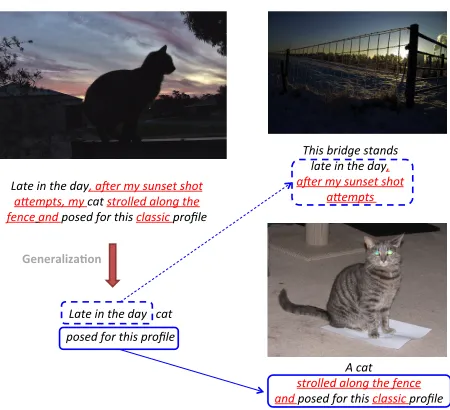
Figure 4: Compressed captions (on the left) are more ap-plicable for describing new images (on the right).
optional pre-processing step. Figure 4 illustrates a concrete example of image caption generalization in the context of image caption generation.
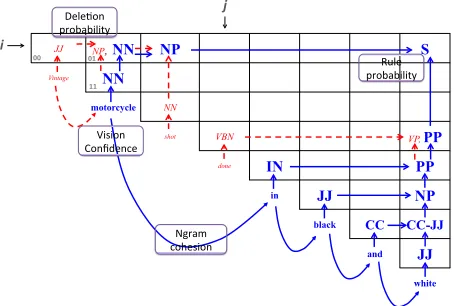
We cast caption generalization as sentence com-pression. We encode the problem as tree pruning via lightweight CKY parsing, while also incorporating several other considerations such as leaf-level ngram cohesion scores and visually informed content selec-tion. Figure 5 shows an example compression, and Figure 6 shows the corresponding CKY matrix.
At a high level, the compression operation resem-bles bottom-up CKY parsing, but in addition to pars-ing, we also consider deletion of parts of the trees. When deleting parts of the original tree, we might need to re-parse the remainder of the tree. Note that we consider re-parsing only with respect to the orig-inal parse tree produced by a state-of-the-art parser,
hence it is only alight-weightparsing.5
4.1 Dynamic Programming
Input to the algorithm is a sentence, represented as a
vectorx=x0...xn−1 =x[0 :n−1], and its PCFG
parseπ(x) obtained from the Stanford parser. For
simplicity of notation, we assume that both the parse
tree and the word sequence are encoded inx. Then,
the compression can be formalized as:
5Integrating full parsing into the original sentence would be
a straightforward extension conceptually, but may not be an em-pirically better choice when parsing for compression is based on vanilla unlexicalized parsing.
ˆ
y= arg max
y
Y
i
φi(x,y) (14)
Where eachφiis a potential function, corresponding
to a criteria of the desired compression:
φi(x,y) = exp(θi·fi(x,y)) (15)
Whereθi is the weight for a particular criteria
(de-scribed in§4.2), whose scoring function isfi.
We solve the decoding problem (Equation 14) us-ing dynamic programmus-ing. For this, we need to solve the compression sub-problems for sequences
x[i: j], which can be viewed as branchesyˆ[i, j]of
the final treeyˆ[0 :n−1]. For example, in Figure 5,
the final solution isyˆ[0 : 7], while a sub-solution of
x[4 : 7] corresponds to a tree branch P P. Notice
that sub-solutionyˆ[3 : 7]represents the same branch
asyˆ[4 : 7]due to branch deletion. Some computed
sub-solutions, e.g., yˆ[1 : 4], get dropped from the
final compressed tree.
We define a matrix of scores D[i, j, h]
(Equa-tion 17), wherehis one of the nonterminal symbols
being considered for a cell indexed byi, j, i.e. a
can-didate for the root symbol of a branchyˆ[i:j]. When
all valuesD[i, j, h]are computed, we take
ˆ
h= arg max
h
D[0, n−1, h] (16)
and backtrack to reconstruct the final compression (the exact solution to equation 14).
D[i, j, h] = max k∈[i, j)
r∈Rh
(1) D[i, k, p] +D[k+ 1, j, q] +∆φ[r, ij]
(2) D[i, k, p] + ∆φ[r, ij]
(3) D[k+ 1, j, p] + ∆φ[r, ij]
(17)
WhereRh ={r∈R:r=h→pq∨r =h→ p}.
Indexk determines a split point for child branches
of a subtreeyˆ[i:j]. For example, in the Figure 5 the
split point for children of the subtreeyˆ[0 : 7]isk=
2. The three cases ((1) – (3)) of the above equation
correspond to the following tree pruning cases:
Pruning Case (1): None of the children of the cur-rent node is deleted. For example, in Figures 5 and
6, the PCFG rule P P → IN P P, corresponding
to the sequence “in black and white”, is retained.
Another situation that can be encountered is tree re-parsing.
Vintage! motorcycle! shot! done! in! black! and! white!
JJ! NN! NN! VBN! IN! JJ! CC! JJ!
NP,NN!
NP!
CC-JJ
VP, PP
NP!
PP S
Dele%on! probability!
Rule! probability!
Vision! confidence!
Ngram! cohesion!
(Dele%on,)case)2))
(Dele%on,)case)1))
0 1 2 3 4 5 6 7
[image:7.612.316.543.54.207.2]k=2$
Figure 5: CKY compression. Both the chosen rules and phrases (blue bold font and blue solid arrows) and not chosen rules and phrases (red italic smaller font and red dashed lines) are shown.
Pruning Case (2)/(3): Deletion of the left/right child respectively. There are two types of deletion, as illustrated in Figures 5 and 6. The first corre-sponds to deletion of a child node. For example,
the second child N N of rule N P → N P N N is
deleted, which yields deletion of“shot”. The
sec-ond type is a special case of propagating a node to a higher-level of the tree. In Figure 6, this
sit-uation occurs when deleting JJ “Vintage”, which
causes the propagation of N N from cell 11 to cell
01. For this purpose, we expand the set of rulesR
with additional special rules of the form h → h,
e.g.,N N →N N, which allows propagation of tree
nodes to higher levels of the compressed tree.6
4.2 Modeling Compression Criteria
The∆φterm7in Equation 17 denotes the sum oflog
of potential functions for each criteriaq:
∆φ[r, ij] =X
q
θ·∆fq(r, ij) (18)
Note that∆φdepends on the current rule r, along
with the historical information before the current
stepij, such as the original rulerij, and ngrams on
the border between left and right child branches of
rulerij. We use the following four criteriafqin our
model, which are demonstrated in Figures 5 and 6.
I. Tree Structure: We capture PCFG rule
prob-abilities estimated from the corpus as ∆fpcf g =
logPpcf g(r).
6We assign probabilities of these special propagation rules
to 1 so that they will not affect the final parse tree score. Turner and Charniak (2005) handled propagation cases similarly.
7We use∆to distinguish the potential value for the whole
sentence from the gain of the potential during a single step of the algorithm.
JJ NP, NN NP S
Vintage NN
motorcycle NN
shot VBN VP, PP
done IN PP
in JJ NP
black CC CC-JJ
and JJ
white 00"
11"
01" Rule%
probability%
Ngram% cohesion% Dele6on%
probability%
Vision% Confidence%
i"
j"
Figure 6: CKY compression. Both the chosen rules and phrases (blue bold font and blue solid arrows) and not chosen rules and phrases (red italic smaller font and red dashed lines) are shown.
II. Sequence Structure: We incorporate ngram
cohesion scores only across the border between two branches of a subtree.
III. Branch Deletion Probabilities: We compute probabilities of deletion for children as:
∆fdel= logP(rt|rij) = logcount(rt, rij)
count(rij)
(19)
Wherecount(rt, rij)is the frequency in whichrijis
transformed tortby deletion of one of the children.
We estimate this probability from a training corpus,
described in§4.3. count(rij)is the count ofrij in
uncompressed sentences.
IV. Vision Detection (Content Selection): We
want to keep words referring to actual objects in
the image. Thus, we useV(xj), a visual similarity
score, as our confidence of an object corresponding
to wordxj. This similarity is obtained from the
vi-sual recognition predictions of (Deng et al., 2012b). Note that some test instances include rules that we have not observed during training. We default to the original caption in those cases. The weights
θi are set using a tuning dataset. We control
over-compression by setting the weight forfdelto a small
value relative to the other weights.
4.3 Human Compressed Captions
Although we model image caption generalization as sentence compression, in practical applications we may want the outputs of these two tasks to be differ-ent. For example, there may be differences in what should be deleted (named entities in newswire sum-maries could be important to keep, while they may
[image:7.612.75.301.56.192.2]Orig:"Note"the"pillows,"they"match"the" chair"that"goes"with"it,"plus"the"table"
in"the"picture"is"included.%
SeqCompression:%The"table"in"the"
picture." "
TreePruning:"The"chair"with"the"table"
in"the"picture."
Orig:"Only"in"winter;me"we"see"
these"birds"here"in"the"river." %
SeqCompression:"See"these"birds"
in"the"river." "
TreePruning:"These"birds"in"the"
river.""
Orig:"The"world's"most"powerful"
lighthouse"si@ng"beside"the"house" with"the"world's"thickest"curtains."
SeqCompression:%Si@ng"beside"
the"house" "
TreePruning:"Powerful"lighthouse"
beside"the"house"with"the" curtains.""
Orig:"Orange"cloud"on"street"
light"C"near"Lanakila"Street" (phone"camera)." "
SeqCompression:%Orange"street"
"
TreePruning:"Phone"camera.%
Relevance(problem(
Orig:"There's"something"about"
having"5"trucks"parked"in"front"of"my" house"that"makes"me"feel"all" importantClike."
SeqCompression:%Front"of"my"house."
"
TreePruning:"Trucks"in"front"my"
house.%
[image:8.612.81.534.59.194.2]Grammar(mistakes(
Figure 7: Caption generalization: good/bad examples.
be extraneous for image caption generalization). To learn the syntactic patterns for caption generaliza-tion, we collect a small set of example compressed captions (380 in total) using Amazon Mechanical Turk (AMT) (Snow et al., 2008). For each image, we asked 3 turkers to first list all visible objects in an image and then to write a compressed caption by removing not visually verifiable bits of text. We then align the original and compressed captions to mea-sure rule deletion probabilities, excluding misalign-ments, similar to Knight and Marcu (2000). Note that we remove this dataset from the 1M caption cor-pus when we perform description generation.
5 Experiments
We use the 1M captioned image corpus of Ordonez et al. (2011). We reserve 1K images as a test set, and use the rest of the corpus for phrase extraction. We experiment with the following approaches:
Proposed Approaches:
• TREEPRUNING: Our tree compression
ap-proach as described in§4.
• SEQ+TREE: Our tree composition approach as
described in§3.
• SEQ+TREE+PRUNING: SEQ+TREE using
compressed captions of TREEPRUNING as
building blocks.
Baselines for Composition:
• SEQ+LINGRULE: The most equivalent to the
older sequence-driven system (Kuznetsova et al., 2012). Uses a few minor enhancements, such as sentence-boundary statistics, to im-prove grammaticality.
• SEQ: The§3 system without tree models and
mentioned enhancements of SEQ+LINGRULE.
Method Bleu Meteor
w/ (w/o)
penalty P R M
SEQ+LINGRULE 0.152 (0.152) 0.13 0.17 0.095
SEQ 0.138 (0.138) 0.12 0.18 0.094
SEQ+TREE 0.149 (0.149) 0.13 0.14 0.082
SEQ+PRUNING 0.177(0.177) 0.15 0.16 0.101
SEQ+TREE+PRUNING 0.140 (0.189) 0.16 0.12 0.088
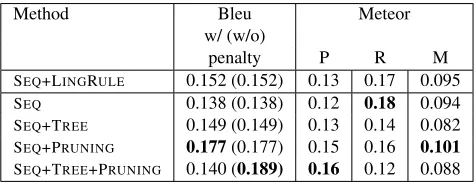
Table 1: Automatic Evaluation
• SEQ+PRUNING: SEQ using compressed
cap-tions of TREEPRUNINGas building blocks.
We also experiment with the compression of human written captions, which are used to generate image descriptions for the new target images.
Baselines for Compression:
• SEQCOMPRESSION(Kuznetsova et al., 2013):
Inference operates over the sequence structure. Although optimization is subject to constraints derived from dependency parse, parsing is not an explicit part of the inference structure. Ex-ample outputs are shown in Figure 7.
5.1 Automatic Evaluation
We perform automatic evaluation using two
mea-sures widely used in machine translation:BLEU
(Pa-pineni et al., 2002)8andMETEOR(Denkowski and
Lavie, 2011).9 We remove all punctuation and
con-vert captions to lower case. We use 1K test
im-ages from the captioned image corpus,10 and
as-sume the original captions as the gold standard cap-tions to compare against. The results in Table 1
8We use the unigram NIST implementation: ftp://jaguar.
ncsl.nist.gov/mt/resources/mteval-v13a-20091001.tar.gz
9With equal weight between precision and recall in Table 1. 10Except for those for which image URLs are broken, or
CPLEX did not return a solution.
[image:8.612.313.551.227.318.2]Method-1 Method-2 Criteria Method-1 preferred over Method-2 (%)
all turkers turkers w/κ >0.55 turkers w/κ >0.6 Image Description Generation
SEQ+TREE SEQ Rel 72 72 72
SEQ+TREE SEQ Gmar 83 83 83
SEQ+TREE SEQ All 68 69 66
SEQ+TREE+PRUNING SEQ+TREE Rel 68 72 72
SEQ+TREE+PRUNING SEQ+TREE Gmar 41 38 41
SEQ+TREE+PRUNING SEQ+TREE All 63 64 66
SEQ+TREE SEQ+LINGRULE All 62 64 62
SEQ+TREE+PRUNING SEQ+LINGRULE All 67 75 77
SEQ+TREE+PRUNING SEQ+PRUNING All 73 75 75
SEQ+TREE+PRUNING HUMAN All 24 19 19
Image Caption Generalization
[image:9.612.71.542.54.225.2]TREEPRUNING SEQCOMPRESSION∗ Rel 65 65 66
Table 2: Human Evaluation: posed as a binary question“which of the two options is better?”with respect toRelevance
(Rel),Grammar(Gmar), andOverall(All). According to Pearson’sχ2test, all results are statistically significant.
show that both the integration of the tree structure
(+TREE) and the generalization of captions using
tree compression (+PRUNING) improve the BLEU
score without brevity penalty significantly,11 while
improving METEOR only moderately (due to an im-provement on precision with a decrease in recall.)
5.2 Human Evaluation
Neither BLEU nor METEOR directly measure grammatical correctness over long distances and may not correspond perfectly to human judgments. Therefore, we supplement automatic evaluation with
human evaluation. For human evaluations, we
present two options generated from two compet-ing systems, and ask turkers to choose the one that
is better with respect to: relevance, grammar, and
overall. Results are shown in Table 2 with 3 turker ratings per image. We filter out turkers based on a control question. We then compute the selec-tion rate (%) of preferring method-1 over method-2. The agreement among turkers is a frequent concern. Therefore, we vary the set of dependable users based
on their Cohen’s kappa score (κ) against other users.
It turns out, filtering users based onκdoes not make
a big difference in determining the winning method. As expected, tree-based systems significantly out-perform sequence-based counterparts. For example,
11While 4-gram BLEU with brevity penalty is found to
cor-relate better with human judges by recent studies (Elliott and Keller, 2014), we found that this is not the case for our task. This may be due to the differences in the gold standard cap-tions. We use naturally existing ones, which include a wider range of content and style than crowd-sourced captions.
Seq:"A"bu&erfly"to"the"car"was"spo&ed"by" my"nine"year"old"cousin."
Seq+Pruning:"The"bu&erflies"are" a&racted"to"the"colourful"flowers"to"the" car.+
Seq+Tree:"The"bu&erflies"are"a&racted"to" the"colourful"flowers"in"Hope"Gardens."
"
Seq+Tree+Pruning:"The"bu&erflies"are" a&racted"to"the"colourful"flowers." Orig:"The"bu&erflies"are"a&racted"
to"the"colourful"flowers"in"Hope" Gardens."
"
SeqCompression:"The"colourful" flowers."
"
"
TreePruning:"The"bu&erflies"are" a&racted"to"the"colourful"flowers."
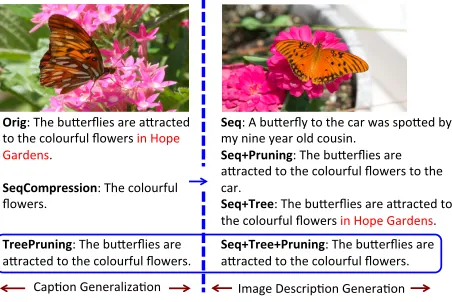
"" Cap>on"Generaliza>on"
Image"Descrip>on"Genera>on"
Figure 8: An example of a description preferred over hu-man gold standard. Image description is improved due to caption generalization.
SEQ+TREE is strongly preferred over SEQ, with a
selection rate of 83%. Somewhat surprisingly, im-proved grammaticality also seems to improve rele-vance scores (72%), possibly because it is harder to appreciate the semantic relevance of automatic cap-tions when they are less comprehensible. Also as expected, compositions based on pruned tree frag-ments significantly improve relevance (68–72%), while slightly deteriorating grammar (38–41%).
Notably, the captions generated by our system are preferred over the original (owner generated) cap-tions 19–24% of the time. One such example is
in-cluded in Figure 8: “The butterflies are attracted to
the colorful flowers.”
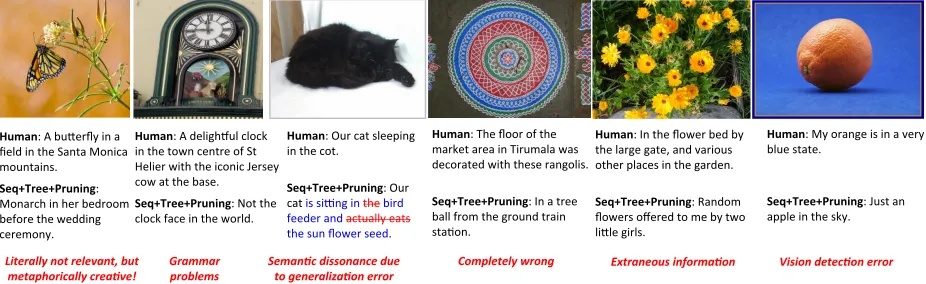
Additional examples (good and bad) are pro-vided in Figures 9 and 10. Many of these captions are highly expressive while remaining semantically
[image:9.612.317.543.268.419.2]Human:"Some"flower"on"a" bar"in"a"hotel"in"Grapevine," TX."
" &
Seq+Tree+Pruning:"The" flower"was"so"vivid"and" a:rac<ve."
Highly'expressive'
Human:"Maybe"the"most"common" bird"in"the"neighborhood,"not"just" the"most"common"water"fowl"in" the"neighborhood!"
&
Seq+Tree+Pruning:"The"duck"was" having"a"feast."
Human:"Spring"in"a"white" dress."
& &
Seq+Tree+Pruning:"Blue" flowers"have"no"scent." Small"white"flowers"have" no"idea"what"they"are."
Poe0c'
Human:"Tower"bridge" London"in"black"and" white.&
& &
Seq+Tree+Pruning:"The" tower"built"on"each"side." Human:"This"stained"glass"
window"is"in"the"porch"of" Kilcash"Church,"Slieve"na" Mon."
&
Seq+Tree+Pruning:"This" window"depicts"the"church."
Interes0ng'choice'of'verb'phrases'
Human:"Shot"in"Blackpool"on" Tescos"car"park"with"use"of"a" 5M"candle"power"light.& &
& &
Seq+Tree+Pruning:"Red"car"in" the"middle"of"the"road."
[image:10.612.74.537.54.195.2]Informa0ve'
Figure 9: Description generation: good examples. Description preferred over human gold standard are highlighted.
Human:"The"floor"of"the"
market"area"in"Tirumala"was" decorated"with"these"rangolis." "
&
Seq+Tree+Pruning:"In"a"tree"
ball"from"the"ground"train" sta:on."
Human:"Our"cat"sleeping"
in"the"cot." " &
Seq+Tree+Pruning:"Our"
cat"is"si=ng"in"the"bird" feeder"and"actually"eats" the"sun"flower"seed."
Human:"My"orange"is"in"a"very"
blue"state." " " &
Seq+Tree+Pruning:"Just"an"
apple"in"the"sky."
Human:"In"the"flower"bed"by"
the"large"gate,"and"various" other"places"in"the"garden." "
&
Seq+Tree+Pruning:"Random"
flowers"offered"to"me"by"two" liEle"girls."
Seman&c(dissonance(due(
to(generaliza&on(error( Completely(wrong( Extraneous(informa&on( Vision(detec&on(error(
Human:"A"delighGul"clock"
in"the"town"centre"of"St" Helier"with"the"iconic"Jersey" cow"at"the"base." &
Seq+Tree+Pruning:"Not"the"
clock"face"in"the"world."
Grammar( problems(
Human:"A"buEerfly"in"a"
field"in"the"Santa"Monica" mountains."
&
Seq+Tree+Pruning:"
Monarch"in"her"bedroom" before"the"wedding" ceremony."
Literally(not(relevant,(but( metaphorically(crea&ve!(
Figure 10: Description generation: bad examples.
plausible, thanks to the expressive, but somewhat predictable descriptions online users write about their photos. Even among the bad examples (Fig-ure 10) one can find highly creative captions with
not literal but metaphorical relevance: “Monarch in
her bedroom before the wedding ceremony”.12 The
complete system captions and the original captions
are available at http://ilp-cky.appspot.
com/
6 Related Work
Sentence Fusion Sentence fusion has been stud-ied mostly for multi-document summarization (Barzilay and McKeown, 2005), where redundancy across multiple sentences serves as a guideline for syntactic and semantic validity of generation. In contrast, we do not have the natural redundancy to rely upon in our task, therefore requiring the compo-sition algorithm to be intrinsically better constrained for correct sentence structures.
12“Monarch” can be a type of butterfly.
Sentence Compression At the core of the image caption generalization task is sentence compression. Much work has considered deletion-only edits like ours (Knight and Marcu, 2000; Turner and Char-niak, 2005; Cohn and Lapata, 2007; Filippova and Altun, 2013), while recent ones explore more com-plex edits, such as substitutions, insertions and re-ordering (Cohn and Lapata, 2008). The latter gener-ally requires a larger training corpus. We leave more expressive compression as a future research work.
7 Conclusion
In this paper, we have presented a novel tree com-position approach for generating expressive image descriptions. As an optional preprocessing step, we also presented a tree compression approach and re-ported the empirical benefit of using automatically compressed captions to improve image description generation. By integrating both the tree structure and the sequence structure, we have significantly im-proved the quality of composed image captions over several competitive baselines.
[image:10.612.75.538.228.370.2]