Identifying Functional Relations in Web Text
Thomas Lin, Mausam, Oren Etzioni
Turing Center University of Washington
Seattle, WA 98195, USA
{tlin,mausam,etzioni}@cs.washington.edu
Abstract
Determining whether a textual phrase denotes a functional relation (i.e., a relation that maps each domain element to a unique range el-ement) is useful for numerous NLP tasks such as synonym resolution and contradic-tion deteccontradic-tion. Previous work on this prob-lem has relied on either counting methods or lexico-syntactic patterns. However, determin-ing whether a relation is functional, by ana-lyzing mentions of the relation in a corpus, is challenging due to ambiguity, synonymy, anaphora, and other linguistic phenomena.
We present the LEIBNIZ system that over-comes these challenges by exploiting the syn-ergy between the Web corpus and freely-available knowledge resources such as Free-base. It first computes multipletyped function-alityscores, representing functionality of the relation phrase when its arguments are con-strained to specific types. It then aggregates these scores to predict the global functionality for the phrase. LEIBNIZ outperforms previ-ous work, increasing area under the precision-recall curve from 0.61 to 0.88. We utilize LEIBNIZ to generate the first public reposi-tory of automatically-identified functional re-lations.
1 Introduction
The paradigm of Open Information Extraction (IE) (Banko et al., 2007; Banko and Etzioni, 2008) has scaled extraction technology to the massive set of relations expressed in Web text. However, additional work is needed to better understand these relations,
and to place them in richer semantic structures. A step in that direction is identifying the properties of these relations,e.g., symmetry, transitivity and our focus in this paper – functionality. We refer to this problem asfunctionality identification.
A binary relation is functional if, for a given arg1, there is exactly one unique value for arg2. Exam-ples of functional relations are father, death date, birth city, etc. We define a relation phrase to be functional if all semantic relations commonly ex-pressed by that phrase are functional. For exam-ple, we say that the phrase ‘was born in’ denotes a functional relation, because the different seman-tic relations expressed by the phrase (e.g.,birth city, birth year, etc.) are all functional.
Knowing that a relation is functional is helpful for numerous NLP inference tasks. Previous work has used functionality for the tasks of contradiction detection (Ritter et al., 2008), quantifier scope dis-ambiguation (Srinivasan and Yates, 2009), and syn-onym resolution (Yates and Etzioni, 2009). It could also aid in other tasks such as ontology generation and information extraction. For example, consider two sentences from a contradiction detection task: (1) “George Washingtonwas born inVirginia.” and (2) “George Washingtonwas born inTexas.” As Ritter et al.(2008) points out, we can only de-termine that the two sentences are contradictory if we know that the semantic relation referred to by the phrase‘was born in’is functional, and that both Virginia and Texas are distinct states.
Automaticfunctionality identification is essential when dealing with a large number of relations as in Open IE, or in complex domains where expert help
Distributional Difference
Assertions Web
Corpus IE
Functionality prediction for Web relations Combination Policy
Freebase
Clean Lists
type lists instances per relation
[image:2.612.113.255.50.186.2]functionality scores (typed)
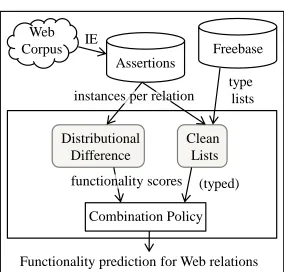
Figure 1: Our system, LEIBNIZ, uses the Web and Free-base to determine functionality of Web relations.
is scarce or expensive (e.g., biomedical texts). This paper tackles automatic functionality identification using Web text. While functionality identification has been utilized as a module in various NLP sys-tems, this is the first paper to focus exclusively on functionality identification as abona fideNLP infer-ence task.
It is natural to identify functions based on triples extracted from text instead of analyzing sentences directly. Thus, as our input, we utilize tuples ex-tracted by TEXTRUNNER(Banko and Etzioni, 2008) when run over a corpus of 500 million webpages. TEXTRUNNERmaps sentences to tuples of the form <arg1, relation phrase, arg2> and enables our LEIBNIZ system to focus on the problem of
decid-ing whether the relation phrase is a function. The naive approach, which classifies a relation phrase as non-functional if several arg1s have multi-ple arg2s in our extraction set, fails due to several reasons: synonymy – a unique entity may be re-ferred by multiple strings, polysemy of both entities and relations – a unique string may refer to multiple entities/relations, metaphorical usage, extraction er-rors and more. These phenomena conspire to make the functionality determination task inherently sta-tistical and surprisingly challenging.
In addition, a functional relation phrase may ap-pear non-functional until we consider the types of its arguments. In our‘was born in’example,<George Washington,was born in, 1732>does not contradict <George Washington,was born in, Virginia>even though we see two distinct arg2s for the same arg1. To solve functionality identification, we need to con-sider typed relations where the relations analyzed are constrained to have specific argument types.
We develop several approaches to overcome these
challenges. Our first scheme employs approximate argument merging to overcome the synonymy and anaphora problems. Our second approach, DIS -TRDIFF, takes a statistical view of the problem and learns a separator for the typical count dis-tributions of functional versus non-functional rela-tions. Finally, our third and most successful scheme, CLEANLISTS, identifies and processes a cleaner subset of the data by intersecting the corpus with en-tities in a secondary knowledge-base (in our case, Freebase (Metaweb Technologies, 2009)). Utiliz-ing pre-defined types, CLEANLISTS first identifies
typed functionality for suitable types for that rela-tion phrase, and then combines them to output a final functionality label. LEIBNIZ, a hybrid of CLEAN
-LISTS and DISTRDIFF, returns state-of-the-art re-sults for our task.
Our work makes the following contributions:
1. We identify several linguistic phenomena that make the problem of corpus-based functional-ity identification surprisingly difficult.
2. We designed and implemented three novel techniques for identifying functionality based on instance-based counting, distributional dif-ferences, and use of external knowledge bases.
3. Our best method, LEIBNIZ, outperforms the existing approaches by wide margins, increas-ing area under the precision-recall curve from 0.61 to 0.88. It is also capable of distinguishing functionality of typed relation phrases, when the arguments are restricted to specific types.
4. Utilizing LEIBNIZ, we created the first public
repository of functional relations.1
2 Related Work
There is a recent surge in large knowledge bases constructed by human collaboration such as Free-base (Metaweb Technologies, 2009) and VerbNet (Kipper-Schuler, 2005). VerbNet annotates its verbs with several properties but not functionality. Freebase does annotate some relations with an ‘is unique’ property, which is similar to functionality, but the number of relations in Freebase is still much
1
George Washington was born in:
Virginia
Westmoreland County
America a town
a plantation
1732
February
the British colony of Virginia Rudy Giuliani visited:
Florida
Boca Raton Synagogue
the Florida Everglades South Carolina
Michigan
Republican headquarters a famous cheesesteak restaurant
Philadelphia
[image:3.612.132.485.59.152.2]Colonial Beach, Virginia
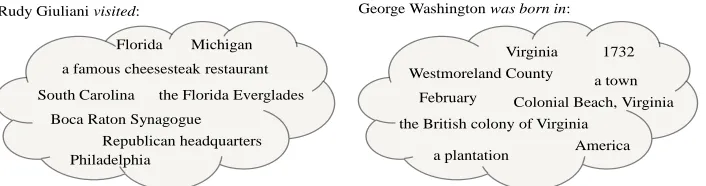
Figure 2: Sample arg2 values for a non-functional relation (visited)vs. a functional relation (was born in) illustrate the challenge in discriminating functionality from Web text.
smaller than the hundreds of thousands of relations existing on the Web, necessitating automatic ap-proaches to functionality identification.
Discovering functional dependencies has been recognized as an important database analysis tech-nique (Huhtala et al., 1999; Yao and Hamilton, 2008), but the database community does not address any of the linguistic phenomena which make this a challenging problem in NLP. Three groups of re-searchers have studied functionality identification in the context of natural language.
AuContraire (Ritter et al., 2008) is a contradic-tion deteccontradic-tion system that also learns relacontradic-tion func-tionality. Their approach combines a probabilis-tic model based on (Downey et al., 2005) with es-timates on whether each arg1 is ambiguous. The estimates are used to weight each arg1’s contri-bution to an overall functionality score for each relation. Both argument-ambiguity and relation-functionality are jointly estimated using an EM-like method. While elegant, AuContraire requires sub-stantial hand-engineered knowledge, which limits the scalability of their approach.
Lexico-syntactic patterns: Srinivasan and Yates (2009) disambiguate a quantifier’s scope by first making judgments about relation functionality. For functionality, they look fornumeric phrases follow-ing the relation. For example, the presence of the nu-meric term ‘four’ in the sentence “the firedestroyed
four shops” suggests thatdestroyedis not functional, since the same arg1 can destroy multiple things.
The key problem with this approach is that it often assigns different functionality labels for the present tense and past tense phrases of the same semantic re-lation. For example, it will consider‘lived in’to be non-functional, but‘lives in’to be functional, since we rarely say “someone lives in many cities”. Since both these phrases refer to the same semantic
rela-tion this approach has low precision. Moreover, it performs poorly for relation phrases that naturally expect numbers as the target argument (e.g.,‘has an atomic number of ’).
While these lexico-syntactic patterns do not per-form as well for our task, they are well-suited for identifying whether a verb phrase can take multiple objects or not. This can be understood as a function-ality property of the verb phrase within a sentence, as opposed to functionality of the semantic relation the phrase represents.
WIE: In a preliminary study, Popescu (2007) ap-plies an instance based counting approach, but her relations require manually annotated type restric-tions, which makes the approach less scalable.
Finally, functionality is just one property of rela-tions that can be learned from text. A number of other studies (Guarino and Welty, 2004; Volker et al., 2005; Culotta et al., 2006) have examined detect-ing other relation properties from text and applydetect-ing them to tasks such as ontology cleaning.
3 Challenges for Functionality Identification
A functional binary relationris formally defined as one such that∀x, y1, y2 :r(x, y1)∧r(x, y2)⇒y1=
y2. We define a relation string to be functional if all semantic relations commonly expressed by the rela-tion string are individually funcrela-tional. Thus, under our definition,‘was born in’and‘died in’are func-tional, even though they can take different arg2s for the same arg1,e.g., year, city, state, country,etc.
that make our problem hard (see Figure 2):
Synonymy: Various arg2s for the same arg1 may refer to the same entity. This makes many func-tional relations seem non-funcfunc-tional. For instance, <George Washington, was born in, Virginia> and <George Washington, was born in, the British colony of Virginia> are not in conflict. Other examples of synonyms include ‘Windy City’ and ‘Chicago’; ‘3rd March’ and ’03/03’,etc.
Anaphora: An entity can be referred to by using several phrases. For instance,<George Washington,
was born in, a town>does not conflict with his be-ing born in ‘Colonial Beach, Virginia’, since ‘town’ is an anaphora for his city of birth. Other examples include ‘The US President’ for ‘George W. Bush’, and ‘the superpower’ to refer to ‘United States’. The effect is similar to that of synonyms – many relations incorrectly appear non-functional.
Argument Ambiguity: <George Washington,was born in, ‘Kortrijk, Belgium’>in addition to his be-ing born in ‘Virginia’ suggests that ‘was born in’
is non-functional. However, the real cause is that ‘George Washington’ is ambiguous and refers to dif-ferent people. This ambiguity gets more pronounced if the person is referred to just by their first (or last name),e.g., ‘Clinton’ is commonly used to refer to both Hillary and Bill Clinton.
Relation Phrase Ambiguity: A relation phrase can have several senses. For instance ‘weighs 80 kilos’ is a differentweighsthan ‘weighshis options’.
Type Restrictions: A closely related problem is type-variations in the argument. E.g., <George Washington, was born in, America>vs. <George Washington, born in, Virginia> both use the same sense of‘was born in’but refer to different semantic relations – one that takes a country in arg2, and the other that takes a state. Moreover, different argu-ment types may result in different functionality la-bels. For example,‘published in’is functional if the arg2 is a year, but non-functional if it is a language, since a book could be published in many languages. We refer to this finer notion of functionality astyped functionality.
Data Sparsity: There is limited data for more ob-scure relations instances and non-functional relation phrases appear functional due to lack of evidence.
Textually Functional Relations: Last but not least, some relations that are not functional may appear functional in text. An example is‘collects’. We col-lect many things, but rarely mention it in text. Usu-ally, someone’s collection is mentioned in text only when it makes the news. We name such relations
textually functional. Even though we could build techniques to reduce the impact of other phenomena, no instance based counting scheme could overcome the challenge posed by textually functional relations. Finally, we note that our functionality predictor operates over tuples generated by an Open IE sys-tem. The extractors are not perfect and their errors can also complicate our analysis.
4 Algorithms
To overcome these challenges, we design three al-gorithms. Our first algorithm, IBC, applies several rules to determine whether two arg2s are equal. Our second algorithm, DISTRDIFF, takes a statistical ap-proach, and tries to learn a discriminator between typical count distributions for functional and non-functional relations. Our final approach, CLEAN -LISTS, applies counting over a cleaner subset of the corpus, which is generated based on entities present in a secondary KB such as Freebase.
From this section onwards, we gloss over the dis-tinction between a semantic relation and a relation phrase, since our algorithms do not have access to relations and operate only at the phrase level. We use ‘relation’ to refer to the phrases.
4.1 Instance Based Counting (IBC)
For each relation, IBC computes a global function-ality score by aggregating local functionfunction-ality scores for each arg1. The local functionality for each arg1 computes the fraction of arg2 pairs that refer to the same entity. To operationalize this computation we need to identify which arg2s co-refer. Moreover, we also need to pick an aggregation strategy to combine local functionality scores.
George Washington was born in:
Colonial Beach
Colonial Beach, Virginia
Westmoreland County, Virginia
[image:5.612.118.252.56.169.2]February February 1732 1732
Figure 3: IBC judges thatColonial Beachand Westmore-land County, Virginiarefer to the same entity.
an extraction only once per unique sentence. This reduces the disproportionately large frequencies of some assertions that are generated from a single ar-ticle published at multiple websites. Similarly, it al-lows an extraction only once per website url. More-over, it filters out any arg1 that does not appear at least 10 times with that relation.
Equality Checking: This key component judges if two arg2s refer to the same entity. It first em-ploys weak typing by disallowing equality checks across common nouns, proper nouns, dates and numbers. This mitigates the relation ambiguity problem, since we never compare ‘born in(1732)’ and‘born in(Virginia)’. Within the same category it judges two arg2s to co-refer if they share a content word. It also performs a connected component anal-ysis (Hopcraft and Tarjan, 1973) to take a transitive closure of arg2s judged equal (see Figure 3).
For example, for the relation ‘was named after’
and arg1=‘Bluetooth’ our corpus has three arg2s: ‘Harald Bluetooth’, ‘Harald Bluetooth, the King of Denmark’ and ‘the King of Denmark’. Our equal-ity method judges all three as referring to the same entity. Note that this is a heuristic approach, which could make mistakes. But for an error, there needs to be extractions with the same arg1, relation and similar arg2s. Such cases exist, but are not com-mon. Our equality checking mitigates the problems of anaphora, synonymy as well as some typing.
Aggregation: We try several methods to aggre-gate local functionality scores for each arg1 into a global score for the relation. These include, a simple average, a weighted average weighted by frequency of each arg1, a weighted average weighted by log of frequency of each arg1, and a Bayesian approach that estimates the probability that a relation is func-tional using statistics over a small development set.
Overall, the log-weighting works the best: it assigns a higher score for popular arguments, but not so high that it drowns out all the other evidence.
4.2 DISTRDIFF
Our second algorithm, DISTRDIFF, takes a purely statistical, discriminative view of the problem. It recognizes that, due to aforementioned reasons, whether a relation is functional or not, there are bound to be several arg1s that look locally functional and several that look locally non-functional. The difference is in thenumberof such arg1s – a func-tional relation will have more of the former type.
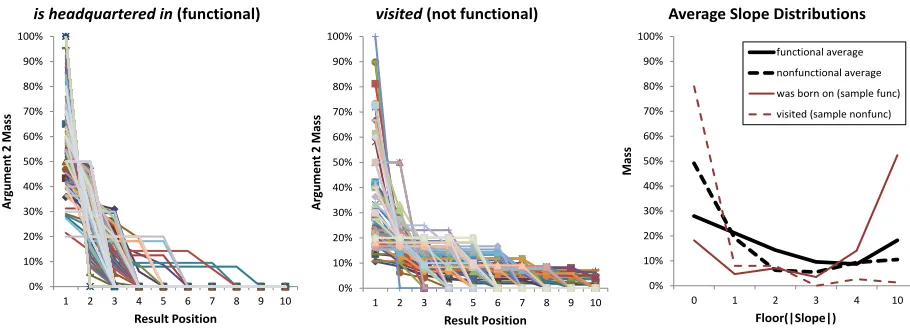
DISTRDIFF studies the count distributions for a small development set of functional relations (and similarly for non-functional) and attempts to build a separator between the two. As an illustration, Figure 4(a) plots the arg2 counts for various arg1s for a functional relation (‘is headquartered in’). Each curve represents a unique arg1. For an arg1, thex-axis represents the rank (based on frequency) of arg2s and y-axis represents the normalized fre-quency of the arg2. For example, if an arg1 is found with just one arg2, then x=1 will match with y=1 (the first point has all the mass) andx=2 will match with y=0. If, on the other hand, an arg1 is found with five arg2s, say, appearing ten times each, then the first fivex-points will map to 0.2 and the sixth point will map to 0.
We illustrate the same plot for a non-functional relation (‘visited’) in Figure 4(b). It is evident from the two figures that, as one would expect, curves for most arg1s die early in case of a functional relation, whereas the lower ranked arg2s are more densely populated in case of a non-functional relation.
0% 10% 20% 30% 40% 50% 60% 70% 80% 90% 100%
1 2 3 4 5 6 7 8 9 10
Arg
ume
n
t
2
Mas
s
Result Position
is headquartered in (functional)
0% 10% 20% 30% 40% 50% 60% 70% 80% 90% 100%
1 2 3 4 5 6 7 8 9 10
Ar
gumen
t
2
Mass
Result Position
visited (not functional)
0% 10% 20% 30% 40% 50% 60% 70% 80% 90% 100%
0 1 2 3 4 10
Mass
Floor(|Slope|) Average Slope Distributions
functional average nonfunctional average
[image:6.612.79.534.57.222.2]was born on (sample func) visited (sample nonfunc)
Figure 4: DISTRDIFF: Arg2 count distributions fall more sharply for (a) a sample functional relation, than (b) a sample non-functional relation. (c) The distance of aggregated slope-distributions from average slope-distributions can be used to predict the functionality.
the opposite. Notice that the aggregated curve for
‘visited’in the figure is closer to the average curve for non-functional than to functional and vice-versa for‘was born on’.
We plot the aggregated slope-distributions for each relation and use the distance from average dis-tributions as a means to predict the functionality. We use KL divergence (Kullback and Leibler, 1951) to compute the distance between two distributions. We score a relation’s functionality in three ways using: (1) KLFUNC, its distance from average functional
slope-distribution Favg, (2) KLDIFF, its distance from average functional minus its distance from av-erage non-functionalNavg, and (3) average of these two scores. For a relation with slope distributionR, the scores are computed as:
KLFUNC=P
iR(i)ln R(i) Favg(i)
KLDIFF= KLFUNC-(P
iR(i)ln R(i) Navg(i))
Section 5.2 compares the three scoring functions. A purely statistical approach is resilient to noisy data, and does not need to explicitly account for the various issues we detailed earlier. A disadvantage is that it cannot handle relation ambiguity and type restrictions. Moreover, we may need to relearn the separator if applying DISTRDIFF to a corpus with very different count distributions.
4.3 CLEANLISTS
Our third algorithm, CLEANLISTS, is based on the intuition that for identifying functionality we need not reason over all the data in our corpus; instead,
a small but cleaner subset of the data may work best. This clean subset should ideally be free of syn-onyms, ambiguities and anaphora, and be typed.
Several knowledge-bases such as Wordnet, Wikipedia, and Freebase (Fellbaum, 1998; Wikipedia, 2004; Metaweb Technologies, 2009), are readily and freely available and they all provide clean typed lists of entities. In our experiments CLEANLISTS employs Freebase as a source of clean lists, but we could use any of these or other domain-specific ontologies such as SNOMED (Price and Spackman, 2000) as well.
CLEANLISTS takes the intersection of Freebase entities with our corpus to generate a clean subset for functionality analysis. Freebase currently has over 12 million entities in over 1,000 typed lists. Thus, this intersection retains significant portions of the useful data, and gets rid of most of anaphora and synonymy issues. Moreover, by matching against typed lists, many relation ambiguities are separated as well, since ambiguous relations often take dif-ferent types in the arguments (e.g.,‘ran(Distance)’
vs. ‘ran(Company)’). To mitigate the effect of argu-ment ambiguity, we additionally get rid of instances in which arg1s match multiple names in the Freebase list of names.
By intersecting the relation data with argument lists for these types, we will be left with a smaller, but much cleaner, subset of relation data, one for each type. CLEANLISTSanalyzes each subset using sim-ple, instance based counting and computes a typed functionality score for each type. Thus, it first com-putes typed functionality for each relation.
There are two subtleties in applying this algo-rithm. First, we need to identify the set of types to consider for each relation. Our algorithm currently picks the types that occur most in each relation’s observed data. In the future, we could also use a selectional preferences system (Ritter et al., 2010; Kozareva and Hovy, 2010). Note that we remove Freebase types such as Written Workfrom consid-eration for containing many entities whose primary senses are not that type. For example, both ‘Al Gore’ and ‘William Clinton’ are also names of books, but references in text to these are rarely a reference to the written work sense.
Secondly, an argument could belong to multiple Freebase lists. For example, ‘California’ is both a city and a state. We apply a simple heuristic: if a string appears in multiple lists under consideration, we assign it to the smallest of the lists (the list of cities is much larger than states). This simple heuris-tic usually assigns an argument to its intended type. On a development set, the error rate of this heuristic is<4%, though it varies a bit depending on the types involved.
CLEANLISTS determines the overall functional-ity of a relation string by aggregating the scores for each type. It outputs functional if a majority of typed senses for the relation are functional. For example, CLEANLISTSjudges‘was born in’to be functional, since all relevant type restrictions are individually typed functional – everyone is born in exactly one country, city, state, month,etc.
CLEANLISTShas a much higher precision due to
the intersection with clean lists, though at some cost of recall. The reason for lower recall is that the ap-proach has a bias towards types that are easy to enu-merate. It does not have different distances (e.g., 50 kms, 20 miles,etc.) in its lists. Moreover, arguments that do not correspond to a noun cannot be handled. For example, in the sentence, “He weighed eating a cheeseburger against eating a salad”, the arg2 of
‘weighed’ can’t be matched to a Freebase list. To
increase the recall we back off to DISTRDIFFin the cases when CLEANLISTS is unable to make a pre-diction. This combination gives the best balance of precision and recall for our task. We name our final system LEIBNIZ.
One current limitation is that using only those arg2s that exactly match clean lists leaves out some good data (e.g., a tuple with an arg2 of ‘Univ of Wash’ will not match against a list of universities that spells it as ‘University of Washington’). Be-cause we have access to entity types, using typed equality checkers (Prager et al., 2007) with the clean lists would allow us to recapture much of this useful data. Moreover, the knowledge of functions could apply to building new type nanotheories and reduce considerable manual effort. We wish to study this in the future.
5 Evaluation
In our evaluation, we wish to answer three ques-tions: (1) How do our three approaches, Instance Based Counting (IBC), DISTRDIFF, and CLEAN -LISTS, compare on the functionality identification task? (2) How does our final system, LEIBNIZ, compare against the existing state of the art tech-niques? (3) How well is LEIBNIZ able to identify typed functionality for different types in the same relation phrase?
5.1 Dataset
For our experiments we test on the set of 887 re-lations used by Ritter et al. (2008) in their exper-iments. We use the Open IE corpus generated by running TEXTRUNNERon 500 million high quality Webpages (Banko and Etzioni, 2008) as the source of instance data for these relations. Extractor and corpus differences lead to some relations not occur-ring (or not occuroccur-ring with sufficient frequency to properly analyze,i.e.,≥5 arg1 with≥10 evidence), leaving a dataset of 629 relations on which to test.
0 0.1 0.2 0.3 0.4 0.5 0.6 0.7 0.8 0.9 1
0 0.2 0.4 0.6 0.8 1
Pr
eci
si
on
Recall
Distr. Diff. Scoring Functions
KLfunc KLdiff Average
0 0.1 0.2 0.3 0.4 0.5 0.6 0.7 0.8 0.9 1
0 0.2 0.4 0.6 0.8 1
Pr
eci
si
on
Recall
Internal Methods Comparison
IBC Distr. Diff. CleanLists
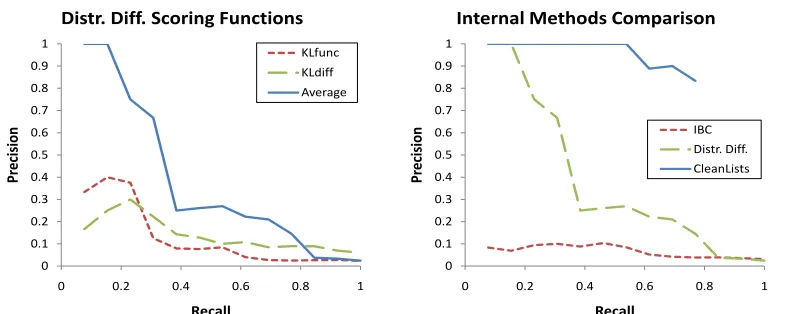
Figure 5: (a) The best scoring method for DISTRDIFFaverages KLFUNCand KLDIFF. (b) CLEANLISTSperforms significantly better than DISTRDIFF, which performs significantly better than IBC.
on which the two experts agreed (a subset of 601 relation phrases).
5.2 Internal Comparisons
First, we compare the three scoring functions for DISTRDIFF. We vary the score thresholds to gener-ate the different points on the precision-recall curves for each of the three. Figure 5(a) plots these curves. It is evident that the hybrid scoring function, i.e., one which is an average of KLFUNC(distance from average functional) and KLDIFF(distance from av-erage functional minus distance from avav-erage non-functional) performs the best. We use this scoring in the further experiments involving DISTRDIFF.
Next, we compare our three algorithms on the dataset. Figure 5(b) reports the results. CLEANLISTSoutperforms DISTRDIFFby vast mar-gins, covering a 33.5% additional area under the precision-recall curve. Overall, CLEANLISTSfinds the very high precision points, because of its use of clean data. However, it is unable to make 23.1% of the predictions, primarily because the intersection between the corpus and Freebase entities results in very little data for those relations. DISTRDIFF
per-forms better than IBC, due to its statistical nature, but the issues described in Section 3 plague both these systems much more than CLEANLISTS.
To increase the recall LEIBNIZ uses a
combina-tion of DISTRDIFFand CLEANLISTS, in which the algorithm backs off to DISTRDIFFif CLEANLISTS
is unable to output a prediction.
5.3 External Comparisons
We next compare LEIBNIZagainst the existing state of the art approaches. Our competitors are AuCon-traire and NumericTerms (Ritter et al., 2008; Srini-vasan and Yates, 2009). Because we use the Au-Contraire dataset, we report the results from their best performing system. We reimplement a version of NumericTerms using their list of numeric quanti-fiers and extraction patterns that best correspond to our relation format. We run our implementation of NumericTerms on a dataset of 100 million English sentences from a crawl of high quality Webpages to generate the functionality labels.
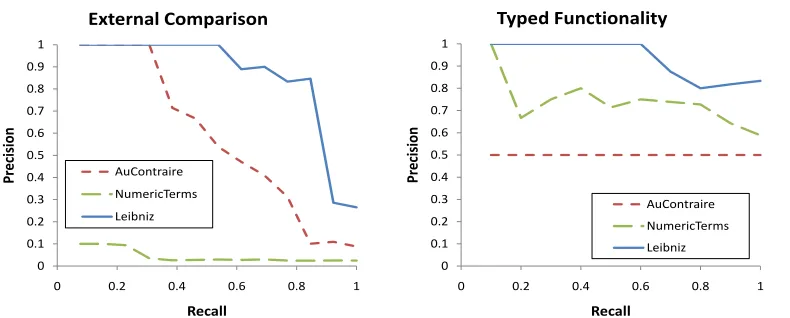
Figure 6(a) reports the results of this experiment. We find that LEIBNIZ outperforms AuContraire by vast margins covering an additional 44% area in the precision-recall curve. AuContraire’s AUC is 0.61 whereas LEIBNIZ covers 0.88. A Bootstrap Per-centile Test (Keller et al., 2005) onF1 score found the improvement of our techniques over AuCon-traire to be statistically significant atα= 0.05. Nu-mericTerms does not perform well, because it makes decisions based only on the local evidence in a sen-tence, and does not integrate the knowledge from different occurrences of the same relation. It returns many false positives, such as ‘lives in’, which ap-pear functional to the lexico-syntactic pattern, but are clearly non-functional, e.g., one could live in many places over a lifetime.
[image:8.612.104.502.57.214.2]0 0.1 0.2 0.3 0.4 0.5 0.6 0.7 0.8 0.9 1
0 0.2 0.4 0.6 0.8 1
Pr
eci
si
on
Recall
Typed Functionality
AuContraire NumericTerms Leibniz 0
0.1 0.2 0.3 0.4 0.5 0.6 0.7 0.8 0.9 1
0 0.2 0.4 0.6 0.8 1
Pr
eci
si
on
Recall
External Comparison
AuContraire NumericTerms Leibniz
Figure 6: (a) LEIBNIZ, which is a hybrid of CLEANLISTSand DISTRDIFF, achieves 0.88 AUC and outperforms the 0.61 AUC from AuContraire (Ritter et al., 2008) and the 0.05 AUC from NumericTerms (Srinivasan and Yates, 2009). (b) LEIBNIZis able to tease apart different senses of polysemous relations much better than other systems.
but the human experts might have had some non-functional senses in mind while labeling.
5.4 Typed Functionality
Next, we conduct a study of the typed functional-ity task. We test on ten common polysemous re-lations, each having both a functional and a non-functional sense. An example is the ‘was pub-lished in’ relation. If arg2 is a year it is func-tional, e.g. <Harry Potter 5, was published in, 2003>. However, ‘was published in(Language)’ is not functional, e.g. <Harry Potter 5, was pub-lished in, [French / Spanish / English]>. Simi-larly,‘will become(Company)’ is functional because when a company is renamed, it transitions away from the old name exactly once, e.g. <Cingular,
will become, AT&T Wireless>. However,‘will be-come(government title)’ is not functional, because people can hold different offices in their life, e.g., <Obama,will become, [Senator / President]>.
In this experiment, a simple baseline of predict-ing the same label for the two types of each rela-tion achieves a precision of 0.5. Figure 6(b) presents the results of this study. AuContraire achieves a flat 0.5, since it cannot distinguish between types. Nu-mericTerms can be modified to distinguish between basic types – check the word just after the numeric term to see whether it matches the type name. For example, the modified NumericTerms will search the Web for instances of “was published in [nu-meric term]years” vs. “was published in[numeric term] languages”. This scheme works better when the type name is simple (e.g., languages) rather than
complex (e.g., government titles).
LEIBNIZ performs the best and is able to tease apart the functionality of various types very well. When LEIBNIZ did not work, it was generally be-cause of textual functionality, which is a larger issue for typed functionality than general functionality. Of course, these results are merely suggestive – we per-form a larger-scale experiment and generate a repos-itory of typed functions next.
6 A Repository of Functional Relations
We now report on a repository of typed functional relations generated automatically by applying LEIB
-NIZto a large collection of relation phrases. Instead of starting with the most frequent relations from TEXTRUNNER, we use OCCAM’s relations (Fader et al., 2010) because they are more specific. For in-stance, where TEXTRUNNERoutputs an
underspec-ified tuple,<Gold,has, an atomic number of 79>, OCCAMextracts<Gold,has an atomic number of, 79>. OCCAMenables LEIBNIZto identify far more
functional relations than TEXTRUNNER.
6.1 Addressing Evidence Sparsity
Scaling up to a large collection of typed relations requires us to consider the size of our data sets. For example, consider which relation is more likely to be functional—a relation with 10 instances all of which indicate functionality versus a relation with 100 in-stances where 95 behave functionally.
[image:9.612.106.501.57.216.2]For a typed relation withninstances,fof which in-dicate functionality, the G-test (Dunning, 1993),G
= 2*(f*ln(f/k)+(n-f)*ln((n-f)/(n-k))), provides a mea-sure for the likelihood that the relation is not func-tional. Herekdenotes the evidence indicating tionality for the case where the relation is not func-tional. Settingk=n*0.25 worked well for us. This G-score replaces our previous metric for scoring functional relations.
6.2 Evaluation of the Repository
In CLEANLISTS a factor that affects the quality of the results is the exact set of lists that is used. If the lists are not clean, results get noisy. For exam-ple, Freebase’s list offilmscontains 73,000 entries, many of which (e.g., ”Egg”) are not films in their pri-mary senses. Even with heuristics such as assigning terms to their smallest lists and disqualifying dictio-nary words that occur from large type lists, there is still significant noise left.
Using LEIBNIZ with a set of 35 clean lists on OCCAM’s extraction corpus, we generated a repos-itory of 5,520 typed functional relations. To eval-uate this resource a human expert tagged a random subset of the top 1,000 relations. Of these relations 22% were either ill-formed or had non-sensical type constraints. From the well-formed typed relations the precision was estimated to be 0.8. About half the errors were due to textual functionality and the rest were LEIBNIZerrors. Some examples of good functions found include isTheSequelTo(videogame)
and areTheBirthstoneFor(month). An example of a textually functional relation found is wasThe-FounderOf(company).
This is the first public repository of automatically-identified functional relations. Scaling up our data set forced us to confront new sources of noise in-cluding extractor errors, errors due to mismatched types, and errors due to sparse evidence. Still, our initial results are encouraging and we hope that our resource will be valuable as a baseline for future work.
7 Conclusions
Functionality identification is an important subtask for Web-scale information extraction and other ma-chine reading tasks. We study the problem of
pre-dicting the functionality of a relation phrase auto-matically from Web text. We presented three algo-rithms for this task: (1) instance-based counting, (2) DISTRDIFF, which takes a statistical approach and discriminatively classifies the relations using aver-age arg-distributions, and (3) CLEANLISTS, which
performs instance based counting on a subset of clean data generated by intersection of the corpus with a knowledge-base like Freebase.
Our best approach, LEIBNIZ, is a hybrid of DISTRDIFF and CLEANLISTS, and outperforms the existing state-of-the-art approaches by covering 44% more area under the precision-recall curve. We also observe that an important sub-component of identifying a functional relation phrase is identifying typed functionality, i.e., functionality when the ar-guments of the relation phrase are type-constrained. Because CLEANLISTS is able to use typed lists, it
can successfully identify typed functionality. We run our techniques on a large set of relations to output a first repository of typed functional relations. We release this list for further use by the research community.2
Future Work: Functionality is one of the sev-eral properties a relation can possess. Others in-clude selectional preferences, transitivity (Schoen-mackers et al., 2008), mutual exclusion, symme-try,etc.These properties are very useful in increas-ing our understandincreas-ing about these Open IE relation strings. We believe that the general principles devel-oped in this work, for example, connecting the Open IE knowledge with an existing knowledge resource, will come in very handy in identifying these other properties.
Acknowledgements
We would like to thank Alan Ritter, Alex Yates and Anthony Fader for access to their data sets. We would like to thank Stephen Soderland, Yoav Artzi, and the anonymous reviewers for helpful comments on previous drafts. This research was supported in part by NSF grant IIS-0803481, ONR grant N00014-08-1-0431, DARPA contract FA8750-09-C-0179, a NDSEG Fellowship, and carried out at the University of Washington’s Turing Center.
2
References
M. Banko and O. Etzioni. 2008. The tradeoffs between open and traditional relation extraction. In Proceed-ings of the 46th Annual Meeting of the Association for Computational Linguistics (ACL).
M. Banko, M. Cafarella, S. Soderland, M. Broadhead, and O. Etzioni. 2007. Open information extraction from the web. InProceedings of the 20th International Joint Conference on Artificial Intelligence (IJCAI). A. Culotta, A. McCallum, and J. Betz. 2006. Integrating
probabilistic extraction models and data mining to dis-cover relations and patterns in text. InProceedings of the HLT-NAACL.
D. Downey, O. Etzioni, and S. Soderland. 2005. A prob-abilistic model of redundancy in information extrac-tion. In Proceedings of the 19th International Joint Conference on Artificial Intelligence (IJCAI).
T. Dunning. 1993. Accurate methods for the statistics of surprise and coincidence. InComputational Linguis-tics, volume 19.
A. Fader, O. Etzioni, and S. Soderland. 2010. Identi-fying well-specified relations for open information ex-traction. (In preparation).
C. Fellbaum, editor. 1998. WordNet: An Electronic Lex-ical Database. MIT Press, Cambridge, MA.
N. Guarino and C. Welty. 2004. An overview of On-toClean. In Handbook of Ontologies in Information Systems, pages 151–172.
J. Hopcraft and R. Tarjan. 1973. Efficient algorithms for graph manipulation. Communications of the ACM, 16:372–378.
Y. Huhtala, J. K¨arkk¨ainen, P. Porkka, and H. Toivonen.
1999. TANE: An efficient algorithm for
discover-ing functional and approximate dependencies. InThe Computer Journal.
M. Keller, S. Bengio, and S.Y. Wong. 2005. Bench-marking non-parametric statistical tests. InAdvances in Neural Information Processing Systems (NIPS) 18. K. Kipper-Schuler. 2005. Verbnet: A broad-coverage,
comprehensive verb lexicon. InPh.D. thesis. Univer-sity of Pennsylvania.
Z. Kozareva and E. Hovy. 2010. Learning arguments and supertypes of semantic relations using recursive patterns. InProceedings of the 48th Annual Meeting of the Association for Computational Linguistics (ACL). S. Kullback and R.A. Leibler. 1951. On information
and sufficiency. Annals of Mathematical Statistics, 22(1):79–86.
Metaweb Technologies. 2009. Freebase data dumps. In
http://download.freebase.com/datadumps/.
A-M. Popescu. 2007. Information extraction from un-structured web text. In Ph.D. thesis. University of Washington.
J. Prager, S. Luger, and J. Chu-Carroll. 2007. Type nan-otheories: a framework for term comparison. In Pro-ceedings of the 16th ACM Conference on Information and Knowledge Management (CIKM).
C. Price and K. Spackman. 2000. SNOMED clincal terms. InBritish Journal of Healthcare Computing & Information Management, volume 17.
A. Ritter, D. Downey, S. Soderland, and O. Etzioni. 2008. It’s a contradiction - no, it’s not: A case study using functional relations. InProceedings of the 2008 Conference on Empirical Methods in Natural Lan-guage Processing (EMNLP).
A. Ritter, Mausam, and O. Etzioni. 2010. A latent dirich-let allocation method for selectional preferences. In
Proceedings of the 48th Annual Meeting of the Associ-ation for ComputAssoci-ational Linguistics (ACL).
S. Schoenmackers, O. Etzioni, and D. Weld. 2008. Scal-ing textual inference to the web. In Proceedings of the 2008 Conference on Empirical Methods in Natural Language Processing (EMNLP).
S. Schoenmackers, J. Davis, O. Etzioni, and D. Weld. 2010. Learning first-order horn clauses from web text. In Proceedings of the 2010 Conference on Empirical Methods in Natural Language Processing (EMNLP).
P. Srinivasan and A. Yates. 2009. Quantifier scope
disambiguation using extracted pragmatic knowledge: Preliminary results. InProceedings of the 2009 Con-ference on Empirical Methods in Natural Language Processing (EMNLP).
J. Volker, D. Vrandecic, and Y. Sure. 2005.
Auto-matic evaluation of ontologies (AEON). In Proceed-ings of the 4th International Semantic Web Conference (ISWC).
Wikipedia. 2004. Wikipedia: The free encyclopedia. In
http://www.wikipedia.org. Wikimedia Foundation. H. Yao and H. Hamilton. 2008. Mining functional
de-pendencies from data. InData Mining and Knowledge Discovery.