/
II
/
/
I
/
l
/
/
/
/
/
/
/
/
/
/
The segmentation problem in morphology learning
C h r i s t o p h e r D . M a n n i n g U n i v e r s i t y o f S y d n e y [email protected]
Recently there has been a large literature on various approaches to learning morphology, and the success and cognitive plausibility of different approaches (Rumelhart and McClelland (1986), MacWhinney and Leinbach (1991) arguing for connectionist models, Pinker and Prince (1988), Lachter and Bever (1988), Marcus et al. (1992) arguing against connectionist models, Ling and Marinov (1993), Ling (1994) using ID3/C4.5 de- cision trees, and Mooney and Califf (1995, 1996) using inductive logic programming/decision lists, among others). However - except for a couple of forays into German - this literature has been ex- clusively concerned with the learning of the En- glish past tense. This has not worried some. Ling is happy to describe it as "a landmark task". But while the English past tense has some interesting features in its combination of regular rules with semi-productive strong verb patterns, it is in many other respects a very trivial morphological system - reflecting the generally vestigal nature of inflec- tional morphology within modem English.
In this paper, I briefly discuss some experiments on learning morphological forms in languages with much richer morphological paradigms. Such lan- guages are common throughout much of the globe (from Latin and Greek to Inuit and Cashinahua or Anmajere and Kayardild - to finish with some Australian examples). Attempting to learn mor- phology in languages with rich morphology raises quite different problems from those discussed in the work above, issues discussed - if rather naively and unsatisfactorily from a computational view- point - in earlier work such as Pinker (1984), MacWhinney (1978) and Peters (1983). Foremost among these is the segmentation problem of how one cuts the complex morphological forms into bits with meanings identified. Note that I assume here that the child has already figured out the mean- ings of words. This is a big assumption, but it is
reasonable for a model to focus on one aspect of the learning problem - and at any rate the learn- ing task is still much broader and more realistic than that attempted by the recent English past tense literature. It may not even be unrealistic; see Pinker (1984:29-30) for a general defense of assuming some form of "semantic bootstrapping" and MacWhinney (1978:70-71) who for arguments for the learning of word meanings before gaining a productive understanding of them ("it appears that the use of inflections in amalgams is stabilized semantically before these amalgams are analyzed morphologically"). Thus the learning task which I am attempting to address could be stated thus:
Given a set of words and a representation of their meanings, determine an internalized representation that will allow heard and (reg- ular) unheard forms to be successfully pre- dicted and parsed.
T h e s e g m e n t a t i o n p r o b l e m is d i f f i c u l t
There are many morphological issues that make the segmentation problem difficult. If a learner works on-line, then it has to be careful not to be sent down wrong tracks. For example, suppose a learner already knows that the English past tense is r e g u l a r l y / t / a f t e r a voiceless sound. If it en- counters the past of burst we would expect the following analysis to be generated:
(1) Mea,~i,~a Word S ~ , ~ Tense
[PRIED: burst. TENSE: PAST] burst b u r s t The stem is wrongly found to b e / b u r s / , and could only perhaps be fixed after observing the present and deciding that some form of reanalysis is nec- essary.
Many languages have ~sional morphology where one morpheme expresses multiple semantic
Manning 299 The segmentation problem in morphology learning
components. This means that looking for a con- sistent phonetic exponent for one meaning compo- nent will be in vain. For example, consider tense in the following data from Pocomchi:
(2) 'to see' Present Past
[SUB J: I, OBJ: YOU] tiwil ~atwil
[SUBJ: I, OBJ: THEM] kiwil ~iwil
The account of MacWhinney (1978) does not ad- dress fusional morhology, Pinker (1984) attempts to but various flaws in his proposed segmentation procedures mean that fusional morphology is fre- quently mishandled, and due to the simplicity of the English past tense task, none of the more re- cent work addresses this problem.
Further problems are created by inflectional classes (declensions or conjugations). For exam- ple, if one starts with a bunch of words in the Latin ablative singular:
(3) mensa table.ABL.SG serv5 slave.ABL.SG urbe city.ABL.SG manu hand.ABL.SG r~ thing.ABL.SG
Then there is no (fusional) morpheme that ex- presses ablative singular. It has different allo- morphs for different inflectional classes.
However, if the learning procedure just looks at stem-specific paradigms in isolation, and then compares the results to see if they happen to be similar (as Pinker (1984) suggested), there is noth- ing to make the learner hunt out similarity, to look deeper for alternative analyses that would ex- pose common underlying structure (much as a lin- guist does). It is only this latter sort of approach that will allow us to postulate general phono- logical rules. Although a symbolic morphology learner presumably must start with stem-specific paradigms, we need to have a counterbalancing principle of paradigm economy (Carstairs 1988), which collapses together stem-specific paradigms where possible, even when this wasn't the obvi- ous analysis at first. For example, consider the consonant-stem declension of Greek or Latin (the examples here are from Koin4 Greek). If we see the forms:
(4) himas thong.NOM.SO
himanta thong.ACC.SG
himantos thong.GEN.SG
then (if it were not for any prior knowledge of Greek or Latin), the obvious analysis would be:
(5) hima- [pred: thong]
- s [case: nora, num: sg]
-nta [case: acc, num: sg] -ntos [case: gen, hum: sg]
and we will find other words that appear to decline similarly. However, when we see a reasonable col- lection of words of another kind:
(6) skolops Stake.NOM.SC
skolopa stake.ACC.SG
skolopos stake.GEN.SG
we can decide it would be better to reanalyze the forms above thus:
(7) hima- [pred: thong] / _ s himant- [pred: thong] / elsewhere skolop- [pred: stake]
-s [case: nora, num: sg]
-a [case: acc, num: sg]
-os [case: gen, num: sg]
The key to discovering the phonological rule that deletes alveolars b e f o r e / s / i s a notion of paradigm economy that suggests the reanalysis shown in (7). For identifying allomorphs of morphemes, Pinker (1984) depends heavily on a notion of "pho- netic material in common". However, he merely suggests that the definition of this notion should be drawn from an appropriate theory of phonol- ogy. But in general a theory of phonology cannot just take two words and tell one what their "pho- netic material in common" is. To consider an ex- ample from Latin nouns raised by Braine (1987), given the noun forms on/o and on/inem, the pho- netic material in common is going to b e On/. It requires a more sophisticated level of theory for- mation to determine that the desired root form for this word is actually on~in. Even in simpler cases of sandhi (word internal phonological changes), it will not be immediately apparent what the stem of a word (or other morphemes within it) is. Con- sider the Japanese verb forms in (8):
(8) nomu drink (present) nonda drank (past) nomitai want to drink
nomimasu drink (present honorific)
Is the stem 'drink' no, nora, or even nomi? Such a question cannot in general be answered simply using a notion of common phonetic material, but must. be answered in terms of a broader under- standing of the paradigmatic system of the lan- guage as a whole.
Manning 300 The segmentation problem in morphology learning
I
m
m
m
m
m
m
m
m
m
m
m
m
m
m
l
I
I
/
/
l
I
l
/
I
/
/
/
/
/
l
MacWhinney (1978) does provide an explicit, if simplistic, theory of phonetic similarity. In it, parts of words match only if they are string iden- tical. But this notion is insufficient to account for not only sandhi effects but also many of the phenomena that inspired autosegmental phonol- ogy, that is, melodies being stretched or squashed to fit onto a skeleton. In particular, consider vowel lengthening of the sort shown in (9), from Hungarian: 1
(9) SG PL
water viiz vizek fire tfiiiz tiizek bird madaar madarak
It is clearly necessary for a learner to be able to identify the stems of these words as v/z, t~z and madar, despite the fact that they are not segmen- tally identical in their two appearances. This will never happen if segments are simply matched one- for-one.
We see that getting a start on the segmenta- tion problem seems to have two main components: working out what the allomorphs and/or underly- ing forms in the data are and working out the envi- ronments in which different allomorphs occur. For the first segmentation problem, we saw that nei- ther aUomorphs nor especially underlying forms can be correctly determined by just looking for "phonetic material in common". Indeed, we deter- mined the stronger result that appropriate stems often cannot be determined by looking at a stem- specific paradigm at all, but can only be deter- mined by comparisons across the morphological system, invoking some notion of paradigm econ- omy. For the second problem, we can use exist- ing classification techniques, which have been ex- plored in the English past tense work. For exam- ple, one can use ID3, as I do here, as an algorithm that can find conditioning features while still be- ing reasonably tolerant of noise (that is, irregular forms) in the data.
A n i m p l e m e n t e d s y m b o l i c m o r p h o l o g y l e a r n e r
My model works from being given pairs of a sur- face (allophonic) form and a representation of its meaning (this essentially consists of just encoding 1In Hungarian orthography long vowels axe indi- cated by acute accents, but here I write them as dou- ble vowels, roughly approximating the phonetic input to the child.
a word's position within paradigmatic dimensions of contrast, by giving it a meaning such as [PRED: apple, NUM: SG, CASE: ACC]). It works essen- tially as an azT-tx-stripping model of morphologi- cal processing with a back-end environment cat- egorization system based on the ID3 algorithm. My model and indeed all the models mentioned above, connectionist and symbolic alike, assume that morphemes and words can be satisfactorily represented as a linear sequence of segments. This flies in the face of much recent work in phonology (e.g., Goldsmith 1990), but works for 90% of lan- guages, and is a useful simplifying assumption at this stage. However, I will introduce mechanisms that allow conditioning by nearest consonants or vowels, and the stretching of melodies, which ac- tually allow us to capture some (though not all) of the features of an autosegmental analysis.
The model I will present here, like all English past tense models, is one of conditioned allomor- phy that attempts to provide a solution to the two problems mentioned at the end of the last section: determining what the allomorphs of morphemes are and the environments where they occur. This is still somewhat less than a complete theory of phonology. So long as productive phonological changes are confined to inflectional endings, such a theory is in fact sufficient. However, if productive phonological rules change stems, then something more is needed: one must postulate phonological rules that can then be applied to generate the al- lomorphs of newly heard stems. This last task is not attempted here. However, it seems reasonable to suppose that this is a higher-order inductive step that would build on the results of a theory of learning conditioned allomorphs.
C h o p p i n g w o r d s into m o r p h e m e s Words and their paradigmatic meanings axe collected un- til a reasonable percentage of the forms for a par- ticular stem-specific paradigm have been seen.
At this point a stem-specific paradigm is ana- lyzed. The model (heuristically) determines likely candidates for the first or last morph in all words that contain the appropriate semantic feature (fea- tures are here things like TENSE or SUBJ.NUM) by looking at words that share a certain feature, and seeing if they are all phonetically similar at one end or the other. For each such candidate in turn, the model determines candidate guesses for each morpheme that expresses this feature.
The model uses both similarity matching be- tween all words sharing a morpheme, and differ- ence matching from the other end with all words
that have the same meaning except in the value of the morpheme in question to determine candidate morpheme values, as indicated in (10):
(10)
b.
a. Given carries and carried, one can at- tempt to learn
[PRED: CARRY]
by similarity matching.Again given carries and carried, one can attempt to learn either PAST or PRES.3SG by difference matching (since the rest of the morphemes in these words are identical).
In the presence of word internal sandhi, using both same and difference matching will generally serve to delimit the boundary region wherein sandhi ef- fects are occurring, and the model considers the possibility of a morpheme break anywhere within this sandhi region. For example, given the follow- ing data:
(11)
'foot' 'house''my' kepina y o t n a 'your' kepika yotda
the program d e t e r m i n e s / a / a s a value for 'your' by same matching, b u t / k a / a n d / d R / b y difference matching by looking at the two forms for 'foot' and 'house' respectively. These two boundary points mark out the sandhi region within which the value of 'your' must be found (i.e., it is either / a / of / C a / f o r some consonant).
To determine whether two strings of segments might reasonably be two allomorphs of a mor- pheme, the model uses a similarity condition. This is measured by counting a mismatch in phono- logical features. The model uses fairly standard phonological features (based on those in Halle and Clements 1983). This requirement of surface sim- ilarity between morphs is similar to, but weaker than having a Unique Underlier Condition. Across different word-specific paradigms, the form of a morpheme can vary at will - the similarity condi- tion only applies when analyzing a word-speciflc paradigm, or a group of such paradignas when at- tempting inflectional class formation. Within a paradigm, if a solution satisfying the similarity condition cannot be found, then fusional morphs must be postulated.
As well as allowing a certain amount of mis- match of features between 'matching' segments, the similarity marcher was also built to handle the stretching (or squeezing) of melodies. When a segment occurs multiple times in one form,
the matching routine will nondeterministically at- tempt to match any number of copies of that seg- ment in one word with the segment in other words. In this way the Hungarian stem allomorphs dis- cussed in (9) can make it past the similarity con- dition.
W h e n a proposed form has been found for each value of a feature (i.e., each case of a case feature or whatever), these affixes are then stripped from the correct end of all words that contain them, and the above analysis procedure can then be applied recursively to the remaining partial words. W i t h luck, this procedure will correctly analyze words, but in cases of sandhi where the learner has had to m a k e guesses, there m a y be mistakes. The model includes a number of obvious heuristics to tell it that a mistake has been made:
• If values have been assigned to all features, but there are still some segments left unassigned as a residue, then an error has occurred.
• If a stem is null an error has occurred. (Since most analysis is done on word-specific paradigms, which give no evidence of contrast- ing stems, this can be a useful heuristic.) • A n initial pass examines words that differ in
one feature and if those words are different, the model notes that the values of the feature con- cerned must be different. If a solution then tries to assign an identical value to these different morphs then an error has occurred.
In cases of error, certain potential segmentations are dimiuated (where multiple possible segmen- tations have been generated, as in the presence of sandhi effects). The limiting case is w h e n no possible way of chopping the word into morphs succeeds. As mentioned above, this is indicative of fusion, which was defined as a last resort w h e n there is no available analysis of multiple features into separate morphemes (allomorphs). In such cases all possible analyses should fail in this first phase, and the model will then recursively attempt higher level analyses that postulate first partially and then finally totally fusional analyses (so that, for example, instead of trying to find a m o r p h e m e representing each case of a CASE feature, the model will be trying to find a morpheme representing each value of the crossproduct of two or more fea- tures, for example a value for each case and n u m - ber combination).
O n completion of an analysis of this sort, the history of the morpheme stripping order can be re- constructed to give the morpheme order in words.
Manning 302 The segmentation problem in morphology learning
I
I
I
I
I
I
I
I
I
II
II
II
II
II
II
II
II
II
II
II
II
II
II
II
Additionally the program notes whether each fea- ture appears to be compulsorily expressed or op- tional in the words that it has been trained on. No more subtle ordering information than this is currently learned.
F o r m i n g I n f l e c t i o n a l Classes The above gives a plausible first attempt at a model that chops words into morphemes. But earlier, I argued that the correct chop point cannot always be discov- ered while looking at just a single word-specific paradigm. My program attempts to solve such problems by a process of inflectional class forma- tion. After a second stem-specific paradigm has been analyzed, the model examines the two sets of endings that have been generated, and determines whether they are similar. 2 If the endings appear similar, the analysis procedure described above is then applied to words belonging to both stems si- multaneously. If this analysis succeeds (proposing at most the same amount of fusion as when ex- amining the stem-specific paradigms), then this reanalysis for the two words is recorded. Such a reanalysis can move the morpheme boundaries in cases such as the Greek consonant stem declension discussed above (4).
L e a r n i n g p h o n o l o g i c a l c o n d i t i o n i n g Once words are (hopefully correctly) segmented into morphemes, there may still be several allomorphs of a morpheme, and there remains the problem of determining which allomorph occurs when. The model assumes two possible forms of allomorph conditioning, phonological conditioning and lex- ical conditioning (where the stem lexeme deter- mines which allomorph occurs), and uses a de- cision tree based learning system (with pruning) that can handle noisy input and disjunctive class descriptions is employed. To operate, the ID3 algorithm needs a list of possible features that can condition changes. The list used here is the following: an allomorph can be conditioned by any phonological feature (cons, son, ant, etc.) of any of the preceding or following segment or the preceding or following [-cons] or [-syl] seg- ment. This captures autosegmental-phonology- like affects, since we are allowing the nearest con- sonant and vowel to also be 'adjacent' for the pur- poses of conditioning. If the decision tree falls to
2The model uses an heuristic measure of similar- ity that focuses on the 'nucleus' of morphemes. That is, d u e t o m i s t a k e s i n segmentation, the margins of morphemes may well be different, but if they really belong to the same inflectional class, they should have a common core.
find phonological conditioning features, then lexi- cal conditioning is assumed.
The output decision trees are then converted to something more similar to conventional phonolog- ical rules. However, in this model, all environ- ments are surface conditions, so we cannot com- pact rule systems by using rule ordering (to selec- tively bleed/feed various rules). Instead a system of rule priorities was implemented, so that groups of rules form
default hierarchies
(Holland et al. 1986). This notion is the same as having elsewhere conditions on rules, as in the notion of disjunc- tive rule ordering. So, rather than having either the decision tree in (12a) or the equivalent rule set in (12b), the use of a default hierarchy lets us use the representation shown in (12c). Rules pre- ceded by a number have a higher priority (equal to that number) and will apply in preference to other (usually but not necessarily more general) rules. Rules not preceded by a number can be re- garded as having priority 1. Thus a word ending in a [-cont, +cor, +ant] sound will take the allo- morph [~d], while all other sounds will receive the allomorph [t].(12) a.
-{-CONT -CONT
t --COR + C O R
r
t --ANT + A N T
[
i
t ~1
b. [tense: past] --~ t /
[tense: past] --+ t /
[tense: past] ~ t /
[tense: past] -+ ~d /
X
X _
[- co T]
COR J X _ COR / ANT J
X
COR / ANT
c. [tense: past] --+ t
2: [tense: past] --+ ~d / X
[i co T1
COR /ANT J
Finally the model includes a simple parser/generator which can use the rules learned by the preceding processes to parse and generate morphological forms.
E x p e r i m e n t a l Results
I've done small studies with m y model on por- tions of the morphological systems of a number of languages. Provided the language phenomena stay within the bounds of what the model can cope with (i.e., avoiding semitic and similar tem- platic languages), it is a fairly robust learner. I assure the reader that m y model can also learn the English past tense - essentially duplicating Ling's results, but actually doing the segmentation work rather than just a classification task. Here I will present a small study of the tense endings of Anmajere verbs (Anmajere is an Australian lan- guage; data is from Avery Andrews (p.c., 1989)). In addition, small studies have shown that the model can learn the following examples which I have mentioned previously:
• Latin nouns (this involves learning fusional case and number morphemes)
• Greek consonant stems (this involves learning
paradigm reanalyses for data such as (4)
• Japanese verb morphology (word internal sandhi obscures morpheme size)
• Hungarian nouns (9) - this requires the stretch- ing of melodies
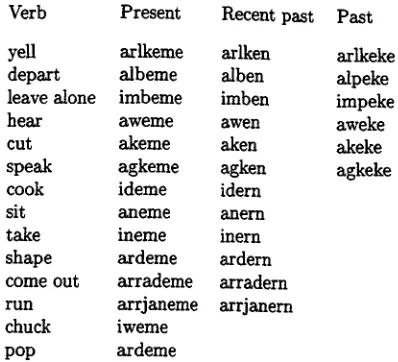
Figure 7? shows verb forms from Anmajere. The digraphs rr, rl, rn and rd represent a sin- gle sound (a trill for rr, the rest are apical reflex- ives), using the usual orthography for Australian languages (Dixon 1980). While all these verbs are regular, they demonstrate more subtle phonologi- cal conditioning than in the English past tense. A final labial stop of verb stems is voiced or voice- less depending on the voicing of the first conso- nant (not the next sound) of the inflection (see the verbs 'depart' and 'leave alone'). In the in- flections, the recent past has two allomorphs, hav- ing an apico-alveolar /n/ when the stem ends in a [-COR] consonant (for example, with arlk- 'yell'),
Verb Present Recent past
yell arlkeme arlken depart albeme alben leave alone imbeme imben
hear aweme awen
cut akeme aken
speak agkeme agken
cook ideme idern
sit aneme anern
take ineme ineru
shape ardeme ardern come out arrademe arradern run arrjaneme arrjanern chuck iweme
pop ardeme
Figure 1. Anmajere verb forms Past
arlkeke alpeke impeke aweke akeke agkeke
and the retroflex / r n / when it ends in a [+cor] consonant (for example, with id- 'cook').
My model can successfully learn these distribu- tions, producing rules such as these:
(13) a. [pred: yell] --+ "arlk"
b. [pred: depart] --+ "alb" / _ C
[+
soN]
c. [pred: depart] --, "alp" / _ C
[-
so ]
d. [tense: reel --~ "ern" / X _ _
[+ coal
e. [tense: rec] ~ "en" / X __
[- coR]
f. [tense: pres] --~ "eme"
g. [tense: past] --+ "eke"
The model chose [+son] rather than [+voiced] as the distinguishing feature for the first alternation, which gives non-distinct results for the data that was given. This knowledge is sufficient for the model to be able to fill in the remaining entries in the above table (as a transfer test). However, as noted before, the model would need to go one stage further and learn universally applicable phonologi- cal rules to be able to extend its knowledge of stem allomorphy from known verbs to new or nonce verbs.
Manning 304 The segmentation problem in morphology learning
R
m
I
m
m
|
m
m
m
m
|
[image:6.612.323.522.59.240.2]II
II
II
II
II
II
II
II
II
II
II
Conclusion
This work introduces a more substantial and re- alistic problem domain for morphology learning programs, and demonstrates a symbolic morphol- ogy learner that can learn an interesting range of the complex morphological systems found in the world's languages. On the other hand, it is not the final word, and more work still has to be done on generalizing its representations and algorithms so that it is capable of learning the morphology of all human languages.
REFERENCES
Archangeli, D. 1988. Aspects of underspecifica- tion theory. Phonology 5:183-208.
Braine, M. D. S. 1987. What is learned in ac- quiring word classes--a step toward an acquisi- tion theory. In B. MacWhinney (Ed.), Mecha- nisms of Language Acquisition, 65-87. Hillsdale, N J: Lawrence Erlbaum.
Carstairs, A. 1988. Nonconcatenative inflec- tion and paradigm economy. In M. Hammond and M. Noonan (Eds.), Theoretical Morphology: Approaches in Modern Linguistics, 71-77. San Diego, CA: Academic Press.
Dixon, R. M. W. 1980. The Languages of Aus- tralia. Cambridge: Cambridge University Press. Goldsmith, J. A. 1990. Autosegmental and Met- rical Phonology. Oxford: Basil Blackwell. Halle, M., and G. N. Clements. 1983. Problem book in phonology. Cambridge, MA: MIT Press. Holland, J. It., K. J. Holyoak, R. E. Nisbett, and P. R. Thagard. 1986. Induction: proceses of in- ference, learning and discovery. Cambridge, MA: MIT Press.
Lachter, J., and T. G. Bever. 1988. The relation between linguistic structure and associative theo- ries of language learning--a constructive critique of some connectionist learning models. Cognition
28:195-247.
Ling, C. X. 1994. Learning the past tense of en- glish verbs: the symbolic pattern associator vs. connectionist models. Journal of Artificial Intel- ligence Research 1:209--229.
Ling, C. X., and M. Marinov. 1993. Answering the connectionist challenge: a symbolic model of learning the past tense of english verbs. Cognition
49:235-290.
MacWhinney, B. 1978. The acquisition of mor- phophonology. Monographs of the Society for Research in Child Development, 43 (1-2, Serial No. 174).
MacWhinney, B., and J. Leinbac~. 1991. Imple- mentations are not conceptualizations: Revising the verb learning model. Cognition 40:121-157. Marcus, G. F., S. Pinker, M. Ullman, M. Hol- lander, T. J. Rosen, and F. Xu. 1992. Overregu- larization in Language Acquisition. Chicago, IL: University of Chicago Press.
Mooney, R. J., and M. E. Califf. 1995. Induction of first-order decision lists: Results on learning the past tense of english verbs. Journal of Arti- ficial Intelligence Research 3:1-24.
Mooney, R. J., and M. E. Califf. 1996. Learn- ing the past tense of english verbs using induc- tive logic programming. In S. Wermter, E. Riloff, and G. Scheler (Eds.), Symbolic, Connectionist, and Statistical Approaches to Learning for Natu- ral Language Processing. Springer Verlag. Peters, A. M. 1983. The units of language acqui- sition. Cambridge: Cambridge University Press. Pinker, S. 1984. Language Learnability and Lan- guage Development. Cambridge, MA: Harvard University Press.
Pinker, S., and A. Prince. 1988. On language and connectionism: Analysis of a parallel distributed processing model of language acquisition. Cogni- tion 28:73-193.
Rumelhart, D. E., and J. L. McClelland. 1986. On learning the past tenses of English verbs. In J. L. McClelland and D. E. Rumelhart (Eds.),
Parallel Distributed Processing: Explorations in the Mierostructure of Cognition, Vol. 2,216-271. Cambridge, MA: MIT Press.