
A statistical model for morphology inspired by the Amis language
Isabelle Bril
∗Lacito-CNRS
[email protected]Achraf Lassoued
University Paris II
[email protected]Michel de Rougemont
University of Paris II, IRIF-CNRS
Abstract
We introduce a statistical model for the morphology of natural languages. As words contain a root and potentially a prefix and a suffix, we associate three vector components, one for the root, one for the prefix, and one for the suffix. As the morphology captures important semantic notions and syntactic instructions, a newContent vectorccan be associated with the sentences. It can be computed online and used to find the most likely derivation tree in a grammar. The model was inspired by the analysis ofAmis, an Austronesian language with a rich morphology.
1
Introduction
The representation of words as vectors of small dimension, introduced by the Word2vec system Mikolov et al.
(2013), is based on the correlation of occurrences of two words in the same sentence, or the second moment
of the distribution of words
1. It is classically applied to predict a missing word in a sentence or to detect an
odd word in a list of words. Computational linguists Socher et al. (2013) also studied how to extend the vector
representation of the words to a vector representation of the sentences, capturing some key semantic parameters
such as Tense, Voice, Mood, Illocutionary force and Information structure.
Words have an internal structure, also called morphology. The word
preexisting
, for example, has a prefix
pre-
, a root
exist
and a suffix
-ing
. In this case, we write
pre-exist-ing
to distinguish these three components.
Given some texts, we can then analyse the most frequent prefixes, the distribution of prefix occurrences, the
distribution of suffixes given a root, and so on. We call these statistical distributions the
Morphology Statistics
of the language.
In this paper, we consider the second moment of the
Morphology Statistics
and can determine which prefix
is the most likely in a missing word of a sentence, which suffix is unlikely given a prefix and a sentence, and
many other predictions. We argue that these informations are very useful to associate a vector representation
to sentences and therefore to capture some key semantic and syntactic parameters. As an example, we selected
Amis
, a natural language with profuse morphology which is well suited for this analysis.
Amis
is one of the
twenty-four Austronesian languages originally spoken in Taiwan, only fifteen of which are still spoken
nowa-days. This approach can be applied to any other language.
Amis
belongs to the putative Eastern Formosan subgroup of the great Austronesian family Blust (1999);
Sagart (2004); Ross (2009).
Amis
is spoken along the eastern coast of Taiwan and has four main dialects which
display significant differences in their phonology, lexicon and morphosyntactic properties. The analysis bears
∗
This research is financed by the ”Typology and dynamics of linguistic systems” strand of the Labex EFL (Empirical Foundations of Linguistics) (ANR-10-LABX-0083/CGI).
1
on Northern Amis; the data were collected during fieldwork. A prior study of the northern dialect Chen (1987)
dealt mostly with verbal classification and the voice system.
We built a tool to represent the statistical morphology of
Amis
, given a set of texts where each word has
been decomposed into components (i.e. prefix, infix, root and suffix). The tool is similar to the OLAP (Online
Analytical Processing) Analysis used for Data Analysis.
•
We can analyse the global distribution of prefixes, roots, suffixes, i.e. the most frequent occurrences.
•
Given a root (or a prefix, or a suffix), we obtain the distribution of the pairs (Prefixes;Suffixes) of that
root, and the distribution of the prefixes, or the distribution of the suffixes by projection. Similarly for a
given prefix, or a given suffix.
We then study the second moment of the
Morphology Statistics
and are able to predict the most likely prefix, root
or suffix given a sequence of words. As some prefixes or suffixes carry some semantic and syntactic information,
as it is the case in
Amis
, we build a
Content
vector for a sentence, and then predict the parsing of a sentence.
Our results are:
•
A statistical representation of prefixes, roots and suffixes, as structured vectors,
•
A vector representation for a sentence, the
Content vector
. We show its use to predict the most likely
derivation tree.
In the next section, we introduce the basic concepts. In the third section, we present our statistical model to
capture the morphology of a natural language and apply it to
Amis
. In the fourth section, we describe its use for
a syntactic and semantic analysis.
2
Preliminaries
We review some basic statistics in the context of natural languages in section 2.1 and the
Amis
language in
section 2.2.
2.1
Basic Statistics
Let
s
=
w
1.w
2...w
nbe a sentence with the words
w
ion some alphabet
Σ
. Let
ustat
(s)
be the
uniform statistics
,
also called the
1
-gram vector of the sentence
s
. It is a vector whose dimension is the size of the dictionary, the
number of distinct words. The value
ustat
(s)[w]
is
#w
the number of occurrences of
w
divided by
n
, the total
number of occurrences.
ustat
(s) =
1
n
.
#w
1#w
2...
#w
m
We can also interpret
ustat
(s)
as the distribution over the words
w
iobserved on a random position in a
text. When the context is clear, we may also display the absolute values as opposed to the relative values of
the distribution. Variations of these distributions are used in Computational Linguistics Manning and Sch¨utze
(1999); Baayen (2008).
Suppose we take two random positions
i, j
and define the
ustat
2(s)
vector as the density of the pairs
symmetric covariance matrix
M(w
i, w
j)
which gives the number of occurrences of the pair
(w
i, w
j)
, i.e.
with-out order. One can view the covariance matrix as the probability to observe a pair of words in a sentence and
the diagonal values of the matrix give the first moment.
Given a
(n, n)
covariance matrix, one can associate a vector of
v
idimension
n
to each
w
isuch that the
dot product
v
i.v
jis equal to
M
(w
i, w
j)
. If we only select the large eigenvalues of
M
, we can obtain vectors
of smaller dimension such that
w
i.w
j'
M(w
i, w
j)
. This PCA (Principal Component Analysis) method goes
back to the 1960s, uses the SVD (Singular Value) Decomposition of the
(n, n)
matrix and has an
O(n
3)
time
complexity. In Mikolov et al. (2013), a learning technique is used to obtain vectors of dimension
200
when
the dictionary has
n
= 10
4words. In this paper, we refine this approach by separating the covariance
matri-ces of prefixes, roots and suffixes. As we observe
30
distinct prefixes and
10
distinct suffixes, a direct SVD
decomposition is efficient.
2.2
The Amis language
A fundamental property of Amis is that roots
2are most generally underspecified and categorially neutral Bril
(2017); they are fully categorised (as nouns, verbs, modifiers, etc.) after being derived and inflected as
mor-phosyntactic word forms and projected in a clause.
Primary derivation operates on roots and is basically category attributing; it derives noun stems and verb
stems. Noun stems are flagged by the noun marker
u
or by demonstratives. Verb stems display voice affixes,
Actor Voice
mi-
(AV), Undergoer Voice
ma-
(UV), passive voice
-en
, Locative
-an
.
Secondary derivation occurs on primarily derived verb stems: (i) operating category-changing derivation
(i.e. deverbal nouns, modifiers, etc.). (ii) deriving applicative voices
3(Instrumental
sa-
, and Conveyance
si-
).
For instance,
mi-
stems are derived as instrumental
sa-pi-
forms,
ma-
stems are derived as instrumental
sa-ka-forms.
Some other brief indications (see section 4.4 for further details), nouns are case-marked; voice-affixed verbs
select a nominative pivot/subject with the same semantic role.
3
A statistical model for morphology
We first built a tool
Morphix
which, given several texts, constructs the distribution of prefixes, suffixes and
roots. Given a root, we can display the distribution of its affixes. Similarly, we can give a prefix (resp. a
suffix) and represent the distribution of roots and suffixes (resp. prefixes). We then consider the second moment
distributions of prefixes, suffixes and roots. We build their vector representations. If we combine them, we
obtain a structured decomposition of the original words.
3.1
Basic Statistics for the Amis language
The distribution of all prefixes and suffixes, given
70
Amis texts with more than
4000
words, is given in Figure
1. All the charts use absolute values. The
Morphix
tool provides an interface where a root (resp. a prefix or a
suffix) can be selected and the distribution of prefixes and suffixes for a given root are graphically displayed, as
in Figure 2.
2
Arootis an atomic word without affixes. Affixes are either inflectional (i.e. express a semantic or syntactic function), or derivational (i.e. create different categories.
3
Figure 1: Most frequent prefixes and suffixes.
Given the distribution of (prefixes;suffixes)
4of Figure 2, we obtain by projection the distribution of prefixes
and suffixes in Figure 3 for this specific root.
3.2
Vector representation of prefixes, roots and suffixes
Given a
(n, n)
correlation matrix
M
, the SVD (Singular Value decomposition), produces
n
vectors
v
iof
dimen-sion
n
such that
v
i.v
j=
M
(v
i, v
j)
. If we project
v
ion the large eigenvalues of
M
, we reduce the dimension
and obtain vectors such that
v
i.v
j'
M(v
i, v
j)
.
Consider the following
4
structured Amis sentences
5:
Nika ina Hungti, mi-padang t-u
suwal n-ira
tatakulaq;
but that King AV-help OBL-ART word GEN-that frog6 But as for the king, he supported the words of the frog;
”Isu Kungcu, yu ira k-u pa-padang-an;
you Princess when exist NOM-ART RED-help-LOC ”You Princess, when (you) had some help;
Sulinay mi-padang k-u taw;
indeed AV-help NOM-ART people indeed when people help;
aka-a ka-pawan t-u ni-padang-an n-u taw.”
PROH-IMP NFIN-forget OBL-ART PFV.NMZ-help-LOC GEN-ART people then, you mustn’t forget people’s help.”
4
A word can have several prefixes and suffixes. In Figure 2, the most frequent pairs (prefixes;suffixes) are(ma-;), i.e. the prefix
ma-with no suffix,(ka-;), i.e. the prefixka-with no suffix,(pa-se-;), i.e. the two prefixespa-andse-with no suffix and(ma;ay), i.e. the prefixma-with the suffix-ay.
5The first line is the original text where words are structured as prefix-root-suffix. The second line is the morphological analysis with
labels such as AV, OBL,....The third line is the translation.
6Abbreviations: AV Actor Voice; ART article; CV conveyanve voice; GEN genitive; IMP imperative; INST.V instrumental voice;
Figure 2: Most frequent (prefixes;suffixes) of the root
banaq
(’ know’).
In these sentences, there are seven prefixes:k,ka,n,ni,mi,pa,t. The matrixMpfor these prefixes is:
Mp=
4 0 0 2 0 2 0
0 2 2 2 0 0 2
0 2 4 2 2 0 4
2 2 2 4 0 0 2
0 0 2 0 2 0 2
2 0 0 0 0 2 0
0 2 4 2 2 0 4
The actual values inMpare doubled to be consistent with the probability measure. The first line indicates2occurrences
ofk-,1occurrence ofk-, pa-(second sentence) and1occurrence ofk-, mi-(third sentence). The large eigenvalues ofMp
are6and3.2. Two other eigenvalues are close to1and the three others are close to0. If we decompose the vectors7on the large eigenvectors, we obtain7vectors of dimension 2, one for each prefix.
B=
1.8860e+ 00 −4.7065e−01
−9.9611e−17 6.5699e−01
−4.7150e−01 −2.8430e−01 9.4301e−01 9.6547e−01
−4.7150e−01 −9.4129e−01 9.4301e−01 −7.7913e−01
−4.7150e−01 −2.8430e−01
andB ∗Btis approximatelyM
p. In this example the absoluteL2 error is11.5. The first vector fork-has coordinates
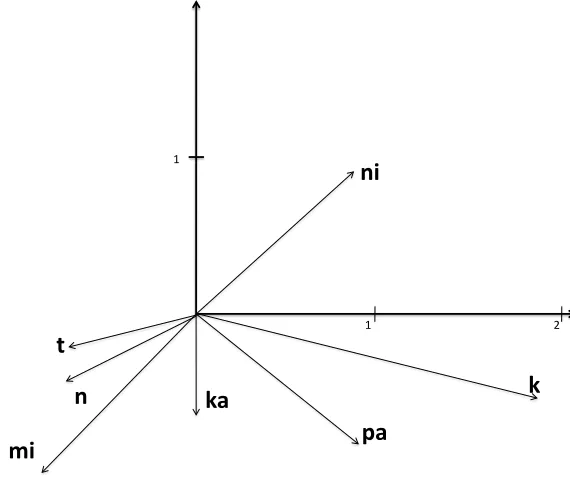
1.88,−0.47. We can therefore represent graphically the7prefixes as in Figure 4. A similar approach can be followed for suffixes and for roots. Figure 4 can be used to predict, given a prefixv, the most likely next prefixvnext. It is the vectorv0
which maximizes the dot product|v.v0|. Given the vector for the prefixk-, the most likely next prefix ispa-.
7
Figure 3: Most frequent prefixes and suffixes of the root
banaq
.
ni
t
k
1 2
pa
ka
mi
n
1
Figure 4: The vectors for the 7 most frequent prefixes
k-,ka-,n-,ni-,mi-,pa-,t-
in two dimensions.
3.3
Distributions and representative vectors
All the distributions are related, mostly by projections. Letδbe the distribution of the words,δP the distribution of the
prefixes (resp. δR the distribution of the roots) and letπp be the mapping which associates the prefix of a word. For
example,πp(mi-padang)=mi-. Similarlyπr(mi-padang)=padang. ThenδP =πp(δ)andδR =πr(δ). Similarly for the
other distributions. The correlation matrixMp of the prefixes is also the projection of the correlation matrixM of the
words, i.e.Mp=πp(M).
For each correlation matrixMp, Mr, Ms, we apply the dimension reduction and obtain vectorsvp,iof dimensionnp
for the prefixes,vr,iof dimensionnrfor the roots andvs,iof dimensionnsfor the suffixes. We associate the union of the
three vectors to a wordw=pre-root-suf:
ustat(w) =
vp,pre
vr,root
vs,suf
[image:6.612.99.384.260.505.2]For two wordswi, wj, letMf(wi, wj) = Mp(prei, prej) +Mr(rooti, rootj) +Mp(sufi,sufj)be the sum of the
correlations of the prefixes, roots and suffixes. The fundamental fact of the approach is that for any two wordswi, wj,
ustat(wi).ustat(wj)'Mf(wi, wj). Indeed,ustat(wi).ustat(wj) =vp,prei.vp,prej+vr,rooti.vr,rootj+vs,sufi.vs,sufj. The
dot productvp,prei.vp,prejapproximatesMp(prei, prej)and similarly for the roots and suffixes. Henceustat(wi).ustat(wj)'
f
M(wi, wj).
Notice thatMf(wi, wj)can be very different fromM(wi, wj). It is possible thatM(wi, wj) = 0, but that its prefixes,
suffixes and roots have strong correlations, henceMf(wi, wj)can be large. A rich theory of these structured vectors can be
developped using cross-correlations, which we do not use at this point.
4
Grammars and statistics
We now study how to extend the vectors from words to sentences, as in Socher et al. (2010, 2013). We follow a different strategy as we fix a probabilisticContent Vectorwith specific dimensions which depend directly on the prefixes, roots and suffixes. We then show its use for a syntactic decomposition. A grammarGis classically represented by rules of the type8:
S→V P.KP+V P.KP∗ V P →V oice.V.KP∗
KP →K.DP
DP →D.N+D.N.M odP
M odP →K.DP
K→t+... V →padang+... V oice→mi+... N →suwal+... D→u+...
Our goal is to compare the possible derivation trees of the sentencemi-padang t-u suwal n-ira tatakulaqand to use the
Content Vectorto infer the ”most likely” tree in the grammarG.
4.1
Stochastic grammars
In a stochastic grammar Manning and Sch¨utze (1999), derivations with the same non terminal symbol have a probability
psuch that the sum of the probabilities for each non terminal is1. The probabilistic space associates with each sentences
and derivation treet, the product of the probabilities of the rules used, notedp(s, t). Given a sentence, a classical task is to predict the most likely derivation tree, and it can be achieved inO(n3)for a sentence ofnwords.
In our context, the probabilistic space is entirely different. The structured vectors allow us to predict the most likely word, prefix or suffix, given a context of previous words. They also determine the distribution ofContent Vectordefined in section 4.2 which predicts some key semantic components. Hence we look at the most likely derivation tree, given this distribution of semantic components.
4.2
Semantic representation
Let us define theContentvector of a sentence as a vector of dimension6whose components are:
• Valence:{0,1,2,3},
• Voice:{AV, UV, LV, INST.V},
• Tense:{Present, Past, Future},
• Mood:{Indicative, Imperative, Hortative, Subjunctive},
• Illocutionary Force:{Declarative, Negative, Exclamative},
• Information Structure:{Topicalisation, Cleft Focus},
This is a just an example and more dimensions could be used. Letc be such vector of dimension6 where values are distributions over each finite domain. For example, the third component c3 over {Present, Past, Future} is[0,1,0]to indicate a PAST or[13,13,13]to indicate a uniform distribution. We read the sentence w1, w2, ....wn, and a vectorvi =
ustat(wi)is associated with each wordwi. Let us define:
ci=F(ci−1, vi)
withc0an initial state andF a function, we construct by cases or by learning techniques. As an example, consider the following sentence:
tengil-i isu k-aku !
hear-IMP.UV GEN.2sg NOM-1sg
’listen to me !’ (lit. let me be listened to by you)
In this case, the suffix-iexpresses the imperative mood in Undergoer Voice. The suffix thus carries specific syntactic and semantic instructions, such as mood and UV voice, which itself encodes a type of alignment (a nominative patient pivot and a genitive agent). In this casec2
i, the second component ofFis defined as:
c2i(ci−1, vi) =
(
[0,1,0,0] if [vi]p=”mi-”
c2
i−1 otherwise
In general, each component ofF is built as a decision tree, with rules and possible learnt components. At the end of a sentence, we have the Content vectorcn. We describe more advanced rules ofAmisin section 4.4.
4.3
Rules and Correlations
The previous rule for the imperative mood is simple. It is also possible to learn this rule from positive and negative ex-amples, i.e. sentences in imperative mood and sentences not in imperative mood, as suggested in Socher et al. (2013). In that case, we would get a correlation and a neural network could approximate the imperative mood given enough examples.
This is a general paradigm, often calledCausality versus Correlation. It is however far more difficult to learn the structure of the Content vector, i.e. the decomposition in6 independent components. Notice that5of the components are set by the prefixes and suffixes. The Valence is set by the roots. As the number of prefixes and suffixes is small, the description of the functionFis much simplified.
4.4
A syntactic outline of Amis
The basic word order of Amis is predicate initial. Arguments are case-marked: nominative is marked byk-, the agent is marked as genitive byn-, oblique themes and oblique arguments are marked byt-Chen (1987). The voice affixes (AV)
mi-, (UV)ma-, also identify verb classes, (i) verbs which only acceptmi-voice, (ii) verbs which only acceptma-, (iii) verbs which accept bothmi-andma-with different semantics, and (iv) stative, property verb stems which accept none of these prefixes.
AVmi-verb stems denote activities or accomplishments. Ma-verbs denote non-actor or undergoer oriented events (depending on their semantics and valency);ma-verbs include states and psych states, properties, verbs of cognition ( ma-banaq’know’), bodily functions, position and motion9(ma-nanuwang’move for object’).
The root’s ontology and semantic features pair up with the semantic and syntactic properties of voice affixes. The voice system is thus based on the co-selection of a nominative argument (the pivot), and a voice affix whose semantics matches the semantics of the nominative pivot. AV mi-and UV ma-voices are restricted to declarative sentences. In non-declarative sentences (such as negative, imperative, hortative),mi-occurs aspi-andma-aska-. Comparema-butiq cira’(s)he is asleep/sleeping’ andka-butiq! ’go to sleep !’.
4.4.1
Transitivity and alignment
Alignment10varies with transitivity.Mi-verbs and extended intransitivema-verbs (labelled Non-Actor Voice,NAV) have an oblique argument marked byt-as in (1a-2). The nominative pivot ofmi-verbs is an Actor, while that of NAVma-verbs is a Non-Actor (i.e. a theme or experiencer, the seat of some property or state). On the other hand, transitive UVma-verbs have a nominative (generally fully affected) patient pivot and a genitive agent as in (1b).
1a.Mi-melaw k-u wawa t-u tilibi.
AV-look NOM-ART child OBL-ART TV ’ The child is watching TV. ’
1b.Ma-melaw n-uhni k-u teker.
UV-look GEN-3pl NOM-ART trap
’They saw the trap.’(lit. the trap was seen by him)
2.Ma-hemek k-aku t-u babainay. (*mi-)
NAV-admire NOM-1sg OBL-ART boy ’I admire the guy.’
Ma-verbs are thus generally oriented towards a non-actor, or an undergoer nominative pivot; the case assignment of the non-pivot argument varies with transitivity: with extended intransitive NAVma-constructions (2), the theme is oblique; with transitive UVma-constructions, the agent is genitive (1b). All other voices, UV-en, INSTsa-, LOC-an, CVsi-, have a nominative pivot which is the corresponding semantic argument (i.e. patient, instrument, location, transported theme), and a genitive Agent (if it is expressed).
4.5
Best derivation tree
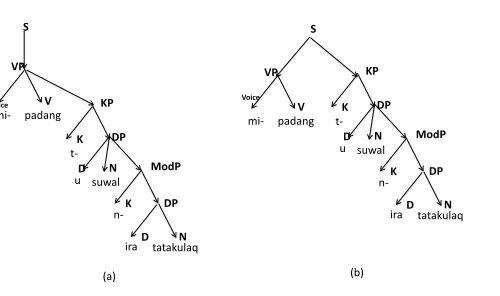
Givencn, we can then decide that the (a) derivation tree of Figure 5 is better suited than the (b) for the sentencemi-padang
t-u suwal n-ira tatakulaq(’he supports the words of the frog’). We follow the explanation of themi-verbs given in section 4.4.
VP
mi-
S
padang
Voice V VP
mi-
S
padang KP
Voice V
suwal t- K
DP
D ModP
K DP
D N
u
n-
ira tatakulaq
N
KP
suwal t- K DP
D ModP
K DP
D N
u
n-
ira tatakulaq
N
[image:9.612.73.323.459.607.2](a) (b)
Figure 5: Tree derivations of the sentence
mi-padang t-u suwal n-ira tatakulaq
for the grammar
G
.
The conceptual structure of a verb stem selects the voice, the number and type of arguments. Case-assignment takes place in the domain of the VP and correlates with Voice which assigns theta-roles to its arguments (for ex. an AV mi-verb
10
assigns nominative to the Actor and oblique to the theme; an UV ma-verb assigns nominative to the Patient and genitive to the agent). Consequently the derivation tree (a) is a better representation.
5
Conclusion
We introduced a statistical model for the morphology of natural languages and applied it toAmis. TheMorphixtool builds the classical distributions of prefixes, roots and suffixes, given a possible root, prefix or suffix. From the second moments of the distributions, we build vectors for prefixes, roots and suffixes which capture their correlations. There are about30
most common suffixes, and15of them carry90%of the mass. Among the10most common suffixes,4of them carry90%
of the mass. Hence, the dimensions of the corresponding vectors are small.
We defined a probabilisticContent vectoras a simplified model for the semantic and syntactic analysis of a sentence. The online analysis of the prefixes and suffixes, realised by the functionF, determines most of the components of the
Contentvectorc. Given a grammarGand a sentencew1, w2, ...wn, we then looked at the most likely tree decomposition
forc.
Other languages have different types of morphology or no morphology, but we argue that the most likely tree decom-position is dependent on semantic features in a probabilistic way.
References
Baayen, R. (2008).Analyzing Linguistic Data: A Practical Introduction to Statistics using R. Cambridge University Press.
Blust, R. (1999). Subgrouping, circularity and extinction: Some issues in austronesian comparative linguistics. In E. Zeitoun and P. Li (Eds.),Selected Papers from the Eighth International Conference on Austronesian Linguistics, pp. 31–94. Taipei: Institute of Linguistics, Academia Sinica.
Bril, I. (2017). Roots and stems: Lexical and functional flexibility in amis and nˆelˆemwa. In E. van Lier (Ed.),Studies in Language. Special issue on lexical flexibility in Oceanic languages (In Press), pp. 358–407.
Chen, T. (1987). Verbal constructions and verbal classifications in nataoran-amis. InSeries C. Canberra: Pacific linguis-tics.
Manning, C. D. and H. Sch¨utze (1999). Foundations of Statistical Natural Language Processing. Cambridge, MA, USA: MIT Press.
Mikolov, T., K. Chen, G. Corrado, and J. Dean (2013). Efficient estimation of word representations in vector space.
CoRR abs/1301.3781.
Ross, M. (2009). Proto austronesian verbal morphology: a reappraisal. In A. Adelaar and A. Pawley (Eds.),Austronesian historical linguistics and culture history. A festschrift for Robert Blust, pp. 285–31. Canberra: Pacific Linguistics.
Sagart, L. (2004). The higher phylogeny of austronesian and the position of tai-kadai.Oceanic Linguistics 43, 411–444.
Socher, R., J. Bauer, C. D. Manning, and A. Y. Ng (2013). Parsing with compositional vector grammars. InIn Proceedings of the ACL conference.


![Effectiveness of behavioural graded activity compared with physiotherapy treatment in chronic neck pain: design of a randomised clinical trial [ISRCTN88733332]](data:image/gif;base64,R0lGODlhAQABAIAAAP///wAAACH5BAEAAAAALAAAAAABAAEAAAICRAEAOw==)