43
A bag-of-concepts model improves relation extraction in a narrow
knowledge domain with limited data
Jiyu Chen, Karin Verspoor and Zenan Zhai
School of Computing and Information Systems The University of Melbourne, Australia
[email protected], {karin.verspoor, zenan.zhai}@unimelb.edu.au
Abstract
This paper focuses on a traditional relation ex-traction task in the context of limited annotated data and a narrow knowledge domain. We ex-plore this task with a clinical corpus consisting of 200 breast cancer follow-up treatment let-ters in which 16 distinct types of relations are annotated. We experiment with an approach to extracting typed relations called window-bounded co-occurrence (WBC), which uses an adjustable context window around entity men-tions of a relevant type, and compare its per-formance with a more typical intra-sentential co-occurrence baseline. We further introduce a new bag-of-concepts (BoC) approach to fea-ture engineering based on the state-of-the-art word embeddings and word synonyms. We demonstrate the competitiveness of BoC by comparing with methods of higher complex-ity, and explore its effectiveness on this small dataset.
1 Introduction
Applying automatic relation extraction on small data sets in a narrow knowledge domain is chal-lenging. Here, we consider the specific context of a small clinical corpus, in which we have a va-riety of relation types of interest but limited ex-amples of each. Transformation of clinical texts into structured sets of relations can facilitate the exploration of clinical research questions such as the potential risks of treatments for patients with certain characteristics, but large-scale annotation of these data sets is notoriously difficult due to the sensitivity of the data and the need for specialized clinical knowledge.
Rule-based methods (Abacha and Zweigen-baum, 2011; Verspoor et al., 2016) typically de-termine whether a particular type of relation exists in a given text by leveraging the context in which key clinical entities are mentioned. For instance,
if two entities with type TestName and TestResult, respectively, are observed in a given sentence, it is likely that a relation of type TestFinding ex-ists between them. However, construction of high-precision rules defining relevant contexts is time-consuming and expensive, requiring extensive ef-fort from domain experts.
The state-of-the-art machine learning algo-rithms such as neural network models (Nguyen and Grishman,2016;Ammar et al.,2017;Huang and Wang, 2017) may over-fit in performing re-lation extraction in this context, due to a limited quantity of training instances.
In this work, we experiment with two automatic approaches to semantic relation extraction ap-plied to a small corpus consisting of breast cancer follow-up treatment letters (Pitson et al., 2017), comparing a simple rule-based co-occurrence ap-proach to machine learning classifiers.
The first approach, simple co-occurrence ( Ver-spoor et al.,2016), is based on the assumption that most relevant relations are intra-sentential, that is, the relation between a pair of named entities is expressed within the scope of a single sentence. However, some relations may be expressed across sentence boundaries, and thus a single sentence may not be the ideal choice of scope, as shown in prior work that considers inter-sentential relations (also known as non-sentence or cross-sentence re-lations) (Panyam et al., 2016;Peng et al., 2017). We extend the co-occurrence approach to allow explicit adjustment of context window size, from one to two sentences, a method called Window-Bounded Co-occurrence (WBC). The best window size for a given relation is identified by choosing the one which produces the highest score under F1-measure on a development set.
binary tasks. We build on a bag-of-concepts (BoC) (Sahlgren and C¨oster, 2004) approach which models the text in terms of phrases or pre-identified concepts, extending it with word embed-dings and word synonyms. We compare two dif-ferent pre-trained word embedding models, and a number of other model variations. We also explore grouping of synonyms into abstractedconcepts.
We find that the intra-sentential rule-based ap-proach outperforms the apap-proach which allows for a larger context window. The supervised learn-ing models outperforms rule-based approaches un-der F1 measure, and their results show that
mod-els using BoC features outperform modmod-els with BoW, dependency parse, or sentence embedding features. We also show that SVM outperforms complex models such as a feed-forward ANN in our low resource scenario, with less tendency to over-fitting.
2 Background
At present, the two primary approaches to au-tomatic relation extraction over biomedical cor-pora are rule-based approaches (Verspoor et al.,
2016;Abacha and Zweigenbaum, 2011) and ma-chine learning approaches based on learners such as logistic regression, support vector machines (SVM) (Panyam et al., 2016) and convolutional neural networks (CNN) (Nguyen and Verspoor,
2018) together with sophisticated feature engi-neering methods.
Verspoor et al. (2016) established a typical intra-sentential co-occurrence baseline with competitive performance comparing to a com-prehensive machine learning-based system, PKDE4J (Song et al., 2015), on the extraction of relations between human genetic variants and disease on the Variome corpus (Verspoor et al., 2013). The sentential baseline is based on the assumption that the scope of relations is within one sentence, and further assumes that any pair of two entities mentioned in the same sentence and satisfying the type constraints of a given relation, expresses that relation. For example, if two entities with type TimeDescriptor and EndocrineTherapy respectively, the relation TherapyTiming will be extracted. The sentential co-occurrence baseline set a benchmark for relation extraction on Variome corpus.
Abacha and Zweigenbaum(2011) explored se-mantic rules for the extraction of relations between
medical entities on PubMed Central (PMC) arti-cles using linguistic patterns. They provide an example of implementing an end-to-end relation extraction system, applying named entity recogni-tion in the first stage, then followed by the stage of relation extraction. They define several relation patterns based on medical knowledge, and lever-aging the dependency parse tree of sentences in which entities occur. However, the linguistic pat-terns and rules developed for their corpus likely are not directly applicable to our semantically dis-tinct context of clinical letters.
Machine learning methods vary based on the choice of models and the features considered. In model selection, the multi-type relation extrac-tion task can be assigned to several independent binary classifiers, each making the decision of whether a certain type of relation exist or not. A basic binary classifier such as logistic regres-sion with ridge regularization is capable of per-forming relation extraction in this scenario. Pa-nyam et al.(2016) used support vector machines (SVM) with a dependency graph kernel to per-form relation extraction on two biomedical lation extraction tasks, showing competitive re-sults. Brown Clustering (Brown et al., 1992) is a hierarchical approach to clustering words into classes through maximizing mutual information of bi-grams; it showed competitive performances in many NLP tasks (Turian et al., 2010).Nguyen and Verspoor (2018) implemented a method us-ing character-based word embeddus-ings which can capture unknown words within the context, cou-pled with CNN and LSTM neural network mod-els. This approach obtained state-of-the-art perfor-mance in extracting chemical-disease relations on the BioCreative-V CDR corpus (Li et al.,2016).
For feature engineering, text features can gen-erally be divided into the two categories of lexical features and syntactic features. Typical features used in other relation extraction tasks are summa-rized here.
• Bag-of-words (BoW) features based on white-space delimited tokens, are used in many tasks as a starting point.
based on techniques such as mutual in-formation (Sahlgren and C¨oster, 2004), or through dictionary-based strategies (Funk et al.,2014). For clinical texts, the MetaMap tool (Aronson,2001) is often used to recog-nize clinical concepts.
• Syntactic features take sentence structure into account. For example, RelEx (Fundel et al.,2006) uses dependency parse trees as-sociated with small numbers of rules in ex-tracting relations from MEDLINE abstract and reaches an overal 80% precision and recall. Approximate Sub-graph Matching (ASM) (Liu et al.,2013) enables sentences to be matched by considering the similarity of the structure of dependency parse subgraphs that connect relevant entities to subgraphs in the training data.
• Word embeddingsaim to capture word se-mantics through lower-dimension projections of word contexts and can be used to find word synonyms by measuring cosine sim-ilarity between word vectors. There are two widely used approaches to train word embeddings, co-occurrence matrix based methods such as GloVe (Pennington et al.,
2014), and learning-based methods using skip-grams (Mikolov et al., 2013b) and CBOW (Mikolov et al.,2013a).
3 Methods
We improve the approaches described above to achieve better efficiency in relation extraction in our context of a narrow knowledge domain with limited data, specific to cancer follow-up treat-ment.
3.1 Corpus
We consider a previously introduced corpus re-lated to breast cancer follow-up treatment, ran-domly sampled and manually annotated by two physicians (Pitson et al.,2017). The corpus con-tains around 1000 sentences and 47,186 tokens. Despite its small size, the corpus is richly an-notated with 16 medical named entity types and 16 types of semantic relations linking those enti-ties with over 1,500 relation occurrences. Entienti-ties within the corpus are related to clinical therapies, temporal events, diseases, and so on. The annota-tion of clinical relaannota-tions includes the associaannota-tions
between identified entities. For example, in the context ”She remains on Arimidex tablets.”, ”re-mains on” is a TimeDescriptor, and ”Arimidex” is a EndocrineTherapy. The relation TherapyTim-ing holds between these two entities in this con-text (e.g., TherapyTiming(TimeDescriptor, En-docrineTherapy)). For conciseness, we use ab-breviations to refer to the entity types; hence we will use TD to represent the entity type of TimeDescriptor. While the dataset hasn’t been published yet, the full terminology list of entity types can be found inPitson et al.(2017). To focus exclusively on the relation extraction task, we de-couple the named entity recognition task from the relation extraction task by utilizing the gold stan-dard entity annotations from the corpus.
3.2 Method 1: Typed Sentential Co-occurrence
The simplest rule-based approach, given typed named entities, is to extract every pair of entities in a document that satisfies the type constraints of a relation. Such an approach yields high re-call but poor precision, due to lack of use of con-text needed to ensure that a specific relation is ex-pressed as holding between the entities. For exam-ple, in our data, only the semantic relation of Tox-icity is defined as connecting a Therapy to a Clini-calFinding (expressing that a therapy was found to cause a specific toxic effect) and so it might seem reasonable to assume that a Toxicity event is be-ing expressed in a document where both a Therapy and a ClinicalFinding are mentioned. However, the occurrence of these two entity types together in a document do not strictly indicate an occur-rence of Toxicity relation between them; the enti-ties may be connected to other mentioned entienti-ties via different relations. Hence assuming a Toxic-ity relation between them would result in a false positive.
We used intra-sentential constraints as de-scribed by (Verspoor et al., 2016) to improve precision by only considering that named enti-ties that co-occur in the same sentence can have valid semantic relations. With this intra-sentential co-occurrence constraint, the relation extraction performance of the sentential baseline achieved strong recall and competitive precision, as well as reasonable overall F-score, on the Variome corpus (Verspoor et al.,2013).
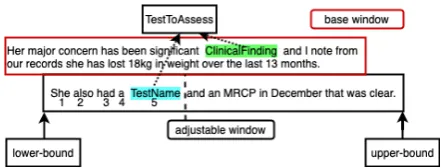
Window-Bounded Co-occurrence (WBC) to explore the im-pact of relaxing the constraint that the sentence boundary defines the scope of a relation. WBC defines a context window for a relation as the ex-pansion to a base window of the sentence where an entity of the appropriate type occurs, and the adjustment of tokens beyond that sentence within which the related entity appears. We assume the occurrence of an inter-sentential relation relies on the distance of two entities, where distance is de-fined based on the number of tokens considered beyond the base sentence in which an entity oc-curs. We introduce a hyperparameter, ρ, to rep-resent the distance of an entity pair in a context, namely the number of tokens allowed in exceeding the single base sentence. ρ= 0denotes the entity pair is intra-sentential;ρ = xdenotes the second entity in a pair isxnumber of tokens away from the base window. Ifρis large than the length of the second context window, then the context window will set to the scope of two sentences by default.
Figure1shows an example whenρ = 5, WBC allows for the extraction of the semantic relation of TestToAssess across the base window contain-ing the entity of ClinicalFindcontain-ing, and into the expanded window encompassing the subsequent sentence and containing the TestName entity.
Figure 1: Example of length-awareness sliding window of WBC in TestToAssess relation case
3.3 Method 2: Supervised Binary Classification Approach
We adopt a traditional pipeline as the architecture of the relation extraction system. Each stage is in-troduced below.
3.3.1 Data Preparation
Considering the semantic variation in the texts, and the small number of examples, training sev-eral independent binary classifiers is more robust for mining individual type of semantic relation patterns. Therefore, we transform the original dataset into 16 independent subsets, by grouping
instances by their relation type. An instance con-sists of a typed entity pair, one or two sentence(s) with the relevant named entities inside as con-text, a label as an indication of relation occur-rence, and a treatment letter id for mapping its position in the original dataset. We remove four relation types with fewer than 10 annotated in-stances, specifically the relations Intervention, Ef-fectOf, RecurLink and GetOpinion.
We apply context selection for generating in-stances during data transformation. One instance represents the occurrence of a single semantic re-lation, containing one relevant entity pair. The context for each instance is the entire raw text of the sentence where the entity pair appears. In cases where more than one entity pair occurs in the same text context, we generate an indepen-dent instance for each entity pair. Where cross-sentence relations occur, we concatenate the two sentences containing the relevant entities into a single sentence, structurally indicating that the two sentences are related. In each instance, we replace the two named entity phrases with their type. In the case of overlapping named entities, such as where one named entity partially or completely collides with another entity, both types are re-tained, adjacent to each other in the text. Other entities mentioned in the context not relevant for the specific relation are left in their original tex-tual form.
We use NLTK (Bird et al.,2009) to perform tok-enization and lemmatization to normalize the rep-resentation of the text, and strip punctuation. We use the Snowball English stopword list1to remove
stopwords.
Further details are presented in the feature engi-neering section below.
3.3.2 Feature Engineering
We implement a set of traditional semantic fea-tures and three main feature sets based on ASM, BoC, and sentence embeddings in the sections be-low.
• Traditional Semantic Features
The traditional semantic features includes bag-of-words (count-based), lemmas (base, unin-flected form of a noun or verb), algebraic ex-pressions, named entity type (derived from the
1http://anoncvs.postgresql.org/
[image:4.595.70.291.441.525.2]gold-standard), POS tags and dependency parse based on Stanford CoreNLP (Manning et al.,
2014), and a transformation from dependency parse tree to graph using NetworkX (Hagberg et al.,2008) where edges are dependencies and nodes are tokens/labels.
• ASM features
The classical ASM measurement was developed by Liu et al.(2013), and was later extended to kernel method by Panyam et al. (2016). The ASM kernel was applied to the chemical in-duced disease (CID) task (Wei et al.,2015) and Seedev shared tasks (Chaix et al., 2016). The performance of ASM significantly depends on the result of POS-tagging and dependency tree parsing. All nodes are normalized to their lem-mas. Here, Stanford CoreNLP (Manning et al.,
2014) is used for POS tagging and dependency tree parsing of the text. The context is split into sentences before dependency parsing is applied on individual sentences.
[image:5.595.93.272.563.673.2]We produce the ASM features following Pa-nyam et al.(2016). Where the context includes two sentences, a dummy root node is introduced to connect the root nodes of two dependency parse trees. Figure2shows an example. After pre-processing, the dependency tree structure is transformed into a graph where nodes are lem-mas with their POS tags, edges are dependen-cies across lemmas within sentence. Then, a shortest path algorithm is applied on the depen-dency graph to generate flat features. In cases where sentences are very long, processing time is unacceptable, and no ASM features are gen-erated.
Figure 2: Illustration of concatenation of two sentence parsing results using dummy root in TestToAssess re-lation setting
• Bag-of-Concepts features
Word embeddings are used to capture word
similarity based on shared surrounding context. The size of the surrounding context, known as window size control, varies the representa-tion of word embeddings from more semantic (shorter window size) to more syntactic (longer window size). Synonyms can be identified by identifying two words with similar embeddings, based on cosine similarity measurement. Over-fitting can occur for word embeddings, where a training corpus is not large enough or a cor-pus is limited to a narrow domain of knowledge. Therefore, instead of training word embeddings on our corpus, we use two publicly available pre-trained word embeddings, GloVe ( Penning-ton et al., 2014) and a Wikipedia-PubMed-PMC embedding (Moen and Ananiadou,2013) to capture more clinically relevant vocabulary. The vocabulary of word embeddings denotes the total number of words that are represented. In our experiment, only the top 20,000 most fre-quent lemmas are selected. Gensim (Rehurek and Sojka,2010) is used to find the synonyms of a lemma from the vocabulary by measuring similarity between GloVe word vectors.
We then implement an algorithm for build-ing BoC. Usbuild-ing a word2concept algorithm (see Equation1), we map a lemma (key) to a con-cept (value) based on the embedding of the lemma expressed asEEE(lemma)and the similar-ity threshold expressed asµµµas a tunable hyper-parameter.
CON CEP T =f(E(lemma), µ) (1)
The algorithm starts by extracting BoW features for each generated instance after data prepara-tion process into a list L. Then, starting from the first lemmaw1 fromL, we retrieve its
em-bedding xw1 = E(w1). We then retrieve a
new lemma wi and its embedding xwi from
the vocabulary V, and calculate the similarity score S = cos(xw1, xwi). If S >= µ,
cre-ate mappings between w1 → concept1 and wi →concept1. If nowisatisfies the condition
ofS >=µ, thenw1 will be kept in its original
form. Next, we move to the second wordw2 in L, check whetherw2 has already been mapped
to a conceptconcept∗, and if so, directly create
the mapping w2 → concept∗. Otherwise, we
iterate.
since they have been mapped to and replaced with the names of the relevant entity types (e.g., “TestName” which is not a token that would be expected to be represented in any pre-trained word embedding model).
• Sentence embedding features
Apart from being a tool for finding word syn-onyms and generating BoC data representation, word embeddings can also be used to obtain sentence embeddings through weighted average pooling. If S denotes a sentence, E(S) de-notes the embedding of sentenceS. E(w1)
de-notes the embedding of the first wordw1of
sen-tenceS, Score(w1) denotes the TF-IDF score
of wordw1, the sentence embeddings based on
weighted average pooling can be expressed as Equation2. We calculate TF-IDF scores of each word using the original documents, as each in-stance has an index to its original document id. Out-of-vocabulary tokens and gold standard named entities will be ignored. However, en-tity information has been considered during that data preparation stage, because the generation of instances takes gold standard entities into ac-count.
E(S) = 1
n n
X
i=1
E(wi)×Score(wi) (2)
3.4 Supervised Learning Models
We build individual binary classifiers for each re-lation type. We introduce the SVM classifiers and Feed-forward ANN models briefly here.
• Support Vector MachineWe select the gen-eral SVM model (Hearst, 1998) and kernels provided by scikit-learn (Pedregosa et al.,2011). For SVM kernels, we integrate ASM kernel as part of feature engineering, to avoid colliding with the use of the linear kernel and the RBF (Radial Basis Function) kernel.
• Feed-forward ANN We use Keras ( Chol-let et al., 2015) to construct a simple feed-forward neural network model with two fully connected layers as shown in Figure3.
[image:6.595.326.502.64.193.2]The dimension of each input and the number of hidden units in each layer is the same as the dimen-sion of feature vectors under each type of relation. The activation function for the first dense layer is ReLU, and for the second dense layer is softmax.
Figure 3: Architecture of FNN
3.5 Experiment Design
Considering the dataset is small, we split the trans-formed dataset into three independent combina-tions of training, development, and test sets with the ratio of 6:1:3.
In training stage, we train independent mod-els for each specific relation type. We use cross-validation and grid search to tune the hyperparam-eters of the classifiers.
In prediction stage, the decision of applying sentence-bounded or window-bounded approach is made by setting the size of sliding window. Set-ting the window size to 0 will apply the sentence-bounded co-occurrence constraint. We choose window sizes of 0, 5, 10 to explore the value of additional context. In supervised binary classi-fication approach, utilizing a similarity threshold of 1 leads to strict use of BoW (word) features, while relaxing the similarity threshold µ of 0.9, 0.8 will generate BoC (concepts). We compare the influence of different word embeddings in gener-ating BoC based on their relation extraction per-formance on the test set.
Both rule-based approach and supervised binary classification approach will make predictions on the same test set, which allows empirical compar-ison between rule-based and machine learning ap-proaches.
treatment. We also explore the combination of BoC and sentence embeddings feature, in order to investigate how best to make integration of them
Finally, we explore the possibility of applying more complex models for analysis of our small and specific knowledge domain dataset. We start from simple linear models including logistic re-gression and lin-SVM, then apply rbf-SVM, feed-forward ANN on Keras with 32 batch per time, and epochs of 2, 10, 100, and 500 for each rela-tion type.
3.6 Evaluation
We evaluate both overall and per relation type per-formance. Evaluation of the two approaches is performed on the same test set derived from the data preparation stage. In addition, considering the dataset is small, we calculate the mean score from three independent combinations of training, development and test sets. We evaluate results us-ing micro F1-measure since the number of
posi-tives and negaposi-tives were highly imbalanced across all relation types. We finally evaluate the perfor-mance growth over nine sub-sampled training sets of increasing size.
4 Result and Discussion
We present experiment results with micro F1
mea-surement. After experimenting with different sim-ilarity threshold values to generate BoC features, the best performance is achieved when the thresh-old is set to 0.9 (results not shown). Word em-beddings derived from Wiki-PubMed-PMC out-perform GloVe-based embeddings (Table1). The models using BoC outperform models using BoW as well as ASM features.
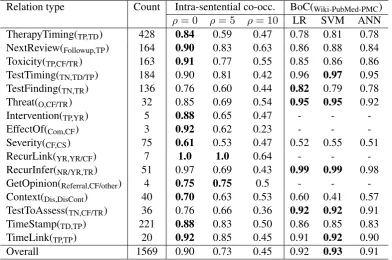
As shown in Table 2, the intra-sentential co-occurrence baseline outperforms other approaches which allow boundary expansion. This is because a majority of relations in the corpus are intra-sentential.
A visualization of the growth in performance for both BoW and BoC-based models as training set size increases, over 12 relation types, based on micro F1, is shown in Figure 4. The
re-sults of BoC in this figure is collected from lin-SVMWiki-PubMed-PMC,µ= 0.9, and BoW is collected
from lin-SVM. We find BoC tends to outperform BoW with only a small number of training in-stances, and also performs better than BoW with incremental training instance.
Figure 4: Performance variation of BoW and BoC(Wiki-PubMed-PMC,µ= 0.9) with increasing data
frac-tions, under linSVM, F1measure.
The reason that Wikipedia-PubMed-PMC em-beddings (Moen and Ananiadou, 2013) outper-forms GloVe (Mikolov et al.,2013a) in the extrac-tion of most relaextrac-tion types (Table1) is because its training corpus has a more similar domain and vo-cabulary as our dataset. Therefore, it leads to more relevant models of the distributional semantics of words. On the other hand, the GloVe embeddings are derived from a more general corpus; thus the semantics of domain specific terms in our dataset are not captured.
By observation, most lemmas that map into concepts are digits, time stamps, common verbs and medical terminologies. For example, in TimeStamp(TD,TP), drugs with similar effects
such as “letrozole” and “anastrozole” map into “CON CEP T3”; all single digits, ranges from
0-9 map into “CON CEP T26; year tags such as
”2011, 2009” map into “CON CEP T56”. We
consider the cause of differences between the BoW and BoC representations. In the normaliza-tion process for BoW, stop-words collected from general knowledge domain are not well-suited to the knowledge domain for our specific task, while limited data does not allow the construction of an appropriate stop-words list from the data. In contrast, BoC models normalize the differences between individual words with shared meaning. While intuitively this should support an improve-ment over BoW models, we find BoW outper-forms BoC when extracting certain relations such as TestTiming(TN,TD), TestToAssess(TN,TR) with
deci-Feature LR SVM ANN
P R F1 P R F1 P R F1
+BoW 0.93 0.91 0.92 0.94 0.92 0.93 0.91 0.91 0.91 +BoC (Wiki-PubMed-PMC) 0.94 0.92 0.93 0.94 0.92 0.93 0.91 0.91 0.91
+BoC (GloVe) 0.93 0.92 0.92 0.94 0.92 0.93 0.91 0.91 0.91
[image:8.595.89.508.62.171.2]+ASM 0.90 0.85 0.88 0.90 0.86 0.88 0.89 0.89 0.89 +Sentence Embeddings(SEs) 0.89 0.89 0.89 0.90 0.86 0.88 0.88 0.88 0.88 +BoC(Wiki-PubMed-PMC)+SEs 0.92 0.92 0.92 0.94 0.92 0.93 0.91 0.91 0.91
Table 1: Performance of supervised learning models with different features.
Relation type Count Intra-sentential co-occ. BoC(Wiki-PubMed-PMC)
ρ= 0 ρ= 5 ρ= 10 LR SVM ANN
TherapyTiming(TP,TD) 428 0.84 0.59 0.47 0.78 0.81 0.78
NextReview(Followup,TP) 164 0.90 0.83 0.63 0.86 0.88 0.84
Toxicity(TP,CF/TR) 163 0.91 0.77 0.55 0.85 0.86 0.86
TestTiming(TN,TD/TP) 184 0.90 0.81 0.42 0.96 0.97 0.95
TestFinding(TN,TR) 136 0.76 0.60 0.44 0.82 0.79 0.78
Threat(O,CF/TR) 32 0.85 0.69 0.54 0.95 0.95 0.92
Intervention(TP,YR) 5 0.88 0.65 0.47 - -
-EffectOf(Com,CF) 3 0.92 0.62 0.23 - -
-Severity(CF,CS) 75 0.61 0.53 0.47 0.52 0.55 0.51
RecurLink(YR,YR/CF) 7 1.0 1.0 0.64 - -
-RecurInfer(NR/YR,TR) 51 0.97 0.69 0.43 0.99 0.99 0.98
GetOpinion(Referral,CF/other) 4 0.75 0.75 0.5 - -
-Context(Dis,DisCont) 40 0.70 0.63 0.53 0.60 0.41 0.57
TestToAssess(TN,CF/TR) 36 0.76 0.66 0.36 0.92 0.92 0.91
TimeStamp(TD,TP) 221 0.88 0.83 0.50 0.86 0.85 0.83
TimeLink(TP,TP) 20 0.92 0.85 0.45 0.91 0.92 0.90
Overall 1569 0.90 0.73 0.45 0.92 0.93 0.91
Table 2: F1score results per relation type of the best performing models.
sion of whether to use the BoC or BoW will de-pend on the characteristics of particular relation types.
Table 1 also shows the combination feature of BoC and sentence embeddings outperforms sen-tence embeddings alone, but do not exceed the upper boundary of BoC feature, in which again demonstrating the competitiveness of BoC feature. Since this corpus is much smaller than other narrow knowledge domain corpus such as CID (Wei et al.,2015) and Seedev shared task (Chaix et al.,2016), the training instances are not enough for the learners to generalize well using syntactic representation. Therefore, the models using ASM kernel (Panyam et al.,2016) do not outperform the simple linear classifiers.
As the results of applying the co-occurrence baseline (ρ = 0) shows (Table 2), the seman-tic relations in this data are strongly concentrated
within a sentence boundary, especially for the re-lation of RecurLink, with an F1 of 1.0. The
ma-chine learning approaches based on BoC lexical features effectively complement the deficiency of cross-sentence relation extraction.
[image:8.595.104.497.206.466.2]5 Conclusion and Future Work
We proposed two ways to perform relation ex-traction for a narrow knowledge domain, with only small available data set. We implemented a window-based context approach and experiment with determining the best context size for the rela-tion extracrela-tion in the rule-based settings. The typ-ical sentential co-occurrence baseline is competi-tive when most relations are intra-sentential. We implemented a BoC feature engineering method, by leveraging word embeddings as a tool for find-ing word synonyms and mappfind-ing them to con-cepts. BoC feature outperforms BoW, ASM syn-tactic feature and sentence embeddings derived by weighted average pooling across word embed-dings in small dataset with respect to its signifi-cant improvements in micro F1score. In addition,
it would be expected to show competitive results on other relation extraction tasks where it is useful to generalize specific tokens such as digits or time stamps.
We also explored the performance of models with different level of complexity, such as logistic regression, lin-SVM, rbf-SVM, and a simple feed-forward ANN. The results highlight that strategies to avoid over-fitting must be considered since the number of training instances is limited.
In future work, we will explore a number of directions, including some unsupervised learning approaches. We will test the performance of BoC on other corpora, to explore BoC vs. BoW as a baseline data representation. We will address comparisons between BoC and other word clus-tering methods such as Brown Clusclus-tering (Brown et al., 1992). Finally, the integration of current named entity recognition tools and end-to-end re-lation extraction, to remove the reliance on gold standard named entity annotations, will also be ex-plored.
References
Asma Ben Abacha and Pierre Zweigenbaum. 2011. Automatic extraction of semantic relations between medical entities: a rule based approach. Journal of biomedical semantics, 2(5):S4.
Waleed Ammar, Matthew Peters, Chandra Bhaga-vatula, and Russell Power. 2017. The AI2 sys-tem at SemEval-2017 Task 10 (ScienceIE): semi-supervised end-to-end entity and relation extrac-tion. In Proceedings of the 11th International
Workshop on Semantic Evaluation (SemEval-2017),
pages 592–596.
Alan R Aronson. 2001. Effective mapping of biomed-ical text to the UMLS Metathesaurus: the MetaMap program. InProceedings of the AMIA Symposium, page 17. American Medical Informatics Associa-tion.
Steven Bird, Ewan Klein, and Edward Loper. 2009.
Natural language processing with Python: analyz-ing text with the natural language toolkit. ” O’Reilly Media, Inc.”.
Peter F Brown, Peter V Desouza, Robert L Mercer, Vincent J Della Pietra, and Jenifer C Lai. 1992. Class-based n-gram models of natural language.
Computational linguistics, 18(4):467–479.
Estelle Chaix, Bertrand Dubreucq, Abdelhak Fatihi, Dialekti Valsamou, Robert Bossy, Mouhamadou Ba, Louise Del˙eger, Pierre Zweigenbaum, Philippe Bessieres, Loic Lepiniec, et al. 2016. Overview of the Regulatory Network of Plant Seed Development (SeeDev) Task at the BioNLP Shared Task 2016. In
Proceedings of the 4th BioNLP Shared Task Work-shop, pages 1–11.
Franc¸ois Chollet et al. 2015. Keras. https:// keras.io.
Katrin Fundel, Robert K¨uffner, and Ralf Zimmer. 2006. RelExRelation extraction using dependency parse trees. Bioinformatics, 23(3):365–371.
Christopher Funk, William Baumgartner, Benjamin Garcia, Christophe Roeder, Michael Bada, K Cohen, Lawrence Hunter, and Karin Verspoor. 2014. Large-scale biomedical concept recognition: an evaluation of current automatic annotators and their parame-ters. BMC Bioinformatics, 15(1):59.
Aric Hagberg, Pieter Swart, and Daniel S Chult. 2008. Exploring network structure, dynamics, and func-tion using NetworkX. Technical report, Los Alamos National Lab.(LANL), Los Alamos, NM (United States).
Marti A. Hearst. 1998. Support Vector Machines.
IEEE Intelligent Systems, 13(4):18–28.
Yi Yao Huang and William Yang Wang. 2017. Deep Residual Learning for Weakly-Supervised Relation Extraction. In Proceedings of the 2017 Confer-ence on Empirical Methods in Natural Language Processing, EMNLP 2017, Copenhagen, Denmark,
September 9-11, 2017, pages 1803–1807.
Jiao Li, Yueping Sun, Robin J Johnson, Daniela Sci-aky, Chih-Hsuan Wei, Robert Leaman, Allan Peter Davis, Carolyn J Mattingly, Thomas C Wiegers, and Zhiyong Lu. 2016. Biocreative v cdr task corpus: a resource for chemical disease relation extraction.
Haibin Liu, Lawrence Hunter, Vlado Keˇselj, and Karin Verspoor. 2013. Approximate subgraph matching-based literature mining for biomedical events and re-lations.PloS one, 8(4):e60954.
Christopher Manning, Mihai Surdeanu, John Bauer, Jenny Finkel, Steven Bethard, and David McClosky. 2014. The Stanford CoreNLP natural language pro-cessing toolkit. In Proceedings of 52nd annual meeting of the association for computational lin-guistics: system demonstrations, pages 55–60.
Tomas Mikolov, Kai Chen, Greg Corrado, and Jeffrey Dean. 2013a. Efficient estimation of word represen-tations in vector space.CoRR, abs/1301.3781.
Tomas Mikolov, Ilya Sutskever, Kai Chen, Greg S Cor-rado, and Jeff Dean. 2013b. Distributed representa-tions of words and phrases and their compositional-ity. InAdvances in neural information processing systems, pages 3111–3119.
SPFGH Moen and Tapio Salakoski2 Sophia Anani-adou. 2013. Distributional semantics resources for biomedical text processing. In Proceedings of the 5th International Symposium on Languages in Biol-ogy and Medicine, Tokyo, Japan, pages 39–43.
Dat Quoc Nguyen and Karin Verspoor. 2018. Convolu-tional neural networks for chemical-disease relation extraction are improved with character-based word embeddings. In Proceedings of the BioNLP 2018
workshop, pages 129–136. Association for
Compu-tational Linguistics.
Thien Huu Nguyen and Ralph Grishman. 2016. Com-bining Neural Networks and Log-linear Models to Improve Relation Extraction. InProceedings of IJ-CAI Workshop on Deep Learning for Artificial Intel-ligence (DLAI).
Nagesh C Panyam, Karin Verspoor, Trevor Cohn, and Rao Kotagiri. 2016. ASM Kernel: Graph Kernel using Approximate Subgraph Matching for Rela-tion ExtracRela-tion. InProceedings of the Australasian
Language Technology Association Workshop 2016,
pages 65–73.
F. Pedregosa, G. Varoquaux, A. Gramfort, V. Michel, B. Thirion, O. Grisel, M. Blondel, P. Pretten-hofer, R. Weiss, V. Dubourg, J. Vanderplas, A. Pas-sos, D. Cournapeau, M. Brucher, M. Perrot, and E. Duchesnay. 2011. Scikit-learn: Machine learning in Python. Journal of Machine Learning Research, 12:2825–2830.
Nanyun Peng, Hoifung Poon, Chris Quirk, Kristina Toutanova, and Wen-tau Yih. 2017. Cross-Sentence N-ary Relation Extraction with Graph LSTMs.
Transactions of the Association of Computational Linguistics, 5(1):101–115.
Jeffrey Pennington, Richard Socher, and Christopher Manning. 2014. Glove: Global vectors for word representation. InProceedings of the 2014 confer-ence on empirical methods in natural language
pro-cessing (EMNLP), pages 1532–1543.
Graham Pitson, Patricia Banks, Lawrence Cavedon, and Karin Verspoor. 2017. Developing a Manu-ally Annotated Corpus of Clinical Letters for Breast Cancer Patients on Routine Follow-Up. Studies in health technology and informatics, 235:196–200.
Radim Rehurek and Petr Sojka. 2010. Software frame-work for topic modelling with large corpora. InIn Proceedings of the LREC 2010 Workshop on New
Challenges for NLP Frameworks. Citeseer.
Magnus Sahlgren and Rickard C¨oster. 2004. Using bag-of-concepts to improve the performance of sup-port vector machines in text categorization. In Pro-ceedings of the 20th international conference on
Computational Linguistics, page 487. Association
for Computational Linguistics.
Min Song, Won Chul Kim, Dahee Lee, Go Eun Heo, and Keun Young Kang. 2015. PKDE4J: Entity and relation extraction for public knowledge discovery.
Journal of Biomedical Informatics, 57:320 – 332.
Joseph Turian, Lev Ratinov, and Yoshua Bengio. 2010. Word representations: a simple and general method for semi-supervised learning. InProceedings of the 48th annual meeting of the association for compu-tational linguistics, pages 384–394. Association for Computational Linguistics.
Karin Verspoor, Antonio Jimeno Yepes, Lawrence Cavedon, Tara McIntosh, Asha Herten-Crabb, Zo¨e Thomas, and John-Paul Plazzer. 2013. Annotat-ing the biomedical literature for the human variome.
Database, 2013.
Karin M Verspoor, Go Eun Heo, Keun Young Kang, and Min Song. 2016. Establishing a baseline for lit-erature mining human genetic variants and their re-lationships to disease cohorts. BMC medical infor-matics and decision making, 16(1):68.
Chih-Hsuan Wei, Yifan Peng, Robert Leaman, Al-lan Peter Davis, Carolyn J Mattingly, Jiao Li, Thomas C Wiegers, and Zhiyong Lu. 2015. Overview of the BioCreative V chemical disease relation (CDR) task. In Proceedings of the fifth
BioCreative challenge evaluation workshop, pages