43
Modeling Hierarchical Syntactic Structures in Morphological Processing
Yohei Oseki
Faculty of Science & Engineering Waseda University
Charles Yang
Department of Linguistics & Psychology University of Pennsylvania [email protected]
Alec Marantz
Department of Linguistics & Psychology New York University
Abstract
Sentences are represented as hierarchical syn-tactic structures, which have been successfully modeled in sentence processing. In contrast, despite the theoretical agreement on hierarchi-cal syntactic structures within words, words have been argued to be computationally less complex than sentences and implemented by finite-state models as linear strings of mor-phemes, and even the psychological reality of morphemes has been denied. In this paper, ex-tending the computational models employed in sentence processing to morphological pro-cessing, we performed a computational sim-ulation experiment where, given incremental surprisal as a linking hypothesis, five com-putational models with different representa-tional assumptions were evaluated against hu-man reaction times in visual lexical decision experiments available from the English Lexi-con Project (ELP), a “shared task” in the mor-phological processing literature. The simula-tion experiment demonstrated that (i) “amor-phous” models without morpheme units un-derperformed relative to “morphous” mod-els, (ii) a computational model with hierarchi-cal syntactic structures, Probabilistic Context-Free Grammar (PCFG), most accurately ex-plained human reaction times, and (iii) this performance was achieved on top of surface frequency effects. These results strongly sug-gest that morphological processing tracks mor-phemes incrementally from left to right and parses them into hierarchical syntactic struc-tures, contrary to “amorphous” and finite-state models of morphological processing.
1 Introduction
Sentences are represented as hierarchical struc-tures, not linear strings of words (Chomsky,1957;
Everaert et al., 2015). The hierarchical represen-tations of sentences have been successfully mod-eled in sentence processing (Hale 2001; Levy
2008; Boston et al. 2008; Demberg and Keller 2008;Roark et al. 2009;Fossum and Levy 2012; cf. Frank and Bod 2011;Frank et al. 2012). In contrast, despite the theoretical agreement on hi-erarchical syntactic structures within words, es-pecially derivational morphology, among various linguistic theories (Lieber,1992;Anderson,1992;
Halle and Marantz,1993;Aronoff,1994), words have been argued to be computationally less com-plex than sentences (Langendoen 1981;Heinz and Idsardi 2011; cf. Carden 1983) and implemented by finite-state models as linear strings of mor-phemes (Beesley and Karttunen,2003;Roark and Sproat,2007;Virpioja et al.,2017), and even the psychological reality of morphemes has been de-nied by connectionist models (Baayen et al. 2011;
Milin et al. 2017; cf. Anderson 1992). Conse-quently, the hierarchical representations of words have not been sufficiently considered in morpho-logical processing, with a few exceptions (Libben,
2003,2006;de Almeida and Libben,2005; Pollat-sek et al.,2010;Song et al.,2019).
In this paper, extending the computational mod-els employed in sentence processing to morpho-logical processing, we perform a computational simulation experiment where, given cumulative surprisal as a linking hypothesis (Hale, 2001;
Levy, 2008), several computational models with different representational assumptions are evalu-ated against human reaction times (RTs) in vi-sual lexical decision experiments available from the English Lexicon Project (ELP; Balota et al.,
2007), a “shared task” in the morphological pro-cessing literature, with special focus on deriva-tional morphology. The goal of this paper is to investigate whether morphological processing tracks morphemes and parses them into hierarchi-cal syntactic structures.
assump-tions from sentence processing: two “amor-phous” models, Letter Markov Model and Sylla-ble Markov Model, with transition probabilities among letters and syllables, respectively, with-out reference to morpheme units and three “mor-phous” models, Markov Model, Hidden Markov Model, and Probabilistic Context-Free Grammars (PCFG), with conditional probabilities among morphemes, part-of-speech (POS) tags, and non-terminal nodes of hierarchical structures, respec-tively. Importantly, in the sentence processing lit-erature, Markov Models and PCFGs have been ex-clusively compared (Frank and Bod, 2011; Fos-sum and Levy, 2012), but these computational models differ not only in the presence of hierar-chical structures but also POS tags. Thus, we in-cluded HMM as an important “midpoint” model with POS tags but no hierarchical structures (cf.
Lau et al., 2016). The prediction is that, if mor-phological processing tracks hierarchical syntac-tic structures, PCFG should outperform the al-ternative non-hierarchical models. Moreover, if morphological processing tracks morphemes, the “morphous” models should outperform the “amor-phous” models.
2 Methods
2.1 Simulation Data
The simulation data was created by intersect-ing two corpora: CELEX (Baayen et al., 1995) and English Lexicon Project (ELP;Balota et al.,
2007). These two corpora were selected because CELEX annotates morphological tree structures on which PCFG can be trained supervisedly, while ELP provides human reaction times (RTs) of vi-sual lexical decision experiments against which computational models can be evaluated. First, every word except structurally ambiguous du-plicates was extracted from the revised CELEX (O’Donnell, 2015) that only includes morpho-logically complex derived and monomorphemic words, hence 22,969 CELEX words.1 Second, ev-ery word except those missing RTs or any control predictors to be included in the baseline model was extracted from the restricted ELP, hence 35,493 ELP words.2 Finally, those sets of CELEX and
1The revised CELEX cleaned and expanded the
origi-nal CELEX via hand annotation and heuristic parsing. See
O’Donnell(2015,§7.2.2) for details.
2The restricted ELP only includes the words for which RT
is available and computes paradigmatic lexical statistics like neighborhood density only among them. SeeBalota et al.
ELP words were intersected, resulting in the sim-ulation data of 13,244 morphologically complex derived and monomorphemic words.3
In order to make sure that model performance does not depend on the particular training/testing split, we adopted Monte Carlo cross-validation (MCCV), also known as repeated random sub-sampling, that repeatedly and randomly samples a subset of the full simulation data as the test-ing data and assigns the remaintest-ing data as the training data.4 We only sampled bimorphemic words as the testing data, either suffixed (e.g.
teach+er) or prefixed (e.g. un+lock), for the
fol-lowing two reasons. First, among morphologi-cally complex words (n = 9,336), bimorphemic words account for more than 70% (n = 6,551), while trimorphemic, tetramorphemic, and super-tetramorphemic words amount to only 24% (n = 2,277), 5% (n = 461), and 1% (n = 47), respec-tively. In other words, super-bimorphemic words can be nothing but outliers in the testing data. Sec-ond, given that computational models are multi-plicative in nature (Yang, 2017), it is not fair to simultaneously test the words with different num-bers of morphemes. That is, shorter words are ex-ponentially more probable than longer ones, but shorter expressions are not necessarily more ac-ceptable or easier to process (Lau et al., 2016;
Sprouse et al., 2018). Given these two reasons, for each MCCV iteration, 10% of the bimor-phemic words (n = 655) was randomly held out as the testing data and the remaining 90% (n = 13,244 – 655 = 12,589) was assigned as the
train-(2007) for details.
3Another possibility would be that, like Virpioja et al.
(2017), CELEX and ELP are independently used as train-ing and testtrain-ing data, respectively. While it is crucial in our computational simulation for morphemes to be consistent in training and testing data, however, morphological segmen-tations are not comparable across the two corpora, causing some morphemes to be unknown to computational models during testing, hence poor performance. Therefore, the inter-section of the two corpora was necessary to ensure that mor-phemes are maximally identical in training and testing data.
4
ing data. On the assumption that morphologi-cally complex words are decomposed into com-ponent morphemes before morphological parsing, the testing words were represented as morpheme sequences (e.g. [‘compute’, ‘ion’, ‘al’]).5 The number of iterations was set to 100 and the results presented below are all averaged across those 100 iterations, where the unparsed testing words were excluded (11 words per iteration on average).
2.2 Computational Models
The computational models were implemented with Natural Language Tool Kit (NLTK; Bird et al.,2009) in Python. The architectures of three types of computational models are summarized below: Markov Model, Hidden Markov Model, and Probabilistic Context-Free Grammar.
Markov Model: A Markov Model (also called
n-gram model) was implemented with themodel module. The Markov Model can be defined by an
n-order Markov process that computes the transi-tion probabilities of morphemes at positransi-tionigiven the i–n context, e.g. P(mi|mi−n, mi−1). When i = 1, the 1st-order Markov Model (i.e. bigram model) computes the transition probabilities of morphemes at positionigiven thei–1 context, e.g.
P(mi|mi−1). Whenn= 2, the 2nd-order Markov
Model (i.e. trigram model) computes the transi-tion probabilities of morphemes at positransi-tionigiven the i–2 context, e.g. P(mi|mi−1, mi−2). Given
the Markov assumption, the local probabilities of component morphemes in morphologically com-plex words are merely their transition probabili-ties.6
The transition probabilities are the model pa-rameters empirically estimated from morpheme sequences in the training data via Maximum Like-lihood Estimation with token weighting and Lid-stone smoothing atα = 0.1. The Markov Model is linear and string-oriented in that the transition probabilities merely track morphemes from left to right, which should effectively capture lexically specific dependencies among morphemes.
5
This is an empirical question whether morphological de-composition and morphological parsing are the same or dif-ferent morphological computation(s). One possibility would be that top-down morphological parsing generates hierarchi-cal structures while “emitting” morphemes as terminal nodes that provide cues to morphological decomposition.
6
Bigram Markov Models append one word initial sym-bol<w>as the necessary context to estimate the probability of the first morpheme. Trigram Markov Models append two word initial symbols<w>, <w>to provide the context for the first morpheme, and so on.
Hidden Markov Model (HMM): A HMM was implemented with thehmmmodule. A HMM gen-eralizes the Markov Model by hypothesizing “hid-den” structures behind visible strings. The HMM computes the transition probabilities of POS tags at positionigiven thei–1 context, e.g.P(ti|ti−1),
and the emission probabilities of morphemes at position i given POS tags at the same position
i, e.g. P(mi|ti). Although the HMM, like the Markov Model, can be defined by an n-order Markov process over POS tags, only the Bigram HMM is investigated in this paper. The local prob-abilities of component morphemes in morpholog-ically complex words are the ratio of prefix prob-abilities at position k to positionk–1, where pre-fix probabilities are the sum of path probabilities compatible with morphemes until positionk( Ra-binar,1989).7
While the local probabilities of component mor-phemes in structurally ambiguous words can be computed via a forward algorithm (sum of all paths) or a Viterbi algorithm (max of all paths), given that most probability mass was allocated to the best path and thus there were no sub-stantial differences between forward and Viterbi algorithms, we adopted the forward algorithm. Both transition and emission probabilities are the model parameters empirically estimated from tagged morpheme sequences in the training data via Maximum Likelihood Estimation with token weighting and Lidstone smoothing atα= 0.1. The HMM is structure-oriented in that hidden struc-tures of POS tags are hypothesized behind visible strings, but still linear because the transition prob-abilities track POS tags from left to right.
Probabilistic Context-Free Grammar
(PCFG): A PCFG was implemented with the grammar module. A PCFG is most represen-tationally sophisticated among three types of computational models investigated in this paper and, crucially, can model hierarchical structures. The PCFG computes nonterminal production probabilities of right-hand sides given left-hand side nonterminals, e.g. P(rhs|lhs), and termi-nal production probabilities of right-hand side terminals given left-hand side nonterminals, e.g.
P(mi|ti), corresponding to HMM emission
prob-7
abilities. The local probabilities of component morphemes in morphologically complex words are the ratio of prefix probabilities at position k
to position k–1, where prefix probabilities are the sum of tree probabilities compatible with morphemes until position k (Earley, 1970; Stol-cke, 1995). Note that HMMs and PCFGs make different predictions even for bimorphemic words because derivational affixes are head-lexicalized in PCFGs (e.g. N→Ver), while “emitted” from POS tags in HMMs.
Just like HMMs, while the local probabilities of component morphemes in structurally ambiguous words can be computed via an Earley algorithm (sumof all trees) or a Viterbi algorithm (maxof all trees), we employed the Earley algorithm which may have interesting consequences for the incre-mental nature of morphological processing. Both nonterminal and terminal production probabilities are the model parameters empirically estimated from morphological tree structures in the training data via Maximum Likelihood Estimation with to-ken weighting and Lidstone smoothing atα= 0.1. The PCFG is hierarchical and structure-oriented in that the probabilities are defined over hierarchical structures permitted by the grammar.
2.3 Linking Hypothesis
The information-theoretic complexity metric,
sur-prisal (i.e. self-information), was employed as a
linking hypothesis that bridges between represen-tation and processing (Hale, 2001; Levy, 2008). The surprisal of morphemem,I(m), is defined as Equation (1):
I(m) = log2 1
P(m) =−log2P(m) (1)
The surprisal estimated by computational mod-els has been demonstrated to explain self-paced reading times or eye-fixation durations in sen-tence processing (Boston et al., 2008; Demberg and Keller, 2008; Roark et al., 2009; Frank and Bod,2011;Fossum and Levy,2012) and remains to be extended to morphological processing (cf.
Virpioja et al.,2017). Surprisal is a theory-neutral complexity metric in that computational models with different representational assumptions can be compared on the same probabilistic ground, unlike node counting (Miller and Chomsky,1963) which only applies to the models with hierarchical struc-tures. Thus, despite different representational
as-sumptions, Markov Model, HMM, and PCFG can be equally evaluated through a lens of surprisal. Interestingly, Levy (2008) and Smith and Levy
(2013) dubbed surprisal as a causal bottleneck: “surprisal serves as a causal bottleneck between the linguistic representations constructed during sentence comprehension and the processing diffi-culty incurred at a given word within a sentence” (Levy,2008, p.1128). That is, various representa-tional hypotheses assumed by different computa-tional models can be evaluated via only one com-plexity metric (“the bottleneck”). SeeHale(2016) for a review of information-theoretic complexity metrics.
On the assumption that morphological process-ing proceeds incrementally from left to right, we propose that processing costs of morphologically complex words are proportional tocumulative
sur-prisalof their component morphemes. The
cumu-lative surprisal of word w, CI(w), is defined as Equation (2):8
CI(w) =CI(m1, ..., mn) =
n X
i=1
I(mi) (2)
where I(m) is the surprisal of morpheme m de-fined as Equation (1). In fact, the mathematical equivalence of the cumulative surprisal of wordw,
CI(w), and the vanilla surprisal of wordw,I(w)
can be proved simply via the combination of the chain rule and the Markov assumption.
2.4 Statistical Analyses
Ordinary linear regression models were fitted with the lm function in R.9 The baseline regression model was first fitted with log-transformed by-item average RTs as the dependent variable and control predictors as independent variables. For each computational model, the target regression model was then fitted with cumulative surprisal as the independent variable of interest on top of con-trol predictors in the baseline regression model.
8
In sentence processing, the processing costs of words within sentences can be easily measured with self-paced reading or eye-tracking experiments, but the processing costs of morphemes within words cannot, so that cumulative sur-prisal should be computed to transform processing costs from morphemes to words.
9
That is, the target and baseline regression models minimally differ only in the presence of cumula-tive surprisal. Therefore, the cumulacumula-tive surprisal estimated by computational models was evaluated with nested model comparisons via log-likelihood ratio tests based on the χ2-distribution with df
= 1, the difference in the number of parameters between two nested regression models. Further-more, the control predictors were evaluated via one-sample t-tests on beta regression coefficients based on the z-distribution, given that t-statistics approximately follow the z-distribution with 500
>observations.
Following Lignos and Gorman (2012), four control predictors were included in the baseline re-gression model relative to which cumulative sur-prisal was evaluated: squared length, number of syllables, orthographic neighborhood density, and surface frequency. All control predictors were ob-tained from the ELP.
Squared length: Length (i.e. number of letters) has inhibitory effects on visual word recognition: longer words are recognized more slowly. Since
New et al.(2006) found that the quadratic term of length (i.e. number of letters squared) was closely correlated with RTs in the ELP (i.e. “U-shaped curve” of RTs as a function of length), we adopted squared length.
Number of syllables: New et al. (2006) also observed that number of syllables had “robust lin-ear inhibitory effects” on visual word recogni-tion independent of squared length and thus we adopted number of syllables.
Orthographic neighborhood density: Ortho-graphic neighborhood density has been recog-nized to have inhibitory effects on visual word recognition: words in denser neighborhood are recognized more slowly. Yarkoni et al. (2008) proposed a new measure of orthographic neigh-borhood density called Orthographic Levenshtein Distance (OLD) which was shown to predict RTs in the ELP better than the classic measure known as Coltheart’s N (Coltheart et al.,1977). Thus, we included a version of OLD computed based on 20 closest orthographic neighbors (OLD20).
Surface frequency: Frequency has facilitatory effects on visual word recognition and probably is the most important predictor in the psycholin-guistics literature: more frequent words are rec-ognized more quickly. In morphologically com-plex visual word recognition, theoretical
interpre-tations of frequency crucially depend on the lin-guistic units over which frequency is computed. For example, surface frequency has been inter-preted as an index of storage of morphologically complex words as unanalyzed wholes, whereas base frequency as a “litmus paper” of computa-tion of morphologically complex words from com-ponent morphemes. Among various frequency norms such as the Brown Corpus (Kucera and Francis,1967), the CELEX (Baayen et al.,1995), and the HAL (Burgess and Livesay, 1998), we used the SUBTLEX frequency norm (Brysbaert and New,2009) which was demonstrated to pre-dict RTs in the ELP better than the previous fre-quency norms. Specifically, we log-transformed a version of SUBTLEX frequency scaled per mil-lion, because frequency is known to follow the nonlinear Zipfian distribution (Zipf, 1949). Note that surface frequency is proportional to unigram probability estimated by “word unigram model”, the model of storage discussed by Virpioja et al.
(2017), simply because unigram probabilities are computed by dividing surface frequencies by the corpus size.
2.5 Evaluation Metrics
Two evaluation metrics are derived from surprisal: linguistic accuracy and psychological accuracy (Frank and Bod,2011;Fossum and Levy,2012).10 The linguistic accuracy of modelM, LA(M), is defined as Equation (3):
LA(M) =−1
n n X
i=1
I(mi) (3)
where I(m) is the surprisal of morpheme m de-fined as Equation (1). That is, the linguistic ac-curacy is the negative average surprisal over mor-phemes of morphologically complex words in the testing data. Note also that the linguistic accuracy is just the negative of the NLP evaluation
met-riccross-entropy. The linguistic accuracy may be
cognitively interpreted as offline grammaticality judgment (Keller,2000;Lau et al.,2016;Sprouse et al.,2018): the higher the linguistic accuracy is, the more grammatical the model “judges” the test-ing data never seen before. Note that the ltest-inguistic accuracy is completely independent of human
be-10Virpioja et al.(2017) call variants of linguistic and
havior (i.e. human RTs), in contrast with the psy-chological accuracy introduced below.
The psychological accuracy of model M,
P A(M), is defined as Equation (4):
P A(M) = ∆DB−∆DM (4)
where ∆D is the delta deviance defined as –2 times log-likelihood and B is the baseline model without cumulative surprisal included. That is, the psychological accuracy is the decrease in delta de-viance between the baseline model and the target model fitted to the testing data. The psychological accuracy may be cognitively interpreted as online morphological processing: the higher psycholog-ical accuracy is, the less costly the model “pro-cesses” the testing data never seen before. For example, suppose that the grammatical sentence
Colorless green ideas sleep furiously (Chomsky,
1957) empirically turned out to be less costly. The most “human-like” model must assign the high probability, hence the less surprisal, to this sen-tence. Interestingly, Frank and Bod (2011) and
Fossum and Levy(2012) inductively observed that linguistic and psychological accuracies are posi-tively correlated (cf. Virpioja et al., 2017), sug-gesting that the relationship between represen-tation and processing is transparent (Chomsky,
1965;Hale,2001).
3 Results
3.1 Linguistic and Psychological Accuracies
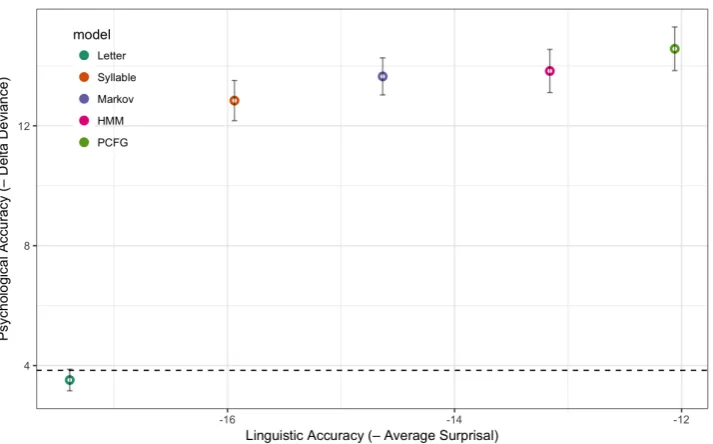
Linguistic and psychological accuracies of com-putational models are summarized in Figure 1, where the x-axis is linguistic accuracy (negative average surprisal) and they-axis is psychological accuracy (decrease in delta deviance). The accu-racies are averaged across 100 MCCV iterations. Points represent computational models and verti-cal bars on the points are 95% confidence intervals of the psychological accuracy.11 The horizontal dashed line isχ2= 3.84, the criticalχ2-statistic at
p= 0.05 withdf = 1.
First, “morphous” models were psychologically more accurate than “amorphous” models. Nested model comparisons via log-likelihood ratio tests revealed that all “morphous” models were statisti-cally significant (p<0.01), but one of two
“amor-11Thanks to the central limit theorem, while the test
statis-tic itself isχ2-statistic, the samples ofχ2-statistic follow the
Gaussian distribution, based on which 95% confidence inter-vals can be computed.
phous” models (i.e. Letter Markov Model) did not reached statistical significance. Second, the PCFG was psychologically most accurate among the five computational models: PCFG (χ2 = 14.57) >
HMM (χ2 = 13.83)>Morpheme Markov Model (χ2 = 13.65) > Syllable Markov Model (χ2 = 12.84)<Letter Markov Model (χ2= 3.52). Third, the PCFG was also linguistically most accurate, where the correlation between linguistic and psy-chological accuracies among five computational models was high (r= 0.81).
3.2 Control Predictors
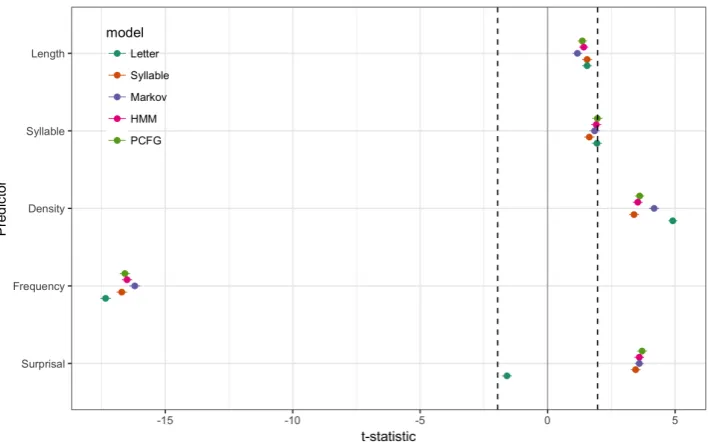
Effects of control predictors are summarized in Figure2, where thex-axis ist-statistic and the y -axis is control predictors. Thet-statistics are av-eraged across 100 MCCV iterations. Points rep-resent computational models and horizontal bars on the points are 95% confidence intervals of the
t-statistic. Vertical dashed lines aret=±1.96, the criticalt-statistic atp= 0.05 withdf =∞.
All control predictors except visual predictors like squared length and number of syllables were statistically significant (p < 0.05). The surface frequency effects were most robustly observed among the four control predictors: Letter Markov Model (t= – 17.34), Syllable Markov Model (t= – 16.71), Morpheme Markov Model (t= – 16.19), HMM (t= – 16.49), and PCFG (t= – 16.58). Note that surface frequency was most pronounced in combination with the PCFG among three “mor-phous” models, suggesting that cumulative sur-prisal estimated by the PCFG explains unique variances not covered by surface frequency.
4 Discussion
In summary, the results of the simulation ex-periment demonstrated that “morphous” models were more psychologically accurate than “amor-phous” models, contrary to “amor“amor-phous” mod-els of morphological processing (Baayen et al.,
Figure 1: Linguistic and psychological accuracies of computational models, averaged across 100 MCCV iterations. Thex-axis is linguistic accuracy (negative average surprisal), while they-axis is psychological accuracy (decrease in delta deviance). Points represent computational models. Vertical bars on the points are 95% confidence intervals of the psychological accuracy. The horizontal dashed line isχ2= 3.84, the criticalχ2-statistic atp= 0.05 withdf
= 1. All computational models except Letter Markov Model were statistically significant (p<0.01).
structures was more accurate than HMM with POS tags but no hierarchical structures, which in turn was more accurate than Markov Model with nei-ther hierarchical structures nor POS tags, meaning that hierarchical structures and POS tags made in-dependent contributions for predicting human RTs in visual word recognition. In addition, given that the cumulative surprisal was computed by the PCFG via a probabilistic Earley parser ( Ear-ley,1970;Stolcke,1995), a top-down parser that incrementally computes probabilities morpheme by morpheme in morphologically complex words, this result may also indicate that morphological processing proceeds incrementally from left to right, despite the inherently non-incremental na-ture of visual word recognition.12
Moreover, the effects of surface frequency and cumulative surprisal were simultaneously ob-served, theoretically reflecting storage and com-putation, respectively. The simultaneous effects of surface frequency and cumulative surprisal were not surprising under either the single-route de-composition model of morphological processing (Taft, 1979,2004;Taft and Forster,1975), where
12
An anonymous reviewer insightfully pointed out that the Cohort Model (Marslen-Wilson,1987) may harmonize with the present idea that a probabilistic parser applied to morpho-logical processing incrementally contracts the mental lexicon from left to right, which remained to be investigated in future.
storage and computation are indexed at function-ally different stages of morphological processing (cf. Solomyak and Marantz, 2010; Fruchter and Marantz, 2015) or the dual-route model of mor-phological processing (Pinker and Prince, 1988;
Figure 2: Effects of control predictors, averaged across 100 MCCV iterations. Thex-axis ist-statistic, while they-axis is control predictors. Points represent computational models. Horizontal bars on the points are 95% confidence intervals of thet-statistic. Vertical dashed lines aret=±1.96, the criticalt-statistic atp= 0.05 withdf
=∞. All control predictors except visual predictors were statistically significant (p<0.05).
surprisal, either.
Nevertheless, remember that we only sampled bimorphemic words as the testing data. However, asLibben(2003,2006) pointed out, bimorphemic words are not sufficient to distinguish hierarchi-cal structures and linear strings, and trimorphemic words are minimally required. In future, the com-putational models must be evaluated against tri-morphemic words to make sure that the results will generalize beyond bimorphemic words.
5 Conclusion
In this paper, we performed a computational sim-ulation experiment with human RTs in visual lex-ical decision experiments available from the ELP (Balota et al., 2007), a “shared task” in the mor-phological processing literature, and evaluated computational models with different representa-tional assumptions via cumulative surprisal as a linking hypothesis (Hale, 2001; Levy, 2008), in order to investigate whether morphological pro-cessing tracks morphemes and parses them into hierarchical syntactic structures. Consequently, the results of the simulation experiment demon-strated that “morphous” models were psycholog-ically more accurate than “amorphous” models and, importantly, a computational model with hi-erarchical syntactic structures, PCFG, was most psychologically accurate among five
computa-tional models, contrary to “amorphous” (Baayen et al., 2011) and finite-state (Beesley and Kart-tunen,2003) models of morphological processing.
Acknowledgments
We would like to thank Tal Linzen and CMCL anonymous reviewers for valuable suggestions. This work was supported by JSPS KAKENHI Grant Number JP18H05589.
References
Roberto de Almeida and Gary Libben. 2005. Chang-ing morphological structures: The effect of sentence context on the interpretation of structurally ambigu-ous English trimorphemic words. Language and Cognitive Processes, 20:373–394.
Stephen Anderson. 1992. A-morphous morphology. Cambridge University Press, Cambridge.
Mark Aronoff. 1994. Morphology by Itself. MIT Press, Cambridge, MA.
Harald Baayen, Douglas Davidson, and Douglas Bates. 2008. Mixed-effects modeling with crossed random effects for subjects and items. Journal of Memory and Language, 59:390–412.
R. H. Baayen, R. Piepenbrock, and L. Gulikers. 1995.
The CELEX Lexical Database (CD-ROM). Linguis-tic Data Consortium, University of Pennsylvania, Philadelphia, PA.
D.A. Balota, M.J. Yap, M.J. Cortese, K.A. Hutchison, B. Kessler, B. Loftis, J.H. Neely, D.L. Nelson, G.B. Simpson, and R. Treiman. 2007. The English Lex-icon Project. Behavior Research Methods, 39:445– 459.
Kenneth Beesley and Lauri Karttunen. 2003. Finite State Morphology. CSLI Publications, University of Chicago Press.
Steven Bird, Ewan Klein, and Edward Loper. 2009. Natural Language Processing with Python. O’Reilly Media.
Marisa Boston, John Hale, Reinhold Kliegl, Umesh Patil, and Shravan Vasishth. 2008. Parsing costs as predictors of reading difficulty: An evaluation us-ing the Potsdam Sentence Corpus. Journal of Eye Movement Research, 2:1–12.
Marc Brysbaert and Boris New. 2009. Moving beyond Kuˇcera and Francis: A critical evaluation of current word frequency norms and the introduction of a new and improved word frequency measure for Ameri-can English. Behavior Research Methods, 41:977– 990.
Curt Burgess and Kay Livesay. 1998. The effect of cor-pus size in predicting reaction time in a basic word recognition task: Moving on from Kuˇcera and Fran-cis. Behavior Research Methods, 30:272–277.
Guy Carden. 1983. The Non-Finite = State-Ness of the Word Formation Component. Linguistic Inquiry, 14:537–541.
Noam Chomsky. 1957. Syntactic Structures. Mouton, The Hague.
Noam Chomsky. 1965. Aspects of the Theory of Syn-tax. MIT Press, Cambridge, MA.
Max Coltheart, Eileen Davelaar, Jon Torfi Jonasson, and Derek Besner. 1977. Access to the internal lex-icon. In Stanislav Dornic, editor,Attention and Per-formance, pages 535–555. Erlbaum, Hillsdale, NJ.
Vera Demberg and Frank Keller. 2008. Data from eye-tracking corpora as evidence for theories of syntactic processing complexity. Cognition, 109:193–210.
Jay Earley. 1970. An ecient context-free parsing algo-rithm. Communications of the Association for Com-puting Machinery, 13:94–102.
Martin Everaert, Marinus Huybregts, Noam Chom-sky, Robert Berwick, and Johan Bolhuis. 2015. Structures, Not Strings: Linguistics as Part of the Cognitive Sciences. Trends in Cognitive Sciences, 19:729–743.
Victoria Fossum and Roger Levy. 2012. Sequential vs. hierarchical syntactic models of human incre-mental sentence processing. Proceedings of the 3rd Workshop on Cognitive Modeling and Compu-tational Linguistics, pages 61–69.
Stefan Frank and Rens Bod. 2011. Insensitivity of the human sentence-processing system to hierarchical structure. Psychological Science, 22:829–834.
Stefan Frank, Rens Bod, and Morten Christiansen. 2012. How hierarchical is language use? Proceed-ings of the Royal Society B, 279:4522–4531.
Joseph Fruchter and Alec Marantz. 2015. Decompo-sition, lookup, and recombination: MEG evidence for the Full Decomposition model of complex visual work recognition. Brain and Language, 143:81–96.
John Hale. 2001. A Probabilistic Earley Parser as a Psycholinguistic Model. Proceedings of NAACL-2001, pages 159–166.
John Hale. 2016. Information-theoretical Complex-ity Metrics. Language and Linguistics Compass, 10:397–412.
Morris Halle and Alec Marantz. 1993. Distributed Morphology and the Pieces of Inflection. In Ken Hale and Samuel Keyser, editors, The View from from Building 20: Essays in Linguistics in Honor of Sylvain Bromberger, pages 111–176. MIT Press, Cambridge, MA.
Jeffrey Heinz and William Idsardi. 2011. Sentence and Word Complexity.Science, 333:295–297.
Frank Keller. 2000. Gradience in grammar: Exper-imental and computational aspects of degrees of grammaticality. Ph.D. thesis, University of Edin-burgh.
Henry Kucera and Nelson Francis. 1967. Compu-tational analysis of present-day American English. Brown University Press, Providence.
Terence Langendoen. 1981. The Generative Capac-ity of Word-Formation Components. Linguistic In-quiry, 12:320–322.
Jey Han Lau, Alexander Clark, and Shalom Lappin. 2016. Grammaticality, acceptability, and probabil-ity: a probabilistic view of linguistic knowledge.
Cognitive Science, pages 1–40.
Roger Levy. 2008. Expectation-based syntactic com-prehension. Cognition, 106:1126–1177.
Gary Libben. 2003. Morphological parsing and mor-phological structure. In Egbert Assink and Do-miniek Sandra, editors, Reading Complex Words, pages 221–239. Kluwer, New York.
G. Libben, T. Priestly, R. Smyth, and S. Wang, edi-tors,Phonology, Morphology, and the Empirical Im-perative, pages 349–369. Crane, Taipei.
Rochelle Lieber. 1992. Deconstructing Morphology. University of Chicago Press, Chicago.
Constantine Lignos and Kyle Gorman. 2012. Revisit-ing frequency and storage in morphological process-ing. Proceedings of CLS, 48:447–461.
William Marslen-Wilson. 1987. Functional parallelism in spoken word recognition. Cognition, 25:71–102.
Petar Milin, Laurie Feldman, Michael Ramscar, Peter Hendrix, and Harald Baayen. 2017. Discrimination in lexical decision. PLoS ONE, 12.
George Miller and Noam Chomsky. 1963. Finitary models of language users. In Duncan Luce, Robert Bush, and Eugene Galanter, editors, Handbook of Mathematical Psychology, volume 2, pages 419– 491. Wiley, New York.
Boris New, Ludovic Ferrand, Christophe Pallier, and Marc Brysbaert. 2006. Reexamining the word length effect in visual word recognition: New evi-dence from the English Lexicon Project. Psycho-nomic Bulletion and Review, 13:45–52.
Timothy O’Donnell. 2015. Productivity and Reuse in Language. MIT Press, Cambridge, MA.
Steven Pinker and Alan Prince. 1988. On language and connectionism. Cognition, 28:73–193.
Steven Pinker and Michael Ullman. 2002. The past and future of the past tense. Trends in Cognitive Sci-ences, 6:456–462.
Alexander Pollatsek, Denis Drieghe, Linnaea Stockall, and Roberto de Almeida. 2010. The interpretation of ambiguous trimorphemic words in sentence con-text. Psychonomic Bulletion and Review, 17:88–94.
Lawrence Rabinar. 1989. A Tutorial on Hid-den Markov Models and Selected Applications in Speech Recognition. Proceedings of the IEEE, 77:257–286.
Brian Roark, Asaf Bachrach, Carlos Cardenas, and Christophe Pallier. 2009. Deriving lexical and syntactic expectation-based measures for psycholin-guistic modeling via incremental top-down parsing.
Proceedings of the Conference on Empirical Meth-ods in Natural Language Processing, pages 324– 333.
Brian Roark and Richard Sproat. 2007. Computa-tional Approaches to Morphology and Syntax. Ox-ford University Press, OxOx-ford.
Nathaniel Smith and Roger Levy. 2013. The effect of word predictability on reading time is logarithmic.
Cognition, 128:302–319.
Olla Solomyak and Alec Marantz. 2010. Evidence for Early Morphological Decomposition in Visual Word Recognition: A Single-Trial Correlational MEG Study. Journal of Cognitive Neuroscience, 22:2042–2057.
Yoonsang Song, Youngah Do, Jongbong Lee, Arthur Thompson, and Eileen Waegemaekers. 2019. The reality of hierarchical morphological structure in multimorphemic words. Cognition, 183:269–276.
Jon Sprouse, Sagar Indurkhya, Beracah Yankama, Sandiway Fong, and Robert C. Berwick. 2018. Col-orless green ideas do sleep furiously: gradient ac-ceptability and the nature of the grammar. Linguistic Review, 35:575–599.
Andreas Stolcke. 1995. An ecient probabilistic context-free parsing algorithm that computes prefix probabilities. Computational Linguistics, 21:165– 201.
M. Taft. 1979. Recognition of affixed words and the word frequency effect. Memory and Cognition, 7:263–272.
M. Taft. 2004. Morphological decomposition and the reverse base frequency effect. The Quarterly Jour-nal of Experimental Psychology, 57:745–765.
M. Taft and K. I. Forster. 1975. Lexical storage and re-trieval of prefixed words. Journal of Verbal Learn-ing and Verbal Behavior, 14:638–647.
Sami Virpioja, Minna Lehtonen, Annika Hulten, Henna Kivikari, Riitta Salmelin, and Krista Lagus. 2017. Using Statistical Models of Morphology in the Search for Optimal Units of Representation in the Human Mental Lexicon. Cognitive Science, pages 1–35.
Charles Yang. 2017. Rage against the machine: Eval-uation metrics in the 21st century.Language Acqui-sition, 24:100–125.
Tal Yarkoni, David Balota, and Melvin Yap. 2008. Moving beyond Coltheart’s N: A new measure of orthographic similarity. Psychonomic Bulletion and Review, 15:971–979.