1
Parallelizable Stack Long Short-Term Memory
Shuoyang Ding Philipp Koehn Center for Language and Speech Processing
Johns Hopkins University {dings, phi}@jhu.edu
Abstract
Stack Long Short-Term Memory (StackL-STM) is useful for various applications such as parsing and string-to-tree neural machine translation, but it is also known to be notori-ously difficult to parallelize for GPU training due to the fact that the computations are de-pendent on discrete operations. In this paper, we tackle this problem by utilizing state access patterns of StackLSTM to homogenize compu-tations with regard to different discrete opera-tions. Our parsing experiments show that the method scales up almost linearly with increas-ing batch size, and our parallelized PyTorch implementation trains significantly faster com-pared to the Dynet C++ implementation.
1 Introduction
Tree-structured representation of language has been successfully applied to various applications includ-ing dependency parsinclud-ing (Dyer et al., 2015), sen-timent analysis (Socher et al., 2011) and neural machine translation (Eriguchi et al.,2017). How-ever, most of the neural network architectures used to build tree-structured representations are not able to exploit full parallelism of GPUs by minibatched training, as the computation that happens for each instance is conditioned on the input/output struc-tures, and hence cannot be naïvely grouped together as a batch. This lack of parallelism is one of the ma-jor hurdles that prevent these representations from wider adoption practically (e.g., neural machine translation), as many natural language processing tasks currently require the ability to scale up to very large training corpora in order to reach state-of-the-art performance.
We seek to advance the state-of-the-art of this problem by proposing a parallelization scheme for one such network architecture, the Stack Long Short-Term Memory (StackLSTM) proposed in
Dyer et al. (2015). This architecture has been
successfully applied to dependency parsing (Dyer et al., 2015, 2016; Ballesteros et al., 2017) and syntax-aware neural machine translation (Eriguchi et al., 2017) in the previous research literature, but none of these research results were produced with minibatched training. We show that our paral-lelization scheme is feasible in practice by showing that it scales up near-linearly with increasing batch size, while reproducing a set of results reported in (Ballesteros et al.,2017).
2 StackLSTM
StackLSTM (Dyer et al.,2015) is an LSTM archi-tecture (Hochreiter and Schmidhuber,1997) aug-mented with a stack H that stores some of the hidden states built in the past. Unlike traditional LSTMs that always build statehtfromht−1, the
states of StackLSTM are built from the head of the state stack H, maintained by a stack top pointer
p(H). At each time step, StackLSTM takes a real-valued input vector together with an additional dis-crete operation on the stack, which determines what computation needs to be conducted and how the stack top pointer should be updated. Throughout this section, we index the input vector (e.g. word embeddings)xtusing the time steptit is fed into
the network, and hidden states in the stackhj using
their positionjin the stackH,jbeing defined as the 0-base index starting from the stack bottom.
The set of input discrete actions typically con-tains at least Push and Pop operations. When these operations are taken as input, the correspond-ing computations on the StackLSTM are listed be-low:1
• Push: read previous hidden statehp(H),
per-form LSTM forward computation withxtand
1To simplify the presentation, we omitted the updates on
Transition Systems Transition Op Stack Op Buffer Op Composition Op
Arc-Standard
Shift push pop none
Left-Arc pop, pop, push hold S1←g(S0, S1)
Right-Arc pop hold S1←g(S1, S0)
Arc-Eager
Shift push pop none
Reduce pop hold none
Left-Arc pop hold B0←g(B0, S0)
Right-Arc push pop B0←g(S0, B0)
Arc-Hybrid
Shift push pop none
Left-Arc pop hold B0←g(B0, S0)
[image:2.595.100.502.64.234.2]Right-Arc pop hold S1←g(S1, S0)
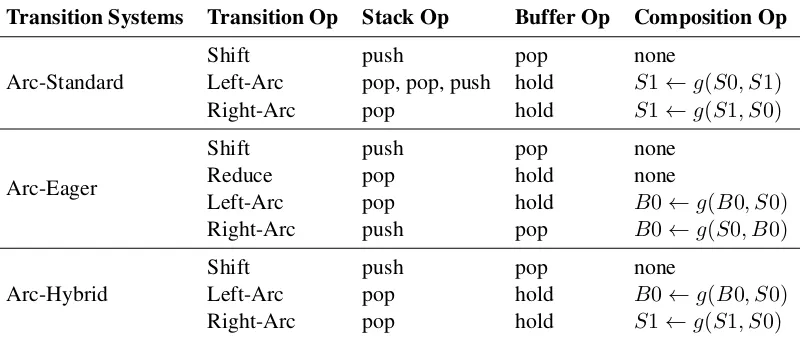
Table 1: Correspondence between transition operations and stack/buffer operations for StackLSTM, whereg de-notes the composition function as proposed by (Dyer et al.,2015). S0 and B0 refers to the token-level representa-tion corresponding to the top element of the stack and buffer, while S1 and B1 refers to those that are second to the top. We use a different notation here to avoid confusion with the states in StackLSTM, which represent non-local information beyond token-level.
hp(H), write new hidden state tohp(H)+1,
up-date stack top pointer withp(H)←p(H) + 1. • Pop: update stack top pointer withp(H)←
p(H)−1.
Reflecting on the aforementioned discussion on parallelism, one should notice that StackLSTM falls into the category of neural network architec-tures that is difficult to perform minibatched train-ing. This is caused by the fact that the computation performed by StackLSTM at each time step is de-pendent on the discrete input actions. The follow-ing section proposes a solution to this problem.
3 Parallelizable StackLSTM
Continuing the formulation in the previous section, we will start by discussing our proposed solution under the case where the set of discrete actions contains onlyPushandPopoperations; we then move on to discussion of the applicability of our proposed solution to the transition systems that are used for building representations for dependency trees.
The first modification we perform to thePush
andPopoperations above is to unify the pointer update of these operations asp(H)←p(H) +op, whereopis the input discrete operation that could either take the value +1 or -1 forPushandPop
operation. After this modification, we came to the following observations:
Observation 1 The computation performed for
Popoperation is a subset ofPushoperation.
Now, what remains to homogenize Pushand
Popoperations is conducting the extra computa-tions needed forPushoperation whenPopis fed in as well, while guaranteeing the correctness of the resulting hidden state both in the current time step and in the future. The next observation points out a way for this guarantee:
Observation 2 In a StackLSTM, given the current stack top pointer positionp(H), any hidden state hi where i > p(H) will not be read until it is overwritten by aPushoperation.
What follows from this observation is the guar-antee that we can always safely overwrite hidden stateshi that are indexed higher than the current
stack top pointer, because it is known that any read operation on these states will happen after another overwrite. This allows us todo the extra computa-tion anywaywhenPopoperation is fed, because the extra computation, especially updatinghp(H)+1,
will not harm the validity of the hidden states at any time step.
Algorithm1gives the final forward computation for the Parallelizable StackLSTM. Note that this algorithm does not contain any if-statements that depends on stack operations and hence is homoge-neous when grouped into batches that are consisted of multiple operations trajectories.
Algorithm 1:Forward Computation for Paral-lelizable StackLSTM
Input:input vectorxt
discrete stack operationop Output: current top hidden statehp(H)
h_prev←hp(H);
h←LSTM(xt, h_prev); hp(H)+1←h;
p(H)←p(H) +op;
returnhp(H);
Arc-Hybrid transition systems, we can simply add aholdoperation, which is denoted by value 0 for the discrete operation input. For that reason, we will focus on parallelization of these two transition systems for this paper. It should be noted that both observations discussed above are still valid after adding theholdoperation.
4 Experiments
4.1 Setup
We implemented2the architecture described above in PyTorch (Paszke et al.,2017). We implemented the batched stack as a float tensor wrapped in a non-leaf variable, thus enabling in-place operations on that variable. At each time step, the batched stack is queried/updated with a batch of stack head positions represented by an integer vector, an op-eration made possible bygatheroperation and advanced indexing. Due to this implementation choice, the stack size has to be determined at ini-tialization time and cannot be dynamically grown. Nonetheless, a fixed stack size of 150 works for all the experiments we conducted.
We use the dependency parsing task to evaluate the correctness and the scalability of our method. For comparison with previous work, we follow the architecture introduced inDyer et al. (2015);
Ballesteros et al.(2017) and chose the Arc-Hybrid transition system for comparison with previous work. We follow the data setup inChen and Man-ning(2014);Dyer et al.(2015);Ballesteros et al.
(2017) and use Stanford Dependency Treebank (de Marneffe et al.,2006) for dependency parsing, and we extract the Arc-Hybrid static oracle using the code associated withQi and Manning(2017). The part-of-speech (POS) tags are generated with Stanford POS-tagger (Toutanova et al.,2003) with
2https://github.com/shuoyangd/hoolock
100 101 102
batch size
0 50 100 150 200 250 300 350 400
sent/s
[image:3.595.308.509.63.222.2]training speed Dyer et al. 2015
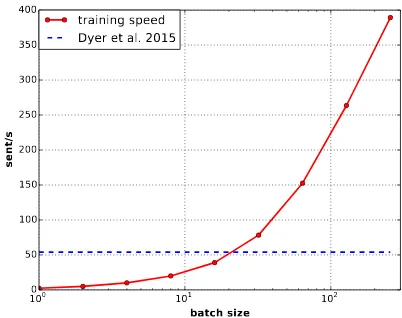
Figure 1: Training speed at different batch size. Note that thex-axis is in log-scale in order to show all the data points properly.
a test set accuracy of 97.47%. We use exactly the same pre-trained English word embedding asDyer et al.(2015).
We use Adam (Kingma and Ba,2014) as the opti-mization algorithm. FollowingGoyal et al.(2017), we apply linear warmup to the learning rate with an initial value ofτ = 5×10⁻⁴and total epoch num-ber of 5. The target learning rate is set byτ multi-plied by batch size, but capped at 0.02 because we find Adam to be unstable beyond that learning rate. After warmup, we reduce the learning rate by half every time there is no improvement for loss value on the development set (ReduceLROnPlateau). We clip all the gradient norms to 5.0 and apply a L2-regularization with weight1×10−6.
We started with the hyper-parameter choices in
Dyer et al. (2015) but made some modifications based on the performance on the development set: we use hidden dimension 200 for all the LSTM units, 200 for the parser state representation before the final softmax layer, and embedding dimension 48 for the action embedding.
We use Tesla K80 for all the experiments, in or-der to compare withNeubig et al.(2017b);Dyer et al.(2015). We also use the same hyper-parameter setting asDyer et al.(2015) for speed comparison experiments. All the speeds are measured by run-ning through one trairun-ning epoch and averaging.
4.2 Results
Figure1shows the training speed at different batch sizes up to 256.3 The speed-up of our model is
3At batch size of 512, the longest sentence in the training
[image:3.595.76.292.80.211.2]b dev test
UAS LAS UAS LAS
1* 92.50* 89.79* 92.10* 89.61*
8 92.93 90.42 92.54 90.11
16 92.62 90.19 92.53 90.13
32 92.43 89.89 92.31 89.94
64 92.53 90.04 92.22 89.73
128 92.39 89.73 92.55 90.02
[image:4.595.81.281.63.230.2]256 92.15 89.46 91.99 89.43
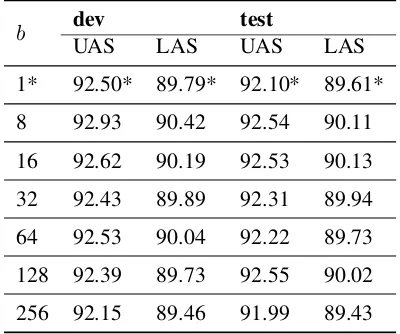
Table 2: Dependency parsing result with various train-ing batch size b and without composition function. The results marked with asterisks were reported in the
Ballesteros et al.(2017).
close to linear, which means there is very little over-head associated with our batching scheme. Quan-titatively, according to Amdahl’s Law (Amdahl,
1967), the proportion of parallelized computations is 99.92% at batch size 64. We also compared our implementation with the implementation that comes with Dyer et al. (2015), which is imple-mented in C++ with DyNet (Neubig et al.,2017a). DyNet is known to be very optimized for CPU com-putations and hence their implementation is reason-ably fast even without batching and GPU accelera-tion, as shown in Figure1.4 But we would like to point out that we focus on the speed-up we are able to obtain rather than the absolute speed, and that our batching scheme is framework-universal and superior speed might be obtained by combining our scheme with alternative frameworks or languages (for example, the torch C++ interface).
The dependency parsing results are shown in Ta-ble2. Our implementation is able to yield better test set performance than that reported in Balles-teros et al.(2017) for all batch size configurations except 256, where we observe a modest perfor-mance loss. LikeGoyal et al.(2017);Keskar et al.
(2016); Masters and Luschi(2018), we initially observed more significant test-time performance deterioration (around1%absolute difference) for models trained without learning rate warmup, and concurring with the findings inGoyal et al.(2017), we find warmup very helpful for stabilizing large-batch training. We did not run experiments with batch size below 8 as they are too slow due to
4Measured on one core of an Intel Xeon E7-4830 CPU.
Python’s inherent performance issue.
5 Related Work
DyNet has support for automatic minibatching (Neubig et al.,2017b), which figures out what com-putation is able to be batched by traversing the computation graph to find homogeneous compu-tations. While we cannot directly compare with that framework’s automatic batching solution for StackLSTM5, we can draw a loose comparison to the results reported in that paper for BiLSTM transition-based parsing (Kiperwasser and Gold-berg,2016). Comparing batch size of 64 to batch size of 1, they obtained a 3.64x speed-up on CPU and 2.73x speed-up on Tesla K80 GPU, while our architecture-specific manual batching scheme ob-tained 60.8x speed-up. The main reason for this difference is that their graph-traversing automatic batching scheme carries a much larger overhead compared to our manual batching approach.
Another toolkit that supports automatic mini-batching is Matchbox6, which operates by analyz-ing the sanalyz-ingle-instance model definition and deter-ministically convert the operations into their mini-batched counterparts. While such mechanism elim-inated the need to traverse the whole computation graph, it cannot homogenize the operations in each branch ofif. Instead, it needs to perform each op-eration separately and apply masking on the result, while our method does not require any masking. Unfortunately we are also not able to compare with the toolkit at the time of this work as it lacks sup-port for several operations we need.
Similar to the spirit of our work,Bowman et al.
(2016) attempted to parallelize StackLSTM by us-ing Thin-stack, a data structure that reduces the space complexity by storing all the intermediate stack top elements in a tensor and use a queue to control element access. However, thanks to Py-Torch, our implementation is not directly depen-dent on the notion of Thin-stack. Instead, when an element is popped from the stack, we simply shift the stack top pointer and potentially re-write the corresponding sub-tensor later. In other words, there is no need for us to directly maintain all the in-termediate stack top elements, because in PyTorch, when the element in the stack is re-written, its un-derlying sub-tensor will not be destructed as there
5
This is due to the fact that DyNet automatic batching cannot handle graph structures that depends on runtime input values, which is the case in StackLSTM.
are still nodes in the computation graph that point to it. Hence, when performing back-propagation, the gradient is still able to flow back to the ele-ments that are previously popped from the stack and their respective precedents. Hence, we are also effectively storing all the intermediate stack top elements only once. Besides, Bowman et al.
(2016) didn’t attempt to eliminate the conditional branches in the StackLSTM algorithm, which is the main algorithmic contribution of this work.
6 Conclusion
We propose a parallelizable version of StackLSTM that is able to fully exploit the GPU parallelism by performing minibatched training. Empirical results show that our parallelization scheme yields comparable performance to previous work, and our method scales up very linearly with the increasing batch size.
Because our parallelization scheme is based on the observation made in section1, we cannot incor-porate batching for neither Arc-Standard transition system nor the token-level composition function proposed inDyer et al.(2015) efficiently yet. We leave the parallelization of these architectures to future work.
Our parallelization scheme makes it feasible to run large-data experiments for various tasks that requires large training data to perform well, such as RNNG-based syntax-aware neural machine trans-lation (Eriguchi et al.,2017).
Acknowledgement
The authors would like to thank Peng Qi for help-ing with data preprocesshelp-ing and James Bradbury for helpful technical discussions. This material is based upon work supported in part by the DARPA LORELEI and IARPA MATERIAL programs.
References
Gene M. Amdahl. 1967. Validity of the single pro-cessor approach to achieving large scale computing capabilities. In American Federation of Informa-tion Processing Societies: Proceedings of the AFIPS ’67 Spring Joint Computer Conference, April 18-20,
1967, Atlantic City, New Jersey, USA, pages 483– 485.
Miguel Ballesteros, Chris Dyer, Yoav Goldberg, and Noah A. Smith. 2017. Greedy transition-based de-pendency parsing with stack lstms. Computational Linguistics, 43(2):311–347.
Samuel R. Bowman, Jon Gauthier, Abhinav Ras-togi, Raghav Gupta, Christopher D. Manning, and Christopher Potts. 2016. A fast unified model for parsing and sentence understanding. InProceedings of the 54th Annual Meeting of the Association for Computational Linguistics, ACL 2016, August 7-12, 2016, Berlin, Germany, Volume 1: Long Papers.
Danqi Chen and Christopher D. Manning. 2014. A fast and accurate dependency parser using neural net-works. InProceedings of the 2014 Conference on Empirical Methods in Natural Language Processing, EMNLP 2014, October 25-29, 2014, Doha, Qatar, A meeting of SIGDAT, a Special Interest Group of the ACL, pages 740–750.
Chris Dyer, Miguel Ballesteros, Wang Ling, Austin Matthews, and Noah A. Smith. 2015. Transition-based dependency parsing with stack long short-term memory. In Proceedings of the 53rd Annual Meeting of the Association for Computational Lin-guistics and the 7th International Joint Conference on Natural Language Processing of the Asian Fed-eration of Natural Language Processing, ACL 2015, July 26-31, 2015, Beijing, China, Volume 1: Long Papers, pages 334–343.
Chris Dyer, Adhiguna Kuncoro, Miguel Ballesteros, and Noah A. Smith. 2016. Recurrent neural net-work grammars. InNAACL HLT 2016, The 2016 Conference of the North American Chapter of the Association for Computational Linguistics: Human Language Technologies, San Diego California, USA, June 12-17, 2016, pages 199–209.
Akiko Eriguchi, Yoshimasa Tsuruoka, and Kyunghyun Cho. 2017. Learning to parse and translate improves neural machine translation. In Proceedings of the 55th Annual Meeting of the Association for Compu-tational Linguistics, ACL 2017, Vancouver, Canada, July 30 - August 4, Volume 2: Short Papers, pages 72–78.
Priya Goyal, Piotr Dollár, Ross B. Girshick, Pieter No-ordhuis, Lukasz Wesolowski, Aapo Kyrola, Andrew Tulloch, Yangqing Jia, and Kaiming He. 2017. Ac-curate, large minibatch SGD: training imagenet in 1 hour. CoRR, abs/1706.02677.
Sepp Hochreiter and Jürgen Schmidhuber. 1997. Long short-term memory. Neural Computation, 9(8):1735–1780.
Nitish Shirish Keskar, Dheevatsa Mudigere, Jorge No-cedal, Mikhail Smelyanskiy, and Ping Tak Peter Tang. 2016. On large-batch training for deep learn-ing: Generalization gap and sharp minima. CoRR, abs/1609.04836.
Diederik P. Kingma and Jimmy Ba. 2014. Adam: A method for stochastic optimization. CoRR, abs/1412.6980.
Marco Kuhlmann, Carlos Gómez-Rodríguez, and Gior-gio Satta. 2011. Dynamic programming algorithms for transition-based dependency parsers. In The 49th Annual Meeting of the Association for Com-putational Linguistics: Human Language Technolo-gies, Proceedings of the Conference, 19-24 June, 2011, Portland, Oregon, USA, pages 673–682.
Marie-Catherine de Marneffe, Bill MacCartney, and Christopher D. Manning. 2006. Generating typed dependency parses from phrase structure parses. In Proceedings of the Fifth International Confer-ence on Language Resources and Evaluation, LREC 2006, Genoa, Italy, May 22-28, 2006., pages 449– 454.
Dominic Masters and Carlo Luschi. 2018. Revisit-ing small batch trainRevisit-ing for deep neural networks.
CoRR, abs/1804.07612.
Graham Neubig, Chris Dyer, Yoav Goldberg, Austin Matthews, Waleed Ammar, Antonios Anastasopou-los, Miguel Ballesteros, David Chiang, Daniel Cloth-iaux, Trevor Cohn, Kevin Duh, Manaal Faruqui, Cynthia Gan, Dan Garrette, Yangfeng Ji, Lingpeng Kong, Adhiguna Kuncoro, Gaurav Kumar, Chai-tanya Malaviya, Paul Michel, Yusuke Oda, Matthew Richardson, Naomi Saphra, Swabha Swayamdipta, and Pengcheng Yin. 2017a. Dynet: The dynamic neural network toolkit. CoRR, abs/1701.03980.
Graham Neubig, Yoav Goldberg, and Chris Dyer. 2017b. On-the-fly operation batching in dynamic computation graphs. In Advances in Neural Infor-mation Processing Systems 30: Annual Conference on Neural Information Processing Systems 2017, 4-9 December 2017, Long Beach, CA, USA, pages 3974–3984.
Joakim Nivre. 2008. Algorithms for deterministic in-cremental dependency parsing. Computational Lin-guistics, 34(4):513–553.
Adam Paszke, Sam Gross, Soumith Chintala, Gregory Chanan, Edward Yang, Zachary DeVito, Zeming Lin, Alban Desmaison, Luca Antiga, and Adam Lerer. 2017. Automatic differentiation in pytorch. InNIPS-W.
Peng Qi and Christopher D. Manning. 2017. Arc-swift: A novel transition system for dependency parsing. InProceedings of the 55th Annual Meeting of the As-sociation for Computational Linguistics, ACL 2017, Vancouver, Canada, July 30 - August 4, Volume 2: Short Papers, pages 110–117.
Richard Socher, Cliff Chiung-Yu Lin, Andrew Y. Ng, and Christopher D. Manning. 2011. Parsing natu-ral scenes and natunatu-ral language with recursive neu-ral networks. In Proceedings of the 28th Inter-national Conference on Machine Learning, ICML 2011, Bellevue, Washington, USA, June 28 - July 2, 2011, pages 129–136.