Proceedings of NAACL-HLT 2018, pages 1595–1604
Tracking State Changes in Procedural Text:
A Challenge Dataset and Models for Process Paragraph Comprehension
Bhavana Dalvi Mishra1*, Lifu Huang2∗, Niket Tandon1, Wen-tau Yih1, Peter Clark1 1Allen Institute for AI, Seattle,2Rensselaer Polytechnic Institute, Troy
{bhavanad,nikett,scottyih,peterc}@allenai.org, {warrior.fu}@gmail.com
Abstract
We present a new dataset and models for com-prehending paragraphs about processes (e.g., photosynthesis), an important genre of text de-scribing a dynamic world. The new dataset, ProPara, is the first to contain natural (rather than machine-generated) text about a chang-ing world along with a full annotation of entity states (location and existence) during those changes (81k datapoints). The end-task, tracking the location and existence of entities through the text, is challenging because the causal effects of actions are often implicit and need to be inferred. We find that previous models that have worked well on synthetic data achieve only mediocre performance on ProPara, and introduce two new neural models that exploit alternative mechanisms for state prediction, in particular using LSTM input en-coding and span prediction. The new models improve accuracy by up to 19%. The dataset and models are available to the community at
http://data.allenai.org/propara.
1 Introduction
Building a reading comprehension (RC) system that is able to read a text document and to answer questions accordingly has been a long-standing goal in NLP and AI research. Impressive progress has been made in factoid-style reading compre-hension, e.g., (Seo et al., 2017a; Clark and Gard-ner, 2017), enabled by well-designed datasets and modern neural network models. However, these models still struggle with questions that require
inference(Jia and Liang, 2017).
Consider the paragraph in Figure 1 about pho-tosynthesis. While top systems on SQuAD (Ra-jpurkar et al., 2016) can reliably answer lookup questions such as:
Q1: What do the roots absorb? (A: water, minerals) they struggle when answers are not explicit, e.g.,
Q2: Where is sugar produced? (A: in the leaf)1 ∗
*Bhavana Dalvi Mishra and Lifu Huang contributed
equally to this work.
1For example, the RC system BiDAF (Seo et al., 2017a)
answers “glucose” to this question.
Chloroplasts in the leaf of the plant trap light from the sun. The roots absorb water and min-erals from the soil. This combination of water and minerals flows from the stem into the leaf. Carbon dioxide enters theleaf. Light, water and minerals, and the carbon dioxide all com-bine into a mixture. This mixture formssugar
(glucose) which is what the plant eats.
Q: Where is sugar produced?
A: in the leaf
Figure 1: A paragraph fromProParaabout photosyn-thesis (bold added, to highlight question and answer el-ements). Processes are challenging because questions (e.g., the one shown here) often require inference about the process states.
To answer Q2, it appears that a system needs knowl-edge of the world and the ability to reason with state transitions in multiple sentences: If carbon dioxideentersthe leaf (stated), then it will beat
the leaf (unstated), and as it is then used to produce sugar, the sugar production will be at the leaf too.
This challenge of modeling and reasoning with a changing world is particularly pertinent in text aboutprocesses, demonstrated by the paragraph in Figure 1. Understanding what is happening in such texts is important for many tasks, e.g., procedure execution and validation, effect prediction.
How-ever, it is also difficult because the world state is
changing, and the causal effects of actions on that
state are often implicit.
To address this challenging style of reading com-prehension problem, researchers have created sev-eral datasets. The bAbI dataset (Weston et al., 2015) includes questions about objects moved throughout a paragraph, using machine-generated language over a deterministic domain with a small lexicon. The SCoNE dataset (Long et al., 2016) contains paragraphs describing a changing world state in three synthetic, deterministic domains, and
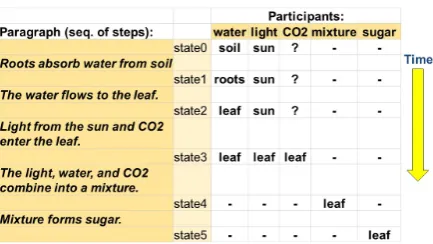
Figure 2: A (simplified) annotated paragraph from ProPara. Each filled row shows the existence and lo-cation of participants between each step (“?” denotes “unknown”, “-” denotes “does not exist”). For example
in state0, water is located at the soil.
assumes that a complete and correct model of the initial state is given for each task. However, ap-proaches developed using synthetic data often fail to handle the inherent complexity in language when applied to organic, real-world data (Hermann et al., 2015; Winograd, 1972).
In this work, we create a new dataset,ProPara
(Process Paragraphs), containing 488 human-authored paragraphs of procedural text, along with 81k annotations about the changing states (exis-tence and location) of entities in those paragraphs, with an end-task of predicting location and exis-tence changes that occur. This is the first dataset containing annotated, natural text for real-world processes, along with a simple representation of entity states during those processes. A simplified example is shown in Figure 2.
When applying existing state-of-the-art systems, such as Recurrent Entity Networks (Henaffet al.,
2016) and Query-reduction Networks (Seo et al., 2017b), we find that they do not perform well on
ProParaand the results are only slightly better than the majority baselines. As a step forward, we pro-pose two new neural models that use alternative mechanisms for state prediction and propagation, in particular using LSTM input encoding and span prediction. The new models improve accuracy by up to 19%.
Our contributions in this work are twofold: (1) we createProPara, a new dataset for process para-graph comprehension, containing annotated, natu-ral language paragraphs about real-world processes, and (2) we propose two new models that learn to infer and propagate entity states in novel ways, and outperform existing methods on this dataset.
2 Related Work
Datasets: Large-scale reading comprehension datasets, e.g., SQuAD (Rajpurkar et al., 2016), TriviaQA (Joshi et al., 2017), have successfully driven progress in question answering, but largely targeting explicitly stated facts. Often, the result-ing systems can be fooled (Jia and Liang, 2017), prompting efforts to create harder datasets where
a deeper understanding of the text appears neces-sary (Welbl et al., 2017; Araki et al., 2016).
Procedural text is a genre that is particularly challenging, because the worlds they describe are largely implicit and changing. While there are few large datasets in this genre, two exceptions are bAbI (Weston et al., 2015) and SCoNE (Long et al., 2016), described earlier2. bAbI has helped advance
methods for reasoning over text, such as memory network architectures (Weston et al., 2014), but has also been criticized for using machine-generated text over a simulated domain. SCoNE is closer to our goal, but has a different task (givena perfect
world model of the initial state, predict the end state) and different motivation (handling ellipsis
and coreference in context). It also used a deter-ministic, simulated world to generate data.
Models:For answering questions about procedural text, early systems attempted to extract a process structure (events, arguments, relations) from the paragraph, e.g., ProRead (Berant et al., 2014) and for newswire (Caselli et al., 2017). This allowed questions about event ordering to be answered, but not about state changes, unmodelled by these ap-proaches.
More recently, several neural systems have been developed to answer questions about the world state after a process, inspired in part by the bAbI dataset. Building on the general Memory Network archi-tecture (Weston et al., 2014) and gated recurrent models such as GRU (Cho et al., 2014), Recurrent Entity Networks (EntNet) (Henaffet al., 2016) is a
state-of-the-art method for bAbI. EntNet uses a dy-namic memory of hidden states (memory blocks) to maintain a representation of the world state, with a gated update at each step. Memory keys can be preset ("tied") to particular entities in the text, to encourage the memories to record information about those entities. Similarly, Query Reduction Networks (QRN) (Seo et al., 2017b) tracks state in
2The ProcessBank (Berant et al., 2014) dataset is smaller
[image:2.595.73.290.60.182.2]a paragraph, represented as a hidden vectorh. QRN performs gated propagation ofhacross each time-step (corresponding to a state update), and usesh
to modify (“reduce”) the query to keep pointing to the answer at each step (e.g., “Where is the apple?” at step1 might be modified to “Where is Joe?” at
step2if Joe picks up the apple). A recent proposal,
Neural Process Networks (NPN) (Bosselut et al., 2018), also models each entity’s state as a vec-tor (analogous to EntNet’s tied memories). NPN computes the state change at each step from the step’s predicted action and affected entity(s), then
updates the entity(s) vectors accordingly, but does not model different effects on different entities by
the same action.
Both EntNet and QRN find a final answer by decoding the final vector(s) into a vocabulary en-try via softmax classification. In contrast, many of the best performing factoid QA systems, e.g., (Seo et al., 2017a; Clark and Gardner, 2017), re-turn an answer by finding a spanof the original paragraph using attention-based span prediction, a method suitable when there is a large vocabulary. We combine this span prediction approach with state propagation in our new models.
3 The ProPara Dataset
Task: Our dataset,ProPara, focuses on a partic-ular genre of procedural text, namely simple sci-entific processes (e.g., photosynthesis, erosion). A system that understands a process paragraph should be able to answer questions such as: “What are
the inputs to the process?”, “What is converted
into what?”, and “Where does the conversion take
place?”3 Many of these questions reduce to
under-standing the basic dynamics of entities in the pro-cess, and we use this as our task: Given a process paragraph and an entityementioned in it, identify: (1)Isecreated (destroyed, moved) in the process? (2)When(step #) isecreated (destroyed, moved)? (3)Whereisecreated (destroyed, moved from/to)?
If we can track the entities’statesthrough the pro-cess and answer such questions, many of the higher-level questions can be answered too. To do this, we now describe how these states are representated in ProPara, and how the dataset was built.
Process State Representation: The states of the world throughout the whole process are represented as a grid. Each column denotes aparticipantentity
3For example, science exams pose such questions to test
student’s understanding of the text in various ways.
(a span in the paragraph, typically a noun phrase) that undergoes some creation, destruction, or move-ment in the process. Each row denotes thestates
of all the participants after astep. Each sentence is a step that may change the state of one or more participants. Therefore, a process paragraph with
m sentences and n participants will result in an (m+1)×n grid representation. Each cell li j in
this grid records thelocationof the j-th participant after thei-th step, andl0j stores the location of j-th
participant before the process.4 Figure 2 shows one
example of this representation.
Paragraph Authoring: To collect paragraphs, we first generated a list of 200 process-evoking prompts, such as “What happens during photosyn-thesis?”, by instantiating five patterns5, with nouns
of the corresponding type from a science vocabu-lary, followed by manual rewording. Then, crowd-sourcing (MTurk) workers were shown one of the prompts and asked to write a sequence of event sentences describing the process. Each prompt was given to five annotators to produce five (indepen-dent) paragraphs. Short paragraphs (4 or less sen-tences) were then removed for a final total of 488 paragraphs describing 183 processes. An example paragraph is the one shown earlier in Figure 1.
Grid and Existence: Once the process para-graphs were authored, we asked expert annotators6
to create the initial grids. First, for each paragraph, they listed the participant entities that underwent a state change during the process, thus creating the column headers. They then marked the steps where a participant was created or destroyed. All state cells before a Create or after a Destroy marker were labeled as "not exists". Each initial grid annotation was checked by a second expert annotator.
Locations: Finally, MTurk workers were asked to fill in all the location cells. A location can be “unknown" if it is not specified in the text, or a span of the original paragraph. Five grids for the same paragraph were completed by five different Turkers,
with average pairwise inter-annotator agreement of 0.67. The end result was 81,345 annotations over 488 paragraphs about 183 processes. The dataset
4We only trace locations in this work, but the
represen-tation can be easily extended to store other properties (e.g., temperature) of the participants.
5The five patterns are: How arestructureformed? How
doessystemwork? How doesphenomenonoccur? How do
you usedevice? What happens duringprocess?
6Expert annotators were from our organization, with a
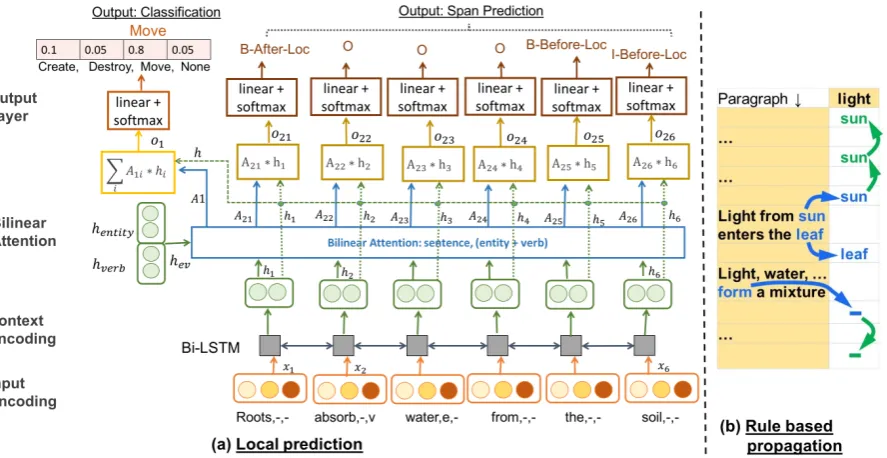
Figure 3: (a) ProLocaluses bidirectional attention to make local predictions about state change type and location (left), and then (b) propagates those changes globally using a persistence rule (right, shown for a single participant (the Light), local predictions shown in blue, propagations via persistence in green).
bAbI SCoNE ProPara
Sentences Synthetic Natural Natural Questions templated templated templated
# domains 20 3 183
[image:4.595.87.531.64.293.2]Vocab #words 119 1314 2501 # sentences 131.1k 72.9k 3.3k # unique sents 3.2k 37.4k 3.2k Avg words/sent 6.5 10.2 9.0
Table 1: ProPara vs. other procedural datasets.
was then split 80/10/10 into train/dev/test by
pro-cess prompt, ensuring that the test paragraphs were
all about processes unseen in train and dev. Table 1 compares our dataset with bAbI and SCoNE.
4 Models
We present two new models for this task. The first, ProLocal, makes local state predictions and
then algorithmically propagates them through the process. The second, ProGlobal, is an end-to-end
neural model that makes all state predictions using global information.
4.1 ProLocal: A Local Prediction Model
The design of ProLocalconsists of two main
com-ponents: local predictionandcommonsense
per-sistence. The former infers all direct effects of
individual sentences and the latter algorithmically propagates known values forwards and backwards to fill in any remaining unknown states.
4.1.1 Local Prediction
The intuition for local prediction is to treat it as a surface-level QA task. BiLSTMs with span predic-tion have been effective at answering surface-level
questions, e.g., Given “Roots absorb water.” and “Where is the water?”, they can be reliably trained to answer “Roots” (Seo et al., 2017a). We incorpo-rate a similar mechanism here.
Given a sentence (step) and a participantein it, the local prediction model makes two types of pre-dictions: the change type ofe(one of:no change,
created,destroyed,moved) and the locations ofe
before and after this step. The change type predic-tion is a multi-class classificapredic-tion problem, while the location prediction is viewed as a SQuAD-style surface-level QA task with the goal to find a lo-cation span in the input sentence. The design of this model is depicted in Figure 3(a), which adapts a bidirectional LSTM (Hochreiter and Schmidhu-ber, 1997) recurrent neural network architecture (biLSTM) with attention for input encoding. The prediction tasks are handled by two different output
layers. We give the detail of these layers below.
Input Encoding: Each wordwi in the input
sen-tence is encoded with a vectorxi =[vw :ve :vv],
the concatenation of a pre-trained GloVe (Penning-ton et al., 2014) word embeddingvw, indicator
vari-ablesve on whetherwiis the specified participant
[image:4.595.73.291.358.457.2]Context Encoding: A biLSTM is used to con-textualize the word representations in a given sen-tence. hi denotes the concatenated output of the
bidirectional LSTM for the embedded wordxi, and
encodes the word’s meaning in context.
Bilinear Attention: Given the participant and verb, the role of this layer is to identify which con-textual word embeddings to attend to for generat-ing the output. We first createhevby concatenating
the contextual embedding of the participant and verb.7 We then use a bilinear similarity function
sim(hi,hev)=(hTi ∗B∗hev)+b, similar to (Chen
et al., 2016), to compute attention weightsAiover
each wordwiin the sentence.
For state change type prediction, the words be-tween the verb and participant may be important, while for the location tagging, contextual cues such as “from” and “to” could be more predictive. Hence, we train two sets of attention parameters resulting in weightsA1andA2which are combined
with the contextual vectorshi as described below
to produce hidden stateso1ando2that are fed to
the output layers. Here,|step|refers to number of words in the given step or sentence.
o1=
X
i
A1i∗hi
o2=[(A21∗h1) : (A22∗h2) :. . .: (A2|step|∗h|step|)]
Output 1: State Change Type: We apply a feed-forward network on hidden stateo1to derive
the probabilities of the four state change type cate-gories: Create, Destroy, Move and None.
Output 2: Location Spans: The second output is computed by predicting BIO tags (one of five tags: B-Before-LOC, I-Before-LOC, B-After-LOC, I-After-LOC, O) for each word in the sentence. We apply a feed-forward network on hidden state
o2i for wordi to derive the probabilities of these
location tags. Notice that if the change type is predicted as “Create" (or “Destroy”) then only the “after" (or “before”) location prediction is used.
Training: We train the state change type pre-diction and location tag prepre-diction models jointly, where the loss is the sum of their negative log like-lihood losses. We use Adadelta (Zeiler, 2012) with learning rate 0.2 to minimize the total loss.
4.1.2 Commonsense Persistence
The local prediction model will partially fill in the state change grid, showing the direct locational
7Multi-word entities/verbs or multiple verbs are
repre-sented by the average word vectors.
effects of actions (including “not exists” and
“un-known location”). To complete the grid, we then al-gorithmically apply a commonsense rule of persis-tence that propagates locations forwards and back-wards in time where locations are otherwise miss-ing. Figure 3(b) shows an example when applying this rule, where ‘?’ indicates “unknown location". This corresponds to a rule of inertia: things are by default unchanged unless told otherwise. If there is a clash, then the location is predicted as unknown.
4.2 ProGlobal: A Global Prediction Model
Unlike ProLocal, the design principle behind
ProGlobalis to model the persistence of state
infor-mationwithinthe neural model itself, rather than as a post-processing step. ProGlobalinfers the states
ofallparticipants at each step, even if they are not mentioned in the current sentence, using: (1) the global context (i.e., previous sentences), and (2) the participant’s state from the previous step.
Given a sentence (step) with its context (para-graph) and a participante, ProGlobalpredicts the
existence and location ofe after this step in two stages. It first determines the state ofeas one of the classes (“not exist”, “unknown location”, “known location”). A follow-up location span prediction is made if the state is classified as “known location”. Figure 4 shows ProGlobal’s neural architecture,
where the left side is the part for state prediction at each step, and the right side depicts the propagation of hidden states from one step to the next. We discuss the detail of this model below.
Input Encoding: Given a participant e, for each stepi, we take the entire paragraph as input.
Each wordwin the paragraph is represented with three types of embeddings: the general word em-beddingvw, a position embeddingvd which
indi-cates the relative distance to the participant in the paragraph, and a sentence indicator embeddingvs
which shows the relative position (previous,
cur-rent, following) of each sentence in terms of the
current stepi. Both the position embedding and the sentence indicator embedding are of size 50 and are randomly initialized and automatically trained by the model. We concatenate these three types of em-beddings to represent each wordx=[vw:vd:vs].
Context Encoding: Similar to ProLocal, we use
a biLSTM to encode the whole paragraph and use ˜
hto denote the biLSTM output for each word.
… … … …
Photosynthesis Paragraph:
Roots absorb water from the soil. The water flows to the leaf. Light from the sun and CO2 enter the leaf. The light, water and CO2 combine into a mixture. Mixture forms sugar.
statei-1 Start Probs
Step 1
Embedding State 0
Encoder
Step 1
Embedding State 1
Encoder
Step 2
Embedding State 2
Encoder
Step n
Embedding State n
Encoder
Roots,-2,C absorb,-1,C water,0,C from,1,C the,2,C soil,3,C .4,C
The,5,F water,6,F flows,7,F to,8,F the,9,F leaf,10,F …
State Predic9on
Embedding:
Glove,
Word Posi9on,
Sent Indicator
Bi-LSTM
LSTM + SoMmax LSTM + SoMmax
Start End
Linear + SoMmax
[-/?/K]
max pooling
Output
statei-1 Category Probs
[image:6.595.80.518.66.228.2]Contextual Embedding
Figure 4: ProGlobalpredicts a participant’s state (type and location) after a given step using bilinear attention over the entire paragraph, combined with its predictions from the previous step.
LSTM
Contextual Embedding Linear
Predic9on
si-1,i Si-i,2 Si-1,|P|
Weighted Sum
Linear LinearLinear + SoMmax Linear + SoMmax
… … … Linear Linear SoMmax Concatena9on Span Probs
statei-1 Start Probs
LSTM
Contextual Embedding Linear
Predic9on
si-1,i
Si-i,2
Si-1,|P|
Weighted Sum
Linear LinearLinear + SoMmax Linear + SoMmax
… … … Linear Linear SoMmax Concatena9on Span Probs
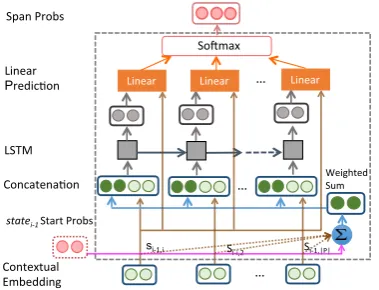
Figure 5: Details of the LSTM+Softmax unit, used for predicting the start/end words of a location.
˜
HP
i = [˜h1i,h˜2i, ...,h˜|iP|] denote the hidden vectors
(contextual embeddings) for words in stepi with
respect to participante, whereht
i denotes thet-th
word representation output by the biLSTM layer andPis the whole paragraph. We then apply max pooling to derive a paragraph representation:µiP=
max( ˜HP
i ). To incorporate the category prediction
of the previous step, stepi−1, we concatenate its
probability vectorcP
i−1 ∈R3withµPi, and apply a
feed-forward network to derive the probabilities of the three categories:
cP
i =softmax(Wc·[µPi :ciP−1]+bc)
Location Span Prediction: (Figure 5). To predict the location span, we predict the start word of the span (by generating a probability distribution over words) and the end word. To predict the location start, we take two types of information as input: the start probability distributionsP
i−1 ∈R|P|predicted
from stepi−1, and the contextual embeddings ˜HiPof
words in the current stepi:
˜
H∗
i =
|P| X
t=1
st i−1·H˜it
ϕti=LSTM([ ˜Hit : ˜Hi∗])
where ˜H∗
i is a sum of word vectors in the paragraph,
weighted by the start probabilities from the previ-ous step stepi−1.ϕti is the encoded vector
represen-tation for thet-th word in the paragraph. We then concatenate ˜HP
i andϕPi, and apply a feed-forward
network to obtain the start probability distribution for stepi: siP=softmax(Ws·[ ˜HiP :ϕPi]+bs).
Simi-larly, to predict the end word of the span, we use the start probability distribution sP
i of stepi and
˜
HP
i , and apply another LSTM and feed-forward
networks to obtain the probabilities. For state0(the
initial location before any steps), we directly feed the sequence of the vectors from the encoding layer to a linear transformation to predict the location start, and apply the same architecture to predict the location end.
Training: For each participanteof paragraphP, the objective is to optimize the sum of the nega-tive log likelihood of the category classification and location span prediction8. We use Adadelta to
optimize the models with learning rate 0.5.
5 Experiments and Analysis 5.1 Tasks&Evaluation Metrics
As described in Section 3, the quality of a model is evaluated based on its ability to answer three categories of questions, with respect to a given participante:
8We compute the loss for location span prediction only
[image:6.595.88.278.283.428.2]Sentence Encoding Intermediate State Representn. Propagation through time Answer Decoding EntNet positional encoding Dynamic memory blocks Gated propagation Softmax classification
QRN positional encoding Single latent vectorh Gated propagation ofh Softmax classification
ProLocal LSTM Explicit symbolic Algorithmic Span prediction
[image:7.595.71.523.61.115.2]ProGlobal LSTM Distribution over spans LSTM Span prediction
Table 2: Design decisions in the four neural models.
(Cat-1)Isecreated (destroyed, moved) in the pro-cess?
(Cat-2) When (step#) is e created (destroyed, moved)?
(Cat-3) Where is e created (destroyed, moved from/to)?
These questions are answered by simple scans over the state predictions for the whole process. (Cat-1) is asked over all participants, while (Cat-2) and (Cat-3) are asked over just those participants that were created (destroyed, moved). The accuracy of the answers is used as the evaluation metric, except for questions that may have multiple answers (e.g., “When is e moved?"). In this case, we compare the predicted and gold answers and use the F1score as
the “accuracy" of the answer set prediction.9
For questions in category (3), an answer is con-sidered correct if the predicted location is iden-tical to, or a sub-phrase of, the labeled location (typically just one or two words), after stop-word removal and lemmatizing.
5.2 Baseline Methods
We compare our models with two top methods in-spired by the bAbI dataset, Recurrent Entity Net-works (EntNet) and Query Reduction NetNet-works (QRN), described earlier in Section 2. Both models make different use of gated hidden states to
propa-gate state information through time, and generate answers using softmax. The detailed comparisons in their design are shown in Table 2.
We use the released implementations10(with
de-fault hyper-parameter values), and retrained them on our dataset, adapted to the standard bAbI QA format. Specifically, we create three separate varia-tions of data by adding three bAbI-style quesvaria-tions after each step in a paragraph, respectively:
Q1. “Doeseexist?” (yes/no)
Q2. “Is the location ofeknown?” (yes/no)
Q3. “Where ise?” (span)
The template Q1 is applied to all participants. Q2
9This approach has been adopted previously for questions
with multiple answers (e.g., (Berant et al., 2013)). For ques-tions with only one answer, F1is equivalent to accuracy.
10https://github.com/siddk/entity-network and
https://github.com/uwnlp/qrn
will only be present in the training data if Q1 is “yes”, and similarly Q3 is only present if Q2 is “yes”. These three variations of data are used to train three different models from the same method.
At test time, we cascade the questions (e.g., ask Q2 only if the answer to the Q1 model is “yes”), and combine the model outputs accordingly to an-swer the questions in our target tasks (Section 5.1). We also compare against a rule-based base-line and a feature-based basebase-line. The rule-based method, called ProComp, uses a set of rules that map (a SRL analysis of) each sentence to its effects
on the world state, e.g., IF X moves to Y THEN after: at(X,Y). The rules were extracted from Verb-Net (Schuler, 2005) and expanded. A full descrip-tion of ProComp is available at (Clark et al., 2018). The feature-based method uses a Logistic Regres-sion (LR) classifier to predict the state change type (Move, Create, etc.) for each participant+sentence
pair, then a NER-style CRF model to predict the from/to locations as spans of the sentence. The LR
model uses bag-of-word features from the sentence, along with a discrete feature indicating whether the participant occurs before or after the verb in the given sentence. The CRF model uses standard NER features including capitalization, a verb indicator, the previous 3 words, and the POS-tag of the cur-rent and previous word. Similar to our ProLocal
model, we apply commonsense persistence rules (Section 4.1.2) to complete the partial state-change grids predicted by both these baselines.
5.3 Results
Parameter settings:Both our models use GloVe embeddings of size 100 pretrained on Wikipedia 2014 and Gigaword 5 corpora11. The number
of hidden dimensions for the biLSTM are set to 50(ProLocal) and 100(ProGlobal). Dropout rates
(Srivastava et al., 2014) for the contextual encod-ing layer are 0.3(ProLocal) and 0.2(ProGlobal).
ProGlobaluses word position and sentence
indi-cator embeddings each of size 50, and span pre-diction LSTMs with a hidden dimension of 10. The learning rates for Adadelta optimizer were
Question type Baseline Models Our Models Human (# questions) Majority QRN EntNet Rule-based Feature-based ProLocal ProGlobal Upper Bound
Cat-1 (750) 51.01 52.37 51.62 57.14 58.64 62.65 62.95 91.67
Cat-2 (601) - 15.51 18.83 20.33 20.82 30.50 36.39 87.66
Cat-3 (823) - 10.92 7.77 2.4 9.66 10.35 35.9 62.96
macro-avg - 26.26 26.07 26.62 29.7 34.50 45.08 80.76
[image:8.595.78.521.61.146.2]micro-avg 26.49 25.96 26.24 29.64 33.96 45.37 79.69
Table 3: Model accuracy on the end task (test partition ofProPara). Questions are (Section 5.1): (Cat-1)Isei created (destroyed, moved)? (Cat-2)Wheniseicreated (...)? (Cat-3)Whereiseicreated (...)?
0.2(ProLocal) and 0.5(ProGlobal). Our models
are trained on the train partition and the parameters tuned on the dev partition.
Table 3 compares the performance of various models on theProParatest partition. For the first category of questions, we also include a simple majority baseline. We aggregate results over the questions in each category, and report both macro and micro averaged accuracy scores.
From Table 3, we can see that EntNet and QRN perform comparably when applied to ProPara. However, despite being the top-performing sys-tems for the bAbI task, when predicting whether a participant entity is created, destroyed or moved, their predictions are only slightly better than the majority baseline. Compared to our local model ProLocal, EntNet and QRN are worse in
predict-ing the exact step where a participant is created, destroyed or moved, but better in predicting the location. The weak performance of EntNet and QRN onProParais understandable: both systems were designed with a different environment in mind,
namely a large number of examples from a few conceptual domains (e.g., moving objects around a house), covering a limited vocabulary. As a re-sult, they might not scale well when applied to real procedural text, which justifies the importance of having a real challenge dataset likeProPara.
Although the rule-based baseline (Clark et al., 2018) uses rules mapping SRL patterns to state changes, its performance appears limited by the incompleteness and approximations in the rulebase, and by errors by the SRL parser. The feature-based baseline performs slightly better, but its perfor-mance is still poor compared to our neural models. This suggests that it has not generalized as well to unseen vocabulary (25% of the test vocabulary is not present in the train/dev partitions ofProPara).
When comparing our two models, it is interest-ing that ProGlobalperforms substantially better
than ProLocal. One possible cause of this is
cas-cading errors in ProLocal: if a local state
predic-tion is wrong, it may still be propagated to later time steps without any potential for correction, thus amplifying the error. In contrast, ProGlobalmakes
a state decision for every participant entity at every time-step, taking the global context into account, and thus appears more robust to cascading errors. Furthermore, ProGlobal’s gains are mainly in
Cat-2 and Cat-3 predictions, which rely more heavily on out-of-sentence cues. For example, 30% of the time the end-location is not explicitly stated in the state-change sentence, meaning ProLocalcannot
predict the end-location in these cases (as no sen-tence span contains the end location). ProGlobal,
however, uses the entire paragraph and may iden-tify a likely end-location from earlier sentences.
Finally, we computed a human upper bound for this task (last column of Table 3). During dataset creation, each grid was fully annotated by 5 diff
er-ent Turkers (Section 3). Here, for each grid, we identify the Turker whose annotations result in the best score for the end task with respect to the other Turkers’ annotations. The observed upper bound of∼80% suggests that the task is both feasible and well-defined, and that there is still substantial room for creating better models.
5.4 Analysis
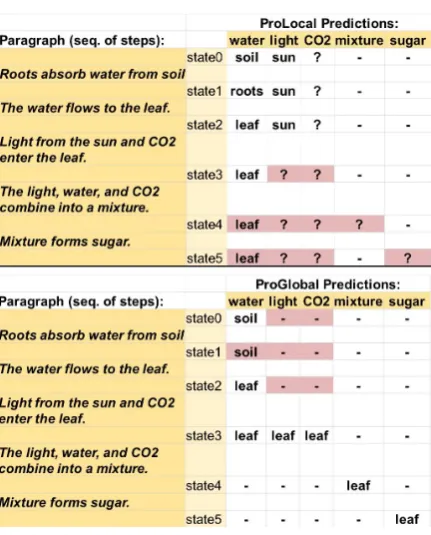
To further understand the strengths and weaknesses of our systems, we ran the simplified paragraph in Figure 2 verbatim through the models learned by ProLocaland ProGlobal. The results are shown
in Figure 6, with errors highlighted in red.
ProLocalcorrectly interprets “Light from the
sun and CO2 enters the leaf.” to imply that the
predic-Figure 6: ProLocal(top) and ProGlobal(bottom) pre-dictions on a simple paragraph (errors in red).
tions ignore surrounding sentences (context), po-tentially making it harder to distinguish destructive vs. non-destructive uses of “combine”.
ProGlobalalso makes some errors on this text,
most notably not realizing the light and CO2 exist from the start (rather, they magically appear at the leaf). Adding global consistency constraints may help avoid such errors. It is able to predict the sugar is formed at the leaf, illustating its ability to persist and transfer location information from earlier sentences to draw correct conclusions.
We additionally randomly selected 100 predic-tion errors from the dev set for ProGlobal, and
identified four phenomena contributing to errors:
(1) Implicit Creation/Destruction: In 37% of
the errors, the information about the creation or destruction of a participant is implicit or missing, which resulted in existence classification errors. For example, in the sentences “A fuel goes into the generator. The generator converts mechanical energy into electrical energy.”, “fuel” is implicitly consumed as the generator converts mechanical energy into electrical energy.
(2) Location Errors: In 27% of the examples, the location spans were not perfectly identified as follows: absolute wrong location span prediction (17%), longer span prediction (6%), and location prediction from different granularity (4%).
(3) Complex Syntax:In 13% of the examples, a
moving participant and its target location are sepa-rated with a wide context within a sentence, making it harder for the model to locate the location span.
(4) Propagation:ProGlobaltends to propagate
the previous location state to next step, which may override locally detected location changes or prop-agate the error from previous step to next steps. 9% of the errors are caused by poor propagation.
5.5 Future Directions
This analysis suggests several future directions:
Enforcing global consistency constraints: e.g., it does not make sense to create an already-existing entity, or destroy a non-existent entity. Global con-straints were found useful in the earlier ProRead system (Berant et al., 2014).
Data augmentation through weak supervision:
additional training data can be generated by ap-plying existing models of state change, e.g., from VerbNet (Kipper et al., 2008), to new sentences to create additional sentence+state pairs.
Propagating state information backwards in time: ifej is at li j after stepi, it is likely to also
be there atstepi−1given no information to the
con-trary. ProGlobal, EntNet, and QRNs are inherently
unable to learn such a bias, given their forward-propagating architectures.
6 Conclusion
New datasets and models are required to take read-ing comprehension to a deeper level of machine understanding. As a step in this direction, we have created the ProPara dataset, the first to con-tain natural text about a changing world along with an annotation of entity states during those changes. We have also shown that this dataset presents new challenges for previous models, and presented new models that exploit ideas from surface-level QA, in particular LSTM input encod-ing and span prediction, producencod-ing performance gains. The dataset and models are available at
http://data.allenai.org/propara.
Acknowledgements
[image:9.595.74.290.57.325.2]References
Jun Araki, Dheeraj Rajagopal, Sreecharan Sankara-narayanan, Susan Holm, Yukari Yamakawa, and Teruko Mitamura. 2016. Generating questions and multiple-choice answers using semantic analysis of texts. InCOLING. pages 1125–1136.
Jonathan Berant, Andrew Chou, Roy Frostig, and Percy Liang. 2013. Semantic parsing on freebase from question-answer pairs. InProc. EMNLP’13.
Jonathan Berant, Vivek Srikumar, Pei-Chun Chen, Abby Vander Linden, Brittany Harding, Brad Huang, Peter Clark, and Christopher D Manning. 2014. Modeling biological processes for reading compre-hension. InProc. EMNLP’14.
Antoine Bosselut, Omer Levy, Ari Holtzman, Corin Ennis, Dieter Fox, and Yejin Choi. 2018. Simulat-ing action dynamics with neural process networks. 6th International Conference on Learning Represen-tations (ICLR).
Tommaso Caselli, Ben Miller, Marieke van Erp, Piek Vossen, Martha Palmer, Eduard Hovy, Teruko Mita-mura, and David Caswell. 2017. Proceedings of the events and stories in the news workshop. In Proceed-ings of the Events and Stories in the News Workshop.
Danqi Chen, Jason Bolton, and Christopher D. Man-ning. 2016. A thorough examination of the cnn/daily mail reading comprehension task. CoRR abs/1606.02858.
Kyunghyun Cho, Bart van Merriënboer, Dzmitry Bah-danau, and Yoshua Bengio. 2014. On the properties of neural machine translation: Encoder–decoder ap-proaches. InProc. Workshop on Syntax, Semantics and Structure in Statistical Translation (SSST’14). pages 103–111.
Christopher Clark and Matt Gardner. 2017. Simple and effective multi-paragraph reading comprehen-sion.arXiv preprint arXiv:1710.10723.
Peter Clark, Bhavana Dalvi Mishra, and Niket Tandon. 2018. What happened? leveraging verbnet to pre-dict the effects of actions in procedural text. arXiv preprint arXiv:1804.05435.
Mikael Henaff, Jason Weston, Arthur Szlam, Antoine Bordes, and Yann LeCun. 2016. Tracking the world state with recurrent entity networks. CoRR abs/1612.03969.
Karl Moritz Hermann, Tomas Kocisky, Edward Grefen-stette, Lasse Espeholt, Will Kay, Mustafa Suleyman, and Phil Blunsom. 2015. Teaching machines to read and comprehend. In Advances in Neural Informa-tion Processing Systems. pages 1693–1701.
Sepp Hochreiter and Jürgen Schmidhuber. 1997. Long short-term memory. Neural computation9(8):1735– 1780.
Robin Jia and Percy Liang. 2017. Adversarial exam-ples for evaluating reading comprehension systems. InProc. EMNLP’17.
Mandar Joshi, Eunsol Choi, Daniel S. Weld, and Luke Zettlemoyer. 2017. TriviaQA: A large scale dis-tantly supervised challenge dataset for reading com-prehension. InProc. ACL’17.
Karin Kipper, Anna Korhonen, Neville Ryant, and Martha Palmer. 2008. A large-scale classification of english verbs. Language Resources and Evaluation 42(1):21–40.
Reginald Long, Panupong Pasupat, and Percy Liang. 2016. Simpler context-dependent logical forms via model projections. InACL.
Jeffrey Pennington, Richard Socher, and Christopher Manning. 2014. Glove: Global vectors for word rep-resentation. InProceedings of the 2014 conference on empirical methods in natural language process-ing (EMNLP). pages 1532–1543.
Pranav Rajpurkar, Jian Zhang, Konstantin Lopyrev, and Percy Liang. 2016. Squad: 100,000+ ques-tions for machine comprehension of text. In Proc. EMNLP’16.
Karin Kipper Schuler. 2005. VerbNet: A broad-coverage, comprehensive verb lexicon. Ph.D. thesis, Univ Colorado at Boulder.
Min Joon Seo, Aniruddha Kembhavi, Ali Farhadi, and Hannaneh Hajishirzi. 2017a. Bidirectional attention flow for machine comprehension. InProc. ICLR’17. Minjoon Seo, Sewon Min, Ali Farhadi, and Hannaneh
Hajishirzi. 2017b. Query-reduction networks for question answering. InICLR.
Nitish Srivastava, Geoffrey Hinton, Alex Krizhevsky, Ilya Sutskever, and Ruslan Salakhutdinov. 2014. Dropout: A simple way to prevent neural networks from overfitting. The Journal of Machine Learning Research15(1):1929–1958.
Johannes Welbl, Pontus Stenetorp, and Sebastian Riedel. 2017. Constructing datasets for multi-hop reading comprehension across documents. arXiv preprint arXiv:1710.06481.
Jason Weston, Antoine Bordes, Sumit Chopra, Alexan-der M Rush, Bart van Merriënboer, Armand Joulin, and Tomas Mikolov. 2015. Towards AI-complete question answering: A set of prerequisite toy tasks. arXiv preprint arXiv:1502.05698.
Jason Weston, Sumit Chopra, and Antoine Bor-des. 2014. Memory networks. arXiv preprint arXiv:1410.3916.
Terry Winograd. 1972. Understanding natural lan-guage. Cognitive Psychology3(1):1–191.