Proceedings of NAACL-HLT 2018, pages 831–840
Implicit Argument Prediction with Event Knowledge
Pengxiang Cheng
Department of Computer Science The University of Texas at Austin [email protected]
Katrin Erk
Department of Linguistics The University of Texas at Austin [email protected]
Abstract
Implicit arguments are not syntactically con-nected to their predicates, and are therefore hard to extract. Previous work has used mod-els with large numbers of features, evaluated on very small datasets. We propose to train models for implicit argument prediction on a simple cloze task, for which data can be gen-erated automatically at scale. This allows us to use a neural model, which draws on narrative coherence and entity salience for predictions. We show that our model has superior perfor-mance on both synthetic and natural data.1
1 Introduction
When parts of an event description in a text are missing, this event cannot be easily extracted, and it cannot easily be found as the answer to a ques-tion. This is the case withimplicit arguments, as in this example from the reading comprehension dataset ofHermann et al.(2015):
Text:More than 2,600 people have been infected by Ebola in Liberia, Guinea, Sierra Leone and Nigeria since the out-breakbegan in December, according to the World Health Organization. Nearly 1,500 havedied.
Question: The X outbreak has killed nearly 1,500.
In this example, it is Ebola that broke out, and Ebola was also the cause of nearly 1,500 people dying, but the text does not state this explicitly. Ebolais an implicit argument of bothoutbreakand die, which is crucial to answering the question.
We are particularly interested in implicit argu-ments that, like Ebola in this case, do appear in the text, but not as syntactic arguments of their 1Our code is available at https://github.com/ pxch/event_imp_arg.
predicates. Event knowledge is key to determin-ing implicit arguments. In our example, diseases are maybe the single most typical things tobreak out, and diseases also typically kill people.
The task of identifying implicit arguments was first addressed by Gerber and Chai (2010) and Ruppenhofer et al.(2010). However, the datasets for the task were very small, and to our knowledge there has been very little further development on the task since then.
In this paper, we address the data issue by train-ing models for implicit argument prediction on a simple cloze task, similar to the narrative cloze task (Chambers and Jurafsky, 2008), for which data can be generated automatically at scale. This allows us to train a neural network to perform the task, building on two insights. First, event knowl-edge is crucial for implicit argument detection. Therefore we build on models for narrative event prediction (Granroth-Wilding and Clark,2016; Pi-chotta and Mooney,2016a), using them to judge how coherent the narrative would be when we fill in a particular entity as the missing (implicit) ar-gument. Second, the omitted arguments tend to be salient, asEbolais in the text from which the above example is taken. So in addition to narra-tive coherence, our model takes into account entity salience (Dunietz and Gillick,2014).
In an evaluation on a large automatically gener-ated dataset, our model clearly outperforms even strong baselines, and we find salience features to be important to the success of the model. We also evaluate against a variant of theGerber and Chai (2012) model that does not rely on gold features, finding that our simple neural model outperforms their much more complex model.
Our paper thus makes two major contributions. 1) We propose an argument cloze task to gener-ate synthetic training data at scale for implicit ar-gument prediction. 2) We show that neural event
models for narrative schema prediction can be used on implicit argument prediction, and that a straightforward combination of event knowledge and entity salience can do well on the task.
2 Related Work
While dependency parsing and semantic role la-beling only deal with arguments that are available in the syntactic context of the predicate, implicit argument labeling seeks to find argument that are not syntactically connected to their predicates, like Ebolain our introductory example.
The most relevant work on implicit argument prediction came from Gerber and Chai (2010), who built an implicit arguments dataset by select-ing 10 nominal predicates from NomBank (Mey-ers et al.,2004) and manually annotating implicit arguments for all occurrences of these predicates. In an analysis of their data they found implicit ar-guments to be very frequent, as their annotation added 65% more arguments to NomBank. Gerber and Chai(2012) also trained a linear classifier for the task relying on many hand-crafted features, in-cluding gold features from FrameNet (Baker et al., 1998), PropBank (Palmer et al.,2005) and Nom-Bank. This classifier has, to the best of our knowl-edge, not been outperformed by follow-up work (Laparra and Rigau, 2013;Schenk and Chiarcos, 2016;Do et al.,2017). We evaluate on the Gerber and Chai dataset below.Ruppenhofer et al.(2010) also introduced an implicit argument dataset, but we do not evaluate on it as it is even smaller and much more complex thanGerber and Chai(2010). More recently, Modi et al. (2017) introduced the referent cloze task, in which they predicted a man-ually removed discourse referent from a human annotated narrative text. This task is closely re-lated to our argument cloze task.
Since we intend to exploit event knowledge in predicting implicit arguments, we here refer to recent work on statistical script learning, started by Chambers and Jurafsky (2008, 2009). They introduced the idea of using statistical informa-tion on coreference chains to induce prototypi-cal sequences of narrative events and participants, which is related to the classical notion of a script (Schank and Abelson,1977). They also proposed the narrative cloze evaluation, in which one event is removed at random from a sequence of narrative events, then the missing event is predicted given all context events. We use a similar trick to
de-fine a cloze task for implicit argument prediction, discussed in Section3.
Many follow-up papers on script learning have used neural networks. Rudinger et al. (2015) showed that sequences of events can be efficiently modeled by a log-bilinear language model. Pi-chotta and Mooney (2016a,b) used an LSTM to model a sequence of events. Granroth-Wilding and Clark (2016) built a network that produces an event representation by composing its compo-nents. To do the cloze task, they select the most probable event based on pairwise event coherence scores. For our task we want to do something sim-ilar: We want to predict how coherent a narrative would be with a particular entity candidate filling the implicit argument position. So we take the model of Granroth-Wilding and Clark (2016) as our starting point.
TheHermann et al.(2015) reading comprehen-sion task, like our cloze task, requires systems to guess a removed entity. However in their case the entity is removed in a summary, not in the main text. In their case, the task typically amounts to finding a main text passage that paraphrases the sentence with the removed entity; this is not the case in our cloze task.
3 The Argument Cloze Task
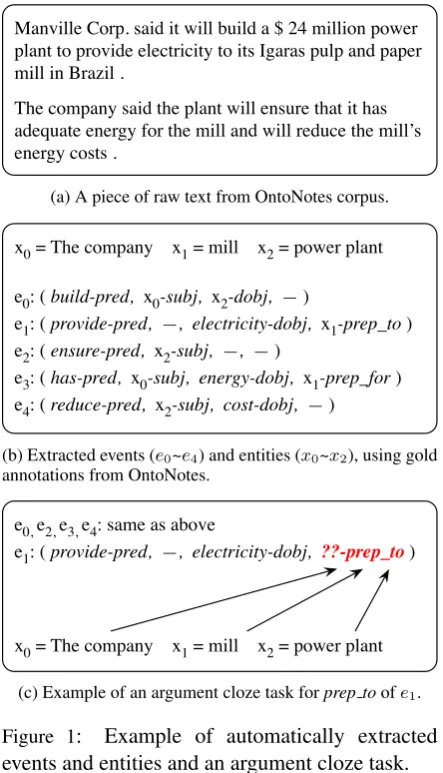
We present theargument clozetask, which allows us to automatically generate large scale data for training (Section6.1) and evaluation (Section5.1). In this task, we randomly remove an entity from an argument position of one event in the text. The entity in question needs to appear in at least one other place in the text. The task is then for the model to pick, from all entities appearing in the text, the one that has been removed. We first de-fine what we mean by an event, then what we mean by an entity. LikePichotta and Mooney(2016a); Granroth-Wilding and Clark(2016), we define an eventeas consisting of a verbal predicatev, a
sub-jects, a direct objecto, and a prepositional object p (along with the preposition). Here we only al-low one prepositional argument in the structure, to avoid variable length input in the event composi-tion model.2 By anentity, we mean a coreference chain with a length of at least two – that is, the entity needs to appear at least twice in the text.
For example, from a piece of raw text (Figure
Manville Corp. said it will build a $ 24 million power plant to provide electricity to its Igaras pulp and paper mill in Brazil .
The company said the plant will ensure that it has adequate energy for the mill and will reduce the mill’s energy costs .
(a) A piece of raw text from OntoNotes corpus.
x0 = The company x1 = mill x2 = power plant
e0: ( build-pred, x0-subj, x2-dobj, — )
e1: ( provide-pred, —, electricity-dobj, x1-prep_to ) e2: ( ensure-pred, x2-subj, —, — )
e3: ( has-pred, x0-subj, energy-dobj, x1-prep_for ) e4: ( reduce-pred, x2-subj, cost-dobj, — )
(b) Extracted events (e0~e4) and entities (x0~x2), using gold annotations from OntoNotes.
e0, e2, e3, e4: same as above
e1: ( provide-pred, —, electricity-dobj, ??-prep_to)
[image:3.595.71.293.61.448.2]x0 = The company x1 = mill x2 = power plant (c) Example of an argument cloze task forprep toofe1.
Figure 1: Example of automatically extracted events and entities and an argument cloze task.
1a), we automatically extract a sequence of events from a dependency parse, and a list of entities from coreference chains. In Figure1b,e0~e4are events, x0~x2are entities. The argumentselectricity-dobj andenergy-dobjare not in coreference chains and are thus not candidates for removal. An exam-ple of the argument cloze task is shown in Figure 1c. Here theprep toargument ofe1 has been re-moved.
Coreference resolution is very noisy. Therefore we use gold coreference annotation for creating evaluation data, but automatically generated coref-erence chains for creating training data.
4 Methods
4.1 Modeling Narrative Coherence
We model implicit argument prediction as select-ing the entity that, when filled in as the implicit argument, makes the overall most coherent nar-rative. Suppose we are trying to predict the di-rect object argument of some target eventet. Then
we completeetby putting an entity candidate into
the direct object argument position, and check the coherence of the resulting event with the rest of the narrative. Say we have a sequence of events
e1, e2, . . . , en in a narrative, and a list of entity
candidatesx1, x2, . . . , xm. Then for any candidate
xj, we first complete the target event to be
et(j) = (vt, st, xj, pt), j = 1, . . . , m (1)
wherevt,st, andptare the predicate, subject, and
prepositional object of et respectively, and xj is
filled as the direct object. (Event completion for omitted subjects and prepositional objects is anal-ogous.)
Then we compute the narrative coherence score
Sj of the candidatexjby3
Sj = n
max
c=1, c6=tcoh
~ et(j), ~ec
, j = 1, . . . , m
(2) where e~
t(j) and e~c are representations for the
completed target eventet(j)and one context event
ec, andcoh is a function computing a coherence
score between two events, both depending on the model being used. The candidatexjwith the
high-est scoreSj is then selected as our prediction.
4.2 The Event Composition Model
To model coherence (coh) between a context event
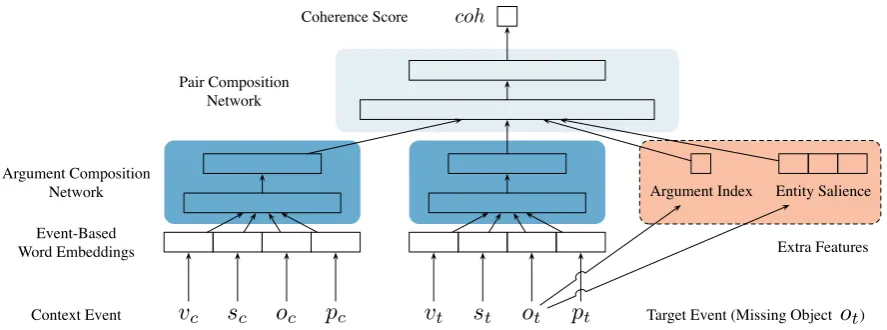
and a target event, we build an event composition model consisting of three parts, as shown in Fig-ure2: event components are representated through
event-based word embeddings, which encode event knowledge in word representations; the ar-gument composition networkcombines the com-ponents to produce event representations; and the
pair composition networkcompute a coherence score for two event representations.
This basic architecture is as in the model of Granroth-Wilding and Clark(2016). However our model is designed for a different task, argument cloze rather than narrative cloze, and for our task entity-specific information is more important. We therefore create the training data in a different way, as described in Section4.2.1. We now discuss the three parts of the model in more detail.
Event-Based Word Embeddings The model
Context Event
Argument Index
Target Event (Missing Object ) Entity Salience Coherence Score
Pair Composition Network
Event-Based Word Embeddings Argument Composition
Network
Extra Features
v
ts
to
t ptv
cs
co
c pco
t [image:4.595.78.522.62.227.2]coh
Figure 2: Diagram for event composition model. Input: a context event and a target event. Event-Based
Word Embeddings: embeddings for components of both events that encodes event knowledge.
Argu-ment Composition Network: produces an event representation from its components. Pair Composition
Network: computes a coherence scorecoh from two event representations. Extra Features: argument
index and entity salience features as additional input to the pair composition network.
arguments as input to compute event representa-tions. To better encode event knowledge in word level, we train an SGNS (skip-gram with nega-tive sampling) word2vec model (Mikolov et al., 2013) with event-specific information. For each extracted event sequence, we create a sentence with the predicates and arguments of all events in the sequence. An example of such a training sen-tence is given in Figure3.
build-pred company-subj plant-dobj provide-pred electricity-dobj mill-prep_to ensure-pred plant-subj has-pred company-subj energy-dobj mill-prep_for reduce-pred plant-subj cost-dobj
Figure 3: Event-based word2vec training sentence, constructed from events and entities in Figure1b.
Argument Composition Network The
argu-ment composition network (dark blue area in Fig-ure2) is a two-layer feedforward neural network that composes an event representation from the embeddings of its components. Non-existent ar-gument positions are filled with zeros.
Pair Composition Network The pair composi-tion network (light blue area in Figure2) computes a coherence scorecohbetween 0 and 1, given the
vector representations of a context event and a tar-get event. The coherence score should be high when the target event contains the correct argu-ment, and low otherwise. So we construct the
training objective function to distinguish the cor-rect argument from wrong ones, as described in Equation3.
4.2.1 Training for Argument Prediction
To train the model to pick the correct candidate, we automatically construct training samples as event triples consisting of a context eventec, a
pos-itive event ep, and a negative event en. The
con-text event and positive event are randomly sam-pled from an observed sequence of events, while the negative event is generated by replacing one argument of positive event by a random entity in the narrative, as shown in Figure4.
x0 = The company x1 = mill x2 = power plant
Context: ( build-pred, x0-subj, x2-dobj, — ) Positive: ( reduce-pred, x2-subj, cost-dobj, — ) Negative: ( reduce-pred, x1-subj, cost-dobj, — )
Figure 4: Example of an event triple constructed from events and entities in Figure1b.
We want the coherence score between ec and
ep to be close to1, while the score forecanden
should be close to0. Therefore, we train the model
to minimize cross-entropy as follows:
1
m
m
X
i=1
−log(coh(eci, epi))−log(1−coh(eci, eni))
where eci, epi, and eni are the context, positive,
and negative events of theith training sample
re-spectively.
4.3 Entity Salience
Implicit arguments tend to be salient entities in the document. So we extend our model by en-tity salience features, building on recent work by Dunietz and Gillick(2014), who introduced a sim-ple model with several surface level features for entity salience detection. Among the features they used, we discard those that require external re-sources, and only use the remaining three features, as illustrated in Table1. Dunietz and Gillick found mentionsto be the most powerful indicator for en-tity salience among all features. We expect similar results in our experiments, however we include all three features in our event composition model for now, and conduct an ablation test afterwards.
Feature Description
1st loc Index of the sentence where the first mention of the entity appears head count Number of times the head word
of the entity appears
mentions A vector containing the numbers of named, nominal, pronominal, and total mentions of the entity
Table 1: Entity salience features fromDunietz and Gillick(2014).
The entity salience features are directly passed into the pair composition network as additional in-put. We also add an extra feature for argument position index (encoding whether the missing ar-gument is a subject, direct object, or prepositional object), as shown in the red area in Figure2.
5 Evaluation Datasets
5.1 Argument Cloze Evaluation
Previous implicit argument datasets were very small. To overcome that limitation, we automat-ically create a large and comprehensive evaluation dataset, following theargument clozetask setting in Section3.
Since the events and entities are extracted from dependency labels and coreference chains, we do not want to introduce systematic error into the evaluation from imperfect parsing and coreference algorithms. Therefore, we create the evaluation set
from OntoNotes (Hovy et al.,2006), which con-tains human-labeled dependency and coreference annotation for a large corpus. So the extracted events and entities in the evaluation set are gold. Note that this is only for evaluation; in training we do not rely on any gold annotations (Section6.1). There are four English sub-corpora in OntoNotes Release 5.04 that are annotated with dependency labels and coreference chains. Three of them, which are mainly from broadcast news, share similar statistics in document length, so we combine them into a single dataset and name itON-SHORTas it consists mostly of short documents. The fourth subcorpus is from the Wall Street Journal and has significantly longer documents. We call this subcorpus ON-LONG
and evaluate on it separately. Some statistics are shown in Table2.
ON-SHORT ON-LONG
# doc 1027 597
# test cases 13018 18208
Avg # entities 12.06 36.95
Table 2: Statistics on argument cloze datasets.
5.2 The Gerber and Chai (G&C) Dataset
The implicit argument dataset from Gerber and Chai (2010) (referred as G&C henceforth) con-sists of 966 human-annotated implicit argument instances on 10 nominal predicates.
To evaluate our model on G&C, we convert the annotations to the input format of our model as fol-lows: We map nominal predicates to their verbal form, and semantic role labels to syntactic argu-ment types based on the NomBank frame defini-tions. One of the examples (after mapping seman-tic role labels) is as follows:
[Participants]subj will be able to trans-fer [money]dobj to [other investment funds]prep to. The [investment]pred choices are limited to [a stock fund and a money-market fund]prep to.
For the nominal predicateinvestment, there are three arguments missing (subj,dobj,prep to). The model first needs to determine that each of those argument positions in fact has an implicit filler. Then, from a list of candidates (not shown here), it
needs to selectParticipantsas the implicitsubj ar-gument,moneyas the implicitdobjargument, and eitherother investment fundsora stock fund and a money-market fundas the implicitprep to.
6 Experiments
6.1 Implementation Details
We train our neural model using synthetic data as described in Section 3. For creating the training data, we do not use gold parses or gold coreference chains. We use the 20160901 dump of English Wikipedia5, with 5,228,621 documents in total. For each document, we extract plain text and break it into paragraphs, while discarding all structured data like lists and tables6. We construct a sequence of events and entities from each paragraph, by run-ning Stanford CoreNLP (Manrun-ning et al.,2014) to obtain dependency parses and coreference chains. We lemmatize all verbs and arguments. We in-corporate negation and particles in verbs, and nor-malize passive constructions. We represent each argument by the corresponding entity’s represen-tative mention if it is linked to an entity, otherwise by its head lemma. We keep verbs and arguments with counts over 500, together with the 50 most frequent prepositions, leading to a vocabulary of 53,345 tokens; all other words are replaced with an out-of-vocabulary token. The most frequent verbs (with counts over 100,000) are down-sampled.
For training the event-based word embeddings, we create pseudo-sentences (Section4.2) from all events of all sequences (approximately 87 million events) as training samples. We train an SGNS word2vec model with embedding size =300,
win-dow size =10, subsampling threshold =10−4, and
negative samples =10, using the Gensim package (ˇReh˚uˇrek and Sojka,2010).
For training the event composition model, we follow the procedure described in Section 4.2.1, and extract approximately 40 million event triples as training samples7. We use a two-layer feed-forward neural network with layer sizes 600 and 300 for the argument composition network, and another two-layer network with layer sizes 400 and 200 for the pair composition network. We use cross-entropy loss with `2 regularization of 0.01.
5https://dumps.wikimedia.org/enwiki/ 6We use the WikiExtractor tool athttps://github. com/attardi/wikiextractor.
7We only sample one negative event for each pair of con-text and positive events for fast training, though more training samples are easily accessible.
We train the model using stochastic gradient de-scent (SGD) with a learning rate of 0.01 and a batch size of 100 for 20 epochs.
To study how the size of the training set af-fects performance, we downsample the 40 million training samples to another set of 8 million train-ing samples. We refer to the resulttrain-ing models as
EVENTCOMP-8MandEVENTCOMP-40M.
6.2 Evaluation on Argument Cloze
For the synthetic argument cloze task, we compare our model with 3 baselines.
RANDOM Randomly select one entity from the candidate list.
MOSTFREQ Always select the entity with high-est number of mentions.
EVENTWORD2VEC Use the event-based word embeddings described in Section 4.2 for predi-cates and arguments. The representation of an eventeis the sum of the embeddings of its com-ponents, i.e.,
~e=~v+~s+~o+~p (4)
where~v, ~s, ~o, ~p are the embeddings of verb,
sub-ject, obsub-ject, and prepositional obsub-ject, respectively. The coherence score of two events in this base-line model is their cosine similarity. Like in our main model, the coherence score of the candidate is then the maximum pairwise coherence score, as described in Section4.1.
The evaluation results on the ON-SHORT dataset are shown in Table 3. The E VENT-WORD2VEC baseline is much stronger than the other two, achieving an accuracy of 38.40%. In fact, EVENTCOMP-8M by itself does not do better than EVENTWORD2VEC, but adding en-tity salience greatly boosts performance. Using more training data (EVENTCOMP-40M) helps by a substantial margin both with and without entity salience features.
SUBJ DOBJ POBJ Argument Type 0
10 20 30 40 50
Accuracy
(%)
27.0
18.8
13.0 39.3 40.2
32.5 40.4
48.4
37.9 47.8
51.5
42.0 MOSTFREQ
EVENTWORD2VEC EVENTCOMP-40M EVENTCOMP-40M + Salience
(a) Accuracy by Argument Type
Noun Pronoun
POS of Head Word 0
10 20 30 40 50
Accuracy
(%)
19.8
31.9 37.542.8 41.440.2
47.5 49.6
MOSTFREQ EVENTWORD2VEC EVENTCOMP-40M EVENTCOMP-40M + Salience
(b) Accuracy by POS of Head Word
2 3 4 5 6 7 8 9 10+ Entity Frequency 0
10 20 30 40 50 60 70
Accuracy
(%)
MOSTFREQ EVENTWORD2VEC EVENTCOMP-40M EVENTCOMP-40M + Salience
[image:7.595.77.522.63.227.2](c) Accuracy by Entity Frequency
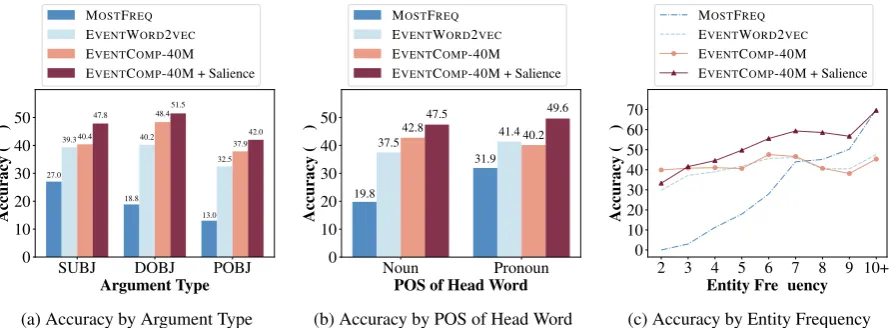
Figure 5: Performance of EVENTCOMP(with and without entity salience) and two baseline models by (a) argument type, (b) part-of-speech tag of the head word of the entity, and (c) entity frequency.
Accuracy (%)
RANDOM 8.29
MOSTFREQ 22.76
EVENTWORD2VEC 38.40
EVENTCOMP-8M 38.26
+ entity salience 45.05
EVENTCOMP-40M 41.89
+ entity salience 47.75
Table 3: Evaluation on ON-SHORT.
Features Accuracy (%)
no entity salience feature 38.26
–mentions 39.02
–head count 45.71
–1st loc 45.65
all entity salience features 45.05
Table 4: Ablation test on entity salience features. (Using EVENTCOMP-8M on ON-SHORT.)
We take a closer look at several of the mod-els in Figure 5. Figure 5a breaks down the re-sults by the argument type of the removed argu-ment. On subjects, the EVENTWORD2VEC base-line matches the performance of EVENTCOMP, but not on direct objects and prepositional objects. Subjects are semantically much less diverse than the other argument types, as they are very often an-imate. A similar pattern is apparent in Figure5b, which has results by the part-of-speech tag of the head word of the removed entity. Note that an en-tity is a coreference chain, not a single mention; so when the head word is a pronoun, this is an entity
which has only pronoun mentions. A pronoun en-tity provides little semantic content beyond, again,
animacy. And again, EVENTWORD2VEC
per-forms well on pronoun entities, but less so on en-tities described by a noun. It seems that EVENT-WORD2VECcan pick up on a coarse-grained pat-tern such as animate/inanimate, but not on more fine-grained distinctions needed to select the right noun, or to select a fitting direct object or prepo-sitional object. This matches the fact that EVENT-WORD2VEC gets a less clear signal on the task, in two respects: It gets much less information than EVENTCOMP on the distinction between ar-gument positions,8 and it only looks at overall event similarity while EVENTCOMP is trained to detect narrative coherence. Entity salience con-tributes greatly across all argument types and parts of speech, but more strongly on subjects and nouns. This is again because subjects, and pro-nouns, are semantically less distinct, so they can only be distinguished by relative salience.
Figure 5canalyzes results by the frequency of the removed entity, that is, by its number of men-tions. The MOSTFREQ baseline, unsurprisingly, only does well when the removed entity is a highly frequent one. The EVENTCOMP model is much better than MOSTFREQ at picking out the right entity when it is a rare one, as it can look at the semantic content of the entity as well as its fre-quency. Entity salience boosts the performance of EVENTCOMPin particular for frequent entities.
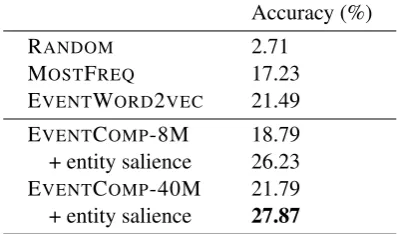
The ON-LONG dataset, as discussed in Sec-tion 5.1, consists of OntoNotes data with much
longer documents than found in ON-SHORT. Evaluation results on ON-LONGare shown in Ta-ble 5. Although the overall numbers are lower than those for ON-SHORT, we are selecting from
36.95 candidates on average, more than 3 times
more than for ON-SHORT. Considering that the accuracy of randomly selecting an entity is as low as2.71%, the performance of our best performing
model, with an accuracy of27.87%, is quite good.
Accuracy (%)
RANDOM 2.71
MOSTFREQ 17.23
EVENTWORD2VEC 21.49
EVENTCOMP-8M 18.79
+ entity salience 26.23
EVENTCOMP-40M 21.79
+ entity salience 27.87
Table 5: Evaluation on ON-LONG.
6.3 Evaluation on G&C
The G&C data differs from the Argument Cloze data in two respects. First, not every argument po-sition that seems to be open needs to be filled: The model must additionally make a fill / no-fill de-cision. Whether a particular argument position is typically filled is highly predicate-specific. As the small G&C dataset does not provide enough data to train our neural model on this task, we instead train a simple logistic classifier, the fill / no-fill classifier, with a small subset of shallow lexical features used inGerber and Chai(2012), to make the decision. These features describe the syntactic context of the predicate. We use only 14 features; the original Gerber and Chai model had more than 80 features, and our re-implementation, described below, has around 60.
The second difference is that in G&C, an event may have multiple open argument positions. In that case, the task is not just to select a candidate entity, but also to determine which of the open ar-gument positions it should fill. So the model must domulti implicit argument prediction. We can flexibly adapt our method for training data gener-ation to this case. In particular, we create extra negative training events, in which an argument of the positive event has been moved to another argu-ment position in the same event, as shown in Fig-ure6. We can then simply train our EVENTCOMP
model on this extended training data. We refer to the extra training process asmulti-arg training.
x0 = The company x1 = mill x2 = power plant
[image:8.595.81.280.200.317.2]Context: ( build-pred, x0-subj, x2-dobj, — ) Positive: ( reduce-pred, x2-subj, cost-dobj, — ) Negative: ( reduce-pred, —, cost-dobj, x2-prep)
Figure 6: Event triples for training multi implicit argument prediction.
We compare our models to that of Gerber and Chai (2012). However, their original logistic re-gression model used many features based on gold annotation from FrameNet, PropBank and Nom-Bank. To create a more realistic evaluation setup, we re-implement a variant of their original model by removing gold features, and name it GCAUTO. Results from GCAUTOare directly comparable to our models, as both are trained on automatically generated features.9
P R F1
Gerber and Chai(2012) 57.9 44.5 50.3
GCAUTO 49.9 40.1 44.5
EVENTCOMP-8M 8.9 27.9 13.5
+ fill / no-fill classifier 22.0 22.3 22.1 + multi-arg training 43.5 44.1 43.8 + entity salience 45.7 46.4 46.1
EVENTCOMP-40M 9.4 30.3 14.3
+ fill / no-fill classifier 23.7 24.0 23.9 + multi-arg training 46.7 47.3 47.0 + entity salience 49.3 49.9 49.6
Table 6: Evaluation on G&C dataset.
achieves a performance comparable to the much more complex G&C reimplementation GCAUTO. Adding entity salience features further boosts both precision and recall, showing that implicit argu-ments do tend to be filled by salient entities, as we had hypothesized. Again, more training data sub-stantially benefits the task. Our best performing model, at 49.6F1, clearly outperforms GCAUTO, and is comparable with the original Gerber and Chai(2012) model trained with gold features. 10
7 Conclusion
In this paper we have addressed the task of im-plicit argument prediction. To support training at scale, we have introduced a simple cloze task for which data can be generated automatically. We have introduced a neural model, which frames im-plicit argument prediction as the task of select-ing the textual entity that completes the event in a maximally narratively coherent way. The model prefers salient entities, where salience is mainly defined through the number of mentions. Evalu-ating on synthetic data from OntoNotes, we find that our model clearly outperforms even strong baselines, that salience is important throughout for performance, and that event knowledge is partic-ularly useful for the (more verb-specific) object and prepositional object arguments. Evaluating on the naturally occurring data from Gerber and Chai, we find that in a comparison without gold features, our model clearly outperforms the pre-vious state-of-the-art model, where again salience information is important.
The current paper takes a first step towards pre-dicting implicit arguments based on narrative co-herence. We currently use a relatively simple model for local narrative coherence; in the future we will turn to models that can test global coher-ence for an implicit argument candidate. We also plan to investigate how the extracted implicit ar-guments can be integrated into a downstream task that makes use of event information, in particular we would like to experiment with reading compre-hension.
Acknowledgments
This research was supported by NSF grant IIS 1523637. We also acknowledge the Texas Ad-10We also tried fine tune our model on the G&C dataset with cross validation, but the model severely overfit, possibly due to the very small size of the dataset.
vanced Computing Center for providing grid re-sources that contributed to these results, and we would like to thank the anonymous reviewers for their valuable feedback.
References
Collin F. Baker, Charles J. Fillmore, and John B. Lowe. 1998. The Berkeley FrameNet project. In36th An-nual Meeting of the Association for Computational Linguistics and 17th International Conference on Computational Linguistics, Volume 1. http://
www.aclweb.org/anthology/P98-1013.
Nathanael Chambers and Dan Jurafsky. 2008. Unsu-pervised learning of narrative event chains. In Pro-ceedings of ACL-08: HLT. Association for Com-putational Linguistics, pages 789–797. http://
www.aclweb.org/anthology/P08-1090.
Nathanael Chambers and Dan Jurafsky. 2009. Unsu-pervised learning of narrative schemas and their par-ticipants. InProceedings of the Joint Conference of the 47th Annual Meeting of the ACL and the 4th In-ternational Joint Conference on Natural Language Processing of the AFNLP. Association for Computa-tional Linguistics, pages 602–610. http://www.
aclweb.org/anthology/P09-1068.
Quynh Ngoc Thi Do, Steven Bethard, and Marie-Francine Moens. 2017. Improving implicit seman-tic role labeling by predicting semanseman-tic frame argu-ments. In Proceedings of the Eighth International Joint Conference on Natural Language Processing (Volume 1: Long Papers). Asian Federation of Nat-ural Language Processing, pages 90–99. http://
www.aclweb.org/anthology/I17-1010.
Jesse Dunietz and Daniel Gillick. 2014. A new en-tity salience task with millions of training exam-ples. In Proceedings of the 14th Conference of the European Chapter of the Association for Com-putational Linguistics, volume 2: Short Papers. Association for Computational Linguistics, pages 205–209. https://doi.org/10.3115/v1/ E14-4040.
Matthew Gerber and Joyce Chai. 2010. Beyond Nom-Bank: A study of implicit arguments for nomi-nal predicates. InProceedings of the 48th Annual Meeting of the Association for Computational Lin-guistics. Association for Computational Linguistics, pages 1583–1592. http://www.aclweb.org/
anthology/P10-1160.
Matthew Gerber and Joyce Y. Chai. 2012. Semantic role labeling of implicit arguments for nominal pred-icates. Computational Linguistics38(4). https:
//doi.org/10.1162/COLI_a_00110.
Karl Moritz Hermann, Tomas Kocisky, Edward Grefenstette, Lasse Espeholt, Will Kay, Mustafa Su-leyman, and Phil Blunsom. 2015. Teaching ma-chines to read and comprehend. InAdvances in Neu-ral Information Processing Systems. pages 1693– 1701.
Eduard Hovy, Mitchell Marcus, Martha Palmer, Lance Ramshaw, and Ralph Weischedel. 2006. OntoNotes: The 90% solution. In Proceedings of the Human Language Technology Conference of the NAACL, Companion Volume: Short Papers.http://www.
aclweb.org/anthology/N06-2015.
Egoitz Laparra and German Rigau. 2013. ImpAr: A deterministic algorithm for implicit semantic role la-belling. In Proceedings of the 51st Annual Meet-ing of the Association for Computational LMeet-inguistics (Volume 1: Long Papers). Association for Compu-tational Linguistics, pages 1180–1189. http://
www.aclweb.org/anthology/P13-1116.
Christopher Manning, Mihai Surdeanu, John Bauer, Jenny Finkel, Steven Bethard, and David McClosky. 2014. The Stanford CoreNLP natural language pro-cessing toolkit. In Proceedings of 52nd Annual Meeting of the Association for Computational Lin-guistics: System Demonstrations. Association for Computational Linguistics, pages 55–60. https:
//doi.org/10.3115/v1/P14-5010.
Adam Meyers, Ruth Reeves, Catherine Macleod, Rachel Szekely, Veronika Zielinska, Brian Young, and Ralph Grishman. 2004. The NomBank project: An interim report. In Proceedings of the Work-shop Frontiers in Corpus Annotation at HLT-NAACL 2004. pages 24–31. http://www.aclweb.
org/anthology/W04-2705.
Tomas Mikolov, Ilya Sutskever, Kai Chen, Greg S Cor-rado, and Jeff Dean. 2013. Distributed representa-tions of words and phrases and their compositional-ity. InAdvances in neural information processing systems. pages 3111–3119.
Ashutosh Modi, Ivan Titov, Vera Demberg, Asad Say-eed, and Manfred Pinkal. 2017. Modelling seman-tic expectation: Using script knowledge for referent prediction. Transactions of the Association of Com-putational Linguistics 5:31–44. http://www.
aclweb.org/anthology/Q17-1003.
Martha Palmer, Daniel Gildea, and Paul Kingsbury. 2005. The Proposition Bank: An annotated corpus of semantic roles. Computational
Lin-guistics 31(1). http://www.aclweb.org/
anthology/J05-1004.
Karl Pichotta and Raymond J Mooney. 2016a. Learn-ing statistical scripts with LSTM recurrent neural networks. In AAAI Conference on Artificial Intel-ligence. pages 2800–2806.
Karl Pichotta and Raymond J. Mooney. 2016b. Using sentence-level LSTM language models for script
in-ference. InProceedings of the 54th Annual Meet-ing of the Association for Computational LMeet-inguis- Linguis-tics (Volume 1: Long Papers). Association for Com-putational Linguistics, pages 279–289. https:
//doi.org/10.18653/v1/P16-1027.
Radim ˇReh˚uˇrek and Petr Sojka. 2010. Software Frame-work for Topic Modelling with Large Corpora. In
Proceedings of the LREC 2010 Workshop on New Challenges for NLP Frameworks. ELRA, Valletta, Malta, pages 45–50. http://is.muni.cz/
publication/884893/en.
Rachel Rudinger, Pushpendre Rastogi, Francis Fer-raro, and Benjamin Van Durme. 2015. Script in-duction as language modeling. In Proceedings of the 2015 Conference on Empirical Methods in Nat-ural Language Processing. Association for Compu-tational Linguistics, pages 1681–1686. https:
//doi.org/10.18653/v1/D15-1195.
Josef Ruppenhofer, Caroline Sporleder, Roser Morante, Collin Baker, and Martha Palmer. 2010. SemEval-2010 Task 10: Linking events and their participants in discourse. In Proceedings of the 5th International Workshop on Semantic Evalua-tion. Association for Computational Linguistics, pages 45–50. http://www.aclweb.org/
anthology/S10-1008.
Roger C Schank and Robert Abelson. 1977. Scripts, goals, plans, and understanding.
Niko Schenk and Christian Chiarcos. 2016. Unsuper-vised learning of prototypical fillers for implicit se-mantic role labeling. In Proceedings of the 2016 Conference of the North American Chapter of the Association for Computational Linguistics: Human Language Technologies. Association for Computa-tional Linguistics, pages 1473–1479. https://