Proceedings of the First Workshop on Linguistic Resources for Natural Language Processing, pages 47–56 47
A Pedagogical Application of NooJ in Language Teaching:
the Adjective in Spanish and Italian
Andrea Rodrigo
Universidad Nacional de Rosario Entre Ríos 758
S2000CRN Rosario, Argentina [email protected]
Mario Monteleone Universitá di Salerno Via Giovanni Paolo II, 132
84084 Fisciano SA, Italy [email protected]
Silvia Reyes
Universidad Nacional de Rosario Entre Ríos 758
S2000CRN Rosario, Argentina [email protected]
Abstract
This paper relies on the work developed by the research team IES_UNR (Argentina) and pre-sents a pedagogical application of NooJ for the teaching and learning of Spanish as a foreign language. However, as this proposal specifically addresses learners of Spanish whose mother tongue is Italian, it also entailed vital collaboration with Mario Monteleone from the University of Salerno, Italy.The adjective was chosen on account of its lower frequency of occurrence in texts written in Spanish, and particularly in the Argentine Rioplatense variety, and with the aim of developing strategies to increase its use. The features that the adjective shares with other grammatical categories render it extremely productive and provide elements that enrich the learner’s proficiency. The reference corpus contains the front pages of the Argentinian newspa-per Clarín related to an emblematic historical moment, whose starting point is March 24, 1976, when a military coup began, and covers a thirty year period until March 24, 2006. The use of the linguistic resources created in NooJ for the automatic processing of texts written in Spanish accounts for the adjective in a relevant historical context for Argentina.
1 Introduction*
1.1 Research Subject
Our subject matter deals with the pedagogical application of NooJ in the teaching and learning of Span-ish as a foreign language, which relies on the research project carried out by the IES_UNR group since 2015 (Rodrigo et al. 2018). An antecedent of this work can be observed in Frigière and Fuentes (2015), which examines the pedagogical application of NooJ for learners of French as a foreign language. In this paper, we focus on a specific group: native speakers of Italian learning Spanish as a foreign lan-guage. Our interest lies in a main grammatical category: the adjective. And our work entails the follow-ing steps: (1) selection of a reference corpus in Spanish; (2) presentation of the adjective in relation to other categories and inserted in real texts; (3) use of NooJ for automatic text processing (Silberztein 2015); and (4) presentation of a pedagogical proposal specifically directed to learners of Spanish whose mother tongue is Italian (see Appendix B).
1.2 Reference corpus
Our approach to Spanish takes the Argentine Rioplatense variety1 and centres on journalistic texts
pro-duced during thirty years in Argentina. These written texts represent an important historical moment since they are concerned with the last dictatorship and the democratic period immediately following it.
This work is licenced under a Creative Commons Attribution 4.0 International Licence. Licence details: http://crea-tivecommons.org/licenses/by/4.0/
Our reference corpus, the Clarín_corpus,2 spans the years 1976 to 2006, and includes the same date each
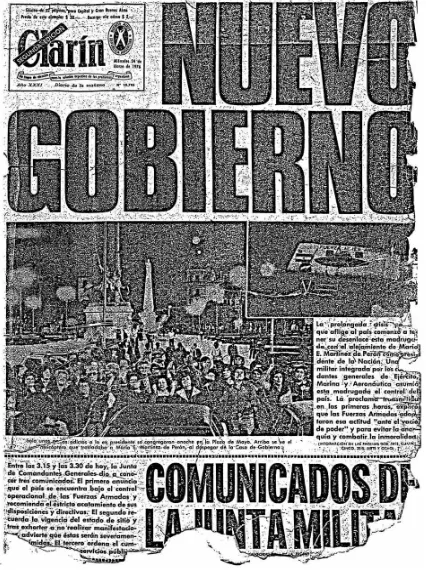
[image:2.595.198.411.161.446.2]year, March 24, which was the day the Armed Forces took power by force in 1976 and overthrew the democratic Argentine government in charge of President María Estela Martínez de Perón. This repres-sive de facto regime known as la Junta Militar “the Military Junta” seized power and ruled until De-cember 1983, when a democratic government was again elected by the Argentinian people. The first front page that was published by Clarín when the coup d’état began is displayed in Figure 1.
Figure 1. Front page published on March 24, 1976.
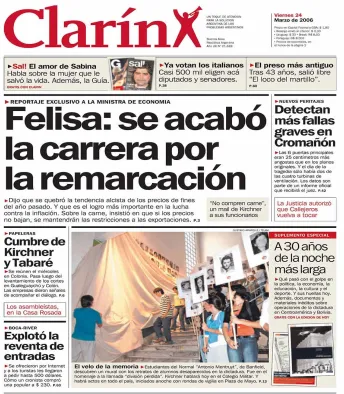
The phrase Nuevo Gobierno “New Government” is a distant and neutral expression, whereas at the bottom right corner of the last front page of the corpus, which corresponds to March 24, 2006 (see Appendix A), the word noche “night,” in the expression A 30 años de la noche más larga “30 years after the longest night,” overtly condemns the beginning of the military regime.
The corpus comprises 2,898 words and always deals with the front pages of the daily newspaper Clarín, assuming the front page to be a focus of journalistic and ideological attention.
1.3 The adjective
At a first stage, the adjective is presented in relation to the noun, the verb and the adverb; then, the frequency of adjectives in the Clarín_corpus is detected, in contrast to other categories. At a second stage, our intention is to observe what types of adjectives appear there. For instance, if the term de-saparecido “disappeared” − which from a historical viewpoint has so many connotations in Argentina −
is used, we observe what prefixes and suffixes are allowed with derivations, and in what types of con-structions it is included. It is important to recall that the word desaparecido is also listed in English dictionaries. The Oxford Dictionary of English3 defines it as, “(especially in South America) a person
who has disappeared, presumed killed by members of the armed services or the police.” And the Mer-riam-Webster’s Dictionary4 offers the following definition: “an Argentine citizen who has been abducted and usually murdered by right-wing terrorists.”
1.4 Use of NooJ
We have been working with the linguistic resources created for the Spanish Module Argentina,5
specif-ically built by the IES_UNR research team to be used with NooJ,6 a computational tool designed by
Max Silberztein. Our linguistic resources include dictionaries and grammars that are now in full devel-opment. In this paper we will particularly deal with the dictionary of adjectives and some specific gram-mars, leaving aside the dictionaries of other grammatical categories, which we use to recognise different types of entries such as nouns, verbs and adverbs.
Similarly, the linguistic resources created for the Italian Module7 provide an anchor to the Italian
learners of Spanish as a foreign language. Notice however that the Italian Module is not our main pur-pose, for it is only tangentially addressed as a starting point for those learners.
The choice of NooJ entails, above all, a methodological decision, which assumes that it is possible to create language teaching and learning situations by taking into account natural language processing. Then, it is understood that in a given environment and with a given input, learners formulate linguistic hypotheses that may be checked with a computational tool. The NooJ platform provides a favourable means to create this type of situations since: (1) it articulates different levels of analysis (orthography, morphology, syntax, etc.); (2) its connected dictionaries and grammars involve an integral knowledge of language; and (3) a single platform allows a comparison of Italian and Spanish using a common language.
We will try to formulate possible language teaching and learning strategies for learners of Spanish as a foreign language, whose mother tongue is Italian.
2 Development
2.1 Comparison between the adjective and other categories in Spanish
From a morphological viewpoint, Spanish nouns and adjectives share the same diminutive suffix -ito (e.g., mesa “table” - mesita “little table” and claro “clear”- clarito “very clear”). Many adjectives derive from nouns as in: cultura “culture” - cultural “cultural” and trabajo “work” - trabajador “worker”. From a syntactic viewpoint, an adjective may become the head of a noun phrase, as in the sentence el militar abrió fuego “the military (man) opened fire,” where the adjective militar “military” functions as a noun.
From a morphological viewpoint, it is possible to create adjectives out of certain verbs (e.g., tonificar “to tone” - tonificante “toning” and desear “to desire” - deseable “desirable”). From a syntactic view-point, past participles and adjectives occur in common environments, as in: un traje combinado “a com-bined suit” and un traje azul “a blue suit.”
From a morphological viewpoint, adjectives and adverbs admit the same diminutive and superlative suffixes -ito and -ísimo respectively (e.g., buenito “very good” - tempranito “very early” and buenísimo “great” - tempranísimo “very early”). Moreover, adverbs in -mente derive from adjectives as in: lento “slow” - lentamente “slowly.” From a syntactic and semantic viewpoint, adjectival adverbs constitute an intersection of adjectives and adverbs, as in the sentence llovió fuerte “it rained hard,” where fuerte “hard” functions as an adjectival adverb modifying the verb llovió; whereas in the phrase un fuerte viento “a strong wind,” fuerte “strong” is simply an adjective modifying a noun.
2.2 Comparison between the adjective and other categories in Italian
In Italian, adjectives have a high percentage of categorical ambiguity with two other grammatical cate-gories, specifically those of the noun and the past participle (Monteleone 2016). A typical example of this ambiguity is the word anguished. In the sentence Giovanni è angosciato “Giovanni is anguished,” angosciato is an adjective. And in the sentence Paolo è un angosciato “Paul is an anguished man,” angosciato functions as a noun. However, in the sentence Paolo è angosciato da Giovanna “Paolo is anguished because of Giovanna,” angosciato is a past participle.
5Spanish Module (Argentina) available at http://www.nooj-association.org/index.php?option= com_k2&view=item&id=6:spanish-module-argentina&Itemid=611)
6 Software NooJ available at http://nooj-association.org
However, through specific automatic parsing tools (grammars, automata and finite-state transducers in NooJ), it is possible to solve this ambiguity and automatically tag syntactic sequences containing only adjectives. For reasons of space, those tools will not be discussed here, but developed in a future paper.
3 Analysis of the Clarín_corpus
3.1 Category frequency
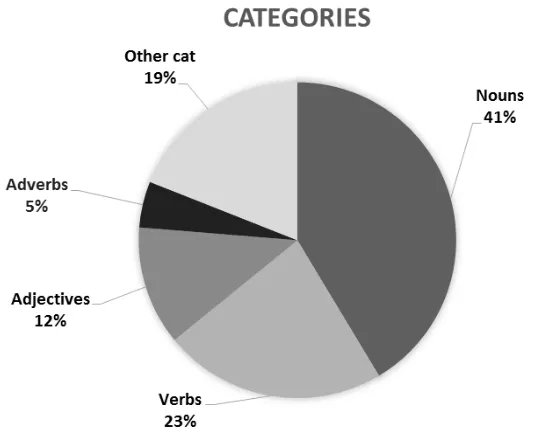
Within NooJ, we apply the command “Linguistic Analysis” in order to obtain the frequency of the cat-egories contained in the corpus: nouns, verbs, adjectives and adverbs. Then, by applying Locate for each category in turn: <N>, <V>, <ADJ> and <ADV>, the following piece of information is obtained: Nouns: 1,200; Verbs: 658; Adjectives: 353; Adverbs: 137; Other categories: 550 (conjunctions, prepo-sitions, pronouns).
[image:4.595.168.436.291.509.2]The graph in Figure 2 shows that adjectives and adverbs are the least frequent out of the five catego-ries. This data provides a first conclusion. The low frequency of adjectives points out that, due to its low proportion in the text input, this category is susceptible to be reinforced by the foreign language teacher’s intervention.
Figure 2. Frequency of grammatical categories in the Clarín_corpus.
3.2 Adjectives
As frequency is our working criterion, those adjectives recording more frequency in the corpus represent the starting point. It is then specified which categories precede these adjectives, which morphological suffixes and prefixes they admit, and which adjectival structures are more recurrent.
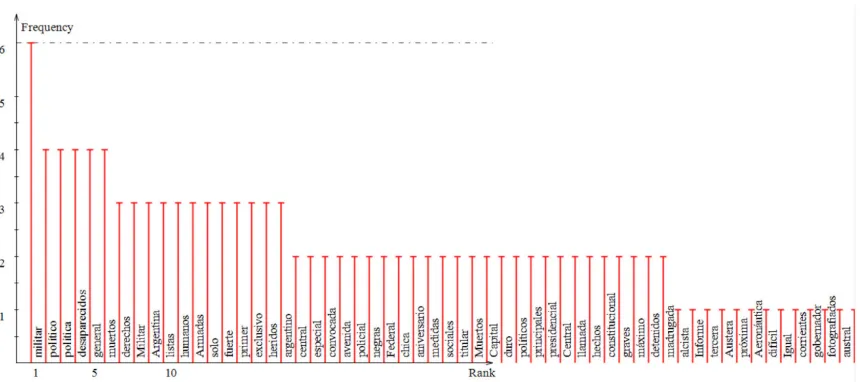
In Figure 3, after applying the commands “Locate” and “Statistical Analysis,” it is possible to recog-nise the twenty most frequent adjectives in the corpus: militar “military,” político “political,” política “political,” desaparecidos “disappeared,” general “general,” muertos “dead,” derechos “right,” Militar “Military,” Argentina “Argentinian, listas “ready,” heridos “injured,” humanos “human,” Armadas “Armed, solo “alone,” fuerte “strong,” primer “first,” exclusivo “exclusive,” argentino “Argentine,” central “central” and especial “special.”
Figure 3. Frequency of adjectives in the Clarín_corpus.
3.3 Morphological Inflection and Derivation
Next, the inflectional paradigms of some of the most frequent adjectives are shown, as they are recorded in the inflectional grammars (Rodrigo et al. 2018) and in the dictionary of adjectives created in NooJ for the Spanish Module Argentina.
The adjective militar “military” inflects like ÁGIL: militar, militares. The following words are part of its derivational paradigm as recorded in the dictionary of adjectives: antimilitar “military,” anti-militarista “anti-militarist,” paramilitar “paramilitary,” desmilitarizado “demilitarised,” militarizado “militarised.”
The adjective político “political” belongs to the paradigm FLACO: político, política, políticos, polí-ticas. The words apolítico “apolitical,” geopolítico “geopolitical” and impolítico “non-political” are part of its derivational paradigm in the dictionary of adjectives.
The adjective desaparecido “disappeared” also follows the paradigm FLACO: desaparecido, desa-parecida, desaparecidos, desaparecidas. It is important to note that there are no words derived from desaparecido.
The adjective general “general” inflects like ÁGIL: general, generales. The words generalista “gen-eralist,” generalizable “generalisable” and generalizado “generalised” are part of its derivational para-digm as it is recorded in the dictionary of adjectives.
3.4 Context of occurrence
The context of occurrence allows us to know which categories can accompany the adjective. The adjec-tive militar “military” is preceded by nouns, as in the phrases reacción militar “military reaction,” au-tocrítica militar “military self-criticism,” caudillo militar “military leader,” uniforme militar “military uniform,” golpe militar “military coup,” colegio militar “military college.”
The adjectives político, política “political” are preceded by nouns, as in: sector político “political sector,” Reforma política “political Reform,” favoritismo político “political favouritism,” enemigo pol-ítico” political enemy” and terror político “political terror.” However, they may also be preceded by determiners: su política “his/her/their/your politics,” la política “(the) politics.”
The adjective desaparecidos “disappeared” is preceded by verbs (e.g., son desaparecidos “(they) are disappeared”), by the construction adjective+preposition (e.g., miles de desaparecidos “thousands of disappeared”), by numeral adjectives (e.g., catorce desaparecidos “fourteen disappeared”), and by nouns (e.g., alumnos desaparecidos “disappeared students”).
3.5 Syntactic structure
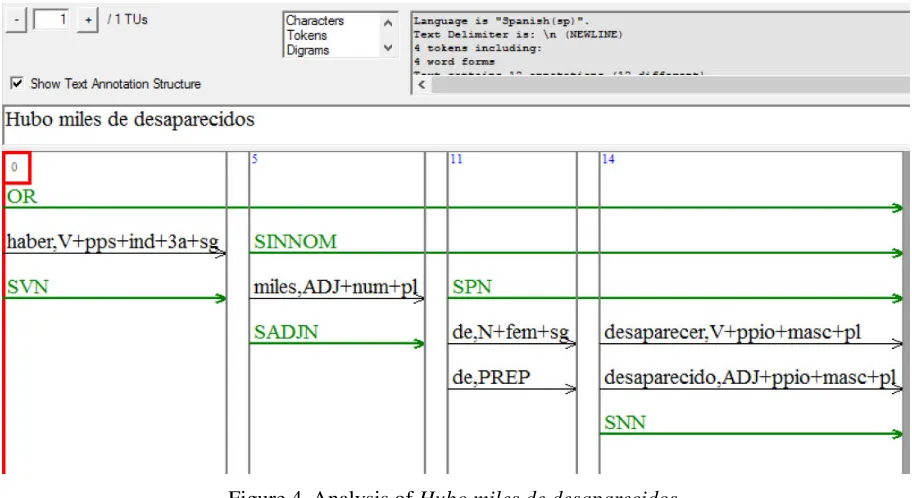
The basis of our analysis are the concepts developed by Bès (1999) and our approach is related to context-sensitive grammars. Our NooJ grammars take into account two types of constructions: nucleus phrases, such as a nucleus verb phrase (SVN), a nucleus adjective phrase (SADJN), a nucleus preposi-tion phrase (SPN), a nucleus noun phrase (SNN), and larger phrases, such as the noun phrase (SINNOM), which contain nucleus phrases. These expressions will be analysed with the different syn-tactic grammars available in the Spanish Module Argentina.
In Spanish, the expression Hubo miles de desaparecidos “There were thousands of disappeared” is an impersonal sentence, i.e., without a subject. In the above example, we distinguish a nucleus adjective phrase (SADJN), miles “thousands” and a nucleus preposition phrase (SPN), de desaparecidos “of dis-appeared,” both inside the noun phrase (SINNOM). On the other hand, the verb hubo “were,” which is the past indicative of haber “to be,” constitutes a nucleus verb phrase (SVN). These two structures make up the impersonal sentence, as it can be seen in Figure 4.
Figure 4. Analysis of Hubo miles de desaparecidos.
[image:6.595.70.526.234.483.2]The corresponding main grammar for impersonal sentences is displayed in Figure 5.
Figure 5. Grammar for impersonal sentences.
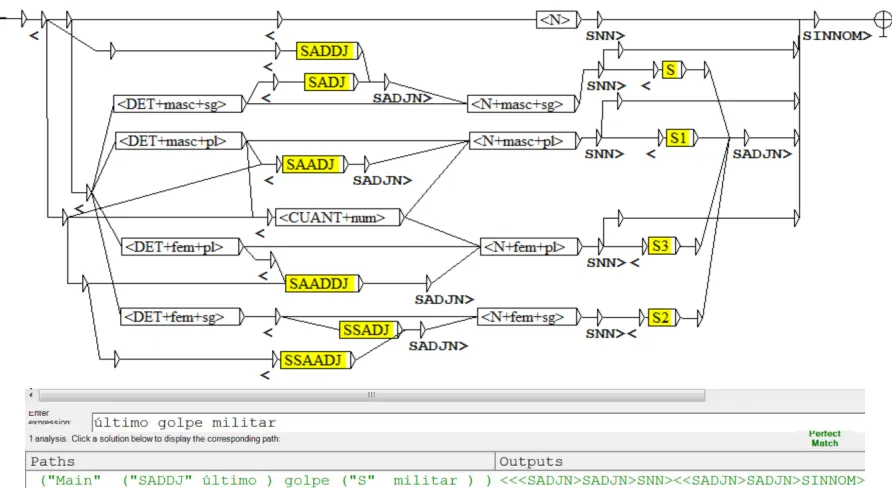
Figure 6. Noun Phrase Grammar.
“Show Debug” checks to see if the grammar designed for the noun phrase identifies that último “last” and militar “military” are two nucleus adjective phrases (SADJN), inside a larger unit, the noun phrase (SINNOM). The intermediate unit is the nucleus noun phrase (SNN), último golpe “last coup.”
The analyses of both expressions, Hubo miles de desaparecidos “There were thousands of disap-peared” and último golpe militar “last military coup,” show the adjective in two different syntactic con-structions. In the first example, the adjective miles “thousands” is the nucleus of the noun phrase (SINNOM) miles de desaparecidos “thousands of disappeared” and is part of an impersonal sentence; in the second example, two adjectives occur in different positions: último “last” is a nucleus adjective phrase (SADJN) inside the nucleus noun phrase (SNN) último golpe “last coup,” and, at the same time, último “last” is part of the noun phrase (SINNOM) último golpe militar “last military coup,” and militar “military” is a nucleus adjective phrase (SADJN) inside a noun phrase (SINNOM), peripheral to the nucleus noun phrase (SNN).
The syntactic structure shows how the adjective can integrate noun phrases and even become the nucleus of a noun phrase.
4 Conclusions
In this paper, we have proposed a pedagogical application of the NooJ approach to a specific situation by choosing a significant corpus (the Clarín_corpus), which can provide an idea of the use of the Spanish language in a particular historical and cultural context. Our intention has been to identify adjectives and to do a global reading of them within the corpus. Our focus was mainly placed on the adjective de-saparecido “disappeared,” because of its ideological importance. As we have already stated in the In-troduction, our subject matter deals with the pedagogical application of NooJ in the teaching-learning of Spanish as a foreign language. And we have concentrated on a specific group: native speakers of Italian learning Spanish as a foreign language. Our strategy has been to make explicit some contact points between Spanish and Italian by using NooJ as a common platform. Our purpose was not to com-pare the Italian and Spanish resources, but to highlight that both languages can be formalised using a common platform, since the structure of dictionaries and grammars is the same. This provides unity and coherence to our pedagogical proposal, which is the goal of the research project carried out by the IES_UNR team, since both languages can be analysed with NooJ (Appendix B).
References
Gabriel G. Bès, 1999. La phrase verbale noyau en français. Recherches sur le français parlé, volume 15: 273–358.
Andrea Rodrigo, Silvia Reyes and Rodolfo Bonino. 2018. Some Aspects Concerning the Automatic Treatment of Adjectives and Adverbs in Spanish: A Pedagogical Application of the NooJ Platform. In: Mbarki S., Mourchid M., Silberztein M. (eds) Formalizing Natural Languages with NooJ and Its Natural Language Processing Ap-plications. NooJ 2017. Springer, Cham. https://doi.org/10.1007/978-3-319-73420-0_11. Communications in Computer and Information Science, volume 811: 130-140.
Julia Frigière and Sandrine Fuentes. 2015. Pedagogical Use of NooJ dealing with French as a Foreign Language. In J. Monti, M. Silberztein, M. Monteleone, and M. P. di Buono (eds.) Formalizing Natural Languages with NooJ,
Cambridge Scholars Publishing, London, 186-197.
Mario Monteleone. 2016. Local Grammars and Formal Semantics: Past Participles vs. Adjectives in Italian. In T. Okrut, Y. Hetsevich,M. Silberztein, and H. Stanislavenka, (eds) Automatic Processing of Natural-Language Electronic Texts with NooJ. Communications in Computer and Information Science, volume 607:83-95,
Sprin-ger, Cham.
Max Silberztein, 2015. La formalization des langues, l´approche de NooJ. Iste Ediciones, London.
Appendices
A. Last front page of the Clarín_corpus.
[image:8.595.127.471.310.704.2]The last front page that was published by Clarín (2006) is displayed in Figure 7.
B. A pedagogical proposal.
Our work will be carried out in parallel to the NooJ Italian module, since the starting point is the same platform and our proposal includes the activities detailed below.
• Open the text in the Italian Module: Ringraziamenti (Dan Brown, The Da Vinci Code, 2003)8.
• Apply Locate <A> in order to extract all adjectes, as stated in the properties_definiton file (Figure
8):
Figure 8. Locate <A> in the Italian text.
• Apply Locate and search a string of characters for the adjective buon “good.” Note how
[image:9.595.78.502.474.696.2]concord-ance is done. Figure 9 presents a sample of some of the sequences.
Figure 9. Locate buon “good” in the Italian text.
8Ringraziamenti (Dan Brown The Da Vinci Code, 2003) available at
• Identify the inflectional features of some of the nouns following the previous adjective: e.g., il
buon nome “the good name,” un buon amico “a good friend,” etc.
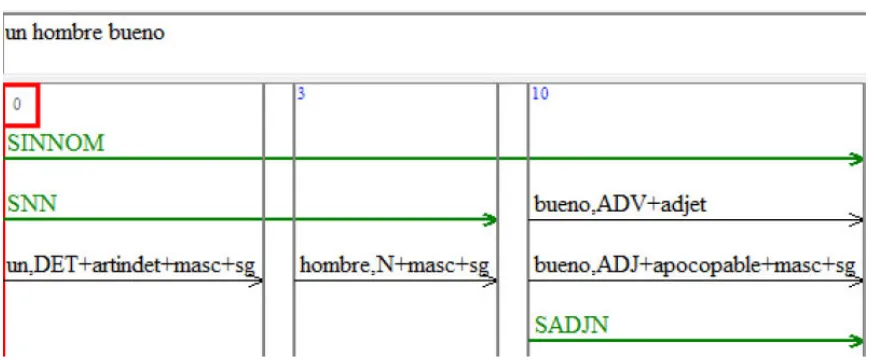
• Return to the Spanish Module Argentina, and perform Linguistic Analysis on the following
[image:10.595.80.517.130.310.2]se-quence: un hombre bueno “a good man” (Figure 10).
Figure 10. Linguistic Analysis of an adjectival sequence
• Detect concordance features in the sequence: masculine (masc) and singular (sg).
• State which variations this adjective may adopt, since according to the corresponding lexical
grammar, bueno “good” inflects like FLACO (FLACO = <E>/masc+sg | s/masc+pl | <B> a/fem+sg | <B> as/fem+pl;).
• Look up, in the dictionary of adjectives, another adjective inflecting like desaparecido and
com-plete the following expressions:
Un hombre… .. “A man…”
Unos hombres… .. “Some men…”
Mi libro… ..”My book…”
La señora… .. “The lady…”
• Check through Linguistic Analysis how it is possible, by virtue of concordance, to build noun
phrases.
• Do an online search to complete the analysis with its historical implications of the term
desapare-cido in expressions such desaparedesapare-cidos Argentina and disappeared Argentina9.