Exploring Soft-Clustering for German (Particle) Verbs
across Frequency Ranges
Moritz Wittmann iteratec GmbH
Maximilian K¨oper
Institut f¨ur Maschinelle Sprachverarbeitung Universit¨at Stuttgart
Sabine Schulte im Walde
Institut f¨ur Maschinelle Sprachverarbeitung Universit¨at Stuttgart
Abstract
In this paper we explore the role of verb frequencies and the number of clusters in soft-clustering approaches as a tool for automatic semantic classification. Relying on a large-scale setup includ-ing 4,871 base verb types and 3,173 complex verb types, and focusinclud-ing on synonymy as a task-independent goal in semantic classification, we demonstrate that low-frequency German verbs are clustered significantly worse than mid- or high-frequency German verbs, and that German complex verbs are in general more difficult to cluster than German base verbs.
1
Introduction
Semantic classifications are of great interest to computational linguistics, specifically regarding the per-vasive problem of data sparseness in the processing of natural language. Such classifications have been used in applications such as word sense disambiguation (Dorr and Jones, 1996; Kohomban and Lee, 2005; McCarthy et al., 2007),parsing(Carroll et al., 1998; Carroll and Fang, 2004), machine transla-tion(Prescher et al., 2000; Koehn and Hoang, 2007; Weller et al., 2014), andinformation extraction (Sur-deanu et al., 2003; Venturi et al., 2009), among many others.
2
Data and Algorithm
UsingDECOW(Sch¨afer and Bildhauer, 2012; Sch¨afer, 2015) as one of the currently largest German web corpora, we extracted all base verbs and particle verbs from versionDECOW14. The corpus sentences were morphologically annotated and parsed using SMOR(Faaß et al., 2010), MarMoT (M¨uller et al., 2013) and the MATE dependency parser (Bohnet, 2010). Relying on the morphological annotation, and after disregarding prefix verbs (i.e., non-separable complex verbs), we extracted a total of 4,871 base verb types and 3,173 particle verb types.
As vector spaces for the verbs, we relied onword2vec(Mikolov et al., 2013) using a symmetrical window of sizes 3 and 10. The underlying corpus was again DECOW14. We applied a min-frequency threshold of 50, the dimensionality was set to 400, and we used 10 corpus iterations and 15 negative samples. Other parameters were set to default.
For soft clustering, we usedNon-negative matrix factorization (NMF), a factorisation approach with an inherent (soft) clustering property (Ding et al., 2005). NMF has been applied successfully to other NLP tasks before, such as document clustering (Xu et al., 2003), topic number estimation (Yokoi, 2013), and preposition classification (K¨oper and Schulte im Walde, 2016). We applied the NMF algorithm from theLAML(Linear Algebra and Machine Learning) Java library, version 1.6.2 (Qian, 2016).
3
Clustering Experiments
3.1 Clustering Setup
In all clustering experiments, we clustered the German verbs using Non-negative Matrix Factorization with k-Means initialisation. We distinguished the following parameters.
• Verb set: We clustered (i) either the base verbs, or (ii) the particle verbs, or (iii) both base and particle verbs, to explore differences for simplex vs. complex verbs.
• Frequency ranges: The verbs were sorted by their corpus frequencies, and then split into three equally sized bins, to distinguish between low-, mid- and high-frequency verbs. We clustered only verbs from the same frequency range (LOW, MID, HIGH), or all verbs at the same time.
• Verb vector spaces: We applied two different vector spaces, relying on window sizes of 3 vs. 10.
• Number of clusters: We used 50, 100, and 250 clusters.
• Number of iterations: We let the clustering algorithm perform a maximum of 500 iterations (or less if it converged successfully).
Due to the combination of all parameters used, a total of 24 clusterings can be obtained for each of the three verb sets. For one parameter combination, the clustering algorithm failed to produce an output: base verbs, all frequencies, vectors relying on a window size of 3, and splitting into 250 clusters. The Java library used did not provide any reasons or explanations in the event of failure.
3.2 Clustering Evaluations
evaluation targets a semantic relatedness between the complex and the simplex verbs that is not too different to the synonymy evaluation, yet more task-oriented.
3.2.1 Evaluation: Synonymy
We assess the cluster analyses on their ability to contain pairs of synonymous verbs in the same clusters. As basis for the evaluation, we use synonyms provided by the German online synonym dictionary Du-den1. The dictionary contained 2,158 of our particle verbs (with an average of 19 synonyms), and 3,303 of our base verbs (with an average of 13 synonyms). Some examples are listed below:
aussehen ausblicken, ausschauen, aussp¨ahen, beobachten, entgegensehen, erwarten, sp¨ahen, umher-blicken, ausgucken, luchsen, ¨ahneln, anmuten, erscheinen, scheinen, vorkommen, wirken, sehen, suchen, umsehen
zugestehen akzeptieren, bewilligen, billigen, einwilligen, erlauben, genehmigen, gestatten, gew¨ahren, zubilligen, zuerkennen, konzedieren, legitimieren, sanktionieren, tolerieren, zugutehalten, absegnen, un-terschreiben, abnicken, stattgeben
erkl¨aren aufzeigen, auseinanderlegen, auseinandersetzen, ausf¨uhren, darlegen, definieren, entwick-eln, erl¨autern, er¨ortern, konkretisieren, veranschaulichen, verdeutlichen, zeigen, exemplifizieren, ex-plizieren, klarlegen, klarmachen, verdeutschen, verklickern, verkasematuckeln, auslegen, begr¨unden, belegen, deuten, kommentieren, motivieren, rechtfertigen, fundieren, interpretieren, legitimieren, sub-stanziieren, aufkl¨aren, einweihen, informieren, unterrichten, anbringen, anmelden, ausdr¨ucken, ¨außern, aussprechen, bekennen, bekunden, er¨offnen, formulieren, melden, mitteilen, sagen, verlautbaren, vor-bringen, kundgeben, kundtun, offenbaren, unterbreiten, verk¨unden, verk¨undigen, artikulieren, dokumen-tieren, verbalisieren, angeben, ausweisen, bescheinigen, bezeichnen, deklarieren, kennzeichnen, einset-zen, einstehen, eintreten, zustimmen, starkmachen, enth¨ullen, offenbaren, outen
siegen bezwingen, gewinnen, schlagen, triumphieren
Across the clusters within a cluster analysis, we check for all pairs of verbs whether they represent synonyms according to our gold standard or not, and compute precision, recall and the harmonic f-score. As NMF clustering provides a membership scorex ≥0for each verb and each cluster, we assume that the higher the membership score of a verb for a certain cluster, the more likely the verb is to be part of it. Before running the synonym evaluation, we thus apply an inclusion threshold in order to decide for each verb whether it is considered to be in a cluster or not. Since there is no maximum membership score, and since the values lie on different scales depending on the clustering parameters, determining the ideal membership threshold for each of the clusterings is not straightforward. We therefore employ a brute-force solution: after finding the largest membership scoretmaxfor a specific cluster analysis, the
synonym evaluation is applied to all non-negative thresholds in the settmax−k·0.001, k ∈ N0. For
example, if the largest membership value in a clustering is 0.8916, the synonym evaluation is applied to all thresholds in the set{0.8916,0.8906,0.8896, ...,0.0036,0.0026,0.0016,0.0006}.
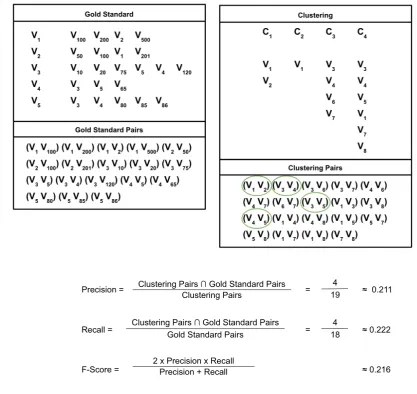
For a given threshold value, the synonym evaluation counts all verb pairs given by the clustering. Two verbs are considered a pair if they share one or more clusters. Since verbs are included in more clusters as the threshold is lowered, we add an abort condition: as soon as 50% of all possible verb pairs are present in the clustering, the threshold is not lowered any further.
See Figure 1 for a small-scale example, listing all symmetric verb pairs for the gold standard and the clustering, marking the correct pairs among the clustering pairs, and calculating precision, recall and f-score. Since the clusterings in our experiments cover thousands of verbs, the actual number of verb pairs in our clusterings is large. This results in f-scores on a very low magnitude, which is not important for our evaluation, however, as the scores are used to compare clustering parameter variations, rather than providing impressive evaluation scores.
Figure 1: Small-scale example of verb pair evaluation.
As an alternative to the brute-force search for the best inclusion threshold, we also apply a method for assigning verbs to their top nclusters, with 1 ≤ n ≤ N
2 and N representing the total number of
clusters. In this variant, verbs are added to the n clusters with the highest membership scores. For example, suppose that in a clustering of verbs into 6 clusters, verbv1has the membership values 0.7, 0.4,
0.45, 0.2, 0.5, and 0.8 for clusters 1 to 6 respectively. Forn= 1, the verb will be included only in cluster 6, forn= 2, it will be considered part of clusters 6 and 1, and forn= 3, it belongs to clusters 6, 1, and 5. This variant is referred to astop-n evaluation, whereas the previously described method is referred to asthreshold evaluation.
3.2.2 Evaluation: Compositionality
Similarly to the evaluation metric described in the previous section, the compositionality evaluation is also applied to all thresholds in the settmax−k·0.001, k∈N0, withtmaxbeing the largest inclusion
value found in the clustering, as well as to all top-ncluster assignments with1≤n≤ N
2. For each pair
of particle verb and base verb, e.g.,abnehmen – nehmen, we then compare the assignment of the two verbs to the same vs. different clusters in two different ways.
• Pointwise Mutual Information (PMI):
We calculatelogp(pP V(P V,BV)p(BV)), withp(P V, BV)the proportion of clusters containing both the parti-cle verbP V and the base verbBV, andp(P V)andp(BV)the proportions of clusters containing the particle and base verbs individually. The proportions are relative to the total number of clus-ters, sop(P V, BV) = 0.2means that 20% of the clusters contain bothP V andBV. A high PMI means that a pair tends to occur in the same clusters rather than in different ones.
• Cosine similarity between average cluster centroid vectors:
For each cluster, we calculate the centroid vector as the average over all verb vectors in that cluster. In addition, we calculate average cluster centroid vectors for all verbs, as the average over all centroid vectors a verb has been assigned to. Then, each two verbs are compared by calculating the cosine of the angle between the respective average cluster centroid vectors. A high cosine similarity means that a pair tends to occur in the same clusters, or that the clusters in which the two verbs occur have similar centroids.
In the final evaluation step, we compute the correlation between the PV–BV similarity predictions relying on PMI/cosine in comparison to the gold standard ratings, using Spearman’s Rank-Order Correlation Coefficientρ(Siegel and Castellan, 1988).
4
Results
In the following, we present the results of our clustering experiments and evaluations. Please (a) re-member that the f-score values for the synonym evaluation are in a very low range because they assess a comparably large number of verb pairs across 4,871 base verbs and 3,173 particle verbs within the cluster analyses; and (b) note that the compositionality evaluation is carried out on a subset of only 400 particle verbs for which the gold standard contains compositionality ratings.
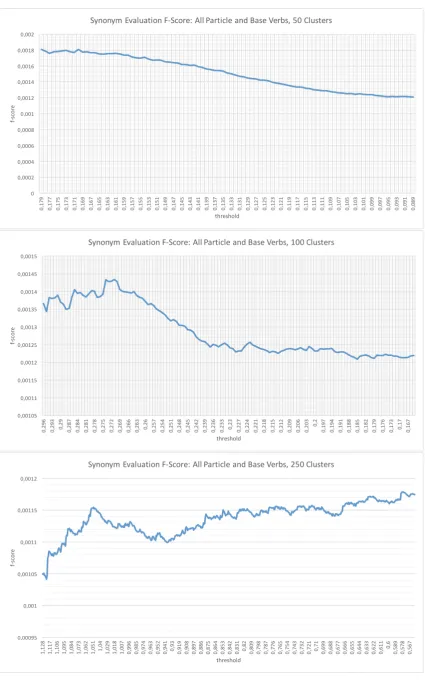
Figure 2 presents the synonymy evaluation f-score values when clustering all particle and base verbs in 50, 100 and 250 clusters. With an increasing threshold (x-axis), a smaller number of verbs is included in the clusters. The resulting quality of the cluster analyses differs across the different numbers of clus-ters, as one would have expected. For 50 and 100 clusclus-ters, the correlation decreases with an increasing threshold along the x-axis, so a more general inclusion is better, but for 250 clusters, the clusters are better when they contain less verbs. As the different scales on the y-axis across the three plots show, overall a smaller number of clusters with generous assignment is best.
Table 1 zooms into the differences of clustering low-, mid, high-frequency or all verbs, regarding base verbs (BVs), particle verbs (PVs) and both BVs and PVs. For each cell, we show the best result across thresholds/top-n and vector spaces. For low- and mid-frequency verbs, we did not assess the compositionality evaluation because less than 10% of the particle verbs and corresponding base verbs from the gold standard were found in the clustering, regardless of the inclusion threshold or the top-n
value used.
The results in the table demonstrate the following differences:
• The results for base verbs are generally better than for particle verbs (only applicable to the syn-onym evaluation), demonstrating that particle verbs are harder to assess semantically than base verbs, presumably because they are more ambiguous.
• Confirming insights from Figure 2, the results for clusterings with 50 clusters are generally better than for clusterings with 100 or 250 clusters.
• For predicting particle verb compositionality, PMI generally works better than the cosine.
• (not shown in the table:) There is no strong tendency for one of the vector spaces (i.e., using a window of 3 vs. 10 words) outperforming the other.
5
Conclusion
We provided an extensive clustering setup and focused on synonymy as a task-independent goal in se-mantic classification, in order to explore the role of verb frequency ranges across various numbers of clusters. We demonstrated that (1) low-frequency German verbs are clustered significantly worse than mid- or high-frequency German verbs, and that (2) German complex verbs are in general more difficult to cluster than German base verbs. While (1) the effect of clustering low-frequency target verbs has been investigated by a restricted number of earlier approaches, (2) might be considered as general knowledge but has –as far as we are aware of– not explicitly been proven before.
Acknowledgments
The research was supported by the DFG Collaborative Research Centre SFB 732/D12“Sense Discrim-ination and Regular Meaning Shifts of German Particle Verbs”(Maximilian K¨oper, Moritz Wittmann), the DFG Research Grant SCHU-2580/2“Distributional Approaches to Semantic Relatedness”(Moritz Wittmann), and the DFG Heisenberg Fellowship SCHU-2580/1 (Sabine Schulte im Walde).
References
Chris Biemann. 2006. Chinese Whispers: An Efficient Graph Clustering Algorithm and Its Application to Natural Language Processing Problems. In Proceedings of the 1st Workshop on Graph-Based Methods for Natural Language Processing. Stroudsburg, PA, USA, pages 73–80.
Bernd Bohnet. 2010. Top Accuracy and Fast Dependency Parsing is not a Contradiction. InProceedings of the 23rd International Conference on Computational Linguistics. Beijing, China, pages 89–97.
Stefan Bott, Nana Khvtisavrishvili, Max Kisselew, and Sabine Schulte im Walde. 2016. Ghost-PV:
A Representative Gold Standard of German Particle Verbs. InProceedings of the 5th Workshop on Cognitive Aspects of the Lexicon. Osaka, Japan, pages 125–133.
John Carroll and Alex C. Fang. 2004. The Automatic Acquisition of Verb Subcategorisations and their Impact on the Performance of an HPSG Parser. InProceedings of the 1st International Joint Confer-ence on Natural Language Processing. Sanya City, China, pages 107–114.
Chris Ding, Xiaofeng He, and Horst D. Simon. 2005. On the Equivalence of Nonnegative Matrix Fac-torization and Spectral Clustering. In Proceedings of the SIAM International Conference on Data Mining. Newport Beach, CA, USA, pages 606–610.
Bonnie J. Dorr and Doug Jones. 1996. Role of Word Sense Disambiguation in Lexical Acquisition: Predicting Semantics from Syntactic Cues. InProceedings of the 16th International Conference on Computational Linguistics. Copenhagen, Denmark, pages 322–327.
Gertrud Faaß, Ulrich Heid, and Helmut Schmid. 2010. Design and Application of a Gold Standard for Morphological Analysis: SMOR in Validation. InProceedings of the 7th International Conference on Language Resources and Evaluation. Valletta, Malta, pages 803–810.
Elias Iosif and Alexandros Potamianos. 2007. A Soft-Clustering Algorithm for Automatic Induction of Semantic Classes. InProceedings of the 8th Interspeech Conference. Antwerp, Belgium, pages 1609–1612.
Philipp Koehn and Hieu Hoang. 2007. Factored Translation Models. InProceedings of the Joint Confer-ence on Empirical Methods in Natural Language Processing and Computational Natural Language Learning. Prague, Czech Republic, pages 868–876.
Upali S. Kohomban and Wee Sun Lee. 2005. Learning Semantic Classes for Word Sense Disambigua-tion. InProceedings of the 43rd Annual Meeting on Association for Computational Linguistics. Ann Arbor, MI, pages 34–41.
Maximilian K¨oper and Sabine Schulte im Walde. 2016. Automatic Semantic Classification of German Preposition Types: Comparing Hard and Soft Clustering Approaches across Features. InProceedings of the 54th Annual Meeting of the Association for Computational Linguistics. Berlin, Germany, pages 256–263.
Anna Korhonen, Yuval Krymolowski, and Zvika Marx. 2003. Clustering Polysemic Subcategorization Frame Distributions Semantically. InProceedings of the 41st Annual Meeting of the Association for Computational Linguistics. Sapporo, Japan, pages 64–71.
Jey Han Lau, Paul Cook, Diana McCarthy, David Newman, and Timothy Baldwin. 2012. Word Sense Induction for Novel Sense Detection. InProceedings of the Conference of the European Chapter of the Association for Computational Linguistics. Avignon, France, pages 591–601.
Jiwei Li and Dan Jurafsky. 2015. Do Multi-Sense Embeddings Improve Natural Language Understand-ing? In Proceedings of the Conference on Empirical Methods in Natural Language Processing. Lisbon, Portugal, pages 1722–1732.
Diana McCarthy, Sriram Venkatapathy, and Aravind K. Joshi. 2007. Detecting Compositionality of Verb-Object Combinations using Selectional Preferences. InProceedings of the Joint Conference on Empirical Methods in Natural Language Processing and Computational Natural Language Learning. Prague, Czech Republic, pages 369–379.
Tomas Mikolov, Ilya Sutskever, Kai Chen, Greg S. Corrado, and Jeff Dean. 2013. Distributed Rep-resentations of Words and Phrases and their Compositionality. In Advances in Neural Information Processing Systems 26. Lake Tahoe, Nevada, USA, pages 3111–3119.
Thomas M¨uller, Helmut Schmid, and Hinrich Sch¨utze. 2013. Efficient Higher-Order CRFs for Morpho-logical Tagging. InProceedings of the 2013 Conference on Empirical Methods in Natural Language Processing. Seattle, Washington, USA, pages 322–332.
Detlef Prescher, Stefan Riezler, and Mats Rooth. 2000. Using a Probabilistic Class-Based Lexicon for Lexical Ambiguity Resolution. InProceedings of the 18th International Conference on Computational Linguistics. Saarbr¨ucken, Germany, pages 649–655.
Mingjie Qian. 2016. LAML. https://github.com/MingjieQian/LAML.
Mats Rooth, Stefan Riezler, Detlef Prescher, Glenn Carroll, and Franz Beil. 1999. Inducing a Semanti-cally Annotated Lexicon via EM-Based Clustering. InProceedings of the 37th Annual Meeting of the Association for Computational Linguistics. Maryland, MD, pages 104–111.
Carolina Scarton, Lin Sun, Karin Kipper-Schuler, Magali Sanches Duran, Martha Palmer, and Anna Korhonen. 2014. Verb Clustering for Brazilian Portuguese. In Alexander Gelbukh, editor,Proceedings of the 15th International Conference on Intelligent Text Processing and Computational Linguistics. Kathmandu, Nepal, pages 25–39.
Roland Sch¨afer. 2015. Processing and Querying Large Web Corpora with the COW14 Architecture. In Proceedings of the 3rd Workshop on Challenges in the Management of Large Corpora. Mannheim, Germany, pages 28–34.
Roland Sch¨afer and Felix Bildhauer. 2012. Building Large Corpora from the Web Using a New Effi-cient Tool Chain. InProceedings of the 8th International Conference on Language Resources and Evaluation. Istanbul, Turkey, pages 486–493.
Sabine Schulte im Walde. 2000. Clustering Verbs Semantically According to their Alternation Behaviour. In Proceedings of the 18th International Conference on Computational Linguistics. Saarbr¨ucken, Germany, pages 747–753.
Sabine Schulte im Walde. 2006. Experiments on the Automatic Induction of German Semantic Verb Classes. Computational Linguistics32(2):159–194.
Sidney Siegel and N. John Castellan. 1988. Nonparametric Statistics for the Behavioral Sciences. McGraw-Hill, Boston, MA.
Mihai Surdeanu, Sanda Harabagiu, John Williams, and Paul Aarseth. 2003. Using Predicate-Argument Structures for Information Extraction. InProceedings of the 41st Annual Meeting of the Association for Computational Linguistics. Sapporo, Japan, pages 8–15.
Giulia Venturi, Simonetta Montemagni, Simone Marchi, Yutaka Sasaki, Paul Thompson, John Mc-Naught, and Sophia Ananiadou. 2009. Bootstrapping a Verb Lexicon for Biomedical Information Extraction. In Alexander Gelbukh, editor,Linguistics and Intelligent Text Processing, Springer, Hei-delberg, pages 137–148.
Marion Weller, Sabine Schulte im Walde, and Alexander Fraser. 2014. Using Noun Class Information to model Selectional Preferences for Translating Prepositions in SMT. In Proceedings of the 11th Conference of the Association for Machine Translation in the Americas. Vancouver, Canada, pages 275–287.
Wei Xu, Xin Liu, and Yihong Gong. 2003. Document Clustering Based on Non-negative Matrix Fac-torization. InProceedings of the 26th Annual International ACM SIGIR Conference on Research and Development in Information Retrieval. Toronto, Canada, pages 267–273.