Original Article
Serum vancomycin levels in critically ill elderly patients
undergoing continuous renal replacement therapy
Zexun Mo1,2,3, Jie Sun1,2,3, Rui Chen1,2,3, Fei Xiao1,2,3, Richeng Xiong1,2,3, Jiahui Dong1,2,3, Lingling Wang1,2,3, Zhaokun Sun1,2,3, Qitao Yan1,2,3, Zhou Yu1,2,3, Zhenhui Guo1,2,3
1Department of Medical Intensive Care Unit, The General Hospital of Guangzhou Military Command, Guangzhou
510010, Guangdong Province, PR China; 2Guangdong Provincial Key Laboratory of Geriatric Infection and Organ
Function Support, Guangzhou 510010, Guangdong Province, PR China; 3Guangzhou Key Laboratory of Geriatric
Infection and Organ Function Support, Guangzhou 510010, Guangdong Province, PR China
Received November 4, 2015; Accepted February 10, 2016; Epub June 15, 2016; Published June 30, 2016
Abstract: Objective: To determine the pharmacokinetic parameters of vancomycin in critically ill elderly patients un-dergoing Continuous Renal Replacement Therapy (CRRT) and provide a baseline for dose adjustment. Methods: We carried out a prospective study that included 10 critically ill elderly patients aged ≥72 years. Vancomycin was given on the day when patients received CRRT. The CRRT parameters were as follows: a blood flow rate of 180 ml/min, a 3000 ml/h dialysate flow rate, and a 200 ml/h ultrafiltration clearance rate. Blood samples were collected at 0.25 h, 0.5 h, 0.75 h, 1 h, 2 h, 2.5 h, 3 h, 4 h, 8 h, 12 h and 24 h after vancomycin administration. Results: Vancomycin levels peaked at 1.5 h and remain plateaued at 8 h after dosing, insufficient or excessive drug concentrations were found in several time points. The estimated Vd, total clearance, AUC0-24 h and t1/2 were 28.38±7.00 L, 1.82±1.34 L/h, 282.51±77.87 mg L/h and 20.28±13.22 h. Vancomycin concentration ≥20 mg/L had a sensitivity of 25%, a specificity of 100%, a PPV of 100% and a NPV of 67% to predict AUC/MIC0-24 >400. The vancomycin concentration threshold associated with a PPV of 100% was 15 mg/L. Conclusion: This study revealed that vancomycin can be re-moved by CRRT. In critical ill elderly patients, a dose regimen of 1 g every 24 h was unable to provide a steady-state trough concentration of 15-20 mg/L. The fact that the pharmacokinetic parameters varied among these patients suggests the importance of monitoring vancomycin concentrations in critically ill elderly patients.
Keywords: Vancomycin, critically ill elderly patients, continuous renal replacement therapy, pharmacokinetic parameter
Introduction
Critically ill patients in intensive care units (ICU) are at high risk of bacterial infections, especial-ly if those patients are elderespecial-ly. The earespecial-ly and effective use of the appropriate antibiotics reduces mortality rates in these patients [1]. However, the effectiveness of antibiotics decreases in elderly patients with decreased physiological functions [2]. Critically ill elderly patients with or without decreased renal func-tion who are hemodynamically unstable and require vasopressor support might receive con-tinuous renal replacement therapy (CRRT) depending on the patient’s clinical condition [3]. CRRT can effectively remove drugs from a patient’s bloodstream, with drugs with a molec-ular weight less than 500 Da, a low
protein-low endogenous clearance exhibiting particu-larly easy removal [4, 5].
mg/L was recommended in guidelines for achieving effective treatment and preventing resistance [10]. Nevertheless, patient’s basic characteristics included location of infection, weight, glomerular filtration rate, co-medication and so on make it a great challenge to achieve appropriate trough serum levels. It is reported that hypoproteinemia can increase clearance rate in critically ill patients because of the increase of the unbound drug concentration [11, 12]. While vancomycin clearance in criti-cally ill patients undergoing CRRT has already been explored, the pharmacokinetic parame-ters of vancomycin in critically ill elderly patients receiving CRRT remains unknown.
The purpose of this study was to explore the pharmacokinetic parameters of critically ill elderly patients receiving vancomycin during CRRT and provide evidence for dose adjust- ments.
Materials and methods
Study design
This prospective study was carried out in the Medical Intensive Care Unit (MICU) of the General Hospital of Guangzhou Military Command (Guangzhou, China) between Janu- ary 2015 and June 2015. This study was con-ducted in accordance with the 1975 Helsinki Declaration and approved by the Ethics Committee of the General Hospital of Guang- zhou Military Command, Guangzhou, China (Approval ID: 2014 [128]). We prospectively studied ten adult patients who were treated with vancomycin as monotherapy or combined with other antibiotics undergoing CRRT treat-ment. Inclusion criteria included that patients were aged ≥72 years, having an ICU stay for at least 48 h.
Dosing regimen
The dose regimen was selected based on the recommendation in patients with renal dys-function. A 3000 ml/h dialysate flow rate was used in our study, thus we assumed that the creatinine clearance of these patients is 50 ml/ min. Vancomycin serum concentration between 20-30 mg/L was defined as adequate concen-tration, and insufficient or excessive drug con-centrations were defined as <20 mg/L or >30 mg/L. All of the patients received vancomycin
(Edicin, Sandoz, Lek Pharmaceuticals d.d., Ljubljana, Slovenia) at a dose of 0.5 g every 12 hours. The vancomycin was dissolved and dilut-ed in 100 ml of 0.9% sodium chloride solution and administered at an infusion rate of 50 ml per hour. In addition to vancomycin, the patients also received other prescribed drugs based on their conditions.
CRRT
Vancomycin was introduced on the day of CRRT treatment for all of the patients. The modality of CRRT was CVVHDF. The patients received 24 h CRRT with a 180 ml/min blood flow rate, 3000 ml/h dialysate flow rate, and a 200 ml/h ultrafiltration clearance rate. Blood samples were obtained 0.25 h, 0.5 h, 0.75 h, 1 h, 2 h, 2.5 h, 3 h, 4 h, 8 h, 12 h and 24 h after vanco-mycin administration. Blood samples were col-lected and centrifuged at 500 g for 5 min. Serum vancomycin concentrations were deter-mined using the fluorescence polarization immunoassay method with the AxSYM Vancomycin II Reagent Pack (Abbott, Wiesba- den, Germany). The assay was performed according to the instructions provided in the manufacturer’s manual.
Pharmacokinetic and statistical analysis
The following pharmacokinetic parameters were calculated using Kinetica v5.1 software (Thermo Fisher, USA): total clearance (CLtot), volume of distribution (Vd), elimination half-life (t1/2) and area under the serum concentration time curve (AUC0-24). GraphPad Prism for Windows v5 (GraphPad Prism Software, Inc.) was used to graph the results.
Results
Patient characteristics
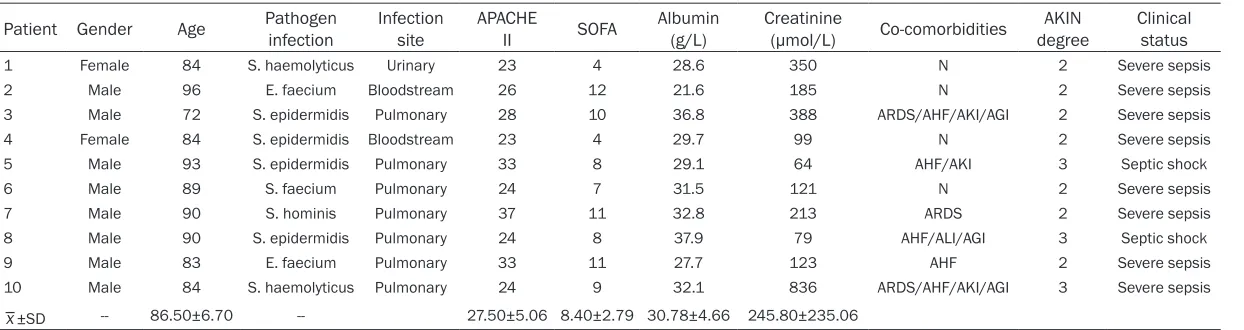
Table 1. Patient characteristics
Patient Gender Age Pathogen infection Infection site APACHE II SOFA Albumin (g/L) Creatinine (µmol/L) Co-comorbidities degreeAKIN Clinical status 1 Female 84 S. haemolyticus Urinary 23 4 28.6 350 N 2 Severe sepsis 2 Male 96 E. faecium Bloodstream 26 12 21.6 185 N 2 Severe sepsis 3 Male 72 S. epidermidis Pulmonary 28 10 36.8 388 ARDS/AHF/AKI/AGI 2 Severe sepsis 4 Female 84 S. epidermidis Bloodstream 23 4 29.7 99 N 2 Severe sepsis 5 Male 93 S. epidermidis Pulmonary 33 8 29.1 64 AHF/AKI 3 Septic shock 6 Male 89 S. faecium Pulmonary 24 7 31.5 121 N 2 Severe sepsis 7 Male 90 S. hominis Pulmonary 37 11 32.8 213 ARDS 2 Severe sepsis 8 Male 90 S. epidermidis Pulmonary 24 8 37.9 79 AHF/ALI/AGI 3 Septic shock 9 Male 83 E. faecium Pulmonary 33 11 27.7 123 AHF 2 Severe sepsis 10 Male 84 S. haemolyticus Pulmonary 24 9 32.1 836 ARDS/AHF/AKI/AGI 3 Severe sepsis
_
x±SD -- 86.50±6.70 -- 27.50±5.06 8.40±2.79 30.78±4.66 245.80±235.06
hominis and Staphylococcus aureus. The me- an APACHE II score for the patients was 27.50±5.06, varying from 23 to 37. The mean serum albumin level was 30.78±4.66 g/L, rang-ing from 21.6 to 37.9 g/L. The serum albumin levels for all of the patients were lower than the reference range. The mean creatinine level was 245.80±235.06 µmol/L, with a range of 64 to 836 µmol/L. The infection sites were mainly in bloodstream and pulmonary tissues.
Vancomycin serum levels and time course of vancomycin therapy targets
The time course of vancomycin levels is dis-played in Figure 1. Altogether, according to the time course, the achieved median serum van-comycin concentration was 15.00, 18.84, 21.19, 25.92, 20.80, 17.27, 15.77, 13.91, 8.99, 9.45 and 12.46, respectively. Vancomycin levels peak at 1.5 h after dosing, dropped below 10 µg/mL 8h and remain subtherapeutic status at 24 h, median vancomycin concentra-tions were 25.92 mg/L, 8.99 mg/L and 12.46 mg/L at 1.5 h, 8 h and 24 h. The distribution of serum vancomycin concentrations in the insuf-ficient concentration (<20 mg/L), adequate concentration (20-30 mg/L) and excessive concentration (>30 mg/L) were shown in Figure 2. Vancomycin concentration remain insuffi-cient concentration in more than 50% of criti-cally ill septic patients undergoing CRRT at 2.5 h after dosing or displayed excessive drug con-centrations in 10%, 20%, 30%, 30% and 20% at 15 min, 30 min, 45 min and 1.5 h.
The individual and population pharmacoki-netic parameters of vancomycin
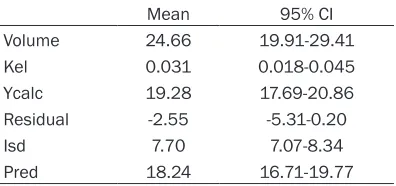
The individual pharmacokinetic parameters of vancomycin are summarized in Table 2. Over the 24 h period, the estimated Vd was 28.38± 7.00 L, with a range from 22.10 to 44.81 L. The total clearance was 1.82±1.34 L/h, with a range of 0.30 to 4.69 L/h. The mean AUC0-24 h was 282.51±77.87 mg h/L, ranging from 189.10 to 409.68 mg L/h. Lastly, t1/2 was 20.28±13.22 h, with a range of 8.33 to 54.65 h. The mean and 95% CI of the variables about population pharmacokinetics are shown in Table 3.
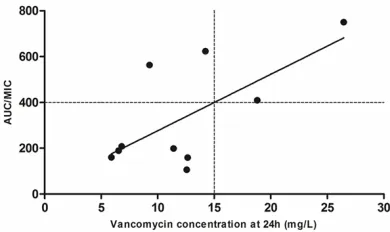
When considering the AUC/MIC ratio for differ-ent MICs, we found that the presdiffer-ent regimen provided AUC/MIC >400 in only one patient. Vancomycin concentration ≥ 20 mg/L had a sensitivity of 25%, a specificity of 100%, a PPV of 100% and a NPV of 67% to predict AUC/ MIC0-24 >400. The vancomycin concentration threshold associated with a PPV of 100% was 15 mg/L (Figure 3).
Discussion
In this study, we evaluated the effect of a dos-ing regimen in medical ICU elderly patients undergoing CRRT therapy. According to the results of our study, the dosing regimen we used was able to reach a sufficient vancomycin concentration during the very early phase of therapy. However, subtherapeutic drug concen-tration was observed at most of the time points. Finally, the recommended vancomycin concen-trations (20-30 mg/L) that are associated with AUC/MIC >400 were not useful in our patients. There is still insufficient evidence to guide a confirmed recommended vancomycin dose reg-imen for patients with reduced kidney function, moreover, the method of drug infusion and the CRRT parameters can affect vancomycin thera-py [13, 14]. In order to reduce the different elimination rate caused by the therapy itself, we used the same infusion procedure and set CRRT parameters that were appropriate for all of the patients. In our study, we found a larger Vd and a longer t1/2 a faster clearance of 28.38±7.00 L and 20.28±13.22 h, respective-ly, with the pharmacokinetic parameters vary-ing among the 10 patients. Previous research indicates that the Vd of vancomycin in critically
be reduced [19, 20]. The albumin levels observed in our study was ranging from 21.6 to 32 g/L, which is lower than the reference range. Thus the reason of the longer t1/2 of vancomycin may contribute to hypoalbuminemia. Our result was corresponded to the previous report. Trough vancomycin concentrations have been regularly measured to prevent the toxicity and drug ineffectiveness caused by subtherapeutic and excessive concentrations [21]. Weerachai Chaijamorn revealed that vancomycin concen-trations in critically ill patients started to decrease due to CRRT at 0.5 h after dosing dur-ing the infusion period and that the vancomycin concentration remained at 15-20 µg/mL 7.5 h after dosing [22]. In our study, the vancomycin concentration in critically ill elderly patients ill patients is 24.69±11.00 L with a t1/2 of
12.02±7.00 [15]. In patients with moderate to severe chronic kidney disease (CKD) and those
[image:5.612.94.520.73.222.2] [image:5.612.92.397.307.468.2] [image:5.612.91.289.538.631.2]who develop to acute kidney injury (AKI) may present an increased Vd
[16, 17]. Llopis
suggest-ed that the accumula- tion of fluid in the third space due to tissue oedema induced by sep-sis might be a possible reasonfor an elevated Vd
[18]. In addition, hypoal-buminemia may affect vancomycin concentra-tions and present a high concentration based on active unbound drug concentration and cover the fact that the total drug concentration may
Figure 2. The proportion of patients with different vancomycin concentration levels. According to the time course of vancomycin treatment, the distribution (%) of patients with a concentration below 20 mg/L, within the range of 20-30 mg/L and above 30 mg/L.
Table 2. The pharmacokinetic parameters of vancomycin in 9 critically ill elderly patients
Patient Vd (L) AUC (mg L/h) CLtot (L/h) κe (h-1) t 1/2 (h)
1 23.83 409.68 0.30 0.013 54.65 2 24.54 311.74 0.84 0.034 20.32 3 22.87 212.21 1.95 0.042 16.27 4 44.81 198.82 4.69 0.052 13.12 5 27.52 207.98 1.80 0.066 10.58 6 28.25 281.59 0.99 0.035 19.69 7 26.72 189.10 2.22 0.083 8.33 8 26.97 318.11 0.70 0.026 26.71 9 36.18 375.23 3.32 0.059 19.68 10 22.10 320.66 1.35 0.051 13.49
_
x±SD 28.38±7.00 282.51±77.87 1.82±1.34 0.05±0.02 20.28±13.22 Abbreviations: Vd: volume of distribution; AUC: Area under the concentration-time-curve; CLtot, Total clearance; κe: elimination rate constant; t1/2, Terminal half-life.
Table 3. Population pharmacokinetics param-eters
dropped below 10 µg/mL 8 h and remain sub-therapeutic status till 24 h. Vancomycin con-centration remains insufficient concon-centration at most of the time point. Our result was corre-sponding to other report and indicated an effective clearance of CRRT therapy. In addi-tion, the pharmacodynamics parameter that is thought to best predict vancomycin efficacy is the ratio of the 24-hour area under the concen-tration-time curve to MIC (AUC/MIC) [23, 24]. The guideline recommended a vancomycin tar-get AUC/MIC of >400, it is considered to be more accurate than other related measures and evaluating clinical success [25]. However, the result of our study shown that the ratio of achievement of adequate vancomycin concen-tration and AUC/MIC >400 was rather low. These results suggest that it is important to track vancomycin concentration in elderly criti-cally ill patients and appropriately adjust the dose to maintain an effective concentration. A few limitations of our study need to be men-tioned here. First, the number of patients enrolled in this study was relatively small. Thus, our results may have a limitation for expand to a large amount of critically ill elderly patients. A further study with a larger sample size was needed to be performed. Second, patients in this study mostly shown oliguria or anuria, the-oretically speaking, the creatinine clearance from the patient can be omitted. In our study, a 3000 ml/h dialysate flow rate was used, thus we consider that the creatinine clearance of these patients is 50 ml/min. According to the manufacturer’s description, the recommended dosage was 770 mg every 24 hours under 50 ml/min creatinine clearance. However, the reg-ular therapeutic drug monitoring of vancomycin
suggested that the patients can hardly reach the target trough concentration in this condi-tion. Consider the efficacy and safety, we set a dose of 1 g every day for these oliguric or anuric patients undergoing a 3000 ml/h dialysate flow rate CRRT treatment, then perform the therapy drug monitoring (TDM). We find that even with a dose of 1 g every 24 hours, the patients still can’t reach the target concentration of 15-20 mg/L. The possible reason may be: (1) Oliguric or anuric patients still retain renal excretion function in a certain extent; (2) The vancomycin removal was also depended on the dialyzer, dialysate flow rate and treatment time. Thus, we suggested that sieving coefficient (SC) of vancomycin should be measured to better pre-dict the vancomycin removal and a body weight adapted loading dose was also suggested in the further experiment.
In conclusion, this study revealed that vanco-mycin can be removed by CRRT, which may reduce the effectiveness of this antibiotic. The pharmacokinetic parameters of vancomycin in elderly critically ill patients show an increase in Vd and t1/2 compared to non-elderly critically ill patients. The pharmacokinetic parameters var-ied among these patients, suggesting the importance of monitoring vancomycin concen-trations in critically ill elderly patients.
Acknowledgements
This work was supported by grants from Science and technology project of Guangdong Province (No. 2012A061400010) and Scientific research condition construction project of Guangzhou City (No. 7411675081103).
Disclosure of conflict of interest
None.
[image:6.612.90.285.71.187.2]Address correspondence to: Dr. Zhenhui Guo, De- partment of Medical Intensive Care Unit, The General Hospital of Guangzhou Military Command, Guangzhou 510010, Guangdong Province, PR China; Guangdong Provincial Key Laboratory of Geriatric Infection and Organ Function Support, Guangzhou 510010, Guangdong Province, PR China; Guangzhou Key Laboratory of Geriatric Infection and Organ Function Support, Guangzhou 510010, Guangdong Province, PR China. Tel: +86 20 88653485; Fax: +86 20 61648324; E-mail: [email protected]
References
[1] Cunningham R. Antibiotic prescribing in the ICU. Anaesthesia & Intensive Care Medicine 2006; 7: 147-148.
[2] Corsonello A, Abbatecola AM, Fusco S, Luciani F, Marino A, Catalano S, Maggio MG, Lattanzio F. The impact of drug interactions and poly-pharmacy on antimicrobial therapy in the el-derly. Clin Microbiol Infect 2015; 21: 20-26. [3] Petejova N, Martinek A, Zahalkova J, Duricova
J, Brozmannova H, Urbanek K, Grundmann M, Plasek J, Kacirova I. Vancomycin pharmacoki-netics during high-volume continuous venove-nous hemofiltration in critically ill septic pa-tients. Biomed Pap Med Fac Univ Palacky Olomouc Czech Repub 2014; 158: 65-72. [4] Golper TA, Wedel SK, Kaplan AA, Saad AM,
Donta ST, Paganini EP. Drug removal during continuous arteriovenous hemofiltration: theo-ry and clinical observations. Int J Artif Organs 1985; 8: 307-312.
[5] Schetz M, Ferdinande P, Van den Berghe G, Verwaest C, Lauwers P. Pharmacokinetics of continuous renal replacement therapy. Inten- sive Care Med 1995; 217: 612-620.
[6] Oh SJ, Hong K, Lee EJ, Choi HJ, Kong KA, Lee M, Chung WS. Assessment of Therapeutic Drug Monitoring of Vancomycin in Elderly Patients According to New Guidelines. Ann Lab Med 2014; 34: 1.
[7] Ye Z, Tang H, Zhai S. Benefits of Therapeutic Drug Monitoring of Vancomycin: A Systematic Review and Meta-Analysis. PLoS One 2013; 8: e77169.
[8] Udy AA, Covajes C, Taccone FS, Jacobs F, Vincent JL, Lipman J, Roberts JA. Can popula-tion pharmacokinetic modelling guide vanco-mycin dosing during continuous renal replace-ment therapy in critically ill patients? Int J Antimicrob Agents 2013; 41: 564-568. [9] Tafelski S, Nachtigall I, Troeger U, Deja M,
Krannich A, Günzel K, Spies C; ABx Study Group. Observational clinical study on the ef-fects of different dosing regimens on vancomy-cin target levels in critically ill patients: Continuous versus intermittent application. J Infect Public Health 2015; 8: 355-363. [10] Davis SL, Scheetz MH, Bosso JA, Goff DA,
Rybak MJ. Adherence to the 2009 consensus guidelines for vancomycin dosing and monitor-ing practices: a cross-sectional survey of U.S. hospitals. Pharmacotherapy 2013; 33: 1256-1263.
[11] Meijers BK, Bammens B, Verbeke K, Evenepoel P. A review of albumin binding in CKD. Am J Kidney Dis 2008; 51: 839-850.
[12] Dromgoole SH. The binding capacity of albu-min and renal disease. J Pharmacol Exp Ther 1974; 191: 318-323.
[13] Akers KS, Cota JM, Chung KK, Renz EM, Mende K, Murray CK. Serum Vancomycin Levels Resulting from Continuous or Intermittent Infusion in Critically Ill Burn Patients with or Without Continuous Renal Replacement Therapy. J Burn Care Res 2012; 33: e254-e262.
[14] Covajes C, Scolletta S, Penaccini L, Ocampos-Martinez E, Abdelhadii A, Beumier M, Jacobs F, de Backer D, Vincent JL, Taccone FS. Continuous infusion of vancomycin in septic patients receiving continuous renal replace-ment therapy. Int J Antimicrob Agents 2013; 41: 261-266.
[15] Boereboom FT, Ververs FF, Blankestijn PJ, Savelkoul TJ, van Dijk A. Vancomycin clearance during continuous venovenous haemofiltration in critically ill patients. Intensive Care Med 1999; 25: 1100-1104.
[16] Friedlander MA, Wu YC, Schulak JA, Monnier VM, Hricik DE. Influence of dialysis modality on plasma and tissue concentrations of pentosi-dine in patients with end-stage renal disease. Am J Kidney Dis 1995; 25: 445-451.
[17] Thomson BK, Nolin TD, Velenosi TJ, Feere DA, Knauer MJ, Asher LJ, House AA, Urquhart BL. Effect of CKD and dialysis modality on expo-sure to drugs cleared by nonrenal mecha-nisms. Am J Kidney Dis 2015; 65: 574-582. [18] Llopis-Salvia P, Jimenez-Torres NV. Population
pharmacokinetic parameters of vancomycin in critically ill patients. J Clin Pharm Ther 2006; 31: 447-454.
[19] Nolin TD, Frye RF, Le P, Sadr H, Naud J, Leblond FA, Pichette V, Himmelfarb J. ESRD impairs nonrenal clearance of fexofenadine but not midazolam. J Am Soc Nephrol 2009; 20: 2269-2276.
[20] Mizuno T, Mizokami F, Fukami K, Ito K, Shibasaki M, Nagamatsu T, Furuta K. The influ-ence of severe hypoalbuminemia on the half-life of vancomycin in elderly patients with methicillin-resistant Staphylococcus aureus hospital-acquired pneumonia. Clin Interv Aging 2013; 8: 1323-1328.
[21] Moise-Broder PA, Forrest A, Birmingham MC, Schentag JJ. Pharmacodynamics of vancomy-cin and other antimicrobials in patients with Staphylococcus aureus lower respiratory tract infections. Clin Pharmacokinet 2004; 43: 925-942.
[23] Holmes NE, Turnidge JD, Munckhof WJ, Robinson JO, Korman TM, O’Sullivan MV, Anderson TL, Roberts SA, Warren SJ, Gao W, Howden BP, Johnson PD. Vancomycin AUC/ MIC ratio and 30-day mortality in patients with Staphylococcus aureus bacteremia. Antimicrob Agents Chemother 2013; 57: 1654-1663. [24] Jung Y, Song KH, Cho Je, Kim HS, Kim NH, Kim
TS, Choe PG, Chung JY, Park WB, Bang JH, Kim ES, Park KU, Park SW, Kim HB, Kim NJ, Oh MD. Area under the concentration-time curve to minimum inhibitory concentration ratio as a predictor of vancomycin treatment outcome in methicillin-resistant Staphylococcus aureus bacteraemia. Int J Antimicrob Agents 2014; 43: 179-183.