Original Article
Elevated mean platelet volume in patients with primary
hyperparathyroidism
Dilek Arpaci1, Fatih Kuzu1, Ali Ugur Emre2, Guldeniz Karadeniz Cakmak2, Mustafa Unal1, Sevil Ilikhan Uygun3, Basak Erol3, Taner Bayraktaroglu1
1Division of Endocrinology and Metabolism, Department of Internal Medicine, Faculty of Medicine, Bulent Ecevit
University, Zonguldak, Turkey; Departments of 2General Surgery, 3Internal Medicine, Faculty of Medicine, Bulent
Ecevit University, Zonguldak, Turkey
Received September 23, 2015; Accepted February 26, 2016; Epub March 15, 2016; Published March 30, 2016 Abstract: Objectives: In patients with primary hyperparathyroidism (PHP), morbidity and mortality due to
cardiovas-cular disease are seen more frequently than the normal population. Platelets play a significant role on the onset
and progression of clotting and therefore contribute to the atherosclerotic process. Increased mean platelet volume
(MPV) is an indicator of platelet activation. Therefore, it was defined as an independent risk factor for atherosclerotic
process. The aim of this study was to compare MPV in patients with PHP and control subjects and also to assess postoperative MPV levels at third months. Materials and methods: We retrospectively reviewed the data of 74 pa-tients with PHP and 71 controls matched for age, gender and presence of diabetes. Results: Age, gender and pres-ence of diabetes were similar between the groups. (P=0.052, P=0.056 and P=0.374 respectively). MPV was found
to be higher in patients with PHP compared to controls (8.64±1.20 fL and 7.77±0.88 fL, respectively) (P≤0.01). There was no significant difference between the groups in terms of MPV levels both at the time of diagnosis and
third month after surgery (P=0.136). Conclusions: In this study, we found MPV to be higher in patients with PHP than the controls as independent of diabetes. Also, this increase in MPV had been continued until the early stage of postoperative period.
Keywords: Platelet, volume, hyperparathyroidism
Introduction
Parathyroid hormone (PTH) that release from parathyroid glands plays an important role in bone mineral metabolism and the regulation of serum calcium and phosphorus levels. Primary hyperparathyroidism (PHP) is a syndrome with excessive PTH secretion from parathyroid gland and have abroad spectrum of symptoms like elevated serum calcium level, osteoporosis, kidney stones. Etiology of PHP ncludes parathy-roid adenoma (85%), parathyparathy-roid hyperplasia (15%) and parathyroid cancer 1% [1, 2]. PHP is closely associated with cardiovascular morbid-ity and mortalmorbid-ity [3, 4].
Platelets are the tiny cells with certain role on coagulation and atherosclerotic processes [5]. In case of overproduction, mean platelet vol-ume (MPV) extends and these large platelets with metabolic and enzymatic hyperactivity,
produce tendency towards thrombosis and ath-erosclerotic disease [6-8]. Accordingly, MPV has been defined as an independent risk factor for cardiovascular disease (CVD), together with cerebrovascular disease and transient isch-emic attack [9, 10]. The purpose of this study was to compare MPV patients with PHP to con-trols, and to evaluate pre- and postoperative MPV level at postoperative third months.
Materials and methods
post-Results
Mean age of patients and control group were 52.77±9.35 and 49.93±9.73 years (P=0.052). There were 48 (64.9%) female and 26 (35.1%) male patients with 37 (52.1%) female and 34 (47.9%) male controls (P=0.056). Diabetes mellitus was diagnosed in 23 (31%) patients and in 23 (26.8%) control subjects (P=0.374). Mean calcium levels were 11.5±0.87 mg/dL in patients; 8.90±1.08 mg/dL in controls (P≤0.001); Mean phosphorus levels were 2.2±0.05 mg/dL in patients; 3.7±0.80 mg/dL in controls (P≤0.001); serum albumin levels were 4.54±0.41 g/dL in patients; 3.98±0.30 g/dL in controls (P<0.001); serum PTH levels were 336.93±365.76 pg/dL in patients; 46.94±9.34 pg/dL in controls (P<0.001). Mean 25-OH D levels were 20.13±7.67 ng/mL in patients; 29.60±5.04 ng/mL in controls (P< 0.001). MPV was determined to be higher in patients with PHP than controls, with mean val-ues of 8.64±1.20 fL and 7.77±0.85 fL, respec-tively (P≤0.001) (Table 1). Mean 24-hours-urine calcium level was 375.64±205.12 mg/day. While we revealed 66 parathyroid adenomas in operative third month time. All patients
under-went 99mTc-sestamibi parathyroid scintigraphy and neck ultrasonography for preoperative localization. To assess necessary of parathy-roidectomy, 24-hour-urine calcium (normal range 100-300 mg/day) creatinine clearance, renal ultrasound and bone mineral densitome-try (BMD) were done. BMD was measured with dual-energy-X-ray absorptiometry (DEXA). Acc- ording to World Health Organization criteria; BMD T-score >-1.0 is normal; <-1.0 to >-2.5 is osteopenia; ≤-2.5 is osteoporosis. 2009 third workshop was used for indications of parathy-roidectomy. These indications are: [11].
1) Serum calcium 1.0 mg/dL or 0.25 mmol/liter (> upper limit of normal). 2) Creatinine clear-ance is <60 mL/min. 3) Age <50 years. 4) Skeletal BMD at any site (hip, spine and distal radius 1/3) is more than 2.5 standard deviation (T score <-2.5) in perimenopausal and post-menopausal women and >50 years male and in premenopausal women and <50 years male: Z score <-2.5 and/or fragility fracture.
Patients who had any history of coronary artery disease was excluded.
Statistical methods
[image:2.629.100.343.105.224.2]SPSS 19.0 was used for all statistical analysis. Descriptive statistics of con-tinuous variables were given with mean, standard deviation and percent for categorical variables. Shapiro Wilk test was used for test of normality. Independent samples t test was used for two independent groups compari-sons of normal distrubuted variables and Mann Whitney U test for non-nor-mal distrubuted variables. Similarly paired samples t test was used for two dependent group comparisons of nor-mal distrubuted variabes and Wilcoxon test for non-normal distrubuted vari-ables. Spearman correlation test was used to determine the relationship between contiuous variables. Pearson chi-square, Yates chi-square and Fisher exact chi-square test were used for comparison of categorical variables among groups. For all statistical com-parisons with a P value below 0.05 assumed as there is a statistically significance.
Table 1. Demographic, biochemical parameters in pa-tients with PTH and healthy controls
Variable Patients (n=74) Controls (n=71) P Age (year) 52.77±9.35 49.93±9.73 0.052* Gender (F/M) 48/26 37/34 0.056** Presences of DM 19/55 23/48 0.374** MPV (fL) 8.64±1.20 7.77±0.85 <0.001* Calcium (mg/dL) 11.5±0.87 8.90±1.08 <0.001* Albumin (g/dL) 4.54±0.41 3.98±0.30 <0.001* PTH (pg/dL) 336.93±365.76 46.94±9.34 <0.001* 25-OH D (ng/mL) 20.13±7.67 29.60±5.04 <0.001*
Mean: average, Abbreviations BMI body mass index, BP blood pressu-re, HDL-plasma high-density lipoprotein, LDL plasma low density lipop-rotein-CRP plasma level of C-reactive protein, DM-diabetes mellitus. *: Mann-Whitney U Test, **: Pearson Chi-Square Test.
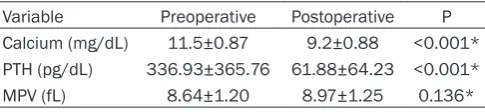
Table 2. Pre- and post-operative biochemical parameters
Variable Preoperative Postoperative P Calcium (mg/dL) 11.5±0.87 9.2±0.88 <0.001* PTH (pg/dL) 336.93±365.76 61.88±64.23 <0.001* MPV (fL) 8.64±1.20 8.97±1.25 0.136*
[image:2.629.100.343.301.357.2]strated. But especially coronary artery disease, myocardial, vascular and valvular calcification, myocardial fibrosis, hypertension, left ventricu-lar hyperthyrophy; arrthythmias and endotheli-al disfunction have been observed [3, 4]. Some studies showed that patients with PHP has significant higher mortality than healthy controls [3, 12]. Vestergaard et al. found that patients with PHP has an increased risk even parathyroid ultrasound; 62 cases were
deter-mined with parathyroid scintigraphy.
There were only 19 cases of renal stones in patients with renal ultrasonography. Eleven patients had normal BMD; 35 patients had osteopenia and 28 patients had osteoporosis. Sixty-two patients had parathyroid adenoma, seven patients had parathyroid hyperplasia, four patients had parathyroid carcinoma and
one patient had atypical para-thyroid adenoma. Despite the persistence of just increased PTH levels in two patients; no parathyroid lesions were seen at ultrasonography. Po- stoperative mean calcium lev-els: 9.2±0.88 g/dL; Phospho- rus: 3.22±0.77 mg/dL, PTH 61.88±64.23 pg/dL were found. However, there was no statistical difference for MPV level between pre- and post-operative third months (P= 0.136) (Table 2).
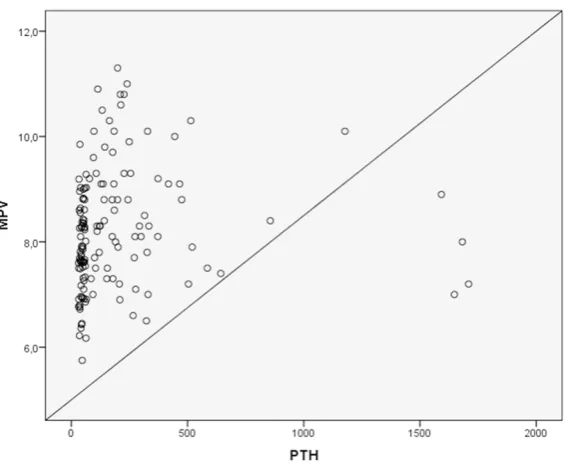
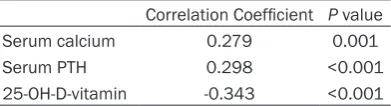
In the Pearson’s correlation analysis, MPV levels were positive correlated with serum calcium levels (r=0.279; P= 0.001) (Figure 1) and PTH (r=0.298; P<0.001) (Figure 2). But MPV was negative cor-related with 25-OH vitamin D (r=-0.343; P<0.001) (Figure 3; Table 3).
Discussion
This study demonstrated hi- gher levels of MPV in patients with PHP than healthy con-trols matched for age, gender and presence of diabetes. Nevertheless, remission of the disease did not lead to a decrease in MPV levels at third month. This might be attributed to the short length of remission period.
[image:3.629.101.386.78.309.2]Increased cardiovascular dis-ease and mortality has been reported in patients suffering from PHP. The exact reason of this has not been demon-Figure 1. Correlation of MPV with serum calcium level.
[image:3.629.102.385.347.580.2]suggested that increased serum calcium could be induced to increase MPV. Baradaran et al. found similar results; serum PTH correlated with serum MPV levels [27].
Other authors suggested that PTH increases serum calcium, then serum calcium increases platelet calcium and blood pressure [28]. Also serum calcium changes shape and activation of platelets [29]. PHP induces inflammation, oxidative stress and eventually platelets activa-tion [30, 31].
Similar to our results, Cure et al. [32] found negative correlation between MPV levels and 25-OH-D vitamin levels.
The presented data showed that MPV, an indi-cator of platelet activation, was higher in patients with PHP than the control group irre-spective of age, gender and presence of diabe-tes. However, there was no decrease in MPV levels among patients that were at postopera-tive third months. Therefore, a further study design with a larger size and longer follow-up period to evaluate MPV is needed.
Disclosure of conflict of interest
None.
Authors’ contribution
DA and FK designated the study and writing. GKC made English editing. MU, SUI and BE col-after effective surgery [13]. This study may be
supported our results. We did not find any decrease in MPV at postoperative third months. Platelets play an important role in pathogene-sis of every stage of atherotrombopathogene-sis, such as inflammation, coagulation and thrombosis [14]. Platelets’ activity varies according to size, large platelets are more active than small ones enzi-matically and metabolically [15, 16]. Subjects with hypercalcemia had increased cardiovascu-lar disease and mortality compared to age and gender-matched normocalcemic controls [17-19]. In our study we found that serum calcium level was correlated with MPV levels.
MPV is recently defined as a factor considered to predict platelet activity and atherosclerosis [5, 7]. Increase in MPV is associated with the incline in the size and activity of platelets lead-ing to atherosclerotic process [5, 7, 8]. The method of MPV determination is easier, cheap-er and more available than the othcheap-er platelet markers. Several studies in current literature proposed MPV as an independent risk factor
for atherosclerosis [20, 21]. The relationship between MPV and cardiovascular dis-ease has also been reported repeatedly [9, 22-25].
[image:4.629.102.386.78.309.2]Yılmaz et al. [26] found similar results that MPV was incre- ased in patients with PHP compared to controls. In con-trast to our results, they found MPV was decreased after surgery at six months. We did not found any decrease in MPV levels after surgery, but we evaluated at third months. Maybe third months could be very early stage for evaluation of decreasing serum MPV lev-els. Also as like our results, they found that both serum calcium and PTH were corre-lated with MPV levels. They Figure 3. Correlation of MPV with serum vitamin D levels.
Table 3. Correlation between MPV levels and serum calcium, PTH, 25-OH-D-vitamin
[image:4.629.100.296.376.429.2]lected data from patients. TB made the statisti-cal analysis of the study.
Address correspondence to: Dr. Dilek Arpaci, Divi- sion of Endocrinology and Metabolism, Department of Internal Medicine, Faculty of Medicine, Bulent Ecevit University, Esenkoy/Kozlu/Zonguldak, Turkey. Tel: +905072476698; Fax: +903722612502; E-mail: [email protected]
References
[1] Marx SJ. Hyperparathyroid and hypoparathy-roid disorders. N Engl J Med 2000; 21: 343: 1863-75.
[2] Solomon BL, Schaaf M, Smallridge RC. Psy- chologic symptoms before and after parathy-roid surgery. Am J Med 1994; 96: 101-6. [3] Hedbäck G, Odén A. Increased risk of death
from primary hyperparathyroidism-an update. Eur J Clin Invest 1998; 28: 277-8.
[4] Hagström E, Hellman P, Larsson TE, Ingelsson E, Berglund L, Sundström J. Plasma parathy-roid hormone and the risk of cardiovascular mortality in the community. Circulation 2009; 119: 2765-71.
[5] Butterworth RJ, Bath PM. The relationship be-tween mean platelet volume, stroke subtype and clinical outcome. Platelets 1998; 9: 359-364.
[6] Van der Loo B, Martin JF. Megakaryocytes and platelets in vascular disease. Baillieres Clin Haematol 1997; 10: 109-23.
[7] Endler G, Klimesch A, Sunder-Plassmann H, Schillinger M, Exner M, Mannhalter C, Jordanova N, Christ G, Thalhammer R, Huber K, Sunder-Plassmann R. Mean platelet volume is an independent risk factor for myocardial infarction but not for coronory artery disease. Br J Haematol 2002; 117: 399-404.
[8] Bath PM, Missouris CG, Buckenham T, Mac- Gregor GA. Increased platelet volume and platelet mass in patients with atherosclerotic renal artery stenosis. Clin Sci (Lond) 1994; 87: 253-257.
[9] Jung DH, Lee HR, Lee YJ, Kim JK, Park BJ, Shim JY. The association between coronary
ar-tery calcification and mean platelet volume in
the general population. Platelets 2011; 22: 567-571.
[10] López-Velasco R, Escobar-Morreale HF, Vega B, Villa E, Sancho JM, Moya-Mur JL. Cardiac
involvement in acromegaly: specific myocardi -opathy or consequence of systemic hyperten-sion? J Clin Endocrinol Metab 1997; 82: 1047-53.
[11] Bilezikian JP, Khan AA, Potts JT Jr. Guide- lines for the management of asymptomatic
primary hyperparathyroidism: summary state-ment from the third international workshop. Third International Workshop on the Mana- gement of Asymptomatic Primary Hyper- thyroidism. J Clin Endocrinol Metab 2009; 94: 335-9.
[12] Hedbäck G, Tisell LE, Bengtsson BA, Hedman I, Oden A. Premature death in patients operated on for primary hyperparathyroidism. World J Surg 1990; 14: 829-35.
[13] Vestergaard P, Mollerup CL, Frøkjaer VG, Christiansen P, Blichert-Toft M, Mosekilde L. Cardiovascular events before and after surgery for primary hyperparathyroidism. World J Surg 2003; 27: 216-22.
[14] Coppinger JA, Cagney G, Toomey S, Kislinger T, Belton O, McRedmond JP. Characterization of the proteins released from activated platelets leads to localization of novel platelet proteins in human atherosclerotic lesions. Blood 2004; 103: 2096-104.
[15] Davì G, Patrono C. Platelet activation and ath-erothrombosis. N Engl J Med 2007; 357: 2482-94.
[16] Meadows TA, Bhatt DL. Clinical aspects of platelet inhibitors and thrombus formation. Circ Res 2007; 100: 1261-75.
[17] Lundgren E, Lind L, Palmér M, Jakobsson S, Ljunghall S, Rastad J. Increased cardiovascu-lar mortality and normalized serum calcium in patients with mild hypercalcemia followed up for 25 years. Surgery 2001; 130: 978-85. [18] Lind L, Skarfors E, Berglund L, Lithell H,
Ljunghall S. Serum calcium: a new, indepen-dent, prospective risk factor for myocardial in-farction in middle-aged men followed for 18 years. J Clin Epidemiol 1997; 50: 967-73. [19] Leifsson BG, Ahrén B. Serum calcium and
sur-vival in a large health screening program. J Clin Endocrinol Metab 1996; 81: 2149-53.
[20] Mayer FJ, Hoke M, Schillinger M, Minar E, Arbesu I, Kompensteiner R. Mean platt volume predicts outcome in patients with asymptom-atic carotid artery disease. Eur J Clin Invest 2014; 44: 22-8.
[21] Ma H, Lin H, Hu Y, Li X, He W, Jin X, Gao J, Zhao N, Gao X. Mean platelet volume in relation to carotid atherosclerosis in normotensive, eugly-cemic, and normolipidemic Chinese middle-aged and elderly adults. Angiology 2014; 65: 512-8.
[22] Korkmaz L, Korkmaz AA, Akyüz AR, Ağaç MT, Acar Z, Kırış A. Association between mean platelet volume and coronary artery calcifica -tion in patients without overt cardiovascular disease: an observational study. Anadolu Kardiyol Derg 2012; 12: 35-9.
[23] Ozlu MF, Ozturk S, Ayhan SS, Tosun M, Alçelik
volume in young patients with non-ST-segment elevation acute coronary syndromes: a retro-spective observational study. Anadolu Kardiyol Derg 2013; 13: 57-61.
[24] Martin JF, Bath PM, Burr ML. Influence of plate -let size on outcome after myocardial infarction. Lancet 1991; 338: 1409-11.
[25] Han JY, Choi DH, Choi SW, Kim BB, Ki YJ, Chung JW. Stroke or coronary artery disease predic-tion from mean platelet volume in patients with type 2 diabetes mellitus. Platelets 2013; 24: 401-6.
[26] Yilmaz H. Assessment of mean platelet volume (MPV) in primary hyperparathyroidism: effects of successful parathyroidectomy on MPV lev-els. Endocr Regul 2014; 48: 182-8.
[27] Baradaran A, Nasri H. Impact of parathormone Hormone on Platelet Count and Mean Volume in End-stage Renal Failure Patients on regular Hemodialysis. J Med Sci 2005; 5: 266-71. [28] Fliser D, Franek E, Fode P, Stefanski A, Schmitt
CP, Lyons M. Subacute infusion of physiologi-cal doses of parathyroid hormone raises blood pressure in humans. Nephrol Dial Transplant 1997; 12: 933-8.
[29] Salzman EW, Ware JA. Ionized calcium as an intracellular messenger in blood platelets. Prog Hemost Thromb 1989; 9: 177-202. [30] Rashid G, Bernheim J, Green J, Benchetrit S.
Parathyroid hormone stimulates the endothe-lial nitric oxide synthase through protein ki-nase A and C pathways. Nephrol Dial Transplant 2007; 22: 2831-7.
[31] Robinson SD, Harding SA, Cummins P, Din JN, Sarma J, Davidson I. Functional interplay be-tween platelet activation and endothelial dys-function in patients with coronary heart dis-ease. Platelets 2006; 17: 158-62.