Automatic Morpheme Segmentation and Labeling in Universal
Dependencies resources
Miikka Silfverberg and Mans Hulden Department of Linguistics
University of Colorado
{miikka.silfverberg,mans.hulden}@colorado.edu
Abstract
Newer incarnations of the Universal De-pendencies (UD) resources feature rich morphological annotation on the word-token level as regards tense, mood, aspect, case, gender, and other grammatical infor-mation. This information, however, is not aligned to any part of the word forms in the data. In this work, we present an al-gorithm for inferring this latent alignment between morphosyntactic labels and sub-strings of word forms. We evaluate the method on three languages where we have manually labeled part of the Universal De-pendencies data—Finnish, Swedish, and Spanish—and show that the method is ro-bust enough to use for automatic discov-ery, segmentation, and labeling of allo-morphs in the data sets. The model allows us to provide a more detailed morphosyn-tactic labeling and segmentation of the UD data.
1 Introduction
Recent versions of Universal Dependencies (UD) (Nivre et al., 2017) provide not only part-of-speech labeling, but also universal lexical and in-flectional features on most word forms. Table 1 illustrates a few example words from the three ex-periment languages used in this paper.1
A noteworthy aspect of this layout of the data is that it provides for an interesting inference prob-lem in the realm of weakly supervised learning of inflectional morphology.2 First, we note that
1We have deviated slightly from the original annotation,
incorporating the lemma as a feature for each word, the need for which will be explained in the technical portion of the paper.
2A similar annotation is provided in the SIGMORPHON
shared task (Cotterell et al., 2016a) data set, although without implicit token frequency information since the data comes in the form of inflection examples mostly from Wiktionary.
the feature-value pairs in the annotation corre-spond mostly to individual allomorphs in the sur-face form of the word. For example, in the Span-ish wordasignados(Table1), a standard analysis would be that theasign- part corresponds to the stem, the-ad-corresponds toVerbForm=Part
and Tense=Past, the -o- to Gender=Masc
and the -s to Number=Plur. The inference problem is then: given many annotated word forms with morphosyntactic features which are not matched to any substrings in the word, find a globally satisfactory segmentation of all word forms and associate the morphosyntactic labels in each word with these segmented substrings.
2 Related Work
Morphological segmentation, particularly in unsu-pervised scenarios, is a standard problem in NLP, and has been explored in numerous works ( Gold-smith (2001), Creutz and Lagus (2005), Poon et al. (2009), Dreyer and Eisner (2011) inter alia). We recommend Ruokolainen et al. (2016)for an overview. Likewise, semi-supervised, or mini-mally supervised models—where the supervision usually implies access to some small number of segmented words—have also been widely inves-tigated (Dasgupta and Ng, 2007; Kohonen et al., 2010;Gr¨onroos et al., 2014;Sirts and Goldwater, 2013). Many approaches also take advantage of a semantic signal, or a proxy for semantic similarity between words such as Latent Semantic Analysis (Schone and Jurafsky, 2000) or its more modern counterpart, word embeddings (Soricut and Och, 2015). The specific formulation of an inference problem like the one presented in this paper has to our knowledge not been directly addressed pre-viously, probably due to the necessity of anno-tated resource schemas such as those present in UD 2.0. A related problem, dealt with inCotterell et al. (2016b)andKann et al. (2016), concerns si-multaneous segmentation and canonicalization—
Finnish j¨a¨all¨a Noun|Lemma=j¨a¨a|Case=Ade|Number=Sing
[image:2.595.308.524.138.209.2]Spanish asignados Verb|Lemma=asignar|Gender=Masc|Number=Plur|Tense=Past|VerbForm=Part Swedish inneb¨ar Verb|Lemma=inneb¨ara|Mood=Ind|Tense=Pres|VerbForm=Fin|Voice=Act
Table 1: Examples of the modified UD annotations used for inference of segmentation and labeling.
a task where allomorphs are both segmented and rendered as a single canonical form, e.g. commu-nism7→commune ism. This task was addressed
in an entirely supervised scenario, however, and so the results are not directly comparable.
3 The Segmentation and Labeling Problem
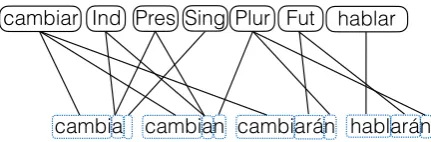
As implied above, the current labeling of the UD data provides significant constraints and a supervi-sion signal that can guide us in the inference pro-cess. One strong linguistically informed bias is that labels, i.e. abstractions of morphemes such as Number=Sing, Gender=Masc, should be assigned to substrings in such a way as to co-occur only with a small number of distinct strings throughout the data. This corresponds to the idea that each morpheme be realized as a limited num-ber of distinct allomorphs. For example, the En-glish pluralizer morpheme by and large occurs as only three allomorphs,-s,-es,∅. Another intuition is the inverse of the previous one: that each al-lomorph only co-occur with a limited number of labels. For example, the-s allomorph in English serves mainly two distinct functions: a pluralizer and the third person present tense marker. We ex-pect rampant ambiguity not to be present in the morphology of a language. On the whole, since most labels are seen a large number of times, we can develop a model that leverages this informa-tion to favor correspondences that are systematic in the data. Figure 1 illustrates a linguistically sound correspondence over several word forms that involve two stems in Spanish.
The intuition behind our model is that we’d like to find a segmentation of all words in the data into constituent allomorphs, and provide a label for each allomorph that fulfills the properties above. To perform this, we take advantage of the fact that we already know which morphemes (feature-value pairs) are present in each word (although some of these labels will correspond to null allomorphs).
In general, we want to explore the space of all possible segmentations and labelings in the data and find one that optimizes some objective
func-cambia cambian cambiarán hablarán cambiar Ind Pres Sing Plur Fut hablar
Figure 1: Morphosyntactic features are assigned correspond-ing substrcorrespond-ings where re-use of the same label-substrcorrespond-ing cor-respondences is encouraged by the model. Note that some labels (such asSinghere) can be assigned to empty sub-strings.
tionC, based on the above observations. A given
proposal segmentation S and labeling F of the data gives us a joint distribution PS,F over pairs
of substringss ∈ Σ∗ and labels l ∈ Y, whereY
is the set of labels (feature-value pairs) used in the data. We can formalize a cost function C(S, F) based on the distributionP(S, F). This cost
func-tion could take many linguistically motivated spe-cific forms: simply minimizing the total number of resulting distinct allomorphs in the data, mini-mizing the joint entropy of the labels and the al-lomorphs, maximizing the mutual information of the allomorphs and the labels, etc. Below, we use a specific cost function that maximizes a measure of symmetric conditional probability between seg-ments and labels.
4 Model 4.1 Definitions
LetD={(x1, y1), ...,(xk, yk)}be a collection of
word formsxiand sets of associated
morphologi-cal featuresyi, for example
dogs {lemma=dog,num=plural}
As explained in Section 3, we learn a segmen-tation S = {s1, ..., sk} of words in D, where
eachsi = (sii ...sin) is a segmentation of wordxi
into substrings, and a set of feature assignments
F = {fi :yi → si|1 ≤ i≤ k}of morphological
features inyionto substrings insi.
each segmentation.
Each segmentation and label assignment of the data setDdefines joint countsc(s, f)of substrings
sand morphological featuresf as in Equation1.
c(s, f) =k{sij|sij =sandfi(f) =sij}k (1)
Usingc(s, f) we express the probability of the co-occurrence of a feature and substring in Equa-tion2.
P(s, f)∝c(s, f) +αB(s, f) (2)
The functionB in Equation2expresses a prior
belief about the joint counts of segments and la-bels, and hyper-parameter α controls the weight
of the prior information (Goldwater and Griffiths, 2007). A largeαwill result inP(s, f)which very closely reflects the prior belief while a smallerα
letsPadapt more closely to the current segmenta-tion and label assignment. We setα to 0.1 in all
experiments.
We use the joint distribution of substrings and labels in the unsegmented data set Das prior in-formation. ThusB(s, f) = #(s, f)/#(f), where
#(s, f)is the count of substringssin words with
morphological featuref and#(f)is the count of featurefinD.
For lemma features, for examplelemma=dog, we add an additional factor to the co-occurrence probabilityP(s, f) as shown in Equation 3. The quantityd(s, f)represents the edit distance of the substringsand the lemma corresponding tof. For example, d(do,lemma=dog) = 1. This allows us to model the fact that the stem and lemma of a word form often share a long common substring.
P(s, f)∝(c(s, f) +αB(s, f))·2−d(s,f) (3)
4.2 Objective Function
Our objective function is the symmetric condi-tional probabilityover segmentssand
morpholog-ical featuresfdefined by Equation4
C(S, F) = Y
s∈Σ∗,f∈Y
P(s|f)P(f|s) (4)
Symmetric conditional probability was intro-duced by da Silva et al. (1999) for multi-word expression extraction. The measure is intuitively appealing for our purposes since it is maximized when each morphological feature is associated with exactly one allomorph, and this allomorph, in
turn, only occurs with the specific morphological feature.3
4.3 Inference
The space of possible segmentations and label as-signments to each allomorph segment is very large except for toy data sets. Therefore, an exact so-lution to the optimization problem presented in Section 4.2 is infeasible. Instead, we use Gibbs sampling to explore the space of possible segmen-tations S and feature assignments A of our data
set D with the intent of finding the
segmenta-tionSmaxand assignmentAmaxwhich maximize
the symmetric conditional probability of segments and features.
Gibbs sampling in this context proceeds by sampling a new segmentation S0 and assignment A0 from the current segmentation S and
assign-mentA, and then either rejecting the old
segmen-tation and assignment in favor of the new one with probability(C(A0, S0)/C(A, S))β, or keeping the old segmentation and assignment. We set the hyper-parameterβto 2 in all experiments and run
the Gibbs sampler on the data setDuntil the value
of the objective functionChas converged.
A new segmentationS0and label assignmentA0
can be sampled from an existing segmentationS
and assignment A in two steps. First, randomly
choose a word xi from the data set. Using its
current segmentationsi inS, form the set of new
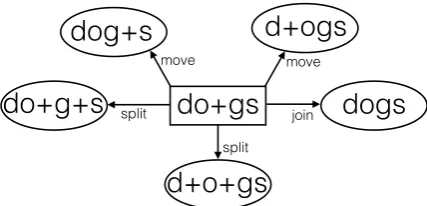
segmentation candidatesCby (1) joining two
seg-ments insi, (2) splitting one of the segments insi,
or (3) moving a segment boundary insione step to
the left or right. The setC is illustrated in Figure
2.4 Then randomly sample a new segmentationc fromC.
Next, assign the labels inyi to the segments of
cin the following way. Iteratively, choose the
sub-strings ∈ cand featuref ∈ yi of maximal
sym-metric conditional probabilityP(s|f)P(f|s),
pro-vided that no features have yet been assigned tos,
andf has not been assigned to a substring. When
each substring inchas been assigned exactly one
label, assign remaining labels to substrings in c
which maximize the symmetric conditional prob-ability.
3This is, of course, not true in general because morphemes
often have more than one allomorph. Nevertheless, the num-ber of allomorphs is small for most stems and affixes.
4We assume that every non-empty segment has a
(a)
Finnish Spanish Swedish
Recall 87.43 84.38 88.71
Precision 94.63 88.63 94.01 F1-score 90.89 86.45 91.28
Morfessor baseline
Recall 80.65 81.32 90.82
Precision 76.92 73.64 75.58 F1-score 78.74 77.29 82.50
(b)
Finnish Spanish Swedish
Recall 62.79 50.10 55.87
Precision 71.06 54.22 61.82 F1-score 66.67 52.08 58.69
Morfessor baseline
Recall 30.51 25.93 44.13
Precision 28.45 22.24 32.92 F1-score 29.45 23.94 37.71
(c)
Finnish Spanish Swedish
Recall 80.07 73.49 88.26
Precision 90.62 79.54 97.66 F1-score 85.02 76.39 92.73
Morfessor baseline
Recall 74.96 48.34 83.10
[image:4.595.78.523.60.168.2]Precision 69.90 41.47 62.00 F1-score 72.34 44.64 71.01
Table 2: Results for (a) morpheme boundaries; (b) unlabeled morphemes; (c) labeled morphemes.
do+gs
dog+s
dogs
do+g+s
d+o+gs
d+ogs
move
split
split join move
Figure 2: The set of new segmentation candidates for word dogs given the old segmentationdo+gs. Each of the new segmentations is equally probable.
5 Experiments
We conduct experiments by running Gibbs sam-pling on words and morphological labels in the combined training and test data (without manual segmentations and label assignments). We then compare the segmentations and label assignments, discovered by the system, with the manually pre-pared annotations in the test data.
5.1 Baseline
As a baseline, we use the Morfessor system (Creutz and Lagus, 2005) for unsupervised seg-mentation.5We then assign labels to substrings as explained in Section4.3. However, as we cannot control the number of segments given by Morfes-sor, we may end up with substrings to which we cannot assign morphological features. This hap-pens in the case where the number of substrings given by Morfessor exceeds the number of mor-phological features for the word.
5.2 Data and Evaluation
We use three treebanks from the Univer-sal Dependency v1.4 resource for experi-ments: UD-Finnish, UD-Spanish and
5We use revision 4219fbcc27ee0f5e3a4dca8de9f7ffc7a5bfe5e0of
https://github.com/aalto-speech/morfessorand default settings
for all hyperparameters.
UD-Swedish. We use the first 10,000 word forms from the training sets of each treebank for training (these contain 5,892 unique word forms for Finnish, 3,624 unique word form for Swedish and 4,092 unique word forms for Spanish) and the first 300 words from the test sets of each tree-bank for testing (these contain 253 unique word forms for Finnish, 172 unique word forms for Swedish and 278 unique word forms for Spanish). Punctuation and numbers were excluded from the training and test sets.
We remove a number of UD labels which do not express morphological categories, for example
style=archandabbr=yes.6
The test sets were manually segmented and morphological features were manually assigned to the segments by competent language speakers. The average number of morphemes per word in the test sets are 1.9 for Finnish, 1.7 for Spanish and 1.4 for Swedish, respectively.
We evaluate our system with regard to recall, precision and F1-score for (1) morpheme
bound-aries including word boundbound-aries, (2) unlabeled morphemes, and (3) labeled morphemes. In the case of labeled morphemes, a single substring can be counted multiple times if it has been assigned multiple morphological features. That is, even when the system fails to predict some of the mor-phological features correctly for a given substring, it will still receive a score for the features it did manage to predict correctly.
5.3 Results
Results are shown in Figures 2 (a), (b), and (c). The advantage given by leveraging the weak la-beling in UD is visible in that the proposed sys-tem clearly outperforms the unsupervised Morfes-sor baseline for all languages.
Results for labeled morphemes are substantially
6Our data sets and code are publicly available athttps:
[image:4.595.74.288.207.310.2]better than for unlabeled morphemes because the same substring can be scored as correct multiple times if it is associated to several morphologi-cal features. Moreover, the F1-score for labeled
morphemes is computed over both non-empty and empty substrings because morphological features can be realized as a zero morpheme. In contrast, the unlabeled morpheme F1-score only considers
non-empty substrings—i.e. the unlabeled segmen-tation is not rewarded for declaring empty allo-morphs.
Overall, our system performs well on Finnish and Swedish but performance is markedly worse on Spanish—although an error analysis reveals that many of the incorrect segmentations in Span-ish are linguistically defensible.
6 Discussion & Future Work
The system is immediately deployable for all UD languages and provides a segmentation and label-ing of allomorphs, which may be useful for other downstream tasks. While the segmentation is not linguistically perfect, it is consistent. We also note that in many cases it is not linguistically clear-cut where morpheme boundaries should be drawn. An illustrative example is provided by Spanish verb forms where the infinitive, future, and conditional forms always contain an-ar,-er, or-irsubstring, e.g. hablar,comer,vivir. Traditionally, the verb stem itself is not assumed to include these since, for example, subjunctive and some preterite forms surface without the vowel or ther: habl´e,com´ıa,
viva. From an information-theoretic point of view, it is unclear which stem shape is an appropriate linguistic choice to declare. This is due to the fact that most witnessed forms in the data retain at least the vowel because present indicative forms are quite frequent, e.g. hablan(3P-PL) orhablamos
(1P-PL), etc. Indeed, our algorithm chooses to include the vowel, probably because of the over-whelming frequency of present tense forms.
Our algorithm generally performs quite well on Finnish, however, there are a number of prob-lematic morphological features which cause seg-mentation errors. For example, plural number for nouns, adjectives and pronouns is a source of er-rors. In Finnish, plural number in nouns and ad-jectives is realized by three different affixes-i-,
-j-and-t. Pronouns are also marked for number in the UD data set but these affixes are not present in pronouns. Instead, plural number is realized as
the zero morpheme in our gold standard segmen-tation. This means that there is a large number of different realizations for plural number, which may explain the fact that our system quite often incorrectly assigns plural number to the zero mor-pheme. Another problem is caused by illative case which is realized as-Vnor-hVn whereVrefers to the last vowel of the preceding word stem. As in the case of plural number, this leads to a large amount of different realizations for illative case. All of these, nevertheless, share the final suffix -n. Therefore, our system often prefers to drop all non-final characters and incorrectly marks illative case as-n.
The most frequent error in the Swedish data set is that the definite noun markers (-en, -et, -n) and adjective markers (-a) are assigned to the zero morpheme. This may be related to the fact that pronouns, which are quite common in the data set, are marked for definiteness but do not always carry the same affixes as nouns. For example, the Swedish pronoundessa is definite but carries none of the definiteness markers for nouns. This can most likely be addressed by invoking sepa-rate models per part of speech so that the model is not confused by similar suffixes occurring with entirely different tags.
References
Ryan Cotterell, Christo Kirov, John Sylak-Glassman, David Yarowsky, Jason Eisner, and Mans Hulden.
2016a. The SIGMORPHON 2016 shared
task—morphological reinflection. In Proceed-ings of the 14th SIGMORPHON Workshop on Computational Research in Phonetics, Phonology, and Morphology, pages 10–22, Berlin, Germany, August. Association for Computational Linguistics.
Ryan Cotterell, Tim Vieira, and Hinrich Sch¨utze. 2016b. A joint model of orthography and mor-phological segmentation. In Proceedings of the 2016 Conference of the North American Chapter of the Association for Computational Linguistics: Hu-man Language Technologies, pages 664–669, San Diego, California, June. Association for Computa-tional Linguistics.
Mathias Creutz and Krista Lagus. 2005. Unsupervised morpheme segmentation and morphology induction from text corpora using Morfessor 1.0. Technical Report A81, Helsinki University of Technology.
Joaquim Ferreira da Silva, Ga¨el Dias, Sylvie Guillor´e, and Jos´e Gabriel Pereira Lopes. 1999. Using Local-Maxs algorithm for the extraction of contiguous and non-contiguous multiword lexical units. InProgress in Artificial Intelligence: 9th Portuguese Conference on Artificial Intelligence, EPIA ’99 ´Evora, Portugal, September 21–24, 1999 Proceedings, pages 113– 132. Springer Berlin Heidelberg, Berlin, Heidelberg. Sajib Dasgupta and Vincent Ng. 2007. High-performance, language-independent morphological segmentation. In Human Language Technologies 2007: The Conference of the North American Chap-ter of the Association for Computational Linguistics; Proceedings of the Main Conference, pages 155– 163, Rochester, New York, April. Association for Computational Linguistics.
Markus Dreyer and Jason Eisner. 2011. Discover-ing morphological paradigms from plain text usDiscover-ing a Dirichlet process mixture model. InProceedings of EMNLP 2011, pages 616–627, Edinburgh. Asso-ciation for Computational Linguistics.
John Goldsmith. 2001. Unsupervised learning of the morphology of a natural language. Computational linguistics, 27(2):153–198.
Sharon Goldwater and Tom Griffiths. 2007. A fully Bayesian approach to unsupervised part-of-speech tagging. In Proceedings of the 45th Annual Meet-ing of the Association of Computational LMeet-inguistics, pages 744–751, Prague, Czech Republic, June. As-sociation for Computational Linguistics.
Stig-Arne Gr¨onroos, Sami Virpioja, Peter Smit, and Mikko Kurimo. 2014. Morfessor FlatCat: An HMM-based method for unsupervised and semi-supervised learning of morphology. In Proceed-ings of COLING 2014, the 25th International Con-ference on Computational Linguistics, pages 1177–
1185, Dublin, Ireland, August. Dublin City Univer-sity and Association for Computational Linguistics.
Katharina Kann, Ryan Cotterell, and Hinrich Sch¨utze. 2016. Neural morphological analysis: Encoding-decoding canonical segments. In Proceedings of the 2016 Conference on Empirical Methods in Nat-ural Language Processing, pages 961–967, Austin, Texas, November. Association for Computational Linguistics.
Oskar Kohonen, Sami Virpioja, and Krista Lagus. 2010. Semi-supervised learning of concatenative morphology. In Proceedings of the 11th Meet-ing of the ACL Special Interest Group on Com-putational Morphology and Phonology (SIGMOR-PHON), pages 78–86. Association for Computa-tional Linguistics.
Joakim Nivre, ˇZeljko Agi´c, Lars Ahrenberg, Maria Je-sus Aranzabe, Masayuki Asahara, Aitziber Atutxa, et al. 2017. Universal dependencies 2.0. LIN-DAT/CLARIN digital library at the Institute of For-mal and Applied Linguistics, Charles University in Prague.
Hoifung Poon, Colin Cherry, and Kristina Toutanova. 2009. Unsupervised morphological segmentation with log-linear models. In Proceedings of Human Language Technologies: The 2009 Annual Confer-ence of the North American Chapter of the Associa-tion for ComputaAssocia-tional Linguistics, pages 209–217. Association for Computational Linguistics.
Teemu Ruokolainen, Oskar Kohonen, Kairit Sirts, Stig-Arne Gr¨onroos, Mikko Kurimo, and Sami Virpioja. 2016. A comparative study of minimally supervised morphological segmentation. Computational Lin-guistics, 42(1):91–120.
Patrick Schone and Daniel Jurafsky. 2000. Knowledge-free induction of morphology us-ing latent semantic analysis. In Proceedings of the 2nd workshop on Learning language in logic and the 4th conference on Computational natural language learning, pages 67–72. Association for Computational Linguistics.
Kairit Sirts and Sharon Goldwater. 2013. Minimally-supervised morphological segmentation using adap-tor grammars. Transactions of the Association for Computational Linguistics, 1:255–266.
Radu Soricut and Franz Och. 2015. Unsupervised morphology induction using word embeddings. In