Cross-lingual parser selection for low-resource languages
ˇZeljko Agi´c
Department of Computer Science IT University of Copenhagen
Rued Langgaards Vej 7, 2300 Copenhagen S, Denmark
Abstract
In multilingual dependency parsing, trans-ferring delexicalized models provides un-matched language coverage and compet-itive scores, with minimal requirements. Still, selecting the single best parser for any target language poses a challenge. Here, we propose a lean method for parser selection. It offers top performance, and it does so without disadvantaging the truly low-resource languages. We consistently select appropriate source parsers for our target languages in a realistic cross-lingual parsing experiment.
1 Introduction
Treebanks are available for only∼1% of the lan-guages spoken in the world today, the resource-rich sources. One major goal of cross-lingual transfer learning is to provide robust NLP for all thetargets, or the remaining∼99%.
If we want to parse anylanguage for syntactic dependencies, the only principled method that cur-rently enables it is delexicalized model transfer. By relying on uniform POS tags only, it offers un-precedented language coverage. First introduced by Zeman and Resnik (2008), and consolidated by the seminal works of McDonald et al. (2011; 2013) and Søgaard (2011), delexicalized parsing is nowadays considered to be a simple baseline.
Recent work promises cross-lingual methods that score almost as high as supervised parsers. Unfortunately, it also introduces requirements that a vast majority of languages cannot meet. The sys-tems proposed by, e.g., Ma and Xia (2014) or Ra-sooli and Collins (2015) require:
- very large parallel corpora, often in excess of 2M parallel sentences for each language pair, coupled with near-perfect tokenization and sentence splitting;
- high-quality sentence and word alignments for all the language pairs, provided by align-ers that favor closely related languages; - accurate POS tagging using fully supervised
taggers that score∼95% on held-out data. Latest work by Johannsen et al. (2016), among a few others, shows that in a real-world scenario, where no such unrealistic assumptions are made, delexicalized transfer still constitutes a very com-petitive choice for multilingual parsing.
Here, we assert that even simple delexicalized parsing might be in need of a reality check. Realistic delexicalized parsing? The idea be-hind delexicalization is very simple: we omit all lexical features from the parsers, both at training and at runtime, so that they operate on POS se-quences only. All that is then needed to parse an unknown language is a tagger using a uniform POS representation such as the “universal” POS tagset by Petrov et al. (2011).
Delexicalized parsing itself comes in two dis-tinct basic variants:
i) multi-source, where we train a single parser by joining multiple delexicalized source-language treebanks, and
ii) single-source, where each source-language treebank contributes a single parser, and then we select the one to use from this pool of parsing models.
Most often, we pick thesingle-bestsource parser for a given target language. The rankings of the candidate source parsers are determined by evalu-ation on target language test data.
Single-best parsers generally perform better than multi-source parsers. For example, in their experiment, Agi´c et al. (2016) show that the single-source variant beats multi-source delexical-ization in 23/27 languages and scores +3 points higher in UAS on average. For fairness, their parsers all work with cross-lingual POS taggers.
However, we argue that single-best source pars-ing isnot realistic. Only in an evaluation frame-work do we possess prior knowledge of i) which target language we are parsing, and ii) what the source rankings are for the targets. Single-best parsing thus amounts to an oracle. By contrast, in the real world, we expect to parse by i) pre-dictingthe target language name from the text in-put at runtime, and by ii)selecting the most ap-propriate source parser for that language from the parser pool. If the prediction or selection turn out incorrect, we are likely to end up producing a sub-optimal parse. Furthermore, while parsing accu-racy is measured on test sets of∼1000 sentences on average, the real input can take a much wider size range. This variation in size may challenge the validity of any design choices made on test set-level only.
The cross-lingual parsing community has largely ignored this problem, focusing instead on test set-based evaluation by proxy. This, in addition to a list of methodological biases, has spawned a number of complex models incapable of scaling down to real low-resource languages. Our contributions. How do we single out the best source parser if the language of the input text has to be predicted at runtime?
To answer this question, our paper makes the following contributions:
i) We propose a set of methods for matching texts to source parsers. Our methods are sim-ple, as they rely on nothing but character-based language identification and typologi-cal similarity. They consistently find the best parsers for the target languages.
ii) We set aside the test-set granularity assump-tion. Instead, we assume that the parser input can vary in size from as little as one sentence. Our methods prove to be remarkably adapt-able to this size variation.
iii) By combining our approaches, our best sys-tem even manages to exceed the performance of single-best oracle source parsers.
In our submission, we strive to introduce only the minimal requirements, and to maintain a re-alistic setup. For example, in all the experi-ments, we apply cross-lingual POS taggers for truly low-resource languages. By controlling for POS sources, we show how an ingrained bias to-wards direct supervision of taggers may render
any parsing results irrelevant in a low-resource context. Our code and data are freely available.1 2 Method
Say we had to find a suitable source parser for the following sentence, written in an unknown target language:
Knjiga ima 12 svezaka .
NOUN VERB NUM NOUN PUNCT
Intuitively, and following the language relatedness hypothesis of McDonald et al. (2013), among the source languages, we would single out the one ty-pologically closest to the target sentence, and ap-ply its delexicalized parser. Further, we build our approach on this intuition.
More formally, letS ∈ S be a source language treebank, andT ∈ T a POS-tagged target text to
parse. Further, let dist : S × T → [0,+∞) be a cross-lingual distance measure.2 In this
frame-work, finding the single-best parser amounts to minimizing the distance over all sources:
ˆ
Smin= arg min
S∈Sdist(S, T)
2.1 Distance measures
In estimating distance, or similarity as its inverse, we consider two basic sources of available infor-mation for sources and targets: i) the raw texts and ii) the POS tag sequences.
We proceed to define three distance measures over these information sources. The first measure is based on sequences of POS tags. The other two model character sequences and typological infor-mation, and they are novel to our work.
KL-POS. This is the POS trigram-based distance metric of Rosa and ˇZabokrtsk´y (2015a). Essen-tially, it expresses the Kullback–Leibler (KL) di-vergence between distributions of source and tar-get trigrams of POS tags:
distK(S, T) = X
ti∈T
fT(ti) logfT(ti)
fS(ti)
The relative frequenciesfS andfT of trigramsti
in source and target data are estimated on the re-1https://bitbucket.org/zeljko_agic/
freasy
spective POS sequences:
f(ti) = Pcount(ti)
∀tj
count(tj)
We inherit the properties of the original KL-POS proposal, but we introduce one minor change: while i) special tag values are used to encode sen-tence beginnings and endings, and ii) the source counts for unseen trigrams are smoothed for the distance to be well-defined, we use linear in-terpolation smoothing following Brants (2000) rather than set these counts to 1 in the Rosa and
ˇZabokrtsk´y (2015a) implementation.
In plain words, this measure compares the rela-tive frequencies of target POS trigramsti ∈ T to
the frequencies of these trigrams in all the sources
S ∈ S, and then we select the one associated
with the lowest KL divergence. For our example sentence, KL-POS predicts Finnish to be the best source parser. The sentence is, however, in Croa-tian, for which the Finnish parser ranks as 19/26 in our experiment. In contrast, if we feedKL-POS five sentences at a time, it selects Slovene (1/26).
We expect KL-POS to be sensitive to both the sample size and the POS tagging quality. The lat-ter is of particular importance for low-resource de-pendency parsing. Incidentally, the POS tags in our Croatian example are all correct. For these rea-sons, we propose the following two measures. The first one (LANG-ID) is based on character, i.e., byte n-grams, while the other one (WALS) augments the n-grams approach by leveraging typological data. LANG-ID. The approach is very straightforward: We use Lui and Baldwin’s (2012) langid.py
module to identify the best source language for the given input. They employ a naive Bayes classifier with a multinomial event model, and feed it a mix-ture of byte n-grams (1≤n≤4).
More specifically,langid.pyhas predefined models for ∼100 languages, but we constrain it to predict into the set of source languagesSonly. We also use its probability re-normalization fea-ture. Our distance measure then amounts to:3
distL(S, T) = 1−pS,(S, pS)∈langid.rank(T)
As langid.pyestimates pS, the probability of
3Note that langid.rank(T) returns pairs of source languages and respective probabilities (S, pS),∀S ∈ S. We apply langid.py with the options -d -l -n, see
https://github.com/saffsd/langid.py.
inputTbelonging to a source languageS, we con-vert it to a distance (1−pS).
For our Croatian sample sentence, LANG-ID predicts Slovene with a confidence of 0.99, and it converges already for the first token.
On the downside, limitinglangid.py predic-tions to sources S only might negatively impact
parsing. The classifier commits early on to one answer, assigning it a high confidence, and for lan-guages with fewer related source lanlan-guages in the model, source selection might be significantly off. For example, take this Hungarian sentence:
Ett˝ol a gy˝ozelemt˝ol magabiztos lettem . ADV VERB NOUN NOUN NOUN PUNCT
WhileKL-POSselects Estonian (1/26), our source-constrained LANG-IDpredicts Spanish (19/26) as the best source. However, if we allowLANG-IDto predict beyond the list of source languages only, it guesses Hungarian withp= 1.
Since Hungarian poses as a target language, we cannot use this correct guess to select a model di-rectly, but we can exploit it downstream. Our next distance measure does so by leveraging typology data on top ofLANG-ID.
WALS. Our typology-based approach relies on a simple premise: If we can guess the language of the target text, we can employ a language database to match the input with a similar source language. This language database should encode various lin-guistic properties across many languages in a prin-cipled way. One such resource is WALS (Dryer and Haspelmath, 2013). Currently it contains structured data for 2,679 languages.4 Each
lan-guage is described through 202 features: they in-clude various structural properties in several cat-egories, most notably in phonology, morphology, and syntax.
Now we describe the WALS-reliant distance measure. For any target language T, we predict
the language name usingLANG-ID. For this pre-diction, we retrieve the corresponding feature vec-torvTfrom WALS, provided that WALS contains
some information on T. Our distance measure
then amounts to comparing the target WALS vec-torvTto source WALS vectorsvS,∀S:
distW(S, T) =dh(vS,vT),
wheredhis the Hamming distance between WALS
source and target vectorsvSandvT.
For each S and T, we only compare the sub-sets of features for which bothvSandvTare
non-empty. If there would be no WALS entries forT,
we would fall back to LANG-ID. In our experi-ments, however, all the languages are already rep-resented in WALS.
For our Croatian example input, WALSpredicts Slovene as source (1/26), while it chooses Finnish (6/26) for the Hungarian sentence.
2.2 Combining the measures
BothLANG-IDandWALSsuffer a same constraint: in contrast to KL-POS, they do not abstract away from the alphabet. This may cause issues for lan-guages with distinct alphabets. On the other hand, KL-POSneeds more data for estimation, and might deteriorate with POS tagging accuracy.
Since the strengths and drawbacks of the three approaches appear to be complementary, here we propose their linear combination.
Normalization. The distances that our measures output are not directly comparable, even if their source language rankings are. We normalize the distances into probability distributions by apply-ing a softmax function:
ˆ
P(S|T) = softmax(dist−1(S, T), τ)
= exp
dist−1(S,T) τ
X
X∈S
expdist−1τ(X,T)
Note that we invert the distances (dist−1) as a small distance between S and T translates into
a high probability of S lending its parser to T.
We use the softmax temperatureτ for controlling
the contributions of the sources. For very large
τ, τ → +∞, the probabilities for the individual sources all even out atp →1/|S|, whileτ → 0+ isolates the most probable source atp→1.
The change from dist toPˆ(S|T) changes our objective from minimizing the distance between sources and targets to maximizing the probability ofSlending a parser toT:
ˆ
Smax= arg max S∈S
ˆ
P(S|T)
COMBINED. With the probability normalization in place, we now introduce the linear combination of the three approaches:
ˆ
P(S|T) =X
i
λiPˆi(S|T),with
X
i
λi = 1
Algorithm 1:Source selection and reparsing. Data:Target language sampleT, source
language treebanksS, and parsershS Result:Predicted single-best parsesGt
max,
reparsed treesDMST(Gt),∀t∈T
Create the sources distribution. ˆ
P(S|T)←softmax(dist−1(S, T), τ),∀S
Find the best source. ˆ
Smax ←arg max
S
ˆ
P(S|T)
foreach sentencetinT do
Get all parses, build the graph.
Gt= (V, E), E ={(u
S, v)∈hS(t),∀S}
Get the single-best parse.
Gtmax = (V, Emax),
whereEmax ={(uSˆmax, v)}
end
returnGtmax,DMST(Gt),∀t∈T
The valuesλi can be tuned empirically on
devel-opment data, with i indexing our three distance
measures. That way, we can control the amounts of contributions for the individual methods, sim-ilar to tuning the contributions of the individual sources through softmax temperatureτ.
With the COMBINED approach, we aim specif-ically at providing “the best of both worlds” in source discovery: an improved robustness to or-thographies on one side, and an added stability to varying input sample sizes on the other.
3 Experiments
In our setup, we parse the target textsT with mul-tiple source parsershS, and we seek to predict the
best source parses for all the targets. We now ex-pose the details of this experiment outline. Data. We use the Universal Dependencies (UD) treebanks (Nivre et al., 2016) version 1.3.5 UD
currently offers 54 dependency treebanks for 41 different languages.
Since our experiment requires realistic cross-lingual POS taggers, we use the freely available collection of training sets by Agi´c et al. (2016).6
It is built through low-resource annotation projec-tion over parallel texts from The Watchtower on-line library (WTC).7 Thus, we intersect the
lan-5hdl.handle.net/11234/1-1699 6https://bitbucket.org/lowlands/
release/
guages with POS tagging support from WTC with the UD treebanks for a total of 26 languages whose training and testing sets that we proceed to use in the experiment. We make use of the English UD development data in hyper-parameter tuning. Tools. For POS tagging, we use a state-of-the-art CRF-based tagger MarMoT8 (M¨uller et al.,
2013). We use Bohnet’s (2010) mate-tools
graph-based dependency parser. Both tools are run with their default settings.
In our experiments, we control for the sources of POS tags. We distinguish i) direct in-language supervision, where the taggers are trained on tar-get language UD training data, from ii) cross-lingually predicted POS, where we train the tag-gers on WTC-projected annotations.
For training the delexicalized source parsers, we use the following standard features, in reference to the CoNLL 2009 file format:9 ID, POS, HEAD,
and DEPREL (Hajiˇc et al., 2009). In specific, we don’t leverage the UD morphological features (FEATS) as not all languages support them in the 1.3 release. We subsample the treebanks for parser training with a ceiling of 10k sentences, so as to avoid the bias towards the largest treebanks such as Czech with 68k training set sentences.
Baselines and upper bounds. We set the oracle SINGLE-BESTsource parsing results as the main reference point for our evaluation. We compare all systems to these scores, as our benchmarking goals are to i) reach SINGLE-BEST performance through best source prediction and to ii) surpass it by weighted reparsing.
We compare our approach to the standard multi-source delexicalized parser of McDonald et al. (2011) (multi-dirin their paper, MULTI here). In training, we uniformly sample from the contribut-ing sources up to 10k sentences.
Reparsing. We collect all single-source parses of target sentencest∈Tinto a dependency graph.
The graphGt = (V, E) has target tokens as ver-ticesV. The edges(uS, v) ∈ E originate in the
delexicalized source parsershS,∀S.
Following Sagae and Lavie (2006), we can apply directed maximum spanning tree decod-ingDMST(Gt), resulting in a voted dependency
8https://github.com/muelletm/cistern/
blob/wiki/marmot.md
9https://ufal.mff.cuni.cz/
conll2009-st/task-description.html
parse for a target sentence t, where each source contributes a unit vote. Such unit voting presumes that all edges have a weight of 1. We refer to this approach asUNIFORMreparsing. We also ex-periment with weighing the edges inGt through
the distance measures KL-POS, WALS, and COM -BINED:
weight(uS, v) = ˆP(S|T),∀uS∈Gt,∀t∈T
The weights in turn depend on the granularity, as varying sizes of T influence the similarity esti-mates coming fromKL-POSandWALS.
Parameters. We tune the softmax temperature toτ = 0.2for bothKL-POSandWALSby using the English UD development data. For simplicity, we fixλK =λW = 0.5, λL = 0without tuning, i.e.,
in theCOMBINED system we give equal weight to KL-POS and WALS. We exclude LANG-ID from reparsing as it is subsumed byWALS.
Our experiment assumes the variability of input size in sentences. We use the full UD test sets for all 26 languages. However, we vary the sample size orgranularitygin best source prediction. It
is implemented as a moving window over the test sets, with sizes of 1 to 100.
The experiment workflow is condensed in Algo-rithm 1. It shows how we arrive at best source pre-dictions and reparsed trees for a target sampleT.
In the algorithm sketch, we assumeg = |T|, i.e.,
the granularity is implied by the sample size, but further we provide results for varyingg. Any edge
weighting in reparsing is made internal toDMST.
4 Results
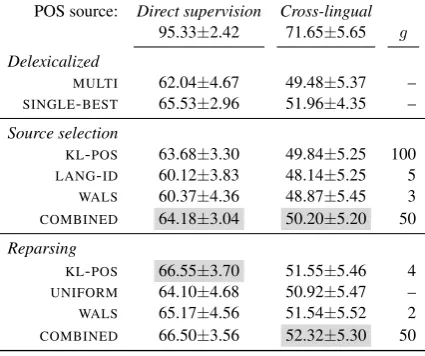
First, we provide a summary of our experiment re-sults in Table 1. We then proceed to break down the scores by language in Table 2.
Summary. We discern that our COMBINED ap-proach yields the best overall scores in the re-alistic scenario, both in source selection and in reparsing. The latter score remarkably even sur-passes the informed upper bound SINGLE-BEST system by 0.36 points UAS. It reaches the highest UAS over cross-lingual POS in both selection and reparsing, whileKL-POSclosely beats it in repars-ing over fully supervised POS.
POS source: Direct supervision Cross-lingual
95.33±2.42 71.65±5.65 g
Delexicalized
MULTI 62.04±4.67 49.48±5.37 – SINGLE-BEST 65.53±2.96 51.96±4.35 –
Source selection
KL-POS 63.68±3.30 49.84±5.25 100 LANG-ID 60.12±3.83 48.14±5.25 5 WALS 60.37±4.36 48.87±5.45 3 COMBINED 64.18±3.04 50.20±5.20 50
Reparsing
KL-POS 66.55±3.70 51.55±5.46 4 UNIFORM 64.10±4.68 50.92±5.47 – WALS 65.17±4.56 51.54±5.52 2 COMBINED 66.50±3.56 52.32±5.30 50
Table 1: Summary UAS parsing scores for all 26 languages, over two underlying sources of POS tags. Gray: highest scores grouped by POS and method. ±: 95% confidence intervals. g: sample
size (granularity) associated with the best score.
Looking into the optimal target sample sizesg,
theCOMBINEDsystem peaks at 50 sentences.KL -POSworks best with samples of 100 sentences in source prediction, and only 4 sentences in repars-ing. In contrast, WALS needs only 2-3 for both, whileLANG-IDpeaks at 5 sentences.
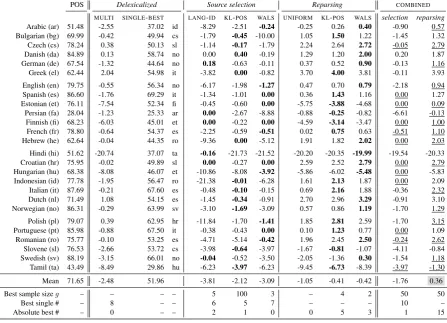
Split by languages. The results in Table 2 are provided as differences in UAS to our reference point: the oracleSINGLE-BEST system. In source selection, we aim to match the oracle scores, while we seek to surpass them through reparsing.
The top-performing source predictionsystem is theCOMBINEDone: it comes closest to the ora-cle score for 10/26 languages. The other three ap-proaches manage the same feat for 5-7 languages, while theMULTI-source delexicalized parsers still pose a challenge for 8/26 languages.10
Notably, KL-POS even beats the SINGLE-BEST oracle by 0.4 UAS for one language (Danish), a score that is made possible by changes in source selection for different portions of the test set due to sample granularity. KL-POS andLANG-ID reach the oracle score for 3 languages,WALSfor 5, and COMBINED for 9 languages. In reparsing, the COMBINEDsystem once again produces the abso-lute best scores, here for 15/26 languages. MULTI parsers are unable to match the reparsing systems, as both KL-POS and WALS also come very close to the upper bound on average. Viewed separately, 10Note that in some cases more than one system records the same score for a language.
these two reparsing systems are evenly split with 13/26 languages for each, and reach almost iden-tical average scores, withKL-POSaheadWALSby only 0.01 point UAS.
5 Discussion
We reflect on the results of our experiment from the viewpoints of i) POS tagging impact, and ii) input size or granularity.
Sources of POS tags. Throughout the paper, we emphasized the importance of using cross-lingual POS tagging in dependency parsing work that fea-tures truly low-resource languages.
We conducted triple runs of all our experi-ments, by changing the underlying POS tags from cross-lingual to i) tags obtained through direct in-language supervision via the UD training data and ii) gold POS tags. The respective average tagging accuracies over the 26 test languages thus changed from 71.65% to 95.33% and 100%. As the ob-servations were virtually unchanged between fully supervised tagging and gold tagging, we reported the former together with cross-lingual tagging.
Table 1 adds insight into the influence of tag-ging quality. Insource selection,KL-POS outper-forms LANG-ID and WALS by ∼2.5 points UAS over monolingual POS, but this advantage drops to less than 1 point with cross-lingual POS.
There is an even more notable turnabout follow-ing the underlyfollow-ing POS source change in repars-ing. With direct supervision, KL-POSbeats UNI -FORM and WALS by 2.35 and 1.38 points UAS, and even surpasses the COMBINED system by 0.05 points. However, when working with cross-lingually induced POS tags, the COMBINED ap-proach beats the three other systems by 0.77–1.40 points UAS, andKL-POSandWALSeven out.
We expected KL-POS to show less resilience to changes in POS tagging quality compared to the other methods. The significant change in the observations highlights the need for more careful treatment of low-resource languages in contribu-tions to cross-lingual parsing.
Granularity. Input size in sentences, or granu-larity g as a model of input size variation, is an
[image:6.595.75.288.65.243.2]POS Delexicalized Source selection Reparsing COMBINED MULTI SINGLE-BEST LANG-ID KL-POS WALS UNIFORM KL-POS WALS selection reparsing Arabic (ar) 51.48 -2.55 37.02 id -8.29 -2.51 -0.24 -0.25 0.26 0.40 -0.90 0.57 Bulgarian (bg) 69.99 -0.42 49.94 cs -1.79 -0.45 -10.00 1.05 1.50 1.22 -1.45 1.32 Czech (cs) 78.24 0.38 50.13 sl -1.14 -0.17 -1.79 2.24 2.64 2.72 -0.05 2.79
Danish (da) 84.89 0.13 58.74 no 0.00 0.40 -0.19 1.29 1.20 2.00 0.20 1.87
German (de) 67.54 -1.32 44.64 no 0.18 -0.63 -0.11 0.37 0.52 0.90 -0.13 1.16 Greek (el) 62.44 2.04 54.98 it -3.82 0.00 -0.82 3.70 4.00 3.81 -0.11 3.93 English (en) 79.75 -0.55 56.34 no -6.17 -1.98 -1.27 0.47 0.70 0.79 -2.18 0.94 Spanish (es) 86.60 -1.76 69.29 it -1.34 -1.01 0.00 0.36 1.43 1.16 0.00 1.27 Estonian (et) 76.11 -7.54 52.34 fi -0.45 -0.60 0.00 -5.75 -3.88 -4.68 0.00 0.09 Persian (fa) 28.04 -1.23 25.33 ar 0.00 -2.67 -8.88 -0.88 -0.25 -0.82 -6.61 -0.13 Finnish (fi) 68.23 -6.03 45.01 et 0.00 -0.22 0.00 -4.59 -3.14 -3.47 0.00 1.00 French (fr) 78.80 -0.64 54.37 es -2.25 -0.59 -0.51 0.02 0.75 0.63 -0.51 1.10 Hebrew (he) 62.64 -0.04 44.35 ro -9.36 0.00 -5.12 1.91 1.82 2.02 0.00 2.03 Hindi (hi) 51.62 -20.74 37.07 ta -0.16 -21.73 -21.52 -20.20 -20.35 -19.99 -19.54 -20.33 Croatian (hr) 75.95 -0.02 49.89 sl 0.00 -0.27 0.00 2.59 2.52 2.79 0.00 2.79 Hungarian (hu) 68.38 -8.08 46.07 et -10.86 -8.08 -3.92 -5.86 -6.02 -5.48 0.00 -5.83 Indonesian (id) 77.78 -1.95 56.47 ro -21.38 -0.01 -6.28 1.61 2.13 1.87 0.00 2.09 Italian (it) 87.69 -0.21 67.60 es -0.48 -0.10 -0.15 0.69 2.16 1.88 -0.36 2.32 Dutch (nl) 71.49 1.08 54.15 es -1.45 -0.34 -0.91 2.70 2.96 3.29 -0.91 3.10 Norwegian (no) 86.31 -0.29 63.99 sv -3.10 -1.69 -3.09 0.57 0.86 1.19 -1.70 1.29 Polish (pl) 79.07 0.39 62.95 hr -11.84 -1.70 -1.41 1.85 2.81 2.59 -1.70 3.15 Portuguese (pt) 85.98 -0.88 67.50 it -0.38 -0.43 0.00 0.10 1.23 0.77 0.00 1.09 Romanian (ro) 75.77 -0.10 53.25 es -4.71 -5.14 -0.42 1.96 2.45 2.50 -0.24 2.62 Slovene (sl) 76.53 -2.66 53.72 cs -3.98 -0.64 -3.97 -1.67 -0.81 -1.07 -4.11 -0.84 Swedish (sv) 88.19 -3.15 66.01 no -0.04 -0.52 -3.50 -2.05 -1.36 0.30 -1.54 1.18 Tamil (ta) 43.49 -8.49 29.86 hu -6.23 -3.97 -6.23 -9.45 -6.73 -8.39 -3.97 -1.30 Mean 71.65 -2.48 51.96 -3.81 -2.12 -3.09 -1.05 -0.41 -0.42 -1.76 0.36
Best sample sizeg – – – – 5 100 3 – 4 2 50 50
Best single # – 8 – – 6 5 7 – – – 10 –
Absolute best # – 0 – – 2 1 0 0 5 3 1 15
Table 2: Parsing target languages using source language weighting. We report changes in UAS over the SINGLE-BEST delexicalized parsers. POS tags are provided by cross-lingual taggers. Bold: the best system for a given language, separate for source selection and reparsing, excluding COMBINED. Underlined: COMBINED systems that match or beat the other respective weighting methods. Gray: Best overall average score.
source selection and reparsing, for all the weight-ing approaches.
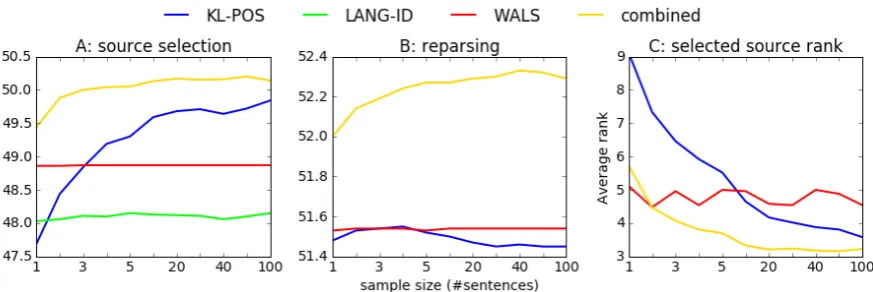
Figure 1A shows the changes in UAS for best source prediction with varying input sizes. LANG-IDandWALSconverge on their predictions early on, so their UAS scores remain nearly con-stant. Yet, KL-POS largely benefits from more POS data: it starts at around -1.5 UAS fromWALS and even belowLANG-ID, but steadily rises up to ∼1 point overWALSat its peak UAS forg = 100 sentences.
The B part of Figure 1 reveals a different pat-tern forKL-POSinreparsing. WhileWALS once again stays expectedly constant, KL-POS peaks with +0.01 UAS atg = 4, only to decrease with growing input sizes. SinceWALSrarely updates its initial predictions, its source distributionsPˆ(S|T) mostly remain unchanged with g, implying the
same invariance for the reparsing scores. How-ever,KL-POSconverges much later, which means that its Pˆ(S|T) decreases in variation as g
in-creases: all but the best source start contributing less weight to the edges inGtfor reparsing.
More-over, while the differences between WALS vectors do not update withg, the KL divergences update
towards the predicted best source, and away from the other contributing sources.
The COMBINED method manages to integrate the advantages ofKL-POSandWALS. In source se-lection, it improves its predictions with larger sam-ples, while maintaining the robustness over very small samples (+0.5 UAS over WALS, +1.9 over KL-POS for g = 1,2). In reparsing, the combi-nation significantly outperforms the two systems it integrates. Even more notably, where KL-POS deteriorates and WALS flatlines, the COMBINED reparsing scores steadily improve withg. We
sug-gest that integrating i) the invariance ofWALS lan-guage vector distances with ii) the variation of KL-POStowards the predicted best source with in-creasing granularity causes this positive effect.
[image:7.595.74.522.65.388.2]Figure 1: Sample size (granularity) impact on source selection and reparsing. A, B: Changes in UAS over different sample sizes for the four approaches in best single source prediction, and three approaches in reparsing. C: Average true rank of the predicted best source in relation to granularity.
ˆ
P(S|T). Here, we compare them to the gold rank-ings induced from the SINGLE-BEST scores. In Figure 1C, we observe how theaverage true rank of the selected source changes with granularity. KL-POS significantly improves with larger sam-ples. Working with one-sentence inputs, it assigns the targets to only the 9th best source on average, while with 50-100 sentences, it assigns the 3rd or 4th best source parser. WALS is mostly constant at an average rank of 4.5. COMBINEDonce again provides the best of both worlds, as it assigns the 5th or 6th best source withg = 1,2, and stably predicts the 3rd best source on average with inputs of +20 sentences.
6 Limitations
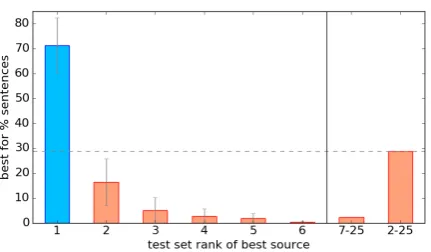
Contributions of sources. In our experiments, we used SINGLE-BEST parsers as upper bounds. There, the best source parser was selected for each target language by its overall performance on the respective test set. This system recorded an aver-age UAS of 51.96±4.35. However, if we select the best single source for each sentence instead, the oracle score rises significantly: by +13.58 points UAS, to 65.54±4.88.
To substantiate, in Figure 2, we show that for 28.66% of the parsed sentences on average, the best parse doesnotcome from the parser that was ranked best in test set-level evaluation. We view this 13-point gap in UAS as a margin for improv-ing our source selection in future work, as it sug-gests that we have yet to exhaust the search space of predictive features for sentence-level source ranking. For example, we could use the UD devel-opment data to learn models that predict the
rank-ings of source parsers from the target sequences of tokens and POS tags, possibly using WALS as an additional feature source.
Scalability. Our contribution is mainly focused on the link between delexicalized parsing and lan-guage identification. In that focus, we abstracted away from certain relevant low-level issues in re-alistic text processing.
Firstly, we used gold-standard tokenization and sentence splits. While accurate splitters exist for many languages, realistic segmentation would still incur a penalty. Secondly, the LANG-ID models we used are readily available for around 100 lan-guages. Scaling up to +1000 languages would re-quire scaling down on the available resources for building identifiers, which would likely result in a minor performance decrease downstream.
Finally, and most importantly, our models de-pend on the existing cross-lingual POS taggers by Agi´c et al. (2016), which in turn rely on parallel resources. While their models do scale up, we ex-cluded POS tagging from language identification. A more realistic proposal would assume that tag-gers, too, have to be selected at runtime before any parsing takes place.
7 Related work
Research in cross-lingual POS tagging and depen-dency parsing is nowadays plentiful, but only a fraction of it focuses on truly low-resource lan-guages andrealisticproposals.
ex-periments. They employed the label propagation-based taggers from Das and Petrov (2011). Agi´c et al. (2015; 2016) used a simpler approach to pro-jection, but they were the first to propose multilin-gual projection for building taggers and parsers for 100+ low-resource languages in one pass. Zeman and Resnik (2008) used perplexity per word as a metric to select the source training instances that relate to the target data. Søgaard (2011) extended their approach to sequences of POS tags, and to multiple sources. Their metrics in turn relate to LANG-IDandKL-POS, but their approach is based on test-set granularity and the selection of appro-priate data for training the parsers, while ours deals with varying input sizes and source parser selection at runtime.
Ammar et al. (2016) noted a -6.3 points de-crease in UAS for cross-lingual parsing accuracy when the language identifiers and POS tags are predicted at runtime. Their taggers are fully su-pervised with 93.3% average accuracy for the seven resource-rich languages from their experi-ment. They also simulated a low-resource sce-nario, where they used gold POS and omitted lan-guage guessing.
WALS data has been heavily exploited in NLP research. In that line of work, and partly related to our paper, Søgaard and Wulff (2012) proposed adapting delexicalized parsers through distance-based instance weighting over WALS data. Their work in turn relates to Naseem et al. (2012), who also use WALS features in a multilingual parser adaptation model. The research by Naseem et al. (2012) and T¨ackstr¨om et al. (2013) addresses the issues with multi-source delexicalized trans-fer by selectively sharing model parameters, also with typological motivation through WALS fea-tures. This line of work has seen subsequent im-provements by Zhang and Barzilay (2015), who introduce a hierarchical tensor-based model for constraining the learned representations based on desired feature interactions. Georgi et al. (2010) and Rama and Kolachina (2012) used WALS to evaluate the concept of language similarity for fa-cilitating cross-lingual NLP. ¨Ostling (2015) used WALS to evaluate word order typologies induced through word alignments. O’Horan et al. (2016) provide a comprehensive survey on the usage of typological information in NLP.
[image:9.595.310.526.60.186.2]Plank and Van Noord (2011) applied similarity measures over cross-domain data for dependency
Figure 2: Distribution of per-sentence top-scoring source parsers over their test-set ranks. Blue: Per-centage of sentences for which the best parser was ranked #1 in test set-based evaluation. Red: Sen-tences where the best parser was ranked #2-25, i.e., not ranked #1. The percentages are averaged over 26 languages.
parser adaptation. Prior to our contribution, only Rosa and ˇZabokrtsk´y (2015a; 2015b) attempted to address source parser selection, by using KL di-vergence over gold POS tags.
8 Conclusions
We introduced an unbiased approach for cross-lingual transfer of delexicalized parsers. It is a robust and scalable source parser selection and reparsing system for low-resource languages. In a realistic experiment over cross-lingual POS tags and varying quantities of input text, our method remarkably outperformed even the informed up-per bound delexicalized system. We emphasize the importance of acknowledging specifics of ac-tual low-resource languages through realistic ex-periment design when proposing solutions aimed at addressing these languages.
Acknowledgements
We are thankful to H´ector Mart´ınez Alonso, Bar-bara Plank, and Natalie Schluter for their valuable comments on an earlier version of the paper. We also thank the anonymous reviewers for their feed-back. Finally, we acknowledge the NVIDIA Cor-poration for supporting our research.
References
ˇZeljko Agi´c, Anders Johannsen, Barbara Plank, H´ector Mart´ınez Alonso, Natalie Schluter, and Anders Søgaard. 2016. Multilingual Projection for Parsing Truly Low-Resource Languages. TACL, 4:301–312.
Waleed Ammar, George Mulcaire, Miguel Ballesteros, Chris Dyer, and Noah A. Smith. 2016. Many Lan-guages, One Parser. TACL, pages 431–444.
Bernd Bohnet. 2010. Very High Accuracy and Fast Dependency Parsing is not a Contradiction. In COL-ING, pages 89–97.
Thorsten Brants. 2000. TnT: A Statistical Part-of-Speech Tagger. InANLP, pages 224–231.
Dipanjan Das and Slav Petrov. 2011. Unsupervised Part-of-Speech Tagging with Bilingual Graph-Based Projections. InACL, pages 600–609.
Matthew S. Dryer and Martin Haspelmath, editors. 2013. The World Atlas of Language Structures On-line. Max Planck Institute for Evolutionary Anthro-pology, Leipzig.
Ryan Georgi, Fei Xia, and William Lewis. 2010. Comparing Language Similarity Across Genetic and Typologically-Based Groupings. InCOLING, pages 385–393.
Jan Hajiˇc, Massimiliano Ciaramita, Richard Johans-son, Daisuke Kawahara, Maria Ant`onia Mart´ı, Llu´ıs M`arquez, Adam Meyers, Joakim Nivre, Sebastian Pad´o, Jan ˇStˇep´anek, et al. 2009. The CoNLL-2009 Shared Task: Syntactic and Semantic Dependencies in Multiple Languages. InCoNLL, pages 1–18.
Anders Johannsen, ˇZeljko Agi´c, and Anders Søgaard. 2016. Joint Part-of-Speech and Dependency Projec-tion from Multiple Sources. InACL, pages 561–566.
Marco Lui and Timothy Baldwin. 2012. langid.py: An Off-the-Shelf Language Identification Tool. InACL, pages 25–30.
Xuezhe Ma and Fei Xia. 2014. Unsupervised De-pendency Parsing with Transferring Distribution via Parallel Guidance and Entropy Regularization. In ACL, pages 1337–1348.
Ryan McDonald, Slav Petrov, and Keith Hall. 2011. Multi-Source Transfer of Delexicalized Dependency Parsers. InEMNLP, pages 62–72.
Ryan McDonald, Joakim Nivre, Yvonne Quirmbach-Brundage, Yoav Goldberg, Dipanjan Das, Kuz-man Ganchev, Keith Hall, Slav Petrov, Hao Zhang, Oscar T¨ackstr¨om, Claudia Bedini, N´uria Bertomeu Castell´o, and Jungmee Lee. 2013. Universal Dependency Annotation for Multilingual Parsing. InACL, pages 92–97.
Thomas M¨uller, Helmut Schmid, and Hinrich Sch¨utze. 2013. Efficient Higher-Order CRFs for Morpholog-ical Tagging. InEMNLP, pages 322–332.
Tahira Naseem, Regina Barzilay, and Amir Globerson. 2012. Selective Sharing for Multilingual Depen-dency Parsing. InACL, pages 629–637.
Joakim Nivre, Marie-Catherine de Marneffe, Filip Gin-ter, Yoav Goldberg, Jan Hajiˇc, Christopher D Man-ning, Ryan McDonald, Slav Petrov, Sampo Pyysalo, Natalia Silveira, et al. 2016. Universal Dependen-cies v1: A Multilingual Treebank Collection. In LREC 2016, pages 1659–1666.
Helen O’Horan, Yevgeni Berzak, Ivan Vuli´c, Roi Re-ichart, and Anna Korhonen. 2016. Survey on the Use of Typological Information in Natural Language Processing. arXiv preprint arXiv:1610.03349. Robert ¨Ostling. 2015. Word Order Typology Through
Multilingual Word Alignment. InACL, pages 205– 211.
Slav Petrov, Dipanjan Das, and Ryan McDonald. 2011. A Universal Part-of-Speech Tagset. arXiv preprint arXiv:1104.2086.
Barbara Plank and Gertjan Van Noord. 2011. Effective Measures of Domain Similarity for Parsing. InACL, pages 1566–1576.
Taraka Rama and Prasanth Kolachina. 2012. How Good are Typological Distances for Determining Genealogical Relationships among Languages? In COLING, pages 975–984.
Mohammad Sadegh Rasooli and Michael Collins. 2015. Density-Driven Cross-Lingual Transfer of Dependency Parsers. InEMNLP, pages 328–338.
Rudolf Rosa and Zdenˇek ˇZabokrtsk´y. 2015a. KLcpos3 - a Language Similarity Measure for Delexicalized Parser Transfer. InACL, pages 243–249.
Rudolf Rosa and Zdenˇek ˇZabokrtsk´y. 2015b. MST-Parser Model Interpolation for Multi-source Delexi-calized Transfer. InIWPT, pages 71–75.
Kenji Sagae and Alon Lavie. 2006. Parser Combina-tion by Reparsing. InNAACL, pages 129–132. Anders Søgaard and Julie Wulff. 2012. An Empirical
Study of Non-Lexical Extensions to Delexicalized Transfer. InCOLING, pages 1181–1190.
Anders Søgaard. 2011. Data Point Selection for Cross-Language Adaptation of Dependency Parsers. In ACL, pages 682–686.
Oscar T¨ackstr¨om, Ryan McDonald, and Joakim Nivre. 2013. Target Language Adaptation of Discrimina-tive Transfer Parsers. InNAACL, pages 1061–1071. Daniel Zeman and Philip Resnik. 2008. Cross-Language Parser Adaptation between Related Lan-guages. InIJCNLP, pages 35–42.