Use Generalized Representations, But Do Not Forget Surface Features
Nafise Sadat Moosavi and Michael Strube
Heidelberg Institute for Theoretical Studies gGmbH Schloss-Wolfsbrunnenweg 35
69118 Heidelberg, Germany
{nafise.moosavi|michael.strube}@h-its.org
Abstract
Only a year ago, all state-of-the-art coref-erence resolvers were using an extensive amount of surface features. Recently, there was a paradigm shift towards us-ing word embeddus-ings and deep neural net-works, where the use of surface features is very limited. In this paper, we show that a simple SVM model with surface features outperforms more complex neural models for detecting anaphoric mentions. Our analysis suggests that using general-ized representations and surface features have different strength that should be both taken into account for improving corefer-ence resolution.
1 Introduction
Coreference resolution is the task of finding dif-ferent mentions that refer to the same entity in a given text. Anaphoricity detection is an important step for coreference resolution. An anaphoricity detection module discriminates mentions that are coreferent with one of the previous mentions. If a system recognizes mentionmas non-anaphoric, it does not need to make any coreferent links for the pairs in whichmis the anaphor.
The current state-of-the-art coreference re-solvers (Wiseman et al., 2016; Clark and Man-ning, 2016a; Clark and ManMan-ning, 2016b), as well as their anaphoricity detection modules, use deep neural networks, word embeddings and a small set of features describing surface properties of men-tions. While it is shown that this small set of fea-tures has significant impact on the overall perfor-mance (Clark and Manning, 2016a), their use is very limited in the state-of-the-art systems in com-parison to the embedding features.
In this paper, we first introduce a new neu-ral model for anaphoricity detection that consid-erably outperforms the anaphoricity detection of the state-of-the-art coreference resolver, i.e. deep-coref introduced by Clark and Manning (2016a). However, we show that a simple SVM model that is adapted from our coreferent mention detec-tion approach (Moosavi and Strube, 2016), signifi-cantly outperforms the more complex neural mod-els. We show that the SVM model also general-izes better than the neural model on a new domain other than the CoNLL dataset.
2 Discriminating Mentions for Coreference Resolution
The recognition of various categories of men-tions can be beneficial for coreference resolution. The detection of the following categories is most common in the literature: (1) non-referential, (2) discourse-old, and (3) coreferent mentions. One can also discriminate other categories of mentions like mentions that are unlikely to be antecedents or discourse-new mentions (Uryupina, 2009). How-ever, they are not common in comparison to the above categories.
2.1 Non-Referential Mentions
Non-referential mentions do not refer to an en-tity. These mentions only fill a syntactic posi-tion. For instance, “it” in “it is raining” is a non-referential mention. The approaches proposed by Evans (2001), M¨uller (2006), Bergsma et al. (2008), Bergsma and Yarowsky (2011) are ex-amples of detecting non-referential cases of the pronoun it. Byron and Gegg-Harrison (2004) present a more general approach for detecting non-referential noun phrases.
2.2 Discourse-Old Mentions
Each mention can be assessed from the point of view of the discourse model (Prince, 1992). Ac-cording to the discourse model, a mention may be new, old or inferable. Mentions which introduce a new entity into the discourse arediscourse-new mentions. A discourse-new mention may be a sin-gleton or it may be the first mention of a corefer-ence chain. For instance, The first “Plato” in Ex-ample 2.1 is adiscourse-newmention.
Example 2.1. Plato was a philosopher in Classi-cal Greece.This philosopheris the founder of the Academy in Athens.Platodied at the age of 81.
Adiscourse-oldmention refers to an entity that is already evoked in the discourse. Except for first mentions of coreference chains, other coref-erent mentions are discourse-old. For instance, “this philosopher” and the second “Plato” in Ex-ample 2.1 arediscourse-oldmentions.
A mention isinferableif the hearer can infer the identity of the mention from another entity that has already been evoked in the discourse. “the win-dows” in Example 2.2 is aninferablemention.
Example 2.2. I walked into the room. The win-dowswere all open.
The detection of discourse-old mentions is com-monly referred to as anaphoricity detection (e.g. Zhou and Kong (2009), Ng (2009), Wiseman et al. (2015), Lassalle and Denis (2015), inter alia) while the task of anaphoric mention detection, based on its original definition, is of no use for coreference resolution. Mentions whose interpre-tations do not depend on previous mentions are callednon-anaphoricmentions (van Deemter and Kibble, 2000). For example, both ”Plato”s in Ex-ample 2.1 are non-anaphoric.
For consistency with the coreference literature, we refer to the task of discourse-old mention de-tection as anaphoricity dede-tection.
Currently, all the state-of-the-art coreference re-solvers learn anaphoricity detection jointly with coreference resolution (Wiseman et al., 2015; Wiseman et al., 2016; Clark and Manning, 2016a). The approaches proposed by Ng and Cardie (2002), Ng (2004), Ng (2009), Zhou and Kong (2009), Uryupina (2009) are examples of indepen-dent anaphoricity detection approaches.
2.3 Coreferent Mentions
Marneffe et al. (2015) discriminate mentions as
coreferent vs. non-coreferent. Coreferent men-tions are those menmen-tions that appear in a corefer-ence chain. A non-coreferent mention therefore can be a non-referential noun phrase or a referen-tial noun phrase whose entity is only mentioned once (i.e. singleton). The proposed approaches of Recasens et al. (2013), Marneffe et al. (2015), and Moosavi and Strube (2016) discriminate mentions for coreference resolution this way.
3 Anaphoricity Detection Models
Anaphoricity detection is the most common ap-proach for discriminating mentions for a ence resolver. All of the state-of-the-art corefer-ence resolvers use anaphoricity detection. In this paper, we compare three different anaphoricity de-tection approaches: two approaches using neu-ral networks and word embeddings, and one us-ing an SVM model and surface features. Clark and Manning (2016a) introduce the first neural model. Since Clark and Manning (2016a) train their anaphoricity model jointly with the corefer-ence model, we refer to this model as the joint model. We introduce a new anaphoricity detection model as the second neural model using a Long-Short Term Memory (LSTM) network (Hochreiter and Schmidhuber, 1997). The third approach is adapted from our state-of-the-art coreferent men-tion detecmen-tion (Moosavi and Strube, 2016).
3.1 Joint Model
As one of the neural models for anaphoricity de-tection, we consider the anaphoricity module of deep-coref1, the state-of-the-art coreference
reso-lution system introduced by Clark and Manning (2016a). This model has three layers for encoding different types of information regarding a mention. The first layer encodes the word embeddings of the head, first, last, two previous/following words, and the syntactic parent of the mention. The second layer encodes the averaged word embeddings of the five previous/following words, all words of the mention, sentence words, and document words. The third layer encodes the following features of a mention: type, length, position and whether it is embedded in another mention. The outputs of these three layers are combined into one vector and then get passed through a network with two hidden layers. This anaphoricity model is trained
1Available at https://github.com/clarkkev/
jointly with the deep-coref coreference model.
3.2 LSTM Model
In this section we propose a new neural model for anaphoricity detection. Apart from the properties of the mention itself, we consider a limited number of surrounding words. We first generalize the con-text of a mention by removing the mention from the context and replacing it with a special place-holder. In our experiments, we consider the 10 previous and following words of a mention. We concatenate the mention tokens and the head token to the generalized word sequence. We separate the head and mention tokens in the concatenated se-quence using two different placeholders.
The word embeddings of the above sequence are encoded using a bidirectional LSTM. LSTMs show convincing results on generating meaning-ful representations for various NLP tasks (e.g. Sutskever et al. (2014) and Vinyals et al. (2014)).
We also incorporate a set of surface features that contains (1) mention type (proper, nominal (definite, indefinite), pronouns (he, I, it, she, they, we, you)), (2) string match in the text, (3) string match in the previous context, (4) head match in the text, (5) head match in the previous context, (6) contains tokens of another mention, (7) con-tains tokens of a previous mention, (8) contained in another mention, (9) contained in a previous mention, and (10) embedded in another mention. These features are concatenated with the output of the bidirectional LSTM and get passed through one more layer that generates the output.
We also experiment with a more complex model including two different LSTMs for encoding men-tions and their surrounding words. We consider longer sequences of previous words and an atten-tion mechanism for processing the long sequence. However, the performance did not improve upon the LSTM model while it considerably increased the training time.
3.2.1 Implementation Details
Hyperparameters are tuned on the CoNLL 2012 development set. We minimize the cross entropy loss using gradient-based optimization and the Adam update rule (Kingma and Ba, 2014). We use minibatches of size 50. A dropout (Hinton et al., 2012) with a rate of 0.3 is applied to the output of LSTM. We initialize the embeddings with the 300-dimensional Glove embeddings (Pennington et al., 2014). The size of LSTM’s hidden layer is
set to 128. The model is trained in only one epoch.
3.3 SVM Model
Our SVM model introduced in Moosavi and Strube (2016), achieves state-of-the-art results for coreferent mention detection. This model uses the following set of features: lemmas and POS tags of all words of a mention, lemmas and POS tags of the two previous/following words, mention string, mention length, mention type (proper, nominal, pronoun, list), string match in the text, and head match in the text. We use a similar SVM model for anaphoricity detection. In addition to the features we used for coreferent mention detection, we also add the following features for anaphoricity detec-tion: string match in the previous context, head match in the previous context, mention words are contained in another mention, mention words are contained in a previous mention, mention contains words of another mention, mention contains words of a previous mention. Similar to Moosavi and Strube (2016), we use an anchored SVM (Gold-berg and Elhadad, 2007) with a polynomial kernel of degree two and remove feature-values that oc-cur less than 10 times. The use of an anchored SVM with pruning helps the model to general-ize better on new domains (Goldberg and Elhadad, 2009).
4 Performance Evaluation
We evaluate the anaphoricity models on the CoNLL 2012 dataset. It is worth noting that all of the examined anaphoricity detectors in this sec-tion use the same mensec-tion detecsec-tion module and results are reported using system detected men-tions. The performance of the mention detection module is of crucial importance for anaphoricity detection. Therefore, it is important that the com-pared anaphoricity detectors use the same mention detection.
Non-Anaphoric Anaphoric
R P F1 R P F1
joint - - - 81.81 77.18 79.43 LSTM 90.71 92.64 91.66 85.00 81.48 83.20 LSTM∗ 90.51 87.31 88.88 72.64 78.64 75.52
[image:3.595.311.523.620.683.2]SVM 92.42 92.61 92.51 84.66 84.30 84.48
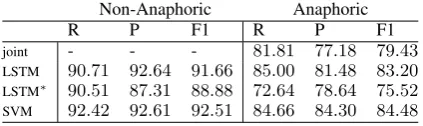
Table 1: Results on the CoNLL 2012 test set.
features, we also report the results of the LSTM model without using these features (LSTM∗).
The following observations can be drawn from the results of Table 1: (1) our LSTM model outper-forms the joint model while using less features and being trained independently, (2) the results of the LSTM∗model is considerably lower than those of
LSTM, especially for recognizing anaphoric men-tions, and (3) the simple SVM model outperforms the neural models in detecting both anaphoric and non-anaphoric mentions.
4.1 Generalization Evaluation
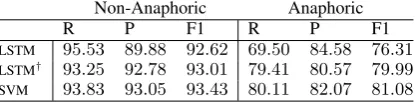
In order to investigate the generalization on new domains, we evaluate the LSTM and SVM models on the WikiCoref dataset (Ghaddar and Langlais, 2016). The WikiCoref dataset is annotated ac-cording to the same annotation guideline as that of CoNLL. Therefore, it is an appropriate dataset for performing out-of-domain evaluations when CoNLL is used for training. For the experiments of Table 2, all models are trained on the CoNLL 2012 training data and tested on the WikiCoref dataset.
The word dictionary that is used for the LSTM model is built based on the CoNLL 2012 training data. All words that are not included in this dictio-nary are treated as out of vocabulary words with randomly initialized word embeddings. We fur-ther improve the performance of LSTM on Wiki-Coref, by adding the words from the WikiCoref dataset into its dictionary. The LSTM model trained with this extended dictionary is denoted as LSTM† in Table 2. LSTM† results are still lower
than those of the SVM model while SVM does not use any information from the test dataset. Pruning rare lexical features from the training data along the incorporation of part of speech tags, which are far more generalizable than lexical features, could explain the generalizability of the SVM model on the new domain.
Non-Anaphoric Anaphoric
R P F1 R P F1
LSTM 95.53 89.88 92.62 69.50 84.58 76.31 LSTM† 93.25 92.78 93.01 79.41 80.57 79.99
[image:4.595.310.523.507.608.2]SVM 93.83 93.05 93.43 80.11 82.07 81.08
Table 2: Results on the WikiCoref dataset.
5 Analysis Based on Mention Types
We analyze the output of the LSTM and SVM models on the CoNLL 2012 test set to see how well they perform for different types of men-tions. As can be seen from Table 3, there is not much difference between the performance of LSTM and SVM for recognizing anaphoric pro-nouns. SVM detects anaphoric proper names bet-ter while LSTM is betbet-ter at recognizing anaphoric common nouns.
We also analyze the output of LSTM∗. As can
be seen, the incorporation of surface features does not affect the detection of anaphoric pronouns very much while it mainly affects the detection of anaphoric proper names by about 24 percent.
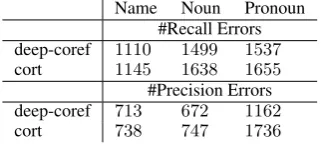
In order to see whether the same pattern holds for coreference resolution, we compare the re-call and precision errors of the best coreference system that only uses surface features, i.e. cort (Martschat and Strube, 2015) with singleton fea-tures (Moosavi and Strube, 2016)2, and the
state-of-the-art deep coreference resolver, i.e. deep-coref (Clark and Manning, 2016a). The compar-ison of the errors for the CoNLL 2012 test set is shown in Table 4. We use the error analysis tool of cort introduced by Martschat and Strube (2014) for the results of Table 4. As can be seen from Ta-ble 4, while deep-coref is significantly better than cort for resolving common nouns and specially pronouns, its result does not go far beyond that of cort when it comes to resolving proper names.
Anaphoric
R P F1 R P F1
Proper names Common nouns
LSTM 79.49 82.31 80.88 62.96 65.04 63.99 LSTM∗ 47.60 70.09 56.69 46.30 57.75 51.40
SVM 83.80 85.71 84.74 52.46 71.98 60.69
Pronouns Other
LSTM 94.67 85.60 89.91 29.11 63.88 40.00 LSTM∗ 92.67 86.01 89.22 10.13 34.78 15.69
[image:4.595.78.286.664.715.2]SVM 95.59 86.29 90.71 32.91 76.47 46.02
Table 3: Anaphoricity results for each mention type on the CoNLL 2012 test set.
6 Discussion
In this paper we analyze the effect of surface fea-tures for anaphoricity detection, which is a small but an important step for coreference resolution.
2Available at https://github.com/
Name Noun Pronoun #Recall Errors deep-coref 1110 1499 1537
cort 1145 1638 1655
#Precision Errors deep-coref 713 672 1162
[image:5.595.101.262.63.135.2]cort 738 747 1736
Table 4: Coreference error analysis.
Our analysis shows that surface features, as it was known, are important. Based on our results, the ef-fects of incorporating surface properties and gen-eralized representations are different for different types of mentions. These results suggest that apart from a unified model, we should consider differ-ent models or at least differdiffer-ent features for pro-cessing different types of mentions and do not put all the burden on a single model to learn the dif-ferences. The works by Lassalle and Denis (2013) and Denis and Baldridge (2008) are examples of models in which distinct models have been used for various types of mentions. Besides, our analy-sis shows the importance of surface features for proper names. Word embeddings are very use-ful for capturing semantic relatedness. A coref-erence resolver that uses word embeddings has a great advantage in better resolution of common nouns and pronouns. However, the use of surface features in current state-of-the-art coreference re-solvers is very limited. Before going towards us-ing more sophisticated knowledge sources, there are still easy victories that can be achieved by in-corporating more generalizable surface properties, especially for proper names.
Acknowledgments
The authors would like to thank Kevin Clark for his help with the deep-coref software and Mark-Christoph M¨uller for his helpful comments. We would also like to thank the four anonymous re-viewers for their detailed comments on an earlier draft of the paper. This work has been funded by the Klaus Tschira Foundation, Heidelberg, Ger-many. The first author has been supported by a Heidelberg Institute for Theoretical Studies PhD. scholarship.
References
Shane Bergsma and David Yarowsky. 2011. NADA: A robust system for non-referential pronoun detection. InAnaphora Processing and Applications.
Proceed-ings of the 8th Discourse Anaphora and Anaphor Resolution Colloquium, Lisbon, Portugal, 6-7 Oc-tober 2011, pages 12–23. Springer, Heidelberg.
Shane Bergsma, Dekang Lin, and Randy Goebel. 2008. Distributional identification of non-referential
pronouns. InProceedings of the 46th Annual
Meet-ing of the Association for Computational LMeet-inguis- Linguis-tics: Human Language Technologies, Columbus, Ohio, 15–20 June 2008, pages 10–18.
Donna Byron and Whitney Gegg-Harrison. 2004. Eliminating non-referring noun phrases from
coref-erence resolution. In Proceedings the Discourse
Anaphora and Reference Resolution Conference, pages 21–26.
Kevin Clark and Christopher D. Manning. 2016a. Im-proving coreference resolution by learning entity-level distributed representations. InProceedings of the 54th Annual Meeting of the Association for Com-putational Linguistics (Volume 1: Long Papers), pages 643–653, Berlin, Germany, August. Associ-ation for ComputAssoci-ational Linguistics.
Kevin Clark and Christopher D. Manning. 2016b. Deep reinforcement learning for mention-ranking
coreference models. In Proceedings of the 2016
Conference on Empirical Methods in Natural Lan-guage Processing, pages 2256–2262, Austin, Texas, November. Association for Computational Linguis-tics.
Pascal Denis and Jason Baldridge. 2008. Specialized models and ranking for coreference resolution. In
Proceedings of the 2008 Conference on Empirical Methods in Natural Language Processing,Waikiki, Honolulu, Hawaii, 25–27 October 2008, pages 660– 669.
Richard Evans. 2001. Applying machine learning to-ward an automatic classification of it. Literary and Linguistic Computing, 16(1):45–57.
Abbas Ghaddar and Philippe Langlais. 2016. Wi-kiCoref: An English coreference-annotated corpus
of Wikipedia articles. InProceedings of the Tenth
International Conference on Language Resources and Evaluation (LREC 2016), Portoroˇz, Slovenia, 05/2016.
Yoav Goldberg and Michael Elhadad. 2007. SVM model tampering and anchored learning: a case
study in Hebrew NP chunking. Proceedings of the
45th Annual Meeting of the Association for Compu-tational Linguistics, pages 224–231.
Geoffrey E. Hinton, Nitish Srivastava, Alex Krizhevsky, Ilya Sutskever, and Ruslan R.
Salakhut-dinov. 2012. Improving neural networks by
preventing co-adaptation of feature detectors. arXiv preprint arXiv:1207.0580.
Sepp Hochreiter and J¨urgen Schmidhuber. 1997.
Long short-term memory. Neural Computation,
9(8):1735–1780.
Diederik Kingma and Jimmy Ba. 2014. Adam: A
method for stochastic optimization. arXiv preprint
arXiv:1412.6980.
Emmanuel Lassalle and Pascal Denis. 2013. Im-proving pairwise coreference models through fea-ture space hierarchy learning. InProceedings of the 51st Annual Meeting of the Association for Compu-tational Linguistics (Volume 1: Long Papers),Sofia, Bulgaria, 4–9 August 2013, pages 497–506. Emmanuel Lassalle and Pascal Denis. 2015. Joint
anaphoricity detection and coreference resolution
with constrained latent structures. In Proceedings
of the 29th Conference on the Advancement of Ar-tificial Intelligence, Austin, Texas, 25–30 January 2015, pages 2274–2280.
Marie-Catherine de Marneffe, Marta Recasens, and Christopher Potts. 2015. Modeling the lifespan of discourse entities with application to corefer-ence resolution. Journal of Artificial Intelligent Re-search, 52:445–475.
Sebastian Martschat and Michael Strube. 2014. Recall
error analysis for coreference resolution. In
Pro-ceedings of the 2014 Conference on Empirical Meth-ods in Natural Language Processing, Doha, Qatar, 25–29 October 2014, pages 2070–2081.
Sebastian Martschat and Michael Strube. 2015. La-tent structures for coreference resolution. Transac-tions of the Association for Computational Linguis-tics, 3:405–418.
Nafise Sadat Moosavi and Michael Strube. 2016. Search space pruning: A simple solution for
bet-ter coreference resolvers. In Proceedings of the
2016 Conference of the North American Chapter of the Association for Computational Linguistics: Hu-man Language Technologies, San Diego, Cal., 12– 17 June 2016, pages 1005–1011.
Christoph M¨uller. 2006. Automatic detection of non-referential itin spoken multi-party dialog. In Pro-ceedings of the 11th Conference of the European Chapter of the Association for Computational Lin-guistics,Trento, Italy, 3–7 April 2006. 49-56. Vincent Ng and Claire Cardie. 2002. Identifying
anaphoric and non-anaphoric noun phrases to
im-prove coreference resolution. In Proceedings of
the 19th International Conference on Computational Linguistics,Taipei, Taiwan, 24 August – 1 Septem-ber 2002, pages 730–736.
Vincent Ng. 2004. Learning noun phrase anaphoricity
to improve coreference resolution. InProceedings
of the 42nd Annual Meeting of the Association for Computational Linguistics,Barcelona, Spain, 21–26 July 2004, pages 151–158.
Vincent Ng. 2009. Graph-cut-based anaphoricity de-termination for coreference resolution. In Proceed-ings of Human Language Technologies 2009: The Conference of the North American Chapter of the Association for Computational Linguistics,Boulder, Col., 31 May – 5 June 2009, pages 575–583.
Jeffrey Pennington, Richard Socher, and Christo-pher D. Manning. 2014. GloVe: Global vec-tors for word representation. InProceedings of the 2014 Conference on Empirical Methods in Natural Language Processing,Doha, Qatar, 25–29 October 2014, pages 1532–1543.
Ellen F. Prince. 1992. The ZPG letter: Subjects, defi-niteness, and information-status. In W.C. Mann and
S.A. Thompson, editors,Discourse Description.
Di-verse Linguistic Analyses of a Fund-Raising Text, pages 295–325. John Benjamins, Amsterdam.
Marta Recasens, Marie-Catherine de Marneffe, and Christopher Potts. 2013. The life and death of dis-course entities: Identifying singleton mentions. In
Proceedings of the 2013 Conference of the North American Chapter of the Association for Computa-tional Linguistics: Human Language Technologies,
Atlanta, Georgia, 9–14 June 2013, pages 627–633. Ilya Sutskever, Oriol Vinyals, and Quoc V. Le. 2014.
Sequence to sequence learning with neural
net-works. Advances in Neural Information Processing
Systems, pages 3104–3112.
Olga Uryupina. 2009. Detecting Anaphoricity and
Antecedenthood for Coreference Resolution.
Proce-samiento del Lenguaje Natural, 42.
Kees van Deemter and Rodger Kibble. 2000. On core-ferring: Coreference in MUC and related annotation
schemes. Computational Linguistics, 26(4):629–
637.
Oriol Vinyals, Lukasz Kaiser, Terry Koo, Slav Petrov,
Ilya Sutskever, and Geoffrey Hinton. 2014.
Grammar as a foreign language. arXiv preprint
arXiv:1412.7449.
Sam Wiseman, Alexander M. Rush, Stuart Shieber, and Jason Weston. 2015. Learning anaphoricity and an-tecedent ranking features for coreference resolution. In Proceedings of the 53rd Annual Meeting of the Association for Computational Linguistics (Volume 1: Long Papers),Beijing, China, 26–31 July 2015, pages 1416–1426.
Sam Wiseman, Alexander M. Rush, and Stuart Shieber. 2016. Learning global features for coreference
res-olution. InProceedings of the 2016 Conference of
Computational Linguistics: Human Language Tech-nologies,San Diego, Cal., 12–17 June 2016. To ap-pear.