Twitter Language Identification Of Similar Languages And Dialects
Without Ground Truth
Jennifer Williams and Charlie K. Dagli∗
Human Language Technology Group
Massachusetts Institute of Technology, Lincoln Laboratory 244 Wood Street, Lexington, MA 02420, USA {jennifer.williams,dagli}@ll.mit.edu
Abstract
We present a new method to bootstrap filter Twitter language ID labels in our dataset for automatic language identifica-tion (LID). Our method combines geo-location, original Twitter LID labels, and Amazon Mechanical Turk to resolve miss-ing and unreliable labels. We are the first to compare LID classification per-formance using the MIRA algorithm and
langid.py. We show classifier perfor-mance on different versions of our dataset with high accuracy using only Twitter data, without ground truth, and very few training examples. We also show how Platt Scaling can be use to calibrate MIRA classifier output values into a probability distribution over candidate classes, mak-ing the output more intuitive. Our method allows for fine-grained distinctions be-tween similar languages and dialects and allows us to rediscover the language com-position of our Twitter dataset.
1 Introduction
Every second, the Twitter microblogging webser-vice relays as many as 6,0001 short written mes-sages (less than 140 characters), called tweets, from people around the world. The tweets are created and viewed publicly by anyone with inter-net access. Tweets obtained from the Twitter API are tagged with metadata such as language ID and geo-location (Graham et al, 2014).
∗ This material is based upon work supported by the
De-fense Advanced Research Projects Agency under Air Force Contract No. (FA8721-05-C-0002 and/or FA8702-15-D-0001). Any opinions, findings and conclusions or recommen-dations expressed in this material are those of the author(s) and do not necessarily reflect the views of the Defense Ad-vanced Research Projects Agency.
1http://www.internetlivestats.com/twitter-statistics/
Currently there is a mismatch between the built-in language identification support provided by the Twitter API and the needs of the natural lan-guage processing (NLP) community. While there are around 7,0002 human languages spoken to-day, only 34 of the most common languages are currently recognized and tagged by Twitter3 us-ing automatic methods for language identification (LID). In addition to Twitter’s low-coverage of languages, Twitter’s default language tags are not always accurate (Zubiaga et al, 2015; Lui and Baldwin, 2014; Bergsma et al, 2012) making it very challenging to obtain the necessary ground-truth for training a language classifier.
Twitter data is linguistically diverse and has tremendous global reach and influence. Discrim-inating languages and dialects automatically is a critical pre-processing step for more advanced NLP applications (Dagli et al, 2016). Heavy, worldwide use of Twitter has created a very rich landscape for developing NLP applications such as support for disaster relief (Sakaki et al., 2010; Kumar et al., 2011), sentiment analysis (Volkova et al., 2013), as well as recognizing named enti-ties (Ritter et al., 2011) and temporal reasoning for events and habits (Williams and Katz, 2012).
In this work we show how geo-location can be used to identify the language of a tweet when appropriate language tags are seemingly incor-rect, or absent. Specifically, we are interested in discriminating similar languages English, Malay and Indonesian (en, ms, id) as well as dialects of Spanish from Europe and Mexico(es-ES, es
-MX)and dialects of Portuguese from Europe and Brazil(pt-P T, pt-BR). Language names are rep-resented using the ISO-639-2 language codes and 2-letter country abbreviation added for dialects. The methods we present in this paper provide a fast, low-cost approach to filtering Twitter LID
la-2https://www.ethnologue.com/
3https://dev.twitter.com/web/overview/languages
bels. It is very important to have data with reliable language labels because it allows us to make fine-grained distinctions between dialects and similar languages, in order to expand the linguistic scope of NLP applications.
This paper is organized as follows: Section 2 describes related work, Section 3 describes the data collection and preparation, Section 4 de-scribes classification algorithms, Section 5 shows our re-annotation experiments and results, Section 6 presents results using Platt Scaling, and finally Section 7 is discussion and future work.
2 Related Work
Language identification has a rich history in nat-ural language processing (Cavnar and Trenkle, 1994; Dunning, 1994). Recently, many dif-ferent language combinations have appeared in benchmark shared tasks, most notably in the DSL (Discriminating Similar Languages) Shared Task 2014, 2015, and 2016 (Lui et al, 2014; Zampieri et al, 2014; Zampieri et al, 2015, Malmasi et al, 2016). In these shared-tasks the train/test data is not composed entirely of social media while si-multaneously providing support for the languages and dialects that we are interested in. Addition-ally, English is sometimes used by Twitter users within the country geo-boundaries of Indonesia and Malaysia. Therefore we cannot rely on user profile settings as in previous work (Saloot et al., 2016), including Kevin Scannell’s ongoing Indige-nous Tweets Project4which relies on self-reported minority language usage but does not guarantee homogeneity of labeled language collections.
Ranaivo-Malanc¸on (2006) was the first to work on Malay-Indonesian LID usingn-gram profiling and other linguistic features. While their work capitalizes on nuanced linguistic differences be-tween Malay and Indonesian, it does not address whether or not this technique can be expanded to include English, or dialect pairs, and the re-sults for classifier accuracy are not reported. We are also interested in discriminating dialects of Spanish and Portuguese, as these are widely spo-ken languages with important dialect distinctions (Zampieri et al, 2016; C¸¨oltekin and Rama, 2016).
The 2014 DSL Shared-Task was the first large-scale task for distinguishing between sim-ilar languages and dialects in a language group, including: Malay/Indonesian, Brazilian
Por-4http://indigenoustweets.com/
tuguese/Portuguese, and Spanish/Mexican Span-ish. The data for this shared-task, compiled by Tan et al (2014), was collected from the web, cleaned, and consists of 18,000 training sentences per lan-guage group. Performance results per lanlan-guage group are reported for the top 8 systems, with the best performing system, NRC-CNRC (Goutte et al, 2014), achieving overall accuracy between 91%-99% on the language groups that we are in-terested in. Our work is distinct from the DSL Shared-Tasks for language and dialect identifica-tion because we are interested in learning a classi-fier using only Twitter data, without ground truth, using very few training examples.
3 Data Collection
[image:2.595.321.508.493.599.2]We collected tweets from Twitter using the 10% firehose that we obtained from GNIP5 between January 2014 and October 2014. The 10% fire-hose is a real-time random sampling of all tweets as they are relayed through the Twitter webservice. As part of their service, GNIP provided a filtering with geo-tagging enabled, so that all of the tweets in our collection were geographically tagged with longitude and latitude, allowing us to pin-point the exact location of the tweet. Initially, we collected over 25.6 million tweets during that time period. In our collection, 24 languages were automatically identified by the Twitter API using the ISO-639-2 and ISO-639-3 language codes6.
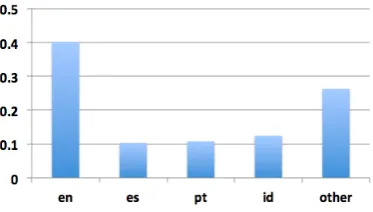
Figure 1: Twitter LID label composition (relative frequency) for our collected Twitter dataset
The most commonly occurring languages in our dataset were English, Spanish, Indonesian, and Portuguese. We note that our dataset did not con-tain any tweets initially identified as being in the Malay language. Figure 1 shows the distribution of languages relative to the overall collection. The
5https://gnip.com/
language distribution in our data does not accu-rately represent the languages used on Twitter for two reasons: 1) Twitter’s own language ID codes are not always accurate in identifying the language of a tweet, and 2) this distribution in Figure 1 rep-resents 10% geo-enabled firehose from GNIP col-lected during a specific time period. Furthermore without adequate language ID technology and re-liable language labels, the true distribution of lan-guages on Twitter is not known with certainty. 4 Classification Algorithms
In this section we describe two classification algo-rithms that we used in our experiments. We com-pared performance of the MIRA algorithm with the popular pre-trained software calledlangid.py.
4.1 MIRA
Advances in statistical learning theory have made it possible to expand beyond binary classifica-tion with perceptrons (Rosenblatt, 1958) to mul-ticlass online learners such as the Margin Infused Relaxed Algorithm (MIRA) from Crammer and Singer (2003). The MIRA algorithm is formulated as a multiclass classifier which maintains one pro-totype weight vector for each class. MIRA per-forms similar to Support Vector Machines (SVM) without batch training (Crammer et al, 2006).
For multiclass classification, MIRA is formu-lated as shown in equation (1):
c∗= arg max
c∈Cfc(d) (1)
where
fc(d) =w·d (2)
and w is the weight vector which defines the model for classc. The output of the classifier, for each class, is the dot product between a document vector d and the weight vector for each class c, shown in equation (2). Therefore the predicted class is chosen by selecting theargmax. The val-ues for each class, from equation (2) are neither normalized or scaled, and so they do not represent a probability distribution over candidate classes. We discuss this in greater depth in Section 6 with regard to calibrating the classifier output.
To train MIRA, we swept values for the margin slack (0.0005to0.00675) and number of training epochs (5to30). The value for training epochs de-noted a hard-stop for training iterations and served as the stopping criterion. The feature vectors con-tained log-normalized frequency counts for word
and character n-grams, with values for n swept separately for words (1 to 5) and characters (1
to 5), to allow various word and character-level
n-gram combinations. After sweeping all possi-ble feature combinations, we report experiment re-sults based on the highest achieved overall accu-racy. Words were defined by splitting on whites-pace and we did not do any pre-processing or text normalization of the original tweets, similar to Lui and Baldwin (2014). For MIRA we used the open-source software suite called LLClass7, which proved useful for other types of text cate-gorization tasks (Shen et al, 2013).
4.2 langid.py
For comparison, we used the off-the-shelf tool
langid.pyfrom Lui and Baldwin (2012). This tool employs a multinomial n¨aive Bayes classifier, and
n-gram feature set. The n-gram features are se-lected using information gain to maximize infor-mation with respect to language while minimizing information with respect to data source. A pre-trained model also comes off-the-shelf and covers 97 languages, including the specific languages that we use for this work. At the time of this writing the pre-trained model does not include support for dialect distinction. While we did not sweep pa-rameters for thelangid.pysoftware, as we wanted to evaluate off-the-shelf performance, we did use their built-in feature “label constraint” which re-stricts the multinomial distribution to a specified set of target labels, rather than all 97 supported languages. For example, with experiments involv-ing English/Malay/Indonesian, we restricted the language label set to these three languages.
5 Re-Annotation Experiments
In this section we present our method tobootstrap filterour Twitter dataset to re-annotated data and arrive at ground truth labels. Our data processing technique is fast, easy, cheap, and independent of the classification algorithm. We also present clas-sification results for each dataset using MIRA and
langid.pyclassifiers. All classification results are reported as the overall average accuracy with an 80/20 train/test split. Each experiment is based on N total tweets per target language and classes were stratified irrespective of tweet length.
5.1 Exp 1: Twitter Labels
First for Experiment 1, we used Twitter API labels as ground truth for language classification. Unfor-tunately, our dataset did not contain Twitter LID labels for Malay, or the Portuguese and Spanish dialects.
Languages N/class MIRA langid.py
en, id 500 98.0 90.1
[image:4.595.308.526.61.216.2]pt, es, en, id 500 93.5 85.95
Table 1: Exp 1 results using Twitter API language labels as ground truth
The performance shown for the En-glish/Indonesian pair in Table 1 is competitive with the DSL Shared Task performance for this language pair (Zampieri et al, 2016). We also used Twitter labels to evaluate multiclass classification forpt, es, en, idand note that the MIRA classifier outperforms langid.py for this set.
5.2 Exp 2: Geo-Boundary Filtering
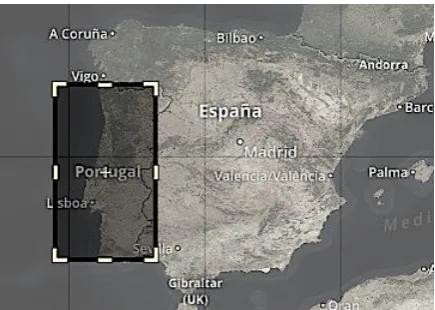
In Experiment 2, we filtered our Twitter dataset by establishing geo-bounding boxes to geographi-cally define countries where the language of inter-est is suspected to be most prominent. For exam-ple, we used the country Malaysia as a represen-tative geo-source for Malaysian tweets. We used a free website to set up the latitudinal and longi-tudinal geo-bounding boxes around the countries 8 and there are additional alternative websites to obtain similar geo-boundaries910. Each bounding box corner was defined by a latitude/longitude co-ordinate pair corresponding to SW, NW, SE, NE. Multiple bounding boxes were used for approxi-mating the shape of each country and we made every effort to include major metropolitan cities within the bounds. In some cases, our bounding boxes were slightly overspecified and slightly un-derspecified depending on the geometric shape of the country as shown for Portugual in Figure 2.
We recognize that Twitter users in each of the geo-bounded countries are able to tweet in any lan-guage. Our data filtering method was based on the assumption that the majority of tweets from a country would be composed in that country’s most common language. We calculated how fre-quently different Twitter API language labels oc-curred within the bounds of the target country
de-8http://boundingbox.klokantech.com/ 9http://www.naturalearthdata.com/ 10https://help.openstreetmap.org/
Figure 2: Example of geo-bounding box to iden-tify tweets that originated from Portugal
fine a target label purity, with respect to the ex-pected majority language. This is the conditional probability of the target Twitter LID label occur-ring in the target country, shown in equation (3)
p(label|country) = countcountlabel
country (3)
Geo-Bound Country Language Label Purity
Malaysia Malaysian ms 0%
Indonesia Indonesian id 63%
United States English en 85%
Portugal Portuguese pt 68%
Brazil Portuguese pt 71%
Spain Spanish es 72%
Mexico Spanish es 69%
Table 2: Twitter LID label purity within geo-graphic country boundaries
The majority of tweets originating from Malaysia were tagged asidanden. We observed similar scarcity of Malay tweets in Twitter’s pub-licly released language identification datasets 11. In fact, Malay tweets make up less than 0.001% of Twitter’s uniformly sampled dataset despite API support for Malay language identification. Our estimates of label purity, in addition to Twitter’s dataset coverage of Malay, emphasize the persist-ing need for automatic language disambiguation. We compared classifier performance using geo-boundary as a stand-in for ground truth labels, and our results are shown in Table 3.
5.3 Exp 3: Geo Filtering + Twitter Labels
To generate ground truth in Experiment 3, we took the intersection of labels from geo-bounds and
Languages N/class MIRA langid.py
en, id, ms 1000 80.8 54.2
en, id 1000 93.5 79.5
id, ms 1000 86.3 51.7
en, ms 1000 86.0 76.6
pt-PT, pt-BR 1000 75.0 –
es-ES, es-MX 1000 66.8 –
en, id, ms, pt-PT,
[image:5.595.74.290.62.156.2]pt-BR, es-ES, es-MX 1000 68.5 –
Table 3: Exp 2 results using geo-boundaries to represent ground truth LID labels (i.e. country la-bels=language labels)
original Twitter LID labels. For example, we ex-tracted all tweets from Brazil that the Twitter API had labeled as pt for Portuguese, and re-labeled them as Brazilian Portuguese,pt-BR. We repeated the classification experiment using a separate sub-set of tweets and these new labels. As shown in Ta-ble 4, the classification results for MIRA in Exper-iment 3 are competitive with results from related benchmarking tasks, such as DSL 2016 (Malmasi et al, 2016).
Languages N/class MIRA langid.py
en, id, ms 1000 85.5 60.7
en, id 1000 99.5 92.8
id, ms 1000 90.5 49.0
en, ms 1000 88.7 78.9
pt-PT, pt-BR 1000 80.5 –
es-ES, es-MX 1000 67.2 –
en, id, ms, pt-PT,
pt-BR, es-ES, es-MX 1000 77.2 –
Table 4: Exp 3 results using combined geo-boundary definitions and Twitter LID labels
5.4 Exp 4: Mechanical Turk-Verified Labels
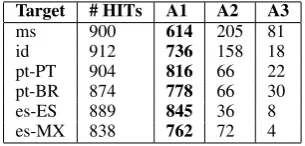
Finally, in Experiment 4 we further refined the ground truth labels obtained from earlier experi-ments. We verified the target language of tweets using Amazon Mechanical Turk Human Intelli-gence Tasks (HITs), using the same train/test data from Experiment 3 (before classification). Each HIT contained one tweet. We assigned 3 work-ers per HIT at the rate of $0.02 USD per HIT and the total cost for MTurk annotation in this work was $360.00 USD. In an effort to ensure that workers were qualified for the task, we allowed only workers who had an MTurk approval rating
>95%, however we did not administer a language performance test in this work. To complete a HIT, workers selected one answer to a multiple-choice question, described below, and we did not inform workers that the text was from Twitter.
Instructions: Please indicate which language the text is in. Some text snippets are full sentences while others are partial sentences or phrases. If the text contains more than one language, indicate that in your response. Note that you can ignore URLs, punctuation, and emoticons to decide the language. In order to be paid you must answer each question correctly.
The authors would like to note that this final statement of the instructions to workers was to mo-tivate them to complete the task meaningfully. All workers who completed tasks in the allotted time frame were paid automatically.
Workers were asked to select one of the follow-ing three statements, where language X the lan-guage label used for train/test in Experiment 3.
A1. The text is entirely composed in languageX A2. The text is composed in language X and at
least one other language
A3. None of the text is composed in languageX
Target # HITs A1 A2 A3
ms 900 614 205 81
id 912 736 158 18
pt-PT 904 816 66 22
pt-BR 874 778 66 30
es-ES 889 845 36 8
[image:5.595.340.493.348.421.2]es-MX 838 762 72 4
Table 5: MTurk annotations per language
The annotation results of our MTurk experiment are shown in Table 5. Columns A1, A2, and A3
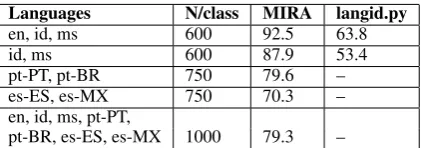
[image:5.595.76.288.369.464.2]training examples.
Languages N/class MIRA langid.py
en, id, ms 600 92.5 63.8
id, ms 600 87.9 53.4
pt-PT, pt-BR 750 79.6 –
es-ES, es-MX 750 70.3 –
en, id, ms, pt-PT,
[image:6.595.77.288.86.160.2]pt-BR, es-ES, es-MX 1000 79.3 –
Table 6: Exp 4 results using MTurk verified labels
6 MIRA Classifier Calibration
Classifier output scores for MIRA and similar al-gorithms, like SVM, do not correspond to proba-bilities. For example, the raw score cannot guide the researcher or end user to knowing if a tweet is 80% likely to be English or 50% likely to be En-glish. The ability to transform raw classifier scores into probabilities is very important if the technol-ogy is to be used as a consumable for text analytics or as part of an advanced NLP pipeline. In this sec-tion, we show how we calibrated scores using out-put from the MIRA classifier for 3 different exper-iments from Section 5. As with many classifiers, the raw score output can be difficult to interpret intuitively since the scalar values for each class do not represent a probability distribution over the classes. We used a technique called Platt Scaling, which learns logistic regression from the raw score output of the MIRA classifier. The Platt Scaling technique provides us with a probability distribu-tion on classes and is easy to train and test. For our reliability plots and calibration, we used clas-sifier output scores of test sets from experiments described in Section 5. For the purpose of brevity, we describe classifier scaling using results for one language pair: Indonesian and Malay.
6.1 Score Reliability Plots
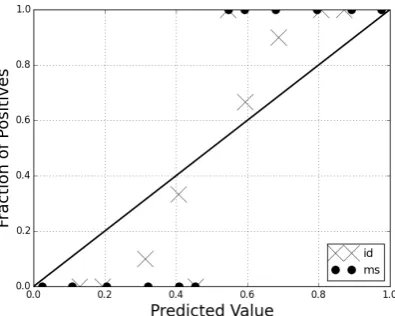
Reliability plots show how well a classifier’s out-put is calibrated when the true probability distri-bution for classes is not known (Niculescu-Mizil and Caruana, 2005; Zadronzy and Elkan, 2002; DeGroot and Feinberg, 1983). For this visualiza-tion, the classifier output scores, also called pre-dicted values, are normalized between 0 and 1 and then values are binned into 10 bins. The values plotted are the binned scoress versus the condi-tional probability of correct class prediction given the score,P(c|s(x) =s). A classifier that is well-calibrated will have values that fall close to the di-agonal linex=y.
We normalized the raw classifier output val-ues so that the scores fell between 0 and 1, using exponent-normalization as in equation (4), for a given tweet:
expc= e
sc
P
c∈Ces (4)
whereexpcis the normalized score for classc, andscis the raw classifier output score for classc.
We further divide by the sum, so that the normal-ized class scores for a given tweet sum to 1.
We created reliability plots for the id, ms pre-diction task from Experiments 2, 3, and 4. Fig-ures 3 - 11 show the histogram distribution of nor-malized classifier scores with the corresponding reliability plot. Recall that each experiment was based on different kinds of ground truth. All of the reliability plots before Platt-scaling exhibit a sigmoidal distribution. The prevalence of our ob-served sigmoidal distribution is similar to findings from Niculescu-Mizil and Caruana (2005), who noted this shape for learning algorithms based on maximum margin methods, such as SVM. MIRA and SVM both use maximum margin principles and are known to perform similarly, with the ad-ditional benefit that MIRA does not require batch training because it is online (Crammer et al., 2006)
6.2 Platt Scaling
Platt scaling uses logistic regression to learn a mapping between classifier output scores and probability estimates (Platt, 1999). The output of Platt scaling is a probability distribution over candidate classes, rather than raw scores from the classifier which are often non-intuitive and diffi-cult to interpret (Zadronzy and Elkan, 2002). Platt scaling is traditionally used in binary problems, and adapted to multiclass problems by develop-ing the original classifier as an ensemble of one-vs-all classifiers, then fitting logistic regression for each binary model (Niculescu-Mizil and Caruana, 2005; Zadronzy and Elkan, 2002). We trained and tested logistic regression on a binary class problem with MIRA output using the Logistic Regression library in Python Scikit-Learn, which is designed to handle binary, one-vs-rest, and multinomial lo-gistic regression (Pedregosa et al, 2011).
Figure 3: Geo-only, normalized scores
Figure 4: Geo-only, reliability plot
[image:7.595.315.517.323.486.2]Figure 5: Geo-only, with Platt-scaling
Figure 6: Geo+Twitter, normalized scores
Figure 7: Geo+Twitter, reliability plot
[image:7.595.83.285.328.487.2] [image:7.595.317.517.508.686.2] [image:7.595.85.284.517.686.2]Figure 9: MTurk, normalized scores
[image:8.595.83.283.326.485.2]Figure 10: MTurk, reliability plot
Figure 11: MTurk, with Platt-scaling
of 200 tweets per class. To do Platt scaling on this dataset, we used 160 tweets per class for training and 40 per class for testing.
With each of the datasets, Platt-scaling tends to affect calibration probabilities for Indonesian tweets more than for Malay tweets. This is ob-served as Indonesian data points are closer to the diagonal line. At the same time, the Platt-scaling plots also reveal that predicted values, especially for Malay, are pushed closer to 0 and 1. For exam-ple, logistic regression will always correctly pre-dictmsfor Malay, when the probability of Malay is>0.5, but not for Indonesian. This could indi-cate a need for further data purification.
We examined the accuracy of logistic regres-sion, where the predicted class is taken to be the
argmaxclass probability. In Figure 12, the over-all classification accuracy on each dataset is simi-lar for MIRA with and without Platt-scaling. We think this is an important finding because it shows that LID classifier output can be converted into probability distributions without loss of accuracy.
Figure 12: MIRA and Platt-scaling Test Accuracy
What do scores look like for a given tweet? In Table 7 we show raw classifier output scores, normalized scores, and probabilities from Platt-scaling for the following Malay tweet:
Malay: Nak tengok wayang. Rindu tempat kerja. Hehehe
English12: Want to see a movie. Miss work.
hehehe
ma id Raw scores 0.514 -0.514
Exponent Normalized 0.737 0.263
Platt + Exponent Normalized 0.535 0.465
Table 7: Score distribution for Malay tweet
[image:8.595.311.523.379.516.2] [image:8.595.84.282.562.720.2]The raw output scores from MIRA, while clearly separating binary classes, are not easily in-terpreted as a measure of certainty or probability. While the exponent normalized scores do sum to 1, and appear to situate probability mass towards the predicted class, it is not a true probability. The probabilities that are output during Platt-scaling are true probabilities and this method preserves the original MIRA classifier accuracy, thus it is a valid and meaningful technique, especially when language ID is a consumable pre-processing tech-nology for NLP pipelines.
7 Discussion and Future Work
In this work, we showed that geo-bounding com-bined with “best-guess” language labels can be used to annotate language labels on easily con-fused language pairs and dialects, when ground truth is unreliable. In each experiment, we showed how our data purification method resulted in in-creasing accuracy and classifier performance for both classifiers, MIRA and langid.py. Further, our method to purify language labels is easy to implement for tweets that are geo-tagged with latitude and longitude. Once a model has been learned from geo-tagged tweets, the model can also be used for tweets that are not geo-tagged.
We uncovered hidden Malay tweets in our dataset with high accuracy. We also showed that MIRA is useful for LID, with performance ac-curacy near state-of-the-art on very few training examples without pre-processing or text clean-ing. While previous work has shown that Malay/Indonesian can be learned using 18,000 training sentences with accuracy as high as 99.6% (Goutte et al., 2014), our result of 90.5% trained on 1600 tweets is competitive with previous work. We believe performance will further increase as more training examples are added with high con-fidence ground truth labels. Using geo-bounding, we were also able to separate dialects of Spanish and Portuguese to achieve finer-grained distinc-tions at the dialect level, which the Twitter API does not currently provide.
The highest weighted MIRA n-gram features correspond to high-frequency characters in each target language, suggesting that MIRA is learn-ing features of languages and not Twitter artifacts (URLs, hashtags, @mentions, emoticons, etc).
In future work, we want to explore other eas-ily confused language pairs, such as Ukrainian and
Russian. Also, since MIRA is well-formulated for multiclass classification, we are interested in see-ing how well it performs on a large multi-language dataset that includes several easily confused lan-guage pairs. Sometimes a single tweet will be written in more than one language, for example with code-switching or code-mixing (Barman et al, 2014). We are especially interested in adapting the MIRA classifier for code-switching and lan-guage segmentation problems. In the case of code-switching, it may be possible to utilize raw scores from classifier output or the results of Platt-scaling to construct a model that predict language mixture in a single utterance.
References
Ustab Barman, Amitava Das, Joachim Wagner, and Jennifer Foster. “Code Mixing: A Challenge for Language Identification in the Language of Social Media”. In Proceedings of First Workshop on Computational Approaches to Code Switching, Em-pirical Mdethods in Natural Language Processing (EMNLP), Doha, Qatar, (2014): 13-23.
Shane Bergsma, Paul McNamee, Mossaab Bagdouri, Clayton Fink, and Theresa Wilson. “Language Identification for Creating Language-Specific Twit-ter Collections.” In Proceedings ofNorth American Chapter of the Association for Computational Lin-guistics (NAACL-HLT)2012.
William B. Cavnar and John M. Trenkle. “N-gram Based Text Categorization”. Ann Arbor, MI, 48113(2), 1994, 161-175.
C¸agri C¸¨oltekin, and Taraka Rama. “Discriminating similar languages: experiments with linear SVMs and neural networks”. In Proceedings of3rd Work-shop on Language Technology for Closely Related Languages, Varieties and Dialects (VarDial), Osaka, Japan. 2016.
Koby Crammer and Yoram Singer. “Ultraconserva-tive Online Algorithms for Multiclass Problems”. In Journal of Machine Learning Research, 2003, Jan(3): 951-991.
Koby Crammer, Ofer Dekel, Joseph Keshet, Shai Shalev-Schwartz, and Yoram Singer. “Online Passive-Aggressive Algorithms”. InJournal of Ma-chine Learning Research, 2006, Mar(7): 551-585. Charlie K. Dagli, William M. Campbell, Lin Li,
Morris H. DeGroot and Stephen E. Feinberg. “The comparison and evaluation of forecasters.”. The Statistician (1983): 12-22.
Ted Dunning. “Statistical Identification of Language”. Computing Research Laboratory, New Mexico State University, 1994, 10-03.
Cyril Goutte, Serge L´eger, Marine Carpuat. “The NRC System for Discriminating Similar Languages”. In Proceedings of First Workshop on Applying NLP Tools to Similar Languages, Varieties, and Dialects, 139-145, Dublin, Ireland, August 2014.
Cyril Goutte, Serge Lger, Shervin Malmasi and Mar-cos Zampieri. “Discriminating Similar Languages: Evaluations and Explorations”. In Proceedings of
10th International Conference on Language Re-sources and Evaluation (LREC), 2016.
Mark Graham, Scott A. Hale, and Devin Gaffney “Where in the world are you? Geolocation and lan-guage identification in Twitter”. The Professional Geographer, 66, no. 4 (2014): 568-578.
Shamanth Kumar, Geoffrey Barbier, Mohammad Ali Abbasi, and Huan Liu. “TweetTracker: An Analysis Tool for Humanitarian and Disaster Relief.” In Pro-ceedings of International Conference on Weblogs and Social Media (ICWSM), AAAI, 2011.
Marco Lui and Tim Baldwin. “langid. py: An off-the-shelf language identification tool.”. In Proceedings ofACL 2012 system demonstrations, pp. 25-30. As-sociation for Computational Linguistics, 2012.
Marco Lui and Tim Baldwin. “Accurate Language Identification of Twitter Messages”. In Proceed-ings ofJoint Workshop on Language Technology for Closely Related Languages, Varieties and Dialects (LT4VarDial), 2015, 35-43.
Marco Lui, Ned Letcher, Oliver Adams, Long Duong, Paul Cook, Timothy Baldwin. “Exploring methods and resources for discriminating similar languages”. In Proceedings ofFirst Workshop on Applying NLP Tools to Similar Languages, Varieties and Dialects, pp. 129-138. 2014.
Shervin Malmasi and Mark Dras “Language Identifi-cation Using Classifier Ensembles”. In Proceedings ofFifth Workshop on Language Analysis for Social Media (LASM), European Association for Compu-tational Linguistics (EACL), Gothenburg, Sweden, 2014: 17-25.
Shervin Malmasi, Marcos Zampieri, Nikola Ljube˘sic, Preslav Nakov, Ahmed Ali, and J¨org Tiedemann. “Discriminating between similar languages and ara-bic dialect identification: A report on the third dsl shared task”. In Proceedings of 3rd Workshop on Language Technology for Closely Related Lan-guages, Varieties and Dialects (VarDial), Osaka, Japan. 2016.
Alexandru Niculescu-Mizil, and Rich Caruana. “Pre-dicting good probabilities with supervised learning”. In Proceedings of 22nd International Conference on Machine learning (ICML), Opp. 625-632. ACM, 2005.
Fabian Pedregosa, Ga¨el Varoquaux, Alexandre Gram-fort, Vincent Michel, Bertrand Thirion, Olivier Grisel, Mathieu Blondel et al. “Scikit-learn: Ma-chine learning in Python”. In Journal of Machine Learning Research, 12, no. Oct (2011): 2825-2830. John Platt. “Probabilistic outputs for support vector machines and comparisons to regularized likelihood methods”. InAdvances in large margin classifiers, 10.3 (1999): 61-74.
Bali Ranaivo-Malanc¸on. “Automatic Identification of Close Languages - Case Study: Malay and Indone-sian.” InECTI Transaction on Computer and Infor-mation Technology, 2006, 2(2): 126-133.
Alan Ritter, Sam Clark, and Oren Etzioni. “Named Entity Recognition in Tweets: An Experimental Study.” In Proceedings of Conference on Em-pirical Methods in Natural Language Processing (EMNLP), 2011, 1524-1534.
Frank Rosenblatt. “The Perceptron: A Probabilistic Model For Information Storage and Organization in the Brain”. InPsychological Review, 1958, 65(6): 386.
Takeshi Sakaki, Makoto Okazaki, and Yutaka Mat-suo. “Earthquake Shakes Twitter Users: Real-Time Event Detection by Social Sensors.” In Proceedings of the19th International Conference on World Wide Web, Association for Computing Machinery, 2010, 851-860.
Mohammad Arshi Saloot, Norisma Idris, AiTi Aw, and Dirk Thorleuchter. “Twitter Corpus Creation: The Case Of A Malay Chat-Style Text Corpus (MCC)”.
Digital Scholarship in the Humanities 2016, 31(2), 227-243.
Wade Shen, Jennifer Williams, Tamas Marius, and Elizabeth Salesky. “A language-independent ap-proach to automatic text difficulty assessment for second-language learners”. In Proceedings of Sec-ond Workshop on Predicting and Improving Text Readability for Target Reader Populations (PITR), Association for Computational Linguistics (ACL)
2013, 30-38.
Liling Tan, Marcos Zampieri, Nikola Ljube˘sic, and J¨org Tiedemann. “Merging comparable data sources for the discrimination of similar languages: The DSL corpus collection”. In Proceedings of 7th Workshop on Building and Using Comparable Cor-pora (BUCC), pp. 11-15. 2014.
Svitlana Volkova, Theresa Wilson, and David Yarowsky. “Exploring Demographic Language Variations to Improve Multilingual Sentiment Analysis in Social Media”. In Proceedings of
Empirical Methods in Natural Language Processing (EMNLP), 2013, 1815-1827.
Jennifer Williams and Graham Katz. “Extracting and modeling durations for habits and events from Twit-ter.” In Proceedings ofProceedings of the 50th An-nual Meeting of the Association for Computational Linguistics: Short Papers-Volume 2, Association for Computational Linguistics, 2012.
Yin-Lai Yeong and Tien-Ping Tan. “Language Identi-fication of Code Switching Sentences and Multilin-gual Sentences of Under-Resourced Languages by Using Multi-Structural Word Information”. In Pro-ceedings ofINTERSPEECH2014, 3052-3055. Bianca Zadronzy and Charles Elkan.
“Transform-ing classifier scores into accurate multiclass prob-ability estimates.”. In Proceedings ofEighth ACM SIGKDD International Conference on Knowledge Discovery and Data Mining pp. 694-699. ACM, 2002.
Marcos Zampieri and Binyam Gebrekidan Gebre. “Au-tomatic identification of language varieties: The case of Portuguese”. In Proceedings of KON-VENS2012 - The 11th Conference on Natural Lan-guage Processing. ¨Osterreichischen Gesellschaft f¨ur Artificial Intelligende ( ¨OGAI), 2012, 233-237. Marcos Zampieri, Liling Tan, Nikola Ljube˘sic, and
J¨org Tiedemann. “A report on the DSL shared task 2014.” In Proceedings ofFirst Workshop on Apply-ing NLP Tools to Similar Languages, Varieties and Dialects2014, 58-67.
Marcos Zampieri, Liling Tan, Nikola Ljube˘sic, and J¨org Tiedemann. “Overview of DSL Shared Task 2015”. In Proceedings ofJoint Wokrshop on Closely Related Languages, Varieties, and Dialects2015. Marcos Zampieri, Shervin Malmasi, Octavia-Maria
Sulea and Liviu P. Dinu. “A Computational Ap-proach to the Study of Portuguese Newspapers Pub-lished in Macau”. In Proceedings of Workshop on Natural Language Processing Meets Journalism (NLPMJ)2016, 47-51.